Join MikeLigalig.com!

Why Just Read When You Can Join, Post, and Read!

Menu

Show posts

This section allows you to view all posts made by this member. Note that you can only see posts made in areas you currently have access to.

Show posts Menu

Messages - islander

#801

Admittedly, the process of domestic retooling is as tedious as it is fraught, but upwards of 40% of Filipinos live on less than $2 a day.

This sobering statistic underlines the unfinished nature of Aquino's reform drive—and the tragedy of Duterte pivoting elsewhere. Again, Duterte didn't invent the "Cult of GDP" that warps Manila's incentives. But China's cash infusions are enabling Manila's penchant for thinking that when gross domestic product is zooming along, its job is done.

That disposition collides with a Trump trade war slamming China. Philippine growth slowed to a four-year low in the first quarter. That 5.6% growth from a year earlier makes for a grim bookend. Granted, few foresaw Trump's November 2016 election win–or the epic trade battle to come–when Aquino was leaving the palace. At least from a growth standpoint, Duterte is squandering the Aquino boom.
#802

Duterte didn't create a system where people are the nation's main export. It's been a growth industry for decades. But Aquino, to his credit, looked for ways to woo back the Filipino diaspora. Duterte is going the other way, even creating an Overseas Filipino Bank to facilitate the process of exporting more talent needed at home. In his travels around the globe, Duterte does Trump-like rallies with overseas laborers, treating them like a key voting block he needs to grow.

The Philippines needs its best and brightest to stay home. As Indonesia generates an impressive stable of tech unicorns and Singapore's Grab divides and conquers, Duterte's economy is largely looking on from the sidelines. The divergence is an economic indicator all its own–and a wakeup call for Manila to raise its competitive game.

To date, Duterte has focused more on old-economy growth drivers, not the information-age disruption needed to compete in the "Made in China 2025" era. Unfortunately, China's largess lets Asian governments off the hook.
#803

Better roads, ports, bridges and power grids are plenty important. Poor hardware explains why the Philippines often has one Asia's highest inflation rates. Chaotic distribution systems and poor storage and refrigeration raise the cost of living. But Duterte isn't tending enough to the economic software.


Duterte delivers a speech during the 25th International Conference on The Future Of Asia in Tokyo on May 31, 2019. CHARLY TRIBALLEAU/AFP/GETTY IMAGES

To compete in this rapidly advancing region, Manila most improve education and training. It must slash red tape and smash the myriad levels of rent-seeking middlemen undermining new business formation and job creation. Manila must internationalize investment rules and taxation.

The government must attack its brain-drain problem. An undersupply of good-paying jobs forces more than 10% of the nation's 105 million people to seek opportunities abroad and send cash back home. This feeds an addiction to remittances, one that reduces the urgency on Manila to raise its game.
#804

The second is Duterte's lack of job creation after three years at the helm. In 2016, Duterte was elected to turn Aquino's reform success to 11. When Aquino took office in 2010, Transparency International put the Philippines behind Nigeria in its annual corruption perceptions index. By 2016, Aquino improved that 134th ranking to 95th.

Aquino's efforts to curb graft, boost tax collection and increase public accountability won Manila its first-ever investment-grade ratings. His government was the first in more than a decade to prioritize growing better over growing faster. Aquino's policies sought to ensure that the fruits of 5% or 6% growth are more widely shared.

Under Duterte, the reformist momentum has slowed, and China helps explain why. Rather than get under the economy's hood, Duterte subcontracted economic management to Beijing. He bet that a tidal wave of Chinese investment into his "Build, Build, Build" infrastructure push would create jobs and higher incomes. Hardly.
#805

Now that bet is going awry. Obama's successor, Donald Trump, launched an intensifying trade war, putting China's economy on the ropes. It raises big questions about Duterte putting all his eggs in the proverbial Chinese basket.

Two problems are coming to head. One is how a rapidly decelerating Chinese growth leaves less growth to go around in Asia. China is still growing, but exports are grinding to a halt just as manufacturing activity is cratering. In May, the closely watched Caixin/Markit Manufacturing Purchasing Managers' Index signaled slowing output, falling factory prices and the weakest business confidence since at least April 2012.

China's reading is now at 50.2, on the verge of falling below 50. That shrinkage is already showing up in proxy economies from Malaysia to South Korea to Taiwan, all of which are below the 50-mark denoting contraction. Vietnam is heading that way and, odds are, Duterte's economy, too.
#806

Duterte Faces GDP Headache As Trump Vs. China Hits Philippines

William Pesek
Contributor


Philippine President Rodrigo Duterte, left, shakes hands with Chinese President Xi Jinping, right, before their meeting at the Great Hall of People in Beijing, China, on April 25, 2019. KENZABURO FUKUHARA/KYODO NEWS - POOL/GETTY IMAGES

Rodrigo Duterte's efforts to cozy up to China these last few years isn't paying the economic dividends the Philippines hoped.

It all seemed so simple in June 2016, when Duterte grabbed the keys to the presidential palace from Benigno Aquino. His predecessor drew Manila close to Barack Obama's America. In his six years in office, Aquino pushed back at China's territorial expansionism in the South China Sea. He even took China to international court (and won).

Duterte went the other way, engaging with Xi Jinping's China. In September 2016, he insulted Obama with a slur in Tagalog after the U.S. leader had criticized the extrajudicial killings that characterized Duterte's war on drugs. China, Duterte figured, was a better fit: deep pockets to help build Filipino infrastructure and a policy of non-interference with Duterte's domestic activities.
#807

Andres Cozar of the University of Cadiz said the Mediterranean was "a great accumulation zone of plastic debris".

The researchers said huge amounts of plastic were also being found in other seas including the Bay of Bengal, South China Sea and Barents Sea in the Arctic Ocean.

https://www.bbc.com/
#808

Unless action was taken plastic pollution in the region was expected to quadruple by 2050, it added.

The Mediterranean Sea represents less than 1% of the global ocean area but is important in economic and ecological terms.

It contains between 4% and 18% of all marine species, and provides tourism and fishing income for Mediterranean countries.

In 2015 Spanish researchers warned that plastic in the Mediterranean was being found in the stomachs of fish, birds, turtles and whales and that tiny pieces of plastic - microplastics - had also been found in oysters and mussels.
#809

It said high levels of plastic consumption by residents and tourists coupled with poor waste collection systems, remained a problem in several countries.

Italy is the largest consumer of bottled water in the world, the report said, with about 178 litres of water sold in plastic bottles per person, per year.


GETTY IMAGES
Italian fisherman collected huge amounts of plastic bottles for recycling last year

In its recommendations, the report said all Mediterranean governments should set targets to reuse and recycle 100% of plastic items, thus creating zero waste. It also called for single-use plastic items to be phased out.

The WWF says marine pollution costs tourism, fisheries and maritime sectors around €641m (£568m; $722m) each year.
#811

According to the WWF, the coastline of Cilicia in south-east Turkey has the highest plastic pollution in the Mediterranean with 31.3 kg of debris per kilometre.

The other hotspots it lists are:

Barcelona - 26.1 kg
Tel Aviv - 21.0 kg
The Po Delta - 18.2 kg
Valencia - 12.9 kg
Alexandria - 12.7 kg
Algiers - 12.2 kg
Bay of Marseille - 9.4 kg
Izmir - 7.2 kg

The report also highlighted Egypt as the biggest source of plastic waste in the Mediterranean, followed by Turkey.
#813

The conservation group is calling on governments and the EU drastically to reduce plastic production and increase recycling.

The conservation group is calling on governments and the EU drastically to reduce plastic production and increase recycling.

"Our plastic system is broken - all Mediterranean countries still fail to collect all their waste," said Giuseppe Di Carlo, director of WWF Mediterranean Marine Initiative.

"Plastic production is far too cheap while its waste management and pollution costs are largely discharged on societies and nature. All countries must overhaul their whole supply chain... This is the only way we can keep plastic out of the Mediterranean Sea."
#814

Mediterranean plastic pollution hotspots highlighted in report

07 May 2019


GETTY IMAGES
Plastic bottles are a huge source of marine pollution

Nine coastlines have been identified as the places in the Mediterranean most polluted with plastic, a report says.

They include top tourist spots such as Barcelona, Marseilles, Tel-Aviv and the Venice coast near the Po river.

The report by the World Wide Fund for Nature (WWF) said all Mediterranean countries had underperformed in managing plastic contamination.

It said 570,000 tonnes of plastic went into the sea each year - the equivalent of 33,800 plastic bottles every minute.
#815
English Dictionary / Re: Spat
June 04, 2019, 02:51:57 AM

more on spat... never had i suspected that what i thought was a simple word can have so many unrelated meanings. :)

spat
You probably recognize the word spat from the phrase "lover's spat," which describes a minor squabble between a couple. The spat is usually over something as silly as which partner has to do the laundry, and the relationship usually recovers quickly, with no long-term harm done.

For purposes of this definition, the noun spat refers to a minor argument or mild bickering. That is the definition by which spat is probably best known, but the word has other meanings. Depending on how you use spat, it can be the past participle of spit, the short piece of leather men wore over their shoes in the old days, or an oyster that hasn't quite reached its prime.

Primary Meanings of Spat

1. (noun) a quarrel about petty points

2. (noun) a cloth covering (a legging) that covers the instep and ankles

3. (noun) a young oyster or other bivalve

4. (verb) come down like raindrops

5. (verb) clap one's hands together

6. (verb) become permanently attached

Full Definitions of Spat

1 (noun) a quarrel about petty points
Synonyms: bicker, bickering, fuss, pettifoggery, squabble, tiff
Type of: dustup, quarrel, row, run-in, words, wrangle
an angry dispute
(verb) engage in a brief and petty quarrel
Type of: altercate, argufy, dispute, quarrel, scrap
have a disagreement over something

2 (noun) a cloth covering (a legging) that covers the instep and ankles
Synonym: aiter
Type of: leg covering, legging, leging
a garment covering the leg (usually extending from the knee to the ankle)

3 (noun) a young oyster or other bivalve
Type of: offspring, young, any immature animal
(verb) spawn
"oysters spat"
Type of: spawn, lay spawn

4 (verb) come down like raindrops
"Bullets were spatting down on us"
Type of: come down, fall, precipitate
fall from clouds
(verb) strike with a sound like that of falling rain
"Bullets were spatting the leaves"
Type of: collide with, hit, impinge on, run into, strike
hit against; come into sudden contact with

5 (verb) clap one's hands together
Synonyms: clap
Type of: gesticulate, gesture, motion
show, express or direct through movement
(verb) clap one's hands or shout after performances to indicate approval
Synonyms: acclaim, applaud, clap
Antonyms: boo, hiss
show displeasure, as after a performance or speech
Types: bravo
applaud with shouts of `bravo' or `brava'
Type of: gesticulate, gesture, motion
show, express or direct through movement

6 (verb) become permanently attached
"mollusks or oysters spat"
Type of: attach
become attached

https://www.vocabulary.com/
#819


People pray in front of an altar especially set up Tama's funeral in Kinokawa City, Wakayama prefecture. Photograph: Chika Oshima/AP
#820

"The station comes alive as a cat when the eyes light up," Yamaki said. "They say cats ward off evil and misfortune. Maybe the station does."


Nitama poses with her custom-made conductor hat in front of a framed image of Tama, Kishi station's original 'cat master' (Credit: Rob Goss)

Maybe so. After all, throughout history, cats have been considered to be spiritual animals and a symbol of good luck in Japan. The famous Maneki-neko cat figurines, with their beckoning left paw, are said to bring good fortune to businesses, which has led them to be placed inside storefront windows across the globe. There are also shrines and statues across Japan dedicated to cats – such as Nekogami (Cat God) Shrine in Kagoshima, where two cats were enshrined by a feudal warlord in honour of their military service. More than 10 Japanese 'cat islands', where hundreds of felines roam free, have become popular tourist destinations; as have Tokyo's many pay-to-pet cat cafes. And this is to say nothing of Hello Kitty, one of Japan's most beloved cartoon characters.

In a nation that seems especially fond of felines, Tama and her successors have not only brought plenty of good fortune to the Kishigawa Line, they've also carved a place in many Japanese people's hearts.

But what does Yontama think about it all? She just looked up and sweetly meowed.

http://www.bbc.com/
#821

Nowadays, one of Tama's former apprentices, eight-year-old Nitama (literally: 'Tama Two'), serves as the Kishi stationmaster, with four-year-old Yontama ('Tama Four') functioning as her feline assistant five stations away in Idakiso. Both work 10:00 to 16:00 with two days off a week: Monday and Friday for Yontama; Wednesday and Thursday for Nitama. And Tama Three? She's currently an employee of Japan's Okayama Electric Tramway and serves as the acting director of the Okaden Museum.


When Tama passed away, adoring fans left bouquets of flowers and cans of tuna, and now she has a shrine outside Kishi station (Credit. Rob Goss)

While Tama and her successors have played a major part in the Kishigawa Line's revival, Yamaki is keen to point out that the railway's revival hasn't solely been due to the cats. The railway also hired Mitooka to create several other themed trains to help attract tourists, including a strawberry train (Ichigo Densha) and a pickled plum train (Umeboshi Densha) – both fruits that Wakayama is well known for.

In 2009, Mitooka also designed a new building for Kishi Station, a small thatched structure in the shape of a cat's head. Little ears stick up from the roof, the entrance serves as a mouth and two oval windows rising from the slanted roof resemble eyes – each glowing yellow when the lights are on in the evenings.
#822


When Tama passed away, her funeral was attended by thousands of people and she was elevated to the status of a goddess of the Wakayama Electric Railway (Credit: Rob Goss)

To capitalise on the region's Tama craze, in 2010 the railway hired award-winning industrial designer Eiji Mitooka – known for his sleek Japanese bullet trains – to completely redesign the train's exteriors and interiors as a Tama-themed line. The Tamaden railway was born.

In an ode to Tama, the outsides of Tamaden's two white carriages are now decorated with paw prints and 101 cartoon images of Tama, including Tama enjoying a satisfying stretch, cheerfully licking a paw and mischievously poised to pounce. The front of the train even has little whiskers, while inside are old-fashioned wooden floors and shelves of children's books. As a finishing touch, when the doors open at each station, a few meows purr through the PA system – an actual recording of Tama.

"Having her around the station
makes everyone happy."


By the time Tama passed away in 2015, she was 16 years old and had appeared in prominent TV shows, magazines and newspapers across Japan. Thousands of people attended her funeral at the station, leaving piles of flower bouquets and cans of tuna outside. The 'Honourable Eternal Station Master', as she is now called, was then memorialised with a phone box-sized shrine on Kishi's platform, and in the Japanese Shinto religious tradition, she was elevated to the status of a goddess of the Wakayama Electric Railway. In honour of what would have been Tama's 18th birthday in 2017, she even had her own commemorative Google Doodle. And four years after her death, her Twitter account has more than 80,000 followers and is still growing.
#823


The carriages on the Tamaden railway are adorned with whiskers, paw prints and images of Tama (Credit: Rob Goss)

As stationmaster, one of Tama's duties was to be the face of the railway and appear in promotional material and media coverage. She also got paws-on at the station, sometimes greeting passengers from atop a table set up by the ticket gates or from the behind the glass window of her 'office' – a converted ticket booth equipped with a litter tray and bed.

Tama was so adored by riders and railway staff that a painted portrait of her was soon commissioned, which now hangs alongside numerous glossy photos of her in Kishi Station's souvenir shop – where visitors can buy everything from Tama badges and keyrings to Tama-branded candy. In lieu of a 'salary', Tama got all the cat food she needed. She received a promotion, too: in 2008, she became a 'super station manager' and was even knighted by the prefecture's governor. In the process, she received a dark blue ceremonial gown with white lace neck ruffles, and thousands of tourists began coming to the small, single-platform station to see her.

In fact, according to a 2008 study by Katsuhiro Miyamoto, professor at Kansai University's School of Accountancy, Tama's purring presence at the station is estimated to have attracted 55,000 more riders on the Kishigawa Line than were expected in 2007, and during her full reign as stationmaster from 2007 until 2015, she contributed upwards of 1.1bn yen (£7.85m) to the local economy. With the help of its whiskered manager, Wakayama Electric Railway says the annual number of passengers on the Kishigawa Line has increased by almost 300,000 from 2006.
#824


Yontama ('Tama Four') is the latest calico to serve as stationmaster of the Wakayama Electric Railway and works at the Idakiso station (Credit: Rob Goss)

This story began in the late 1990s with a young calico cat called Tama. The kitten lived near Kishi Station – the final of 14 stops on a 14.3km line that connects small communities to Wakayama City, the region's hub ­– and would frequently hang out by the railway, soaking up affection from commuters.

Over the years, Tama's sweet nature and photogenic features made her popular with the commuters, and adoring onlookers affectionately began referring to her as Kishi's 'stationmaster'. But by the mid-2000s, a combination of low ridership and financial problems threatened to close down the rural rail line, and the line's 14 stations were finally unstaffed in 2006.

But fortunately, it wasn't the end for the railway or the beloved feline's role in it. "In 2006, the current president of the Wakayama Electric Railway, Mitsunobu Kojima, was asked by residents to revive the Kishigawa Line after the previous owner had announced it was to be abolished," said Keiko Yamaki, an executive for Ryobi, the company that owns the Wakayama Electric Railway. Yamaki explained that the owner of a local convenience store near Kishi Station, who had become Tama's guardian, had also decided to move on, but before leaving he requested that the railway look after Tama. "Our president has always been a dog person, but when he met Tama that was it," Yamaki said, while swiping through images on her phone of Kojima happily cuddling the station's 'cat master'. "He fell for her."

In a big way. Soon after adopting Tama, Kojima ordered a customised stationmaster's hat for his little cat, and in January 2007 he officially named Tama the 'Stationmaster of Kishi Station' – the first feline stationmaster in Japan.
#825

The cat who saved a Japanese rail line


Children pet Tama, the original feline stationmaster of Japan's Kishi train station

Not only did Tama's sweet nature and photogenic features make her popular with commuters on the Kishigawa railway, but the 'cat master' became so famous she was knighted.

By Rob Goss
22 May 2019

On a bright May morning at Japan's Idakiso train station, a small cat basked in the sun as her photo was taken by a group of tourists before getting a tummy tickle from a toddler. While the white, tan and black kitten purred and meowed in the arms of a visitor, one of the station workers looked on with a grin, interjecting only to gently reposition the cat's brimmed conductor hat whenever it threatened to slip over her eyes.

"I sometimes forget
that she is my boss."


"Having her around the station makes everyone happy," he said, as the cat playfully swiped at a tourist's iPhone. "I sometimes forget that she is my boss."

Meet Yontama, the latest in a line of feline stationmasters that has helped save the Kishigawa railway line in Japan's Wakayama prefecture, a largely mountainous and rural part of the country famous for temple-studded hillsides and sacred pilgrimage trails.
#826

Why are tropical storms and hurricanes named?

NOAA's National Hurricane Center does not control the naming of tropical storms. Instead, there is a strict procedure established by the World Meteorological Organization. For Atlantic hurricanes, there is a list of male and female names which are used on a six-year rotation. The only time that there is a change is if a storm is so deadly or costly that the future use of its name on a different storm would be inappropriate. In the event that more than twenty-one named tropical cyclones occur in a season, any additional storms will take names from the Greek alphabet.

https://southcoastsun.co.za/
#827

What is the difference between tornadoes and hurricanes?


A tornado is a violently spiraling funnel cloud that extends from the bottom of a thunderstorm to the ground. It is important not to confuse a tornado with a hurricane or tropical cyclone because tornadoes and hurricanes are very different phenomena. The only similarity between them is that they both contain strong rotating winds that can cause damage.

Location: Tornadoes usually occur over land, while hurricanes almost always form over the ocean.

Size: The largest tornado every observed was 4 km wide, but most tornadoes are about 0.8 km wide. Hurricanes are much larger, ranging from about 160 km to 1600 km wide.

Life cycles: A tornado's lifetime is short, ranging from a few seconds to a few hours. A hurricane's life cycle can last from days to weeks.

Wind speeds: The strongest tornadoes can have wind speeds over 483 kph, but even the strongest hurricanes rarely produce wind speeds over 322 kph.
#828

But tornadoes are a different kettle of fish


Tembisa 27 July 2016. Picture: sabreakingnews.co.za

"Tornadoes are really beyond the edge of our understanding of things," says Tony Del Genio, a climatologist at NASA's Goddard Institute for Space Studies in New York City. "This science is in its infancy."

Del Genio says tornadoes are nature's hardest weather event to predict. They are essentially flukes of nature. Unlike hurricanes, they form spontaneously, are short-lived, and traverse a much smaller land mass by comparison.

Many atmospheric conditions need to converge at the right time for tornadoes to form. They need hot, humid air near the ground with a cool air mass above them. They also need strong wind velocity at higher altitudes, known as wind shear, to get them spinning.
#829

They are classified as follows:

Tropical Depression: A tropical cyclone with maximum sustained winds of 38 mph (33 knots) or less.

Tropical Storm: A tropical cyclone with maximum sustained winds of 39 to 73 mph (34 to 63 knots).

Hurricane: A tropical cyclone with maximum sustained winds of 74 mph (64 knots) or higher. In the western North Pacific, hurricanes are called typhoons; similar storms in the Indian Ocean and South Pacific Ocean are called cyclones.

Major Hurricane: A tropical cyclone with maximum sustained winds of 111 mph (96 knots) or higher, corresponding to a Category 3, 4 or 5 on the Saffir-Simpson Hurricane Wind Scale.
#830


Tropical cyclone or cyclone. What's the difference?

A tropical cyclone is a generic term used by meteorologists to describe a rotating, organized system of clouds and thunderstorms that originates over tropical or subtropical waters and has closed, low-level circulation. Once a tropical cyclone reaches maximum sustained winds of 74 miles per hour or higher, it is then classified as a hurricane, typhoon, or cyclone depending upon where the storm originates in the world.

Tropical cyclones rotate counterclockwise in the Northern Hemisphere.
#831

Hurricane, cyclone, typhoon, tornado – what's the difference?

We take a look at  hurricanes, cyclones, typhoons and tornadoes.

March 13, 2019


Hurricane Irma from space.

What is the difference between a hurricane, a cyclone, and a typhoon?

The only difference between a hurricane, a cyclone, and a typhoon is the location where the storm occurs.

Hurricanes, cyclones, and typhoons are all the same weather phenomenon; we just use different names for these storms in different places. In the Atlantic and Northeast Pacific, the term "hurricane" is used. The same type of disturbance in the Northwest Pacific is called a "typhoon" and "cyclones" occur in the South Pacific and Indian Ocean.
#833

A study posted in the Journal of Vascular and Interventional Nuerology states that "a decreased risk for death due to MI and all cardiovascular diseases (including stroke) was observed among persons with cats. Acquisition of cats as domestic pets may represent a novel strategy for reducing the risk of cardiovascular diseases in high-risk individuals."

Owning cats can seriously help out your health situation. Kitties can easily reduce your levels of stress — especially for women above 50 years old — and the comforting rhythmic sound of their purring actually has healing qualities. The sound has been linked to lessening chances of a heart attack and even strengthening your bones.

So, tell everyone who's ever diminished your cat-loving nature to the cat lady stereotype — even calling it "crazy" — to knock it off. In the end, just know that you'll be the healthiest (and happiest) one in the room. Other than your cat, of course.

https://www.wdsu.com/
#834

Science says being a 'crazy cat lady' is actually good for you

Cats have significant, positive impact on mental health, study says

May 17, 2019
Elizabeth Gulino
Editorial Fellow


Tell the "crazy cat lady" archetype to step aside — there's some new research in town, and it says that owning cats actually makes you healthier and definitely not a crazy cat lady. According to Psychological Medicine, there's absolutely no link to owning cats and psychosis later in life, and there's even more research proving that cats are actually beneficial to several parts of our health. In fact, living with a cute kitten — or two or three or four — can actually reduce the risk for cardiovascular diseases.
#835


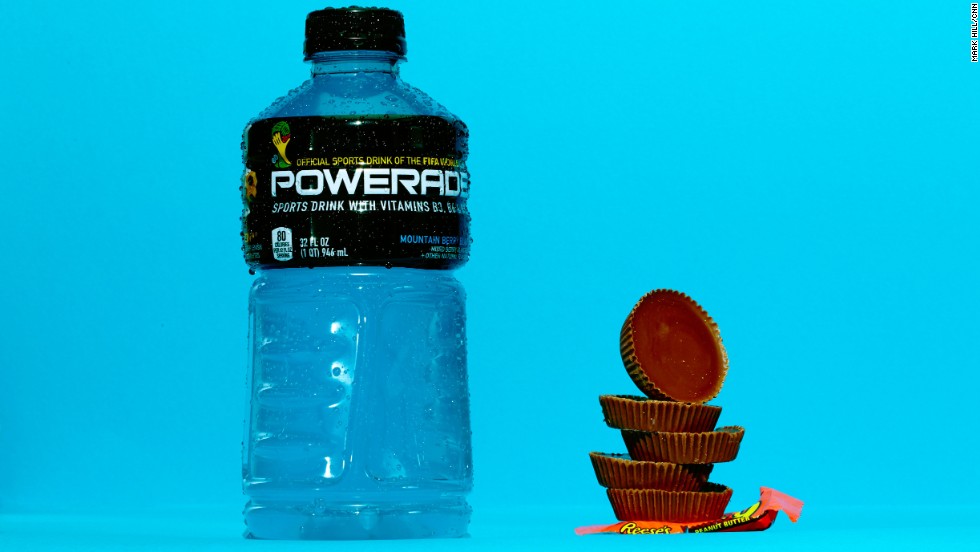
Sports drink: Powerade Mountain Berry Blast – Powerade's Mountain Berry Blast also has 56 grams of sugar. Each of these five Reese's cups contains about 11 grams of sugar.


Iced coffee: Starbucks Iced Flavored Latte – A Grande Starbucks Iced Flavored Latte with 2% milk and your choice of syrup has about 28 grams of sugar. The same amount of sugar is in 2.5 Krispy Kreme donuts.


Iced coffee: Dunkin Donuts Iced Caramel Latte – A 16-ounce Dunkin Donuts Iced Caramel Latte has 37 grams of sugar. Each Krispy Kreme donut has about 11 grams of sugar.

https://edition.cnn.com/
#836


Juice smoothie: Bolthouse Farms Berry Boost – You'd consume 24 grams of sugar by drinking this Bolthouse Farms Berry Boost 15.2-ounce bottle -- or by eating six Chips Ahoy! cookies.


Sports drink: Gatorade Thirst Quencher Cool Blue – This 32-ounce Gatorade bottle has 56 grams of sugar, the same that can be found in approximately five Reese's Peanut Butter Cups.
#837

The recommendations for kids between 1 and 6 years old are to limit fruit juice consumption to 6 ounces per day, while children 7 years and older, teens and adults should limit fruit juice to 8 ounces per day, according to the American Academy of Pediatrics and the Dietary Guidelines for Americans.

"Further research is needed to examine the health risks and potential benefits of specific fruit juices," Guasch-Ferré and Hu said.

Welsh said we need to consider both fruit juices and sugar-sweetened beverages when we think about how much sugar we consume each day. Between the two, she tipped the scales in favor of fruit juice: "Given its vitamin and mineral content, fruit juice in small amounts may have a beneficial effect that isn't seen with sodas and other sugar-sweetened beverages."


Milk: Silk Almond Milk Original – A glass of original almond milk contains 7 grams of sugar. Unsweetened almond milk has 0 grams.


Juice smoothie: Naked Berry Blast – The 15.2-ounce bottle of Naked Berry Blast has 29 grams of sugar. Each of these eight Chips Ahoy! cookies contains about 3.6 grams of sugar.
#838

Recommended amounts of fruit juice

This is one of the first studies to examine the relationship between sugary drinks, including 100% fruit juices, and early death, wrote Marta Guasch-Ferré, a research scientist in the Department of Nutrition at Harvard T.H. Chan School of Public Health and Dr. Frank B. Hu, a professor of medicine at Harvard Medical School, in an editorial published alongside the new study.

However, the study is limited in what it can tell us, noted Guasch-Ferré and Hu, who were not involved in the research. Because so few coronary heart disease-related deaths occurred, the analysis here is considered weak; more time and a higher number of participants would probably give a stronger signal either way. Also, each participant's sugary drink consumption was recorded at the start of the study only, based entirely on self-reporting, which is not considered reliable.

"Although fruit juices may not be as deleterious as sugar-sweetened beverages, their consumption should be moderated in children and adults, especially for individuals who wish to control their body weight," Guasch-Ferré and Hu wrote.


Milk: Generic skim milk – An 8-ounce glass of skim milk has about 11 grams of sugar. A single Starburst candy has 2.7 grams.


Milk: Silk Vanilla Soymilk – A glass of vanilla soymilk has about 8 grams of sugar, which is equal to the amount found in three Starbursts.
#839

Each additional 12-ounce serving of fruit juice per day was associated with a 24% higher risk of death from any cause, and each additional 12-ounce serving of sugary beverages per day was associated with an 11% higher risk. A similar relationship between sugary beverages and death due to coronary heart disease was not found.

"In looking at our results for sugar-sweetened beverages and juices independently, we need to be clear that the risk presented is relative to that present in the lowest consumers of each," Welsh explained.

She was not surprised by the the findings. She and her co-authors said "a number of possible biological mechanisms" explain the elevated risk of death. For example, research suggests that sugary beverages increase insulin resistance, which is known to raise the risk of cardiovascular disease, while fructose consumption may stimulate hormones that promote weight gain around the waist -- another cardiovascular disease risk factor.


Energy drink: Red Bull – Three-quarters of a cup of generic-brand frosted flakes contains about 11 grams of sugar. This 16-ounce can of Red Bull has 52 grams of sugar. Red Bull and many of the companies in this gallery offer lower or no-sugar versions of their drinks. "Nearly half -- 45% -- of all non-alcoholic beverages contain 0% (sugar)," said Christopher Gindlesperger, spokesman for the American Beverage Association.


Energy drink: Monster Energy – This 16-ounce can of Monster Energy has 54 grams of sugar. It contains the same amount of sugar as about 3.5 cups of frosted flakes.
#840

To address this issue, she and her colleagues repurposed data from the Reasons for Geographic and Racial Differences in Stroke study, which seeks to understand why more African-Americans die from strokes than other races and why people in the Southeast have more strokes than those in other areas of the United States.

Drawing from this multiethnic study, Welsh and her coauthors analyzed data from 13,440 adults 45 and older, nearly 60% men and almost 71% of them overweight or obese.

People who consumed 10% or more of their daily calories as sugary beverages had a 44% greater risk of dying due to coronary heart disease and a 14% greater risk of an early death from any cause compared with people who consumed less than 5% of their daily calories as sugary beverages, the study showed.


Tea: Arizona Green Tea with Ginseng & Honey – A 23-ounce can of Arizona Green Tea contains 51 grams of sugar, which is about the same as can be found in 20 Hershey's Kisses. The World Health Organization recently proposed new guidelines that recommend consuming less than 5% of our total daily calories from added sugars. For an adult at a normal body mass index, or BMI, 5% would be around 25 grams of sugar -- or six teaspoons.


Tea: Lipton Lemon Iced Tea – There are 32 grams of sugar in this 20-ounce bottle of iced tea. Each of these 12 Hershey's Kisses contains approximately 2.5 grams of sugar.
#841

Cardiovascular disease link

Seven US cities, including New York and most recently Philadelphia, have levied taxes on sweetened drinks with added sugar in an effort to reduce consumption. These laws often highlight how soda and other sugary beverages contribute to the obesity epidemic among kids and high rates of diabetes among adults.

The new study defined "sugary beverages" as both sugar-sweetened thirst-quenchers, like soda and fruit-flavored infusions, and 100% natural fruit juices that have no added sugar. So how does fruit juice stack up against soda?

"Previous research has shown that high consumption of sugars like those in soft drink and fruit juices is linked to several cardiovascular disease risk factors," Welsh explained. Obesity, diabetes and elevated triglycerides (a type of fat found in the blood) are among the risk factors linked to excessive sugar intake. "Few studies have been able to look at how this consumption might impact mortality risk," she said.


Juice: Minute Maid 100% Apple Juice – This 15.2-ounce bottle contains 49 grams of sugar, which is about the amount of sugar in 10 Oreos.


Juice: SunnyD Original – A 16-ounce bottle of SunnyD Original contains 28 grams of sugar. Each these six Oreos contains about 4.6 grams of sugar.
#842

It's not just soda: Drinking too much fruit juice (or any sugary drink) linked to premature death risk

By Susan Scutti, CNN
May 17, 2019

(CNN)Many sugar-sweetened beverages have little to no nutritional value and lots of calories, and their harmful health effects have been well-documented. Now, a study links drinking too many sugary beverages -- and even 100% natural fruit juices -- to an increased risk of early death.

Specifically, drinking an excessive amount of fruit juice could lead to an increased risk of premature death ranging from 9% to 42%, according to the study, published Friday in the journal JAMA Network Open.

Overall, the sugars found in orange juice, although naturally occurring, are pretty similar to the sugars added to soda and other sweetened beverages, the study suggests.

"Sugary beverages, whether soft drinks or fruit juices, should be limited," Jean A. Welsh, a co-author of the study and an assistant professor in the Department of Pediatrics at Emory University in Atlanta, wrote in an email.


A 20-ounce bottle of Coca-Cola Classic contains 65 grams of sugar, which is the same amount of sugar found in five Little Debbie Swiss Rolls.


A 20-ounce bottle of Pepsi contains 69 grams of sugar. Each Little Debbie Swiss Roll contains an estimated 13 grams of sugar.
#843

In a sense, you are called upon to stand up and give voice to the aspirations of many who have become timid or fearful, who have become indifferent or apathetic, who have been cowed to silence and intimidated by the forces of state repression or coercion, or have been overwhelmed by the demands of daily subsistence—the  unceasing efforts simply to wait for a ride (which I have witnessed a thousand times) or just to survive.

We believe in you. We have seen hope in your eyes. We have seen courage in your actions. Our generation may have tried but failed. But yours is more prepared, more real, more capable, and certainly "woke." Thus, with you in the forefront, the battle is joined, and may the words of the poet accompany you in this uncertain and improbable quest: "to strive, to seek, to find, and not to yield!"

* * *

Ed Garcia is a framer of the 1987 Constitution. He worked at Amnesty International and International Alert in the United Kingdom for over two decades and taught at the Ateneo, UP and FEU.

See the bigger picture with the Inquirer's live in-depth coverage of the election here https://inq.ph/Election2019

https://opinion.inquirer.net/
#844

To the young who were not only witnesses but participants in the valiant campaign of the Otso Diretso, I have this to say: "Be not afraid! Yours is the successor generation. The future belongs to you, and its shape and texture, its spaces for freedom and progress are yours to design, and the ranks of the committed yours to forge."

If you feel underrepresented in the halls of Congress, remember that you have power in your hands and strength in your numbers—if you are able to organize and mobilize.
#845

But the Otso Diretso experience, in a sense, is just the beginning. It could signal a new awakening. It provides our youth an opportunity to shape a future different from the shameful past. It raises issues you will need to grapple with, such as the following: the challenge of Charter change by an unbridled Congress that will be converted into a constituent assembly (con-ass); the pushback against an escalation of the bloody war on drugs with its attendant devaluation of human life, particularly in inner-city communities; the resistance against the continued incursion of China into Philippine waters; the fight back against threats to our freedom to dissent and our rights to a free press and media; and the resolve to put a stop to the moral meltdown in our society caused by so-called leaders who believe that cursing those who differ is unifying the country.

We have in our hands a continuing nightmare, certainly a far cry from the dream of our great statesman Ka Pepe Diokno who, in confronting the dictatorship that had jailed him in solitary confinement for seven long years, said in defiance: "I fight, I continue to struggle to build a nation for our children."
#846

I relate this experience because the FQS in a sense presaged the political upheaval that led to the eventual overthrow of the conjugal dictatorship. The fact that a Marcos is poised once again to claim a seat in the Senate, another scion of the family to reclaim the family's place in Congress, and yet still another in the provincial capitol of Ilocos Norte without mentioning its capital city, is perhaps irony in the most bitter sense of the word. Where in the world is redemption gained without even a hint of remorse or acknowledgment of wrongdoing? Or, is this the warped justice that we have become used to because of the countless times justice has been denied in our country?

Never before, except perhaps in 1938 or some 80 years ago, has democratic opposition been so obliterated as in the recent midterm elections. Not a single candidate from the opposition survived the onslaught of the resource-laden administration. The names that your generation voted at the top of your slates in some 40 mock polls held in colleges and universities across the land were nowhere on the list that will represent you in the Senate.
#847

'To strive, to seek, to find and not to yield!'

By: Ed Garcia
Philippine Daily Inquirer
May 16, 2019

I still vividly remember the first truncheons that were swung at students at the foot of the Old Congress in Manila during the First Quarter Storm (FQS) in 1970. The annual address dubbed the "State of the Nation" had just been intoned by then President-turned-dictator Ferdinand Marcos, while the real state of the nation with all its unrest, suppressed brutally, was unraveling in the streets.

"Conscientization," a word coined by the author of the "Pedagogy of the Oppressed," the Brazilian Paolo Freire, meaning "growing social awareness," was hastened by the blows of truncheons or the suffocation caused by tear gas or the sudden gust of water cannons thrown at protesters; "mulat" we said then, the equivalent of the word "woke" that you often use now.
#848

The takeaway

Overall, ACV is safe. Everything has a possible downside, even ACV. Before you start guzzling apple cider vinegar, here are a few negative possibilities.

The acid in apple cider vinegar may erode your teeth enamel. You may want to guzzle some water after drinking it.
Anecdotally, acidic foods or liquids like vinegar may exacerbate acid reflux.

If you have chronic kidney disease, your kidneys may not be able to process the excess acid that comes along with drinking apple cider vinegar.

Like any supplement, ACV won't replace a healthy lifestyle. It may have some benefits to our bodies, but overall, we need more studies to truly understand the health benefits and side effects associated with ACV.

Edwin K. McDonald IV, MD, is dedicated to improving the health of individuals and communities through nutrition education.

https://www.uchicagomedicine.org/
#849

5. Apple cider vinegar will not cure cancer.

A few studies show that vinegar may have anti-cancer properties. Most of these studies involved culturing cancer cells and exposing them to vinegar or acetic acid. The limitation of these studies is obvious; we can't directly pour ACV on cancers inside of people. Further, you definitely can't give someone an ACV IV infusion without causing serious harm or death.

Yet, a large population study from China found lower rates of esophageal cancer in people who frequently consumed vinegar. It's worth noting that the people in the study were likely consuming rice vinegar, not ACV.

Bottom line: ACV is not going to cure esophageal cancer, unfortunately. As a GI doctor, I'm typically the first person to tell someone they have esophageal cancer. I wish I could tell people all they have to do is drink some vinegar. Sadly, things aren't that easy.

If you are concerned about the risk of esophageal cancer, then don't smoke and don't drink a lot of alcohol. Talk to your doctor if you have chronic heartburn because you may need screening for Barrett's esophagus.
#850

4. Apple cider vinegar will not control your high blood pressure.

One popular myth is that ACV can be used for controlling blood pressure. In my research, I found one small study in rats that showed a decrease in systolic blood pressure in rats fed a diet containing acetic acid compared to those without it. There weren't any studies using ACV for high blood pressure in people.

Bottom line: High blood pressure is nothing to play with. I've seen people have strokes in real-time from high blood pressure. If you have high blood pressure, there's simply not enough data to support using ACV as a blood pressure medication. Eat a healthy diet, exercise, and take your meds if you need them.
#851

3. Apple cider vinegar may help boost weight loss.

Everyone wants to lose weight. Supplements that facilitate weight loss are in high demand. And as it turns out, a randomized, clinical trial recently published in the Journal of Functional Food showed that ACV might help with weight loss.

The participants drank 15ml of ACV with lunch and dinner (a total of 2 tablespoons). They also ate a diet that was 250 calories less than their daily estimated requirements. The researchers found that ACV significantly reduced weight. In fact, the people in the ACV group lost an average of 8.8 lbs over 12 weeks. On the other hand, the participants who did not receive ACV only lost 5 lbs over the 12 week study period. The researchers also found that ACV decreased cholesterol levels.

Bottom line: ACV may have a modest effect on weight loss, but don't get rid of your gym membership. Keep in mind that the people in this study were on a calorie restricted diet and they exercised. The researchers argued that ACV affects weight by lowering one's appetite.
#852

2. Apple cider vinegar may keep the bacteria on your salad from getting out of control.

In 2005, a study assessed vinegar's anti-microbial properties by inoculating arugula with Salmonella. The researchers treated the tainted arugula with either vinegar, lemon juice, or a combination of them both. The researchers sought to see if these interventions could reduce bacterial growth.

They found that both lemon juice and vinegar decreased the growth of Salmonella. In fact, the ACV/lemon juice mixture decreased Salmonella to undetectable levels (I wouldn't bank on this at home, though).

Bottom line: Nowadays, it seems like there's a recall for lettuces at least once per week. Throwing some ACV on your salad may serve a purpose beyond adding flavor. Even if you use ACV, you still have to use common sense. If you dip raw chicken in your spinach, the vinegar won't stop the bout of diarrhea that's coming.
#853

All in all, the probiotics, acetic acid, and the nutrients in ACV are responsible for its health benefits.

1. Apple cider vinegar can help with blood sugar control.

It's no secret that diabetes is common in the United States. Is ACV a reasonable weapon in the fight against diabetes?

It is, according to some studies. One example is a small study published in the Journal of the American Association of Diabetes in 2004. The study entailed giving participants a meal composed of a bagel, OJ, and butter. After the meal, the participants received 20 grams of apple cider vinegar or a placebo. The researchers checked blood glucose levels 30 and 60 minutes after the meal.

They found that ACV significantly lowered post-meal blood glucose levels. Several other studies report similar findings.

Bottom line: ACV won't cure diabetes, but it may moderately lower blood glucose levels. It won't take the place of any medications for diabetes, but it's a safe enough addition to a diabetes treatment plan (as long as you don't have kidney disease).
#854

Where does ACV come from?

Vinegar comes from the French phrase vin aigre, meaning sour wine. The sourness comes from the acetic acid. Making apple cider vinegar entails taking advantage of controlled-spoilage.

Yeast digests the sugars in apples and converts them into alcohol. A bacteria, acetobacter, then turns the alcohol into acetic acid. I don't want to get too technical, but you can call this process fermentation. The "mother" refers to the combination of yeast and bacteria formed during fermentation. If you look at an apple cider vinegar bottle, you can see strands of the "mother" floating around.

Many people attribute apple cider vinegar's effects to the "mother." There's some truth to this since the mother counts as a probiotic. But, the importance of the mother has not been established with research. Aside from probiotics, ACV has a vitamin profile similar to apple juice. Hence, the sour drink is ripe with B-vitamins and polyphenols (plant-based antioxidants).
#855

Debunking the health benefits of apple cider vinegar

August 24, 2018

Written By
Edwin McDonald IV, MD


The Internet would have you believe apple cider vinegar is the new pixie dust due to its health benefits. It's tempting to believe the Internet claims about apple cider vinegar (ACV). They sound so fantastic — even doctors can fall victim to them.

ACV is not pixie dust, but it's also not snake oil. For those who want to try ACV, it does have some proven health benefits. Here are a few of those health benefits — and limitations — straight, no chaser.
#856

An intimidated opposition

Mass authoritarian mobilization of the electorate is what the traditional opposition has been up against, and it has made the mistake of allowing itself to be intimidated by it.

https://www.rappler.com/
#857

This is not because those 30% of Americans and 70% of Filipinos are stupid, as implied in the derogatory term "Dutertards" that many anti-Duterte people have used to describe his base. The reality is that we are no longer paddling in the waters of democratic politics as usual, where factors such as money, interests, issues, and name recall spell the difference, though they continue to have some influence.

Many analysts have said that they have not lived through a period as tumultuous as the last 3 years. That is because we were launched in 2016 into a whole new ball game, one where the country was seized by a collective fever that some call the politics of faith, others term the politics of charisma, and still others say is authoritarian politics.

Whatever one calls it, what it essentially is is the willingness of people to hold their critical faculties in abeyance and allow themselves to be swept away by the hope that an authoritarian leader will lead the country into a future that he himself has only vague ideas about.
#858

That several thousand people have been killed in the President's war on drugs is something that Duterte's supporters say is a necessary cost to be incurred on the way to the good society. That inflation is making life difficult for most people is a detail, something not to be blamed on the President.

That corruption continues to be rife and is, in fact, synonymous with some of those running under Duterte's banner is something to be tolerated because he'll eventually whip the corrupt in line. And when there are reports on the President's unexplained wealth, they shrug and say no one is perfect.

Mass politics of authoritarianism

In the U.S., political analysts have noted that whatever he does, some 30% of the population will always approve of Trump. There is a similar phenomenon going on here, except that here some 70-80% appear to approve of Duterte whatever he does.
#859

The acid test is their willingness to swear absolute, unthinking fealty to the President. Apparently, if the surveys are right, most Filipinos agree with Sara and are willing to hold their noses and overlook the fact that quite a number of the Hugpong candidates are out-and-out rascals, liars, or plain ass-lickers and are willing to put the likes of Jinggoy Estrada, Bong Revilla, Imee Marcos, and Bong Go in the Senate.

The need to believe

In times of crisis, there is a desperate need for people to believe in something and someone. And after putting up with what they viewed as the corruption, incompetence, and hypocrisy of previous administrations, a great part of the electorate has placed its faith in Duterte to lead them to the promised land.

A disgruntled middle class that had high hopes in the post-Marcos "Edsa Republic" and felt betrayed by its failure to deliver on its promises is the driving force of what is essentially an insurgency against liberal democracy, a force that is sweeping most of the rest of the country along with it.
#860

[ANALYSIS] 2019 elections: The jolt we all need

Perhaps we need to realize that we are no longer in the realm of politics as usual and take seriously the task of forging an effective mass political movement to head off the Final Solution

Walden Bello
May 07, 2019

If the polls are any indication, the May 13 elections will be a continuation of the electoral trend that brought Rodrigo Duterte to power in 2016.

The Hugpong ng Pagbabago candidates are not running for their stand on the issues, on character, on their record of public service.

Sara Duterte, the President's daughter, made it very clear that it's the administration slate's loyalty to her father that counts when she said a candidate's honesty should not be a factor in these elections.
#861

"As it affects men in their teens, in their productive years, it can impact the quality of life of the patients and affect the patient's family socio-economically, because AS also leads to other atrioventricular problems," Vista said.

Meanwhile, PRA Patient Advocacy Committee member Geraldine Zamora said AS cannot be acquired through unhealthy lifestyle.

"Genes play a big factor in AS, and it is common misconception that arthritis is caused by what the person ate or what the person did. This is due to his genes and infections or other diseases may have added to the condition," she said, noting that AS is not contagious.

https://philippinesnews.worldtimes.news/
#862

Early diagnosis, treatment for AS patients

Vista said AS affects men more than women and it is "underdiagnosed" in the country.

"We don't have a local prevalence study, but the PRA is collecting information about AS patients so we might have urban prevalence data since half of the rheumatologists' population is in the urban areas," he said.

While there is no cure for AS, most experts say that early diagnosis and treatment of the disease can help control the pain and stiffness, and prevent or reduce the significant deformity in the patient's spine.
#863

Since AS usually starts as a regular back or neck pain, Vista said most Filipinos take pain relievers immediately instead of going to a specialist for a consultation.

"At first, AS patients' bodies respond to pain relievers and this makes them think that it's a simple back pain when in fact they already have a bigger problem," he said.
#864

Vista said the symptoms of AS include recurring back pain, nocturnal back pain affecting sleep, bladder or bowel incontinence, bilateral lower extremity weakness and saddle anesthesia or feeling of numbness on the buttocks.

"Around one million out of 100 million Filipinos are (at) risk of AS. To say that a person has AS and not just simple back pain, we doctors follow a guideline for inflammatory back pain and these include chronic lower back pain that is more than three months, if you're less than 45 years old, and HLA-B27 positivity," he added.

The HLA-B27 gene can be detected in the blood of most patients with AS.
#865

Health Expert: Neck, back pains can be symptoms of spinal arthritis

May 7, 2019267
By Ma. Teresa Montemayor/Philippine News Agency


Philippine Rheumatology Association Patient Advocacy Committee member Geraldine Zamora (center) says Ankylosing Spondylitis (AS), a type of arthritis that attacks the spine, has no cure but AS sufferers can still experience quality of life through early diagnosis and pain management. (Photo by Ma. Teresa Montemayor)

MANILA — A health expert on Tuesday urged the public not to neglect severe and prolonged neck and back pains as they can be symptoms of Ankylosing Spondylitis (AS), a type of arthritis that attacks the spine.

"All of us will develop some sort of back pain. For example, if you're working in a sedentary position in the office, you are in an ergonomically challenged position or you carry heavy objects like construction or mechanical workers. But, there's a type of back pain that you need to take seriously, the one that is accompanied with fever and weight loss, and other red flags of AS," Philippine Rheumatology Association (PRA) board member, Dr. Evan Vista, said in a press briefing during World Ankylosing Spondylitis Day in Quezon City.
#866

And it couldn't have been a supernova, they found - they occur far too often, putting the actinide abundances they would produce beyond the constraints defined by the meteorites.

It's a result, the researchers said, that can shed some light on the processes that shaped the Solar System. And it has some existential significance, too.

"Our results address a fundamental quest of humanity: Where did we come from and where are we going?" Márka said.

"It is very difficult to describe the tremendous emotions we felt when we realised what we had found and what it means for the future as we search for an explanation of our place in the Universe."

https://www.sciencealert.com/
#867

The best fit for the observed actinide abundances was a neutron star collision about 1,000 light-years from the Solar System (so, inside the Milky Way galaxy), roughly 100 million years before the Earth formed, when the gas cloud that became the Solar System was still in the process of coalescing.

"If a comparable event happened today at a similar distance from the solar system, the ensuing radiation could outshine the entire night sky," Márka said.

This event, their research found, sprayed elements out into the surrounding space, contributing 70 percent of the early Solar System's curium, and 40 percent of its plutonium. Because of radioactive decay, there is much less of it now, 4.6 billion years later.
#868

Radioactive isotopes have a half-life. That refers to the period of time it takes for half the atomic nuclei in a sample to decay, and it's a known quantity for various elements. Radioactive half-life can, therefore, be used as a sort of time capsule to reconstruct specific time periods.

So the researchers were able to use these meteorite actinides, plutonium, uranium and curium, to reconstruct the abundances of heavy elements in the early Solar System.

In and of itself, this doesn't tell us much more than that, so the team ran numerical simulations of the early Solar System to compare the real-life meteorite abundances against the simulations. And they found that the two didn't match up without a neutron star smash-up.
#869

The reactions need to happen quickly enough that radioactive decay doesn't have a chance to occur before more neutrons are added to the nucleus, which means it needs to happen where there are a lot of free neutrons floating about - like an exploding star.

To figure out where Earth's heavy elements may have come from - whether a supernova or a neutron star merger - Bartos and his colleague Szabolcs Márka of Columbia University have analysed the radioactive isotopes in early Solar System meteorites.

These are found in actinides - heavy elements with atomic numbers from 89 through 103, from actinium through lawrencium, all of which are radioactive; their traces can be found in meteorites from the early days of the Solar System.
#870

"This means that in each of us we would find an eyelash worth of these elements," said astrophysicist Imre Bartos of the University of Florida, "mostly in the form of iodine, which is essential to life."   

The famous neutron star collision detected in 2017 taught us many things - not least of which is that such collisions produce heavy elements. In the electromagnetic data produced by GW 170817, scientists detected, for the first time, the production of heavy elements including gold, platinum and uranium.

This is because a powerful explosion, such as a supernova or stellar merger, can trigger the rapid neutron-capture process, or r-process - a series of nuclear reactions in which atomic nuclei collide with neutrons to synthesise elements heavier than iron.
#871

SPACE


(NASA's Goddard Space Flight Center/CI Lab)

Astronomers Just Found The Ancient Cosmic Event That Gave Earth Gold And Platinum

MICHELLE STARR 8 MAY 2019

A violent collision between two neutron stars 4.6 billion years ago showered the as-yet-unformed Solar System with heavy elements, new research has found.

As much as 0.3 percent of Earth's gold, platinum and uranium (along with other heavy elements) could have been forged in the fire of a merger 1,000 light-years away, when the Solar System was little more than a cloud of gas and dust.
#872

In 2013, when the SC banned any more pork, the uncovered insertions totaled P24.8 billion. Five years after the recidivists had multiplied it fourfold. Reports are that congressmen already had received fat advances of commissions from contractors. Let that be a lesson to all.

Lacson hailed Duterte's veto: "I hope Malacañang has just started a new pattern of cleansing the annual budget measure until pork allocations become extinct in accordance with the 2013 SC ruling."

Criminal charges are in order, so that the frustrated pork conspirators of 2019 shall be put away forever.

https://www.philstar.com/opinion/
#873

That transfer fell under the third and oft-ignored SC definition of pork, that is, "All informal practices of similar import and effect, deem(ed) to be acts of grave abuse of discretion."

That third definition showed the SC justices to be thorough in their repudiation of congressional pork. They deserve praise: ponente Justice Estela M. Perlas-Bernabe, Chief Justice Maria Lourdes Sereno, Justices Antonio T. Carpio, Teresita Leonardo-de Castro, Arturo D. Brion, Diosdado M. Peralta, Lucas P. Bersamin, Mariano C. del Castillo, Roberto A. Abad, Martin S. Villarama Jr., Jose Portugal Perez, Jose Catral Mendoza, Bienvenido L. Reyes, Mario Victor Marvic F. Leonen.

From lawmakers' own accusations against each other, pork is their source of kickbacks. From projects ranging from indeterminate river dredgings to farm-to-(pocket) market roads, they derived up to 50-percent cuts of the funds. Oftentimes only 35 percent of the budget is left for labor and materials, so the roads melt from rains.
#874

Lucky for the porky congressmen they were not identified. Impliedly, however, they represent the intolerable corruption, not worthy of public office. For the first time, the President signed a budget law without inviting the heads of Congress and the appropriations committees.

The SC ruling of Nov. 2013 (G.R. No. 208566) was as historic. In illegalizing the Priority Development Assistance Fund, it defined congressional pork as: (1) lump sum allocations to districts or personal projects, (2) identified only post-enactment.

This 2019 the Congress leaders tried to circumvent those by detailing the district loots after the ratification of the reconciled Senate and House versions. That was when the 62 congressmen decried the transfer of their allocations to the others.
#875

Speaker Gloria Macapagal Arroyo, appropriations committee chairman Rolando Andaya, Majority Leader Ferdenil Castro, Minority Leader Danilo Suarez. They continue to justify their insertions, and mumble that Duterte's veto was wrong.

No way could the P95.3-billion pork have been acceptable. A good part of it, P72 billion, was taken from Malacañang's "Build, Build, Build" infrastructure works for 2019. The congressmen realigned that as district pork allocations, Sotto and Lacson discovered. The rest was taken from 62 faction mates of the former Speaker, and divvied up among followers of the incumbent.

Duterte minced no words in his 13-page veto message: "Consistent with the foregoing aspirations and in the faithful exercise of my office and due fidelity to my oath, I will not tolerate attempts to circumvent the Constitution or any other action that will prejudice the Filipino people whom I serve... Any provision introduced in this budget which does not relate to a particular appropriation or those which seek to amend the Constitution and existing laws have no place in the General Appropriation Act as these are considered 'rider' provisions and therefore must be subject to direct veto... Allow me to take this opportunity to emphasize that the hard-earned money of our people must be used to improve the condition of our country and their overall welfare. I have said this before and I will say it again – I will not tolerate corruption in my administration... Our positions should never be used for personal gain; otherwise, we are not worthy of the offices we hold."
#876

GOTCHA

Recidivist lawmakers defeated by budget veto

Jarius Bondoc
The Philippine Star
April 22, 2019

Lawmakers couldn't help themselves. Congressional pork barrels had been outlawed five years ago. Yet in this 2019 national budget they again granted themselves slabs of people's money. It's as if the Supreme Court never voted 14-0 to end their crookedness. As if none of them was indicted thereafter for plunder, corruption, or malversation. Incorrigibly they lapsed back into crime. They even expanded their pork barrels four times over. The President had to stop them in their tracks.

Rodrigo Duterte's veto of the P95.3-billion congressional pork is momentous. Weeks earlier he had told lawmakers he'd scratch out any illegal item in the budget bill. Anti-pork senator Panfilo Lacson had exposed congressmen's illegal fund insertions for their districts. Senate President Vicente Sotto III had refused to certify the House of Reps' printed bill due to illegal alterations of the ratified details. Those were fair warnings to Congress leaders that they'd been caught. The story already was in the papers. They were being given a chance to correct themselves, to undo the exposed illegalities, to resurrect themselves for posterity. They did not. They preferred damnation.
#877

He ends his address with a question:

"In one of my postings during the Holy Week, I noted that Pontius Pilate gave the people a chance to vote which prisoner deserved to be released for the Passover Festival. The choice was between Jesus and Barabbas. They elected Barabbas, and had Jesus crucified, relying on the strong public opinion that the Sadducees had successfully generated against Jesus.

"I ENDED BY POSING THE QUESTION, 'WILL YOUR VOTE IN MAY BE FOR JESUS, OR FOR BARABBAS?' It can only be for Jesus if the truth still matters to the one who votes, and allows his vote to be informed by experience, understanding, judging, and decision-making."

https://opinion.inquirer.net/
#878

"The evil one is often presented in the Scriptural narratives as the purveyor of falsehood. In fact Satan is regarded as a Prince of Lies in Christian tradition. In yesterday's [Easter Sunday's] renewal of baptismal vows, the first vow, which is a rejection of evil, is formulated this way: DO YOU REJECT SATAN?"

In the same way Morales draws moral authority from her profound understanding of the rule of law, David draws prophetic power—the power to proclaim the truth—from his assured acceptance of the truth of Scripture:

"In the Scriptures, the purveyors of disinformation are often portrayed as instruments of the Evil One. We have, for instance, the snake character in Genesis 3 (who tricks Eve with half truths and outright lies). We also have Cain in Genesis 4, who lies when God asks him where his brother is. He says: 'Am I my brother's keeper?' We have the wicked accusers of Susanna in Daniel 13. We have the detractors of Jesus and their false testimonies against him before Pilate in Luke 22:2,37."
#879

"The absence of a checks and balances mechanism plus a timid press present a clear and present danger to democracy. One just has to rule by fear and intimidation to impose tyranny."

The bishop of Caloocan, Pablo Virgilio David, keynoted the conference with his thoughts on the nature of truth in an age of disinformation. In a revealing interview skillfully conducted by journalist Patricia Evangelista before he read his speech, David spoke for many other people when he described the government's signature antidrugs "war" as the biggest lie of all.

Listening to him discourse on how different philosophers and theologians understood truth, one could glimpse the renowned professor behind the controversial pastor; but he did not create the impression that he was too fine, his sensibilities too refined, to be taking such a leading role in the pushback against the violence of the so-called war. He drew his strength not only from the people he served but also from the sources that formed him—not least of them, scripture.
#880

She had choice words for plunder-charged senators. "The upcoming election on May 13, as we may unfortunately expect, may be again a manifestation of our people's political literacy. I am reminded that among the frontrunners in the senatorial election are ex-senators whom I would rather see faulted than elected."

But perhaps her strongest criticism was reserved, startlingly, for the judiciary.

"Having served the executive branch and the judiciary, I am inclined to conclude that the balance has tilted against the judicial branch. While the 1987 Philippine Constitution enshrined judicial activism through, among others, judicial review of actions and decisions of the two other branches, much still has to be done to promote the independence of the courts. Here, I am reminded of your recent statement [she was referring to the Consortium on Democracy and Disinformation's joint statement on the first arrest of Maria Ressa] which characterized 'a frail and compromised justice system.' I can't help but agree with your generous characterization.
#881
Philippine Daily News / Are you voting for Barabbas?
April 30, 2019, 09:39:36 PM

NEWSSTAND

Are you voting for Barabbas?

By: John Nery
Philippine Daily Inquirer
April 30, 2019

Last week, on the Monday a strong earthquake struck off the coast of Zambales and wrought substantial damage in Pampanga, two speeches also made an impact. They were addressed to the participants at the 2nd Conference on Democracy and Disinformation, but their real audience was an occasional resident in the Palace by the Pasig.

The former ombudsman of the Philippines, retired Supreme Court justice Conchita Carpio Morales, gave a rousing address on "democratic decay in the Philippines." She linked the erosion of democratic institutions to the new information disorder in the starkest terms possible to a lifelong anticorruption crusader.

"Disinformation and misinformation are forms of corruption. It is not difficult to explain why narratives on human rights and corruption are among the favorite topics for 'fake' news and hate speech by the enemies of democracy," Morales said.
#882

A model for modernization

On April 10, 1959, more than half a million people lined the parade route, while an estimated 15 million tuned in to watch the wedding live. After the ceremony, Akihito and Michiko continued to embrace their public roles, using the media to help shape a new, modern image for the imperial family -- both before and after they were named emperor and empress in 1989.

During photo opportunities, cameras were invited to get closer shots and better angles than ever before, according to Chikashige. Images from the time show the young couple raising their own children and taking them to school, as well as cooking in the palace kitchen.


The couple often broke with tradition, opting to raise their own children. Credit: Keystone-France/Gamma-Keystone/Getty Images

"They (the couple) wanted to show they were not reigning, but rather, they were just like us," he said. "Thanks to these pictures of the prince and princess, the image of the imperial family gradually changed from one of reverence to one of love and respect.

"They became a model for modern, Westernized lifestyles at a time when Japan was moving away from the destruction of war and into a new era."

https://edition.cnn.com/
#883

Television sets had only arrived in the country six years earlier, and live broadcasting was in its infancy. Prior to the royal wedding, footage had been delivered from fixed cameras. But the event marked one of the first instances when moving cameras, mounted on dollies, were used, according to Suzuki.

"There weren't many TV sets yet, so television came behind newspapers, radio and magazines. But the wedding changed that," he said.


The royal wedding marked one of the first instances when moving cameras, mounted on dollies, were used in the country. Credit: Jack Garofalo/Paris Match/Getty Images
#884

Photography and mass media again played a huge role in this evolution, especially on the wedding day. "Everyone was enraptured by this 'romance of the century,'" recalled Shigeo Suzuki, a former TV producer who oversaw coverage of the wedding in 1959.


Crown Prince Akihito and Crown Princess Michiko riding a carriage through the streets of Tokyo on their wedding day. Credit: Kyodo News/Getty Images

"The country was coming out of the shadows of defeat in World War II and was working hard to create the image of a new Japan. It was in the beginning of an economic boom, material and electronic products were entering households, and all of this coincided with the prince's marriage."

Along with his team from Tokyo Broadcasting System (TBS), Suzuki set up 12 camera positions to capture the event.
#885


Crown Prince Akihito of Japan and his fiancee Michiko Shoda play tennis at the Tokyo Lawn Tennis Club, on December 6, 1958 in Tokyo, Japan. Credit: Keystone-France/Gamma-Keystone/Getty Images

"A 'Mitchi boom' exploded nationwide," said one of the magazine's current reporters, Yukiya Chikashige, who has covered the imperial family for more than three decades.
"She was smart, beautiful and good at sports. Her popularity was like that of Meghan's, Catherine's or even Princess Diana's. Her image was similar to Princess Ann (Audrey Hepburn's character) in 'Roman Holiday.'

"Japanese women adored her -- her hairstyle, fashion, accessories, the way she spoke," Chikashige added. "So sales of TV sets shot up because everyone wanted to see them wed."

Shaping public perception

Historically, Japanese emperors were revered as human deities. They rarely, if ever, interacted with the public. But from an early age Emperor Akihito, who steps down on Tuesday, began taking down the centuries-old barriers between the royal family and the public -- especially as he courted and then married Michiko.
#886

How Emperor Akihito's 'love match' won over Japan

30th April 2019


Written by Stephy Chung, CNN and Yoko Wakatsuki, CNN.
Tokyo, Japan


In the late 1950s, royal wedding fever swept Japan. Then-Crown Prince Akihito had fallen for literature graduate Michiko Shoda, whom he met on a tennis court in 1957 in a fateful encounter that came to be known as the "love match."

National fascination with the prince's wedding was due, in part, to Michiko's status as a commoner -- a move that broke with over 2,000 years of tradition. But the growth of mass media and the emergence of live television also helped to cement the pair's enormous popularity, forever changing the way that the royal family shaped its public image.

The nation was enthralled by the future princess, and photos of her appeared everywhere. Media outlets, like the women's weekly magazine Josei Jishin, pored over Michiko in glossy, picture-led features that dissected her style choices, among much else.
#887
Philippine Government / Re: The Last Good Senator
April 25, 2019, 06:54:38 PM

After his stint, he went back to his law practice. He was among the lawyers of then President Joseph Estrada in his corruption charges. Then, he hibernated, opting to hop from one dance floor to another to perfect his skills in ballroom dancing. In 2007, he and his wife, Dulce, met a road accident that killed his wife and nearly crippled him.

In early 2017, Saguisag formed a new version of MABINI, now called Artikulo Tres Human Rights Alliance Inc. It has vowed to represent without charge the human rights victims in court. There's no way to stop Rene Saguisag from his first love, which is to represent the downtrodden.


Philip M. Lustre Jr. is a freelance writer and journalist, who engages in economic and political writing. He covered the Senate in the 8th Congress. He does book writing projects.

https://news.abs-cbn.com/
#888
Philippine Government / Re: The Last Good Senator
April 25, 2019, 06:53:41 PM

Immediately after the EDSA Revolution, Cory Aquino named him as her presidential spokesman, where he gained prominence for his colorful language and knowledge of the classics. After a year, Mrs. Aquino named him as one of her 24 candidates for the Senate. He placed ninth.

Saguisag practiced what he preached. While in government service, he had personified moral rectitude. He hardly touched public funds, and stuck to rules, including the audit of said funds. His name was hardly mentioned in any talks of corruption or illegal acts.

Moreover, Saguisag was rarely absent from the Senate sessions. In fact, records showed he attended all session days. For this reason, he deserved every peso the Filipino people had paid him as their servant.
#889
Philippine Government / Re: The Last Good Senator
April 25, 2019, 06:53:00 PM

A man of his word

Born in the idyllic town of Mauban in Quezon, Rene Augusto V. Saguisag finished law at San Beda College in 1963. He was admitted to the Bar in the same year, placing sixth in its examinations. He declined working as a corporate lawyer, but opted to represent the poor and downtrodden as a human rights lawyer.

During the 20 years of Marcos rule, 13 years of which were under a dictatorship, Saguisag flitted from one court to another arguing for human rights victims, who could not afford legal services. He was always seen carrying thick folders of his clients and driving a worn-out car. Most cases were pro-bono; He did everything for the love of humanity.

Saguisag was among the founders of Movement of Attorneys for the Advancement of Brotherhood, Nationalism, and Integrity (MABINI), a group of lawyers, who attended to victims of human rights abuses. Joker Arroyo, Jejomar Binay, Fulgencio Factoran Jr. and several others were his colleagues in that group.
#890
Philippine Government / Re: The Last Good Senator
April 25, 2019, 06:52:14 PM

As a lawmaker, Saguisag did not seek out the public limelight, leaving his colleagues to speak out on burning issues of the day. But he contributed immensely to the legislative grind, or the crafting of landmark legislations. As co-author of RA 6770, or the Ombudsman Act of 1989, Saguisag gave key inputs to strengthen the Office of the Ombudsman as the main agency to run after raiders of the national coffers.

Saguisag was not wanting in advocacy works. For him, the president is the architect of foreign policy. "We speak as one when it comes to foreign policy and only the president should speak for us," he thundered on the Senate floor. Saguisag was one of the 16 senators, who voted against a new treaty that sought to extend the U.S. military bases here. Its rejection led to their dismantling and their conversion for civilian use.
#891
Philippine Government / Re: The Last Good Senator
April 25, 2019, 06:51:27 PM

Amid those fractious noises, Saguisag took the bull by its horns and focused sharply on the legislative agenda laid down by the Aquino government. He stood on the Senate floor as author and co-author of landmark legislations that put flesh on the 1987 Constitution, the blueprint of the restored democracy.

He is the primary author of RA 6713, or Code of Conduct and Ethical Standards for Public Officials and Employees. This mandates all public servants to remain accountable to the people and work with responsibility, integrity, competence, and loyalty, act with patriotism and justice, lead modest lives, and uphold public interest over personal interest. This law has been the basis of many decisions of the courts and state regulatory agencies.

This law lays down the moral code, where public servants acknowledge and assume accountability for their actions and decisions, and their results and implications. It includes the public servants' obligation to report and explain their actions and decisions and answer criticisms.
#892
Philippine Government / Re: The Last Good Senator
April 25, 2019, 06:50:43 PM

When he ran for the Senate in 1987, human rights lawyer Rene Saguisag vowed to serve a single term and seek no reelection. It was a campaign promise he piously kept. When his term ended in 1992, Saguisag quietly bowed out of public office, but not without leaving his mark.

He was elected senator in the first elections after the fateful 1986 EDSA People Power Revolution that toppled the Marcos dictatorship. As one of the 24 senators, he was mandated to restore democracy, specifically its democratic institutions and processes.

The one time senator knew the route from authoritarianism to democracy was tortuous and arduous. In three years or less, the Corazon Aquino government dealt with seven military coups that brought the Philippine economy on its knees. Fractious elements sowed discord by taking advantage of the new space given by the restored democracy.
#893
Philippine Government / The Last Good Senator
April 25, 2019, 06:49:48 PM

rene - Start new topic
Art by Gica Tam

CULTURE SPOTLIGHT

The Last Good Senator: Rene Saguisag
While others seek the limelight and more time in public office, the former presidential spokesman promised to seek only one term in the Senate—and stuck to the promise. One journalist recalls how, in that short stint as a lawmaker, Saguisag was a workhorse, and the epitome of moral rectitude.

Philip M. Lustre Jr. | Apr 21 2019

Three weeks before we head to the polls to vote for our senatorial bets, do we really know what we want out of the personalities we will elect? What does it really mean to earn a seat in our senate halls? In this series of ANCX essays, some of our distinguished journalists and opinion makers reflect on the careers of past and present senators whose careers have made the most impact, and created a significant difference.
#894

7. Finally, and most importantly: A free, independent, and critical press is a hallmark of democracy. A press beholden to the powers-that-be and shirks from its responsibility to fully inform the people on issues of grave public concern mocks its purpose for being.  – PCIJ, 22 April 2019
#895

6.    As early as 2005, PCIJ had disclosed on numerous occasions its funding structure. Check out https://pcij.org/patron/

About the PCIJ: Who we are · Writing fellowships · Investigative reports · Be a PCIJ patron · Awards and Citations

"The PCIJ is funded in various ways. Funds come from revenues from the sale of publications and videos as well as contributions from PCIJ Patrons (who donate P3,000 to P10,000 each a year and get PCIJ products in return). The PCIJ also makes money by conducting journalism training in the Philippines and other countries.

"Revenue also comes from the proceeds of an Endowment Fund whose seed money was donated by the Ford Foundation (the rest was contributed by PCIJ revenues). That donation came with few conditions, only that the money be properly managed and used only to fund PCIJ operations.

"The remaining funds for our budget consist of grants for special projects.

"The PCIJ is unique — and not only because of its special focus on investigative reporting. No other media organization in the Philippines is funded in a similar way: a combination of grants, revenues, and contributions from individual supporters.

"Our funding structure allows us to be independent because we are beholden neither to media owners nor to advertisers, nor even to grant-giving organizations (the diversity of our funding base allows us to choose the projects we want to do with donors and to set our own terms with them). We are, however, accountable to our board and ultimately, to our readers."
#896

5.    Mr. Rigoberto Tiglao, a co-founder and the first treasurer of PCIJ, helped raise seed money for PCIJ's operations initially from the Asia Foundation and the Ford Foundation. Mr. Tiglao himself wrote about his role in PCIJ's funding in this article in Harvard's Nieman Reports: "The PCIJ has helped change Philippine journalism... It's a success story of an NGO, non-governmental organization, committed to a specific cause and funded by both foreign and local development agencies."

PCIJ has disclosed that it has received funds from the National Endowment for Democracy for the conduct of training seminar-workshops since 2014, in all such events. These seminars had drawn the participation of hundreds of reporters and editors from national and regional print, TV, radio, and online media agencies, including about a dozen from The Manila Times.
#897

Foreign funding is not equivalent to foreign ownership of for-profit media. Truth be told, government agencies are the biggest recipients of foreign funding from the United States, Japan, China, Australia, and other multilateral and bilateral agencies.

For instance, since 2017, the state-run People's Television (PTV-4) and the Presidential Communication Operations Office (PCOO) have received from China's state-run media donations of digital radio and other broadcast equipment; brought to China a number of journalists and columnists, including those from The Manila Times, via a "professional exchange program"; started to re-broadcast China programs in Manila; and sent PCOO personnel to learn the Chinese language.
#898

3.    For the record, the "matrix" had linked at least five persons to the PCIJ who are in fact no longer in PCIJ's employ. Three of the five are personnel who had resigned from as far back as March 2018 to January 2019. Two others, OtsoDiretso candidate for senator Jose Manuel Diokno and Summit Media publisher Lisa Gokongwei-Cheng, had quit their posts in the PCIJ's Board of Editors. Diokno resigned before the campaign period started.

4.    PCIJ, a non-stock, not-for-profit independent media organization, is funded in various ways: revenues from sale of publications and video, contributions from PCIJ patrons, interest income from an endowment fund that Ford Foundation gave in 2003, and grants for projects, from both local and foreign sources.
#899

PCIJ Statement on The Manila Times's report on "Oust-Duterte plot", 22 April 2019

The Manila Times's "association matrix" and story about a supposed "oust-Duterte plot" that include journalists with the PCIJ are wrong on many points.

1.    PCIJ had absolutely not nor ever received any email from Ms. Ellen Tordesillas on the link to the so-called "narcolist video" of "Bikoy." PCIJ has neither posted nor distributed any stories or commentaries on the "narcolist video" of "Bikoy." The video was posted on YouTube from where the news media and citizens got to watch it. That is where the so-called "cybercrime experts" of the unnamed "highly placed source in the Office of the President" should look instead.

2.    The Manila Times story admits to a crime that may have been committed, and fundamental freedoms that may have been violated. It offers tacit admission that these "experts," apparently working with the Office of the President, had invaded the privacy of the emails and correspondence of journalists now being singled out.
#900

PCIJ on 'Oust-Duterte plot':
Wrong report, on many counts


Quote