Join MikeLigalig.com!

Why Just Read When You Can Join, Post, and Read!

Menu

Show posts

This section allows you to view all posts made by this member. Note that you can only see posts made in areas you currently have access to.

Show posts Menu

Messages - islander

#601
Science and Research / Re: Dangers of Microwave Oven
September 21, 2019, 05:19:43 PM

Does it zap the nutrients out?

Putting raw foods through any type of process – including heating and cooling – leads to changes in their physical properties, chemical composition and nutritional profile.

If nutrients are lost from foods cooked in microwaves, this would be because too high a temperature was used, or they were cooked for too long. The correct combination of time and temperature can help preserve most nutrients while also improving the foods' taste, texture and colour.

The time and temperature required depends on the type of food. High risk foods such as meat, fish and eggs need to be heated to at least 60℃ to be safe.
#602
Science and Research / Re: Dangers of Microwave Oven
September 21, 2019, 05:19:10 PM

the other claim, if i may...

Health check: is it safe to microwave your food?

January 9, 2017 11.48am AEDT

Today every kitchen would seem "under-equipped" without a microwave, with its efficient ability to cook, defrost and reheat a variety of different foods. The handy appliance uses microwave radiation to do so. This is a type of electromagnetic radiation similar to radio waves and infrared light.

Although generally recognised as safe, the internet is awash with articles about the dangers microwave radiation poses to your food. Some claim using microwaves can cause "cataracts and cancer". Other posts says it "zaps the nutrients right out of your food".

If you believe this, the "killer" oven in your kitchen must be a terrifying sight, but there is actually no research to support the supposed dangers of microwave cooking. Hopefully we can allay your fears by checking some common danger claims against the evidence.
#603
for marking down thus:

1) topical

2) for numbing or deadening toothache and cold sores (ogahip in cebuano-visayan)

3) active ingredient: benzocaine

the usual rule applies; it's best to read over-the-counter medicine ingredients before self-medicating.
#604

Numbing medication caused her reaction

In his patient's case, her reaction was caused by benzocaine, an active ingredient found in over-the-counter toothache and cold sore medicine. And while hers is a rare side effect, it warranted a warning from the Food and Drug Administration, which cautioned against its use in children under 2, who sometimes take the medicine to soothe teething pain.

Warren's patient recovered after two doses of methylene blue and an overnight stay at the hospital. But when levels of the mutated blood rise 50% or higher, patients can enter a coma or develop heart and brain complications from the lack of blood to tissue. Any amount over 60% can cause death, he said.

https://edition.cnn.com/
#605

Her condition kept blood from tissue

Warren diagnosed her with "acquired methemoglobinemia," a reaction caused by certain medicines that stops blood from carrying oxygen to tissue, he said.

Oxygen-rich blood is typically associated with a bright-red color. But even though blood appears blue in patients with methemoglobinemia, oxygen levels are actually quite high, Warren said.

Blood "selfishly binds" with oxygen and doesn't release it to the tissue where it's needed. And thus, the patient appears blue.

It's fitting that the antidote is a brilliant blue, too. Methylene blue returns a missing electron to the hemoglobin molecule that restores oxygen levels and helps release oxygen back into tissue, he said.

"In my field, emergency medicine, when you can cure a patient with a single antidote--that's a rare thing for us," he said.
#606

They attributed her blueness to a numbing agent the woman was using, which deadens nerve endings in the skin.

"She reported having used large amounts of topical benzocaine the night before for a toothache," the two co-authors wrote.

Warren, an emergency medicine physician at Miriam Hospital in Providence, told CNN he'd only ever seen one other "blue" patient while completing his residency. It stuck with him, so he was immediately able to identify the woman's condition.

"It's one of those rare cases that we're taught about, you study for, you take tests on, but you rarely ever see," he told CNN.
#607

A numbing medicine turned a woman's blood blue

By Ryan Prior and Scottie Andrew, CNN

September 20, 2019


(CNN)A 25-year-old woman walked into an emergency department in Providence, Rhode Island, complaining of generalized weakness, fatigue, shortness of breath... and an unusual symptom you don't see every day.

She was turning blue. Literally.

Drs. Otis Warren and Benjamin Blackwood wrote about the case in a study published in the New England Journal of Medicine on Thursday. Their patient, they wrote, looked "cyanotic," the clinical term for appearing blue.
#608

Carl Sagan once wrote, "If we've been bamboozled long enough, we tend to reject any evidence of the bamboozle. We're no longer interested in finding out the truth. The bamboozle has captured us. It's simply too painful to acknowledge, even to ourselves, that we've been taken."

Never again should Filipinos be bamboozled by the Marcoses. But to ensure that, all of us must never, ever forget. – Rappler.com

The author is a PhD candidate at the UP School of Economics. His views are independent of the views of his affiliations. Thanks to Jess Pasibe for generously sharing materials from his own research on the topic. For a suggested reading list on the economics of Martial Law, check out this Twitter thread. Follow JC on Twitter (@jcpunongbayan) and Usapang Econ (usapangecon.com).
#609

Post-EDSA, you can't blame former president Cory Aquino for urgently ordering the creation of the Presidential Commission on Good Government (PCGG), whose primary task was to recover the Marcoses' ill-gotten wealth.

As of 2017 the PCGG has recovered P171.4 billion. Their work is far from over, yet President Duterte – a close ally of the Marcoses – wants the PCGG abolished.

Never again, never forget

We've barely scratched the surface. At the UP School of Economics it takes an entire semester to teach this and other economic aspects of the Martial Law years.

To be honest, researching this piece was emotionally draining. In spite of the wholesale corruption that took place during Martial Law, it's baffling to think that the Marcoses today are firmly back in political power.
#610

Years before, the Marcoses had also bought 50 or so real estate properties in New York (including the 72-story Trump Building in lower Manhattan), New Jersey, and Connecticut. Some of these were bought using Panamanian shell or dummy corporations.

Imelda was also an infamous hoarder of rare paintings, including a Monet that fetched $43 million when it was resold at a London gallery in 2010, and jewelries (3 collections are now in the Bangko Sentral's vaults for safekeeping).

Awash with cash, Ferdinand and Imelda had also stashed about $500 million in ill-gotten wealth in Swiss bank accounts using the pseudonyms William Saunders and Jane Ryan, respectively.
#611

When the Marcoses were exiled and fled to Hawaii, they carted off in two C-141 planes a total of 23 wooden crates, 12 suitcases, and 70 boxes and bags.

Contained therein were, among others: $9 million in cash, jewelry, and bonds; P27 million in "freshly printed" bills; 24 gold bricks; 413 pieces of jewelry including tiaras, necklaces, earrings, and brooches studded in diamonds, rubies, and sapphires.

Imelda couldn't bring everything, of course, and had to leave behind in Malacañang relatively less valuable things like 1,060 pairs of shoes (1,800 more pairs were at Tacloban), 508 floor-length gowns, 427 dresses, 15 mink coats, and even one swan feather gown.
#612

In 1993 the Central Bank was abolished and replaced by a new institution, the Bangko Sentral ng Pilipinas, partly in a bid to leave behind its dark past.

The Central Bank's bankruptcy was a key event in the run-up to the country's worst postwar recession in the mid-1980s.

Excesses

The Marcoses not only ransacked the economy, they also flaunted their loot to the world.

Even in their last two years in power – at the height of the economic crisis – the Marcoses had spent a whopping $68 million: $11 million on clothes, paintings, antiques, and handicrafts; $2.4 million on food, hotel accommodations, and transport; and $1.6 million on flowers alone.
#613

In the early 1990s, prominent economist Paul Krugman came to the country and assessed what exactly had bankrupted our Central Bank.

He found that, "In essence the problem is that the Central Bank is itself insolvent. Abuse of its domestic credit creation during the Marcos era has left the Central Bank with a portfolio consisting largely of uncollectable loans..."

By the end of the Marcos regime, the old Central Bank had amassed about P300 billion in losses. On top of this, then-governor Jaime C. Laya was discovered to have overstated the Central Bank's supply of foreign reserves.
#614

Bankrupted central bank

Besides the private sector, Marcos also prodigiously plundered the public coffers. But few people remember it came to the point where our Central Bank went bankrupt.

To understand how this seemingly impossible economic tragedy had happened, note that Marcos – again by virtue of his absolute power – routinely "raided" the treasury and other government financial institutions.

The regime was particularly infamous for its "behest loans": Government banks and social security institutions like SSS and GSIS lent – at Marcos' behest – huge sums to the cronies' projects, even if many of them were wholly unfeasible. The Central Bank facilitated many of these behest loans.
#615

Multiply this scheme across the country's major industries, and you begin to grasp the staggering degree of corruption that took place during Martial Law. Marcos and his cronies were co-conspirators in a systematic scheme to loot the Philippine economy, which, in their minds, was theirs for the taking.

In 1998 Imelda was even quoted as saying in an Inquirer interview: "We practically own everything in the Philippines, from electricity, telecommunications, airlines, banking, beer and tobacco, newspaper publishing, television stations, shipping, oil and mining, hotels and beach resorts, down to coconut milling, small farms, real estate, and insurance."

Imelda also once said, "If you know how much you've got, you probably don't have much."
#616

Juan Ponce Enrile, whose staged assassination attempt was used to justify Martial Law, enjoyed several concessions in the logging industry.

Herminio Disini, aside from monopolizing the importation of cigarette filters, also brokered the construction of the useless Bataan Nuclear Power Plant and received $50 million in commissions (Marcos himself got $30 million out of that deal).

Special levies, in lieu of regular taxes, fattened the pockets of Marcos and his cronies.

Arguably the most famous of these was the coco levy, essentially a tax imposed by Marcos on the coconut industry by presidential decree. Ostensibly, revenues from the coco levy – which amounted to about P93 billion – were meant to improve the welfare of coconut farmers. Ultimately, most of it got siphoned by the Marcoses and their ilk.
#617

While he stamped out the opposition, Marcos appointed key cronies (friends and relatives) to monopolize key industries, thus forming the backbone of so-called "crony capitalism."

To name a few of these captured industries, bananas were monopolized by Antonio Floirendo, sugar by Roberto Benedicto, and coconuts by Eduardo "Danding" Cojuangco.

Marcos also routinely issued presidential decrees that granted special privileges to his cronies.

For instance, Lucio Tan secured from Marcos substantial concessions for his beer and cigarette manufacturing businesses. Retail magnates Benny and Glecy Tantoco operated those famous duty-free shops.
#618

Sure, Marcos did his share of "traditional" corruption. But during Martial Law he wielded a trump card: absolute power. His regime's subsequent corruption proved just as absolute.

To begin with, Marcos forcibly took over the businesses of political rivals like the Lopezes.

Meralco at one point was taken over by Imelda's brother Kokoy Romualdez, who mismanaged and drained the company of its finances.

In fact, the expense of Imelda's birthday celebration in Leyte in 1974 was shouldered by Meralco, and the company's catering – including staff, silverware, and china – were flown from Manila all the way to Leyte using Meralco's private planes. By the way, Imee Marcos' fake graduation ceremony from UP Law was also staged at the Meralco Theater.
#619

Part of the reason is that, to this day, it's hard to pin down the true extent of corruption during the Martial Law years. Corruption then was so rampant not just in the public sector but also – more insidiously – in the private sector.

In this article let's look back at the horrific scale of corruption during the Marcos years.

"We practically own everything"

By no means did Marcos invent corruption. But you might say he perfected it.

When we talk of corruption in government we commonly think of bribes, rigged biddings, and kickbacks in overpriced public projects.
#620

Just how bad was corruption during the Marcos years?

The Marcoses not only ransacked the economy, they also flaunted their loot to the world

JC Punongbayan
September 19, 2019


We're 3 years shy of the 50th anniversary of Marcos' Martial Law declaration. Yet so many myths about the Marcoses still abound.

One is that Marcos supposedly holds the Guinness World Record for "World's Most Brilliant President in History."

Although that one's false, Marcos does have a legitimate Guinness World Record to his name: "Greatest Robbery of a Government" to the tune of $5 billion to $10 billion. This record has yet to be beaten.

You might wonder: why such a wide estimate of the Marcos plunder?
#621

:( kung kamote pa lang unta iyang gidala, sayon ra unta pagpatulon ani sa iyang uyab nga nagbudhi.
#622

(Vicks' VapoRub product has about a 5.26% camphor content; the unapproved camphor cubes and tablets referenced above may contain higher concentrations of camphor.)

Vicks has addressed another VapoRub rumor that postulates using the product to combat toenail and fingernail fungus (an alternate use of the product that has been ballyhooed by a number of folks for years, including author Dr. Peter Gott, whose "Dr. Gott" syndicated health column at one time appeared in more than 400 newspapers.) An automated response at the phone number for VapoRub consumers (800-873-8276) advised: "We do not recommend using VapoRub for the treatment of toenail fungus. Consult your doctor or pharmacist on the best treatment to meet your needs. Thanks for calling."

https://www.snopes.com/
#623

The [New York City] Health Department warned New York City parents and caregivers to keep products containing camphor away from children. Some camphor products can be toxic to children when accidentally ingested or excessively applied to skin. Three recent cases of seizures associated with camphor have been confirmed in the Bronx. All three children have recovered. The Health Department is investigating seven additional cases suspected to be associated with camphor.

Camphor, alcanfor in Spanish, is a common ingredient in many products used for colds, pest control, to ward off illness, or as air freshener. Camphor is sold in cubes, or as a balm or ointment. Camphor cubes and tablets are not approved by the FDA for use as cough or cold medicine. Camphor products that are not labeled with ingredients and do not have manufacturer information should not be used; they are unsafe and illegal. Legal camphor products, such as some chest rubs used to relieve congestion, should only be used as directed on the label.
#624

However, while the NRC has neither researched the claim slathering VapoRub on a child's feet will alleviate nighttime cough nor endorses the practice, that particular home cure had been proffered by many people in the health industry prior to the March 2007 e-mail. (That e-mail, by the way, refers to that body as the "Canada Research Council," but its proper name is the "National Research Council Canada.")

Joe and Teresa Graedon of "The People's Pharmacy," a health advice feature run as both a syndicated newspaper column and a weekly show on National Public Radio, included mention of this potential use of the salve in their 2002 "Guide to Unique Uses for Vicks." Expanding on the 2002 suggestion "Easing chest congestion is standard, of course, but have you considered applying it to the soles of the feet for a persistent nighttime cough?" in February 2007, they wrote: "We also suggest putting Vicks VapoRub on the soles of the feet for a nighttime cough. Put on socks to protect the sheets."

Vicks' usage instructions state nothing about slathering its VapoRub product on one's feet; instead, they instruct those looking for temporary relief of cough due to common cold to rub a thick layer of the salve onto their chests and throats. And contrary to the instructions outlined in the e-mailed advisory, some health agencies have warned camphor-containing products should not be used on children and should be used only in accordance with the directions on their labels:
#625

Origin

This advisory that applying Vicks Vaporub (a brand of mentholated topical cream) to the bottom of one's feet at bedtime, then covering those feet with socks, will stop persistent nighttime coughs hit the online world big in March 2007. At that time, the National Research Council of Canada (NRC), the agency touted in the advisory as having "discovered" this cure, sent us a statement denying it extolled the application of Vicks VapoRub to a child's feet as an effective counter to nighttime cough:

The National Research Council of Canada (also referred to as NRC) has recently learned of an email that is circulating which claims we have proven that Vicks VapoRub can be applied to the feet to cure a persistent cough. We would like to take this opportunity to dispel this suggestion.

The e-mail suggests that NRC has conducted research comparing the effectiveness of prescription cough medicines in children to alternative therapies like acupressure. However, our databases indicate that no such studies involving Vicks VapoRub have been conducted at NRC. It is rare for NRC to engage in research into alternate applications of medications.

Home remedies, homeopathy and alternative therapies for illnesses are popular areas of interest for Canadians, especially in recent years. Although NRC conducts some research in these areas (NRC conducts research on nutraceuticals and therapeutic attributes of plants), our focus is more frequently on medical and pharmaceutical treatments for illness and disease. Some of our best-known advancements have been in this field, including: the first practical motorized wheelchair, the first artificial pacemaker, the Meningitis-C vaccine, the cobalt bomb and research into food-borne pathogens and water safety, to name a few.
#626

Should You Apply Vicks VapoRub to Children's Feet?

No substantive evidence documents that the application of Vicks VapoRub to the soles of childrens' feet effectively counters nighttime coughs.

SNOPES STAFF
PUBLISHED 20 MARCH 2007


Claim

Application of Vicks VapoRub to the soles of children's feet effectively counters nighttime cough.

Rating

Unproven
#627

How Can I Adjust My Body's Internal Clock?


If you notice that you're waking up in the middle of the night, feeling exhausted in the middle of the day, or experiencing some other unpleasantness at the same time each day or night, consider what you've been doing that may contribute to it.

This includes diet, habits, relationships, and stress. See if you can pinpoint what's causing the issue, and work to solve it. You might find you're sleeping better.

Did you know that even a improper mattress may prevent you from enjoying deep, restorative sleep? [Casper beds... https://casper.com/mattresses/]

Of course, if you're experiencing pain or other severe discomfort, contact a doctor. Paying attention to your body's little cues can make all the difference.

https://www.aol.com/
#628

3pm - 7pm: Bladder and Kidneys


Late afternoon and evening is all about reassessing at the end of the day.

Feeling exhausted or crabby during this time may mean that you should reconsider your actions, including what you've been eating and doing.

These organs are associated with one's personal resources, both physical and emotional, and remind us to take stock of what we have.
#629

11am - 3pm: Heart and Small Intestine


The late morning and early afternoon are ruled by the heart and small intestine, which both deal with communication and relationships, according to tradition.

If you feel an afternoon slump, try eating something, moving around, or talking to someone to ground yourself again and lift your spirits.
#630

Daytime Internal Clock
7am - 11am: Stomach and Spleen


While it might be more noticeable at night, your body behaves similarly during the day.

A certain slump in energy, feeling of anxiety, or other discomfort during the day can also be traced back to certain organs and their associated emotions.

For example, from 7am to 11am is the time associated with the spleen and stomach.

It's all about nourishment, both of yourself and others, and filling yourself up to start a new day. It's why breakfast is so important!
#631

5am - 7am: Large Intestine


Morgan Swofford for Little Things

Like the liver, the large intestine clears waste from the body and is the final stop for any unwanted food products.

If you wake up during this time, especially with the need to use the bathroom, it could mean that something is happening with your large intestine.

Waking during this time is believed to indicate that you may need to reassess what you're hanging onto and what you should let go.
#632

3am - 5am: Lungs


Morgan Swofford for Little Things

During this time, blood and oxygen is pumped into the muscles, replenishing cells with vital oxygen. This replenishment makes sure they're good to go again after being used all day.

Traditional Chinese medicine also links the lungs with feelings of loss and sadness.

So, if you wake up during these times, you may be feeling empty after a loss of some kind and not getting the emotional replenishment you need.
#633

1am - 3am: Liver


Morgan Swofford for Little Things

Between the hours of 1 and 3 in the morning is when the body cleans itself out, removing waste materials from the blood and other tissues.

Your liver is the big organ in charge of detoxing, and so, is associated with this time.

Waking up during this time can mean that you're backed up with "waste" in the form of negative emotions, and that you need to process them in order to flush them out.

Consider also being nice to your liver, drinking plenty of water and cutting down on alcohol and caffeine.
#634

11pm - 1am: Gall Bladder


Morgan Swofford for Little Things

Your gall bladder produces bile, which is needed during digestion and absorption.

Bile is kind of nasty, albeit necessary, stuff, but if you're waking up during this time, it means something is irritating your gall bladder.

Chinese traditional medicine associates the gall bladder with anxiety and resentment, so this could also mean that something is nagging at you and making you anxious.
#635

Nighttime Internal Clock
9pm - 11pm: Thyroid


Morgan Swofford for Little Things

If you wake during these times, your thyroid may be acting up.

Early stages of sleep sees our endocrine rebalance itself, so if you're waking up here, something is being blocked.

If you have trouble sleeping early on in the night, it may be that you're having trouble calming down enough to sleep. The adrenal glands are responsible for the fight-or-flight hormone — adrenaline.

Waking up during these times could mean that something needs to be confronted.
#636

Why Is Sleep So Important?


Morgan Swofford for Little Things

We spend about a third of our lives asleep, but it's not a waste of time! In fact, it's necessary for staying alive.

While we sleep, our bodies repair tissue, regulate our hormones, and basically tune themselves up for the next day. Without proper sleep, you're not going to be very healthy!

So then, why would your body wake itself up in the wee hours and ruin all that? Well, it might be an underlying issue.
#637

What Is An Internal Clock?


Morgan Swofford for Little Things

Everyone's body has an internal cycle of waking and sleeping.

The amount of sleep and times of sleep will vary from person to person and will also change with age, with most people needing less sleep as they get older.

In feng shui, certain hours of the day are believed to be linked to different body parts.

Therefore, waking up at the same time each night indicates an issue with that body part, or the emotions associated with it.
#638

As you sleep, your body undergoes many states of activity. Think of it like housekeeping, while your brain takes a snooze, repairing tissue, releasing hormones for things like muscle growth.

So, if you find yourself waking up, and the same time each night, it's theorized that your body is signaling you about a specific organ. This theory also has roots in the centuries-old Chinese practice of feng shui, which links times of day, parts of the body, and emotional states.

Read on to see what your late-night waking might mean below!
#639

After all, waking up in the middle of your sleep, and then struggling to fall back asleep makes you tired and cranky the next day. And sometimes, it happens even if we go to bed at the right time and do all the right little tricks, like sleeping on our left side and keeping the room cool.

It's no secret that your body needs regular and deep sleep to stay healthy. So, what gives?

There's a theory that states that waking at a certain time of night is actually a signal from your body about something going on inside.
#640

Waking at the same time each night reveals details about your health

It's happened to all of us. We get into a pattern of waking and sleeping that sees us opening our eyes in the middle of the night.

The room is dark, but sure enough, the clock reads the same time as it did the night before... And the night before that, and the night before that, and... Well, you get the picture.

So, what's happening? Why has your body decided to suddenly nudge you awake in the wee hours? It certainly can't be good for you.
#641

"Our proposal for practical political viability of the law is simple: Bawal ang sabay-sabay pero puwede nang payagan ang sunod-sunod (Prohibit family members serving simultaneously in office but allow them to serve in succession)," Mendoza said.

Mendoza said the proposed compromise would help level the electoral playing field for all Filipinos.

"Give a chance to others. Our democracy is not a family business," he said.

Lawmakers have discussed proposed anti-dynasty measures for years but so far anti-dynasty provisions have only made it to Republic Act No. 10742 or the Sangguniang Kabataan (SK) Reform Act. With majority of Congress members belonging to powerful clans, lawmakers have been hesitant to pass such a law despite a constitutional provision saying so. – Rappler.com
#642

Data from the study showed among all the provinces in the country, Maguindanao had the highest percentage of fat dynasties at 51% of elected posts occupied by political clans with two or more family members in office.

This was followed by Pampanga (49%), Bulacan (45%), Davao Occidental (41%), Isabela (41%), and Sulu (40%).

What can be done: Mendoza reiterated an earlier proposal he and other experts had made to Congress: instead of banning dynasties altogether, it would be best to regulate them by prohibiting fat dynasties and allowing those who serve in succession or "thin dynasties."
#643

Why this matters

Mendoza said studies have shown a link between political dynasties and underdevelopment of local areas.

"Research suggests that more fat dynasties weaken checks-and-balances in our democracy, leading to bad governance, and consequently weaker development outcomes," he said.

Mendoza added data showed "fat dynasties" were also more prevalent in poorer provinces in the Philippines where there were poor business climates and low levels of development.
#644

Data showed that around 57% of governors were fat dynasties in 2004. This swelled to 80% after the 2019 midterm elections. The same was seen among congressmen where fat dynasties accounted for 48% in 2004 and 67% by 2019.

The same trend follows in other local posts:

Vice governor
2004 - 54% were fat dynasties
2019 - 68% were fat dynasties

Mayor
2004 - 40%
2019 - 53%

Vice mayor
2004 - 28%
2019 - 39%

Provincial board member
2004 - 40%
2019 - 45%

Councilor
2004 - 21%
2019 - 23%
#645

29% of local posts now occupied by 'fat' political dynasties

Ateneo School of Government Dean Ronald Mendoza says political dynasties with members simultaneously occupying more than one elective post have grown by about 1% per election period since 1988

Sofia Tomacruz
September 14, 2019

MANILA, Philippines – Political dynasties now possess 29% of all local elected posts, growing by about 1% or 170 positions per election period since 1988, a study by the Ateneo School of Government (ASoG) showed.

ASoG Dean Ronald Mendoza presented findings from a study looking into political dynasties, term limits, and development which showed an increasing trend in the number of local positions occupied by members of "fat" political dynasties or powerful clans. The study was done along with ASoG research associates Leonardo Jaminola and Jurel Yap.

"Fat dynasties" – families whose members simultaneously hold elective posts – occupied 19% of all local elected positions in 1988. Since then, the number has grown across gubernatorial, vice gubernatorial, congressional, mayoral, vice mayoral, provincial board member, and councilor posts.
#646

If passed, the bill authorizes the justice department cybercrime office to determine content that would tend to mislead the public, but does not specify the standards to use in doing so, noted international organization Human Rights Watch in a statement calling for the measure's rejection.

"The Philippines 'false content' bill, if passed, would make a government department the arbiter of permissible online material," said Linda Lakhdhir, HRW Asia legal adviser. "A 'fake news' law would open the door for the government to wantonly clamp down on critical opinions or information not only in the Philippines, but around the globe."

"The bill should immediately be withdrawn and revised to meet international free expression standards."

(The Tsek.ph partners: ABS-CBN, Baguio Midland Courier, CLTV 36, DZUP 1602, Interkasyon, Mindanews, The Philippine Star, Philstar.com, Probe Productions, Rappler, Vera Files, Ateneo de Manila University, De la Salle University and the University of the Philippines. The authors are faculty members of the Journalism Department, which coordinated Tsek.ph.)

https://www.philstar.com/
#647

An ad by former police chief and now senator Ronald "Bato" dela Rosa claimed credit for reducing the country's volume of index crimes by 49 percent, but gave no time frame for the drop it highlighted and provided no clear basis for comparison.

Sen. Ramon "Bong" Revilla, recently made chair of the committee on public information and mass media had expressed readiness to immediately tackle the "false content" bill Sotto filed, saying "fake news" threatens the country's political stability.

Revilla himself on election day was targeted by a post which altered his photo to falsely show him flipping the bird, one of the few times a member of the administration slate was a disinformation victim.

The bill says it "seeks to protect the public from the deleterious effects of false and deceiving content online," aiming to do so by penalizing a broad category of acts that include the creation or publication of false or misleading information; offering services for such purposes; financing online disinformation activities; and noncompliance with rectification, takedown or block access orders, which the Department of Justice cybercrime bureau under the bill is authorized to issue.
#648


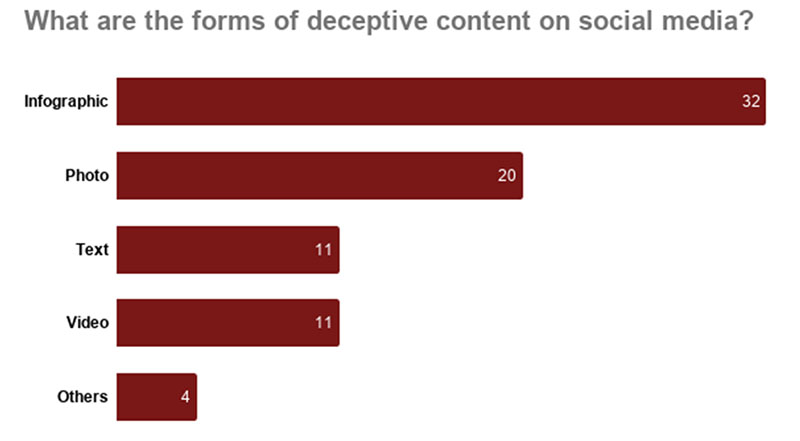
Tsek.ph flagged infographics purporting to be survey results, or falsely showing invented or out-of-context quotes to attack certain candidates.


The "false content" bill in the Senate promises to be tough on the creators of these but does not seem to address the matter of disinformation being a spectrum.

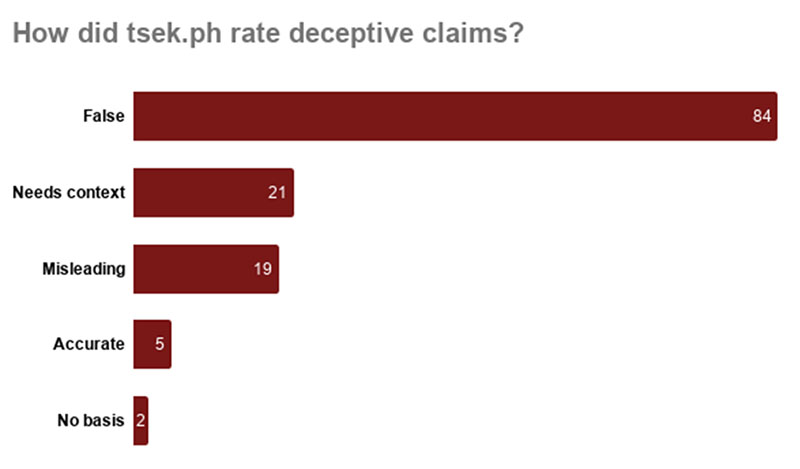
Most of the claims and online content flagged by Tsek.ph—six in 10—are outright false. Most of the rest mislead or take out important context, but are still deceptive and inaccurate.

On election day, two Facebook accounts supposedly associated with the Agusan del Norte police published misleading posts red tagging a number of party-list groups; more than half of those in the list were not party-list groups or were not running at all.
#649

There were indications the attacks were state-sponsored; on election eve, a false post claiming Makabayan party-list groups had been disqualified appeared on a Facebook account claiming to be the police force of Iloilo City as well as four other accounts claiming to be Philippine army reservists in Mindanao.

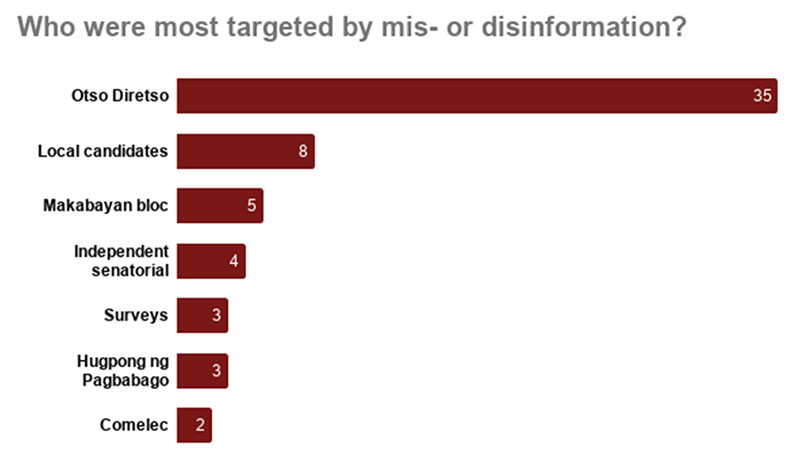
In contrast, the administration Hugpong ng Pagbabago slate was victimized by mis- and disinformation only three times, based on Tsek.ph fact checks.

(Fact checkers from the University of the Philippines, a Tsek.ph partner, monitored all the candidates in the senatorial and party-list races to ensure nonpartisanship and fairness.  -- Ed.)

Altered photos or real ones but posted with out-of-context comments, and fake infographics are the most common types of false or misleading content related to the elections posted on social media.
#650

Even after he lost his Senate bid, Roxas still became subject of false news, when an old altered photo spread on social media showing a woman offering him a rope tied into a noose. The fake photo first went viral in the runup to the 2016 presidential elections, and has already been debunked.

Meanwhile, Aquino was a frequent victim of fake social media quote cards, including one falsely claiming he said poor people should be fed leftovers or scavenged food.

Certain local candidates who were targeted by fake disqualification content on social media up to on the eve and day of the polls are a distant second, only victims eight times to Otso Diretso's 35.

Another political group that saw itself targeted by false or misleading content during the elections was the progressive Makabayan bloc, which fielded several party-list groups in the House of Representatives.
#651


The opposition Otso Diretso slate—notably Manuel "Mar" Roxas II and Paolo Benigno "Bam" Aquino IV who based on pre-election surveys had the biggest chances of winning —was the  most targeted by mis- and disinformation in the midterms; no Otso Diretso member won their Senate bids.

Roxas was a frequent victim of repurposed photos, a common strategy used by disinformation creators.

Months before the polls, multiple Facebook pages posted a photo of the Senate hopeful riding a padyak (cycle rickshaw) with a misleading caption criticizing his supposed gimmickry. The photo was taken during the runup to the 2010 elections, not 2019 as the posts suggest.

Roxas was also the subject of a false blog post claiming he had left the opposition slate.
#652

Tsek.ph documented how state-run and mainstream media amplified election-related disinformation, some of which can be traced to the candidates or their press releases.


In March, two months before the midterms, research organization SWS disowned a purported February survey supposedly showing then candidate and eventual winner Christopher Lawrence "Bong" Go had placed third for the period.

The information came from a media release from Go's very own campaign bureau, which newsrooms, including the state-run Philippine News Agency, published, apparently without double-checking.

While hard to establish if election-related disinformation propelled certain candidates to victory and crushed the chances of others, the pattern that emerges from Tsek.ph data show those who were most targeted indeed lost their bids.                                                                                                       
#653

As when losing candidates Lorenzo "Larry" Gadon and Glenn Chong in Facebook posts made false claims against pre-election surveys and research organizations. Gadon made wrong assertions in an online video about Social Weather Stations and Pulse Asia sample sizes, while Chong posted about topping an online poll, without stating the poll was informal and not scientific.

Facebook was the preferred social media platform of candidates in the last elections, perhaps owing to its massive use by the public, many of whom use "free basics." Of the 62 Senate hopefuls certified by the Commission on Elections, at least 30 had official Facebook pages that regularly posted content.

In the 17th Congress, Sen. Grace Poe, who in 2019 won in her reelection bid, proposed after several hearings on a bill seeking to criminalize "fake news" to provide stiffer punishments for government officials spreading false content after identifying this as a major gap in existing legislation.

Experts who attended the hearings had pointed out how officials like then Assistant Communications Secretary Mocha Uson were among the biggest purveyors of disinformation.
#654

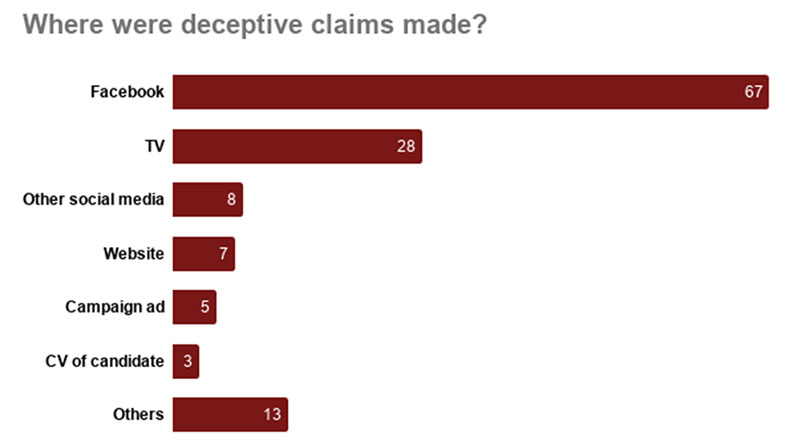
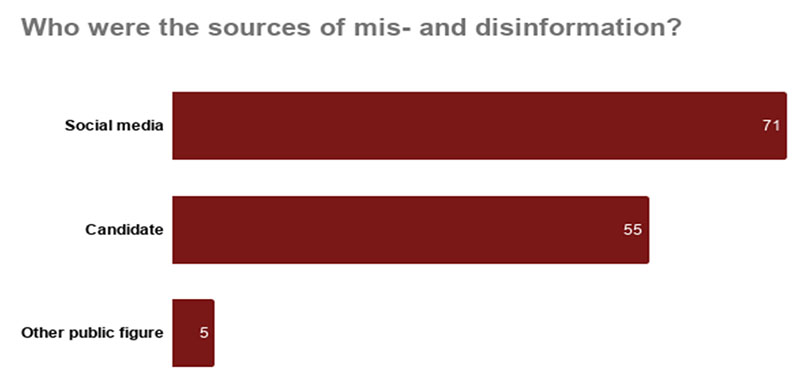
But the other half were untruths or out-of-context statements made by candidates and other public figures themselves, in televised debates, public forums, speeches, campaign ads and even CVs.

As when then candidate and now senator Maria Imelda "Imee" Marcos falsely claimed first in her CV that she graduated from Princeton University, the University of the Philippines College of Law and a boarding school in California, and then repeated in a television interview her fictitious graduation from Princeton. Her claims were fact-checked by Tsek.ph partners and debunked by the institutions themselves.

Or when Duterte himself, in a speech just days before the elections, falsely claimed Otso Diretso candidate Lorenzo "Erin" Tanada III was previously elected senator and had defended communists in court.

On several occasions occasions, certain Senate hopefuls made false and misleading claims directly on social media, through their official pages or accounts.
#655

Indeed, more than half of the total 131 claims flagged by Tsek.ph in the runup, during and after the midterms were user-generated content that spread on social media.


One example: a doctored photo supposedly showing a massive Hugpong ng Pagbabago rally, which crudely edited images of the administration coalition candidates against a background photo of US President Donald Trump's inaugural speech to fake the crowd attendance.

The fake photo went viral on Facebook, and was tracked by analytics tool Crowdtangle before being taken down by its creators.

Another example: a fabricated screenshot purportedly showing media outfit and Tsek.ph partner ABS-CBN News reported anti-Otso Diretso Facebook accounts would be suspended. No such article was posted on the official ABS-CBN website.
#656


Facebook was the preferred social media platform of candidates in the last elections, perhaps owing to its massive use by the public, many of whom use "free basics." AFP File photo

Senate bill goes after online 'fake news,' but Tsek.ph data point to wider problem

Jake Soriano, Yvonne Chua (Tsek.ph)
September 14, 2019

More than three months since the May 2019 midterm elections, the matter of who won and lost on the back of mis- and disinformation still looms large.

Bringing the issue to the fore is a recent bill filed by Senate President Vicente "Tito" Sotto III, which aims to combat "false content" online by penalizing its creators. The text of the measure mentions an instance where a hoax video showing a pre-shaded ballot "raised doubts as to the integrity of the automated election system."

An analysis of election-related mis- or disinformation flagged by Tsek.ph, a pioneering collaborative fact-checking initiative between 11 newsrooms and three universities, shows, however, Senate Bill No. 9 rests on certain assumptions, such as framing "fake news" as if it were only a social media problem where the problem persists both online and off.

By seeking to penalize only "false and deceiving content online," the bill neglects disinformation that spread through other vectors, which Tsek.ph data show were as prominent during the midterms as those on social media.
#657
Quote from: islander on September 12, 2019, 04:53:50 AM
Naveed Sattar, Professor of Metabolic Medicine at the University of Glasgow, said that while the study was "somewhat interesting", it seems that those who nap once or twice a week have healthier or organized lifestyles, but that those who napped daily were likely to be more sick.

Quote from: islander on September 12, 2019, 04:55:06 AM
"I don't think one can work out from this work whether "intentional" napping on one or two days per week improves heart health so no one should take from this that napping is a way to lessen their heart attack risk," he added.

"For now, far better to aim for regular good night's sleep and to follow usual lifestyle advice of good diets and decent activity levels."

oh-oh...
#658

"This means the former pattern of occasional napping is intentional and the latter of more regular napping likely represents sub-clinical illness linked to poorer lifestyle. This would then explain the differential risks," Sattar told the SMC.

"I don't think one can work out from this work whether "intentional" napping on one or two days per week improves heart health so no one should take from this that napping is a way to lessen their heart attack risk," he added.

"For now, far better to aim for regular good night's sleep and to follow usual lifestyle advice of good diets and decent activity levels."

https://edition.cnn.com/
#659

"Sleep patterns have previously been reported to be associated with a range of chronic medical conditions," said Stephen MacMahon, a cardiovascular expert at Oxford University's George Institute for Global Health, who was not involved in the study.

"Some, but not all, these associations will reflect the effects of underlying chronic disease on sleep rather than the converse. It's often difficult to untangle what is cause and effect, especially when some serious conditions, such as coronary heart disease, can be largely symptom-free for decades prior to a critical complication such as a heart attack," he told the Science Media Centre (SMC) in London.

Naveed Sattar, Professor of Metabolic Medicine at the University of Glasgow, said that while the study was "somewhat interesting", it seems that those who nap once or twice a week have healthier or organized lifestyles, but that those who napped daily were likely to be more sick.
#660

The observational study, which was published in Heart, the journal of the British Cardiovascular Society, found that no such association emerged for greater frequency or duration of naps.

While some studies have been done on the impact of napping on heart health, many published studies fail to consider napping frequency or duration, the researchers said.

"Subjects who nap once or twice per week have a lower risk of incident CVD (cardiovascular disease) events, while no association was found for more frequent napping or napping duration," the report authors said.
#661

Daytime naps once or twice a week may be linked to a healthy heart, researchers say

By Amy Woodyatt, CNN
September 10, 2019


Researchers looked at the association between napping frequency and average nap duration and the risk of fatal and non-fatal cardiovascular disease 'events,' such as heart attack, stroke, or heart failure.

(CNN)Some good news for nap fanatics -- a new study has found that a daytime nap taken once or twice a week could lower the risk of heart attacks or strokes.

Researchers from the University Hospital of Lausanne, Switzerland studied the association between napping frequency and duration and the risk of fatal and non-fatal cardiovascular disease complications.

Tracking 3,462 people between the ages of 35 and 75 for just over five years, the report authors found that those who indulged in occasional napping -- once or twice a week, for between five minutes to an hour -- were 48% less likely to suffer a heart attack, stroke or heart failure than those who did not nap at all.
#662

In this crisis, the term "Buddhist" is used to designate cultural identity, not a religious belief or practice. Someone who identifies as a Buddhist doesn't necessarily follow the teachings of the Buddha. Even back in the Buddha's time, there were "bogus monks" who tried to join the sangha. These were not true monks but merely "men in yellow robes," and were ejected from sangha gatherings. We should understand the situation in Myanmar as a cultural conflict rather than a religious conflict. As Azeem Ibrahim wrote, it is the exclusive nature of the Theravada tradition that often leads to "violent inter-ethnic tension in Sri Lanka and Thailand, as well as Myanmar," not Buddhism itself.

The military government of Myanmar is cynically using Buddhism to manipulate people to behave with violence and hatred, rather than compassion and generosity. In my experience, conversations about Myanmar tends to get mired in debate about whether Buddhism is a non-violent religion. Perhaps we should leave Buddhism out of the conversation. In order to focus on addressing the actual situation more effectively and responsibly, it's important to understand the complex political and ethnic issues more deeply. With a deeper understanding, we might be able to engage with the situation more effectively.

https://www.lionsroar.com/
#663

The main point of the documentary is that, despite the apparent movement toward democracy, ethnic violence is engineered by the government in an attempt to keep its grip on power. Based on the evidence presented, it appears that the eruptions of violence against the Rohingya and other Muslim groups across Myanmar were organized and planned, not spontaneous, communal, or unintended consequences of democratization. While the government has dismissed any allegations of its links to the violence as "nonsense," Stoakes writes, "Evidence obtained by Al Jazeera shows conclusively that the recent surge of anti-Muslim hatred has been anything but random. In fact, it's the product of a concerted government campaign clearly aimed at promoting instability and undermining the opposition by stirring up the forces of militant nationalism."

Stoakes responsibly notes that none of this evidence is clear proof of the connection between the government and Ma Ba Tha, but it is nevertheless illuminating. If the government has been corrupting men wearing the robes of a monk, then Buddhism is not being used as a rallying cry of hatred and exclusion, but merely as a veil for it.
#664

The Al Jazeera documentary presents other monk leaders of the Saffron Revolution who claim Wirathu works for the government. These monks specify that Wirathu called them at their monasteries after they were released from prison in 2011, and invited them to come see him. When they went, they say he attempted to recruit them to join his anti-Muslim crusade with the offer of an office, complete with an Internet-connected laptop, a telephone, and a payment of $1,000 (in a country with a per capita income of $1,195). The film also shows a secretly taped mobile phone recording of a meeting between government officials and Ma Ba Tha clerics. Then, an anonymous acquaintance of Wirathu claims that Yangon's Special Branch agency (undercover police) works closely with Wirathu, saying he has seen its members at Wirathu's monastery in Mandalay. Further evidence is seen in a Powerpoint presentation used by members of the military at a training session in 2012 in the capital city of Naypyidaw, titled "Fear of Losing One's Race," a presentation in which the very same anti-Muslim language used by Ma Ba Tha is found, including the conspiracy of a Muslim plot to make Buddhism and Buddhists extinct. Other documents circulated among government officials and obtained by Al Jazeera warn of Muslim plots to rape Buddhist women, start riots, and carry out terrorist acts, including intentions to "cut off the heads of departmental staff members."
#665

Ibrahim explores the origin of the connection between the government and the Ma Ba Tha. The organization did not exist before the opening up of the country in 2011. Ibrahim writes that the monks who were arrested during the Saffron Revolution in 2007 were later offered money and state patronage to join the Ma Ba Tha and promote its core message of hatred of all Muslims. These revelatory claims are based on an article by Emanuel Stoakes, "Monks, Powerpoint Presentations and Ethnic Cleanings," published in Foreign Policy on October 26, 2015.

Based on the evidence presented, it appears that the eruptions of violence against the Rohingya and other Muslim groups across Myanmar were organized and planned.

In his article, Stoakes interviews an anonymous monk who claims that after his release from prison, he had a meeting with three government officials and was offered money to join Ma Ba Tha and preach anti-Muslim rhetoric. He is one of four monk leaders of the Saffron Revolution who claim the government made similar offers to them. Stoakes also produced an investigative documentary with Al Jazeera, "Genocide Agenda," which aired in October 2015. In the film, one anonymous monk leader explains the situation bluntly: "Gradually, monks from the Saffron Revolution ended up in Ma Ba Tha." He further clarifies exactly what anyone trying to understand the situation needs to know: "Ma Ba Tha is controlled by the military. When it wants to start a problem at any time, it's like turning on a tap. They will turn it on or turn it off when they want."
#666

Today

Amnesty International says those Rohingya who remain in their villages and camps are being systematically starved, to force them to flee the country. It is a situation ripe for genocide.

In all cases of violence against Muslims, reports of police participation in the attacks raised suspicions of a link between the mobs and the government. In Azeem Ibrahim's 2016 book The Rohingyas: Inside Myanmar's Hidden Genocide, Ibrahim says that the violence in Myanmar is closely related to inter-ethnic tension in Sri Lanka and Thailand. The key difference in Myanmar, he writes, is that several prominent Buddhist groups are actively driving the anti-Muslim violence, such as Ma Ba Tha. Then Ibrahim makes the shocking assertion that "there is growing evidence that the Ma Ba Tha Buddhist extremist organization was set up by the military as an alternative power base." He suggests the group is a "front organization" for the military. He continues, "In effect, the military is directly backing two different groups in contemporary Myanmar," the USDP (their political party) and "its own organization of Buddhist extremists who both offer the means to channel electoral support to the USDP and to create violence that can later be used to justify a military intervention."
#667

August 2017

Armed Rohingya rebels—of the Arakan Rohingya Salvation Army (ARSA)—launched a coordinated attack on thirty border police posts, killing a dozen security forces. This caused the Burmese army to retaliate against the Rohingya throughout Rakhine State with a "scorched earth campaign."

March 2018

By March, more than 6,000 Rohingya had been killed and more than 655,000 had fled to Bangladesh. Over fifty-five villages had been completely bulldozed, removing traces of buildings, wells, and even vegetation. Here we can see the Myanmar army has learned from the Israeli Army, which many Myanmar officials admire; when asked how to respond to the Rohingya, Dr. Aye Maung, head of Rakhine Nationalities Development Party, said, "We need to be like Israel."
#668

March 2013

Extreme violence erupted in the central Myanmar town of Meikhtila—where both Muslim and Buddhist communities are largely Bamar—after a Buddhist couple claimed a Muslim jewelry store owner sold them a fake golden hairpin and a brawl started between them. While police watched, Muslim-owned shops were burned and Muslims were attacked; later, a group of Muslims knocked a Buddhist monk off of his bike, beating him as he lay on the ground, and then set his body on fire. This led to outright carnage, with outside groups again bused in to lead a full pogrom against Muslims in the town, resulting in a death toll of forty-three people, mostly killed by sticks and knives, and 830 buildings destroyed. (Again, the men making up the mobs were reported to be drunk and/or high on drugs.)

June 2013

After the report of a rape of a Buddhist woman by Kaman Muslim men in Thandwe, violence erupted again, not just against Kaman but also against Rohingya far away from the incident.
#669

October 2012

A second wave of violence occurred, with apparently organized mob attacks on Muslim communities in nine townships across Rakhine State.

There were close-quarter machete attacks and torching of houses on both sides, but only Rohingya violence was "constructed as terrorism," and ascribed to "jihad." In this way, these small, local disturbances—of inter-community slaughter, not uncommon in South Asia—suddenly became part of a global crisis.


Map. Huffington Post. December 16, 2017. "New Report Documents Scope of Religious Violence in Burma." Provided by Physicians for Human Rights.

Wirathu and other monks from his 969 group organized a complete Muslim boycott, prohibiting Buddhists from having any interaction with Muslims whatsoever. Any Muslim "sympathizer" would also be persecuted, and one Buddhist who continued to do business with Muslims was beaten to death. The monks' ban of Muslims set the precedent for an Islamophobia that went beyond the Rohingya to include officially recognized citizens of Myanmar.
#670

Behind the Current Crisis

The current crisis started in 2012. Here's a brief timeline of events:

May 28, 2012

Twenty-six-year-old Rakhine woman Ma Thida Htwe was gang-raped and murdered by three men the state media identified as "Bengali Muslim" or "Islam Followers." These men were promptly arrested.

June 3, 2012

A few days later, three hundred Rakhine men attacked a bus carrying Muslims in the town of Taungup, beating ten passengers to death. These Muslims were not Rohingya, but missionaries from northern areas not in Rakhine State.

June 9, 2012

Mobs of Rohingya retaliated by attacking Rakhine properties in Maungdaw, torching houses. Mobs of Rakhine in turn burned Sittwe's Muslim quarter of Nasi to the ground, chasing tens of thousands of the Rohingya inhabitants out of Rakhine and into camps or exile in Bangladesh (some estimate up to 120,000). These mobs were reportedly bussed in from elsewhere in Rakhine State. They were reported to be drunk and/or high on drugs.
#672

The latest upsurges of violence are also aided by globalization. With the internet, Islamaphobic fanatics can connect the old Burmese narratives about Islam with the contemporary narrative of global jihad. In The Venerable W. —shot before the 2016 election — Wirathu says, "In the USA, if the people want to maintain peace and security, they have to choose Donald Trump." Through such comments, and his aggressive use of social media and DVD propaganda, Wirathu demonstrates his awareness of rising xenophobic nationalism around the world. He's aware of 9/11; the attacks in Paris, Berlin, Nice, and Brussels; Brexit; Marine Le Penn in France; neo-Nazis in Germany; and the right-wing nationalist governments ruling in Hungary, Poland, and elsewhere in Europe. He knows he is tapping into a larger global vilification of Islam — a world vs. Muslim jihadist narrative. This framing is made possible by the internet, which only became widely available in Myanmar in 2011. Wirathu seems to be committed to connecting his regional crusade to a broader global movement. In 2014, he traveled to Colombo, the capital of Sri Lanka, to sign a memorandum of understanding between Sri Lanka's own Islamophobic monk group, Bodu Bala Sena (Army of Buddhist Power), and 969 (the precursor to Ma Ba Tha).

All of these conditions — the colonial history, the emergence of the internet, the global anti-Islamic narrative — provide a ripe ground for violence and persecution. The question that remains: are the crimes against humanity in Myanmar a tragic byproduct of random circumstances unabated by the peaceful doctrines of Buddhism, or is the violence part of some concerted effort by an as-of-yet unnamed actor, Buddhist or otherwise?
#673

With the internet, Islamaphobic fanatics can connect the old Burmese narratives about Islam with the contemporary narrative of global jihad.

Suu Kyi has received widespread criticism for her silence on the Rohingya issue — especially in light of her earlier writing and speeches. In a 1989 open letter to the United Nations Commission on Human Rights, for example, Suu Kyi wrote, "The chief aim of the National League for Democracy (NLD) and other organizations working for the establishment of a democratic government in Burma is to bring about social and political changes which will guarantee a peaceful, stable and progressive society where human rights, as outlined in the Universal Declaration of Human Rights, are protected by rule of law." Then, in a speech she gave in Kachin State on April 27, 1989, Suu Kyi declared, "If we divide ourselves ethnically, we shall not achieve democracy for a long time." Despite the apparent achievement of democracy in Myanmar, violent ethnic divisions continue to occur under Suu Kyi and the NLD's leadership.
#674

We can trace the history of the current crisis in Rakhine State to the military takeover of the country in 1962. Burma achieved independence in 1948, but after fourteen years of constitutional rule, the military junta took over in 1962. The junta systematically stoked fears of the demise of Buddhism and the break-up of the nation to cultivate loyalty among a resentful population. But they also held a monopoly on violence and prevented citizens and monks like Wirathu from encouraging social disturbance. (In 2003, Wirathu was arrested along with forty-four other monks for using hate-speech to promote attacks on Muslims and a mosque, and spent eight years in prison.) Ironically, it was only with the ostensible transition to democracy that began in 2011 that public religious tension between Buddhists and Muslims surfaced again. As Francis Wade writes, the idea was that "the stirrings of democratic change in Myanmar might level the playing field, allowing communities who felt long disenfranchised by the military to assert great claims to the nation." It was feared that Muslims in particular would take advantage of democratic freedom, and if they did, Buddhists would suffer.

A crucial moment came in 1982 with the Citizenship Law, when the government issued an official list of 135 ethnic groups, or "national races" that held Myanmar citizenship. The list excluded the Rohingya, cementing their stateless status. A census in 2014 was then designed to exclude "alien" minorities from voting, and the 2015 elections resulted in Aung San Suu Kyi becoming State Councilor, with great gains for her National League for Democracy (NLD) — and also in the total absence of Muslims from Myanmar's parliament for the first time since independence.
#675

This narrative — that the Burmese people need to protect Buddhism from enemy foreign invaders — has persisted for over a century, though the perceived enemy has changed from British to Muslim. The first instance of this shift can be seen in a rally of 10,000 Burmese at Rangoon's Shwedagon Pagoda, in 1938, to protest the writing of Muslim intellectuals who were accused of insulting Buddhism. The protests resulted in attacks on Muslim communities across the city. In addition to anti-Muslim movements, the 1930s and 1940s also saw the rise of anti-Christian and anti-Hindu sentiments, the latter culminating in a series of anti-Indian riots. All of these incidences arose as part of anti-colonial movements and strengthened the idea that one must be Buddhist in order to be truly Burmese.


A mass grave is uncovered in Myanmar.

An important contributing factor to the current crisis in Rakhine occurred during WWII. Under Japanese occupation, Buddhists in Rakhine (then called Arakan) were recruited to fight as proxies for the Japanese. Local Muslims, in contrast, were armed and mobilized by the British as independent militias who performed guerilla-attacks on Japanese forces. This meant that Buddhists and Muslims were fighting against each other, which resulted in the groups becoming geographically separated and "ghettoized," with Muslims fleeing north to avoid the anti-Muslim violence of the Japanese offensives, and Buddhists fleeing south to avoid the anti-Buddhist violence of the guerilla counter-offensives. After the war, waves of government violence against Rohingya occurred in 1954, 1962 (during the military takeover), 1977-78 (when the military forced the Rohingya to carry Foreign Registration Cards, and over 200,000 were driven into Bangladesh), 1992, 2001 (in response to the Taliban's destruction of Buddhist statues in Bamiyan), and 2003.
#676

The narrative that the Burmese people need to protect Buddhism from enemy foreign invaders has persisted for over a century, though the perceived enemy has changed from British to Muslim.

The 800-year connection between the monarchy and the sangha was severed in 1885, when the British invaded Upper Burma and incorporated it into its Indian colony. Dissolving the border between the countries, Indian Hindus and Muslims moved en masse — voluntarily or forcefully — into Burma, permanently altering the demographics of Rangoon in particular, where many found success in trade. With the loss of a Buddhist king and the loss of favor of the Buddhist education system, due to the British promotion of Christianity, 1885 saw the emergence of the first Buddhist nationalist movements.

The modern movement of Vipassana meditation arose out of this anti-colonial movement, with monk Ledi Sayadaw spreading the idea that it was the duty of every Buddhist to protect and preserve Buddhism by meditating and studying Buddhist scripture, both of which were previously only practiced by a small portion of monastics. Ledi Sayadaw's movement was pacifist, but monks also led armed rebels to attack British troops in upper Myanmar during the British invasion. Nationalistic independence movements rose over the following decades, and in the 1920s and 30s a popular anti-colonial rallying cry was "Amyo, Batha, Thathana!" — which roughly translates to "Race, language, and religion!" The Ma Ba Tha organization derived its name from this slogan, of which it is an acronym.
#677

The Rise of Burmese Nationalism

Buddhism has been used to consolidate the national identity in Burma for centuries. In the twelfth century, King Anawratha used Buddhist scriptures to unite the disparate people of the Ayeyarwady Valley and form the Bagan Empire. From the nation's start, Burma was a Buddhist and Bamar-ethnic majority. From then on, kings would support the order of monks—the sangha—and in return the monks endowed the monarchy with legitimacy. The monks encouraged loyalty to the nation, but they also served as the conscience of the government, making sure that it ruled in accordance with Buddhist ethical principles. When it did not, the monks revolted.

An example of this was seen in the Saffron Revolution of September 2007. When the government allowed gas subsidies to expire, the price of goods rose 500%, and citizens protested. When the protesters were violently suppressed, the monks joined the protest by overturning their begging bowls on their alms round, disallowing government officials from earning merit by giving alms. The protest was a seriously embarrassing gesture, and the military government violently cracked down on the protests, beating and arresting thousands of monks.
#678

In the 2016 book Myanmar's Enemy Within, author Francis Wade talks with a lay member of this group, who shares the narrative fueling the group's thinking. "If the Buddhist cultures vanish," the member said, "Yangon will become like Saudi and Mecca ... It can be the fall of Yangon. It can be the fall of Buddhism. And our race will be eliminated." Though Buddhism is not a race, Ma Ba Tha often conflates race and religion, demonstrating that the group's deeper concern is one of ethnicity.

Those who believe this narrative see verification of it in the history of other formerly Buddhist nations — like Malaysia, Indonesia, Pakistan, and Afghanistan — having been "overrun" by Muslims. Myanmar remains 90% Buddhist, with no evidence of that changing. So where did the idea that Buddhism will vanish originate?
#679

From the nation's start, Burma was a Buddhist and Bamar-ethnic majority.

There's no escaping the fact that men wearing the robes of Buddhist monks are promoting this narrative. The most infamous of these is Ashin Wirathu, the 49-year-old Burmese monk who was on the cover of TIME magazine in 2013 and was the subject of the 2017 documentary film The Venerable W. by French filmmaker Barbet Schroder. As the film shows, Wirathu has led hundreds of thousands of followers in a hate-fueled, violent campaign of ethnic cleansing by claiming that the Rohingya are "a Saudi-backed Bangladeshi insurgency whose purpose is to infiltrate the country, destroy Myanmar's traditional Buddhism and establish a caliphate." Wirathu is a leader of the Organization for the Protection of Race and Religion, commonly known by its Burmese acronym, Ma Ba Tha. This group was founded in June 2013, and quickly found the support of millions. Ma Ba Tha and other Buddhist nationalist groups—not only Myanmar but also in Sri Lanka—describe their purpose as the protection and promotion of Buddhism through preaching about the importance of Buddhist values, history, education, sacred sites, and ceremonies. Yet accompanying this benign rhetoric is their insistence on neutralizing threats to Buddhism, which they claim come from Muslims.
#680

To understand the issue more fully, we must first start with the narrative of Buddhist nationalism — the driving ideological force behind the Islamophobia fueling the violence against the Rohingya. From the perspective of a Buddhist nationalist, the story goes like this: Over the course of decades, Muslim Rohingya slipped over the border from Bangladesh at the point where it meets Rakhine State, and settled on Rakhine land. They grew in number and diluted the Buddhist population, forming the vanguard of a crusade to turn Myanmar into a Muslim country. Therefore, unlike other Muslims in Myanmar, such as the Kaman people, the Rohingya have never been Burmese citizens and do not deserve citizenship status.

This narrative is known as "the Muslim problem." To cement the view that the Rohingya are not Burmese citizens, the Rohingya are referred to as "Chittagong Bengalis."
#681

There is not enough evidence to declare genocide is occurring, but there is evidence of systematic rape, forced labor, restrictions of movement, restrictions on marriage and reproduction, and prevention from access to medicine and food rations. International observers say the situation will soon come to genocide if the international community does not immediately intervene. As the Holocaust demonstrated, ethnic cleansing can swiftly become genocide. Prior to 1941, the Nazi effort to expel all Jews from the Reich qualified as ethnic cleansing. The subsequent concentrating and then exterminating of Jews that began in earnest after the US entered the war was clearly genocide. As Penny Green, Director of the International State Crime Initiative (ISCI) at London's Queen Mary University, states, "Genocide can begin many years before actual extermination." In April 2018, Green and the ISCI released a report arguing that the Myanmar government is "guilty of genocidal intent toward the Rohingya."

In The New York Times article "Why Are We Surprised When Buddhists Are Violent?," Dan Arnold and Alicia Turner write, "How, many wonder, could a Buddhist society—especially Buddhist monks!—have anything to do with something so monstrously violent as the ethnic cleansing now being perpetrated on Myanmar's long-beleaguered Rohingya minority? Aren't Buddhists supposed to be compassionate and pacifist?"
#682

There is not enough evidence to declare genocide is occurring, but there is evidence of systematic rape, forced labor, restrictions of movement, restrictions on marriage and reproduction, and prevention from access to medicine and food rations. International observers say the situation will soon come to genocide if the international community does not immediately intervene. As the Holocaust demonstrated, ethnic cleansing can swiftly become genocide. Prior to 1941, the Nazi effort to expel all Jews from the Reich qualified as ethnic cleansing. The subsequent concentrating and then exterminating of Jews that began in earnest after the US entered the war was clearly genocide. As Penny Green, Director of the International State Crime Initiative (ISCI) at London's Queen Mary University, states, "Genocide can begin many years before actual extermination." In April 2018, Green and the ISCI released a report arguing that the Myanmar government is "guilty of genocidal intent toward the Rohingya."
#683

Hugging the Bay of Bengal on Myanmar's western coast, and separated from central Myanmar by the Arakan Mountains, Rakhine State is home to over a million Muslims, most belonging to the Rohingya ethnic group, and over two million Buddhists of the Rakhine ethnic group, who are ethnically distinct from the country's Bamar majority. The state's capital is Sittwe, where communal violence erupted in 2012, and relations between Rakhine and Muslims were severed. Things have gotten exponentially worse since then; recent articles published in The New York Times and Al Jazeera exposed mass graves of Rohingya massacred by Burmese troops in September 2017, with acid apparently used to disfigure the bodies beyond recognition. In December 2017, Doctors Without Borders estimated that over 10,000 Rohingya had been killed in the most recent upsurge of violence, and that about 700,000 are living in exile in neighboring Bangladesh and India, causing the UN Human Rights chief to state the situation was "a textbook example of ethnic cleansing."


The New York Times. March 30, 2012.
#684

What's the connection between Buddhism and ethnic cleansing in Myanmar?

BY RANDY ROSENTHAL| NOVEMBER 13, 2018

How have Buddhists become implicated in one of the worst humanitarian crises in the world? Randy Rosenthal looks through history to understand how a religion of peace has become a justification for violence.


Muslim protesters burn an effigy of radical Buddhist monk Ashin Wirathu in Hyderabad, India, September 10, 2017. AP Photo/Mahesh Kumar A.


"It is not power that corrupts but fear. Fear of losing power corrupts those who wield it and fear of the scourge of power corrupts those who are subject to it."

– Aung San Suu Kyi

Understanding the Crisis in Myanmar

The scriptures of Judaism, Hinduism, and Islam condone, justify, and even sometimes encourage the use of violence. In Buddhist texts, it's just the opposite. Chapter ten of the Dhammapada, an anthology of verses attributed to the Buddha, reads: "All tremble before violence. All fear death. Having done the same yourself, you should neither harm nor kill." Another verse reads: "In this world hostilities are never appeased by hostility. But by the absence of hostility are they appeased. This is an interminable truth." A line from the Metta Sutta reads: "Toward the whole world one should develop loving-kindness, a state of mind without boundaries—above, below, and across—unconfined, without enmity, without adversaries." This principle of non-violence, consistent throughout the Pali Canon — the collection of early Buddhist teachings — is partly why many Buddhists are deeply troubled by the current situation in Myanmar — a majority-Buddhist country — where, particularly in Rakhine State, massive human rights violations are systematically being committed against the Muslim Rohingya people.
#685
Anonymous Diary Blog / Re: Unsay Akong Gikaon Karon?
September 10, 2019, 01:49:05 PM


you just ate my momma...
#686
Philippine Provinces / Re: Luoya sa Bana aning estoryaha
September 10, 2019, 01:41:56 PM

hoy, botoy, seryoso ang balita intawon.
#687
Photos Unlimited / Re: Cave Canem
September 10, 2019, 01:39:28 PM

#688

Babbling geese

Maurice and his owner are not the only ones ruffling feathers. This week a woman in the duck-breeding heartland of the Landes region was brought to court by a newcomer neighbour fed up with the babbling of the ducks and geese in her back garden.

A petition in support of "the Hardy ducks," as they have been dubbed, after the name of a nearby lake, has garnered some 5,000 signatures.

"More and more people are heading to rural areas, not to work in agriculture, but to live there," Jean-Louis Yengue, a geographer at the University of Poitiers, told AFP.

"Everyone is trying to defend their territory."

https://www.afp.com/
#689

In many rural areas in France, some villagers resent richer urbanites buying up property in declining farming villages, which played into the fierce "yellow vest" anti-government protests that erupted around the country last November.

The mayor of the southwestern village of Gajac, Bruno Dionis, penned a furious open letter in May in defence of the rights of church bells to ring, cows to moo, and donkeys to bray throughout rural France.

He has asked the government to inscribe the sounds on France's heritage list.
#690

'Merely audible'

To verify the Birons' claim that Maurice was disturbing the peace, a court official was sent to their home three nights in a row to assess the hour and volume of Maurice's call.

The official found that the rooster crowed "intermittently" between 6.30-7.00 am (0430-0500 GMT), not from 4 am, and said the noise was "merely audible" but by no means loud if the couple closed their windows.

The court castigated the Birons for bringing what it called a "frivolous" case, saying they should have tried to settle the matter amicably.
#691

Critics saw the lawsuit as part of a broader threat to France's hallowed rural heritage by outsiders and city dwellers unable or unwilling to understand the realities of country life.

The couple's lawyer however rejected the characterisation of the case as a battle between "bobos" -- bourgeois bohemians -- and countryfolk, arguing that the 7,000-strong town of Saint-Pierre d'Oleron where Fesseau lives could not be considered the countryside.

The town's mayor Christophe Sueur, a staunch ally of local woman Fesseau, took a different view, arguing that residents had always lead a rural life-style, "with vegetable gardens and henhouses."
#692

Reacting to the ruling Thursday, she shouted a victorious "Cocorico" (French for cock-a-doodle-doo) outside the courtroom and said she was "speechless".

"It's a victory for everyone in the same situation as me. I hope it will set a precedent for them," she said, calling for a new "Maurice law" protecting the sounds of the countryside.

'Save Maurice' T-shirts

What began as a dispute between neighbours ballooned into a national cause celebre, with 140,000 people signing a "Save Maurice" petition or proudly displaying his picture on "Let Me Sing" T-shirts.
#693

Fesseau had told the court in Rochefort, western France, that nobody on the picturesque Atlantic island of Oleron had ever complained about Maurice before a couple of pensioners bought a holiday home next door.

Jean-Louis Biron, himself a retired farmer, and his wife Joelle, from the Haute-Vienne region of central France, claimed that they were being roused at 4 am by Maurice's shrill wake-up call.

Fesseau said she made several attempts to silence her pet, including placing black sheets around his coop to trick him into thinking that morning had not yet broken -- all to no avail.
#694

French rooster triumphs in battle over right to crow

05 September 2019


AFP/File / XAVIER LEOTY
Corinne Fesseau with her rooster Maurice in the garden of her home in Saint-Pierre-d'Oleron, western France

The owner of famed French rooster Maurice emerged victorious on Thursday from a legal battle with her neighbours over his early-morning crowing, with a court upholding the bird's right to sing in the day.

The case brought by the neighbours of Maurice's owner Corinne Fesseau has made headlines around the world, seen as symptomatic of the tensions in the countryside between rural folk and holiday home owners.

"Maurice won and the plaintiffs must pay his owner 1,000 euros in damages," Fesseau's lawyer Julien Papineau told AFP.
#695
Health and Food / Re: What Is Dehydration in Adults?
September 01, 2019, 05:27:42 PM

Fluid replacement in moderate to severe dehydration

If there is no nausea and vomiting, fluid replacement may begin orally for some patients with moderate dehydration. Patients are asked to drink electrolyte/carbohydrate-containing fluids along with water.

However, if there are signs of moderate to severe dehydration (elevated resting heart rate, low blood pressure), fluids are generally given through an IV.

Disposition

1. If the patient's condition improves enough (most symptoms stop) in the emergency department, the patient may be sent home, preferably in the care of friends or family. This is not an unusual result for many patients who arrive at an emergency department with moderate dehydration symptoms.

2. If the patient remains dehydrated, confused, feverish, has persistently abnormal vital signs, or signs of infection, the person will likely be admitted to the hospital for additional treatment.

Acetaminophen (for example, Tylenol) or ibuprofen (for example, Advil) may be used. This can be given by mouth if the affected person is not vomiting or as a rectal suppository if he or she cannot take anything by mouth.
#696
Health and Food / Re: What Is Dehydration in Adults?
September 01, 2019, 05:25:54 PM

What Is the Medical Treatment for Dehydration in Adults?

Treatment in the emergency department centers first on restoring fluid (blood) volume and electrolytes, and treating any life-threatening symptoms while also trying to determine the underlying cause(s) of the dehydration.

If the affected individual's core body temperature is greater than 104 F (40 C), doctors will cool the entire body. They may promote cooling by evaporation with mists and fans or cooling blankets and baths.
#697
Health and Food / Re: What Is Dehydration in Adults?
September 01, 2019, 05:24:22 PM

If someone shows signs of heat exposure or has an elevated temperature, try to cool the person down in the following ways:

1. Remove any excess clothing and loosen other clothing

2. Air-conditioned areas are best for helping return the affected individual's body temperature to normal and break the heat exposure cycle.

3. If air-conditioning is not available, increase cooling by evaporation by placing the person near fans or in the shade, if outside. Place a wet towel around the person.

4. If available, use a spray bottle or misters to spray tepid (luke-warm) water on exposed skin surfaces to help with cooling by evaporation.

5. Avoid exposing skin to excessive cold, such as ice packs or ice water. This can cause the blood vessels in the skin to constrict and will decrease, rather than increase heat loss. Exposure to excessive cold can also cause shivering, which will increase body temperature, this may cause the dehydration symptoms to become worse.
#698
Health and Food / Re: What Is Dehydration in Adults?
September 01, 2019, 05:21:56 PM

Are There Home Remedies for Dehydration in Adults?

Encourage people who are dehydrated (even those who have been vomiting) to take in fluids in the following ways:

1. Sip small amounts of water.

2. Drink carbohydrate/electrolyte-containing drinks. Good choices are sports drinks such as Gatorade or prepared replacement solutions (Pedialyte is one example).

3. Suck on popsicles made from juices and sports drinks.

4. Suck on ice chips.

5. Sip through a straw (works well for someone who has had jaw surgery or mouth sores).
#699
Health and Food / Re: What Is Dehydration in Adults?
September 01, 2019, 05:19:03 PM

What Are Treatment Options for Dehydration in Adults?

Dehydration treatment options for adults include home remedies like sipping on water, drinking sports drinks that replace lost nutrients, cooling the body, and removing any excess clothing from the person. Medical treatment for dehydration in adults includes hospitalization and replacement of fluids lost.
#700
Health and Food / Re: What Is Dehydration in Adults?
September 01, 2019, 05:16:39 PM

Blood chemistries

1. The amount of salts or electrolytes (sodium, potassium, bicarbonate) and glucose as well as indicators of kidney function (BUN and creatinine) may be important to evaluate the degree of dehydration and possible causes.

2. A complete blood count (CBC) may be ordered if the doctor thinks an underlying infection is causing the dehydration. Other blood tests, such as liver function tests, may be indicated to find causes of the symptoms.