Join MikeLigalig.com!

Why Just Read When You Can Join, Post, and Read!

Menu

Show posts

This section allows you to view all posts made by this member. Note that you can only see posts made in areas you currently have access to.

Show posts Menu

Messages - islander

#4901

ngkatawa ba uroy. if i know, naluspad si iyo. mahadlok nga mabisto sa duha ka baye ang tinuod niyang hinigugma...nga lalaki. :P
#4902
English Dictionary / Re: Jockey for Position Meaning
September 13, 2016, 06:50:44 PM

hundred are doing this now, for juicy government positions. no one thinks they're unqualified.
#4903
Science and Research / Re: Stunning New Images of Mars
September 13, 2016, 06:45:46 PM

After the drilling is completed, Curiosity will continue farther south and higher up Mount Sharp, leaving behind these spectacular formations. These pictures represent Curiosity‘s last stop in the Murray Buttes, where the rover has been spending the past month.

And as of this past September 11th, 2016, Curiosity has been on the planet Mars for a total of 4 years and 36 days (or 1497 Earth days; 1458 sols) since it landed on August 6th, 2012.

One has to wonder how the pareidolia folks are going to interpret these ones. After “seeing” a rat, a lizard, a doughnut, a coffin, and so forth, what’s left? Might I suggest that the top image kind of looks like a statue-column?

Further Reading: NASA â€" Solar System Exploration

http://www.universetoday.com/
#4904
Science and Research / Re: Stunning New Images of Mars
September 13, 2016, 06:33:14 PM

These sediment layers are believed to have been laid down over the course of 2 billion years, and may have completely filled the crater at one time. Since it is widely believed that lakes and streams existed in the Gale Crater 3.3 â€" 3.8 billion years ago, some of the lower sediment layers may have originally been deposited on a lake bed.


A hillside outcrop with finely layered rocks within the “Murray formation” layer of lower Mount Sharp. Credit: NASA

For this reason, the Curiosity team also took drill samples from the Murray Buttes area for analysis. This began on Sept. 9th, after the rover was finished taking pictures of the area. As Vasavada explained:

“The Curiosity team is drilling regularly as the rover ascends Mount Sharp. We are drilling into the fine-grained rock that was deposited within lakes in order to see how the lake chemistry, and therefore the environment, changed over time. Curiosity drilled into the coarser sandstone that forms the upper layers of the buttes when the rover crossed the Naukluft Plateau earlier in 2016.”
#4905
Science and Research / Re: Stunning New Images of Mars
September 13, 2016, 06:31:15 PM

Ashwin Vasavada, the Curiosity Project Scientist of NASA’s Jet Propulsion Laboratory, told Universe Today via email:

” The Murray Buttes region of Mars is reminiscent of parts of the American southwest because of its butte and mesa landscape. In both areas, thick layers of sediment were deposited by wind and water, eventually resulting in a “layer cake” of bedrock that then began to erode away as conditions changed.  In both places, more resistant sandstone layers cap the mesas and buttes because they protect the more easily eroded, fine-grained rock underneath.

“Like at Monument Valley near the Utah-Arizona border, at Murray Buttes there are just small remnants of these layers that once covered the surface more completely.  There were wind-driven sand dunes at both places, too, that now appear as cross-bedded sandstone layers.  There are of course many differences between Mars and the American Southwest.  For example, there were large inland seas in the Southwest, while at Gale crater there were lakes.”
#4906
Science and Research / Re: Stunning New Images of Mars
September 13, 2016, 06:30:17 PM

Using these images, the Curiosity team hopes to assemble another impressive color mosaic that will give a detailed look at the region’s rocky, desert-like landscape. As you can see from the images provided, the region is characterized by mesas and buttes, which are the eroded remnants of ancient sandstone. Much like other spots around Mount Sharp, the area is of particular interest to the Curiosity team.


Sloping buttes and layered outcrops within the “Murray formation” layer of lower Mount Sharp. Credit: NASA

For years, scientists have understood that the rock layers that form the base of Mount Sharp accumulated as a result of sediment being deposited within the ancient lake bed billions of years ago. In this respect, the geological formations are similar to those found in the desert regions of the southwestern United States.
#4907
Science and Research / Stunning New Images of Mars
September 13, 2016, 06:28:23 PM

STUNNING NEW IMAGES OF MARS FROM THE CURIOSITY ROVER


12 September, 2016
by Matt Williams

Since its deployment in 2012 to the surface of Mars, the Curiosity rover has sent back many breathtaking images of the Red Planet. In addition to snapping photos of the comet Siding Spring and Earth from the surface, not to mention some wonderful panoramic selfies, the rover has also taken countless images that show the geology and surface features of Mars’ in stunning detail.

And with the latest photos to be released by NASA, the Curiosity rover has provided us with a wonderful look at the “Murray Buttes” region, which is in the lower part of Mount Sharp. These images were taken by the Curiosity Mast Camera (Mastcam) on Sept. 8th, and provide some lovely insight into the geological history of the region.

#4908
LGU Philippines / Re: The News, and the result.
September 09, 2016, 03:15:47 PM

how's that again?

...[Senator Alan Peter] Cayetano explained that "there was also an excitement about Duterte," and delegates "were also talking about" issues surrounding the Philippine leader.

"Remember, the international press and our local press created the excitement," he said.

When confronted by objections from a reporter who said, "No, no, no, no," Cayetano responded: "I’m not talking about the media. I’m saying everyone in the hall."

Communications Secretary Martin Andanar, for his part, later explained that this seating arrangement "was supposed to happen" on Thursday, September 8, when Laos hands over the ASEAN chairmanship to the Philippines.

more at http://www.rappler.com/newsbreak/inside-track/145665-malacanang-wrong-seat-plan-asean
#4909
LGU Philippines / Re: The News, and the result.
September 08, 2016, 08:23:11 PM

did someone play a joke on our country?
#4910
LGU Philippines / Re: The News, and the result.
September 08, 2016, 07:13:19 PM
#4911
LGU Philippines / Re: The News, and the result.
September 08, 2016, 07:00:01 PM


‏@trishamacas
Duterte not seated beside Obama, Ban Ki-Moon during ASEAN Summit gala dinner
#4912
LGU Philippines / Re: The News, and the result.
September 08, 2016, 06:58:00 PM

the result:

Philippine President Duterte said he’d be sitting next to Obama at dinner. He isn’t.

By Adam Taylor September 7 at 11:28 AM

Philippine President Rodrigo Duterte looked set for a potentially awkward dinner Wednesday, with widespread reports suggesting he would be seated between two men he had recently insulted.

Worse still, these men happen to be two of the most important politicians in the world.

Representatives of the Philippine leader, notorious for both his campaign against drug traffickers and his frequent use of obscenities, had told reporters early Wednesday that he was due to be seated between President Obama and United Nations Secretary General Ban Ki-moon at an Association of Southeast Asian Nations (ASEAN) gala dinner hosted by Laotian Prime Minister Thongloun Sisoulith in Vientiane on Thursday evening.

Despite these claims, images from the dinner quickly revealed that Duterte was not, in fact, seated next to Obama or Ban.


‏@karlmalakunas
After all the hype, Obama does not sit next to Duterte at #ASEAN2016 dinner. He's chatting to Vietnam PM's wife
#4913
LGU Philippines / Re: The News, and the result.
September 08, 2016, 06:43:43 PM

the news cites palace sources. btw, seating arrangements during gala dinners of high government officials, specially national leaders, are not to be trifled with.
#4914
LGU Philippines / The News, and the result.
September 08, 2016, 06:41:49 PM

first, this news was all over:

Duterte to sit beside Obama, UN chief

ABS-CBN News
Sep 08 2016

Philippine President Rodrigo Duterte will be seated beside United States President Barack Obama and United Nations Secretaryâ€"General Ban Ki-moon in a dinner on Wednesday in Laos, two world leaders he has slighted since winning the presidency last May 10.

Duterte will see Obama and Ban today at the Gala Dinner of the Association of Southeast Asian Nations (ASEAN) Summit in Vientiane, Laos, the Palace said.

Duterte made headlines this week after he cursed and attacked the US when asked in a press conference about Obama's plan to discuss with him the human rights situation in the Philippines in light of the government's bloody war on drugs.

Duterte's insulting remarks prompted the White House to cancel what could have been the first meeting between Duterte and Obama on the sidelines of the summit.

Duterte's spokesmen have since said that the president regrets the statements and that the two sides agreed to move the meeting to a later date.

Presidential spokesperson Ernesto Abella said, despite the diplomatic snub, the two are expected to display warmth and civility during the much-awaited encounter.

more at http://news.abs-cbn.com/news/09/07/16/duterte-to-sit-beside-obama-un-chief
#4915
World Daily News / Re: A question of temperament
September 08, 2016, 06:24:15 PM

Would a President Hillary Clinton have navigated that set of challenges as deftly as Mr. Obama? We can't say for certain, but after decades of experience in foreign relations, including four years as secretary of state, we can say that she understands the need for proportional, measured responses to provocation. Mr. Trump, whose business career rests on bombast and whose political rise was fueled by tough-guy rhetoric, clearly does not.

In diplomacy, words have consequences, and the words of the president must be precisely calibrated to the national interest. Mr. Trump doesn't seem to understand that a cool temperament and an ability to respond appropriately are among the most important qualities a U.S. president can have. Instead, he's a loose cannon on the ship of state, and that is what makes him so spectacularly unsuited to serve as commander-in-chief.

The Baltimore Sun
http://www.baltimoresun.com/
#4916
World Daily News / Re: A question of temperament
September 08, 2016, 06:22:01 PM

Mr. Obama didn't say Mr. Putin was acting in bad faith (though he was) or that Russia's support of Syrian President Bashar Assad was prolonging a war that has already killed more than 400,000 people and driven some 6 million from their homes (though it is). Instead, Mr. Obama vowed to keep pressing Russia on the issue. Would Mr. Trump have done the same, or would he have let his open admiration for Mr. Putin get in the way of the best interests of the Syrian (and American) people?

And then there was the North Korean missile launch timed to coincide with the G-20 meeting. Mr. Obama's reaction was entirely appropriate: an immediate denunciation of the test as a violation of U.N. Security Council resolutions and a call for even tougher global sanctions against Pyongyang. It was the most consequential decision the president made during a trip in which Mr. Trump's strongman persona would only have inflamed tensions.
#4917
World Daily News / Re: A question of temperament
September 08, 2016, 06:21:24 PM

We can only imagine how Mr. Trump would have responded to a similar contretemps, but we doubt things would have ended well. Mr. Trump and Mr. Duterte are both bullies accustomed to getting their own way while daring anyone to question them. Mr. Obama recognized the folly of engaging in a pointless war of words with someone as obviously unhinged as Mr. Duterte, and doubtless many world leaders would have the same reaction to a President Trump.

But when toughness really counts, Mr. Obama showed that he could hold his ground. He met with Russian President Vladimir Putin on the sidelines of G-20 but refused to sugarcoat relations between the two countries by signing a Syrian cease fire accord proposed by Moscow that would have allowed the continued bombing civilians in Aleppo and other cities.
#4918
World Daily News / Re: A question of temperament
September 08, 2016, 06:20:34 PM

Nor did Mr. Obama pick up his marbles and go home after Philippine President Rodrigo Duterte, who was elected in June, used a coarse epithet to describe Mr. Obama's mother and then threatened to humiliate the U.S. president if Mr. Obama brought up Mr. Duterte's appalling record of human rights violations against suspected drug offenders, including some 2,400 extrajudicial killings in the three months since he took office.

Rather than respond directly to the insult, Mr. Obama mildly suggested that Mr. Duterte was a "colorful character" and went on to question whether the G-20 summit was really "a time where we can have some constructive, productive conversations." A few hours later his aides canceled the meeting. The next day a chastened Mr. Duterte appeared to have gotten the message: "We ... regret [the remarks] came across as a personal attack on the U.S. president," his office said in a statement issued Tuesday.
#4919
World Daily News / Re: A question of temperament
September 08, 2016, 05:01:49 PM

How would Mr. Trump have reacted? "I've got to tell you, if that were me, I would say, 'You know what, folks, I respect you a lot but close the doors, let's get out of here,'" he told a group of labor leaders in Ohio on Monday. "It's a sign of such disrespect," Mr. Trump complained, "they won't even give him stairs, proper stairs to get out of the airplane. You see that? They have pictures of other leaders who are ... coming down with a beautiful red carpet. And Obama is coming down a metal staircase."

Mr. Obama, by contrast, brushed off the incident as a minor misunderstanding; he and Chinese President Xi Jinping had bigger things to discuss, for example implementation of the Paris climate accord.
#4920
World Daily News / A question of temperament
September 08, 2016, 05:00:48 PM

A question of temperament

Obama's responses to crises during Asia trip reflect the attributes needed by a commander-in-chief.

September 6, 2016
The Baltimore Sun

For a U.S. president, temperament is destiny, and nowhere was that more evident than during President Barack Obama's trip to Asia last week. Confronted with a series of unforeseen glitches, diplomatic mishaps and potentially dangerous military provocations, the president kept his cool even when sorely tried by circumstances that might have flummoxed a less level-headed chief executive. We couldn't help but compare Mr. Obama's grace under pressure to how GOP presidential nominee Donald Trump might have reacted under similar circumstances, and in a head-to-head matchup there's no question who is better suited for the job.

Start with the minor snafu that greeted the arrival of Mr. Obama's plane at the airport in Hangzhou, China, for a Group of 20 summit meeting. For reasons somewhat in dispute, the portable staircase the U.S. had provided for the president to use when deplaning wasn't in place for his arrival. Mr. Obama found himself stuck on his plane for several minutes until he finally decided to exit the aircraft via a little-used hatch.
#4921


the banging shoe that was heard around the world :)
#4922
___
NETANYAHU 'RED LINE' ON IRAN NUCLEAR PROGRAM

Israeli Prime Minister Benjamin Netanyahu, speaking to the General Assembly on Sept. 27, 2012, held up a large, cartoonish diagram of a bomb. The bomb was divided into sections marking 70 percent and 90 percent. Netanyahu said that Iran was 70 percent of the way to enriching uranium for a nuclear weapon and urged the world to draw a clear "red line" and stop the country's nuclear program. He then drew a red line under 90 percent, asserting that the Iranians would be that far along by mid-2013 and must not be allowed to get there. Netanyahu warned that "nothing could imperil the world more than a nuclear-armed Iran" and insisted that "red lines" prevent wars.


In this Sept. 27, 2012, file photo, Prime Minister Benjamin Netanyahu of Israel uses a large, cartoonish diagram of a bomb to dramatize his claim that Iran was 70 percent of the way to enriching uranium for a nuclear weapon, during his address to the United Nations General Assembly at UN headquarters in New York. As the meeting place for all the world¿s nations and their leaders celebrates its 70th anniversary, that address is one many memorable moments in the history of the General Assembly. (AP Photo/Richard Drew, File)

http://www.dailymail.co.uk/
#4923
___
GADHAFI RIPS UN CHARTER

Libyan leader Moammar Gadhafi swept to the podium of the General Assembly for the first time in 40 years on Sept. 23, 2009, and delivered a rambling speech that lasted 1 hour and 36 minutes â€" and emptied much of the chamber. Dressed in flowing brown Bedouin robes and a black beret, he chastised the United Nations for failing to prevent dozens of wars, suggested that those who caused "mass murder" in Iraq be tried, and defended the Taliban's right to establish an Islamic emirate. At one point, Gadhafi waved a copy of the U.N. Charter and appeared to tear it, saying he did not recognize the document's authority. Later that day, British Prime Minister Gordon Brown told the assembly: "I stand here to reaffirm the United Nations Charter, not to tear it up."


FILE - In this Sept. 23, 2009 file photo, Libyan leader Moammar Gadhafi, dressed in flowing brown Bedouin robes, waves a copy of the U.N. Charter after appearing to tear it, saying he did not recognize the document's authority, as he addresses the 64th session of the United Nations General Assembly. As the meeting place for all the world¿s nations and their leaders celebrates its 70th anniversary, that address is one many memorable moments in the history of the General Assembly. (AP Photo/Richard Drew, File)
#4924
___
CHAVEZ CALLS BUSH "THE DEVIL"

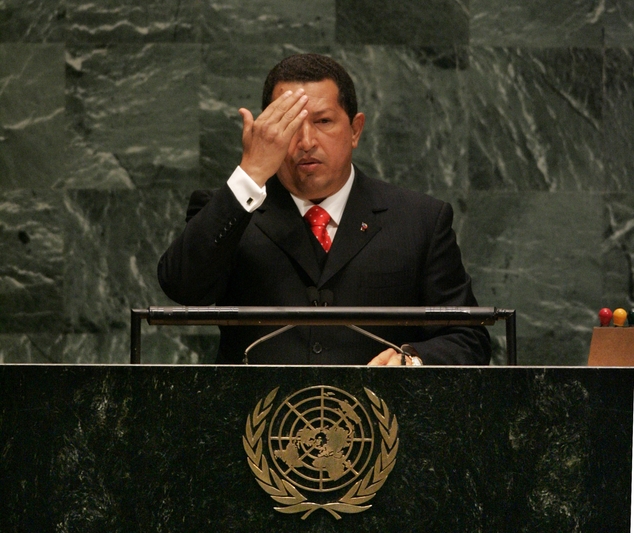
Venezuelan President Hugo Chavez called U.S. President George W. Bush "the devil" in a fiery speech to the General Assembly on Sept. 20, 2006, making the sign of the cross in a dramatic gesture and accusing Bush of "talking as if he owned the world." The address by the leftist leader was seen as one of Chavez' boldest moves to lead an alliance of countries opposed to the United States. Referring to Bush's address to the assembly the previous day, Chavez declared: "Yesterday, the devil came here." He also called Bush a "spokesman of imperialism" who was trying "to preserve the current pattern of domination, exploitation and pillage of the peoples of the world."


FILE - In this Sept. 20, 2006 file photo, Venezuelan President Hugo Chavez makes the sign of the cross during a fiery speech to the General Assembly at U.N. Headquarters. As the meeting place for all the world's nations and their leaders celebrates its 70th anniversary, that address is one many memorable moments in the history of the General Assembly. (AP Photo/Julie Jacobson, File)
#4925
___
ARAFAT'S OLIVE BRANCH OR GUN

Yasser Arafat, the Palestine Liberation Organization leader, addressed the General Assembly for the first time on Nov. 13, 1974, becoming the first representative of a non-member organization to speak to the world body. He appealed to the U.N. to enable the Palestinians "to establish national independent sovereignty" over their own land. In his most memorable lines, Arafat said: "Today I have come bearing an olive branch and a freedom fighter's gun. Do not let the olive branch fall from my hand. I repeat: Do not let the olive branch fall from my hand." After the speech, the PLO was granted observer status at the United Nations and its right to self-determination was recognized.


FILE - In this Nov. 13, 1974 file photo, Palestine Liberation Organization leader Yasser Arafat clasps his arms over his head as he addresses the United Nations General Assembly. "I have come bearing an olive branch and a freedom fighter's gun," he said. "Do not let the olive branch fall from my hands." As the meeting place for all the world¿s nations and their leaders celebrates its 70th anniversary, that address is one many memorable moments in the history of the General Assembly. (AP Photo/Marty Lederhandler, File)
#4926
___
KHRUSHCHEV BANGS HIS SHOE

Soviet prime minister Nikita Khrushchev, during a General Assembly debate on colonialism on Oct. 12, 1960, claimed the right to respond to the Philippines representative who was protesting Eastern European states' lack of freedom as Soviet satellites. Khrushchev got to his feet and started pounding the table angrily. He then picked up a shoe that was under the table and banged it several times in indignation. His granddaughter later wrote that he was wearing new shoes that were tight, so he took them off while sitting. She and his interpreter said that when Khrushchev stood up, he pounded the table so hard with his fists that his watch fell off, and when he went to retrieve it, he saw the shoe and switched to banging that instead.


FILE - In this Oct. 12, 1960 file photo, Soviet Premier Nikita Khrushchev pounds his desk at the United Nations with his fist during a General Assembly debate on colonialism at the UN. His wrist watch, on the desk in front of him, came off during his angry response, before he began using a shoe to pound the desk. As the meeting place for all the world¿s nations and their leaders celebrates its 70th anniversary, that address is one many memorable moments in the history of the General Assembly. (AP Photo, File)
#4927

6 historic moments at the UN General Assembly

By ASSOCIATED PRESS
28 September 2015
 
UNITED NATIONS (AP) â€" Khrushchev pounds the table with his shoe. Castro speaks for hours. Gadhafi tears up the U.N. charter. As the United Nations marks its 70th anniversary and world leaders gather in New York on Monday for the U.N. General Assembly's annual ministerial meeting, here's a look back at six memorable moments from past sessions:
___
FIDEL CASTRO'S EPIC ADDRESS

Cuban leader Fidel Castro denounced the United States in the longest timed speech ever at the U.N. General Assembly â€" 4 hours and 29 minutes â€" on Sept. 26, 1960. Clad in his trademark green military fatigues, Castro said the revolution he led 20 months earlier had ended the country's status as "a colony of the United States," but the U.S. still believed it had "the right to promote and encourage subversion in our country." In the rambling speech, Castro defended Cuba's links to the Soviet Union, expressed serious concern that America's "imperialist government" might attack Cuba, and called U.S. President John F. Kennedy "an illiterate and ignorant millionaire." Castro also complained of undergoing "degrading and humiliating treatment" in New York, including being evicted from his hotel.


FILE - In a Sept. 20, 1960 file photo, Cuban leader Fidel Castro, left, and Soviet leader Nikita Khrushchev hug at the United Nations. On Sept. 26, 1960, Castro denounced the United States in the longest timed speech ever in the U.N. General Assembly, 4 hours and 29 minutes. In the rambling speech, Castro defended Cuba's links to the Soviet Union, expressed serious concern that America's "imperialist government" might attack Cuba, and called U.S. President John F. Kennedy "an illiterate and ignorant millionaire." (AP Photo/Marty Lederhandler, File)
#4928

Archbishop Tutu is 'evil' (2004)


GETTY IMAGES
South Africa's former Archbishop Desmond Tutu was labelled 'evil' by Robert Mugabe


Zimbabwean President Robert Mugabe hit out at South Africa's former Archbishop Desmond Tutu, calling him an "angry, evil and embittered little bishop".

The two are not known to be the closest of friends with Archbishop Tutu earlier saying that Mr Mugabe resembled a caricature of an African dictator.

Mr Mugabe's comments were made in an interview with Sky News.
Archbishop Tutu, who won the Nobel peace prize for his efforts as one of the leading figures in the fight against apartheid in South Africa, did not comment on Mr Mugabe's verbal attack.

http://www.bbc.com/
#4929

President Kirchner an 'old hag' (2013)


BBC Mundo's David Cuen: 'There have been similar precedents in the past'

The Uruguayan president was caught on microphone at the start of a news conference apparently referring to his Argentinean counterpart as an "old hag".

President Jose Mujica, allegedly referring to Cristina Fernandez de Kirchner and her late husband, was overheard in a recording in 2013 saying: "This old hag is even worse than the cross-eyed man."

A Uruguayan newspaper posted audio of his comments on its website, which led to official protests in Argentina.

President Mujica later denied that he had been talking about the Kirchners. To this day he has failed to explain whom he was referring to.
#4930

Trump questions Obama's citizenship (2011)


GETTY IMAGES
Donald Trump demanded proof that President Obama was not born in Kenya


He has blamed US President Barack Obama for everything from Brexit to the rise of so-called Islamic State (IS), but Donald Trump's request to see Mr Obama's full birth certificate triggered a long-running debate - and a string of conspiracy theories.

The colourful billionaire was convinced that Mr Obama was actually born in Kenya and offered the president $5m to reveal his college and passport records.

Later, at the annual White House correspondents' dinner, Mr Obama said: "As some of you heard, the state of Hawaii released my official long-form birth certificate.

"Hopefully this puts all doubts to rest, but just in case… tonight for the first time I am prepared to go one step further, I am releasing my official birth video."

The screen in the conference hall then cut to a clip from the Disney film The Lion King. "Oh well," Mr Obama added, "back to square one".
#4931

Maduro tells Almagro to shove it (2016)


GETTY IMAGES
Venezuelan President Nicolas Maduro was accused of being 'mad as a goat' over his comments


Venezuelan President Nicolas Maduro pulled out a string of epithets for the head of the Organization of American States (OAS,) Luis Almagro.

He called him "rubbish", a "traitor" and told him: "Mr Almagro, you can take your Democratic Charter, put it into a thin tube, and shove it wherever it fits."

In a series of Twitter posts addressed directly to Mr Maduro, Mr Almagro also called him a "petty dictator".

After the remarks, the former Uruguayan President Jose Mujica said President Maduro was "mad as a goat".

The comments were made after Mr Almagro called an emergency meeting over Venezuela's "institutional crisis", a move that could have led to Venezuela's expulsion from the OAS.
#4932

Clinton a 'sadistic nurse' (2007)


GETTY IMAGES
Presidential hopeful Hillary Clinton was described as a 'sadistic nurse' by Boris Johnson


Hillary Clinton could be the next US president. And as leader of "the free world", she would be a useful person to have in your corner.

Not known for her sense of humour, it was unlikely that she would have been amused by this description from UK Foreign Secretary Boris Johnson.

Back in 2007 Mr Johnson said: "She's got dyed blonde hair and pouty lips, and a steely blue stare, like a sadistic nurse in a mental hospital."

In 2016 he said his outspoken comments had been "taken out of context".
#4933

Abbott's run-in with Putin (2014)


GETTY IMAGES
Tony Abbott threatened to 'shirtfront' Vladimir Putin after the downing of Malaysia Airlines MH17


Tony Abbott, then Australian prime minister, controversially threatened to "shirtfront" Russian leader Vladimir Putin ahead of the November G20 summit in Brisbane.

Mr Abbott's comment was made after the shooting down of flight MH17 over Ukraine, in which 38 Australians were among the 298 killed.

Russia was criticised for backing the rebel separatist fighters blamed for shooting down the Malaysia Airlines passenger plane.

The term "shirtfront", commonly associated with the rough and tumble of Australian football, means to target an opponent with a head-on charge aimed at bumping them to the ground.

The two appeared cordial when the meeting took place.
#4934

Berlusconi and the Nazi guard (2003)


GETTY IMAGES
Former Italian Prime Minister Silvio Berlusconi created a diplomatic crisis with his 'Nazi' comment


The EU was plunged into a grave diplomatic crisis following former Italian Prime Minister Silvio Berlusconi's "Nazi guard" remarks to a German MEP, Martin Schulz.

MEPs threatened to break off relations with the EU's top decision-making body, the European Council (headed by Mr Berlusconi at the time), unless a formal apology was given.

"I know that in Italy there is a man producing a film on Nazi concentration camps," Mr Berlusconi said, adding: "I shall put you forward for the role of Kapo [guard chosen from among the prisoners] - you would be perfect."

As the controversy over his remark intensified, he responded: "I'll try to soften it and become boring, maybe even very boring, but I am not sure I will be able to do it."
#4935

Farage and the 'damp rag' (2010)


GETTY IMAGES
Nigel Farage stunned MEPs when he described Herman Van Rompuy as 'a damp rag'


When a sentence begins with the words "I don't want to be rude", you should probably prepare to be offended.

Nigel Farage, leader of the UK Independence Party (UKIP) at the time of his speech to MEPs in the European parliament, launched into a personal attack on Herman Van Rompuy that lasted several minutes.

He said the president of the European Council had "the charisma of a damp rag".

He compared the former Belgian prime minister to a "low-grade bank clerk" and said he came from a "non-country".

The attack, which stunned the chamber, came as Mr Van Rompuy made his maiden appearance in parliament in Brussels.
#4936

Bush is 'the devil' (2006)


GETTY IMAGES
George W Bush was labelled 'the devil' by Venezuela's Hugo Chavez in 2006


In a dramatic speech to the UN in September 2006, the then president of Venezuela, Hugo Chavez, famously described his US counterpart George W Bush as the "devil".

"The Devil is right at home. The devil, the devil himself, is right in the house.

"And the devil came here yesterday. Yesterday the devil came here. Right here. And it smells of sulphur still today.


Chavez: 'Yesterday the president of the United States came here, talking as if he owned the world'

"Yesterday, ladies and gentlemen, from this rostrum, the president of the United States, the gentleman to whom I refer as the devil, came here, talking as if he owned the world. Truly. As the owner of the world."

On the same podium in 2009, Mr Chavez cautiously welcomed Mr Obama's new administration. Looking around, he said: "It doesn't smell of sulphur any more. No, it smells of something else. It smells of hope, and you have to have hope in your heart."
#4937

Arafat the 'son of 60,000 whores' (1999)


GETTY IMAGES
Palestinian leader Yasser Arafat was verbally attacked by the Syrian defence minister


The then Syrian defence minister General Mustafa Tlass, known for his colourful language, triggered a diplomatic row with the Palestinian Authority when he described its leader Yasser Arafat as the "son of 60,000 whores".

Gen Tlass, who launched the outspoken attack on Mr Arafat in a speech in 1999, said: "You should have told the White House that Jerusalem is the capital of the future Palestinian state but instead you stayed as quiet as a mouse and did not dare say a single word in favour of Palestine or Jerusalem."

His comments led to demonstrations in Gaza with thousands of Palestinians protesting at the personal attack on their leader.
#4938

Obama, Duterte and other notorious political insults

6 September 2016


REUTERS
President Duterte has apologised for comments made in the past


Philippine President Rodrigo Duterte has said he regrets calling his US counterpart Barack Obama the "son of a whore".

His controversial comments have led to diplomatic consequences with the US president cancelling a scheduled meeting with Mr Duterte.

But the Philippine leader, who has insulted prominent figures before, is not the only one guilty of offending world leaders.

From a "sadistic nurse" to "the devil" himself, here are some of the more memorable comments made by or about those in positions of power.
#4939
World Daily News / Re: What's the point of Asean?
September 06, 2016, 01:43:43 PM

What is Asean?

Founded in 1967 by Thailand, Malaysia, Singapore, Indonesia and the Philippines

Later expanded to include Brunei, Vietnam, Cambodia, Laos and Myanmar
Purpose is to promote co-operation and collaboration between member states, peace and stability, economic integration and growth, and an "Asean Community"

Works on principles of consultation and consensus, non-interference, non-confrontation and the peaceful settlement of disputes

Asean Secretariat is based in Jakarta, Indonesia


http://www.bbc.com/
#4940
World Daily News / Re: What's the point of Asean?
September 06, 2016, 01:41:24 PM

There is no-one now to match the charisma of Singapore's Lee Kuan Yew and Malaysia's Mahathir Mohamad.

Its supporters often cite Asean's usefulness as a forum that brings regional powers together, like the East Asia Summit, and the Asean Regional Forum which are attended by leaders and foreign ministers of countries as diverse as the US, Russia, India, China, Japan, Australia and North Korea.


AFP
Asean states no longer have charismatic leaders to push it forward - like former Malaysian PM Mahathir Mohamad


MICHAEL STROUD/HULTON ARCHIVE
...or his late Singaporean counterpart Lee Kuan Yew


It is true there is nothing else quite like these gatherings and, although they invariably produce bland and non-committal joint statements, they do offer unique opportunities for otherwise impossible bilateral meetings.

I recall the excitement in Brunei in 2002 when, in the aftermath of President George W Bush's "Axis of Evil" speech, we heard that Secretary of State Colin Powell had met his North Korean counterpart over a cup of coffee. It turned out, though, that with the complications of translation, they never went much beyond some innocuous pleasantries.

But the truth of these big meetings is they end up eclipsing Asean itself. It's a bit like holding a party, inviting a group of super-celebrities, and then finding that the stars only talk among themselves.

In a region confronted by growing tension among the powers on its borders, and challenges like climate change, it is no longer enough for Asean to be the mere talking shop it has been content to be for so long.

http://www.bbc.com/
#4941
World Daily News / Re: What's the point of Asean?
September 06, 2016, 01:35:36 PM


AFP
The South East Asian region saw rapid economic growth in the decades after Asean was formed


The Asean secretariat, with just over 300 staff, is hopelessly under-resourced just to manage the logistics of these constant get-togethers.
There are no Asean institutions to rival the EU's Commission. Council of Ministers and Court of Justice. The so-called Asean Economic Community, launched with great fanfare in Malaysia last year, is little more than a set of distant aspirations.

Asean also lacks leaders of the stature of its founding fathers to drive the bloc forward.

Indonesia, traditionally the weightiest power in the bloc, no longer wields the kind of clout its long-standing former foreign minister Ali Alatas did in the 1980s and 1990s.
#4942
World Daily News / Re: What's the point of Asean?
September 06, 2016, 01:31:35 PM

Many years ago I put this question to Singapore's then-trade minister George Yeo. He suggested I look not so much at what Asean had achieved, as what it had prevented. An impoverished, war-torn region caught up in the hottest of Cold War conflicts was, he said, turned into a zone of peace and prosperity.

By diffusing disputes through the "Asean Way" of meetings, seeking consensus and forswearing any interference in one another's internal affairs, the economies of South East Asia were able to tap into the global supply chain and start their impressive growth.


GETTY IMAGES
When Asean was founded, the region was embroiled in Cold War conflicts


Asean's proudest achievements are its role in ending the Cambodian civil war and bringing the three Indochinese countries into its fold in the 1990s, and its patience, in the face of Western criticism, with Myanmar's military leaders as they shuffled in the direction of democratic reform.

But the association's weaknesses have been cruelly exposed by China. There is no mechanism to ensure solidarity in Asean, just a seemingly endless series of meetings - more than 1,000 every year - in which backroom diplomacy can undo a hard-won consensus decision in minutes.


GETTY IMAGES
Asean diplomacy in the late 1980s helped bring an end to the Cambodian conflict
#4943
World Daily News / What's the point of Asean?
September 06, 2016, 01:23:17 PM

What's the point of Asean?

By Jonathan Head
South East Asia correspondent
BBC
25 July 2016


AFP
Judge Asean by what it has prevented, rather than achieved, some say


Fourteen years after they first began discussing their differences with China over the South China Sea, the 10 members of Asean - the Association of Southeast Asian Nations - have once again bowed to pressure and produced a watered-down joint statement at their summit, in Laos.

No mention of China, which has been creating "facts" in the sea by building islands on disputed reefs.

No mention of the recent ruling at the Permanent Court of Arbitration in The Hague that China had no historic rights over the area.

Once again, it was the smaller Asean members under China's thumb - Cambodia, and host-nation Laos - that were the weak link in the bloc's efforts to stand up to its giant neighbour.

And so, once again, the question pops up: what is the point of an Asean so crippled by its consensus-based decision-making that it rarely makes any decisions at all?


GETTY IMAGES
Cambodia has backed China in regional meetings, and been lavished with aid
#4944
Quotepagkabibo ani nga topic. asa naman ang nagsugod ani nga wala nman mopatim-aw. from lindy, Reply #290 on: September 23, 2012

nadoble tingali ang pagkatiguwang... hinaot wa mag-arthritis ang mga tudlo. :)
#4945

Let me paraphrase, for relevance, four of them here:

1) No extraordinary powers should be initiated unless it is necessary or even indispensable to the preservation of the state and society;

2) All uses of extraordinary powers and all readjustments in the organization of the government should be effected in pursuit of constitutional or legal requirements.

3) No extraordinary powers should be adopted, no right invaded, no regular procedure altered any more than is absolutely necessary defeat a particular crisis;

4) Extraordinary powers should never be permanent in character or effect, and should extend beyond the termination of the crisis for which it was instituted.

In sum, extraordinary powers should only be invoked as a last resort. If options, less ominous, are conferred to the executive by the constitution and the laws sufficient to meet the declared national emergency, then by all means they must be preferred.

Indeed, the slippery slope of frequent recourse to an emergency rule is the ever-present possibility that such will slide into a permanent and unconstitutional regime.

For now, Duterte's declaration does not appear to lead us to that slope. But we must be vigilant. â€" Rappler.com

The author is former dean of the Ateneo School of Government.
#4946

Avoid slippery slope

The problem arises then when an emergency occurs and the government is inevitably hampered with the deliberate pace of constitutional rule. Certainly, the President cannot be expected to wait for congressional deliberation before he can declare a state of war when it is staring at him in the face.

This is the dilemma many constitutional governments face. As a result, most constitutions incorporate provisions and unique power arrangements to deal with emergencies. These extraordinary powers however, can be considered, at best, a necessary evil. It should never be considered normal, must never be lightly granted by Congress, and if the right case or controversy comes, the Supreme Court has to scrutinize this carefully.

In a paper I co-authored several years ago, we cited the guidelines formulated by Clinton Rossiter in his seminal work Constitutional Dictatorship which are designed to avoid the slippery slope of frequent resort to extraordinary powers.
#4947

Most benign


TROOPS. President Duterte with soldiers in a recent visit to a camp in the Visayas.

The power to call on the Armed Forces to prevent or suppress lawless violence which may well be considered as the most benign of these powers while the most serious and carries the most impact on the social and political life of the nations is the martial law powers.

All of these are reviewable by the Supreme Court, including the legal and factual basis of such a declaration. Definitely, Duterte's declaration does not suspend the Bill of Rights, including the privilege of the writ of Habeas Corpus and certainly not freedom of expression and press.

I venture to say that for as far back as I remember, the calling out powers have been continuously invoked, even without official declarations, because the military has been routinely called to support the police in addressing internal threats.

The truth is that constitutions are primarily designed, not to achieve efficiency, but to create an intricate system of checks and balances among the branches of government. By and large, it reflects a great distrust on the part of government to exercise powers entrusted to it in a responsible manner, most notably the Executive branch. Nowhere is it truer than in the present 1987 Constitution, the pervading theme of which is to do away with all possibilities of strongman rule, no doubt a painful lesson of the Marcos dictatorship.
#4948

3 kinds of extraordinary powers

Strictly speaking, there are three (3) kinds of extraordinary powers provided under the 1987 Constitution.

The first is found in Article XII, Section 17, which states: In times of national emergency when the public interest so requires the State may, during the emergency and under reasonable terms prescribed by it, temporarily take over or direct the operation of any privately owned public utility or business affected with public interest. This power was invoked by President Cory Aquino when she issued Proclamation No. 503, declaring a state of emergency after the December 1989 coup attempt.

The second provision is in Article VI, Section 23, which provides that the Congress, by a vote of two-thirds of both Houses in joint session assembled, voting separately, shall have the sole power to declare the existence of a state of war. It also provides that in times of war or other national emergency, the Congress may, by law, authorize the President, for a limited period and subject to such restrictions as it may prescribe, to exercise powers necessary and proper to carry out a declared national policy. Unless sooner withdrawn by resolution of the Congress, such powers shall cease upon the next adjournment thereof. FVR used this provision to deal with the power crisis early in his term. This is the provision being invoked by the Duterte government so it can respond effectively to the transportation crisis.

The third provision refers to the commander-in-chief powers of the President under Article VIII, section 18, which authorizes the President to call on the Armed Forces to prevent or suppress lawless violence, impose martial law, or suspend the privilege of the writ of habeas corpus in case of invasion or rebellion. The provision presupposes that there is an imminent or ongoing threat to public order or national security. To address the threat, the President is provided “a platter of graduated powers” to deal with the situation in accordance to its severity. Marcos used the martial law power in 1972 and Arroyo did the same in 2009 but limited to Maguindanao after the Ampatuan massacre. Both Estrada and Arroyo used the calling out powers which is what Duterte is now invoking with this declaration of state of lawlessness.
#4949

What level of conflict demarcates the choice between ordinary police action and resort to emergency rule? What degree of punitive State action is necessary to address the emergency without exposing civil liberties to unwanted perils? Sadly, the answer to these questions depends largely on this wide presidential discretion; for which reason, emergency rule becomes fraught with opportunities for abuse; a gateway to constitutional shortcuts.

Once emergency rule is declared, the constitutional bonds are loosened that could create a window of opportunity for unrestricted power. As the Supreme Court said in David v. Arroyo, where President Gloria Macapagal Arroyo’s declaration of a state of national emergency (eerily resembling Proclamation 1081, the martial law declaration of President Marcos), “the power is by and large a discretionary power solely vested on the President’s wisdom.”
#4950

Making sense of Duterte's declaration of state of lawlessness

For now, Duterte's declaration does not appear to lead us to a slippery slope. But we must be vigilant.


Tony La Viña

September 03, 2016
Rappler

Extraordinary powers are instituted to allow the President to wage a most efficacious defense of the nation in times of crisis, without being unduly straitjacketed by structural and bureaucratic restraints.

By establishing this framework, the Constitution expected that the process would be far more flexible, and capable of quicker, more decisive action, than the legislative process.

However, the framers of the Constitution, while recognizing the need to provide for such powers, also acknowledge the dangers that it entails. Constitutional safeguards, not the least of which is the instrument of judicial scrutiny, are in place to check against abuse.

The President is given a lot of leeway when it comes to the exercise of extraordinary powers.
#4951

Death toll

The number of persons who died in the explosion at Roxas night market rose to 15 as five more died in the hospital after the initial count of 10 who died on the spot at the crowded night market on Friday.

Around 69 were injured in the explosion shortly past 10 p.m Friday at the Roxas night market near Ateneo de Davao University, according to Davao City Police spokesperson Chief Inspector Catherine Dela Rey.

However, Dela Rey said they have no initial findings of the type of explosive device. She said it is only the Explosive and Ordnance Disposal (EOD) which can confirm further details of the post blast report.

Dela Rey said investigation is still ongoing.

The Roxas night market incident was the fifth bomb explosion in Davao City.

In 1991, two grenades were lobbed inside the San Pedro Cathedral.

In 2003, a bomb ripped through the arrival waiting shed of the old Davao International Airport Sasa Port on March 4 that left about 30 dead. In the same year, a bomb exploded at Sasa Wharf on April 2 with at least 40 dead.

This was followed by another blast at Ecoland Terminal leaving one person dead.

All explosions were linked to the Mindanao conflict.

The explosions happened during the term of then Mayor, now President Rodrigo R. Duterte.

Such incidents were behind his passion of ending the Mindanao conflict and bringing peace in the troubled parts of Mindanao. (PNA) LAM/ER/LILIAN C. MELLEJOR

http://boholtribune.com/
#4952

Leads

Duterte disclosed there are leads to pinpoint responsibility. However, he would not confirm if the bombing is linked to his all-out war against the Abu Sayyaf Group (ASG). But he said it is easy to pinpoint the ASG since the group forewarned to hold retaliatory actions in Mindanao.

The President did not discount the bombing was the handiwork of drug syndicates. He also mentioned the Maute group members who escaped from prison in Lanao.

He stressed that it would be parochial to just point to one group because terrorism is everywhere.
#4953

President Duterte Declares Nationwide State Of Lawlessness

BOHOLTRIBUNE.COM
SEPTEMBER 2, 2016


President Rody Duterte

By Lilian C. Mellejor

DAVAO CITY â€" President Rodrigo R. Duterte has placed the country under a “state of lawlessness” authorizing the police and military to conduct security searches in cars and frisking of individuals in checkpoints.

Duterte clarified the state of lawlessness is not martial law and does not involve the suspension of the writ of habeas corpus.

Any punitive actions should be in the furtherance of protecting the country to stop terrorism, President Duterte told reporters after an ocular inspection of the blast site early Saturday morning.

Duterte said declaration has something to do with protecting the country and people given his intensified drugs operation, extrajudicial killings and terrorism not only in Davao but other places especially in Mindanao. He cited recent bombings in some Mindanao localities.

President Duterte also said he expects people to submit to searches and frisking in all checkpoints as he declared a lockdown of the city.

“We know that this is not a fascist state. I cannot control the movement of the citizens of the city and every Filipino has the right to enter and leave Davao. It is unfortunate we cannot stop and frisk anybody for just any reason,” he said.

“But I am declaring the entire country on alert,” he added.
#4954

Andanar said police are still investigating the explosion.

Meanwhile, the National Capital Region Police Office (NCRPO) has raised the red alert over Metro Manila.

NCRPO Chief Supt. Oscar Albayalde has ordered all police district directors to tighten security especially in crowded places.

He also ordered units to maximize police visibility in airports, seaports, and train and bus terminals; and to set up security checks in malls, parks and other places where people gather on weekends. (Lilybeth G. Ison/PNA)

http://boholtribune.com/
#4955

Communications Secretary Martin Andanar said that Davao City has been placed on high alert and urged residents to cooperate with the police.

He said President Rodrigo Roa Duterte has given an order to set up checkpoints/chokepoints in the city.

“The directive was for the national police to manage a detailed checkpoint all over Davao City, and we encourage all citizens to cooperate,” said Andanar in a statement.

Around 10 p.m. Friday, an explosion of still-undetermined origin rocked the night market on Roxas Avenue at the corner of Padre Gomez St.
#4956

Davao Bombing Death Toll Reaches 14

BOHOLTRIBUNE.COM
SEPTEMBER 2, 2016


DAVAO CITY â€" The death toll from the explosion Friday evening at a night market along Roxas Avenue, here rose to 14, authorities said.

As of 2:00 a.m. Saturday, initial report said 14 died with dozens wounded, according to Buhangin Police Station Commander Milgrace Driz. She said the latest report came from the hospitals with three others in critical condition.

The victims were rushed to the Southern Philippines Medical Center (SPMC), Limso Hospital, Davao Doctors Hospital and Brokenshire Hospital.

An earlier statement from Davao City Vice Mayor Paolo Duterte confirmed that 10 victims died on the spot.
#4957

sa tinuoray, dinhi ko natiguwang. kanyahay ra hapit na mag-silver anniversary ni nga website... :)
#4958

i have a feeling it's the left-handed who may cause the apocalypse. :)
#4959

#3 Lesson Learned

So, next time a dog stands between you and something you want, consider how important it actually is. Or, just don't use physical force like an a-hole to get your way.


http://likes.com/
#4960

#2 Hey Guys, Over Here!

After the the incident, the dog, hellbent to return the mistreatment, returned with his posse and proceeded to vandalize the man's car, chewing on and tearing up the wheel wells and windshield wipers, leaving some well-deserved damage.

#4961

A Guy Kicked a Stray Dog, So the Dog Rounded Up Some Friends to Help Trash the Dude's Car

A dog gets kicked. So he calls his friends. The result is priceless.


#1 My Spot!

This is precisely what a dog exacted on the man that literally kicked him out of a parking spot he was resting in. Smart dog!

#4962
Youtube Replay / Re: Blade Runner - TEARS IN RAIN
September 01, 2016, 02:09:32 AM

I've seen things you people wouldn't believe. Attack ships on fire off the shoulder of Orion. I watched c-beams glitter in the dark near the Tannhauser Gate. All those moments will be lost in time, like tears in rain. Time to die. (quoted from hubag bohol's reply #1)

When Hauer performed the scene, the film crew applauded and some even cried. (wiki)

#4963

Beijing reminds Japan of its invasion of China more than 70 years after the second world war. In mid-August, the People’s Daily published a commentary warning that “Japan’s denial of past military aggression undermines world peace”. China also puts pressure on Japan by sending hundreds of vessels into areas near the Senkaku/Diaoyu islands, controlled by Japan but claimed by China.

As for India, Beijing has campaigned for years to keep it from becoming a permanent member of the UN Security Council. More recently, China opposed Indian membership of the Nuclear Suppliers Group.

Of course, the biggest villain in the Chinese mind is the US. Fu Ying ( å,...ç'© ), a spokesperson for the National People’s Congress, wrote recently that the problems in the South China Sea stem from 2009, when the Obama administration launched its rebalancing strategy. There is one problem with that explanation. The rebalance wasn’t announced until two years later, in late 2011. Fu’s explanation, like much else, was part of the Chinese imagination, and in that imagination, all that matters is the central role of China.

http://uk.businessinsider.com/
#4964

China sees its dominance as crucial because of its own development needs. It wants the resources in the waters as well as under the seabed. It will continue its sticks-and-carrots policy, using trade and investment as weapons. The China-initiated Asian Infrastructure Investment Bank, with capital of US$100 billion, has begun approving its first projects, greatly elevating Chinese bargaining power. The “One Belt, One Road” plan will also bring investment to nearby countries.

China’s vital interests are engaged elsewhere as well, such as South Korea, Japan and India, and relations are strained.

The official Chinese media reprimanded South Korea for having agreed in July to deploy the US-developed THAAD (Terminal High Altitude Area Defence) anti-ballistic missile system. China considers the system a threat to its own security.
#4965

Perhaps that is why Singapore, a predominantly Chinese society, draws disproportionate Chinese ire when it is seen as betraying the Chinese cause, not just Beijing’s interests. The elder statesman Lee Kuan Yew did this in 2009 by appealing to Washington to remain in Asia. “The size of China makes it impossible for the rest of Asia, including Japan and India, to match it in weight and capacity in about 20 to 30 years,” he said. “So we need America to strike a balance.”

The elder statesman’s words were followed two years later by Barack Obama’s policy of rebalancing to Asia, which China sees as containment. Lee’s son, Prime Minister Lee Hsien Loong, in Washington, said that the rebalance had been “warmly welcomed by all Asean countries”. The Global Times accused him of siding with the US.
#4966

The ruling won’t deter China from plans to increase its dominance of Southeast Asia and the larger region. In its imagined world, the realization of Xi Jinping’s (  ç¿'è¿'å¹³  ) Chinese Dream will place China once again at the centre of the world, after a couple of centuries of being disrupted by Western imperialism. In the Chinese imagination, this is not subjugation of neighbours but simply restoration of the normal order. To some, this is a return to the traditional concept of  tianxia , with barbarians benefiting from Chinese civilization.

China’s leaders no longer refer to neighbours as barbarians, but they do recall that Confucian culture is embedded in many Asian countries and that the Chinese system of writing was borrowed by many, including Japan, Korea and Vietnam.
#4967

Contrary to commonly accepted views, China sees no need to challenge the US militarily and wants to avoid such a confrontation unless pushed. The US is unlikely to push. China, through its artificial islands in the South China Sea, can project its air and naval power throughout the area and check American bases in the Philippines. While other countries may still occupy a reef here or a rock there, China is in overall control.

Since 2013, when Manila launched its case, Beijing has called for bilateral talks instead. The day the ruling was issued, Wang said: “Now the farce is over. It is time that things come back to normal.”

China is getting its way. The Philippines, under President Rodrigo Duterte, decided that war is not an option. The alternative, in the new leader’s words is “peaceful talks”. China and the Philippines, in effect, will agree to share economic resources. Joint development is theoretically on the table. Manila also hopes for vast inflows of Chinese investment.


Military delegates arrive at the Great Hall of the People for a meeting ahead of Saturday's opening ceremony of the National People's Congress (NPC), in Beijing, China March 4, 2016. REUTERS/Jason Lee
#4968

To justify its position on this and other issues, Beijing creates an imagined universe where, in the words of Bill Hayton, the BBC specialist on the South China Sea, “they start from the position that everything China does is virtuous and correct and therefore that anyone who disagrees must be wrong”. What China thinks is right must be the law. The day The Hague tribunal’s ruling on the Philippines’ South China Sea claims was made public, foreign minister Wang Yi ( 王æ¯... ) called it a “farce” and said that China, by refusing to accept the ruling, was “upholding international rule of law”.

China has emerged as the dominant power. Its neighbors have kept their mouths shut. A statement released by foreign ministers from the Association of Southeast Asian Nations did not mention the tribunal, though it did endorse rule of law. The fact is that China is seen as the key to economic development in the region. And while the US talks about maintaining “primacy” in the military realm, China is already dominant in much of the region.
#4969

China has all but ended the charade of a peaceful rise

South China Morning Post
Frank Ching, South China Morning Post
Aug. 30, 2016


Chinese President Xi Jingping Reuters

There was a time when China tried hard to convince the world that its rise is peaceful.

That pretense was abandoned seven years ago when, in the wake of the “Great Recession”, China thought its time had come to claim its place as controlling “all under heaven”, or tianxia, in Asia.

Like all great powers in history, China’s emergence is accompanied not just by military expansion but also by assertion of its own law.

In China’s narrative, its rise is still peaceful. The nation built military installations on reefs and rocks in the South China Sea simply because it claims to have owned them from time immemorial. From the Chinese standpoint, the South China Sea is a core interest. There can be no backing down.
#4970

sa davao. aguy. :( 
#4971

Death cannot be a cleansing sacrament to alter Marcos’ sordid and bloody legacy. The impunity of Marcos’ long despotic rule will burden our sense of national dignity for generations to come. And how we reckon with this design to rehabilitate Marcos as a national hero has enormous implications on our values as a people, on the nature of our future, and on the efficacy of our political culture.

To bury Marcos in the heroes’ cemetery mocks the valor, dignity, and sacrifice of martyred Filipinos. But even more, it mocks our national esteem and our shared civic values as a democratic society.

http://opinion.inquirer.net/
#4972

Employing these improbable claims, he captured the central seat of power. Thus, the disingenuous argument goes, Marcos is qualified to rest with our heroes. The trouble with this argument is that, bereft of moral reasoning, it is blind to the infinite harm Marcos inflicted on the social fabric.

It smirks at the historical truth: Marcos’ wanton violation of the Constitution, the brutality of his regime, the astronomical external debt he incurred, the collapse of our economy, and the stunning wealth he stole to become the world’s second most corrupt leader of all time.

As flagrant and unconscionable as these atrocities may be, they were not the worst. The most damning was that Marcos derailed the hopes and aspirations of at least three generations of Filipinos, deepening our despair and our desperation.
#4973

What is deeply disturbing about President Duterte’s decision is the clear disconnect between his rhetoric and reality. On one hand, he is pursuing a devastating campaign against criminality and corruption; on the other, he is coddling the memory of a tyrant whose crimes and corruption stagger our imagination.

On one hand, he is attacking oligarchs who accumulated wealth over decades; on the other, he is praising a discredited leader who became the country’s greatest oligarch overnight by illegally seizing the assets of the elite.

Marcos’ rise to power started with a lie, and he prevailed for so long through the legislative and executive branches of government largely on his capacity to manipulate or conceal the truth. It started with his claims of heroic exploits as a soldier in World War II, claims found fraudulent and without a scintilla of evidence in US Army archives.
#4974

The historical truth will then be irrevocably distorted, and the supreme irony for Filipinos is that history will appear to sustain the side of the disgraced.

As the ranks of martial law victims and the anti-martial law opposition are decimated by attrition, the Marcoses calculate that the passions of the Edsa Revolution will soon fade.

After all, three decades since they fled Malacañang, the Marcoses and their cronies have not been found guilty of any crime in spite of the fact that the Presidential Commission on Good Government has recovered $3.7 billion of an estimated loot of $10 billion.
#4975

Truth as a social value flourishes among a people with a strong sense of morality. But morality is not innate; it is learned. A people cannot build the habits, civility and discipline without the skills of moral reasoning. And we cannot create a more civil national culture by belittling or avoiding what is morally required of us.

The power conveyed by the Marcoses’ infamous, unearned wealth enables them to adjust to political tides and currents. They will never account for that wealth which will provide them continuing access and influence in future governments. And so we still hear the refrain of “Marcos pa rin” (Marcos still) echoing faintly, the way fanatical Peronistas, ignoring the excesses of Argentina’s criminal in chief, chanted “Mujeriego y ladron, pero queremos a Peron!” (Philanderer and thief, we still want Peron!).

Burying Marcos in the Libingan ng mga Bayani is the first step in his family members’ plot to perpetuate their outrageous claims. Once this step is accomplished, they can leisurely proceed to their endgame: to bury Imelda, when her time comes, beside her husband, reminiscent of Jacqueline Kennedy beside JFK at Arlington in the glow of an eternal flame.
#4976

To erect a shrine to the dictator’s memory on sacred ground will obliterate the historical truth. How do we teach our children not to steal when the greatest thief in Philippine history lies there in honored glory?

How do we nourish our moral life and sustain the majesty of our laws when we blur the lines between what is right and what is wrong, between what is virtue and what is evil?

How do we raise the younger generations to believe that honesty, hard work, and right conduct must be the cornerstones of everyday life when a disgraced leader who personified greed, dishonesty, and corruption is honored with a state funeral?
#4977
Talk of the Town / When a leader betrays his people
August 22, 2016, 07:40:31 PM

Commentary

When a leader betrays his people

By: Rex D. Lores
@inquirerdotnet
August 22nd, 2016

WITH THE controversial decision to bury the remains of Ferdinand Marcos in the Libingan ng mga Bayani, the truth is again under siege.

The sentiment behind the move, allegedly to allow the nation to move on, is both misguided and dangerous. By interring the dictator’s remains in the national cemetery for heroes, the first casualty will be the truth, or, more precisely, the historical truth: Marcos betrayed our people on a grand scale, and in the most cynical ways possible.

Truth in a democracy is sacred; it is the basic operating principle of our system of government. This is why truth is a core value at home and in school, church, and workplace. This is why it is a convention in our political and judicial proceedings to “tell the whole truth, and nothing but the truth.” We live and die by the truth.
#4978

why is this such a problem? ladies from countries, both eastern and western, who go to muslim countries that impose the wearing of veils on all women of whatever religion, have no problem following those countries' regulations or dress code. have it the other way around, and it becomes a religious and human rights issue?

go to another country, decide to immigrate there, feel welcomed, take along your memories and most of all your faith, leave your politics behind, and please integrate, adjust, and follow the host country's regulations. i cannot as an immigrant expect my host country to adjust to me.
#4979

hinaot maunhan ni misis ug bugha ang bana. purya ning lalaki nga modapat ug babaye. angay duslitan morag kwitis. >:(
#4980

purya. it looks like he fires his careless non-whisper at just about anything and anyone. we may have a president who hates criticism. he's always right, so praise him. :(
#4981

not bad. sharing the stage isn't such a bad thing. what would be bad is when those who share the stage undertake mutual destruction. i shudder at the thought of china and india...
#4982

nice. :)
#4983
Photos Unlimited / Re: Sad puppy
August 22, 2016, 07:08:25 PM

here's a wish, please lord, make all puppies happy, please.
#4984
Tira-Pasagad | Saksak-Sinagol / Re: Now, really...?
August 22, 2016, 07:07:01 PM

oh, no. wrong mistake. i may stay up later, but i mess up late and do not really curse. por favor. :P
#4985

piskot baya ning balitaa uy. giangin pa ang baka. kalooy sa 17 anyos nga dalagita. kinsa natoy malooy sa baka nga giangin-angin?

piskot nga labaw ang mga rapists. hinaot untang mabawsan sila ug ma-rape pa unta sila ug baka atubangan sa dalagita. >:(
#4986
Asia | Middle East / Re: A Child's Face of War
August 20, 2016, 04:16:46 AM

#4987
Asia | Middle East / Re: A Child's Face of War
August 20, 2016, 04:12:36 AM

#4988
Asia | Middle East / Re: A Child's Face of War
August 20, 2016, 04:07:59 AM

and the memes followed...


#4989
Asia | Middle East / A Child's Face of War
August 20, 2016, 03:57:49 AM


THE FACE OF SYRIANS’ PLIGHT In this frame grab from a video by the Syrian antigovernment group Aleppo Media Center, Omran Daqneesh, 5, stares ahead blankly after being pulled out of a building hit by an air strike in Aleppo, Syria, on Wednesday. Two other children were pulled out from the rubble. ALEPPO MEDIA CENTER VIA AP

http://newsinfo.inquirer.net/
#4990
Health and Food / Re: Phones That Radiate The Most
August 20, 2016, 03:50:32 AM
 
Whatever your point of view is, you should know that different models emit different levels of radiation. The current allowed cell phone radiation is 1.6 watts per kilogram. Watch the video below to see the top 5 cell phones with highest radiation:

https://www.youtube.com/watch?v=Q0o3Ci71W6U


http://www.healthylifevision.com/
#4991
Health and Food / Re: Phones That Radiate The Most
August 20, 2016, 03:48:26 AM

#4992

7. YOU’LL WITNESS MENTAL BENEFITS

Plank exercises have a particular effect on our nerves, making them an excellent means of improving overall mood. How? Well, they stretch out muscle groups that contribute to stress and tension in the body. Just think about it: you are sitting in your chair, at home or at work, all day long; your thigh muscles get tight, your legs get heavy due to being bent for several hours; and tension develops in your shoulders due to being forced to slump forward all day. These are all circumstances that put too stress on the muscles and nerves. The good news is that planks not only calm your brain, but they can also treat anxiety and symptoms of depressionâ€" but only if you make it part of your daily routine.

Now, the last thing left to do is to give you a sample plank exercise you can do to achieve great results in only 5-10 minutes a day!

(Originally taken from: Lifehack)

http://simplecapacity.com/
#4993

6. YOU’LL BECOME MORE FLEXIBLE THAN EVER BEFORE

Flexibility is a key benefit of doing planks regularly, for this form of exercise expands and stretches all your posterior muscle groups â€" shoulders, shoulder blades, and collarbone â€" while also stretching your hamstrings, arches of your feet, and toes. With a side plank added in to the mix, you can also work on your oblique muscles. This will provide you with further benefits when it comes to hyper-extending your toes, a movement that is crucial for supporting your body’s weight.
#4994

5. YOU’LL IMPROVE OVERALL BALANCE

Have you ever felt that when you tried standing on one leg, you couldn’t stand up straight for more than a couple of seconds? It’s not because you were drunk- unless you happened to be at the time!-  but rather, it’s because your abdominal muscles weren’t strong enough to give you the balance you needed. Through improving your balance by doing side planks and planks with extensions you will boost your performance in every kind of sporting activity.
#4995

4. YOU’LL SIGNIFICANTLY IMPROVE YOUR POSTURE

Doing planks greatly improves your ability to stand with straight and stable posture. Through strengthening your core you will be able to maintain proper posture at all times because muscles in the abdomen have a profound effect on the overall condition of your neck, shoulders, chest and back.
#4996
 
3. YOU’LL EXPERIENCE AN INCREASED BOOST TO YOUR OVERALL METABOLISM

Planking is an excellent way of challenging your entire body because doing them every day will burn more calories than other traditional abdominal exercises, such as crunches or sit-ups. The muscles you strengthen by doing this exercise on a day-to-day basis will ensure that you burn more energy even when sedentary. This is especially important if you are spending the majority of your day sitting in front of a computer. Also, making it a daily 10- to 1 minute home exercise before or after work will not only provide an enhanced metabolic rate but it will also ensure that that metabolic rate remains high all day long, (yes, even while you are asleep).
#4997

2. YOU’LL DECREASE YOUR RISK OF INJURY IN THE BACK AND SPINAL COLUMN

Doing planks is a type of exercise that allow you to build muscle while also making sure that you are not putting too much pressure on your spine or hips. According to the American Council on Exercise, doing planks regularly not only significantly reduces back pain but it also strengthens your muscles and ensures a strong support for your entire back, especially in the areas around your upper back.
#4998

1. YOU’LL IMPROVE CORE DEFINITION AND PERFORMANCE

Planks are an ideal exercise for the abdominal muscles exactly because they engage all major core muscle groups including the transverse abdominus, the rectus abdominus, the external oblique muscle, and the glutes. The importance of strengthening each muscle group cannot be underestimated either, for all of these groups serve their own purpose. If you strengthen these muscle groups you will notice:

Transverse abdominis: increased ability to lift heavier weights.
Rectus adbominis: improved sports performance, particularly with jumping. This muscle group is also responsible for giving you the renowned six pack look.
Oblique muscles: improved capacity for stable side-bending and waist-twisting
Glutes: a supported back and a strong, shapely booty.
#4999

These 7 Things Will Happen When You Start Doing Planks Every Day

Bodyweight exercises are gaining ground in the fitness world due to the practicality and simplicity of getting in shape using your own body weight.

Planks are one form of bodyweight exercises that will never go out of fashion. Planks are one of the most effective exercises you can do. Why? Because they require a small time investment on your part, and offer the chance to achieve substantial results in a relatively short span of time.

Abdominal muscles must provide support for our entire back and spinal column. In doing so, they also play a vital role in preventing injuries.

However, for them to perform this function successfully, our core muscles have to be strong and trained on a regular basis. What all this means is that doing plank exercises every day is a great way to strengthen your core, and in doing so, support your spine.

Now, let’s focus on what will happen when you start doing planks every day:
#5000

4 Minutes, 28 Days â€" A New Body!

Take this challenge that is already done by a lot of people from different parts of the world, and you will improve your body shape.

The most important exercises for strengthening the middle part of the body are planks. Maybe as a beginner you think it is very simple and you are skipping them often. Planks will melt down the fat from the stomach, strait the inner and outer muscles of your body’s back and upper part, the buttock muscles, legs and hands. They are almost the same as push-ups. The muscles contract almost like toy do push-ups â€" they are not going to be wider or shorter. They will be strengthened from the inside and will be stronger.


This challenge is made of slow increase of the time you are spending for planks through four weeks. You will start with 20 seconds, and the ultimate goal is to do planks for four minutes.  In the completion stage your body will be prepared for new difficulties and the muscles weight will get to be emphasized.

http://simplecapacity.com/