Join MikeLigalig.com!

Why Just Read When You Can Join, Post, and Read!

Menu

Show posts

This section allows you to view all posts made by this member. Note that you can only see posts made in areas you currently have access to.

Show posts Menu

Messages - islander

#2201

P55.13M, P41.72M investments

Duterte and his daughter co-owned Account No. 0200131000000003103367386 in BPI Greenhills-EDSA and Account No. ST0200124300000002433069539 in the bank's Julia Vargas branch, according to documents Trillanes provided the Senate.

The accounts were the source of two huge placements, initially P48.17 million and P40.14 million, in time deposits and later in other unspecified types of investment.

Records show a deposit of P45.48 million made to the Greenhills branch on Sept. 19, 2006. A slightly higher amount, P48.17 million, was withdrawn that day and placed in a time deposit account (No. 0200131000000003107326064). The placement was terminated on May 22, 2007, or more than eight months later, and was deposited back to Account No. 0200131000000003103367386.

This means Duterte should have recorded the deposit as part of his CIB or investment in his 2006 SALN. But he reported only P6.07 million in cash that year.
#2202

As government employees, both of them are mandated by Republic Act 6713, the Code of Conduct for Public Officials and Employees, to file their sworn SALN every April 30 covering their assets, liabilities, business interests and relatives in government the preceding year.

RA 6713's implementing guidelines require public officials and employees to declare under personal properties their COH, CIB, insurance policies and other investments such as negotiable instruments, securities, stocks and bonds. The amount of cash, on hand and in bank, should be the last balance as of Dec. 31.

For properties co-owned with other individuals, the guidelines require government employees to disclose the proportionate amount of their share in the property.
#2203

The transactions also include transfers made from the joint account of Samuel Cang Uy, Samantha Jayne Yenco Uy and Yaneile Yenco Uy to the accounts of Sara, Paolo, Sebastian and Avancena on several occasions. Duterte listed Samuel Uy as one of his campaign donors in 2016. He also identified Uy as the source of a loan between P1 million and P1.2 million in his SALN from 2012 to 2015.

Duterte was mayor of Davao in 2007-2010 and 2013-2016 and vice mayor to his daughter Sara in 2010-2013. Sara was vice mayor in 2007-2010 before being elected Davao City's first woman mayor in 2010. She chose not to run for public office in 2013, making a comeback in 2016 when her father ran for president.

Like other high-ranking public officials, Duterte and Sara are classified by the Anti-Money Laundering Act, or Republic Act 9160, as "politically exposed persons" or PEP, having been entrusted with a prominent public position in the country "with substantial authority over policy, operations or the use or allocation of government-owned resources."
#2204

Generated on April 21, 2016, in the run-up to the election, the senator's documents list only bank transactions beyond P500,000, or what AMLC would consider as covered transactions. This also means the documents only constitute a partial list of Duterte's and his family's bank records.

Besides Duterte and Sara, the documents show the bank transactions of Duterte's ex-wife Elizabeth and their sons Paolo and Sebastian; Sara's husband Manases and their children; Paolo's children: Duterte's partner Cielito "Honelylet" Avancena and their daughter Veronica.

They show transactions exceeding P500,000 with the following banks: BPI, Banco de Oro, Metrobank, Land Bank, Union Bank, Philippine Savings Bank, East West Bank, Asia United Bank, RCBC, Philippine National Bank, Bank of Commerce and Security Bank.
#2205

AMLC Codes

The Office of the Ombudsman said in late September that a copy of the bank records it obtained from the Anti-Money Laundering Council (AMLC) "more or less" resembles what Trillanes submitted in his complaint.

The AMLC, however, denied being the source of Trillanes' records and providing the Ombudsman any such report.

A source who has knowledge of Trillanes' and the Ombudsman's documents told VERA Files that the bank entries found in these records are accurate.

Trillanes' documents bear transaction codes the AMLC requires banks to use when they report to it "covered" transactions, or those exceeding P500,000 within a banking day.
#2206

Between 2008 and 2015, the number of these workers in Davao City—who also include job order, casual, temporary and coterminous ones—had fluctuated between 6,380 and 11,246, audit reports show. By December 2015, half a year before Duterte bowed out as mayor, contractual workers in Davao City outnumbered regular workers four to one.

Of the 11,000-plus contractual and job-order workers in City Hall, 4,754 were with Duterte's office. Of the more than P707 million spent on these workers, P376 million, or more than half, was budgeted for programs directly under the mayor's (Duterte) office, especially for the city's Peace and Order Program.

The bank records obtained by Trillanes also served as one of the bases for the impeachment complaint filed by Magdalo Rep. Gary Alejano against Duterte. The House dismissed the complaint in May.
#2207

At around the time, after consistently portraying himself as poor, Duterte suddenly announced he came into his first P3 million when he was a high school senior when he and his siblings sold several parcels of land they inherited from their father.

Days preceding the May 2016 election, Trillanes attached the bank records to the plunder complaint he filed against Duterte with the Office of the Ombudsman. He surmised that part of Duterte's wealth came from the payroll of ghost employees when he was mayor.

The Commission on Audit, in its 2015 report, questioned Duterte and other city officials for spending close to P708 million the previous year on more than 11,000 contractual workers. The COA, though, stopped short of calling them ghost employees.
#2208

Duterte has repeatedly said the documents in Trillanes' possession are falsified.

On Sept. 18, however, he admitted co-owning a bank account with Sara but said it only held P500,000.

On Sept. 30, he said his bank deposits "won't go beyond P40 million," or what he called his "life's savings." He told soldiers a few days later to "shoot" or "overthrow" him if he had more than the amount.
#2209

"Furthermore, your story appears to be a rehash of allegations made by Sen. Trillanes since the 2016 elections which until today, remain unsubstantiated," he said.

Roque added, "We would be happy to comment on your future reports which are based on unassailable facts."

Sara Duterte said in a statement emailed Jan. 16 to VERA Files, "So that we could all verify the truthfulness of Trillanes' accusations, we are all waiting for Trillanes to produce his source and put the witness under oath to testify on his/her/their claims about the bank accounts. Anything less than this, what Trillanes is doing is just rumor mongering while hiding behind his parliamentary immunity."
#2210

Palace, Sara's response

VERA Files filed on Oct. 23 an official request with the Office of the Senate Secretary for a copy of the bank transactions and was referred to Trillanes' office. The document was released to VERA Files on Dec. 4.

Malacanang declined to comment on VERA Files' report, which details for the first time the contents of the alleged bank accounts of the Duterte duo side by side with their declarations in their respective SALNs.

Presidential spokesperson Harry Roque said in an email message on Jan. 18, "We are unable to comment on your story which we believe is hearsay. Bank statements are confidential and hence, the statements on the basis of which your story is written are unauthenticated and hence, unworthy of comment."
#2211

Discrepancy between BPI accounts and SALN


*Sara was not in public office in 2013 and 2014. SALN amounts are only Duterte's.
#2212

Sara's SALN: Cash and Investments
#2213

Duterte's SALN: Cash and Investments
#2214

Duterte and Sara's joint deposits and investments in BPI based on Trillanes' documents
#2215

Sara's cash declarations ranged from P2 million to P4.32 million a year from 2007 to 2012. She reported annual investments of from P1.93 million to P2.67 from 2008 to 2012.

What this means: Based on the documents, father and daughter failed to declare from P44.25 million to as much as P85.73 million a year from 2006 to 2014.

For example, when 2011 ended, Duterte and his daughter still had three joint investments totaling P106.58 million, including a dollar placement, according to the bank records. But Duterte only declared P14.96 million in both cash and investments that year and Sara, P6.6 million—a shortfall of P85.03 million.

Republic Act No. 6713, which sets a code of conduct and ethical standards for public officials and employees, imposes a range of punishment from fine to dismissal to imprisonment.
#2216

The bank records came from the Senate. Sen. Antonio Trillanes IV entered the documents that he said were from the Anti-Money Laundering Council (AMLC) into the Senate records on Oct. 3 after delivering a privilege speech saying the president had more than P2.2 billion in questionable bank transactions.

Our analysis shows that the amounts Duterte and Sara listed in their statements of assets, liabilities and net worth (SALN) as cash on hand (COH), cash in bank (CIB) and investments for these years are nowhere near the combined value of their bank transactions as reflected in bank records submitted to the Senate.

Duterte only listed from P6.07 million to P13.85 million a year in cash. He began declaring investments only in 2008, at first P3.65 million and later P3.8 million a year starting in 2011.
#2217

Duterte, Sara fail to declare P100M investments, documents show


VERA FILES
JANUARY 21, 2018

President Rodrigo Duterte and his daughter Sara omitted to fully disclose their joint deposits and investments at the Bank of Philippine Islands, which conservatively exceeded P100 million in some years, when they were mayor and vice mayor of Davao City, our analysis of bank records submitted to Congress and their annual net worth declarations shows.

According to the bank records, Duterte and Sara's transactions with BPI, initially its Greenhills-EDSA branch and later the Julia Vargas branch, included:

-A P48.17 million placement in 2006 that grew to P55.13 million by 2013
-A P40.55 million investment in 2009 that stood at P41.72 million in 2013
-About $220,000, roughly P10 million, from 2006 to 2012
-The purchase of P80 million in insurance policies in 2014
-A P16.85 million investment begun in 2014
#2218

For some netizens, still, volcanoes are "more fun in the Philippines." What can you say, Bong Go?


Mt. Mayon edited using the selfie app of Special Assistant to the President Bong Go, who has been famous recently for his selfies with ASEAN Summit leaders. Photo edited by Philstar.com/Jonathan Asuncion
#2219


Naga City Guide > ‎Bayanihan Para Maibalik ang Mayon Volcano sa Albay
(pseudo invite :D)
#2220


(via Philstar)
#2221


Mayon in Paris. Screenshot from Facebook/Alveen Alamo Osma (via Philstar)
#2222


Mayon in Singapore. Screenshot from Facebook/Alveen Alamo Osma (via Philstar)
#2223


Mayon in Australia. Screenshot from Facebook/Alveen Alamo Osma (via Philstar)
#2224


Mayon in Russia. Screenshot from Facebook/Alveen Alamo Osma (via Philstar)
#2225


Mayon in China. Screenshot from Facebook/Alveen Alamo Osma (via Philstar)
#2226


Mayon in New York. Screenshot from Facebook/Alveen Alamo Osma (via Philstar)
#2227


Mayon in Bohol. Screenshot from Facebook/Alveen Alamo Osma (via Philstar)
#2228


Mayon in Ilocos Norte. Screenshot from Facebook/Alveen Alamo Osma (via Philstar)
#2229


Mayon with its twin, Mt. Fuji, in Japan. Screenshot from Facebook/Alveen Alamo Osma (via Philstar)
#2230


Mayon in Chichén Itzá, Mexico. Screenshot from Facebook/Alveen Alamo Osma (via Philstar)
#2231


"It all started in Naga," Osma said in the caption. Screenshot from Facebook/Alveen Alamo Osma (via Philstar)
#2232

Places where Mayon is now...

introduction:


Esther Margaux J. Uson, aka Mocha
Assistant Secretary
Presidential Communications Operations Office (PCOO)
#2233


The issue of amending the Constitution is a sensitive topic in the Philippines, a country once under Marcos dictatorship for two decades, over fears that it will be used to prolong the term of the chief executive.

A move to amend the charter during President Gloria Arroyo's term was met with protests as concerns that it was intended to extend her term loomed.

http://www.philstar.com/
#2234

Limiting protection of free speech - Without giving a clear explanation on what qualifies as "responsible," the proposed federal charter wants the law to only guarantee "responsible exercise" of the freedom of expression.

"The right of free speech, or any right enshrined in the Bill of Rights, comes with an equal burden of responsibly exercising the same," the House sub-committee's proposal read in part.

"The exercise of one's rights must be done with good faith and reasonable care," it added.

Amendments in "Human Rights" sub-title - The proposed federal charter also seeks to "delete" Article XIII, which contains provisions on social justice and human rights.

The provisions in Article XIII, however, will be transferred to Article II, which lists the Declarations of Principles and State Policies.

On the Human Rights sub-title of Article XIII, all provisions will be retained except in "paragraph 1," which states that the Commission on Human Rights is mandated to investigate human rights violations regardless of whether such abuses were committed by a government or non-state party.

No love - The word "love" will be deleted from the preamble because "it has no place in a Constitution."
#2235

Below are some features of the proposed federal charter by a House sub-committee that have been generating controversies:

No Judicial and Bar Council - Under the proposal, the provision that created the Judicial and Bar Council will be deleted, effectively abolishing the body in charge of conducting careful screening of candidates seeking to fill the vacancies from the lowest to the highest in the judiciary.

Removal of power of judicial review on "grave abuse of discretion" - Citing "judicial overreach," a portion which allows the judiciary to inquire into acts of other branches of government will be deleted.

Grave abuse of discretion refers to arbitrary or despotic exercise of power amounting to lack or excess of jurisdiction.
#2236

According to Duterte, federalism will eliminate poverty in provinces and will provide more powers to local governments, including the power to establish courts, implement business regulations and impose taxes.

The House of Representatives on Tuesday voted to convene Congress as a constitutional assembly. If the House con-ass measure gets Senate concurrence, leaders of both chambers would set a schedule for the drafting of the envisioned federal Constitution.

However, people are divided regarding any attempts to amend the Constitution, with administration critics accusing legislators of seeking to perpetuate themselves in power, or of finding a way to extend Duterte's term beyond 2022.

But Duterte had repeatedly said he would prefer to retire earlier.
#2237

LIST: Controversial features of proposed federal charter by House sub-committee

By Ian Nicolas Cigaral
(philstar.com)
January 17, 2018


The issue of amending the Constitution is a sensitive topic in the Philippines, a country once under Marcos dictatorship for two decades, over fears that it will be used to prolong the term of the chief executive. File photo

MANILA, Philippines — As Philippine lawmakers buckle down to work for the country's shift to federal system of government, Congress cannot amend the 30-year-old constitution, which was designed to stop a repeat of dictatorship, without stirring controversies.

The switch to a federal system was one of the key planks of President Rodrigo Duterte's election campaign. The country currently employs a unitary form of government with much of the power emerging from the central government.
#2238

In October last year, BDO's nearly 4,000 ATMs nationwide became EMV-certified, making it the first bank to fully retrofit its ATM network to allow EMV chip debit card transactions.

Accompanying this change are the upgrade of ATMs and point-of-sale terminals into EMV and the eventual deactivation of the magnetic stripe-only debit card.

BDO has one of the largest distribution networks, with more than 1,100 operating branches and over 3,800 ATMs nationwide. It also has a full-service branch in Hong Kong as well as 26 overseas remittance and representative offices in Asia, Europe, North America and the Middle East.

http://www.philstar.com/
#2239

The Bangko Sentral ng Pilipinas had issued a memorandum giving banks until June 30, 2018 to fully comply with the shift to the mandatory EMV technology. 

To recall, the Sy-led listed bank detected fraudulent transactions of ATM cards last June 16, prompting it to deactivate compromised and affected ATM cards.

BDO President and Chief Executive Officer Nestor Tan earlier confirmed the bank has already paid its clients, but declined to give the specific amount.
#2240

BDO to disable magnetic stripe cards come Feb. 1 amid shift to EMV

By Ian Nicolas Cigaral
(philstar.com)
January 25, 2018


The Bangko Sentral ng Pilipinas had issued a memorandum giving banks until June 30, 2018 to fully comply with the shift to the mandatory EMV technology. Wikimedia Commons, File

MANILA, Philippines — BDO Unibank Inc. on Thursday announced it would be deactivating old automated teller machine cards come February 1, with the lender set to complete the initial shift to the Europay Mastercard Visa technology ahead of the deadline set by the central bank.

"The bank has been advising clients to get their EMV Debit Card since it became available in the third quarter of 2016. For those who still have the magnetic stripe card, they are encouraged to have it replaced at the branches on or before January 31," the country's largest bank said in a statement.

EMV is a global security standard for payment transactions that is more secure than a magnetic-stripe card.
#2241

'Hybrid' Con-con

Puno said he preferred a "hybrid" constitutional convention, as it would be composed of elected and appointed delegates and would be nonpartisan.

He agreed with Davide that if Congress eventually decided on a Con-ass, the Senate and the House should vote separately on proposed amendments to the Constitution.

"We will destroy institutional equality (of the Senate and the House) if we interpret Article 17 (of the Constitution) to mean that the Senate and the House shall vote together and not separately," Puno said.

Article 17 provides that "any amendment to, or revision of, this Constitution may be proposed by the Congress, upon a vote of three-fourths of all its members; or a constitutional convention."

Puno cited several provisions in the Constitution showing the Senate voting separately as an institution like in declaring a state of war.

Davide said he agreed with the opinion of constitutionalist Joaquin Bernas that "what is essential is that both houses vote separately" as "the power to propose amendments is given not to a unicameral body but to a bicameral body."

http://newsinfo.inquirer.net/
#2242

Constitutional convention

Davide, Puno and Pimentel were in agreement that the best mode to amend or revise the Constitution was through a constitutional convention (Con-con), the delegates to which would be elected by the people.

Davide made it clear that there was "absolutely no need to amend or revise" the Constitution, as there was "nothing [there that needed] amendment or revision at this time."

Puno also made it clear that Congress should not be given the task to rewrite the Constitution as its "primary business" was to make laws.

But he agreed that there was a need to amend the Constitution, as times had changed since it was adopted 31 years ago.

Puno also called "cheap" the argument that a constituent assembly (Con-ass) should be the mode since it was cheaper than a Con-con.

"You should not count the cost when writing a Constitution. A good Constitution is the best investment a people can make," he said.
#2243

'Failing democracy'

Answering Sen. Loren Legarda's question whether the 1987 Constitution had served the needs of Filipinos, Puno described the Philippines as a failing democracy under a unitary form of goverment.

"Why are we classified year in and year out as a failing democracy? One of the principal reasons for that is our unitary form of government," Puno said.

He said the decentralization of some of the powers of the national government to local governments to deal with the needs of the people had not worked and this was the reason Pimentel was batting for federalism.

"In noncentralization of powers, you give real political, economic and social powers to the states and you give these powers from the Constitution itself. So it will not be a grant of powers from the national government but a grant of real powers from the Constitution itself, which means these states will have self-rule and self-determination," Puno said.
#2244

Philosophy of federalism

Puno said shifting to federalism would require the "overhauling" of the Constitution or a revision and "not a surgical amendment" because, among other things, there was a need to define the philosophy of the federal government to be adopted.

Former Sen. Aquilino Pimentel Jr., who authored the Local Government Code, disagreed with Davide that going federal was a lethal experiment, saying that on the contrary, it was a "vital" one as this was in the interest of good government and in providing a good life for the Filipinos.

Pimentel said that if the Philippines would go federal, the Constitution should be revised.

"If we have to revise the Constitution to give meaning to the devolution intended by the Local Government Code, we might as well move forward to the scope and power by adopting the federal system," he said.
#2245

Davide, one of the framers of the 1987 Constitution, insisted that the present unitary system best fit the country's history, culture, character, and traditions, among other things, as it had "proven itself to be so."

"My position is: A shift to federalism is a lethal experiment, a fatal leap, a plunge to death, a leap to hell," he told senators on the committee on constitutional amendments and revision of codes headed by Sen. Francis Pangilinan.

Davide said that if the shift to federalism were to deal with the imbalance created by an "Imperial Manila," then this could be done by "effectively and efficiently implementing the relevant provisions" of the present Constitution "for strong local autonomy and decentralization."

He said Congress could also amend the 1991 Local Government Code.

In his comments, Puno joked that he had no intelligent answer to Davide's statement that going federal was a leap to hell because he had never been to hell.
#2246
   

2 former chief justices split on federalism

By: Christine O. Avendaño, Jocelyn R. Uy
Philippine Daily Inquirer
January 18, 2018


LEGAL LUMINARIES Former Chief Justices Hilario Davide Jr. and Reynato Puno led the panel of resource speakers who spoke at Wednesday's Senate hearing. —LYN RILLON/INQUIRER PHOTO

Former Chief Justice Hilario Davide Jr. warned the Senate on Wednesday that shifting to federalism, as proposed by the Duterte administration and its allies, was a "lethal experiment" as it did not suit the Philippines and the "people of our generation and even those of the succeeding generations."

But another former Chief Justice, Reynato Puno, told the senators that the Philippines was a failing democracy under the unitary form of government, where some powers were merely decentralized to local governments.

Davide, the 20th Chief Justice of the Philippines, and Puno, the 22nd, spoke at the opening of the Senate's hearing on proposals to amend the 1987 Constitution for a shift to the federal form of government.
#2247

ako na lang ang mo-react kay hilom man ang duha nga di interesadong mangimbargo. (ambot unsa kahay ilang gustong imbargohon, given the chance.) na, hala, ondoy, palit na lang ug imong kaugalingong panty ha?
#2248
Talk of the Town / Re: Larry Nassar is Going to Prison
January 24, 2018, 04:09:38 PM

more, more. about time people go to the calaboose for their abuses that they thought they could get away with because, well, they thought they are untouchable gods. >:(
#2249

about time. enforcement, please.
#2250

morag lamb's blood on the doors to spare lives at passover (exodus 12).   
#2252

"When we voted at the final voting of the draft of the Constitution on 12 of October 1986, I embedded my affirmative vote with these words, modesty aside: Into this Constitution I have given my blood, tears and sweat. This is the Constitution I'm willing to die for."

"On several occasions I reiterated this soaring pledge. Now I do so, once more in this public hearing. I will until I breathe my last. I am now 82 years old," he added.

Davide also pointed out that under the Constitution, any amendments to or revisions may be proposed either by Congress upon a vote of three-fourths of all its members and through Constitutional Convention (Con-Con).

http://newsinfo.inquirer.net/
#2253

The former top magistrate of the country also earlier said that there is "absolutely no need" to amend the 1987 Constitution, as it remains to be the "best in the world" despite its "imperfections."

"There is absolutely no need to amend or revise our Constitution," Davide said in his opening speech at the Senate hearing, even citing that it has remained un-amended for nearly 31 years.

Davide recalled that he participated during the approval of the draft 1987 Constitution on October 12, 1986.
#2254
 
Davide: Shift to federalism 'lethal experiment, fatal leap, plunge to death, leap to hell'

By: Pathricia Ann V. Roxas
Reporter
January 17, 2018


"A shift to federalism is a lethal experiment. A fatal leap. A plunge to death. A leap to hell."

This was how former Supreme Court Chief Justice Hilario Davide Jr. strongly opposed on Wednesday the proposed shift to a federal form of government amid talks of Charter change (Cha-cha).

Davide said he would take the subject up in another setting as the Senate constitutional amendments and revision of code committee hearing only tackles the proposed revision of the 1987 Constitution.
#2255
Philippine Government / Re: Pros and Cons of Federalism
January 23, 2018, 09:47:24 PM

May not satisfy separatists in Mindanao.


Separatists are calling for their own country, not just a state that still belongs to a larger federal Philippines. Federalism may not be enough for them. After all, the conflict continues despite the creation of the Autonomous Region in Muslim Mindanao.

https://www.rappler.com/
#2256
Philippine Government / Re: Pros and Cons of Federalism
January 23, 2018, 09:45:51 PM

Confusing overlaps in jurisdiction.


Where does the responsibility of state governments end and where does the responsibility of the national government begin? Unless these are very clearly stated in the amended Constitution, ambiguities may arise, leading to conflict and confusion. For instance, in times of disaster, what is the division of responsibilities between state and national governments?
#2257
Philippine Government / Re: Pros and Cons of Federalism
January 23, 2018, 09:45:14 PM

Uneven development among states.


Some states may not be as ready for autonomy as others. Some states may not be as rich in natural resources or skilled labor as others. States with good leaders will progress faster while states with ineffective ones will degrade more than ever because national government will not be there to balance them out.

But in some federal countries, the national government doles out funds to help poorer states. A proposed Equalization Fund will use a portion of tax from rich states to be given to poorer states.
#2258
Philippine Government / Re: Pros and Cons of Federalism
January 23, 2018, 09:41:45 PM

CONS

Possibly divisive.


Healthy competition among states can become alienating – creating rivalries and promoting the regionalism that some say already challenges the sense of unity in the country. It could enflame hostilities between ethnic groups in the country like Tagalogs, Cebuanos, Bicolanos, Ilocanos, Tausugs, and Zamboangueños.
#2259
Philippine Government / Re: Pros and Cons of Federalism
January 23, 2018, 09:38:43 PM

Encourages competition.


With states now more self-reliant and in control of their development, they will judge themselves relative to how their fellow states are progressing. The competitive spirit will hopefully motivate state leaders and citizens to level up in terms of quality of life, economic development, progressive policies, and governance.
#2260
Philippine Government / Re: Pros and Cons of Federalism
January 23, 2018, 09:37:36 PM

Brings government closer to the people.


If detractors say federalism will only make local political dynasties more powerful, supporters give the argument that, in fact, it will make all local leaders, including those part of political dynasties, more accountable to their constituents. State governments will no longer have any excuse for delays in services or projects that, in the present situation, are often blamed on choking bureaucracy in Manila.

Assuming more autonomy for regions leads to economic development, there will be more incentive for Filipinos to live and work in regions outside Metro Manila. More investors may also decide to put up their businesses there, creating more jobs and opportunities to attract more people away from the jam-packed mega city.
#2261
Philippine Government / Re: Pros and Cons of Federalism
January 23, 2018, 09:35:42 PM

Lessens dependence on Metro Manila.


When there is political upheaval in Metro Manila, other regions that have nothing to do with the chain of events are left waiting for the resources that ony the national government can release. With federalism, regions work independently of Metro Manila for most concerns.
#2262
Philippine Government / Re: Pros and Cons of Federalism
January 23, 2018, 09:34:10 PM

Decongestion of Metro Manila.


Through fiscal autonomy for state governments, federalism will more evenly distribute the country's wealth. In 2015, 35% of the national budget went to Metro Manila even if it represents only 14% of the Philippine population.
#2263
Philippine Government / Re: Pros and Cons of Federalism
January 23, 2018, 09:32:43 PM

Possible solution to the Mindanao conflict.


The creation of the state of Bangsamoro within a federalist system may address concerns of separatists who crave more autonomy over the administration of Muslim Mindanao.
#2264
Philippine Government / Re: Pros and Cons of Federalism
January 23, 2018, 09:30:48 PM

Promotes specialization.


The national and state governments can specialize in different policy domains. With most administrative powers now with the regional governments, the national government can focus on foreign policy, defense, and other nationwide concerns, like healthcare and taxation.

States have more autonomy to focus on economic development using their core competencies and industries. The state of Central Luzon can focus on becoming an agricultural hub. The state of Mimaropa, home to Palawan, can choose to use eco-tourism as its primary launch pad.
#2265
Philippine Government / Re: Pros and Cons of Federalism
January 23, 2018, 09:29:25 PM

More power over funds, resources.


Right now, local government units can only collect real estate tax and business permit fees. In federalism, they can retain more of their income and are required to turn over only a portion to the state government they fall under.

Thus, local governments and state governments can channel their own funds toward their own development instead of the bulk of the money going to the national government. They can spend the money on programs and policies they see fit without waiting for the national government's go signal.
#2266
Philippine Government / Re: Pros and Cons of Federalism
January 23, 2018, 09:26:58 PM

PROS

Locals decide for themselves.


Regions have their own unique problems, situations, geographic, cultural, social and economic contexts. Federalism allows them to create solutions to their own problems instead of distant Metro Manila deciding for them.

The states can establish policies that may not be adopted nationwide. For example, liberal Metro Manila can allow same-sex marriage which the state of Bangsamoro, predominantly Muslim, would not allow. In the United States, some states like Colorado and Washington have legalized recreational marijuana even if other states have not.

This makes sense in an archipelago of over 7,000 islands and 28 dominant ethnic groups. For decades, the national government has been struggling to address the concerns of 79 (now 81) provinces despite challenges posed by geography and cultural differences.

With national government, and thus power, centered in Metro Manila, it's no surprise that development in the mega city has spiralled out of control while other parts of the country are neglected.
#2267
Philippine Government / Re: Pros and Cons of Federalism
January 23, 2018, 09:20:59 PM

How is it different from what we have now?

We presently have a unitary form of government. Most administrative powers and resources are with the national government based in Metro Manila. It's Malacañang that decides how much to give local government units. The process is prone to abuse, with governors and mayors sometimes having to beg Malacañang for projects they believe their communities need.


How local government units spend their budget has to be approved by the national government.

In federalism, the states will have the power to make these decisions with little or no interference from the national government.

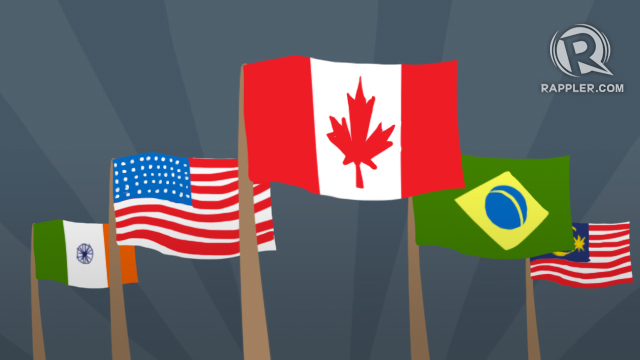
Examples of federal countries: United States, Canada, Australia, Brazil, India, Malaysia.

#2268
Philippine Government / Pros and Cons of Federalism
January 23, 2018, 09:17:30 PM

Extract from Rappler's Will federalism address PH woes? Pros and cons of making the shift by Pia Ranada and Nico Villarete, January 31, 2016)

What is federalism?

It is a form of government where sovereignty is constitutionally shared between a central governing authority and constituent political units called states or regions.

In basic terms, it will break the country into autonomous regions with a national government focused only on interests with nationwide bearing: foreign policy and defense, for example.

The autonomous regions or states, divided further into local government units, will have primary responsibility over developing their industries, public safety, education, healthcare, transportation, recreation, and culture. These states will have more power over their finances, development plans, and laws exclusive to ther jurisdiction.

The central government and states can also share certain powers.
#2269
Bisaya Cebuano Language / Re: Dahon sa saging
January 21, 2018, 06:24:18 PM

#2270
Bisaya Cebuano Language / Re: Dahon sa saging
January 21, 2018, 06:18:37 PM

#2271
Bisaya Cebuano Language / Re: Dahon sa saging
January 21, 2018, 06:16:36 PM

#2273
Photos Unlimited / Re: Days in the life of Aylandil
January 21, 2018, 06:10:27 PM

future aung san suu kyi of cambodia!
#2274

give me a f**king break. if at all, it may create many federal dictators. our current crop of political dynasties will see to that.
#2275
Tira-Pasagad | Saksak-Sinagol / Watching a parade?
January 21, 2018, 03:52:25 PM

#2276
Quotable Quotes / Re: Quote For The Day
January 21, 2018, 02:17:20 PM

#2277

5. DO NOT ALLOW YOUR PET TO ROAM UNSUPERVISED.

Allowing your dog or cat to roam free may seem like you're doing your pet a favor. However, pets that roam are susceptible to a number of dangers, including automobile accidents, predation, exposure to contagious diseases, exposure to poisons, and more. Additionally, allowing your pet to roam unsupervised may alienate your neighbors should your pet ever "relieve" him- or herself in their lawn or dig up their garden.

Following these tips can go a long ways towards providing a long, healthy and happy life for your pet.

https://www.petmd.com/
#2278

4. KEEP YOUR PET'S MOUTH CLEAN.

A common problem among dogs and cats, dental disease and oral health issues can cause your pet pain, making it difficult for him or her to eat. If left untreated, oral health issues may even lead to heart and kidney disease. In addition to regular dental checkups, the most effective means of caring for your pet's mouth at home is to brush his or her teeth at home. If your pet isn't a big fan of toothbrushes there are other alternatives as well, including dental diets, treats, and toys. Ask your veterinarian for some recommendations.
#2279

3. TAKE YOUR PET TO THE VETERINARIAN REGULARLY.

All pets, including both dogs and cats, require regular veterinary care. However, veterinary care goes far beyond routine vaccinations, even though those are important. A routine examination by your veterinarian can uncover health issues of which you are unaware. In many cases, an early diagnosis improves the chances of successful treatment. Early diagnosis is also likely to be less costly for you than waiting until your pet's illness has become advanced and serious before attempting treatment.
#2280

2. KEEP YOUR PET LEAN.

Pets that are overweight are at risk for a myriad of health issues. Obesity is the number one nutritional disease seen in pets currently and studies have shown that being overweight or obese can shorten a dog or cat's life span by as much as two years. Why? Being overweight or obese puts your pet at risk for joint disease, heart disease and diabetes, among other things.
#2281

Five Life-Lengthening Health Tips for Your Pet


How to Add Years to Your Pet's Life

By Lorie Huston, DVM


Anyone who has ever had a dog or cat wishes just one thing — that he or she has a healthy and long life. Here are five tips that can help your pet do just that.

1. FEED A HIGH QUALITY DIET.

Pets fed a high quality diet have a shiny hair coat, healthy skin, and bright eyes. A good diet can help strengthen your pet's immune system, help maintain his or her intestinal health, help increase his or her mental acuity, help keep joints and muscles healthy, and much more.
#2282
Philippine Laws / Re: Statesmen in the Senate
January 19, 2018, 02:50:05 PM

And all of them agreed that if the Senate and the House convene a constituent assembly, the two chambers must vote separately, not jointly. Puno: "We will destroy institutional equality if we interpret Article 17 to mean that the Senate and the House shall vote together and not separately."

Davide: "What is essential is that both houses vote separately" because "the power to propose amendments is given, not to a unicameral body, but to a bicameral body."

And Pimentel: "The voting of the two houses of Congress should be done separately; otherwise, the 24 senators, even if they are to act as one, would suffer fates worse than those who were swallowed by the Fukushima tsunami some time ago."

They know whereof they speak.

http://opinion.inquirer.net/
#2283
Philippine Laws / Re: Statesmen in the Senate
January 19, 2018, 02:49:41 PM

Pimentel, the author of the landmark Local Government Code of 1991 which Puno believed did not go far enough in decentralizing government power but which Davide said could be beneficially amended, sought a middle ground. "If we have to revise the Constitution to give meaning to the devolution intended by the Local Government Code, we might as well move forward to the scope and power by adopting the federal system."

On the issue of federalism itself, and the assumptions they brought to bear on the issue, the statesmen differed. But it is remarkable to realize what they did agree on. They said a constitutional convention was the best way to change the Constitution. (Pimentel again sought common ground. "The more important thing that we, as a people, should consider doing, if the Constitution is
being revised via a constituent assembly, is for us to participate in the process proactively, actively, and decisively.")
#2284
Philippine Laws / Re: Statesmen in the Senate
January 19, 2018, 02:48:15 PM


But Puno supported the proposed shift to a federal system of government because he said he believed the present system was too centralized, and this centralization explained why the Philippines was classified as a "failing democracy."

To truly decentralize a unitary system's considerable powers, he said, the devolution of powers must not come from a mere law but from the
Constitution itself.

Davide, however, sounded the alarm over federalism itself. "My position is: A shift to federalism is a lethal experiment, a fatal leap, a plunge to death, a leap to hell." Strong words, but no name-calling, no insults, no trolling. Why was the experiment lethal? He said the nation's history, the people's character, the country's culture best fit a unitary system of government. It had "proven itself so."
#2285
Philippine Laws / Re: Statesmen in the Senate
January 19, 2018, 02:47:35 PM

But it was luminously clear that former Senate president Aquilino Pimentel Jr. and former chief justices Hilario Davide Jr. and Renato Puno offered their views on Charter change, the federalism initiative, the crucial question of joint or separate voting, and other matters in the spirit of public service; they were motivated by the public's highest interest. Together with former justice Adolfo Azcuna and Edmundo Garcia, like Davide members of the 1986 Constitutional Commission, the statesmen made their arguments with great dignity (punctuated by the occasional attempt at good-natured humor). They offered a sharp contrast to some of the shows of political force inflicted on the public recently, in railroaded hearings in the House of Representatives or contentious exchanges even in the Senate.

It was good to be reminded that Filipinos have an innate dignity. Puno, for instance, coolly demolished the economic justification from congressmen rationalizing their preference for a constituent assembly instead of a constitutional convention, by calling it a "cheap" argument unworthy of our people. "You should not count the cost when writing a constitution. A good constitution is the best investment a people can make."
#2286
Philippine Laws / Statesmen in the Senate
January 19, 2018, 02:46:29 PM

posting this here so we'll have a ready reference, now and in the future.

EDITORIAL

Statesmen in the Senate

Philippine Daily Inquirer
January 19, 2018

It was good to see some of the country's elder statesmen appear at the Senate on Wednesday to speak their mind on the proposal to amend the 1987 Constitution: It was tonic for the citizen wearied and dispirited by the brazen politicking, the blatant positioning for power and advantage, of the Duterte era.

They did not agree on every issue; they did not always speak the same language even on those issues where they were in agreement; they certainly did not give similar answers to some of the most fundamental questions.
#2287

As for the act of drinking water immediately after eating something being bad for you, those claims have also been kicking about for a bit, as evidenced by this entry from a book of common misconceptions published in 1923:

That it is Bad to Drink Water Directly after Eating Fruit

This idea used to be extremely popular at the Cape when the author was there nearly 40 years ago. He has inquired of a Wimpole Street physician (who was also formerly at the Cape), and cannot find that there is any truth in the belief, except the general one that it is not good to dilute the gastric juices too much after eating anything, and especially, of course if the food be indigestible.


Far more recently, we found on the Internet the advice to "drink water at room temperature if possible, as ice-cold water can harm the delicate lining of your stomach." If the lining of the human stomach were that delicate, our tummies would not long survive their being constantly bathed in strong digestive acids.

https://www.snopes.com/
#2288

If that now seems laughable, consider that to this day cancer continues to attract a number of misconceptions, and not just about its potential causes. In 2005 the American Cancer Society conducted a telephone survey of 957 adult Americans who had never had cancer, asking each of them about five common fallacies about the disease. Of the participants, nearly 41 percent believed surgeries to remove cancer actually caused the disease to spread, and another 13 percent weren't sure whether that was true or not. 27 percent of those surveyed believed the medical industry was withholding from the public a cure for cancer just to increase profits, and another 14 percent weren't sure but thought they might be. 19 percent believed pain medications were ineffective against cancer pain (with a further 13 percent unsure), and 7 percent thought the disease was an illness that could not be effectively treated. Finally, 5 percent of those taking part in the survey believed that all that was needed to beat the Big C was a positive attitude.
#2289

Over the years, decades, and even centuries, a variety of things have been pointed to as causing cancer. Once, when it was noted that there had been an increase in the consumption of tomatoes and an increase in the number of cancer patients, the erroneous conclusion was drawn from this correlation that tomatoes in some fashion caused or induced cancer. As to how old that belief was or how seriously it was taken at the time it was being bruited about, we note that in 1896 the Yorkshire Weekly Post printed an item by a physician who felt moved to publicly combat the rumor: "Let me say that the eating of tomatoes has nothing whatever to do with the production of the disease [cancer]."
#2290

The e-mailed advisory against downing cold water after a meal advances a claim that the sludge supposedly formed by the reaction of stomach acids and ingested oils and now said to be adhering to the walls of the intestine will "turn into fats and lead to cancer." That oils (fats) would turn into fats is the least improbable claim made in the e-mail, but it would be better stated that oils (fats) remain fats, rather than change into them. As for such fats "lead[ing] to cancer," a look at the medical literature of the day does not support that allegation. (One genuinely-studied link between fats and cancer has to do with a higher incidence of lung cancer noted in Asian women who over the course of their lives have performed a great deal of wok cooking. The extreme high heat of that form of cookery causes the oils used to break down and give off chemicals capable of causing mutations in cells. Those intent upon doing large amounts of wok cooking should therefore lower their frying temperature from the 240°C to 280°C called for in Chinese cooking to 180°C.)
#2291

As for oils reacting with stomach acids to form a resultant sludge that is subsequently absorbed more quickly by the intestine than solid food is, remember that "solid food" doesn't generally get into the intestines. By the time most of what we ingest gets that far along in our digestive process, it's all pretty much the same consistency.

The belief that fats (particularly animal fats) will "line the intestine" underpins a common scare story about alleged post-mortem discoveries that celebrities (such as John Wayne and Elvis Presley) who epitomized the "meat and potatoes" diet, gluttony, or other negative eating habits had some tremendous amount (40, 60, or even 80 pounds) of "impacted fecal matter" or "impacted feces" lodged in their bowels.
#2292

While the above-quoted bit is accurate with regard to what it says about heart attack symptoms, the implied connection between the drinking of cold water and cardiac disruption (derived from the text's having been appended to the "cold water causes cancer" e-mail) should be dismissed. Medical literature does not offer support for there being such a link.

The proffered bit of advice about eschewing cold drinks after a meal due to cancer concerns is also claptrap: We were unable to find in reputable medical literature mention of frosty beverages causing cancer. As well, chilled liquids do not solidify ingested fats when the two meet in the stomach: the internal heat of the human body quickly nullifies any temperature differences among the various items that have been swallowed, and stomach acids very efficiently break down lumps of ingestibles before they are passed into the intestines.
#2293

meanwhile, a fact check...

Cold Comfort Harm

Rumor: Drinking ice water after meals or at bedtime can cause a host of nasty health issues.

FALSE

ORIGIN

Admonitions against the ingestion of cold beverages immediately following meals first surfaced on the Internet in February 2006, when they first appeared as an item tagged onto a diatribe against the eating of too much rice. By July 2006, it was circulating as the lead-in to the "cough CPR" mailing (which unwisely advocates that medically-unsupervised heart attack victims attempt to cough rhythmically to get themselves through cardiac events). In October 2006 we began receiving e-mailed versions that conclude with the following bit of text that implies a connection between the ingestion of cold water and heart attacks in women (the additional text appearing after the previously-standard "best to drink hot soup or warm water after a meal" ending):

A serious note about heart attacks:

Women should know that not every heart attack symptom is going to be the left arm hurting. Be aware of intense pain in the jaw line.You may never have the first chest pain during the course of a heart attack.

Nausea and intense sweating are also common symptoms.

60% of people who have a heart attack while they are asleep do not wake up.

Pain in the jaw can wake you from a sound sleep. Let's be careful and be aware. The more we know, the better chance we could survive...

A cardiologist says if everyone who gets this mail sends it to 10 people, you can be sure that we'll save at least one life.
#2294

Common Symptoms Of Heart Attack

A serious note about heart attacks - you should know that not every heart attack symptom is going to be the left arm hurting . Be aware of intense pain in the jaw line.

You may never have the first chest pain during the course of a heart attack. Nausea and intense sweating are also common symptoms. 60% of people who have a heart attack while they are asleep do not wake up. Pain in the jaw can wake you  from a sound sleep. Let's be careful and be aware. The more we know, the better chance we could survive.
#2295
Health and Food / Heart Attacks And Drinking Warm Water
January 18, 2018, 12:52:27 PM

Heart Attacks And Drinking Warm Water

This is a very good article. Not only about the warm water after your meal, but about heart attacks. The Chinese and Japanese drink hot tea with their meals, not cold water, maybe it is time we adopt their drinking habit while eating.

For those who like to drink cold water, this article is applicable to you. It is very harmful to have cold drink/water during a meal because the cold water will solidify the oily stuff that you have just consumed. It will slow down the digestion. Once this 'sludge' reacts with the acid, it will break down and be absorbed by the intestine faster than the solid food. It will line the intestine. Very soon, this will turn into fats and lead to cancer. It is best to drink hot soup or warm water after a meal.
#2296


Full moon as seen from Earth's Northern Hemisphere. Some people claim that private ownership of the Moon might be possible. Author: Gregory H. Revera. CC BY-SA 3.0.

All of these cases may sound like a big scam now, but we are moving fast into the future, already planning to colonize Mars, mine asteroids and build moon bases. Things could change. The outer space treaty is not signed by every country and making new treaties that allow people to own something they don't is not so difficult.

However, it is safe to say that NASA won't have any bigger problems with the Yemen Martians in the close future.

https://www.thevintagenews.com/
#2297


Pathfinder and Sojourner at JPL in October 1996, being 'folded' into its launch position.

Interestingly enough, the story about the Yemen trio didn't end with their lawsuit rejected. The next year they started selling pieces of the Red Planet for $2 per square meter. A really nice bargain! They also assured buyers that they would issue a deed of ownership for their new property.


Exposure of silica-rich dust uncovered by the Spirit rover

Owning a piece of extraterrestrial property may sound like a nice idea, but in reality, it is not really possible. Back in 1967, the United Nations issued the Outer Space Treaty (and Yemen signed it!) which holds that no country can claim ownership over extraterrestrial territory.
#2298

A CNN report from July 1997 notes the rather humorous legal charge filed by Adam Ismail, Mustafa Khalil, and Abdullah al-Umari, who stated: "Sojourner and Pathfinder, which are owned by the United States government, landed on Mars and began exploring it without informing us or seeking our approval."


Mars in natural color in 2007. Author: ESA CC BY-SA 3.0

They demanded that the current exploration of Mars is stopped and any further Mars research should go through them. The men also explained that they were only seeking their right now because of the anniversary of several of their ancient cities' foundations, and the desire to raise money to refurbish them.

Apparently, this is not the only case of extraterrestrial estate claims: There was a guy (Sylvio Langevin) who declared he owns all of the planets in the solar system. And another guy who tried to own the moon; Dennis Hope, claimed ownership of the moon back in the 1980s and, according to him, he has sold over 2 million acres of land on the moon at $20 per acre. There was also the "Nation of Celestial Space" which claimed to own everything in space, and Gregory Nemitz who laid claim to an asteroid.
#2299

Adam Ismail, Mustafa Khalil, and Abdullah al-Umari based their claims on family history, supposing that they are descended from the Himyarites and Sabaeans, ethnic groups who lived in southern Arabia. According to their mythologies, these long-lost civilizations had seven temples on each of the planets in the solar system. As stated in a local newspaper, the trio presented "legal" documents that support their claim.

Nobody except the prosecutor saw these documents, and after throwing out the case, he described this group of people as "abnormal," warning them with jail time if they try to sue again. It makes you wonder what a document for owning a planet looks like!?


This image taken by the panoramic camera on the Mars Exploration Rover Opportunity shows the view of Victoria Crater from Cape Verde.

The events that prompted this were NASA's exploratory Pathfinder and Sojourner missions.
#2300

In 1997, NASA was sued for trespassing by men who claim Mars belonged to their ancestors 3,000 years ago


You don't get a lot of property related lawsuits (or do you) when you are in the business of sending rovers and satellites onto distant planets, but this happened to NASA 18 years ago. It was back in 1997 when three guys from Yemen decided to file a lawsuit to the country's prosecutor general in Sana'a. The case was not about intellectual property; they claimed they owned Mars! They were suing NASA for trespassing.

"We inherited the planet from our ancestors 3,000 years ago," they told the weekly Arabic-language newspaper Al-Thawri.