Join MikeLigalig.com!

Why Just Read When You Can Join, Post, and Read!

Menu

Show posts

This section allows you to view all posts made by this member. Note that you can only see posts made in areas you currently have access to.

Show posts Menu

Messages - islander

#9401

"In the Philippines’ view, it is not just the Philippines’ claims against China that rest in your capable hands. Mr President, it is the spirit of UNCLOS itself," Del Rosario said Tuesday, July 7, addressing the 5-member tribunal's president.

"That is why, we submit, these proceedings have attracted so much interest and attention. We call on the tribunal to kindly uphold the convention and enable the rule of law to prevail," he said.
#9402

DAY 2 at the Hague

PH to Hague tribunal: China threatens law of the sea

The Philippines says UNCLOS shows 'that principles trump power; that law triumphs over force; and that right prevails over might'

Paterno Esmaquel II
July 08, 2015


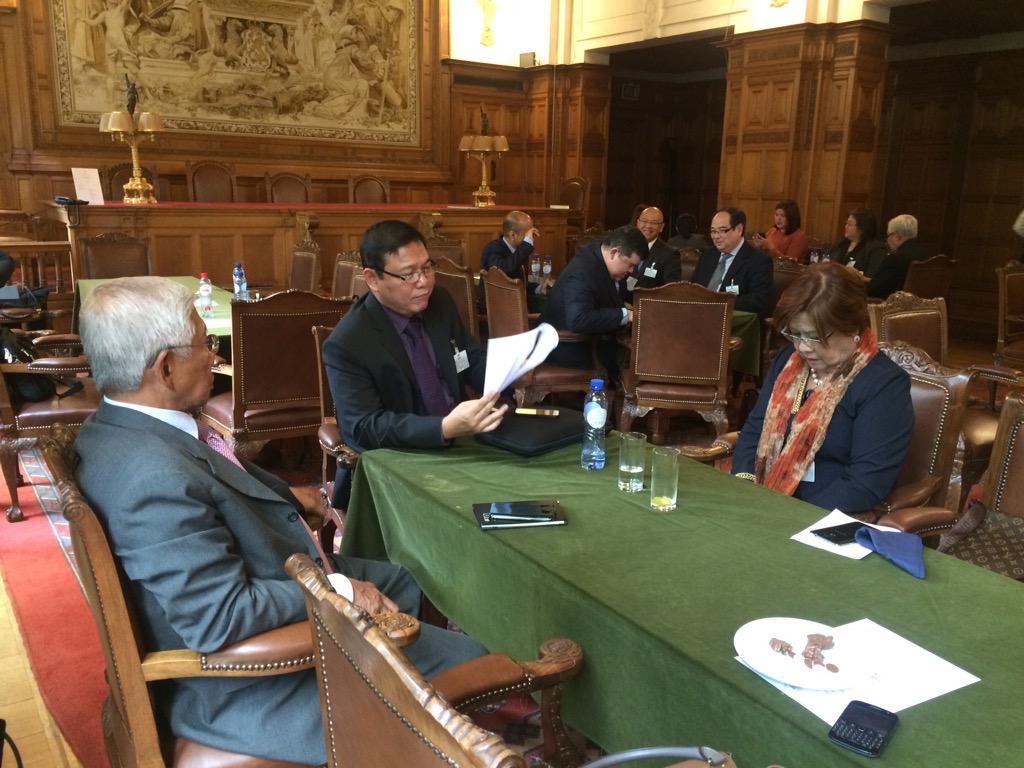
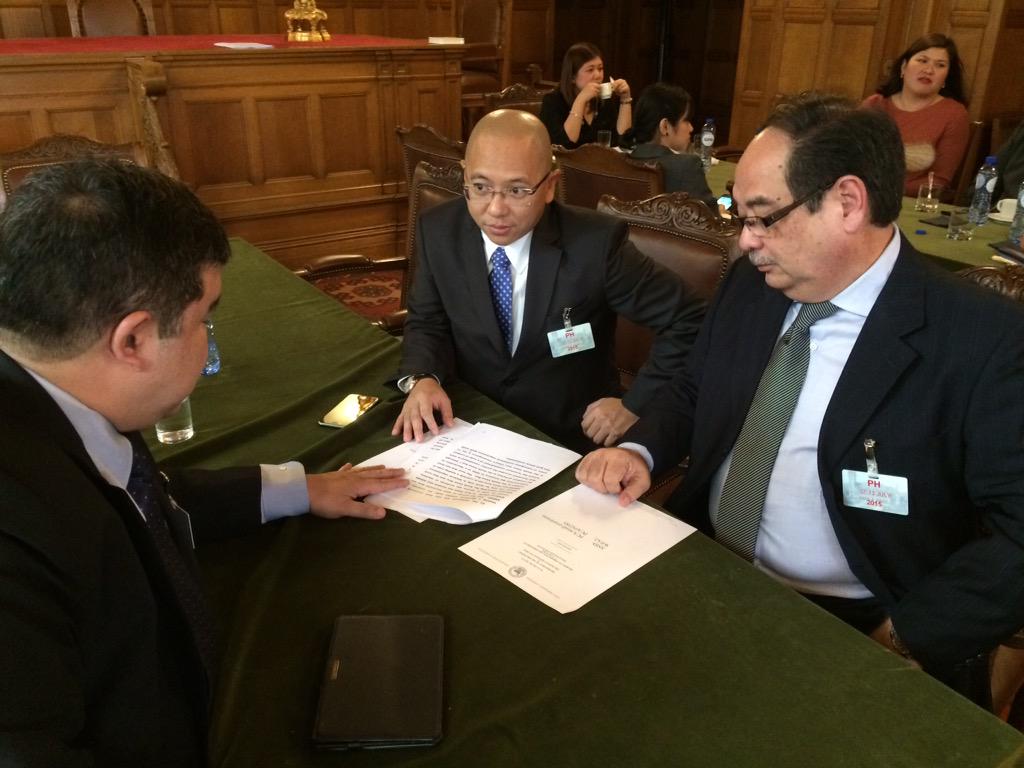
DAY TWO. The Philippine delegation waits inside a session hall at The Hague, The Netherlands, for the second day of the oral hearings on the Philippines' case against China over the South China Sea. Photo courtesy of Abigail Valte

MANILA, Philippines â€" The Philippines cautioned an arbitral tribunal at The Hague, The Netherlands, that China's expansive claim over disputed waters threatens the law of the sea and endangers small countries like the Philippines.

In the Philippines' opening salvo in its case at The Hague, Philippine Foreign Secretary Albert del Rosario said the South China Sea dispute "goes to the very heart" of the so-called Constitution for the Oceans, the United Nations Convention on the Law of the Sea (UNCLOS).
#9406

Neil deGrasse Tyson; born October 5, 1958) is an American astrophysicist, cosmologist, author, and science communicator. Since 1996, he has been the Frederick P. Rose Director of the Hayden Planetarium at the Rose Center for Earth and Space in New York City. The center is part of the American Museum of Natural History, where Tyson founded the Department of Astrophysics in 1997 and has been a research associate in the department since 2003. wikipedia
#9411

"China opposes any moves by the Philippines to initiate and push forward the arbitral proceedings," Hua said.

Still, in an interview with Rappler, Senior Associate Justice Antonio Carpio of the Philippine Supreme Court said China would be forced "one way or another" to comply with the tribunal's ruling. He expects the ruling to favor the Philippines. â€" With reports from Agence France-Presse/Rappler.com

http://www.rappler.com/
#9412

Philippine Communications Secretary Herminio Coloma Jr earlier told journalists that Manila is "following its position of seeking a rules-based, diplomatic and peaceful solution."

But Chinese Foreign Ministry spokesperson Hua Chunying said China opposed the arbitration.

"China has on many occasions expounded its position by neither accepting nor participating in the arbitrary procedure unilaterally initiated by the Philippines in breach of the agreement repeatedly confirmed with China as well as the Philippines," she said.
#9413


@Abi_Valte

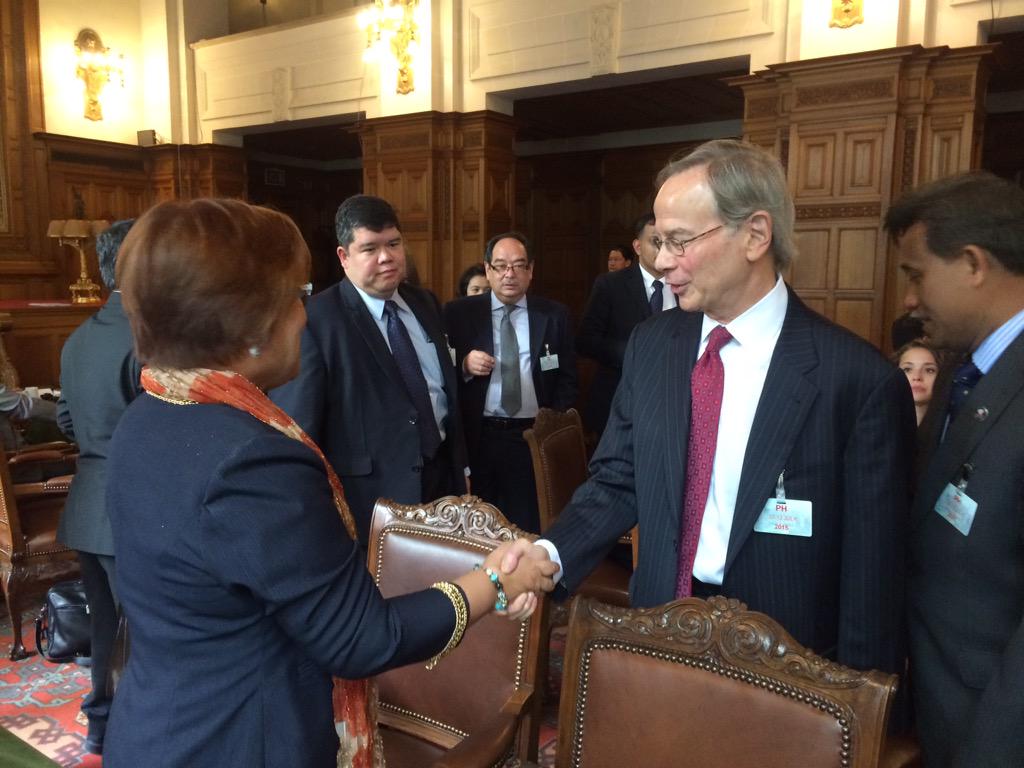
Secretary Leila De Lima is introduced to Paul S. Reichler, our Lead Counsel from Foley Hoag LLP.
7:52 PM - 7 Jul 2015
#9414


@Abi_Valte

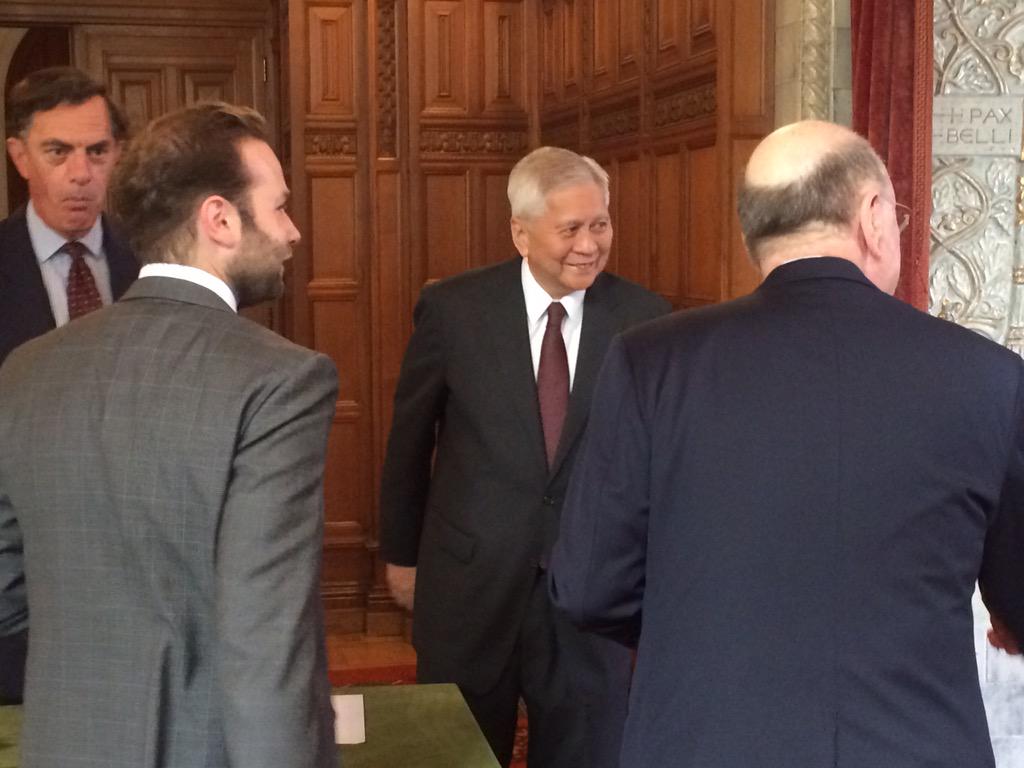
Secretary Albert del Rosario exchanging pleasantries with Professor Alan Boyle (L) and folks from Foley Hoag.
7:50 PM - 7 Jul 2015
#9415


@Abi_Valte

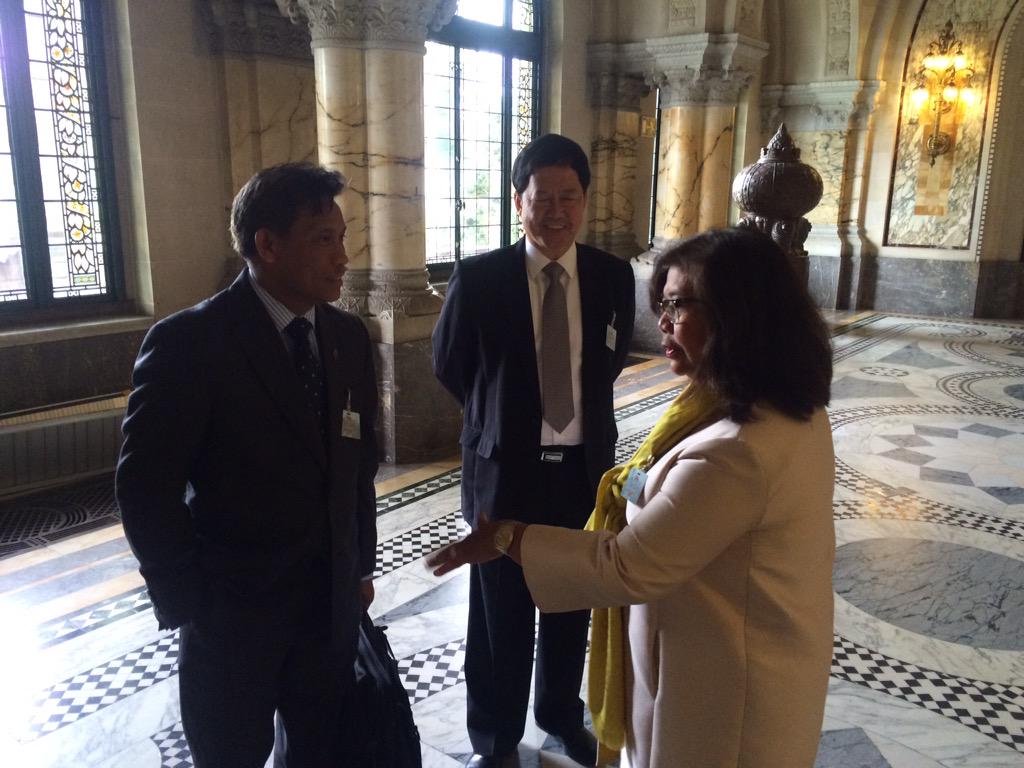
Consul General Henry Bensurto Jr., DESLA Menardo Guevarra and PH Amb. to Belgium Victoria Bataclan.
7:22 PM - 7 Jul 2015
#9416


@Abi_Valte

Speaker of the House Feliciano Belmonte in conversation with Political Affairs Secretary Ronald Llamas.
7:08 PM - 7 Jul 2015
#9417


@Abi_Valte

Defense Sec Voltaire Gazmin, Usec Emmanuel Bautista & Justice Sec Leila de Lima waiting for the hearing to start
7:05 PM - 7 Jul 2015
#9418


@Abi_Valte

Solicitor General Florin Hilbay goes over some points of his presentation w/ DFA Asecs B. Valeriano & E. De Vega
6:58 PM - 7 Jul 2015
#9419

Behind-the-scenes photos

Images published by the Philippine government show a powerhouse team defending the Philippines.

A photo released by the Philippine Department of Foreign Affairs showed an 18-member Philippine delegation at the Peace Palace in The Hague.

The photo includes Hilbay and Reichler, an internationally renowned lawyer.

On Tuesday, Valte tweeted other photos showing the Philippines' last-minute preparations.


‏@Abi_Valte

1st batch of PH delegates arrive at the Peace Palace at The Hague. Hearing begins at 230pm, Netherlands time.
#9420

Foreign Secretary Albert del Rosario, for his part, "made an impassioned plea for the tribunal to recognize its jurisdiction." Del Rosario cited the importance of the case "not just to our country but to the entire world, owing to its impact on the application of the rule of law in maritime disputes."

The Philippines' chief counsel, Paul Reichler, and Professor Philippe Sands later argued why the tribunal has the right to hear the case.

This first round of arguments is set to continue Wednesday.

http://www.rappler.com/
#9421

Eventually, if the tribunal decides it has jurisdiction, the country can proceed to invalidate China's expansive claim over virtually the entire South China Sea.

Deputy Presidential Spokesperson Abigail Valte, who was among the Philippine officials at The Hague, said Solicitor General Florin Hilbay introduced the Philippines' case during Tuesday's hearing. Hilbay also presented the order of speakers.
#9422

Philippines in full force on 1st day at The Hague

Paterno Esmaquel II
July 08, 2015


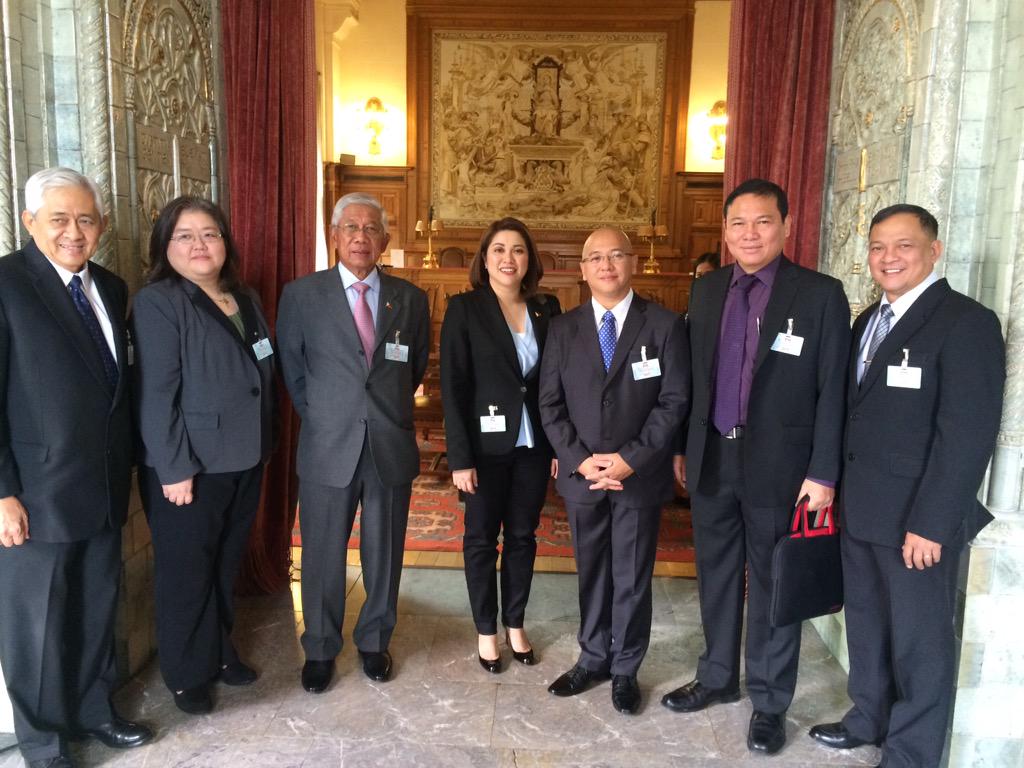
TEAM PHILIPPINES. The Philippine team at the Peace Palace in The Hague, Netherlands, before the start of the oral arguments in connection with the arbitration case against China. The country's delegation includes Solicitor General Florin Hilbay, Senior Associate Justice Antonio Carpio, Justice Secretary Leila de Lima, Presidential Adviser on Political Affairs Secretary Ronald Llamas, Speaker Feliciano "Sonny" Belmonte Jr, Executive Secretary Pacquito Ochoa Jr, Foreign Secretary Albert del Rosario, Defense Secretary Voltaire Gazmin, Associate Justice Francis Jardeleza, Chief Presidential Legal Counsel Benjamin Caguioa, Deputy Executive Secretary for Legal Affairs Menardo Guevarra, Consul General Henry Bensurto, and legal counsels led by Paul Reichler of Foley Hoag. Photo courtesy of DFA

MANILA, Philippines (UPDATED) â€" The Philippines came out in full force on the first day of its oral hearings at The Hague, The Netherlands, over its historic case against China over the South China Sea.

On Tuesday, July 7, the Philippines argued that the arbitral tribunal at the Permanent Court of Arbitration, based in The Hague, has the right to hear the Philippines' case.
#9423
Quote from: hubag bohol on July 07, 2015, 10:54:42 PM
Har de har har! Biktima na man gud ka sa election hilanat... ;D

mananakod man god ka. 
#9424
Jokes and Humor / Re: Scary selfie
July 08, 2015, 01:28:56 PM

hahaha!  arang gajod.  nadaot ang poise. :)
#9425
Quote from: hubag bohol on July 07, 2015, 12:52:49 AMAre his theories something to be taken seriously or is he off in left field? Given the amount of research that has gone into this subject over the years, enough evidence, case studies, and experiences have been documented to suggest it’s not at all unreasonable to believe that aliens not only exist, but that they could be among us already.

but of course.  some may even be already readers or members of tubagbohol.
#9426

in a changing world with changing alliances, i wonder how the two nationalities would be differentiated now?
#9428

circa world war 2: differentiating a friend from an enemy:


http://www.quora.com/
#9429

sure, westerners can hardly tell the difference.  but so do asians. 

just lately a lady approached me at the airport and talked chinese.  she was surprised when i said i'm sorry but i couldn't understand her.  "you're not chinese?" she said, somewhat aghast.

at a recent function (specifically an iftar for the muslim ramadan), an asian guy approached me and said, "i'm buddhist."  he looked disappointed when i answered, "i'm catholic."  he must have hoped that i would be a buddhist judging by my looks.

well, the japanese i've met had said i look chinese while the chinese said i look japanese.  no one dared claim me.  i still have to hear that i look korean.  but i've been mistaken for a thai and vietnamese.  no foreigner outside the philippines ever said that i'm a filipino. 

hey, anybody out there in space?  i'm a boholano!
#9430


This image is a composite of, from left to right, Chinese, Korean, and Japanese women. To me, the most noticeable thing about that composite image is the difference in skin tone, but the general shape of the face and the hair is also different.

more at http://www.quora.com/What-are-the-facial-differences-between-the-Japanese-and-Chinese
#9431

labad ra ka, hubag.  2007 pa man diay ni.
#9432

Q. Is there potential for a worldwide pandemic?

A. Public health experts do not fear that outcome unless the virus mutates to be more infectious, but they do fear that there will be a regular pattern of outbreaks like South Korea’s. They also fear that the virus could spread during the hajj, Muslims’ annual pilgrimage to Mecca. But that has not happened yet, in part because cases in Saudi Arabia seem to surge in February and recede in the summer, while the hajj has occurred in the fall in recent years. The annual surge may be linked to the camel calving season, which starts as winter ends. Blood tests show that about 80 percent of camels have had the disease at one time.

http://www.nytimes.com/
#9433

Q. How can it be stopped?

A. All contacts of all known cases must be found and quarantined. Doctors and nurses who see many patients before realizing they are infected can spread the disease to many others.
#9434

Q. Is there a cure or a vaccine?

A. No.
#9435

Q. How does it circulate among humans?

A. Most of the spread appears to be among close family members and within hospitals. Although it can infect through touch, blood or other transmission routes, MERS has never spread easily and widely like flu or measles, and it appears to infect mainly those who breathe in large amounts of virus. In the SARS epidemic, the most dangerous practices were crowding patients close together or putting pneumonia patients on ventilators and nebulizers, which created clouds of infectious particles that entered ventilation systems. Making sure staff members wear breathing protection, such as N-95 masks or hoods with air filters, is essential. They must be monitored as they remove their gear, experts said, to ensure they do not touch infected surfaces.
#9436

Q. How do people catch it?

A. The virus is believed to circulate in bats and has been found in Middle Eastern dromedary (one-hump) camels. While it could be caught directly from bats, experts believe most first cases in human outbreaks have come from camels, which are kept in Arabian countries for meat and milk; for racing, hauling and riding; and as pets. The virus may be transmitted from camels’ nasal secretions or in raw milk. This makes it similar to SARS, which circulates in bats but was also found in some animals eaten in China, such as palm civets and raccoon dogs.
#9437

Q. How does it kill?

A. Patients usually die from high fevers and pneumonia. The disease appears more likely to kill people with underlying conditions like diabetes, kidney failure and breathing problems. Because MERS is a virus, antibiotics are ineffective, so doctors give oxygen and take other measures to try to keep patients breathing until their own immune systems can defeat the virus. The mortality rate for known cases of MERS exceeds 30 percent, but there may have been many low-grade infections that were never diagnosed, which would lower the mortality rate.
#9438

Q. What causes it?

A. It is caused by a coronavirus (a virus family named for its “crown” of outer spikes) and is related to SARS, or severe acute respiratory syndrome, which first appeared in southern China in 2002. SARS infected 8,273 people in 37 countries and killed 775 of them, a mortality rate of nearly 10 percent, before basically disappearing in early 2004. (Although it no longer exists in humans, SARS is not considered permanently eradicated like smallpox or rinderpest, because it circulates in animals and could reappear at any time.)
#9439
General Topic / What You Need to Know About MERS
July 07, 2015, 09:29:24 PM

What You Need to Know About MERS

By DONALD G. McNEIL Jr.
JUNE 4, 2015


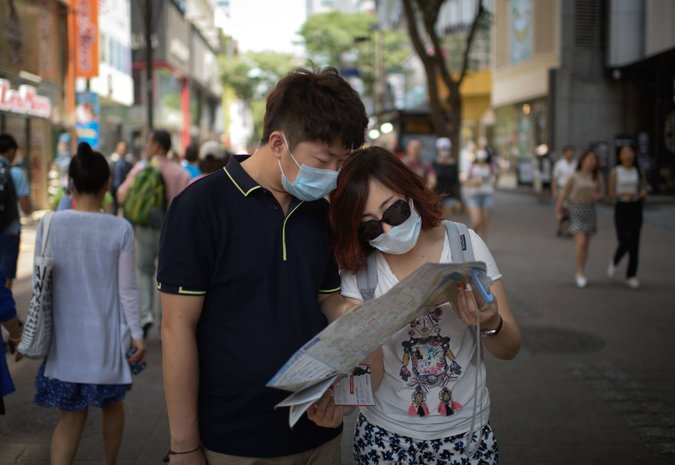
Tourists Thursday in Myeongdong, a popular shopping area of Seoul. South Korea is experiencing the largest outbreak of MERS to occur outside the Middle East. Credit Ed Jones/Agence France-Presse â€" Getty Images

Q. What is MERS?

A. MERS, which stands for Middle East respiratory syndrome, is a disease first detected in Saudi Arabia in late 2012. Most cases have been in the Middle East; some have been diagnosed elsewhere, including in the United States, in people who traveled there. The current outbreak in South Korea is the largest outside the Middle East.
#9440

Nearly 180 people have been infected and 27 people have died in South Korea, the largest outbreak outside Saudi Arabia. In the Thai capital Bangkok, more than a hundred people were believed to have been in contact with an Omani man, the only MERS case in Thailand who eventually recovered.

The World Health Organization described South Korea's outbreak as a "wake-up call" but said it did not constitute a global emergency.

http://www.cnbc.com/
#9441

The first case discovered in the Philippines was in January, a Filipino nurse working in Saudi Arabia who survived.

MERS was first identified in humans in Saudi Arabia in 2012 and the majority of cases have been in the Middle East. Scientists are not sure of the origin of the virus, but several studies have linked it to camels.

Isolated cases cropped up in Asia before South Korea recorded the biggest number in an outbreak that started in May.
#9442
General Topic / Second MERS case in the Philippines
July 07, 2015, 06:49:13 PM

Philippines confirms second MERS case

Monday, 6 Jul 2015
Reuters

   
The Philippines confirmed a second case of the deadly Middle East Respiratory Syndrome (MERS) virus on Monday, in a man who showed symptoms after arriving in Manila last month from Dubai.

The 36-year-old was admitted to hospital on Saturday and was under observation, Health Ministry spokesman Lyndon Lee-suy said, adding contact tracing was now under way to prevent the spread of the disease.

The man had also travelled to Saudi Arabia, the spokesman said. His condition was improving and there was no known transmission so far.
#9443

inspiring story.  welcome back, bart!
#9444

sad, sad, sad.  to think that china makes the world believe that theirs are benevolent projects.
#9445

now i know why it's said that cartoonists are some of the most creative artists on earth. :)
#9446

we're in good company. 
#9447


The Philippine delegation includes (clockwise from top left) Senate President Franklin Drilon, Senior Associate Justice Antonio Carpio, House Speaker Feliciano Belmonte Jr., Foreign Affairs Secretary Albert Del Rosario, Justice Secretary Leila De Lima and former AFP Chief of Staff Manny Bautista. File photos

http://www.philstar.com/headlines/2015/07/03/1472862/philippines-sends-top-execs-south-china-sea-arbitration
#9448

#9449


TOP JURISTS. The Arbitral Tribunal in the Philippines' arbitration case against China, L to R: Judge Jean-Pierre Cot, Judge Stanislaw Pawlak, Judge Thomas A. Mensah (President), Judge Rüdiger Wolfrum, Professor Alfred H. A. Soons. File photo from PCA website
#9450


PERMANENT COURT OF ARBITRATION
COUR PERMANENTE D'ARBITAGE

The PCA is an intergovernmental organization with 117 member states. Established in 1899 to facilitate arbitration and other forms of dispute resolution between states, the PCA has developed into a modern, multi-faceted arbitral institution that is now perfectly situated at the juncture between public and private international law to meet the rapidly evolving dispute resolution needs of the international community. Today the PCA provides services for the resolution of disputes involving various combinations of states, state entities, intergovernmental organizations, and private parties.

The PCA's Secretariat, the International Bureau, headed by its Secretary-General, provides administrative support to tribunals and commissions. Its caseload reflects the breadth of PCA involvement in international dispute resolution, encompassing territorial, treaty, and human rights disputes between states, as well as commercial and investment disputes, including disputes arising under bilateral and multilateral investment treaties.

The PCA can assist in the selection of arbitrators, and may be called upon to designate or act as appointing authority.

The PCA is also a center for scholarship and publication, and a forum for legal discourse.


Palais de la paix / Peace Palace
#9451

A ruling on the jurisdictional issue may be expected anytime within 3 to 6 months after the middle of June 2015. This is on account of the importance of the crucial issue of jurisdiction, the pace at which the Tribunal has proceeded thus far, and assuming that a hearing on oral arguments is not called for, and that Vietnam’s statement does not result in additional proceedings. The latter depends largely on the results of consultations on the matter. This ruling will determine whether the case will terminate at this stage or proceed any further.


About Jay Batongbacal
Jay L. Batongbacal is Assistant Professor, University of the Philippines College of Law, and Director, University of the Philippines Institute for Maritime Affairs and Law of the Sea. He is on leave and affiliated with the East West Center in Washington as a U.S.-ASEAN Fulbright Initiative Visiting Scholar, doing research on evolving US maritime security policies and their impact on the resort to international arbitration and the Rule of Law in the South China Sea disputes.


http://amti.csis.org/
#9452

As these and other events unfold, the arbitration will keep apace with the timetable established by the Tribunal. Assuming that the Philippines submits its supplemental pleading in response to China’s position paper on the March 15 deadline, the Tribunal will wait another 90 days for China to submit a rejoinder, no matter how unlikely it may be for such to be given. This means that the next major milestone will be reached in the middle of June 2015.
#9453

#The Philippines will host APEC in December 2015. Given the tentative steps toward at least a more normal relationship demonstrated in the Aquino-Xi meeting last year, and with the arbitration now in full stride, some room may finally be generated for reaching at least a new modus vivendi that reduces the possibility of sudden escalating conflict. This, however, depends very much on diplomatic initiatives and greater sensitivity to the prevention of untoward incidents.
#9454

#The consortium that owns Service Contract 72 on a concession area in Reed Bank has announced that it will undertake drilling operations by 2016. The consortium attempted to negotiate an agreement with China in order to proceed with petroleum operations, but to date, the political aspects of the dispute have hindered commercial imperatives. However, financial and management considerations may drive a decision to drill, as the consortium may have already made commitments to its investors since 2010 when the service contract was awarded.
#9455

#Activities implementing the EDCA signed last April 2014 will likely commence sometime in 2015, unless the Philippine Supreme Court rules against its constitutionality, or directs that it be subject to Senate ratification, in the case currently pending before it. EDCA is envisioned to play an important role in the modernization of the Philippine armed forces, including the maritime services. Initial plans for the agreement included the development of Oyster Bay in Palawan as a naval base directly accessible to Reed Bank and the disputed areas. If it pushes through, it may become another irritant in relations between the parties even though it is entirely within the Philippine archipelago.
#9456

#The conclusion of talks between the US and China for a MOU establishing rules for safety in air and naval encounters may serve as a model for the initiation of similar arrangements between the Philippines and China. There is a need for such an arrangement given the recent history of encounters between Philippine and Chinese ships in the disputed areas.
#9457

#China’s reclamation activities are expected to resume or continue at their very rapid pace since 2014, and it is likely that at least one of these new artificial islands will achieve an interim operational capability that will give China round-the-clock and year-long maritime surveillance initially within the Spratly region, and later in the whole nine-dash line area. Enforcement capability will follow thereafter, as surveillance will allow China to more efficiently allocate and utilize its maritime enforcement fleet. Surveillance coverage and efficient enforcement could also lead to confrontations taking place in new areas within the Spratly region that previously had not been the scene of such activities.
#9458

#Since 2012, China has reportedly been organizing and mobilizing its civilian fishing fleet into a maritime militia. Such a militia could also extend its range through China’s artificial islands, and the concentration of such a fleet increases the possibility of even more incidents between them and fishers of other countries, as civilian militias could be expected to have a little less discipline and act more unexpectedly than trained armed forces.
#9459

#As the Philippines continues to receive assistance and support in maritime capabilities from countries like the U.S. and Japan, it will continue to create as great a presence in maritime law enforcement as it can with its limited assets. It can be expected to pursue fishery enforcement patrols by military or civilian services. The possibility remains that Chinese fishermen will be arrested and brought to trial, especially in cases of marine environmental and fishery offenses in the near-shore areas. In light of China’s more assertive and proactive protection of its fishermen, this will be a likely source of new tensions.
#9460

#The Philippines will continue supplying its positions and personnel based in the Spratly Island group, but without moving to maintain or repair damaged facilities and equipment in order to maintain the moral high ground in the arbitration. However, given the precarious state of the derelict ship that it uses as an outpost on Second Thomas Shoal, there is a possibility of an incident should the ship’s structure finally yield to the unforgiving sea. Maritime encounters involving interference, and even collision, with Philippine ships are also still possible.
#9461

#The Philippines will surely make a supplemental submission as requested by the Tribunal in order to address the points raised in China’s position paper. Its counsel has welcomed the position paper as providing concrete targets for future proceedings.
#9462

What Next?

Since arbitration was launched in January 2013, incidents over disputes territories and in disputed waters have continued, and we might expect these to do so for the foreseeable future despite legal proceedings. But there may also be opportunities for reducing tensions and minimizing the risk of escalation if incidents do arise. A number of flashpoints for either conflict or cooperation may be considered:
#9463

Third, building on the two previous arguments, China invokes the optional exclusion from jurisdiction under Art. 298, which China exercised through its 2006 declaration. It argues that the right granted to States to exercise this optional exclusion, and the complementary prerogative of States to choose the means for settlement of disputes under Art. 299, would be rendered meaningless. China views the action of the Philippines of unilaterally initiating arbitration as an abuse of the compulsory dispute settlement procedures of UNCLOS. In addition, China also sees it as contravening existing agreements between China and the Philippines, such as the 2002 DOC, to seek a negotiated solution, and other agreements reached between the two countries throughout the 1990s meant to improve the relations between them, as well as the entire region, in spite of the dispute. China further asserts that the actions of the Philippines as a whole to be in bad faith because it seeks a maritime delimitation in disguise, and ignores the need for the two countries to resolve the issues in dispute directly through negotiations.
#9464

Second, China argues that even if the Tribunal could resolve the maritime dispute without dealing with the question of sovereignty over the adjacent land features, it cannot decide on the Philippines’ claims without first undertaking a maritime delimitation. China points to the geography of the area, which aside from the features it currently occupies and included in the case, contains numerous other features such as large islands and other rocks above high tide, including the largest island Itu Aba. China argues that the Philippine case dissects the Spratly island group, distorts the nature and scope of the dispute between the two parties, and avoids questions as to the validity of the Philippines’ own claims to some of the islands; these show that the geographic extent of the Philippines own maritime jurisdiction is still undetermined, and therefore its own claims cannot be decided upon by the Tribunal.
#9465

First, China asserts that the subject matter of the arbitration is, at its core, a dispute over territorial sovereignty over the various features of the Spratly Islands and Scarborough Shoal. China claims absolute sovereignty over those features on various historical and legal grounds, contrary to the Philippines own claims to some of those features. It argues that unless the question of sovereignty over those features is first determined, the issue of who may lawfully exercise the maritime rights and entitlements around them cannot be resolved: the issue of sovereignty over the land and rights over the adjacent seas are inseparable. Since the issue of territorial sovereignty has been expressly excluded by the Philippines from the case, China concludes that it cannot have jurisdiction over the dispute.
#9466

China’s Counter-Arguments

The position paper released by China on December 7, 2014 deals only with the issue of the jurisdiction of the Tribunal, and does not delve into the merits of the Philippine case. From China’s standpoint, the Tribunal does not have jurisdiction over the case filed by the Philippines mainly on the following procedural and substantive grounds:
#9467

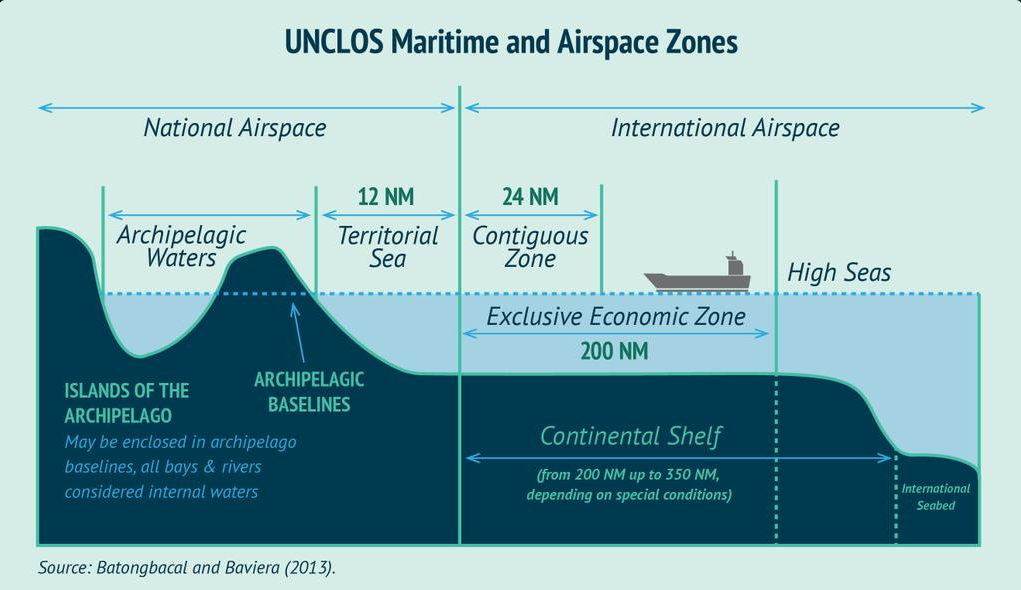
On the basis of these arguments, which are likely dealt with in great detail in the lengthy but still confidential Memorial, the Philippines seeks reliefs in the form of a number of declarations and orders from the Tribunal. The most important of these is a declaration of invalidity under international law of China’s claims based on the nine-dash line map, and that China’s maritime rights and entitlements can only be those based on UNCLOS. Other reliefs sought include a declaration that China’s occupation and facilities on the various reefs are illegal, as well as an order for China to end its occupation thereof. It is also requested for the Tribunal to order China to bring its domestic legislation in accordance with UNCLOS, and stop preventing Philippine vessels from lawfully exploring and exploiting the natural resources of the area, as well as any other activities inconsistent with UNCLOS. The Philippines also asks the Tribunal to declare that the Philippines is fully entitled to its 12 nautical mile territorial sea and 200 nautical mile EEZ and continental shelf measured from its archipelagic baselines as enacted in 2009.
#9468

The Philippine jurisdictional zones in the South China Sea are collectively and officially described in Philippine domestic parlance as the West Philippine Sea. The term “West Philippine Sea” is used by the Philippines to refer to the maritime areas within its sovereignty or jurisdiction in accordance with UNCLOS, and is located within the geographic area of the South China Sea but directly adjacent to its islands.
#9469

Third, the Philippines asserts that China has unlawfully claimed rights or entitlements to, and unlawfully exploited living and non-living natural resources in other areas within the Philippines’ Exclusive Economic Zone and/or Continental Shelf, while preventing the latter from doing so. It is also asserted that China has unlawfully interfered with its rights to navigation under UNCLOS. The Philippines argues that China’s claim based on the nine-dash line map cuts off and deprives the Philippines of its maritime entitlements to those maritime zones under international law.
#9470

At various instances, China has prevented the Philippines from lawfully exploring and exploiting the marine resources within or around these reefs. It is argued that China’s actions against Philippine ships and activities around these areas, and indeed throughout the area within the nine-dash line, assert claims to rights and entitlements far beyond those allowed under Art. 121. The Philippines acknowledges that at most, Scarborough, Johnson South, Cuarteron, and Fiery Cross reefs may be entitled to 12 nautical mile territorial sea zones on account of rocky protrusions above water at high tide, but no more; China’s claims or activities beyond this distance from the features are illegal in international law. The remaining occupied features do not generate any maritime zones at all, and therefore they are on the seabed that are parts of the Philippines’ continental shelf and subject to the latter’s exclusive rights and jurisdictions under UNCLOS.
#9471

#9472

Second, the Philippines argues that China has illegally occupied or controlled eight features within the SCS. Specifically, it occupies Fiery Cross, Cuarteron, Subi, McKennan, Johnson South, Gaven, and Mischief Reefs, and has taken exclusive control of Scarborough Shoal. The Philippines argues this is based on illegitimate claims to title or sovereignty over completely submerged areas, or historic rights to living and non-living natural resources, including control of maritime navigation. It argues further that China has claimed excessive maritime rights and entitlements from these maritime features that it presently occupies or controls, which should be governed by Art. 121 of UNCLOS.
#9473

The Philippine Claims

The Notification and Statement of Claim of the Philippines contains numerous claims against China, but these can all be summarized briefly into the following major groups:

First, the Philippines asserts that China is claiming rights and entitlements far in excess of what has been agreed upon by the international community in UNCLOS. These excessive claims are signified by the nine-dash line map, which China has invoked against the Philippines to justify its claims to sovereignty, jurisdiction, historic title, or historic rights over maritime areas or activities within those lines. The Philippines argues that China’s claims to maritime rights or entitlements based on the nine-dash line map are contrary to UNCLOS and invalid. However, it acknowledges that any issues regarding sovereignty over the land features within those lines are not within the jurisdiction of the Tribunal, and therefore does not seek a ruling from the Tribunal on those issues.
#9474

In accordance with its Rules of Procedure, the Tribunal gave the Philippines until March 15, 2015 to submit a supplemental submission on the Tribunal’s jurisdiction and the merits of the case, in particular to address the points raised by China’s position paper. After the submission, China will have a similar period of 90 days within which to file a response.

The Tribunal also acknowledged receipt of Vietnam’s statement.
#9475

Status of the Proceedings as of January 2015

On December 17, 2014, the Tribunal issued its third Procedural Order. It recorded that China did not submit a Counter-Memorial, and reiterated its decision to neither accept nor participate in the arbitration. The Tribunal acknowledged that its members had been furnished with copies of China’s public position paper while noting that it also expressly stated that the position paper should not be regarded as acceptance or participation in the proceedings.
#9476

Two days later, China publicly released a position paper outlining its objections to the jurisdiction of the arbitral tribunal while reiterating that it was not participating in the proceedings. It asserted that the case was essentially founded on the issue of sovereignty over the islands and other maritime features in the SCS, and that even if the Tribunal were to disregard these sovereignty questions, it could not decide on the Philippine claims without first undertaking maritime delimitations. This meant that either way, the case falls outside the Tribunal’s jurisdiction since it is within the optional exceptions to the jurisdiction of binding dispute settlement mechanisms that China invoked in a 2006 declaration in accordance with the terms of UNCLOS Art. 298(1). China also argued that the Philippines was acting in bad faith and abusing its rights under the UNCLOS by unilaterally taking China to arbitration.
#9477

At the same time, Vietnam quietly submitted a confidential statement to the Tribunal regarding the case. Vietnam stated that it requested the Tribunal to pay due regard to the legal rights and interests of Vietnam, but recognized the Tribunal’s jurisdiction over the case and supported the Philippines’ arguments against the legality of China’s nine-dash line claim. The statement has not been released to the public.
#9478

External Events

On December 5, the United States released an official report which analysed China’s claims to the SCS, and declared that its nine-dash line claim could only be internationally acceptable as a claim to territorial sovereignty over the islands inside the lines. Insofar as the waters beyond those islands is concerned, the claims could only be valid if made in accordance with UNCLOS. The State Department paper criticized China’s ambiguity over the nature of its claims, and denied the validity of its claims to historic title or historic rights that it sometimes expresses in official statements.
#9479

Tensions began to ease somewhat as the year drew to a close. In November 2014, Philippine President Benigno S. Aquino III and Chinese President Xi Jinping met for the first time on the sidelines of the APEC summit in Beijing. However, the December 15 deadline for submission of China’s Counter-Memorial had some unexpected results that were technically outside of the proceedings.
#9480

As China deployed an oil rig off the coast of Vietnam in the same month, the Philippines called for a moratorium on all activities that created tensions. This was later formally proposed as the first and immediate part of a “Triple Action Plan” to manage the territorial and maritime disputes. The second involves full implementation of the 2002 DOC and conclusion of a regional Code of Conduct, while the third proposes the establishment of a binding dispute settlement mechanism. China rejected this proposal.
#9481

Subsequently, in May 2014, the Philippines arrested a group of Chinese and Filipino fishermen engaged in an illegal trade of 500 endangered marine turtles at Half-Moon Shoal, which is even closer to the Philippines than Second Thomas Shoal but also claimed by China. China accused the Philippines of provocation and demanded the release of its fishermen. This was followed by the release of surveillance photographs of land reclamation taking place on a massive scale and at rapid pace on Johnson South Reef. Similar activities have been reported on Cuarteron Reef, McKennan Reef, and Gaven Reef. Subsequently, similar reclamation was confirmed in Fiery Cross Reef. Despite the Philippines’ repeated protests, the reclamation activities continue unabated.
#9482

Meanwhile, since 2012, South China Sea issues have prompted the Philippines to renew and strengthen its military alliance with the United States. Several months of negotiations culminated in the signing in April 2014 of the Philippines-US Enhanced Defense Cooperation Agreement (EDCA), to supplement existing arrangements with the US for mutual logistics support and visiting forces. The agreement was signed just in time for a brief visit of U.S. President Barack Obama to Manila on his official tour of Asia. It is intended to assist the Philippines in modernizing its armed forces and developing its capabilities, particularly in the areas of maritime security and maritime domain awareness.
#9483

On March 30, 2014, the Philippines submitted to the Tribunal and China a lengthy Memorial, which is not public but reportedly comprises 4,000 pages of arguments, documents, and maps. The Tribunal thereafter convened on May 14, and gave China until December 15 to submit its Counter-Memorial in response to the Philippines. However, China reiterated that it did not accept the arbitration proceedings in a note to the Tribunal on May 21.
#9484

Pending submission of the Memorial, tensions between the parties continued to rise. In mid-2013, the Philippines noted and protested the increased frequency and proximity of China Maritime Surveillance ships around its outpost the Second Thomas Shoal, as well as the reported blocking of a Philippine civilian vessel on its way to Pag-asa Island. Concrete blocks found by a surveillance flight to Scarborough Shoal were mistaken to be preparations for a permanent Chinese facility on the reef; they were later determined to be from previous and long-forgotten wrecks. In January and February 2013, it was reported that Chinese ships had used water cannon against Philippine fishing boats. The most serious incident occurred in March, just prior to the deadline for submission of the Memorial, when China Maritime Surveillance ships prevented a Philippine Navy ship from re-supplying and replacing personnel on its outpost on Second Thomas Shoal. Several weeks later, another ship with journalists on board successfully evaded Chinese ships blocking its path and was able to carry out the resupply and personnel rotation.
#9485

The Substantial Stage

Likewise in its first Procedural Order, the Tribunal fixed March 30, 2014 as the date on which the Philippines was to submit its Memorial, which is the principal pleading stating its case in full. The Philippines was asked to fully address all the issues, including matters relating to the jurisdiction of the Tribunal the admissibility of its claims, and the merits of the dispute.
#9486

The Tribunal subsequently met for the first time at the Peace Palace in The Hague on July 11, 2013. China reiterated its rejection of the proceedings in a Note to the Tribunal on August 1. The Tribunal thereafter issued its first Procedural Order on August 27. The Order designated the Permanent Court of Arbitration (PCA) to act as registry of the proceedings, and adopted the Tribunal’s Rules of Procedure and initial timetable. The Tribunal is actually a separate entity and independent of either the ITLOS or the PCA; by being the registry, the PCA primarily hosts the tribunal and provides its administrative support.
#9487

Art. 3 of UNCLOS Annex VII provides for constitution of a five-member arbitral tribunal. The Philippines began the process through the nomination of Rudiger Wolfrum as arbitrator in its Notification and Statement of Claim. China had 30 days to likewise nominate one arbitrator, but did not do so in light of its rejection of the arbitration. Normally, the arbitral tribunal is constituted upon mutual agreement of the parties to the case, but in light of the rejection and refusal of China to participate, Annex VII authorizes the President of the International Tribunal on the Law of the Sea (ITLOS), upon request of the initiating party, to appoint the arbitrator on its behalf. This was done with the appointment of ITLOS judge Stanislav Polack as the second tribunal member on March 25, 2013. Subsequently, likewise upon request of the Philippines, the President of ITLOS appointed the remaining three members of the tribunal, namely Jean-Pierre Cot, Chris Pinto, and Alfred Soons. Chris Pinto was subsequently replaced by Thomas Mensah, who was also appointed President of the Tribunal on June 24, 2013.
#9488

China formally rejected the Notification and Statement of Claim and returned it to the Philippines on February 19, 2013. However, under Art. 9 of UNCLOS Annex VII, the absence of a party or its failure to defend the case does not bar the proceedings.
#9489

Since neither the Philippines nor China expressed any preferred third-party dispute settlement mechanism in their ratifications, both are deemed to have selected arbitration as the means to settle maritime disputes between them concerning the interpretation and application of UNCLOS, unless any of the express limitations and optional exceptions are applicable.
#9490

UNCLOS provides for numerous means of peaceful settlement of maritime disputes, which include non-binding means between the disputing parties and binding means involving third parties such as arbitration and adjudication. While all States may resort to any of the non-binding means at any time, Art. 287(3) requires them to select their preferred binding means involving third parties. If they do not do so, they are deemed to have selected arbitration under UNCLOS Annex VII as the mode of dispute settlement. Any selection, however, is subject to certain express limitations under Art. 297(2) and 297(3) and/or optional exceptions under Art. 298(1).
#9491

Launching the Case

On January 23, 2013, the Philippine announced that it initiated an arbitration case against China by issuing a Notification and Statement of Claim in accordance with the dispute settlement provisions of UNCLOS, particularly under Art. 287 and Annex VII. Both the Philippines and China are signatories to UNCLOS, having ratified it in 1984 and 2006 respectively.
#9492

On the Philippine side, the SCS disputes came to the attention of the fledgling Presidential administration with an incident in 2011 involving interference by China Maritime Surveillance ships with a Philippine seismic survey ship at Reed Bank. Soon after, China lodged a diplomatic protest against the Philippines’ public auction of petroleum concession blocks which included two areas between Reed Bank and the Philippine island of Palawan. The Philippines subsequently lodged its own diplomatic protests against China’s fishing and military activities in Reed Bank and nearby areas. Relations increasingly became strained as China’s press openly warned of military action, spurring an official response from the Philippines. The exchange of protests continued well into the first quarter of 2012. Tensions between the two countries reached a head in April that year with a months-long confrontation between Philippine and Chinese vessels at Scarborough Shoal, which ended when Philippine ships left the shoal upon a reported agreement for mutual withdrawal in June 2012. Shortly after, however, Chinese vessels returned and have since been in control of the shoal.
#9493

Preludes

Although the territorial and maritime issues in the SCS have technically been in existence since the 1930s, the case of the Philippines against China is a direct result of very recent events arising out of the long-festering dispute between the two countries. In the aftermath of tensions between the Philippines and China over the latter’s facilities in Mischief Reef in 1999 and the conclusion of a maritime delimitation between China and Vietnam in the Gulf of Tonkin, a modus vivendi was reached with the signing of the 2002 Declaration of Conduct of Parties in the SCS (DOC). By 2005 it appeared that relations between the parties had stabilized enough that their national oil companies entered into a Joint Marine Seismic Undertaking that was implemented until 2008. Relations took a downturn, however, in 2009 when submissions were made (one by Vietnam and Malaysia jointly, and another by Vietnam alone) for areas of the continental shelf beyond 200 nautical miles in the SCS in accordance with UNCLOS. These immediately prompted China’s protest and first official publication of its SCS claim known as the so-called nine dashed line, which was followed by a sharp exchange of diplomatic notes. The tussle was thereafter followed by a string of increasingly risky confrontations at sea.
#9494

ARBITRATION 101: PHILIPPINES V. CHINA

Jay Batongbacal
January 21, 2015


Introduction

The arbitration case launched by the Philippines against China currently stands as the most significant, and most closely watched, development for specialists and observers of the maritime disputes in the South China Sea (SCS). To help observers navigate through this foggy proceeding, this article attempts to provide a focused overview of the arbitration case and developments in the bilateral dispute between the two parties.
#9497

Strong quake rocks Mindanao[/size]

size=8pt]By: Agence France-Presse
July 3, 2015

InterAksyon.com
The online news portal of TV5[/size]

MANILA, Philippines - A strong 6.1-magnitude quake struck off the southern Philippines on Friday, the US Geological Survey said.

There were no immediate reports of damage or casualties after the undersea quake struck at 2:43pm (0643) GMT some 62 kilometres (38.5 miles) northeast of Surigao city on Mindanao island.

The Philippine Institute of Volcanology and Seismology said the quake occurred at a depth of 26 kilometres and was felt on Mindanao's northeast tip as well as on nearby Leyte island.

The Philippines is regularly hit by quakes due to its location along the so-called chain of fire of islands of the Pacific Ocean that were created by volcanic activity.

http://www.interaksyon.com/
#9498
Quote from: TUBAGBOHOL.com on June 30, 2015, 10:35:16 PMInstead of merely pushing for the approval of the draft BBL, Marcos said a better approach toward lasting peace would be to embark on a full-scale modernization program for all of Mindanao.
Quote from: hubag bohol on July 02, 2015, 12:14:55 AMHmmm, brayt jud ning bataa da! :)

buyag. 

translation of bongbong's text:  ipabalik na lang ang pdf para naay funding sa full-scale modernization program for mindanao ug way prisohay sa masakpan.
#9499

mahadlok diay silang mobarog sa ilang baroganan mao nga mexicans na lang ang ilang itud? 
#9500


Kermit Tesoro and Lady Gaga

[size]http://ladygaga.wikia.com/[/size]