Join MikeLigalig.com!

Why Just Read When You Can Join, Post, and Read!

Menu

Show posts

This section allows you to view all posts made by this member. Note that you can only see posts made in areas you currently have access to.

Show posts Menu

Messages - islander

#9301
Photos Unlimited / Re: 2015 News Images
July 12, 2015, 02:50:10 AM

The Philippine delegation to the Permanent Court of Arbitration (PCA) in The Hague, the Netherlands, in its case against China over the West Philippine Sea.


http://cnnphilippines.com/
#9302
Photos Unlimited / Re: 2015 News Images
July 12, 2015, 02:33:26 AM


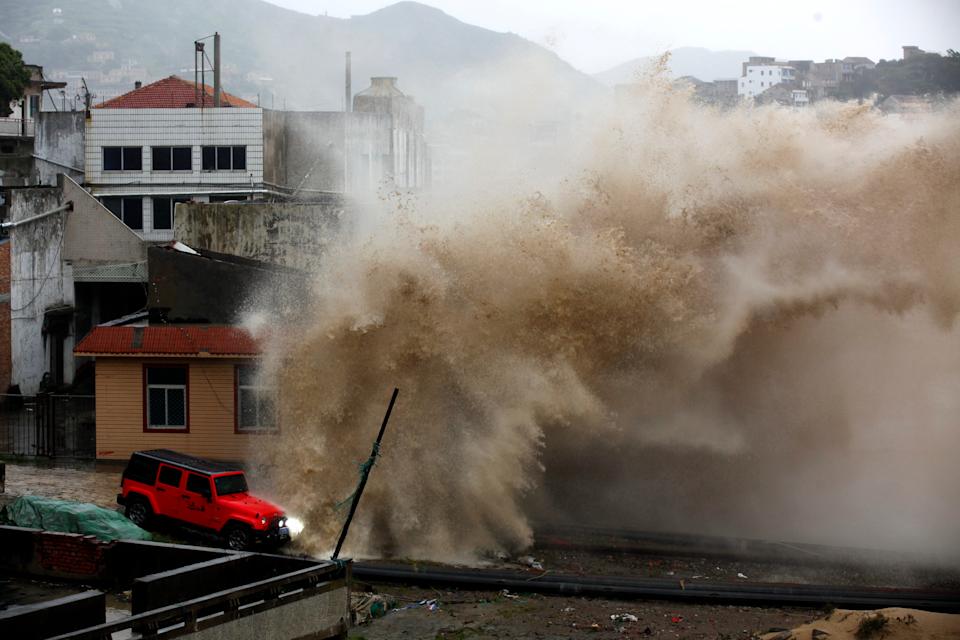
A strong wave breaks over a vehicle along the shore ahead of the landfall of Typhoon Chan-Hom in Wenling in eastern China's Zhejiang province Friday July 10, 2015. Chinese authorities have evacuated tens of thousands of people, canceled scores of trains and flights and shuttered seaside resorts as a super-typhoon with wind gusts up to 200 kilometers per hour (125 mph) heads toward the southeastern coast.(Chinatopix Via AP)

http://news.yahoo.com/
#9303

great manners!
#9305

aw, samot kang na-scholar kun mao.
#9306

bawos, wang.  palakwa pod imong bana, fully naked.  aron mabantog nga pizot diay siya.
#9307

Many who reposted Daniel's photo on their Facebook profiles agreed.
"I hope he makes it because in my book, he is a legend," Alan Butler said on his Facebook page.

"Great story because thanks to this picture, his life will change. Sad, because it is one of the thousands, probably millions who live in these circumstances," wrote Christoffel Sneijders.

Despite strong economic growth in recent years, roughly one quarter of the Philippines' 100 million people still live on less than one dollar a day, and giant slums dominate all major cities.

http://www.telegraph.co.uk/
#9308

Ms Torrefranca's post was shared around the world and in multiple languages, including Spanish, German and Portuguese, all touched by the boy's perseverance.

"I couldn't believe how my post went viral and helped him in his studies," she told AFP on Friday.

She said she snapped a photo of the boy, whom she saw outside the fastfood chain for the first time, while she was on her way home from school.
"I was in awe. While other streetkids were begging for alms, he was studying."
#9309

Ms Espinosa said, aside from the cash, school supplies and scholarship offer that would guarantee his education through college, people had given school uniforms and a reading lamp.

The local church and government social welfare office had also received aid on his behalf.

"Our problem is how to manage all this financial assistance," said Violeta Cavada, the city's social welfare office chief.

"He has become a symbol of poor slum boys in the city who can't study because they don't have electricity."


Daniel Cabrera during a class at a school in Mandaue City (AFP)
#9310

Daniel's father died in 2013 due to severe diarrhoea, said Ms Espinosa, who has three older children, all married and living separate from her.

She described the boy as a tenacious child with a single-mined focus on getting an education.


Daniel-Cabrera's mother has described him as a tenacious child with a single-mined focus on getting an education (AFP)

"He is a very studious and determined boy... he would insist on going to school even without his lunch money because I have no money to give," Ms Espinosa said.

"He always tells me: 'Mama, I don't want to stay poor. I want to reach my dreams'."
#9311

Ms Espinosa and her three youngest children, including Daniel, have been living in her employer's mini-grocery store since their shanty home was gutted by fire five years ago.

Ms Espinosa said she earned just 80 pesos (£1.14) a day working at the store and as a domestic helper for the store's owners in their nearby home. She augments the income by selling cigarettes and candy on the streets on Mandaue, an urban centre on Cebu island in the central Philippines.


Their grocery store home is close to the McDonald's outlet where Daniel was photographed studying, she said.
#9312

It was then shared close to 7,000 times on the social networking site and reported by local television.

Local politician Samuel Pagdilao, of the Anti-Crime and Terrorism through Community Involvement & Support (ACT-CIS) party, awarded Daniel an unspecified "scholarship grant", ABS-CBN reported.

The local police force also raised funds and provided groceries for the family.
#9313


Daniel Cabrera standing next to his mother Christina Espinosa in Mandaue City (AFP)

"We're overjoyed. I don't know what I will do with all of these blessings," said Ms Espinosa, a 42-year-old grocery store employee and domestic helper. "Now, Daniel will not have to suffer just to finish his studies."

The photograph, posted on Facebook last month by a college student, showed Daniel doing his homework on a wooden stool placed close to a McDonald's window to catch the light from the store.

The 20-year-old medical technology student, Joyce Torrefranca, captioned her Facebook post: "I got inspired by a kid."
#9314

now i know nga naka-graduate diay ka, bai hubs. ;D


Filipino boy receives scholarship after photograph of him studying on the street goes viral

The photo showed Daniel Cabrera, 9, doing his homework on a wooden stool placed close to a McDonald's window to catch the light from the store
      

The photo, posted on Facebook last month by a college student, showed Daniel doing his homework on a wooden stool placed close to a McDonald's window Photo: Facebook

By Flynn Murphy, Sydney, and AFP
10 Jul 2015


A homeless Filipino boy has been overwhelmed with aid after a photograph of him studying on the pavement using faint light from a McDonald's outlet went viral on the internet.

Nine-year-old Daniel Cabrera will now be able to fulfil his dream of becoming a policeman after donations of cash, school supplies and a college scholarship poured in, his mother, Christina Espinosa, said on Friday.
#9316

tuko in disguise. ;D
#9317
Photos Unlimited / Re: Pure joy
July 11, 2015, 01:38:49 PM

© Gerald Waller, 1946, New Shoes, Austria

The picture was first published in LIFE magazine on December 30, 1946 (page 22) and again on September 24, 1951 (page 180).

This was the caption in the 1946 issue:

EUROPE’S CHILDREN - Christmas brings joy and sadness

For many of Europe’s children there was a Santa Claus this Christmas. When a big box from the American Red Cross arrived at Vienna’s Am Himmel orphanage, shoes and coats and dresses tumbled out. (from http://blog.burnedshoes.com/)
#9318
Photos Unlimited / Re: Pure joy
July 11, 2015, 01:24:37 PM


Gerald Waller, 1946, New Shoes, Austria Six-year-old Austrian boy Werfel receiving a new pair of shoes at the Am Himmel orphanage, donated by the Junior Red Cross in America. The picture was first published in LIFE magazine on December 30, 1946
#9319

can't say.  wa koy makit-an, morpa.
#9320
Photos Unlimited / Re: Ligngin og mga nawong
July 11, 2015, 01:12:36 PM

aw, kinsa goy di masuya nga wa man kay hexagon...
#9321

eeekkk!  unsa man ni nga thread?  horror movie?
#9322
Photos Unlimited / Re: Ligngin og mga nawong
July 11, 2015, 12:40:47 PM

kompletoha na lang bi.  triangle?  rectangle?  pentagon?  hexagon?  star?
#9323


Lawrence of Arabia (1962)


Dr. Zhivago (1965)


Funny Girl (1968)


Mayerling (1968)


Che! (1969)
#9324

Omar Sharif: Lawrence of Arabia star dies aged 83

10 July 2015

Actor Omar Sharif, best known for his roles in classic films Lawrence of Arabia and Doctor Zhivago, has died aged 83.


Egypt-born Sharif won two Golden Globe awards and an Oscar nomination for his role as Sherif Ali in David Lean's 1962 epic Lawrence of Arabia.

He won a further Golden Globe three years later for Doctor Zhivago.
Earlier this year, his agent confirmed he had been diagnosed with Alzheimer's disease.

His agent Steve Kenis said: "He suffered a heart attack this afternoon in a hospital in Cairo."

Spanish actor Antonio Banderas, who appeared with Sharif in 1999 film The 13th Warrior, remembered him on Twitter as "one of the best". "He was a great storyteller, a loyal friend and a wise spirit."

more at http://www.bbc.com/news/entertainment-arts-33483877
#9325

unsa man ning mga unggoya nga nangawat mag mga nawong ug mga kitties.  lupig man sad ang plastic surgery sa hollywood.
#9326
Photos Unlimited / Re: Ligngin og mga nawong
July 10, 2015, 04:37:29 PM

naa ba ka dinhay eskinadog mga nawong?
#9327
Showbiz & Celebrity / Re: Star Treat: Generations
July 10, 2015, 04:35:24 PM

the most interesting of course, and the real royal treat, is only prince philip.  his gaffes are a real treat.  the other royal personalities in the picture are boring. :)
#9328
Quote from: islander on July 10, 2015, 12:21:09 PM


HIGH-CALIBER TRIBUNAL. The arbitral tribunal hearing the Philippines' case is led by Judge Thomas Mensah of Ghana, the first president of the International Tribunal for the Law of the Sea (C). Other members (L-R) include Judge Jean-Pierre Cot, Judge Stanislaw Pawlak, Judge Rüdiger Wolfrum, and Professor Alfred H. A. Soons. Photo courtesy of the Permanent Court of Arbitration

###

The tribunal is led by Judge Thomas Mensah of Ghana â€" no less than the first president of the International Tribunal for the Law of the Sea (ITLOS).

Founded in 1996, ITLOS settles disputes related to the so-called Constitution for the Oceans, the 1982 United Nations Convention on the Law of the Sea (UNCLOS).

The following members also compose the tribunal:

Judge Rüdiger Wolfrum of Germany
Judge Stanislaw Pawlak of Poland
Judge Jean-Pierre Cot of France
Judge Alfred Soons of the Netherlands

-from Rappler
#9329

In practical terms, the big concern is that while the legal cycle slowly grinds, China is actually changing the facts on the ground on a daily basis. This is why it is extremely important that the Philippines remains vigilant, and primarily focuses on tangibly guarding its interests on the frontline by fortifying its position on features it already controls, negotiate necessary measures (i.e., hotlines) to prevent unwanted clashes and escalation in the high seas, and employ all instruments in its toolkit to protect its territorial integrity.

An urgent concern, in particular, is to prevent China from imposing an Air Defense Identification Zone (ADIZ) in the Spratly chain of islands, which may give Beijing the ability to choke off the supply-lines of other claimant states and dominate arguably the world’s most important maritime highways. The truth is that, we can’t only rely on UNCLOS to address this critical situation, and we will need the help of our allies and partners across the world as well as the full support of the Filipino nation.

http://cnnphilippines.com/
#9330

The Philippines’ case has also presented a huge dilemma for arbitration bodies under UNCLOS. If the Arbitral Tribunal turns down jurisdiction, and refuses to even hear the merits of our arguments, then the very viability of international law as a conflict-management/resolution mechanism will come under question.

At the same time, if it decides to push ahead and eventually rule against China, then there is a huge risk that, as a good friend Columbia University Professor Matthew C. Waxman puts it, it would be "ignored, derided and marginalized by the biggest player [China] in the region." After all, there are no multilateral compliance-enforcement mechanisms to force China â€" a permanent member of the UN Security Council â€" to abide by any unfavorable verdict.

#9331

In preparation for my book, “Asia’s New Battlefield”, I had the chance to consult with leading legal experts from across the United States, Asia, and Europe in the past year. My key impression is that the legal community is quite divided on whether the Philippines can overcome the jurisdictional hurdle, since it will have to argue that its case transcends any sovereignty-related question.

But practically everyone agrees that China has to first clarify sweeping territorial claims, which are neither consistent nor precise. Up to this day, it is not clear whether China is claiming the entire South China Sea or only the features and fisheries and hydrocarbon resources in the area. And if China doesn’t even clarify the precise coordinates of its claims, it would be almost impossible to have any viable joint development scheme among claimant countries.
#9332

The fog of law

First, the Philippines has emphasized the importance of clarifying (under Art. 121 of UNCLOS) the nature of disputed features: Whether they are low-tide or high-tide elevations or islands, since this has a huge implication on whether the features can be appropriated at all or can generate their own 200 nautical miles Exclusive Economic Zone (EEZ).

Perhaps the most important argument of the Philippines’ is that the arbitral tribunal should examine (and hopefully invalidate) China’s nine-dashed-line claims, which are based on pre-modern, questionable, and vague notion of “historical rights/waters”. In short, we want to make sure all claimant countries harmonize their claims and maritime behavior along modern, internationally-accepted legal principles, not obscure doctrines.

#9333

Beijing knows it would be very difficult to justify its notorious nine-dashed-line doctrine, so it has instead chosen to sabotage the Philippines’ arbitration efforts by raising (see its Dec. 7, 2014 position paper, which can be read as an informal counter-memorial) technicality-procedural questions. China has deployed three related arguments that aim to put into question whether the arbitral tribunal should exercise jurisdiction at all.

China cites that the UNCLOS doesn’t have the mandate to address sovereignty-related (title to claim) questions, while, invoking Art. 298 back in 2006, China has opted out of compulsory arbitration on issues that concern its territorial claims, among others. China also claims that it is premature to resort to compulsory arbitration, since alternative mechanisms haven’t been fully exhausted. The Philippines’ savvy legal team, however, has tried to address the jurisdiction issue by eschewing the sovereignty question, instead focusing on two major issues.
#9334

A historic case

The Philippines has been praised by nations around the world, because it is the first country to have dared (under Art. 287 and Annex VII of UNCLOS) to take China to the court. Throughout my visits to and interactions with colleagues and officials from sympathetic countries across the Pacific region â€" and, I must say, there are many of them â€" I have constantly been told about how they genuinely admire our government’s decision to resort to compulsory arbitration despite China’s vehement opposition.

Though China has refused to engage the legal proceedings, claiming “inherent and indisputable” sovereignty over almost the entire South China Sea, the UNCLOS (under Art. 9, Annex VII) has not barred the resumption of our arbitration efforts, which kicked off in early 2013. Without a doubt, the Aquino administration has made a very bold decision by taking on China directly â€" albeit not through force, but instead the language of law.

#9335

What is at stake is not only the merits of the Philippines’ arguments, and the questionable character of China’s sweeping claims, but also the very credibility and viability of international law as the primary arbiter for resolving seemingly intractable territorial spats. This is precisely why the whole international community is anxiously following the ongoing proceedings at The Hague.
#9336

The ultimate aim is to ensure all claimant countries honor their treaty commitments under prevailing international legal regimes, particularly the United Nations Convention on the Law of the Sea (UNCLOS), which has been ratified by the Philippines (1984) and China (2006) alike.


The key hurdle, however, is the question of jurisdiction: That is to say, whether the Arbitral Tribunal, formed under the aegis of the UNCLOS, has the mandate to rule on the Philippines’ case against China. We won’t be able to even defend the merit of our case, unless we convince the court that compulsory arbitration is the way forward.
#9337

The moment of truth: Philippines vs. China at The Hague

By Richard Javad Heydarian, special for CNN Philippines
Thu, July 9, 2015


The week covering July 7 to 13 will be pivotal to the Philippines’ legal battle to assert its claims over the portion of the South China Sea, that it calls the West Philippine Sea.

[Editor's note: Richard Javad Heydarian is an assistant professor in political science at De La Salle University, and a regular contributor to major international publications and think tanks on Asian geopolitical and economic affairs. He is the author of “Asia’s New Battlefield: US, China, and the Struggle for the Western Pacific." The opinions expressed in this commentary are solely those of the author.

Metro Manila (CNN Philippines) â€" The Philippines’ quest for peacefully resolving territorial disputes in the South China Sea has entered a critical stage. After more than two years of hard work and extensive preparations, culminating in the thousand-page-long memorial, Manila has the chance to convince the arbitral tribunal at The Hague that its case deserves to be heard.
#9338


About Will Hatton: Writer and photographer. Adventurer and vagabond. Master of the handstand pushup. Conqueror of mountains, survivor of deserts and crusader for cheap escapades. Will is an avid hitch-hiker, couch-surfer and bargain-seeker. He is a devout follower of the High Temple of Backpackistan and the proud inventor of the man-hug. Will blogs over at The Broke Backpacker about his adventures around the world, you can follow him on Facebook and on twitter or, if you're really friendly, hunt him down on the road for a cheeky beer.

more stories about the philippines by will hatton at:

http://www.rappler.com/life-and-style/travel/ph-travel/97439-british-backpacker-people-philippines-travel

http://www.rappler.com/life-and-style/travel/ph-travel/91321-broke-backpacker-will-hatton-philippines-pulag-climb

http://www.rappler.com/life-and-style/travel/ph-travel/91659-british-broke-backpacker-sagada-baguio-trip

http://www.rappler.com/life-and-style/travel/ph-travel/92064-whang-od-tattoo-british-backpacker-philippines

http://www.rappler.com/life-and-style/travel/ph-travel/92620-british-backpacker-travel-diary-philippines-manila-street-food

http://www.rappler.com/life-and-style/travel/ph-travel/92849-british-backpacker-palawan-travel-diary

http://www.rappler.com/life-and-style/travel/ph-travel/93361-british-backpacker-philippines-travel-diary-palawan-island

http://www.rappler.com/life-and-style/travel/ph-travel/94065-british-backpacker-philippines-travel-diary-leaving-manila
#9339

Filipinos are unbelievably helpful

I’m English. Here, in England, we are painfully polite. Being able to absorb hardship without complaining is seen as a sign of a great strength of character. Because of this, I hate asking for directions. In the past I have wandered around, often in the pouring rain, for hours at a time because it goes against my cultural training to ask a stranger for anything without saying, "Excuse me, I’m so sorry to ask but could you possibly..." This is a phrase I like to avoid.

In the Philippines, I was spared this embarrassment as people seemed to sense when I was lost and on numerous occasions heroic Filipinos leapt to my aid and helped point me in the right direction (often asking for a cheeky picture in exchange!).

I found Filipinos to be so helpful, so willing to make sure I was ok, that my journey was much more relaxing than I had at first anticipated â€" no wandering around in the rain! To all the people who stopped to make sure I wasn’t lost and who stopped to give me tips on how to get the most out of their country, from the bottom of my heart, a massive thank you! â€" Rappler.com

http://www.rappler.com/
#9340

Filipinos always look immaculate

Considering all the adventure activities to be had it really is quite surprising that Filipinos always look immaculate. Fresh-pressed jeans, designer sunglasses and quirky outfits galore; I’m not the kind of guy who knows much about fashion (I practically live in a tank top and combat trousers) but even I was impressed at just how much effort the average Filipino puts into his appearance.

No doubt it’s because Filipinos are aware that, at any minute, somebody could whip out a selfie stick and start taking hundreds of pictures… which brings me to my next point.

If you didn’t get a selfie, it didn’t happen…


The selfie stick might as well have been invented in the Philippines. The first recorded selfie stick in history was made by lashing a huge DSLR to a piece of bamboo… or at least that’s what I choose to believe. Filipinos are big on pictures and, if it’s not on Facebook, it didn’t happen, so be prepared to have your picture taken at any moment.

In the Philippines, I was constantly approached by total strangers who would ask to take a picture with me. What happened to these pictures? I may never know but I like to think that my face proudly adorns many a mantlepiece throughout this quirky country.
#9341

There are more activities than anywhere else in Asia


From caving in Sagada to hiking the slippery slopes of Mt Pulag, The Philippines has more adventure activities than anywhere else I have ever visited. Snorkeling, island hopping, kayaking, sailing, trekking, surfing, scuba diving… the options are literally endless.

I’m used to getting my blood pumping when I travel, the Philippines however is a totally different different kettle of fish (an ancient English saying!), almost every day I would rise early and go for a morning hike… the views and the sunrises never disappointed.

In the afternoon, I would climb, swim, hike or kayak the day away (when I wasn’t singing)... The Philippines is the perfect destination for any adventure junkie; something I genuinely did not know until I got out there.
#9342

You will be expected to sing


I had been in Manila barely 24 hours when I first walked into a karaoke bar. Pumping music, horribly strong Red Horse beers, shouting locals; I was perplexed.

I knew karaoke was a big thing in Japan but had no idea it was popular in the Philippines. Within minutes I was up on stage, another British lad at my side, singing Bon Jovi’s "It’s My Life" at the top of my lungs! Here, it’s not just acceptable to watch, you have to get involved, which brings me to…
#9343

There are many hidden paradises


When I travel, I like to get off the beaten track. This normally involves asking other backpackers for hot tips on hidden gems. I’ve found beautiful places with just a handful of other travelers, sometimes I have places, occasionally even seemingly entire countries (Venezuela!) to myself. In the Philippines, it is so unbelievably easy to get off the beaten track that every single Filipino you meet will proudly show you photos of themselves striding along isolated beaches, camping out on deserted islands or bushwhacking through jungle in search of some legendary falls.

The Philippines is vast, there are over 7,000 islands… and each one has its own secrets. With so many hidden treasures to discover, the Philippines flat out blows every other country out of the water when it comes to getting off the beaten track; this is exploring at its best; raw, wild, sporadic. If you want to get some well earned alone time, go to the Philippines; reconnect with your inner nomad.
#9344

I thought I knew Asia well, I expected that the Philippines would be beautiful, warm, welcoming. I expected that I knew exactly what to expect. I had visited almost every country in Southeast Asia and I loved them all. I was certain that I would love the Philippines; I had seen pictures of golden beaches, swaying palm trees and beaming smiles; what's not to like? It turns out though that despite having mentally prepared for what I expected to find, I was totally unprepared for the reality on the ground.

The Philippines is indeed golden beaches, swaying palm trees and beaming smiles… but it is so much more than this as well. Here are just a handful of things that nobody told me about the Philippines.
#9345

6 things nobody told me about the Philippines

'The Philippines is indeed golden beaches, swaying palm trees and beaming smiles… but it is so much more than this as well,' writes Will Hatton

Will Hatton
July 07, 2015


Asia is no stranger to me. I’ve spent nearly 4 years exploring every nook and crannie, every beach, every mountain, every sun-soaked temple. I lived in India for a year, learning how to survive on just a couple of dollars a day. I made friends with orange-robed Sadhus in Nepal, crimson-clad monks in Myanmar and friendly pilgrims in Cambodia. I have conquered perilous peaks and crossed scorching deserts, hacked a path through steaming jungle and rafted down tumbling rapids.

Along the way, I have learnt that often rumors of a place give the best insight into what to expect when you arrive. I had heard tales of Bagan’s temple studded plains, legends of Laos’ Kalong Cave and whispers of secret ceremonies in India’s deep, unexplored interior.
#9346
Quote from: hubag bohol on July 09, 2015, 07:20:58 PM
The girl’s mother said she did not know her daughter was having a relationship with Rosebush.

After a weeks, Rosebush ditched the 16-year-old and reunited with his assistant.

It was then that that girl’s mother went to the NBI to file a complaint against Rosebush.

awww, c'mon momma.
#9347

kuyawang manoy.  bisag morag hinulbot sa pantyon nagtina gihapon sa iyang buhok.
#9348
Quote from: islander on July 09, 2015, 06:46:12 PM
21.  The mutual acceptance that the Philippines’ disputes with China must be resolved in accordance with UNCLOS was also reflected in a Joint Communiqué issued in July 1998 upon completion of bilateral discussions between my predecessor, Foreign Secretary Domingo Siazon, and China’s Foreign Minister Tang Jiaxuan.  The Communiqué recorded that, and I quote, “The two sides exchanged views on the question of the South China Sea and reaffirmed their commitment that the relevant disputes shall be settled peacefully in accordance with the established principles of international law, including the United Nations Convention on the Law of the Sea.” (End of quote)

22.  Regrettably, neither the bilateral exchanges I have mentioned, nor any of the great many subsequent exchanges, proved capable of resolving the impasse caused by China’s intransigent insistence that China alone possesses maritime rights in virtually the entirety of the South China Sea, and that the Philippines must recognize and accept China’s sovereignty before meaningful discussion of other issues could take place.

the very reason why the philippines opted out of bilateral talks with china.  why the good senator bongbong marcos did not consider this in his recent statement is rather strange.
#9349


In this March 29, 2014 file photo, a Chinese Coast Guard ship attempts to block a Philippine government vessel from entering Ayungin Shoal to replace Philippine troops and resupply provisions on a ship. A Hague-based UN tribunal has asked China to defend its territorial claims in the South China Sea by submitting evidence within six months despite Beijing’s refusal to respond to a Philippine complaint questioning the legality of Beijing’s vast claims to the strategic waters. AP

http://www.philstar.com/
#9350

33.  We understand, Mr. President, that in the exercise of its collective wisdom and judgment, this body has decided to bifurcate the proceedings and to limit these current hearings to the issue of jurisdiction. In this respect, we shall explain in full how our case falls squarely within the jurisdiction of this Tribunal, to the end that justice and fair play may prevail and the Tribunal would recognize its jurisdiction over the case and allow the Philippines to present the actual merits of our position.

34.  In the Philippines’ view, it is not just the Philippines’ claims against China that rest in your capable hands. Mr. President, it is the spirit of UNCLOS itself. That is why, we submit, these proceedings have attracted so much interest and attention. We call on the Tribunal to kindly uphold the Convention and enable the rule of law to prevail.

35.  I humbly thank you, Mr. President, and distinguished Members of the Tribunal. May I now ask that Philippines’ counsel, Mr. Paul Reichler, be called to the podium.

/dfa
#9351

31.  If China can defy the limits placed by the Convention on its maritime entitlements in the South China Sea, and disregard the entitlements of the Philippines under the Convention, then what value is there in the Convention for small States Parties as regards their bigger, more powerful and better armed neighbors? Can the Philippines not invoke Part XV to challenge China’s activities as violations of its obligations and the Philippines’ rights, considering that the Philippines’ claims call for a mere interpretation and application of the Convention and do not fall within any of the jurisdictional exclusions of Articles 297 or 298?

32.  Mr. President, if the Philippines cannot invoke Part XV, then what remains of the obligation regarding judicial settlement of disputes that was such a key element of the comprehensive package that made the Convention acceptable to all State Parties?
#9352

29.  Subsequent events, including China’s acceleration of massive land reclamation activities, which it has undertaken -- and continues to undertake -- in blatant disregard of the Philippines rights’ in its EEZ and continental shelf, and at tremendous cost to the marine environment in violation of UNCLOS -- only serve to reconfirm the need for judicial intervention.

30.  Mr. President, I would like to conclude by conveying my country’s deepest appreciation for the considerable time and attention you have devoted to these proceedings.  The case before you is of the utmost importance to the Philippines, to the region, and to the world.  In our view, it is also of utmost significance to the integrity of the Convention, and to the very fabric of the “legal order for the seas and oceans” that the international community so painstakingly crafted over many years.
#9353

27.  Secondly, in 2012, China forcibly expelled Philippine fishermen from the maritime areas around Scarborough Shoal where the Filipino fishermen have for generations been fishing without so much as a protest from China.

28.  These and other acts by China caused the Philippines to conclude that continued diplomatic efforts, whether bilateral or multilateral, would be futile, and that the only way to resolve our maritime disputes was to commence the present arbitration.
#9354

25.  Mr. President, over the years, China’s positions and behavior have become progressively more aggressive and disconcerting. Outside observers have referred to this as China’s “salami-slicing” strategy:  that is, taking little steps over time, none of which individually is enough to provoke a crisis. Chinese military officials themselves have referred to this as its “cabbage” strategy: peeling one layer off at a time. When these small steps are taken together, however, they reflect China’s efforts to slowly consolidate de facto control throughout the South China Sea.

26.  Two more recent incremental steps caused the Philippines to conclude that it had no alternative other than to invoke compulsory procedures entailing a binding decision.  The first was China’s transmittal of its nine-dash line claim to the United Nations in 2009, after which, it prevented the Philippines from carrying out long-standing oil and gas development projects in areas that are well inside the Philippines’ 200 M EEZ and continental shelf.
#9355

23.  The Philippines has also been persistent in seeking a diplomatic solution under the auspices of ASEAN.  This has proven no more successful than our bilateral efforts.  In fact, China has insisted that ASEAN cannot be used to resolve any territorial or maritime disputes concerning the South China Sea, and that such issues can only be dealt with in bilateral negotiations.  ASEAN and China have yet to conclude a binding code of conduct in the South China Sea.  The most that has been achieved was the issuance, in 2002, of a “Declaration on the Conduct of Parties in the South China Sea.”  Although that document recorded the parties’ commitment to work toward the “eventual” establishment of a code of conduct in the South China Sea, China’s intransigence in the 13 years of subsequent multilateral negotiations has made that goal nearly unattainable.

24.  Nonetheless, Mr. President, the 2002 DOC is significant in at least one important respect: the ASEAN Member States and China undertook therein to “resolve their territorial and jurisdictional disputes by peaceful means, without resorting to the threat or use of force, through friendly consultations and negotiations by sovereign states directly concerned, in accordance with universally recognized principles of international law, including the 1982 UN Convention on the Law of the Sea.”  In so doing, the Declaration encouraged those States, should they prove unable to resolve their disputes through consultations or negotiations, to do so in accordance with the Convention, which includes, of course, the dispute resolution procedures under Part XV.
#9356

21.  The mutual acceptance that the Philippines’ disputes with China must be resolved in accordance with UNCLOS was also reflected in a Joint Communiqué issued in July 1998 upon completion of bilateral discussions between my predecessor, Foreign Secretary Domingo Siazon, and China’s Foreign Minister Tang Jiaxuan.  The Communiqué recorded that, and I quote, “The two sides exchanged views on the question of the South China Sea and reaffirmed their commitment that the relevant disputes shall be settled peacefully in accordance with the established principles of international law, including the United Nations Convention on the Law of the Sea.” (End of quote)

22.  Regrettably, neither the bilateral exchanges I have mentioned, nor any of the great many subsequent exchanges, proved capable of resolving the impasse caused by China’s intransigent insistence that China alone possesses maritime rights in virtually the entirety of the South China Sea, and that the Philippines must recognize and accept China’s sovereignty before meaningful discussion of other issues could take place.
#9357

19.  Mr. President, the Philippines is committed to resolving its disputes with China peacefully and in accordance with international law.  For over two decades, we diligently pursued that objective bilaterally, regionally and multilaterally.  I will not here take this Tribunal through the Philippines’ painstaking and exhaustive diplomatic efforts, which are set out in detail in our written pleadings.  I will, however, mention a few representative examples, if I may.

20.  As far back as August 1995, after China seized and built structures on Mischief Reef -- a low-tide elevation located 126 nautical miles from the Philippine island of Palawan and more than 600 nautical miles from the closest point on China’s Hainan Island -- the Philippines sought to address China’s violation of its maritime rights diplomatically. During those exchanges, the Philippines and China agreed that the dispute should be resolved in accordance with UNCLOS.  As the then Chinese Vice Minister for Foreign Affairs, Mr. Tang Jiaxuan, stated two years later during bilateral negotiations, China and the Philippines should “approach the disputes on the basis of international law, including the United Nations Convention on the Law of the Sea, particularly its provisions on the maritime regimes like the exclusive economic zone.”
#9358

First, that China is not entitled to exercise what it refers to as “historic rights” over the waters, seabed and subsoil beyond the limits of its entitlements under the Convention;

Second[/b], that the so-called nine dash line has no basis whatsoever under international law insofar as it purports to define the limits of China’s claim to “historic rights”;

Third, that the various maritime features relied upon by China as a basis upon which to assert its claims in the South China Sea are not islands that generate entitlement to an exclusive economic zone or continental shelf.  Rather, some are “rocks” within the meaning of Article 121, paragraph 3; others are low-tide elevations; and still others are permanently submerged. As a result, none are capable of generating entitlements beyond 12M, and some generate no entitlements at all.  China’s recent massive reclamation activities cannot lawfully change the original nature and character of these features;

Fourth, that China has breached the Convention by interfering with the Philippines’ exercise of its sovereign rights and jurisdiction; and

Fifth, that China has irreversibly damaged the regional marine environment, in breach of UNCLOS, by its destruction of coral reefs in the South China Sea, including areas within the Philippines’ EEZ, by its destructive and hazardous fishing practices, and by its harvesting of endangered species.
#9359

17.  Mr. President, China has claimed “historic rights” in areas that are beyond 200 M from its mainland coasts, or any land feature over which it claims sovereignty, and within 200 M of the coasts of the Philippines’ main islands, and exploited the resources in these areas while preventing the Philippines from doing so. It has therefore, in the Philippines’ view, breached the Convention by violating Philippine sovereign rights and jurisdiction. China has pursued its activities in these disputed maritime areas with overwhelming force. The Philippines can only counter by invoking international law. That is why it is of fundamental importance to the Philippines, and we would submit, for the rule of law in general, for the Tribunal to decide where and to what limit China has maritime entitlements in the South China Sea; where and to what limit the Philippines has maritime entitlements; where and to what extent the Parties’ respective entitlements overlap and where they do not. None of this requires or even invites the Tribunal to make any determinations on questions of land sovereignty, or delimitation of maritime boundaries.

18.  The Philippines understands that the jurisdiction of this tribunal convened under UNCLOS is limited to questions that concern the law of the sea. With this in mind, we have taken great care to place before you only claims that arise directly under the Convention.  As counsel for the Philippines will discuss at length in the coming days, we have, in essence, presented five (5) principal claims.  They are:
#9360

15.  As our counsel will explain, Mr. President, any recognition of such “historic rights” conflicts with the very character of UNCLOS and its express provisions concerning the maritime entitlements of coastal States. This calls indisputably for the proper interpretation of the fundamental nature of the Convention.

16.  China’s assertion and exercise of its alleged rights in areas beyond its entitlements under UNCLOS have created significant uncertainty and instability in our relations with China and in the broader region. In this respect, I note the presence here today of representatives of Vietnam, Malaysia, Indonesia, Thailand and Japan to observe these critical proceedings.
#9361

13. In fact, China has done much more, Mr. President, than to simply claim these alleged “historic rights.” It has acted forcefully to assert them, by exploiting the living and non-living resources in the areas beyond the UNCLOS limits while forcibly preventing other coastal States, including the Philippines, from exploiting the resources in the same areas â€" even though the areas lie well within 200 M of the Philippines’ coast and, in many cases, hundreds of miles beyond any EEZ or continental shelf that China could plausibly claim under the Convention.

14.     The legal dispute between the Philippines and China over China’s claim to and exercise of alleged “historic rights” is a matter falling under the Convention, and particularly Part XV, regardless of whether China is claiming that “historic rights” are recognized under the Convention, or allowable under the Convention because they are not precluded by it. China has made both arguments in its public statements. But it makes no difference for purposes of the characterization of this dispute as one calling for the interpretation or application of the Convention. The question raised by the conflicting positions of the Philippines and China boils down to this: Are maritime entitlements to be governed strictly by UNCLOS, thus precluding claims of maritime entitlements based on “historic rights”? Or does the UNCLOS allow a State to claim entitlements based on “historic” or other rights even beyond those provided for in the Convention itself?
#9362

11. For the Philippines, the maritime entitlements of coastal States â€" to a territorial sea, exclusive economic zone and continental shelf, and the rights and obligations of the States Parties within these respective zones â€" are established, defined and limited by the express terms of the Convention. Those express terms do not allow for â€" in fact they preclude â€" claims to broader entitlements, or sovereign rights, or jurisdiction, over maritime areas beyond the limits of the EEZ or continental shelf. In particular, the Convention does not recognize, or permit the exercise of, so called “historic rights” in areas beyond the limits of the maritime zones that are recognized or established by UNCLOS.

12. Sadly, China disputes this, Mr. President, in both word and deed. It claims that it is entitled to exercise sovereign rights and jurisdiction, including the exclusive right to the resources of the sea and seabed, far beyond the limits established by the Convention, based on so-called “historic rights” to these areas. Whether these alleged “historic rights” extend to the limits generally established by China’s so-called “nine dash line”, as appears to be China’s claim, or whether they encompass a greater or a narrower portion of the South China Sea, the indisputable fact, and the central element of the legal dispute between the Parties, is that China has asserted a claim of “historic rights” to vast areas of the sea and seabed that lie far beyond the limits of its EEZ and continental shelf entitlements under the Convention.
#9363

9.  Mr. President, allow me to respectfully make it clear: in submitting this case, the Philippines is NOT asking the Tribunal to rule on the territorial sovereignty aspect of its disputes with China.

10. We are here because we wish to clarify our maritime entitlements in the South China Sea, a question over which the Tribunal has jurisdiction. This is a matter that is most important not only to the Philippines, but also to all coastal States that border the South China Sea, and even to all the States Parties to UNCLOS. It is a dispute that goes to the very heart of UNCLOS itself. Our very able counsel will have much more to say about this legal dispute over the interpretation of the Convention during the course of these oral hearings. But in my humble layman’s view, the central legal dispute in this case can be expressed as follows:
#9364

7.  The Philippines took these important steps, Mr. President, because we understand, and accept, that compliance with the rules of the Convention is required of all States Parties.

8.  I mentioned a moment ago the equalizing power of international law.  Perhaps no provisions of the Convention are as vital to achieving this critical objective than Part XV.  It is these dispute resolution provisions that allow the weak to challenge the powerful on an equal footing, confident in the conviction that principles trump power; that law triumphs over force; and that right prevails over might.
#9365

5. These are all matters of central significance to the Philippines.  Indeed, given our lengthy coastline, our status as an archipelagic state, and our seafaring tradition, the rules codified in the law of the sea have always had particular importance for the Philippines. The Philippines is justifiably proud of the fact that it signed the Convention on the day it was opened for signature, on 10 December 1982, and was one of the first States to submit its instrument of ratification, which it did on 8 May 1984.

6.  The Philippines has respected and implemented its rights and obligations under the Convention in good faith. This can be seen in the amendment of our national legislation to bring the Philippines’ maritime claims into compliance with the Convention, by converting our prior straight baselines into archipelagic baselines in conformity with Articles 46 and 47, and by providing that the maritime zones of the Kalayaan Island Group and Scarborough Shoal in the South China Sea would be consistent with Article 121.
#9366

3.  Its organs, coupled with the power of international law, serve as the great equalizer among States, allowing countries, such as my own, to stand on an equal footing with wealthier, more powerful States.

4. Nowhere is this more true, Mr. President, than with respect to the progressive development of the law of the sea, which culminated in the adoption of the Law of the Sea Convention in 1982.  That instrument, which has rightly been called a “Constitution for the Oceans,” counts among its most important achievements the establishment of clear rules regarding the peaceful use of the seas, freedom of navigation, protection of the maritime environment and, perhaps most importantly, clearly defined limits on the maritime areas in which States are entitled to exercise sovereign rights and jurisdiction.
#9367

STATEMENT BEFORE THE PERMANENT COURT OF ARBITRATION

Republic of the Philippines v. People’s Republic of China

Why the Philippines brought this case to arbitration and its importance to the region and the world

By ALBERT DEL ROSARIO
Secretary of Foreign Affairs

1.  Mr. President, distinguished Members of the Tribunal, it is a great honor to respectfully appear before you on behalf of my country, the Republic of the Philippines. It is indeed a special privilege to do so in a case that has such importance to all Filipinos and â€" if I may add â€" to the rule of law in international relations.

2.  Mr. President, the Philippines has long placed its faith in the rules and institutions that the international community has created to regulate relations among States. We are proud to have been a founding member of the United Nations, and an active participant in that indispensable institution.
#9368
Quote from: islander on July 09, 2015, 04:34:34 PM
He cited how China had been prodding the Philippines to return to its version of “the right track.”

“That suggests that the best the Philippines (or any other South China Sea claimant) can hope for is cooperation with China ‘to manage’ resources and protect free navigation in the South China Sea. That is hardly an enticement for the Philippines to negotiate,” he said.

kun sa binisaya pa: "o, sige.  estoryahan ni nato.  pero kahibawo ka nga nanghuwam lang ka anang t-shirt nga imong gisul-ob.  ako na."
#9369
Quote from: islander on July 09, 2015, 04:34:15 PM
He said the Philippines had also brought together Asean nations to cooperate on its approach toward China regarding the dispute.

“It is remarkable what the Philippines has achieved diplomatically, given the limited resources at its disposal and the disproportionate power of China. But diplomacy alone cannot change the facts on the ground. China knows that,” Chang said.

mabuhay!  cheers!  gan bei!
#9370

He cited how China had been prodding the Philippines to return to its version of “the right track.”

“That suggests that the best the Philippines (or any other South China Sea claimant) can hope for is cooperation with China ‘to manage’ resources and protect free navigation in the South China Sea. That is hardly an enticement for the Philippines to negotiate,” he said.

http://globalnation.inquirer.net/
#9371

He said the Philippines had also brought together Asean nations to cooperate on its approach toward China regarding the dispute.

“It is remarkable what the Philippines has achieved diplomatically, given the limited resources at its disposal and the disproportionate power of China. But diplomacy alone cannot change the facts on the ground. China knows that,” Chang said.
#9372

Forcing limits on China

As the Philippines hopes for a favorable ruling from the UN arbitral tribunal, it has already achieved what Southeast Asia, as a bloc, “had failed to do” for years: “It forced China to further delineate its views on the South China Sea,” Felix Chang of the Foreign Policy Institute wrote in a commentary on Dec. 7 last year, commending the Philippines for boldly taking the step to bring China before an international tribunal.

“Second, it helped to change the tenor of the maritime dispute in the region. By forcing China to put its claims into sharper relief, the Philippines helped to show its fellow Southeast Asian claimants just how little room they have to negotiate with China,” Chang said.
#9373

The Citizen Daily cited how the International Tribunal on the Law of the Sea, if faced with a case invoking Unclos’ environmental protection, may order “provisional measures” requiring that “states take certain actions to preserve the parties’ rights or prevent harm to the marine environment.”

“If the Philippines or another littoral state brought a claim against China for violation of Unclos’ environmental protection provisions, the claimant state could rest its case on the damage being caused by land reclamation in a region that hosts the world’s greatest marine biodiversity,” it said.
#9374

Complications

Researchers Youna Lyons and Wong Hiu Fung of the Nanyang Technological University’s S. Rajaratnam School of International Studies did not directly refer to China, but said “states carrying out construction activities” in the disputed waters “must avoid damaging the marine environment due to the far reaching risks to the states bordering the South China Sea.”

“To ignore such risks could create broader complications for regional cooperation and political stability amongst the states of Southeast Asia and the southwestern Pacific,” they said in an April 30 article.

The article noted how construction work must be done in consultation with other affected states, as this “carries a risk of severe or irreversible damage to the local marine environment and risk transboundary damage to coral reefs and fisheries of states bordering the South China Sea.”
#9375

Filipino fishermen in Zambales province, for instance, have experienced this in the hands of Chinese patrol boats in Panatag Shoal (Scarborough Shoal) off Zambales, a traditional Philippine fishing ground.

“The dispute should be settled in light of the food security impetus that drove the initial Unclos negotiations. China’s fishing activities in the South China Sea are permissible only to the extent that they have been authorized by the coastal state to land surplus catch,” Kraska said.
#9376

“The exercise of Chinese jurisdiction in its neighbors’ EEZs is incompatible with the original design and structure of Unclos to protect food security for developing coastal states. This lost dimension of the maritime disputes has not been recognized, but it completely upends Chinese claims,” wrote James Kraska, an international law professor at the US Naval War College, on Feb. 26.

The disputed waters are also rich fishing grounds, and Beijing’s law-enforcement exercise in these areas has barred fishermen from other claimant states from undertaking fishing activities they are otherwise entitled to do within their countries’ EEZs under international law, he said.
#9377

Environmental cost

Other analysts cited the environmental cost of China’s reclamation activities in the South China Sea.

In particular, Harvard Law School’s National Security Journal called the issue of food security a “lost dimension” in the dispute.

Chinese encroachment into the exclusive economic zone (EEZ) of other claimant states, it said, undermined their sovereign right to protect food supply, as envisioned under Unclos.
#9378

Cameron noted how the Chinese Navy deployed a spy ship in Hawaii waters in July 2014 to observe the Rim of the Pacific (Rimpac) maritime exercises, the world’s largest such exercise where it participated along with the United States and other naval powers. Beijing said the deployment was “in line with international law and international practice.”

In the same breath, China protests operations of the US Navy near its coast, he said.

Cameron further noted how China believed “everyone else is wrong” in asserting its supposed “reasonable, justified and lawful” claims in the South China Sea.
#9379

Double standard

Along this line, Asia News International’s Ian Cameron noted how China seemed to apply international law with double standard, scoring other countries for supposed incursions while itself committing incursions.

“There are marked discrepancies in Chinese diplomacy too, with appeals to or against international rules depending on how advantageous it is to the government,” Cameron wrote.

“This is very obvious in the South China Sea, where China is engaged in a massive reclamation of eight islets at the cost of billions of dollars. Hundreds of [hectares] of reclamation will see military installations and runways built in quick order,” he said.
#9380

Carl Thayer, of the current affairs magazine The Diplomat, cited how China has been tailoring international law, particularly the United Nations Convention on the Law of the Sea (Unclos), to its favor.

“China has succeeded in legal alchemy by transforming Unclos into international law with Chinese characteristics,” Thayer said. This development will bolster China’s assertion of “indisputable sovereignty” over the South China Sea.

“As I have argued elsewhere, China is slowly and deliberately excising the maritime heart out of Southeast Asia,” Thayer said, referring to Chinese construction of artificial islands in the South China Sea, in a June 7 article in the magazine.
#9381

Australia’s The Age newspaper, in an editorial on May 28, cited how China’s aggressive actions had been disproportionate to its rhetoric of peace.

“For all China’s sweet talk that it will “unswervingly follow the path of peaceful development” and oppose hegemony and “power politics in all forms,” its territorial ambition in the region, which purports to be an essentially defensive strategy, has taken a distinctly antagonistic turn,” the editorial said, citing China’s military buildup in the disputed Spratly Islands.

It warned that these would fan tensions in the Asia-Pacific region: “We deplore China’s implicit threats that military action will result from intrusions in an area where it is squatting.”
#9382

Standing alone

Analysts and opinion writers from prominent international publications have also condemned China’s actions in the South China Sea, citing how Beijing stood out in Asia as a country averse to international adjudication.

“Asians want their region to be peaceful, stable and prosperous. They want the rule of law to be strong and for all disputes between states to be settled peacefully, in accordance with the law and not on the basis that might is right,” said Tommy Koh, chair of the governing board of the National University of Singapore’s Center for International Law.

“With the exception of China, Asians do not have a negative attitude toward settling their disputes by arbitration or adjudication. China should therefore reconsider its position in order to conform to the best Asian and international practice,” he said in a piece published in The Straits Times on June 10.
#9383

Japan has a longstanding dispute with China over a group of uninhabited islands in the East China Sea. Its May statement with the EC echoed concerns that Abe expressed with President Aquino in June, jointly condemning Chinese actions in the disputed waters.

In the chair’s statement issued in Malaysia, the Association of Southeast Asian Nations (Asean) cited how China’s activities in the South China Sea had spurred distrust among neighboring countries.

“We share the serious concerns expressed by some leaders on the land reclamation being undertaken in the South China Sea, which has eroded trust and confidence and may undermine peace, security and stability in the South China Sea,” the chair said on April 27 at the close of the Asean Summit held in Kuala Lumpur and Langkawi.
#9384

Japan-EU view

Besides China and the Philippines, Vietnam, Malaysia, Brunei and Taiwan also claim parts of the South China Sea.

Japan and the European Union (EU) have also cautioned about the impact of China’s activities in the South China Sea, issuing a joint statement during the 23rd Japan-EU Summit held in Tokyo on May 29.

“Mindful of the uncertainties in the regional security environment, we condemn all violations of international law and of the principles of sovereignty and territorial integrity of states,” said the statement signed by Japanese Prime Minister Shinzo Abe, European Council President Donald Tusk and European Commission President Jean-Claude Juncker.
#9385

Arms race

“We are concerned that the scope and nature of China’s actions have the potential to disrupt regional security. China’s actions and increased presence could prompt other regional governments to respond by strengthening their military capabilities at their outposts, which would certainly increase the risk of accidents or miscalculations that could escalate,” Shear said.

He warned that the restraint of other claimants “may not hold.”

An analysis on War on the Rocks, an American website featuring analysis and commentary of foreign policy and national security issues, said the US stand on the dispute would likely remain firm even through next year’s US presidential election, as candidates appear to consistently share this concern over Beijing’s actions.

“And the election may be having an effect in China; some analysts have argued that Beijing has undertaken its recent island-building spree precisely because it anticipates a tougher US stance after the 2016 elections,” wrote authors Zack Cooper and Mira Rapp-Hooper.
#9386

In a meeting with Chinese President Xi Jinping in May, US Secretary of State John Kerry said: “We are concerned about the pace and scope of China’s land reclamation in the South China Sea.”

It was the same concern that US Assistant Secretary of Defense for Asian and Pacific Security Affairs David Shear expressed before the US Senate committee on foreign relations, discussing the extent of China’s reclamation activities in the South China Sea.

He said China had so far reclaimed 800 hectares “more land than all other claimants combined over the history of their claims.”
#9387

Criticism of China’s behavior has intensified in recent months, as it refused to take part in arbitration proceedings that the Philippines has initiated in the Permanent Court of Arbitration in The Hague.

Oral arguments on the Philippine case opened on Tuesday.

Officials of the United States, the Philippines’ defense treaty ally, are the most strident among those concerned about Chinese incursions in the disputed waters, saying it threatens freedom of navigation.
#9388

Int’l opinion against China buildup in disputed sea

Philippine Daily Inquirer
July 9th, 2015


The alleged on-going reclamation of Subi Reef by China is seen from Pag-asa Island in the Spratly Islands in the South China Sea, western Palawan Province, Philippines Monday, May 11, 2015. AP FILE PHOTO

In the face of growing international condemnation for its building artificial islands in the South China Sea from which to project its military power in the region, China appears to have reduced itself into an island.

From world leaders and international organizations to opinion writers around the world, China has drawn criticism for its massive land reclamation in the disputed South China Sea.
#9389
Philippine Business News / Re: Storms, Typhoons
July 09, 2015, 02:17:34 PM

‘Falcon’ stronger, fasterâ€"Pagasa

By: Frances Mangosing
INQUIRER.net
12:38 PM July 9th, 2015


MT Satellite image July 9, 2015, 12:01 p.m. Screengrab from http://www.pagasa.dost.gov.ph/index.php

Typhoon ‘Falcon’ maintained its strength but slightly accelerated midday Thursday, the weather bureau said.

Falcon packed maximum sustained winds of 130 kilometers per hour near the center and gusts of up to 160 kph, Aldczar Aurelio of the Philippine Atmospheric, Geophysical and Astronomical Services Administration said in a televised press briefing.

It was moving northwest at 22 kph and was expected to exit the Philippine area of responsibility some 620 kilometers north northeast of Itbayat in Batanes.

Aurelio said Falcon would continue to enhance the southwest monsoon, which is bringing moderate to occasionally heavy rain over Luzon and the Visayas, especially over the western section.

Falcon is dumping heavy to intense rain within its 300 kilometer diameter, Aurelio said.

Because of rough seas, fishermen were also advised to avoid the seaboards of Luzon and Visayas.

http://newsinfo.inquirer.net/
#9390

if you own a panda suit, then you're most welcome...


Panda returned to wild by completely inconspicuous men in panda suits
#9391
Jokes and Humor / Re: Scary selfie
July 09, 2015, 02:06:34 PM

na, hala.  tagam.  panghilabot pa. ;D
#9392

welcome back, loll!  glad you're feeling okay now.  :) 
#9394

After all, China's claim has "created significant uncertainty and instability in our relations with China and in the broader region."

Referring to UNCLOS, Del Rosario told the tribunal: "If China can defy the limits placed by the convention on its maritime entitlements in the South China Sea, and disregard the entitlements of the Philippines under the convention, then what value is there in the convention for small states parties as regards their bigger, more powerful, and better armed neighbors?" â€" Rappler.com

http://www.rappler.com/
#9395

Filipino fishermen, for one, have complained that China is blocking them from fishing in the South China Sea.

Del Rosario said: "The question raised by the conflicting positions of the Philippines and China boils down to this: Are maritime entitlements to be governed strictly by UNCLOS, thus precluding claims of maritime entitlements based on 'historic rights'? Or does the UNCLOS allow a state to claim entitlements based on 'historic' or other rights even beyond those provided for in the Convention itself?"

Because of this, Del Rosario said the Philippines' case "is of the utmost importance to the Philippines, to the region, and to the world."
#9396

'Of utmost importance' to all

Del Rosario added: "In fact, China has done much more, Mr President, than to simply claim these alleged 'historic rights.' It has acted forcefully to assert them, by exploiting the living and non-living resources in the areas beyond the UNCLOS limits."

China, for instance, has buried 311 hectares of coral reefs through its island building activities, according to the Philippines.

At the same time, China has "forcibly" prevented other coastal states, including the Philippines, "from exploiting the resources in the same areas."
#9397

The EEZ is the area 200 nautical miles within a coastal state's baselines or edges, within which it has the exclusive rights to fish and to exploit other resources.

The Philippines says a huge part of the South China Sea, which it calls the West Philippine Sea, falls within its EEZ.

"Sadly, China disputes this, Mr President, in both word and deed," Del Rosario said.

"It has therefore, in the Philippines’ view, breached the convention by violating Philippine sovereign rights and jurisdiction. China has pursued its activities in these disputed maritime areas with overwhelming force. The Philippines can only counter by invoking international law," he said.
#9398

Violation 'in both word and deed'

In his speech, Del Rosario explained that China violates UNCLOS by asserting its "historic rights" established by its 9-dash line.

The 9-dash line is China's demarcation to claim virtually the entire South China Sea.

The Philippines pointed out that UNCLOS "does not recognize" China's so-called historic rights through the 9-dash line.

What UNCLOS upholds is a 200-nautical mile exclusive economic zone (EEZ).
#9399

Before him, Philippine Solicitor General Florin Hilbay introduced the Philippines' case. Later, the Philippines' chief counsel, Paul Reichler, and Professor Philippe Sands argued why the tribunal has the right to hear the arbitration proceedings.

This is the first time a country brought China to court over the South China Sea dispute.

China refuses to join the proceedings. Instead it pushes for bilateral or one-on-one talks with the countries involved.
#9400

He also hailed the provisions of UNCLOS on settling sea disputes. "It is these dispute resolution provisions that allow the weak to challenge the powerful on an equal footing, confident in the conviction that principles trump power; that law triumphs over force; and that right prevails over might."

The Philippines' top diplomat delivered this statement on the first day of oral hearings at The Hague.