
This section allows you to view all posts made by this member. Note that you can only see posts made in areas you currently have access to.
Pages 1 2 3 4 5 6 7 8 9 10 11 12 13 14 15 16 17 18 19 20 21 22 23 24 25 26 27 28 29 30 31 32 33 34 35 36 37 38 39 40 41 42 43 44 45 46 47 48 49 50 51 52 53 54 55 56 57 58 59 60 61 62 63 64 65 66 67 68 69 70 71 72 73 74 75 76 77 78 79 80 81 82 83 84 85 86 87 88 89 90 91 92 93 94 95 96 97 98 99 100 101 102 103 104 105 106 107 108 109 110 111 112 113 114 115 116 117 118 119 120 121 122 123 124 125 126 127 128 129 130 131 132 133 134 135 136 137 138 139 140 141 142 143 144 145 146 147 148 149 150 151 152 153 154 155 156 157 158 159 160 161 162 163 164 165 166 167 168 169 170 171 172 173 174 175 176 177 178 179 180 181 182 183 184 185 186 187 188 189 190 191 192 193 194 195 196 197 198 199 200 201 202 203 204 205 206 207 208 209 210 211 212 213 214 215 216 217 218 219 220 221 222 223 224 225 226 227 228 229 230 231 232 233 234 235 236 237 238 239 240 241 242 243 244 245 246 247 248 249 250 251 252 253 254 255 256 257 258 259 260 261 262 263 264 265 266 267 268 269 270 271 272 273 274 275 276 277 278 279 280 281 282 283 284 285 286 287 288 289 290 291 292 293 294 295 296 297 298 299 300 301 302 303 304 305 306 307 308 309 310 311 312 313 314 315 316 317 318 319 320 321 322 323 324 325 326 327 328 329 330 331 332 333 334 335 336 337 338 339 340 341 342 343 344 345 346 347 348 349 350 351 352 353 354 355 356 357 358 359 360 361 362 363 364 365 366 367 368 369 370 371 372 373 374 375 376 377 378 379 380 381 382 383 384 385 386 387 388 389 390 391 392 393 394 395 396 397 398 399 400 401 402 403 404 405 406 407 408 409 410 411 412 413 414 415 416 417 418 419 420 421 422 423 424 425 426 427 428 429 430 431 432 433 434 435 436 437 438 439 440 441 442 443 444 445 446 447 448 449 450 451 452 453 454 455 456 457 458 459 460 461 462 463 464 465 466 467 468 469
#7702
Photos Unlimited / Re: Bo Obama
October 13, 2015, 06:36:39 PMPOTUS (President of the United States) and FDOTUS (First Dog of the United States)

November 6, 2013 "Bo was just hanging out in the Outer Oval Office when the President walked in to begin his day. Each morning, the President always enters through this door rather than the direct outside door to the Oval Office." (Official White House Photo by Pete Souza)
#7703
Photos Unlimited / Re: Bo Obama
October 13, 2015, 06:20:23 PM [img]
August 30, 2013 "Seemingly trying to catch a look, Bo, the Obama family dog, sits outside the Oval Office as the President and First Lady participated in a promotion ceremony." (Official White House Photo by Pete Souza)
#7704
Photos Unlimited / Re: Bo Obama
October 13, 2015, 06:18:59 PM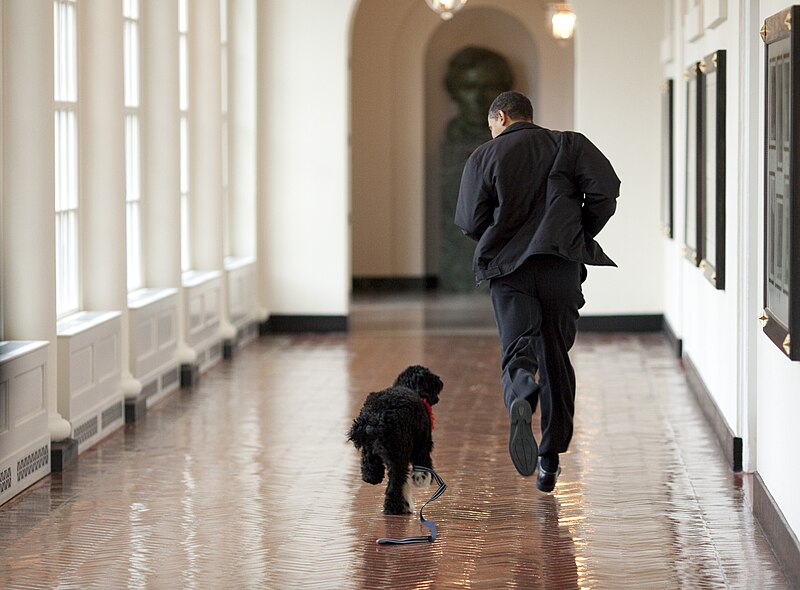
Bo and Obama running through the east wing of the White House
#7705
Photos Unlimited / Re: Bo Obama
October 13, 2015, 06:18:12 PM
April 11 2013 "Chuck Kennedy photographed the First Lady as she takes a 'selfie' with Bo, the Obama family dog, for National Geographic." (Official White House Photo by Chuck Kennedy)
#7706
Photos Unlimited / Re: Bo Obama
October 13, 2015, 05:55:22 PMImmediately after he arrived, the family staged a photo op with Bo on the property's South Lawn. At the conference, Obama was asked if he would allow Bo inside the Oval Office, to which he responded: "of course." He also gave a nod to President Harry Truman's quote, "If you want a friend in Washington, get a dog." The White House website was later updated to include official pictures and biographical details of Bo. (wikipedia)


President Barack Obama’s new dog, a Portuguese water dog named Bo, sniffs a microphone during his introduction to the White House press corps on the South Lawn of the White House April 14, 2009 in Washington, D.C. Photo by Chip Somodevilla/Getty
#7707
Photos Unlimited / Re: Bo Obama
October 13, 2015, 05:38:57 PMMuch was made by the public and press about the family's search for a dog. On April 12, 2009, it was announced that the Obamas would soon accept a six-month-old Portuguese Water Dog puppy as a gift from Senator Kennedy.
The dog was reported to have visited the family some weeks earlier in a secret meeting to gauge compatibility and purportedly referred to by staffers as "The Meeting". However, the gift was not accepted until the dog officially arrived and moved in at the White House on Tuesday, April 14, 2009. (wikipedia)

Bo wearing a lei upon his White House arrival
#7708
Photos Unlimited / Bo Obama
October 13, 2015, 05:33:31 PMBo (born October 9, 2008) is a pet dog of the Obama family, the First Family of the United States.

Official White House portrait of the First Dog (May 2009)
Bo is a neutered male Portuguese Water Dog. President Barack Obama and his family were given the dog as a gift after months of speculation about the breed and identity of their future pet. The final choice was made in part because Malia Obama's allergies dictated a need for a hypoallergenic breed. Bo has occasionally been called "First Dog". (wikipedia)
#7709
LGU Philippines / Re: Thread For Our Next National Administration
October 13, 2015, 04:48:01 PM
Young Bongbong... out of touch?
more at RETURN THE ILL-GOTTEN WEALTH FIRST, BONGBONG (#SAANGALINGANGPERAMO)
Posted by Joe America on October 10, 2015
http://joeam.com/2015/10/10/return-the-ill-gotten-wealth-first-bongbong-saangalingangperamo/
#7710
LGU Philippines / Re: Thread For Our Next National Administration
October 13, 2015, 03:23:04 PMQuote from: islander on October 13, 2015, 02:44:02 PM
The sheer breadth of the plunder, corruption and official wrongdoing represented on that stage by the assembled foursome would appear to have no equal in the world’s annals.
doing the math; alleged amount of plunder:
Ferdinand Marcos - at least $10 billion by 1986, equivalent to about $21.6 billion in 2014 dollars*
Joseph Estrada - $78 million to $80 million**
Juan Ponce Enrile - P172.8 million
*ranked world's no. 2 in order of amount stolen
**ranked world's no. 10
- 2004, the German anti-corruption NGO Transparency International, 2004
wikipedia
#7711
LGU Philippines / Re: Thread For Our Next National Administration
October 13, 2015, 02:46:31 PMAnd so he hasâ€"even now, just recently getting eight Supreme Court justices to release him from incarceration on plunder charges because he is supposedly too old and too sick to be in prison. A joke, of courseâ€"he marched back to the Senate upon release, and is now back not only on the campaign hustings, but also in the bosom of the Marcoses.
Everything you need to know about our greatest fault as a people is in that pictureâ€"principally, our inability to be angry for long at wrongdoing and wrongdoers, and to levy justice on them so that others of the same stripe would know that crime does not pay. That picture is an indictment of Marcos et al.’s sense of impunityâ€"and of our own hand in enabling them.
opinion.inquirer.net/
#7712
LGU Philippines / Re: Thread For Our Next National Administration
October 13, 2015, 02:45:40 PMThere’s Erap, too, raising Bongbong’s right handâ€"the first president impeached from office and convicted of plunder, who should have been expiating in prison for his crookedness while in Malacañang but for the Machiavellian pardon granted him by another widely perceived corrupt president.
And there was, wonder of wonders, Juan Ponce Enrile by Bongbong’s left side, the man who had instigated the rebellion leading to the People Power Revolt that would drive the Marcos family, his former bosses, out of the country. But that’s getting ahead of the story. Enrile was also the defense minister reported to have faked his own ambush to give Marcos another pretext for declaring martial law. Enrile was among the Marcos cronies seen to have amassed extensive hidden wealth, but, unlike them, he could switch sides at opportune moments to ensure that he survived.
#7713
LGU Philippines / Re: Thread For Our Next National Administration
October 13, 2015, 02:44:55 PMThe Marcos son, meanwhile, has invariably feigned ignorance about the excesses of his father’s rule, denying not only the documented deaths and/or disappearances of tens of thousands of people who were cut down by Marcos’ military machineâ€"in 1999, he even called them greedy and only after the money (“Basta’t may pag-asang magkapera, nagaaway-away na sila,†as he put it)â€"but also the billions stashed in Swiss bank accounts in his parents’ names. But, as Raissa Robles had reported in the South China Morning Post in 2011, Bongbong “had a direct hand in trying to withdraw $200 million from a secret family bank account with Credit Suisse in Switzerland.â€
Which means the son’s protestations of cluelessness are hogwash. He remains committed not only to perpetuating the whitewash of the dark, violent chapter his father had visited on the country, but, more sleazily, he has no compunction wallowing in the money his family had robbed from the Filipino people, whom he now thinks are dense and bovine enough to forgetâ€"so soonâ€"the crimes associated with his surname, and thereby make him their VP.
#7714
LGU Philippines / Re: Thread For Our Next National Administration
October 13, 2015, 02:44:02 PMThe sheer breadth of the plunder, corruption and official wrongdoing represented on that stage by the assembled foursome would appear to have no equal in the world’s annals. There, first of all, are the Marcos mother and son, heirs to an estimated $10 billion of illegal wealth looted from the treasury of the Philippines, which they have continued to flaunt with their high living and repeated runs for office, but for which they have, time and again, refused to apologize. Imelda herself has claimed that a raft of local business institutions from Meralco to PLDT to virtually whole industries of the economy are hers and her family’s; but she has yet to stay a day in prison for such willful, on-record admissions of unexplained wealth.
#7715
LGU Philippines / Re: Thread For Our Next National Administration
October 13, 2015, 02:41:58 PMThe truly discerning would have heard some odd cosmic noises rising to the surface when that picture first began making the rounds of social mediaâ€"first, the snickering of the rest of the world at the incredulous spectacle of the family that, not too long ago, ran the Philippines to the ground being allowed to make a comeback of any sort on the political stage, and apparently without having to bat a single remorseful eyelash; and, second, the mass disruption that must have occurred underground as Ninoy Aquino, Jose Diokno, Edgar Jopson and some 30,000 other victims of the Marcoses’ martial law collectively turned in their grave and gnashed their teeth at the sight.
#7716
LGU Philippines / Re: Thread For Our Next National Administration
October 13, 2015, 02:41:12 PM
EDITORIAL
Instructive picture
Philippine Daily Inquirer
October 13th, 2015
THAT THE Philippines is the land of the strange and the surrealâ€"of women who give birth to fish and lawmakers who propose laws to ban typhoonsâ€"is once again reaffirmed with that truly remarkable picture of Sen. Bongbong Marcos joined onstage by former president and now Manila Mayor Erap Estrada, Sen. Juan Ponce Enrile, and his mother, former first lady Imelda Marcos, as they endorse his bid for the vice presidency in the 2016 polls.

#7718
History / Re: Pascual Racuyal
October 13, 2015, 03:20:51 AMone of racuyal's election pledges:
Air-condition the whole of Metro Manila to spare residents the tropical heat to which it is subjected 10 months of every year.
#7719
History / Re: Pascual Racuyal
October 13, 2015, 02:51:16 AMTHE STRANGE AND SAD CAREER OF PASCUAL RACUYAL
a lecture by Dr. Resil Mojares, 26 January (Monday), 4:30-6:00 pm, Faura AVR
The lecture revisits the mostly forgotten story of Pascual Racuyal, the quixotic “nobody†who ran for Philippine president in elections from 1935 to 1986, challenging incumbents from Quezon to Marcos. Commonly cited as the iconic “nuisance†candidate, Racuyal (the lecture argues) deserves more respectful remembrance, as the sad clown who appears on stage to show up the idiocy and farce that characterize much of Philippine politics itself.
The lecture is the fifth in the series as part of the of the master visiting teacher program of the School of Humanities, Ateneo de Manila University.

Resil B. Mojares is the author of Origins and Rise of the Filipino Novel (1983), The War against the Americans (1999), Waiting for Maria Makiling (2002), Brains of the Nation (2006), and Isabelo's Archives (2013), among other books in Philippine history, culture, and literature. In 2013 he was given the Tanglaw ng Lahi award by the Ateneo de Manila University.
#7720
History / Re: Pascual Racuyal
October 13, 2015, 02:48:03 AMUnlike Harold Stassen, the former Minnesota governor whose repeated runs for the American presidency earned him renown of a similar nature, Racuyal, a mechanic by profession, was never a credible political figure at any point in his life. His final attempt at the presidency in 1986 was thwarted after the Commission on Elections disqualified him as a “nuisance candidateâ€.
wikipedia/
pascual racuyal had appeared earlier, in 2009, here in tubagbohol.
http://tubagbohol.mikeligalig.com/politics/kinsay-nakaabot-pa-ni-pascual-racuyal/
#7721
History / Re: Pascual Racuyal
October 13, 2015, 02:47:37 AMThere were questions as to Racuyal’s mental stability. Among his promises should he be elected to the presidency was to construct roads out of plastic to prevent their further deterioration. When he invited Manila Mayor Arsenio Lacson to be his running mate in the 1953 presidential elections, the latter called Racuyal “strictly fiction, utterly fantastic and incredibleâ€. Nonetheless, as time passed, his repeated candidacy provided for an amusing mild diversion to a frequently heated election atmosphere.
#7722
History / Pascual Racuyal
October 13, 2015, 02:46:46 AM
Pascual B. Racuyal (fl. 1986) was a Filipino eccentric and aspirant for the Philippine presidency, whose perseverance despite total lack of success at that venture earned him folk status. Racuyal sought the presidency in every Philippine presidential election beginning in 1935 (against Manuel L. Quezon and Emilio Aguinaldo) until 1986 (against Ferdinand Marcos and Corazon Aquino).
#7723
LGU Philippines / Re: 10 things we should know about Philippine elections
October 12, 2015, 07:19:29 PMThis is not an exhaustive list; it could be expanded to 50 things about Philippine elections. Perhaps we can end with the question: is it more fun with Philippine elections? The response will be mixed. We do not a have a porn star-member of the Italian parliament who delivers her speeches with a breast exposed. We do not have brawling parliamentarians as in Taiwan and South Korea. On the other hand, our elections are fun! We love our elections! Elections are fiestas, extravaganzas, spectator sports, boxing bouts, and cockfights all rolled into one. There are movie stars, starlets, stand-up comics, and dance troupes galore. And there’s food and drink. And cash gifts! Reportage on elections reflect these metaphors. Now you know why a lot of Filipinos want elections to happen annually rather than every three years.
(from a 21 March 2013 article by Amado “Bong†Mendoza Jr., professor of Political Science & International Studies in UP Diliman. He has published extensively on Philippine politics, political economy, ASEAN and the former Soviet Union.)
abs-cbnnews.com
#7724
LGU Philippines / Re: 10 things we should know about Philippine elections
October 12, 2015, 07:18:42 PM10. One thing that political dynasties have going for them is that they are better able to handle the ever-rising costs of elections. Key considerations are population growthâ€"the growth of the voting populationâ€"and the rather fixed length of the electoral campaign period. In the past, candidates (especially those for national posts) thought it was adequate to rely on hand-shaking, posters, flyers, city-hopping, and miting-de-avance to win. However, the increased number of voters and the fixed campaign period forced candidates to use television and radio as the primary campaign tools. Not that the mass media corporations are complaining. They are in fact so happy since a previous ban on electronic campaigning was lifted. The increased prominence of electronic media in Philippine elections raises serious questions regarding election campaign finance and electronic campaigning. If TV and radio presence is a function of a candidate’s money, if TV and radio presence enhances a candidate’s name recall and chances of winning, what rules are being implemented regarding these activities? Are they adequate? What reforms are needed?
#7725
LGU Philippines / Re: 10 things we should know about Philippine elections
October 12, 2015, 07:16:07 PM9. The Philippine Constitution explicitly prohibits political dynasties. However, the same constitutional provision is not self-executory and requires that an enabling law must be passed. However, all attempts to pass such a law have failed so far, and understandably so since most legislators are members of what could be rightly called political dynasties. The current by-elections can lead to the consolidation of several political dynasties associated with the biggest and brightest names in Philippine politicsâ€"Aquino, Angara, Enrile, Cojuangco, Escudero, Binay, etc. The political dynasty issue is rather a complicated one. Proponents of banning or controlling political dynasties argue that it will strengthen Philippine democracy by broadening choice of candidates and removing the undue advantages of dynasties (wealth, experience, exposure, and name recall, among others). Those who would advise caution think an anti-dynasty law is actually an unconstitutional provision. It violates the equal treatment clause of the Constitution. Why should a son or daughter or a brother or a grandson or an uncle be prohibited from contesting an electoral post because a relative is in power? What would justify discriminatory treatment?

#7726
LGU Philippines / Re: 10 things we should know about Philippine elections
October 12, 2015, 07:13:53 PM8. The other way around term-limits is to field relatives (wife, husband, son, daughter, etc.) for the soon-to-be vacated post(s). This could just be a bench-warming strategy; the relative keeps the post for a three-year term until the principal is eligible once more to run for the post. However, it could also be an expansionist strategy. The ‘bench-warmer’ had gained valuable experience and exposure; these assets could be parlayed into another electoral post. These circumstances can explain the origins of political dynasties in the Philippines. Let’s recall the case of former President Gloria Macapagal-Arroyo. Arroyo hunkered into a survival strategy after her electoral mandate was put into serious question after the 2005 ‘Hello Garci’ scandal. The strategy apparently covered the post-presidency period and Arroyo ran for a congressional seat in her home province to acquire a modicum of immunity. During her incumbency as President, that same seat was occupied by one of her sons. To accommodate her, the son did not contest the same seat but chose to run for another post instead. The filial ties between mother and son were key to this unprecedented post-presidential survival strategy.

#7727
LGU Philippines / Re: 10 things we should know about Philippine elections
October 12, 2015, 07:12:33 PM7. In candidate-centered polities like the Philippines, the differences between legislators and local chief executives are blurred. Voters and politicians alike do not consider legislation as the primary work of legislators. If a legislator behaved as a pure legislator and concentrated on making laws, he will most likely not be re-elected. Voters will see him as a useless politician since he did not ‘bring home the bacon’. The legislator must behave like local chief executives (LCEs), as provincial governors, city and town mayors, and even barangay captains, who must deliver divisible goods. For this reason, among others, legislators and LCEs had seen it fit to play a game of electoral musical chairs especially since the enactment of the Local Government Code (LGC) in 1991. Through the 1991 LGC, funds available to LCEs of some local government units (LGUs) became more substantial than those of congressional district representatives. However, a better explanation for this behavior is the term-limit rule. Representatives and LCEs can only serve for three consecutive terms of three years each. The ability to run for other electoral posts helps politicians with expiring terms to maintain their hold on political power.

#7728
LGU Philippines / Re: 10 things we should know about Philippine elections
October 12, 2015, 07:10:03 PM6. The discussion above highlights the difference between candidate-centered vs. party-centered electoral systems. In party-centred polities, political parties choose their candidates through primaries, party conventions and caucuses. In these polities, party discipline prevails; party members follow the party (voting) line in legislative bodies. It is unthinkable for politicians to switch parties like butterflies flitting from a flower to another. In sum, what is important is the political party as a ‘brand’. It stands for somethingâ€"an ideology, a political programâ€"and its leaders and members are secondary. Votes are cast for a politician because he is strongly associated with a party ‘brand’. In contrast, parties are not strong ‘brands’ in candidate-centered systems. Candidates are the ‘brands’ and political parties are just extraneous packaging or wrappings that may be changed in the next election. The candidate does not need an ideology or a political program. Rather, he must have a reputation of performanceâ€"of providing divisible favors to constituents, supporters, and financiers such as hand-outs, jobs, infrastructure projects, and preferential treatment by government such as exemptions and special credits. He then claims that these ‘public goods’ were made possible by his ‘private performance’. Thus, the ubiquitous presence of ‘Epal[1] tarps’ in all corners of archipelago make sense.

#7729
LGU Philippines / Re: 10 things we should know about Philippine elections
October 12, 2015, 07:08:27 PM5. At the end of an election (general or otherwise), political alignments will either be with or against the incumbent administration. There is no rule prohibiting those who styled themselves as opposition candidates and won to join the pro-administration coalition after the elections. The move is explained as a way to ensure funds for district projects, the idea being the President is more inclined to approve projects if they were proposed by political allies rather by political opponents. Sometimes, it does not work in such a neat way. Presidents may court the critical votes of opposition politicians by providing pork barrel allocations and other forms of patronage.

#7730
LGU Philippines / Re: 10 things we should know about Philippine elections
October 12, 2015, 07:06:18 PM4. The Philippine Constitution provides for a multi-party system, which is actually more fit for a parliamentary system. While multiple parties exist in name, most of them are mere vehicles for electoral bids of key politicians. There is no prohibition on party switching and voters do not penalize politicians who switch parties. For example, the senatorial slate of President Benigno Aquino is composed of candidates from several political parties. The opposition line-up is similarly constituted by politicians from different parties. What makes the situation rather absurd is the adoption by the opposing coalitions of three guest candidates. It is an indication of the bankruptcy and lack of imagination on both sides. There is surely no lack of suitable candidates on both camps but they decided instead to guest ‘sure-win’ candidates. In the past week, so-called guest candidates chose to campaign with the administration candidates. This prompted threats from the opposition coalition that it will no longer carry said guest candidates followed by inane ripostes from some of the ‘guests’ that their loyalty is to the Filipino people and not to any political coalition.

#7731
LGU Philippines / Re: 10 things we should know about Philippine elections
October 12, 2015, 07:03:51 PM3. Even if the Philippines is the oldest democracy in Asia, it took more than a century to modernize the way we vote and count votes. Younger Asian democracies (with larger populations) like India had started using electronic voting machines since 1999. In contrast, the Philippines adopted similar machines on a nation-wide basis only in 2010. In both countries, though, the credibility of the voting machines rests on an independent verification system designed to allow voters verify that their votes were cast correctly, to detect possible election fraud or malfunction, and to provide a means to audit the stored electronic results. Since every election in the Philippines is governed by a specific law, the continued use of voting machines is not assured.

#7732
LGU Philippines / Re: 10 things we should know about Philippine elections
October 12, 2015, 07:01:08 PM2. There are only two kinds of politicians in Philippine elections: the winners and the cheated. Instead of conceding gracefully, the default behaviour of losing candidate is to claim the occurrence of fraud in favour of the winning candidate.

#7733
LGU Philippines / 10 things we should know about Philippine elections
October 12, 2015, 07:00:03 PM10 things we should know about Philippine elections
by Amado M. Mendoza, Jr.
03/21/2013
1. Even if the Philippines is in the tropics, it also has four seasons like temperate countries. It has a dry and a wet season. And there’s the Christmas seasonâ€"purportedly the longest Christmas celebration in the world. It starts in September and ends in early January of the following year. Last but not least is the election season, which starts in January and ends in the middle of May. Note that the election season almost immediately follows Christmas for a seamless stream of festivities. Formally, elections are held only every three years. However, politicians (incumbents especially) usually behave as if elections will be held tomorrow. So they preen, and they tidy up, and they put their best foot forward, and dispense all kinds of goodies to constituents.
#7734
LGU Philippines / Re: Thread For Our Next National Administration
October 12, 2015, 05:47:08 PM‘Enrile overstaying’
While the aspirants presented different platforms, they were united in saying that the Senate badly needed new blood.
“Why have elections if we’re going to see the same old faces?†asked Daniel Magtira, the self-proclaimed husband of Kris Aquino, eliciting applause from those present.
He wore a bow tie with a pin that read: “Sen. Magtira.â€

Arsenio Dimaya, a native of Cagayan who promised to supply Filipinos with vegetables if elected, said he wouldn’t mind winning the Senate presidency.
“You’re also from Cagayan, like the Senate President (Juan Ponce Enrile) … Aren’t you afraid about replacing him?†Brillantes asked.
“There has been so little change in the Senate. (Enrile) is already overstaying,†Dimaya replied.
Someone from the gallery shouted: “Give others a chance!â€
Read more: http://newsinfo.inquirer.net/291646/comelec-hears-out-kris-hubby-25-other-oddballs#ixzz3oLRNiBhU
Follow us: @inquirerdotnet on Twitter | inquirerdotnet on Facebook
#7735
LGU Philippines / Re: Thread For Our Next National Administration
October 12, 2015, 05:44:55 PMGoing back home
Brillantes corrected him and said Comelec commissioners preferred to be addressed “Your Honor†rather than “Your Excellency†because “the number of Presidents here might suddenly increase.â€
“But that’s just right for you because your hair is so white,†Fernandez said and, eliciting laughter, added unexplainably: “Kami papunta pa lang, kayo pauwi na (We are just moving on while you are on your way back home).â€
Brillantes replied in jest that he didn’t want to be going home yet.
Each candidate spoke for six minutes on average with the commissioners questioning them on their political views, background and capability to wage a senatorial campaign across the country.

white-haired comelec chairman sixto brillantes jr. ain't goin' home yet
#7736
LGU Philippines / Re: Thread For Our Next National Administration
October 12, 2015, 05:34:36 PMWhite House link
Retiree Eduardo Fernandez all but went down on his knees to beg the Comelec to allow him to run for the Senate.
“I have an online (connection) to the White House. I’ve e-mailed President Obama to ask that we become a US state, like Hawaii or (the US territory) Puerto Rico,†Fernandez said.
Brillantes replied: “I’d pity President Obama if we become a state. We’re too many.â€
But Fernandez said he wanted his grandchildren to have a better life, adding the Philippines was going nowhere because of graft and corruption.
“If I have to kneel, I would, just so I can push for our US statehood … Thank you, Your Excellency,†he said.
#7737
LGU Philippines / Re: Thread For Our Next National Administration
October 12, 2015, 05:33:15 PMApology to Portugal
Among those who showed up was Orlando Suerte, who said he was an employee of the Land Transportation Office conducting seminars for future drivers.
“We should write a letter of apology to the people of Portugal for the death of Magellan,†Suerte saidâ€"referring to the 16th-century Portuguese explorerâ€"when asked about his platform.
He also wanted to change the date of Philippine Independence Day and change the Spanish-sounding surnames of Filipinos, which have “negative meanings.â€
“Surnames like Estupido or Microbio. Generations of Filipinos shouldn’t suffer under those surnames,†said Suerte, whose name means “lucky†in Spanish.
Brillantes joked: “Maybe you also want to ban ‘Malas (unlucky)’ or change these surnames to Filipino, like Puno (tree) … or Sanga (branch), Ugat (root), or Dahon (leaf).â€
#7738
LGU Philippines / Re: Thread For Our Next National Administration
October 12, 2015, 05:31:00 PMthrowback 2012; wish there are more of them.

Oddball election candidates
(excerpts from http://newsinfo.inquirer.net/)
‘Why not try us?’
Brillantes and Commissioners Rene Sarmiento, Grace Padaca, Lucenito Tagle and Armando Velasco patiently posed questions to the hopefuls during the marathon hearing.
Seventeen aspirants out of a total of 43 that were scheduled to appear Thursday failed to show up. Brillantes said the aspirants would be considered nuisance candidatesâ€"and, therefore, eliminatedâ€"unless they could convincingly explain their absence.
Brillantes repeatedly asked the aspirants if they were happy with the performance of the Senate.
“Aren’t you happy with Senator (Lito) Lapid?†Brillantes asked aspirant Elizabeth Capular, a nurse.
Capular said she was satisfied with Lapid but added: “Let new ones participate. Why not try us?â€
#7739
Talk of the Town / Re: China anxious over alleged US plan to challenge island claim
October 12, 2015, 03:47:45 PMSpeaking in July, commander of the U.S. Pacific Fleet Adm. Scott Swift said Washington does not recognize any of the territorial claims and its position won't change even if disputed areas are reinforced by construction work.
"We recognize those claims as being contested and the contested nature of those claims is unchanged despite the reclamation efforts of any country, any country, not just China," Swift said.
http://news.yahoo.com/
#7740
Talk of the Town / Re: China anxious over alleged US plan to challenge island claim
October 12, 2015, 03:45:49 PMIt's not clear how China might respond to such an action, although Beijing issued a formal protest over an incident in May in which a Chinese navy dispatcher demanded eight times that a U.S. Navy P8-A Poseidon surveillance aircraft leave the area as it flew over Fiery Cross Reef, where China has conducted extensive reclamation work.
The U.S. crew responded that they were flying through international airspace.
The U.S. and its allies, including the Philippines, have repeatedly called on China to stop the massive island construction, saying it has increased tensions in an increasingly militarized area and threatened regional stability. They say the project, which includes the construction of buildings, ports and airstrips, violates a 2002 regional pact signed by Beijing which urges rival claimants not to undertake new construction or take any step that would worsen tensions.
#7741
Talk of the Town / Re: China anxious over alleged US plan to challenge island claim
October 12, 2015, 03:45:02 PM
China and the U.S. have discussed the issue on numerous occasions, including during President Xi Jinping's state visit to Washington last month, Hua said.
"We hope the U.S. can look upon the current situation of the South China Sea from an objective and fair perspective and play a constructive role together with China in keeping the peace and stability in the South China Sea," Hua said.
The Navy Times report said rumors have been circulating since May about plans to send a ship through China's claimed territorial waters. It cited three Pentagon officials speaking on background as saying that Navy officials now believe "approval of the mission is imminent."
#7742
Talk of the Town / Re: China anxious over alleged US plan to challenge island claim
October 12, 2015, 03:40:33 PMFive other governments also claim the region in part or in total. The U.S. doesn't take a formal position on sovereignty but insists on freedom of navigation in the vital sea lanes and airspace above.
Asked about the report at a daily briefing, Chinese Foreign Ministry spokeswoman Hua Chunying said China has long made clear its position on the South China Sea, which Beijing claims virtually in its entirety, along with its islands, reefs and atolls.
"I have not noticed the latest report you have mentioned. However, having heard what you said, we express serious concern about it," Hua said.
#7743
Talk of the Town / China anxious over alleged US plan to challenge island claim
October 12, 2015, 03:39:36 PMChina anxious over alleged US plan to challenge island claim
Associated Press By CHRISTOPHER BODEEN
October 8, 2015 7:14 AM
BEIJING (AP) â€" Beijing expressed "serious concern" Thursday about a reported U.S. plan to challenge China's South China Sea territorial claims by sailing a Navy ship near one of its newly built artificial islands.
The U.S. newspaper Navy Times reported on Wednesday that the Navy may soon receive approval for the mission to sail inside the 12-nautical mile (21-kilometer) territorial limit surrounding one of the man-made structures.
That would drive home Washington's stance that the artificial islands do not constitute sovereign territory and build a legal case under international law for the U.S. position, the newspaper said.
#7744
Photos Unlimited / Re: 2015 News Images
October 12, 2015, 02:25:21 PM
In this image made from video provided by Hadi Al-Abdallah, which has been verified and is consistent with other AP reporting, smoke rises after airstrikes in Kafr Nabel of the Idlib province, western Syria. Russian jets carried out a second day of airstrikes in Syria, but there were conflicting claims about whether they were targeting Islamic State and al-Qaeda militants or trying to shore up the defenses of President Bashar Assad. (AP/VoA)
#7745
Photos Unlimited / Re: 2015 News Images
October 12, 2015, 02:17:51 PM
A Palestinian is pushed an Israeli policemen amid clashes in Hebron, West Bank, Saturday, Oct. 10, 2015. A Palestinian teenager stabbed two Israelis in Jerusalem Saturday before being shot dead by police forces, the latest in a series of stabbing attacks against civilians and soldiers that have spread across Israel and the West Bank in the past week. The violence, including the first apparent revenge attack by an Israeli Friday and increasing protests by Israel's own Arab minority, has raised fears of the unrest spiraling further out of control. (AP Photo/Nasser Shiyoukhi)
#7746
Photos Unlimited / Re: 2015 News Images
October 12, 2015, 01:51:02 PM
Tibetan spiritual leader the Dalai Lama arrives at a Tibetan school, his first public function after his return last week from Minnesota in the United States where he had a thorough medical checkup, in Dharmsala, India, Saturday, Oct. 10, 2015. The Dalai Lama says he considers it most important to preserve the Buddhist culture that has helped Tibetan people live together even in exile. Many Tibetans fear that their culture may not endure for long and may weaken after the Dalai Lama is gone. (AP Photo/Ashwini Bhatia)
#7747
Photos Unlimited / Re: 2015 News Images
October 12, 2015, 01:49:36 PM
A man cries over the body of a victim, at the site of an explosion in Ankara, Turkey, Saturday, Oct. 10, 2015. The two bomb explosions targeting a peace rally in the capital Ankara has killed dozens of people and injured scores of others. The explosions occurred minutes apart near Ankara's main train station as people were gathering for the rally, organized by the country's public sector workers' trade union and other civic society groups. The rally aimed to call for an end to the renewed violence between Kurdish rebels and Turkish security forces. (AP Photo/Burhan Ozbilici)
#7748
Photos Unlimited / Re: 2015 News Images
October 12, 2015, 01:48:45 PM
Consumer rights activists take part in a march to protest against the Transatlantic Trade and Investment Partnership (TTIP), mass husbandry and genetic engineering, in Berlin, Germany, October 10, 2015. The European Union is pursuing a trade accord with the United States, called the Transatlantic Trade and Investment Partnership (TTIP), that would encompass a third of world trade and nearly half of global GDP. REUTERS/Fabrizio Bensch TPX IMAGES OF THE DAY
#7749
Photos Unlimited / Re: 2015 News Images
October 12, 2015, 01:46:08 PM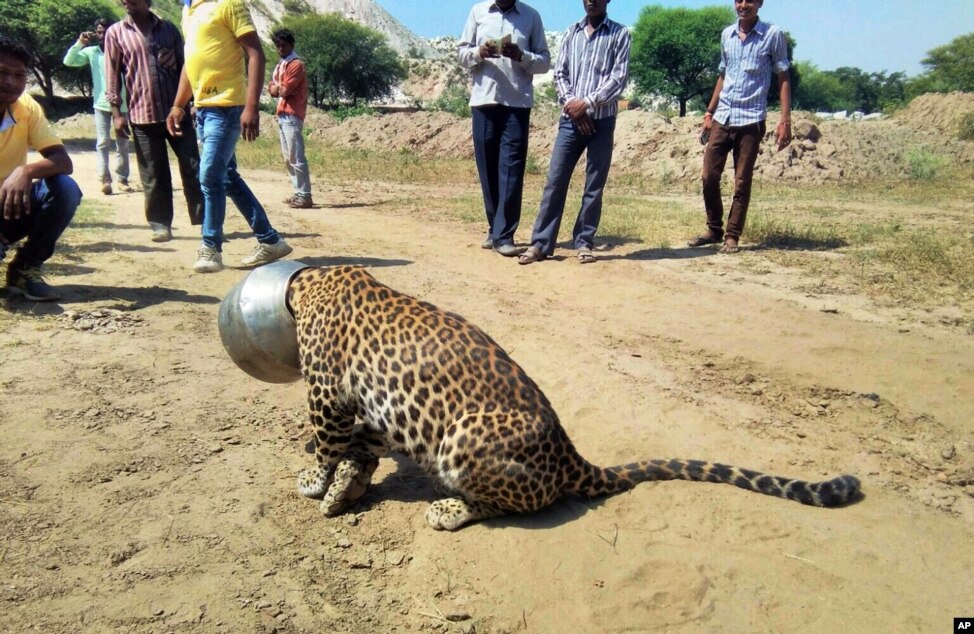
A leopard’s head gets stuck when it attempts to drink water from a pot in Rajsamand district of Rajasthan state, India. Forest officials tranquilized the animal and sawed off the pot later in the day. (VoA/AP)
#7750
Photos Unlimited / Re: 2015 News Images
October 12, 2015, 01:44:00 PM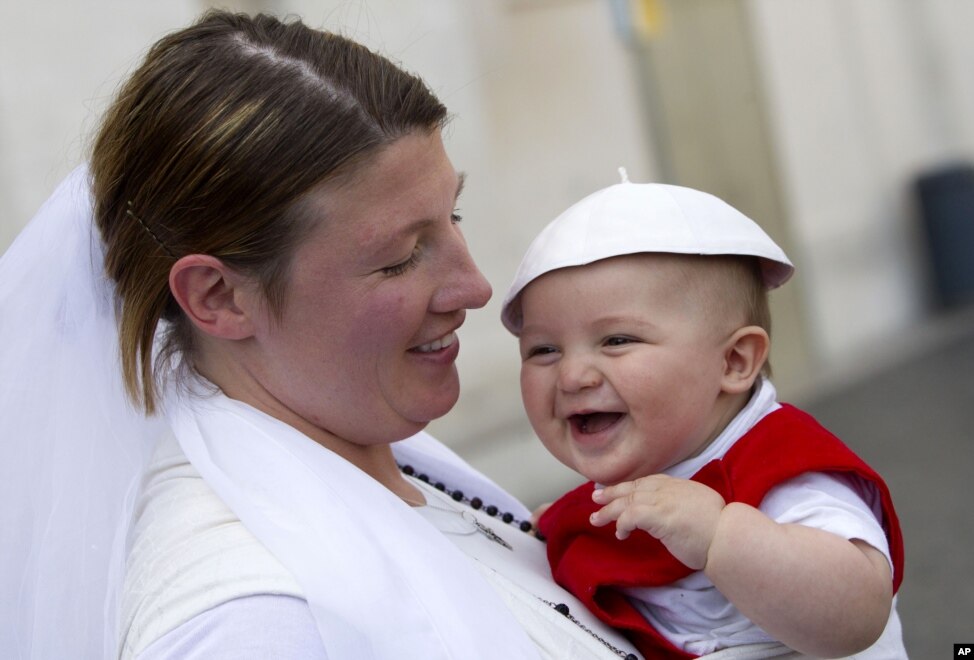
A woman holds a baby wearing a white skull cap, at the end of Pope Francis' weekly general audience, in St. Peter's Square, at the Vatican. (VoA/AP)
#7751
Photos Unlimited / Re: Mountains and castles in the air and clouds and mists
October 12, 2015, 01:30:26 PM Neuschwanstein Castle shrouded in mist in the Bavarian Alps of Germany.
#7752
Photos Unlimited / Re: Mountains and castles in the air and clouds and mists
October 12, 2015, 01:22:36 PM
Hohenzollern Castle in clouds. Zeller Horn, Germany, 2005. Photo by Robin Holler
#7753
Photos Unlimited / Re: Mountains and castles in the air and clouds and mists
October 12, 2015, 01:19:16 PM
Fort de Joux, Jura Mountains, France
#7754
Photos Unlimited / Re: Mountains and castles in the air and clouds and mists
October 12, 2015, 01:17:31 PM
Takeda Castle, Japan’s Breathtaking Castle in the Sky
#7755
Photos Unlimited / Mountains and castles in the air and clouds and mists
October 12, 2015, 01:01:01 PM
Stirling Castle is seen above morning mist in Scotland. (VoA/Reuters)
#7756
Tira-Pasagad | Saksak-Sinagol / Re: Shoe Boat
October 12, 2015, 11:23:27 AMi'll wait for the stilleto-heeled design.
#7757
General Topic / Re: Competing claims on the fortune cookie
October 11, 2015, 07:25:33 PM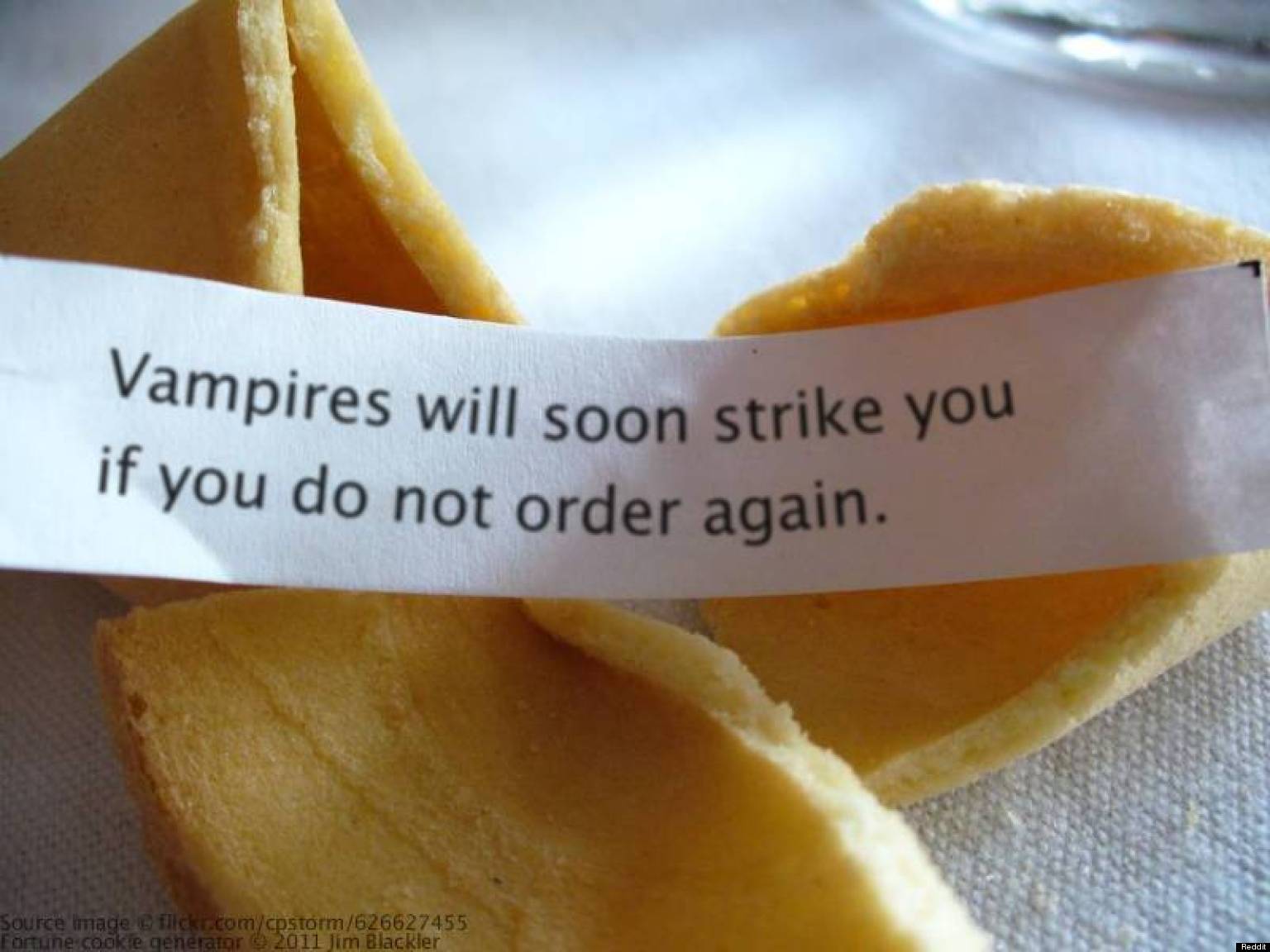
images of fortunes from various online sources. okay, okay, i may be a vampire, but i couldn't find my removable false teeth as yet. it must be inside one of those cookies...


#7761
General Topic / Re: Competing claims on the fortune cookie
October 11, 2015, 07:19:53 PM
Happily ever after
#7762
General Topic / Re: Competing claims on the fortune cookie
October 11, 2015, 07:19:29 PM
how profound!


#7768
General Topic / Re: Competing claims on the fortune cookie
October 11, 2015, 06:59:46 PMChinese legend
Rumors that fortune cookies were invented in China are seen as false. In 1989, fortune cookies were reportedly imported into Hong Kong and sold as "genuine American fortune cookies". Wonton Food attempted to expand its fortune cookie business into China in 1992, but gave up after fortune cookies were considered "too American".
Many view the mooncake hidden message system that was used in the Ming revolution to be a precursor to the modern day fortune cookie. By adding the covert element to the myths of the fortune cookie some have found more meaning behind the simple treat. This led to the act of removing and replacing the fortune inside without breaking for an added bit of good luck. (wikipedia)
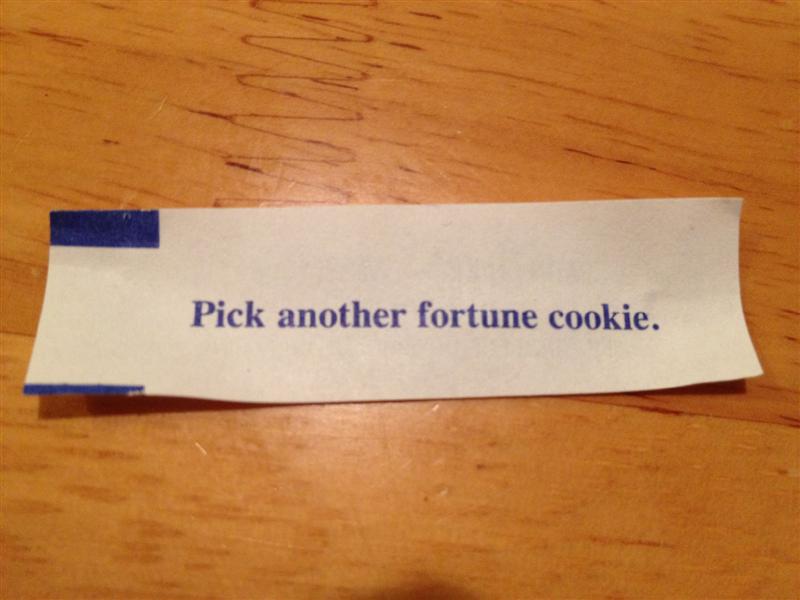
ohhh...
#7769
General Topic / Re: Competing claims on the fortune cookie
October 11, 2015, 06:51:35 PMFortune cookies moved from being a confection dominated by Japanese-Americans to one dominated by Chinese-Americans sometime around World War II. One theory for why this occurred is because of the Japanese American internment during World War II, which forcibly put over 100,000 Japanese-Americans in internment camps, including those who had produced fortune cookies. This gave an opportunity for Chinese manufacturers.

Hot fortune cookies being folded around paper fortunes
Fortune cookies before the early 20th century, however, were all made by hand. The fortune cookie industry changed dramatically after the fortune cookie machine was invented by Shuck Yee from Oakland, California.[9] The machine allowed for mass production of fortune cookies which subsequently allowed the cookies to drop in price to become the novelty and courtesy dessert many Americans are familiar with after their meals at most Chinese restaurants today. (wikipedia)

#7770
General Topic / Re: Competing claims on the fortune cookie
October 11, 2015, 06:43:53 PMSubsequently, the city of Los Angeles condemned the decision.
Seiichi Kito, the founder of Fugetsu-do of Little Tokyo in Los Angeles, also claims to have invented the cookie. Kito claims to have gotten the idea of putting a message in a cookie from Omikuji (fortune slip) which are sold at temples and shrines in Japan. According to his story, he sold his cookies to Chinese restaurants where they were greeted with much enthusiasm in both the Los Angeles and San Francisco areas. Thus Kito's main claim is that he is responsible for the cookie being so strongly associated with Chinese restaurants.

Some fortunes for or from fortune cookies
Up to around World War II, fortune cookies were known as "fortune tea cakes"â€"likely reflecting their origins in Japanese tea cakes. (wikipedia)
#7771
General Topic / Re: Competing claims on the fortune cookie
October 11, 2015, 06:39:27 PMAs many of the people who claim to have introduced the cookie to the United States are Japanese, the theory is that these bakers were modifying a cookie design they were aware of from their days in Japan.
Makoto Hagiwara of Golden Gate Park's Japanese Tea Garden in San Francisco is reported to have been the first person in the USA to have served the modern version of the cookie when he did so at the tea garden in the 1890s or early 1900s. The fortune cookies were made by a San Francisco bakery, Benkyodo.

Unusual non-positive aphorism found in a fortune cookie
David Jung, founder of the Hong Kong Noodle Company in Los Angeles, has made a competing claim that he invented the cookie in 1918. San Francisco's mock Court of Historical Review attempted to settle the dispute in 1983. During the proceedings, a fortune cookie was introduced as a key piece of evidence with a message reading, "S.F. Judge who rules for L.A. Not Very Smart Cookie".
A federal judge of the Court of Historical Review determined that the cookie originated with Hagiwara and the court ruled in favor of San Francisco. (wikipedia)
#7772
General Topic / Re: Competing claims on the fortune cookie
October 11, 2015, 06:29:58 PMOrigin
As far back as the 19th century, a cookie very similar in appearance to the modern fortune cookie was made in Kyoto, Japan; and there is a Japanese temple tradition of random fortunes, called o-mikuji.

An opened fortune cookie
The Japanese version of the cookie differs in several ways: they are a little bit larger; are made of darker dough; and their batter contains sesame and miso rather than vanilla and butter.
They contain a fortune; however, the small slip of paper was wedged into the bend of the cookie rather than placed inside the hollow portion. This kind of cookie is called tsujiura senbei and is still sold in some regions of Japan, especially in Kanazawa, Ishikawa as the lucky items to start Happy New Year. It is also sold in the neighborhood of Fushimi Inari-taisha shrine in Kyoto. (wikipedia)
#7773
General Topic / Re: Competing claims on the fortune cookie
October 11, 2015, 06:22:13 PMA fortune cookie is a crisp cookie usually made from flour, sugar, vanilla, and sesame seed oil with a piece of paper, a "fortune", on which is an aphorism, or a vague prophecy. The message inside may also include a Chinese phrase with translation or a list of lucky numbers used by some as lottery numbers, some of which have become actual winning numbers.

An unopened fortune cookie
Fortune cookies are often served as a dessert in Chinese restaurants in the United States and some other countries, but are absent in China. The exact origin of fortune cookies is unclear, though various immigrant groups in California claim to have popularized them in the early 20th century. (wikipedia)
#7774
General Topic / Competing claims on the fortune cookie
October 11, 2015, 06:17:01 PMapropos an item in another thread here...
Quote from: islander on October 11, 2015, 05:31:59 PM
CHINESE FORTUNE COOKIES
Were not Chinese but Californian, created by local Chinese in the Gold Rush of 1849. When they were introduced into China in the 1990s they were sold as “Genuine American Fortune Cookiesâ€.
Made in China?
- See more at: http://tubagbohol.mikeligalig.com/all/23-little-known-facts-you-probably-didn't-know/#sthash.k7KXfu3w.dpuf
#7775
General Topic / Re: 23 little known facts you probably didn't know
October 11, 2015, 05:34:35 PMAND FINALLY...
What creature did the worst damage to the atmosphere since the beginning of the Earth?
A man called Thomas Midgley Jnr. (1889-1944). The US chemist not only developed the lead additive to improve engine performance but also the first chlorofluoroÂcarbon for refrigeration which he called Freon.
mirror.co.uk/
#7776
General Topic / Re: 23 little known facts you probably didn't know
October 11, 2015, 05:33:50 PMAPT AFTERLIFE
Fredric John Baur, who designed the Pringles can for crisps, had his ashes buried in one in 2008.
#7777
General Topic / Re: 23 little known facts you probably didn't know
October 11, 2015, 05:33:21 PMWHAT SOUND OF MUSIC?
When all-time hit musical The Sound of Music first arrived as a film in South Korea, one cinema owner found it too long for his programme.
So he shortened it by cutting out all the uninterestÂÂing (to him) musical scenes, keeping the story line about the escaping nun and family intact.

One of the rubbish bits from The Sound Of Music
#7778
General Topic / Re: 23 little known facts you probably didn't know
October 11, 2015, 05:32:33 PMGREAT KINGS
Each playing card king is said to show a great historic ruler. Spades - King David, Clubs - Alexander the Great, Hearts â€" Charlemagne, Diamonds â€" Caesar.
#7779
General Topic / Re: 23 little known facts you probably didn't know
October 11, 2015, 05:31:59 PMCHINESE FORTUNE COOKIES
Were not Chinese but Californian, created by local Chinese in the Gold Rush of 1849. When they were introduced into China in the 1990s they were sold as “Genuine American Fortune Cookiesâ€.

Made in China?
#7780
General Topic / Re: 23 little known facts you probably didn't know
October 11, 2015, 05:30:54 PMSHOE SIZE
Where do those strange numbers originate? In Britain, shoe size is measured in barleycorns â€" a medieval unit which defines an inch as three barleycorns.
#7781
General Topic / Re: 23 little known facts you probably didn't know
October 11, 2015, 05:28:07 PMTHE GIFT OF GUM
Wrigley, the chewing gum firm, originally made baking powder and started giving away free sticks of chewing gum with it. The customers preferred the gimmick to the original product and so a multi-million dollar global business was born.

Chew'd have thunk it
#7782
General Topic / Re: 23 little known facts you probably didn't know
October 11, 2015, 05:27:27 PMTHE WRIGHT STUFF
A Boeing 747-400 has six million parts, 147 miles of wiring and a wingspan about twice as long as the Wright Brothers’ first flight.
#7783
General Topic / Re: 23 little known facts you probably didn't know
October 11, 2015, 05:26:48 PMTHE SLUSH FUND
The poor-quality meat, such as salted beef or cheap pork, which was boiled up in large tureens by cooks on ships, caused a fatty scum known as slush to float to the top. This was skimmed off and kept in a barrel. Ashore, the fatty slush was sold to make soap. The resulting slush fund was divided up among the crew.
#7784
General Topic / Re: 23 little known facts you probably didn't know
October 11, 2015, 05:26:01 PMCAULIFLOWER CREAK
Campers in Cornwall are sometimes kept awake by “cauliflower creak†â€" the noise the vegetables make at their peak growing season.
#7785
General Topic / Re: 23 little known facts you probably didn't know
October 11, 2015, 05:25:21 PMWRONG NAME
Canada is a mistake â€" it means village in Iroquoian. When asked what the land was called by an explorer in 1534, the locals said this is our village.
#7786
General Topic / Re: 23 little known facts you probably didn't know
October 11, 2015, 05:24:42 PMCAST IRON ICON
The pillar box was invented by novelist Anthony Trollope. They are now viewed as a British icon, a literally cast iron assurance that your post was safe, the mouth that took all the milestones of your life before emails were invented.
#7787
General Topic / Re: 23 little known facts you probably didn't know
October 11, 2015, 05:24:01 PMTHAT’S JUST DENTAL
Flossing your teeth can prevent a heart attack. No one knows why.
#7788
General Topic / Re: 23 little known facts you probably didn't know
October 11, 2015, 05:23:32 PMHOLE IN THE WALL
The first modern ATM machine was launched by British comedian Reg Varney in Enfield, North London, in 1967 but it used coded strips of paper you had to buy in advance.
#7789
General Topic / Re: 23 little known facts you probably didn't know
October 11, 2015, 05:23:04 PMGROUT EXPECTATIONS
Grout, today used for the white gunge that goes between tiles, is the Anglo-Saxon word for a rough porridge, which it resembles.

Leave it grout
#7790
General Topic / Re: 23 little known facts you probably didn't know
October 11, 2015, 05:21:47 PMUNDIE FIRE
One in 50,000 penguins is hatched with brown not black plumage. These are called Isabelline penguins. Lovely name? Er, no. It is a reference to Archduchess Isabella of Austria who vowed not to change her underwear until her husband united the northern and southern Low Countries by taking Ostend. It took him three years.

Adelie Penguin, Pygoscelis adeliae, in rare isabelline (leucistic) colour phase, Antarctica
#7791
General Topic / Re: 23 little known facts you probably didn't know
October 11, 2015, 05:20:18 PMEND GAME
People commonly say there isn’t a word for the plastic cover on the end of a shoelace. There is. It’s an aglet.
#7792
General Topic / Re: 23 little known facts you probably didn't know
October 11, 2015, 05:19:49 PMGOING ROUND THE BEND
A British expression for becoming insane. Few people recall its origin â€" that the huge 19th century lunatic asylums were built with a curve in their approach drives so the passing public were spared the sight of the inmates. So if you went round the bend, you had indeed gone mad.
#7793
General Topic / Re: 23 little known facts you probably didn't know
October 11, 2015, 05:19:20 PMWINNIE THE BREW
Carlsberg Special Brew is a lager so strong it is ideal for those who want to get canned. But its origins are grander. It was created for Winston Churchill as Denmark’s thank you for Britain’s fight for freedom in the Second World War.
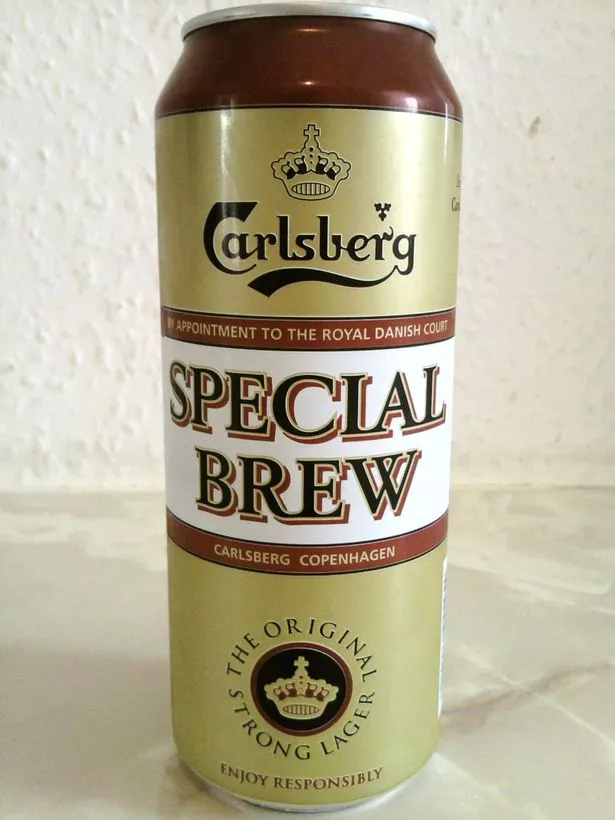
Cheers Churchill!
#7794
General Topic / Re: 23 little known facts you probably didn't know
October 11, 2015, 05:18:29 PMSTRINGING ALONG
Catgut, formerly widely used for stringing tennis racquets, never contained real cat guts. The material, also used for violin strings, hanging weights in grandfather clocks and suturing wounds, was made from sheep, goat, pig or donkey guts. The word was a shortening of cattle gut.
#7795
General Topic / Re: 23 little known facts you probably didn't know
October 11, 2015, 05:18:03 PMBOXING CLEVER
There is no reason why DVD boxes need to be bigger than CD cases because the discs are the same size.
But because they replaced VHS videos, the boxes were made the same height so they could be displayed side by side with videos during the changeover.
#7796
General Topic / Re: 23 little known facts you probably didn't know
October 11, 2015, 05:17:33 PMPAINLESS AND STAINLESS
Harry Brearly was trying to make better rifle barrels in Sheffield in 1913 when he noticed his new mixture, with added chromium, didn’t rust. He’d accidentally created stainless steel with a host of peaceful uses.
#7797
General Topic / Re: 23 little known facts you probably didn't know
October 11, 2015, 05:12:20 PMLIES AND WONDER
William Moulton Marston, who invented the lie detector test, also created Wonder Woman, the cartoon character who later became a TV icon.

Wonder Woman and that's no lie
#7798
General Topic / 23 little known facts you probably didn't know
October 11, 2015, 05:10:59 PMThe Secret History of Everyday Stuff - 23 little known facts you probably didn't know
10 OCT 2015
BY ALAN SELBY
A new book by Ben Le Fay reveals lots you didn’t know about everyday stuff - from food and drink, household appliances, medicines, homes to transport

Flossing your teeth can help prevent heart attacks - but no one knows why
A range of astounding information is to be found in new book The Secret History of Everyday Stuff by Benedict Le Fay.
Whether it’s food and drink, household appliances, medicines, homes or transport, the answers will amaze you.
#7799
Philippine Provinces / Re: Lalaki gipatay sa manok
October 11, 2015, 04:37:47 PMtari ang nakapatay, di ang manok. ang manok nakabawos lang nga wa damha sa tawo nga magpapaaway nila sa igkasi.
#7800
Tira-Pasagad | Saksak-Sinagol / Re: Mysterious woman-shaped figure spotted on Mars is driving the Internet crazy
October 11, 2015, 04:32:42 PM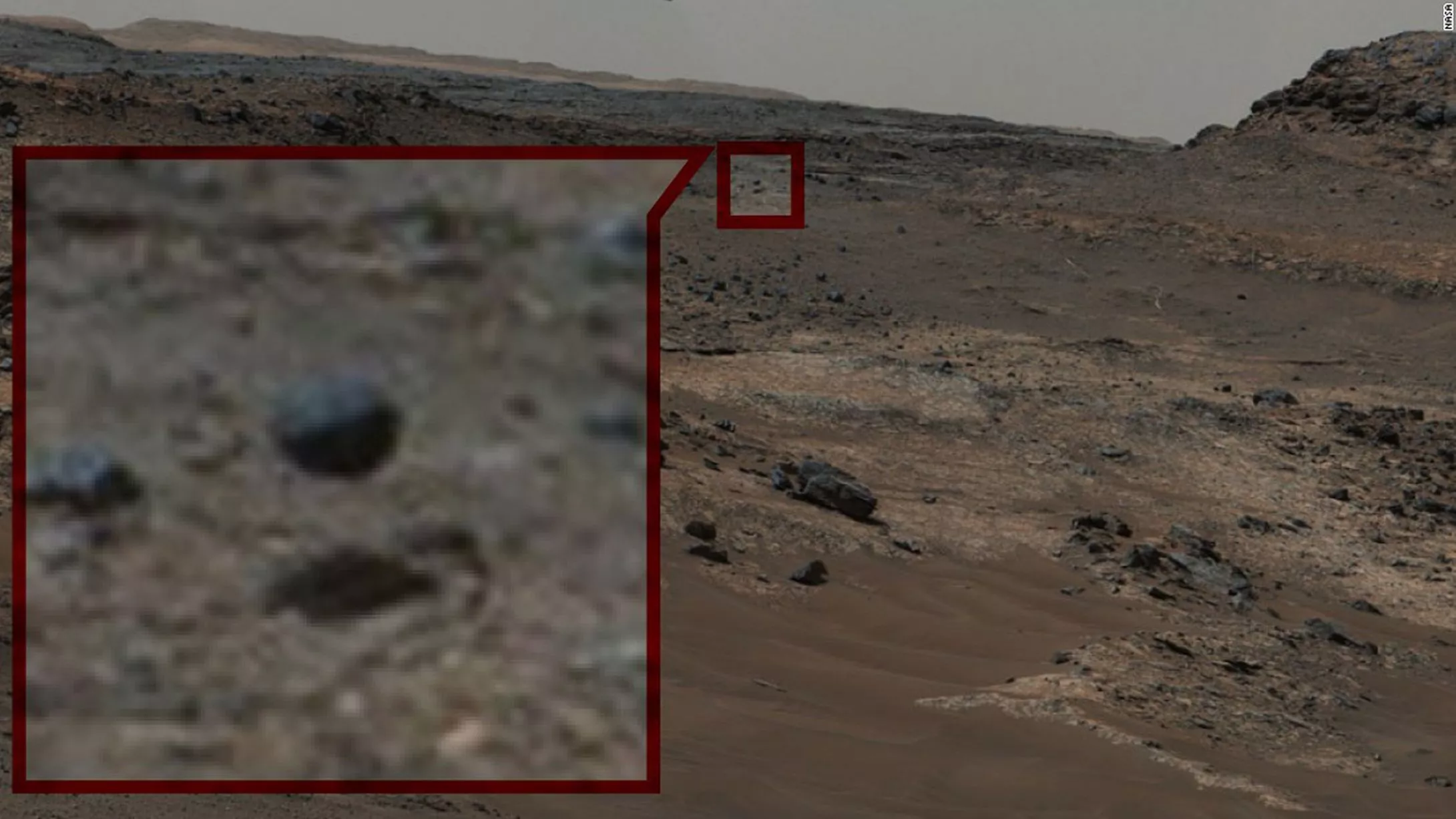
Pages 1 2 3 4 5 6 7 8 9 10 11 12 13 14 15 16 17 18 19 20 21 22 23 24 25 26 27 28 29 30 31 32 33 34 35 36 37 38 39 40 41 42 43 44 45 46 47 48 49 50 51 52 53 54 55 56 57 58 59 60 61 62 63 64 65 66 67 68 69 70 71 72 73 74 75 76 77 78 79 80 81 82 83 84 85 86 87 88 89 90 91 92 93 94 95 96 97 98 99 100 101 102 103 104 105 106 107 108 109 110 111 112 113 114 115 116 117 118 119 120 121 122 123 124 125 126 127 128 129 130 131 132 133 134 135 136 137 138 139 140 141 142 143 144 145 146 147 148 149 150 151 152 153 154 155 156 157 158 159 160 161 162 163 164 165 166 167 168 169 170 171 172 173 174 175 176 177 178 179 180 181 182 183 184 185 186 187 188 189 190 191 192 193 194 195 196 197 198 199 200 201 202 203 204 205 206 207 208 209 210 211 212 213 214 215 216 217 218 219 220 221 222 223 224 225 226 227 228 229 230 231 232 233 234 235 236 237 238 239 240 241 242 243 244 245 246 247 248 249 250 251 252 253 254 255 256 257 258 259 260 261 262 263 264 265 266 267 268 269 270 271 272 273 274 275 276 277 278 279 280 281 282 283 284 285 286 287 288 289 290 291 292 293 294 295 296 297 298 299 300 301 302 303 304 305 306 307 308 309 310 311 312 313 314 315 316 317 318 319 320 321 322 323 324 325 326 327 328 329 330 331 332 333 334 335 336 337 338 339 340 341 342 343 344 345 346 347 348 349 350 351 352 353 354 355 356 357 358 359 360 361 362 363 364 365 366 367 368 369 370 371 372 373 374 375 376 377 378 379 380 381 382 383 384 385 386 387 388 389 390 391 392 393 394 395 396 397 398 399 400 401 402 403 404 405 406 407 408 409 410 411 412 413 414 415 416 417 418 419 420 421 422 423 424 425 426 427 428 429 430 431 432 433 434 435 436 437 438 439 440 441 442 443 444 445 446 447 448 449 450 451 452 453 454 455 456 457 458 459 460 461 462 463 464 465 466 467 468 469