Join MikeLigalig.com!

Why Just Read When You Can Join, Post, and Read!

Menu

Show posts

This section allows you to view all posts made by this member. Note that you can only see posts made in areas you currently have access to.

Show posts Menu

Messages - islander

#5301
History / Re: The Burning of Rome, 64 AD
July 12, 2016, 04:06:58 PM

By the sixth day enormous demolitions had confronted the raging flames with bare ground and open sky, and the fire was finally stamped out at the foot of the Esquiline Hill. But before panic had subsided, or hope revived, flames broke out again in the more open regions of the city. Here there were fewer casualties; but the destruction of temples and pleasure arcades was even worse. This new conflagration caused additional ill-feeling because it started on Tigellinus' estate in the Aemilian district. For people believed that Nero was ambitious to found a new city to be called after himself.

Of Rome's fourteen districts only four remained intact. Three were leveled to the ground. The other seven were reduced to a few scorched and mangled ruins."


References:
   Duruy, Victor, History of Rome vol. V (1883); Grant, Michael (translator), Tacitus, The Annals of Imperial Rome, (1989)

"The Burning of Rome, 64 AD," EyeWitness to History, www.eyewitnesstohistory.com (1999).
#5302
History / Re: The Burning of Rome, 64 AD
July 12, 2016, 03:59:34 PM

Terrified, shrieking women, helpless old and young, people intent on their own safety, people unselfishly supporting invalids or waiting for them, fugitives and lingerers alike - all heightened the confusion. When people looked back, menacing flames sprang up before them or outflanked them. When they escaped to a neighboring quarter, the fire followed - even districts believed remote proved to be involved. Finally, with no idea where or what to flee, they crowded on to the country roads, or lay in the fields. Some who had lost everything - even their food for the day - could have escaped, but preferred to die. So did others, who had failed to rescue their loved ones. Nobody dared fight the flames. Attempts to do so were prevented by menacing gangs. Torches, too, were openly thrown in, by men crying that they acted under orders. Perhaps they had received orders. Or they may just have wanted to plunder unhampered.


Ancient Rome highlighting the Forum

Nero was at Antium. He returned to the city only when the fire was approaching the mansion he had built to link the Gardens of Maecenas to the Palatine. The flames could not be prevented from overwhelming the whole of the Palatine, including his palace. Nevertheless, for the relief of the homeless, fugitive masses he threw open the Field of Mars, including Agrippa's public buildings, and even his own Gardens. Nero also constructed emergency accommodation for the destitute multitude. Food was brought from Ostia and neighboring towns, and the price of corn was cut to less than ¼ sesterce a pound. Yet these measures, for all their popular character, earned no gratitude. For a rumor had spread that, while the city was burning, Nero had gone on his private stage and, comparing modern calamities with ancient, had sung of the destruction of Troy.
#5303
History / Re: The Burning of Rome, 64 AD
July 12, 2016, 03:56:42 PM

From the ashes of the fire rose a more spectacular Rome. A city made of marble and stone with wide streets, pedestrian arcades and ample supplies of water to quell any future blaze. The debris from the fire was used to fill the malaria-ridden marshes that had plagued the city for generations.

The Horror of Fire

The historian Tacitus was born in the year 56 or 57 probably in Rome. He was in Rome during the great fire. During his lifetime he wrote a number of histories chronicling the reigns of the early emperors. The following eye witness account comes from his final work The Annals written around the year 116.

"...Now started the most terrible and destructive fire which Rome had ever experienced. It began in the Circus, where it adjoins the Palatine and Caelian hills. Breaking out in shops selling inflammable goods, and fanned by the wind, the conflagration instantly grew and swept the whole length of the Circus. There were no walled mansions or temples, or any other obstructions, which could arrest it. First, the fire swept violently over the level spaces. Then it climbed the hills - but returned to ravage the lower ground again. It outstripped every counter-measure. The ancient city's narrow winding streets and irregular blocks encouraged its progress.
#5304
History / The Burning of Rome, 64 AD
July 12, 2016, 03:41:08 PM

The Burning of Rome, 64 AD

www.eyewitnesstohistory.com

During the night of July 18, 64 AD, fire broke out in the merchant area of the city of Rome. Fanned by summer winds, the flames quickly spread through the dry, wooden structures of the Imperial City. Soon the fire took on a life of its own consuming all in its path for six days and seven nights. When the conflagration finally ran its course it left seventy percent of the city in smoldering ruins.


Emperor Nero

Rumors soon arose accusing the Emperor Nero of ordering the torching of the city and standing on the summit of the Palatine playing his lyre as flames devoured the world around him. These rumors have never been confirmed. In fact, Nero rushed to Rome from his palace in Antium (Anzio) and ran about the city all that first night without his guards directing efforts to quell the blaze. But the rumors persisted and the Emperor looked for a scapegoat. He found it in the Christians, at that time a rather obscure religious sect with a small following in the city. To appease the masses, Nero literally had his victims fed to the lions during giant spectacles held in the city's remaining amphitheater.
#5305

purya intawon. ambot na lang ning amahana. wa na gyod ko makakatawa ani. >:(
#5306
Learn English Online / Re: Batten down the hatches
July 10, 2016, 03:04:24 AM

The misspellings 'battern down the hatches' and 'baton down the hatches' are sometimes found in print. 'Batons' are sticks or staffs, which makes that particular misspelling plausible. 'Batterns' are a form of stage lighting.


The earliest reference to this practice that I know of is in William Falconer's An Universal Dictionary of the Marine, 1769:

The battens serve to confine the edges of the tarpaulings close down to the sides of the hatches.

The first citation of the explicit use of the phrase 'batten down the hatches' is from the 1883 Chambers Journal:

"Batten down the hatches - quick, men."

http://www.phrases.org.uk/
#5307
Learn English Online / Re: Batten down the hatches
July 10, 2016, 03:03:26 AM

'Hatch' is one of those words with dozens of meanings in the dictionary. In this case we are looking at the 'opening in the deck of a ship' meaning. Ships' hatches, more formally called hatchways, were commonplace on sailing ships and were normally either open or covered with a wooden grating to allow for ventilation of the lower decks. When bad weather was imminent, the hatches were covered with tarpaulin and the covering was edged with wooden strips, known as battens, to prevent it from blowing off. Not surprisingly, sailors called this 'battening down'.

The above was explained, probably better than I just have, in the definitive record of history of nautical language, Admiral W H Smyth’s 1867 encyclopaedia The Sailor’s Word Book. He calls it 'battening of the hatches' but it is clearly the same expression:

“Battens of the hatches: Long narrow laths serving by the help of nailing to confine the edges of the tarpaulins, and keep them close down to the sides of the hatchways in bad weather.”
#5308
Learn English Online / Batten down the hatches
July 10, 2016, 02:58:44 AM

Batten down the hatches

Meaning: Prepare for trouble.

Origin: In his recent (September 2012) song Tempest, which recounts the story of the Titanic's sinking, Bob Dylan uses the lines:

They battened down the hatches
But the hatches wouldn't hold


This has caused a couple of correspondents to write to me asking what 'batten down' means. Many people may know what 'batten down the hatches' means, but some clearly don't, so here goes...
#5309

di gyod lalim, mao nga hilom na lang. wa ma-killed sa babaye nga mat-an pa sa pinya pero basin ma-killed sa kauwaw. aw, hinoon, tingali ug mas mahadlok ning tawhana sa iyang asawa nga di tuod manghimulbol pero mamutol, hahaha! :P
#5310

WHAT HAPPENS NEXT?

- While the findings are legally binding, UNCLOS has no enforcement body and legal experts say it remains unclear what can be done when China ignores the ruling. (Cases involving a ruling over actual sovereignty require mutual consent by states and are heard by the International Court of Justice in The Hague. ICJ rulings are enforceable by the United Nations Security Council.)

- Chinese officials have not ruled out future military action to enforce their claims, including construction on the Scarborough Shoal or the imposition of an air defence zone over the area. They have warned against further expansion of the US military presence in the area.

- US responses could include an increase in the frequency of so-called freedom of navigation operations and overflights in the region and increased defence aid to Southeast Asian countries, according to US officials speaking on the condition of anonymity.

- Other claimants, particularly Vietnam, are being closely watched to see whether they will launch their own action against China. Hanoi has sought legal opinions on a possible case, and its officials have yet to rule out such action.

(Reuters)

http://www.gmanetwork.com/
#5311

WHAT IS THE KEY TO MANILA'S CASE?

- Manila's case is built around 15 points that seek to clarify its rights to exploit its EEZ. It challenges Chinese activities, including fishing, dredging and law enforcement patrols, as well as Beijing's reclamation and construction on seven reefs in the Spratlys. It also challenges China's effective control of the Scarborough Shoal, seeking a ruling that shows it sits entirely within the Philippines' EEZ.

- Any ruling on the legality of the nine-dash line, Beijing's controversial claim to much of the South China Sea, will be closely watched. Created in the late 1940s and used on official Chinese maps, the line bisects the EEZs of several other countries and reaches deep into the maritime heart of Southeast Asia.

- Manila's lawyers have also argued that none of islands, shoals and reefs across the Spratlys are significant enough to lay claim to an EEZ.
#5312

WHAT DOES THE CASE INVOLVE?

- The Philippines formally lodged its arbitration case under the UN's 1982 Convention of the Law of the Sea, known as UNCLOS, in January 2013.

- China repeatedly warned the Philippines against pushing ahead with the case, and Beijing has refused to participate in any of its hearings, forgoing its right to appoint a judge. China says the court has no jurisdiction, and that its historic rights and sovereignty over the South China Sea predates UNCLOS.

- UNCLOS does not deal with sovereignty issues, but sets out what countries can claim from various geographic features at sea, as well maritime behavior. That regime allows for 12 nautical miles of territorial waters from islands and rocks and 200 nautical miles of Exclusive Economic Zone from islands that can sustain ordinary human habitation. An EEZ is not sovereign territory but gives a country the right to the fish and seabed resources, including oil and gas, within that zone.

- China and the Philippines are among the 167 parties that have signed and ratified UNCLOS. The United States has not, as the law has been blocked in the US Senate in the past. But its government recognises it as customary international law, including during naval patrols of the South China Sea.
#5313

Why the Philippines’ South China Sea legal case matters

July 8, 2016

HONG KONG - On July 12, a panel of five judges at the Permanent Court of Arbitration in The Hague will announce their ruling in a case brought by the Philippines against China over its actions in the South China Sea.

WHY IS IT IMPORTANT?

- The Philippines' case against China marks the first time any legal challenge has been bought in the South China Sea territorial dispute. Centered on the Spratlys archipelago which straddle vital international shipping lanes, tensions in the South China Sea have simmered for decades, intensifying in recent years. China, Taiwan, Vietnam, Malaysia and Brunei claim the Spratlys and/or surrounding waters. China, Taiwan and Vietnam claim all of the Paracel Islands in the north of the South China Sea.

- The dispute has intensified political and military rivalry across the region between the rising power of China and the long-dominant player, the United States. China has been projecting its growing naval reach while the US is deepening ties with both traditional security allies, such as Japan and the Philippines, and newer friends, including Vietnam, Indonesia and Myanmar.

- Chinese analysts say the South China Sea will only grow in importance to Beijing, particularly as its submarine base on Hainan Island will be crucial to China's future nuclear deterrent.
#5314

12. The value of compromising

This dad wanted to play on his computer. He also had to look after his baby.


When you gotta play you gotta play

Cleverly, he decided to compromise and do both at the same time. If that kid doesn't grow up to be a genius, then we don't know what's gone wrong.

http://www.mirror.co.uk/
#5315

11. Preparing for the world of work

This dad clearly thought he'd teach his kids the value of hard work.


hafelnuts

While he plays video games sitting in what looks like a tiny paddling pool, his children stand patiently nearby holding things he might like to use.
#5316

10. Producing unique Halloween costumes


Taylor_Satine

There's not a lot you can dress a baby in for Halloween other than cliche chubby pumpkin outfits.

So well done to this dad for thinking outside the box - even if it is a bit creepy.

That kid will grow up mastering Halloween every year, undoubtedly.
#5317

9. Making do with what you've got

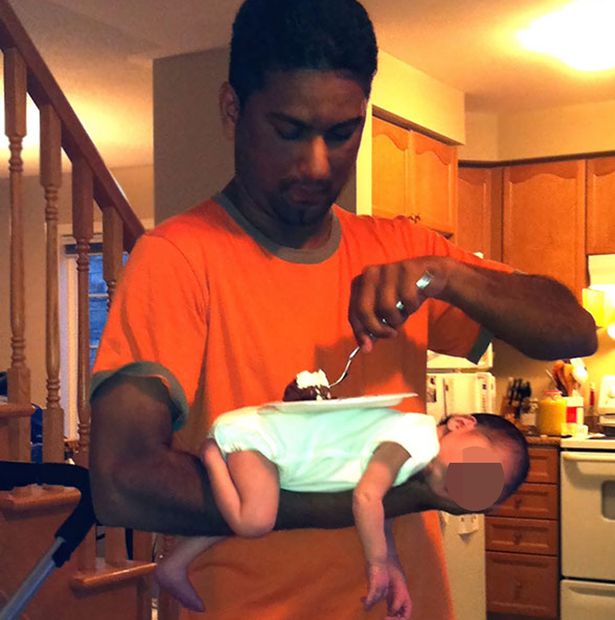
Having spent a while trying to get his three-day-old daughter to sleep and finally figuring out a way that worked, this father realised he was hungry.


2nie

But not being able to move, he simply had to deal with the situation - and eat his food off her back.

Clever, really. And he didn't even wake her.
#5318

8. Solving problems


Baby won't stop wriggling about? Scratching their chicken pox with fingernails?

Then ta-da. This dad has come up with the perfect solution - pulling their tights all the way up to their shoulders.

What could go wrong?
#5319

7. Being creative


daedalus_78

This man was quite happy sitting at the table with his pint and wasn't going to move for anything - especially not pushing his kid on a swing.

But he didn't let that stop him. Oh, no. He decided to use his initiative and came up with a great compromise.
#5320

6. Patience


Twitter/itsZanaa

What better way is there to teach kids the value of patience and tolerance than by slowly and carefully stacking Cheerios on them?

If the stack falls and you have to start all over again, you've also imparted the wisdom of 'getting back on the horse'. Two birds with one stone.
#5321

5. Learning to laugh at yourself

There's nothing worse than when your kid is having a tantrum and you can't keep a straight face.

Sometimes this will further infuriate them because you're not taking them seriously.


Furygoat
"Are we bad parents?"

But you know what, kids, you need to learn not to take yourself too seriously - and this dad knows the value of that.
#5322

4. And time-saving skills...


Don't have a cable tie to hand and want to quickly put your daughter's hair up? This guy has come up with a nifty trick.
#5323

3. Tying hair securely

This dad clearly couldn't find a hair bobble so, teaching his daughter how to be creative and innovative with what you've got, he resorted to the next best thing.


Genius.
#5324

2. Having a sense of humour

This dad noticed an uncanny resemblance between his little baby's head and a... kiwi.


And he decided to prove it by popping a sticker on their head. Super cute.
#5325

1. Rocking any outfit


Brooke Hawley-Basso

Mum Brooke Hawley-Basso was surprised when she picked her daughter Olivia up from daycare and discovered her dad hadn't given her a shirt to wear under her overalls.

D'oh.
#5326

12 photos which prove dads shouldn't be left alone to look after their kids*

7 JUL 2016
BY NICOLA OAKLEY

*Unless they want them to grow up learning valuable life lessons


Flickr/Ambernectar 13
And this isn't even one of the 12.

Dads often get a bad reputation for being the least serious parent.

To be fair, their recent antics of stacking Cheerios on sleeping babies haven't really helped topple that impression.

But instead of criticising dads for their, shall we say, 'unique' parenting techniques, perhaps we should be celebrating them for the valuable life lessons they're teaching our kids.

And they're instilling a great sense of humour in them, too. After all, you've got to laugh at some of these... even if they are classic 'dad jokes'.
#5327

bodies of 9 italian victims in the dhaka terror attack are brought home to italy.

#5328
bodies of japanese victims of the dhaka terrorist attack are brought home to japan.


#5329
Love Talk / Re: Men Vs. Women Redux
July 04, 2016, 06:32:26 PM

#5333

the world is getting weirder everyday. :P
#5334

mirisi ka, dong. arang gajod, nakaako pa ug sumbong. bagaa gajod. :P
#5336

The Terror Attack in Dhaka

01 July 2016
dead: 28
wounded: 50
suspect/s: claimed by both Al-Qaeda in the Indian Subcontinent (AQIS) and ISIS


#5342

The Attack on Istanbul's Airport

28 June 2016
dead: 45
wounded: 147
suspect/s: potential, ISIS or ISIS-related, believed to come from Russia, Uzbekistan and Kyrgyzstan


#5343

hinaot wa siya pabugsaya sa west philippine sea. aw, sure ko nga wa. asenso kaayo si bugsay uy. pila ra goy filipino nga naay abilidad pareha niya. bunalay rag insik, wa na.
#5344

TAIWAN

Taiwan has complained that the tribunal has not solicited its views. While Taipei officially exercises the same nine-dash line claim as Beijing in the South China Sea, it is primarily concerned about Taiping island in the Spratlys. Taiwan administers that remote land feature and is concerned it could be designated as a rock without the rights granted to islands.

Read more: http://globalnation.inquirer.net/
#5345

SOUTH KOREA

Like Japan, South Korea is heavily dependent on fuel imports that pass through the South China Sea, but it has closer ties with China and has been less inclined to speak out. The Foreign Ministry says South China Sea disputes should be resolved under internationally established regulations and that it is “looking with interest” at the Philippine-China arbitration case.
#5346

JAPAN

Japan was an early supporter of the Philippines’ pursuit of arbitration and says both China and the Philippines should abide by the outcome. Japan sees that as upholding international law, but it also reflects concern that historic rival China seeks strategic control of vital sea lanes in the South China Sea that carry 80 percent of Japan’s crude oil imports.

Japan’s support of third-party dispute resolution is not universal. While it has sought to take its dispute with South Korea over the South Korean-held Dokdo or Takeshima islands to the International Court of Justice, it says no such action is needed in its dispute with China over the Senkaku or Diaoyu islands, which are administered by Japan.
#5347

INDIA

India has not issued a categorical position on arbitration case, but has been broadly supportive of the application of international law. India shares U.S. concerns about Beijing’s rising ambitions in the seas of Asia.

India’s External Affairs Ministry says that “all countries must abide by international law and norms on maritime issues.” India set an example in 2014 when it accepted a decision by the Hague-based Permanent Court of Arbitration that ruled in favor of Bangladesh in a dispute over the countries’ maritime boundary.
#5348

AUSTRALIA

In January, Foreign Minister Julie Bishop said the China-Philippines ruling will be “extremely important” as a statement of international principle and will “settle once and for all” whether artificial reefs are entitled to territorial waters. But Australia has been less outspoken in support of arbitration than the U.S., perhaps mindful of Australia’s own resistance to arbitration to resolve its disputed maritime border with tiny East Timor.
#5349

EUROPEAN UNION and G-7

The EU has urged all South China Sea claimants to resolve disputes through peaceful means and “pursue them in accordance with international law,” including the U.N. convention. The Group of Seven wealthy nations, which comprises Britain, Canada, France, Germany, Italy, Japan, the U.S. and the EU, has called on all states to fully implement decisions binding on them in courts and tribunals provided under the convention.

In June, French Defense Minister Jean-Yves Le Drian proposed that European navies coordinate patrols in Asian waters to reinforce a rules-based maritime order. He warned that if the laws of the sea are not respected in that region, they could also be challenged in the Arctic Ocean or Mediterranean Sea.
#5350

CHINA SUPPORTERS IN AFRICA, MIDEAST

China’s state news agency Xinhua on May 20 said that more than 40 countries have expressed support for China’s stance on the arbitration case. The Foreign Ministry has in recent weeks given prominent mention to support it claims to have from nations principally in Africa, the Mideast and Central Asia.

But few of those foreign governments have issued statements independently. Some, including Cambodia, Laos and Fiji, have disavowed China’s description of their position.

Experts at the Center for Strategic and International Studies in Washington said they could confirm official statements from Afghanistan, Gambia, Niger, Sudan and Vanuatu. A Chinese statement with the 21-member Arab League supported China but it was unclear if it represented all the parties’ official positions.
#5351

RUSSIA

Moscow, which shares China’s suspicion of Washington, is Beijing’s most prominent supporter on the issue. On a visit to China in April, Russian Foreign Minister Sergey Lavrov said Russia is against any interference from outside parties in the South China Sea â€" a reference to the U.S. â€" “or any attempts to internationalize these disputes.” Like China, Russia says disputes should be resolved through talks between the parties directly involved.
#5352

Here’s a look at where dozens of countries stand:

ASSOCIATION OF SOUTHEAST ASIAN NATIONS

ASEAN has been trying for years to achieve diplomatic solutions in the South China Sea, making little progress and exposing divisions in the 10-member bloc, which includes the Philippines. Reaching consensus on the Permanent Court of Arbitration ruling will be tough.

When President Barack Obama met ASEAN leaders in February they agreed on “full respect for legal and diplomatic processes” in accordance with the U.N. convention, but pro-China members Cambodia and Laos nixed any mention of “arbitration.”

Vietnam, which has fought China over competing South China Sea claims, has been most supportive of the Philippines’ case and submitted a statement to the tribunal. Hanoi has said it supports “full compliance” to the procedures of the convention.

But other ASEAN nations are generally wary of speaking out for fear of alienating China, the region’s economic heavyweight. Malaysia and Brunei have said little about the case, though they too are South China Sea claimants.

Indonesia and Singapore are not claimants but have been a bit more outspoken. Singapore’s Foreign Minister Vivian Balakrishnan said last week that the ruling could have implications beyond the South China Sea and “we cannot subscribe to the principle that might is right.” Indonesia’s Foreign Ministry declined to say whether the ruling should be binding on both sides but said international law must be respected.

Even the Philippines’ position is unpredictable as a new government takes office there June 30. President-elect Rodrigo Duterte has expressed willingness to restart bilateral negotiations with China.
#5353

a more detailed version...

South China Sea case: Nations pick their side

@inquirerdotnet
Associated Press
June 13th, 2016


Protesters hold placards outside of the the Chinese Consulate to protest China’s occupation and island-building in the disputed Spratlys island group in the South China Sea Friday, June 10, 2016, in Makati City’. AP

WASHINGTON, United States â€" A case brought by U.S. ally the Philippines against China represents a diplomatic dilemma for far-flung nations as Washington and Beijing rally support for their respective positions on the use of international arbitration in South China Sea disputes.

The United States has been building diplomatic pressure in the West and in Asia on China to abide by the Hague-based tribunal’s decision, which is expected soon. China, which maintains it won’t be bound by the ruling, has been pushing back by building support from nations mostly in Africa and the Mideast.

The U.S. is not a party to the U.N. Convention on the Law of the Sea, under which the tribunal has been constituted, but says it wants China to play by international rules. Since there is no enforcement mechanism for the ruling, any impact will depend on how the international community reacts.
#5354

The critical list for Beijingâ€"the list of states that have publicly voiced support for its positionâ€"isn’t mighty impressive, containing just seven states. Two statesâ€"Afghanistan and Lesothoâ€"are landlocked. The others on the list include Gambia, Kenya, Niger, Sudan, and Vanuatu; with the exception of Vanuatu, all the other states are far removed geographically from the South China Sea and have more to gain by placating China over this issue than rebuking Beijing.

There are good reasons to believe that China will care about perceptions and reputational costs in the aftermath of the PCA’s decision. Between now and the release of the decision (or immediately thereafter), more states may well come out and voice their support for China’s position, but for now, Beijing doesn’t look like it has too many explicit backers.

http://thediplomat.com/
#5355

A new resource compiled by the good folks over at the Center for Strategic and International Studies’ Asia Maritime Transparency Initiative (AMTI) helps clear the waters considerably, providing a four-tier list of countries that a) publicly have come out to support China’s position; b) states that China has claimed support its position but have yet to publicly clarify; c) states that have publicly denied support China’s position (in some cases, after China noted that they support its position); and finally, d) states that have come out and said that the PCA’s verdict will be a binding international legal decision (such as the United States). Above all, AMTI’s tracker provides primary source support for the status of these states’ support or lack thereof for China’s position.
#5356

China hasn’t been too transparent in outlining just who supports its position on the South China Sea disputes though. My colleague Shannon Tiezzi, in a recent issue of the Diplomat‘s magazine, outlines some of the initial attempts. In several cases, China has simply issued readouts of diplomatic meetings, noting that the countries it conferred with voiced support for its South China Sea position, without directly quoting any senior officials. What’s even more puzzling is that in a press conference yesterday, Lu Kang, a spokesperson for the Chinese foreign ministry, when asked how many countries supported China’s position, cited the number 60, which a journalist had mentioned in a prior question. China’s offered similar numbers in the past, but even its foreign ministry spokesperson doesn’t have a clear idea of exactly who backs its position.
#5357

Ahead of the highly anticipated decision, Beijing has been hard at work trying to get statesâ€"both regional and extra-regionalâ€"to voice support for China’s position on the South China Sea, which is basically that there’s no need to get an international body involved and that the disputes should be resolved on a bilateral basis, through negotiations. Unsurprisingly, the bilateral approach handily benefits China, which can swing its weight as a large and powerful country against comparatively smaller and weaker claimants (such as the Philippines, for instance).
#5358

South China Sea: Which Countries Are On China's Side?

How many states back Beijing’s position on the South China Sea disputes?

By Ankit Panda
June 16, 2016


Late this summer, or possibly early in the fall, the Netherlands-based Permanent Court of Arbitration (PCA) is expected to hand down a verdict on the merits of the Philippines’ case against China over the status of various features in the South China Sea. The case won’t rule on the sovereignty of those features, but, where the court has jurisdiction, its decision will decide the maritime entitlements of various features. Beyond the legal effects of the decision, which will be a major milestone in the evolution of the disputes in the South China Sea, the case is expected to go in Manila’s favor on almost all counts and deliver substantial reputational costs for China.
#5359

HEADLINES:

Chinese foreign minister claims more countries side with them on SCS dispute
link: https://kami.com.ph/19249-chinese-foreign-minister-claims-countries-side-scs-dispute.html

China confides 47 countries back its sea claim vs PH
link: https://kami.com.ph/19776-china-ph-territory-issue-47-countries-supports-us.html

China brushes off doubts over support on South China Sea, says it is growing
link: http://ca.reuters.com/article/topNews/idCAKCN0Z910M
#5360
Inspiration & Hope / Re: The Mystery Staircase
July 01, 2016, 12:59:37 PM

There is another detail that has just increased the belief in the supposed miracle :

The Staircase has 33 steps, the age of Jesus Christ.

https://www.facebook.com/DailyDoseOfKnowledge
#5361
Inspiration & Hope / Re: The Mystery Staircase
July 01, 2016, 12:58:39 PM

There are 3 mysteries in this case, says the spokesman of the chapel:

1. The 1st mystery is that, until today, the identity of this man is not known.

2. The second mystery â€" all the architects, engineers and scientists say that they cannot understand how this staircase can balance without any central support.

3. And the 3rd mystery â€" from where did the wood come? They have checked and found out that the type of wood used to build the staircase does not exist in the entire region.
#5362
Inspiration & Hope / Re: The Mystery Staircase
July 01, 2016, 12:56:46 PM

Then the carpenter, who did not use a single nail or glue to construct this staircase, disappeared without even waiting for his payment.

There was a rumour in the city of Santa Fé, that the carpenter was St. Joseph himself …. sent by Jesus Christ to attend to the nuns’ problem. Since then, the staircase was known to be called “miraculous” and turned out to be the site for pilgrimage.
#5363
Inspiration & Hope / Re: The Mystery Staircase
July 01, 2016, 12:56:21 PM

What makes this chapel different from all others is that the subject of the supposed miracle that took place in it is a Staircase. A chapel was constructed somewhere in the 19th century. When it was ready, the nuns found that there was no staircase built to take them to the top level.

They spent 9 days praying to St. Joseph, the caring father of Jesus Christ, who was a carpenter.

On the last day, a stranger knocked at their door and said that he was a carpenter who could help them build the staircase. He constructed the staircase, all by himself, which was considered to be the pride of carpentry. None knew how the staircase could stand by itself as it did not have a central support.
#5364
Inspiration & Hope / The Mystery Staircase
July 01, 2016, 12:54:58 PM


Loretto Chapel

City of Santa Fé, in New Mexico, USA â€" A mystery of over 130 years and attracting around 250 thousand visitors every year...
#5365

The word oxymoron comes from the Greek for pointedly foolish: 'oxys' means sharp or keen and 'moros' means foolish.

Richard Watson Todd shows us how easily we accept oxymorons as part of everyday speech in this paragraph from Much Ado About English. There are 10 in this example:

It was an open secret that the company had used a paid volunteer to test the plastic glasses. Although they were made using liquid gas technology and were an original copy that looked almost exactly like a more expensive brand, the volunteer thought that they were pretty ugly and that it would be simply impossible for the general public to accept them. On hearing this feedback, the company board was clearly confused and there was a deafening silence. This was a minor crisis and the only choice was to drop the product line.

http://writerswrite.co.za/
#5366

The common oxymoron phrase is a combination of an adjective followed by a noun with contrasting meanings. We use oxymorons because they make effective titles in literature or film, and add dramatic effect, for example, Dead Man Walking, Mr. Mom, and True Lies.

They add flavour to speech and can also be cynical, sarcastic, or witty and used for comic effect or relief. You will recognise these 13:

1. Affordable housing
2. Airline food
3. American English
4. Business ethics
5. Government organisation
6. Health-care system
7. Human development
8. Marital bliss
9. Military intelligence
10. Political correctness
11. United Nations
12. Weapons of peace
13. Western civilisation
#5367
Learn English Online / 33 Perfectly Odd Oxymorons
June 30, 2016, 08:23:03 PM


An oxymoron is "a phrase that combines two words that seem to be the opposite of each other, for example a 'deafening silence'." (Oxford Dictionaries)

An oxymoron is a compressed paradox. It is a figure of speech where a writer combines seemingly contradictory terms. You may have noticed that I used one in this blog post title.

Here are 10 frequently-used oxymorons:

1. Awfully pretty
2. Clearly misunderstood
3. Foolish wisdom
4. Larger half
5. Minor miracle
6. Only choice
7. Poor health
8. Seriously funny
9. Small crowd
10. Unbiased opinion
#5368

dakog puruhan. intrigira ra kaayo ni nga website.
#5369

what an ending to an otherwise interesting story.
#5370

why is china paranoid? is it guilt over its invasion of tibet in 1950?
#5371

radar online website is one of the worst sources of news online. too gossipy, and too careless with data. and i thought our tagalog tabloids are the worst there are. these are tamer by far.
#5372

time for a gender change, sir! :)
#5373

At the end of the day, Beijing faces a stark choice if it truly wishes to settle disputes in the South China Sea: it can either put its confidence in its claims to the test in appropriate judicial fora, or it can offer rival claimants genuinely attractive terms, which would almost certainly require territorial concessions. At present, both seem highly unlikely. Meanwhile, tensions continue to rise. Fasten your seatbelts.

David A. Welch is CIGI chair of global security at the Balsillie School of International Affairs, professor of political science at the University of Waterloo, and Senior Fellow at the Centre for International Governance Innovation.

http://thediplomat.com/
#5374

If this is the hand Beijing is prepared to play, it would tell us at least three interesting and important things: first, that for China the South China Sea dispute is fundamentally about symbols, respect, and prestige; second, that Chinese leaders do not believe that rival claimants similarly care about symbols, respect, and prestige; and third, that Chinese leaders believe that rival claimants think they can trust China to share in the South China Sea’s resource bounty equitably and reliably. The first of these is eminently plausible. But the latter two are not. People in general tend to care about symbols, respect, and prestige, and it would betray a naïve view of human psychology to think that Chinese do and others do not. Quite apart from the fact that China’s neighbors have feared, resented, and often resisted its “paternal benevolence” for thousands of years, China’s recent behavior has gravely damaged its reputation for trustworthinessâ€"not only in the South China Sea, but also, for example, in Hong Kong. If Chinese leaders think there is a contract zone here, they lack the empathy required to see that this is wishful thinking.
#5375

More likely, Beijing may think that rival claimants may be willing to yield on symbols in return for material gains. A strong indication that this may be so is that Beijing has regularly held out the prospect of “joint development” of natural resources in the South China Sea. Conceivably, Beijing may think that rival claimants would be willing to acknowledge China’s sovereignty over disputed islands in return for access to fishing grounds and the prospect of oil and gas riches. Certainly this would be an attractive outcome for China’s leaders, as they would be able to represent it domestically as standing ground on the “core interest” of sovereignty while at the same time demonstrating paternal benevolence toward China’s smaller and weaker neighbors.
#5376

One possibility is that Beijing is willing to resolve the lingering ambiguity of its South China Sea claims in order to settle disputes. The concession here, presumably, would be clarity. Beijing might say, for instanceâ€"as Taiwan has saidâ€"that the so-called nine-dash line is only meant to encompass the islands over which China claims sovereignty, not the body of water over which it claims maritime jurisdiction. That, China might say, would be governed by UNCLOS rules. The upside of this concession for rival claimants would be that it would pave the way for an orderly demarcation of territorial seas, exclusive economic zones (EEZs), and continental shelf rights. The downside for rival claimants would be that unless China were actually willing to concede sovereignty over some of the Spratly, Paracel, or Pratas islands to others, the gain in clarity would largely be meaningless. China would still be asserting maritime jurisdiction over most of the South China Sea. Moreover, a great irony of this scenario is that the Philippines arbitration tribunal, whose legitimacy China has so hotly rejected, will certainly clarify a number of the provisions of UNCLOS, on the basis of which those maritime entitlements would be determined. If this is China’s default bargaining position, it would appear to be dead on arrival.
#5377

The bilateral negotiation option is particularly puzzling in view of China’s profession that it has had “indisputable sovereignty” in the South China Sea since “ancient times.” One doesn’t make arguments about history at a negotiating table: one makes offers. Negotiation is the art of finding a quid pro quo, not winning a debate. And if Chinese sovereignty is indisputable, what is there to negotiate about? Is Beijing willing to give some up? If, as most analysts believe, the regime is as petrified of rising nationalist sentiment as it appears to be (this seems, after all, to be one of the main reasons that Beijing has been trying to undermine the Philippines arbitration case), then how could it possibly cede ground at a negotiating table without triggering a domestic backlash?

The cynical interpretation is that China wants to negotiate bilaterally so that it can bully others into submission. But it would be strange indeed if Beijing really thought that Vietnam, the Philippines, Malaysia, or Brunei would be willing to sit down at a negotiating table merely to accept surrender terms. Presumably, Beijing thinks there must be a contract zone of some kind. What might that be?
#5378

China's Curious South China Sea Negotiation Policy

What would China expect to achieve with bilateral negotiations on maritime disputes?

By David A. Welch


mage Credit: U.S. State Department Photo

There has been a great deal of commentary recently on Beijing’s strident refusal to participate in the Philippines’ arbitration case and the almost desperate vehemence with which it is preparing to greet the tribunal’s final judgment. This is not terribly surprising, as most analysts agree that the Philippines will win on a number of crucial points, undercutting some, if not all, of China’s maritime claims. However, there has been surprisingly little analysis of Beijing’s preferred alternative to adjudicated dispute resolution: namely, bilateral negotiations. How might we understand this? What does it tell us about China’s wants, needs, or fears? What does it say about Chinese leaders’ view of the world?
#5380
Bohol Directory / Re: Year of Pig
June 27, 2016, 06:17:02 PM

#5381

kanyahay ra mag-una na lang silag angkon sa kadagatan kay adto na sila puyo karong umaabot. :)
#5382


The panel is led by Judge Thomas A. Mensah of Ghana as President of the Tribunal; its members include Judges Jean-Pierre Cot (France), Stanislaw Pawlak (Poland), and Rüdiger Wolfrum (Germany), and Prof. Alfred Soons (Netherlands).

http://www.thephilippinepride.com/
#5383


7. FINDS that the Tribunal has jurisdiction to consider the Philippines’ Submissions No. 3, 4, 6, 7, 10, 11, and 13, subject to the conditions noted in paragraphs 400, 401, 403, 404, 407, 408, and 410 of this Award.

8. FINDS that a determination of whether the Tribunal has jurisdiction to consider the Philippines’ Submissions No. 1, 2, 5, 8, 9, 12, and 14 would involve consideration of issues that do not possess an exclusively preliminary character, and accordingly RESERVES consideration of its jurisdiction to rule on Submissions No. 1, 2, 5, 8, 9, 12, and 14 to the merits phase.

9. DIRECTS the Philippines to clarify the content and narrow the scope of its Submission 15 and RESERVES consideration of its jurisdiction over Submission No. 15 to the merits phase.

10. RESERVES for further consideration and directions all issues not decided in this Award.
#5384


4. FINDS that there is no indispensable third party whose absence deprives the Tribunal of jurisdiction.

5. FINDS that the 2002 Chinaâ€"ASEAN Declaration on Conduct of the Parties in the South China Sea, the joint statements of the Parties referred to in paragraphs 231 to 232 of this Award, the Treaty of Amity and Cooperation in Southeast Asia, and the Convention on Biological Diversity, do not preclude, under Articles 281 or 282 of the Convention, recourse to the compulsory dispute settlement procedures available under Section 2 of Part XV of the Convention.

6. FINDS that the Parties have exchanged views as required by Article 283 of the Convention.
#5385


The announcement from The Hague noted that the following 10 findings or conclusions of the tribunal were all “unanimous decisions.”

1. FINDS that the Tribunal was properly constituted in accordance with Annex VII to the Convention.

2. FINDS that China’s non-appearance in these proceedings does not deprive the Tribunal of jurisdiction.

3. FINDS that the Philippines’ act of initiating this arbitration did not constitute an abuse of process.
#5386


Against all odds

“The Tribunal’s Award of today’s date is unanimous and concerns only whether the Tribunal has jurisdiction to consider the Philippines’ claims and whether such claims are admissible. The Award does not decide any aspect of the merits of the Parties’ dispute. In its Award, the Tribunal has held that both the Philippines and China are parties to the Convention and bound by its provisions on the settlement of disputes. The Tribunal has also held that China’s decision not to participate in these proceedings does not deprive the Tribunal of jurisdiction and that the Philippines’ decision to commence arbitration unilaterally was not an abuse of the Convention’s dispute settlement procedures.”

The tribunal expects to “render its Award on the merits and remaining jurisdictional issues in 2016.”
#5387

UN Arbitration Favors PHL Against China Over Spratly Dispute 

10/30/2015
10:34 Posted in The World


The Philippines scored against China after the International Arbitral Tribunal unanimously decided on Thursday that it has jurisdiction over the marine dispute between the two countries.

The decision means that the tribunal, convened under the provisions of the United Nations Convention on the Law of the Sea (UNCLOS), will hold further hearings to settle the increasingly contentious dispute.

“This arbitration concerns the role of ‘historic rights’ and the source of maritime entitlements in the South China Sea, the status of certain maritime features in the South China Sea and the maritime entitlements they are capable of generating, and the lawfulness of certain actions by China in the South China Sea that are alleged by the Philippines to violate the Convention.”

The panel concluded that it had jurisdiction over the case.
#5389

The Master sat beside this troubled young man, took his hands, and said, “The pain of life is pure salt; no more, no less. The amount of pain in life remains the same, exactly the same.

But the amount we taste the ‘pain’ depends on the container we put it into. So when you are in pain, the only thing you can do is to enlarge your sense of things. Stop being a glass. Become a lake.”

http://rumorhasitlegends.com/
#5390

“Now drink from the lake,” the Master said.

As the water dripped down the young man’s chin, the Master asked, “How does it taste?”

“Not bad!” replied the apprentice.

“Do you taste the salt?” asked the Master.

“No,” remarked the young man.
#5391

The Master chuckled, then asked the young man to take another handful of salt and put it in the lake. The two walked in silence to the nearby lake, where the apprentice swirled his handful of salt into the lake.
#5392

Once an unhappy young man came to an old Master looking for a solution to his very sad life.

The old Master instructed the unhappy young man to put a handful of salt in a glass of water and then to drink it.

“How does it taste?” the Master asked.

“Terrible,” spat the apprentice.
#5393

#5394

#5397
Weird and Extreme / Re: Weird hairstyles...
May 26, 2016, 03:24:56 AM

abilidaran ang nagtupi ani. ;D
#5398
Jokes and Humor / Re: Funny Babies
May 26, 2016, 03:23:59 AM

oh, ok, with donald trump then.
#5399
Jokes and Humor / Re: Funny Babies
May 26, 2016, 03:23:39 AM

this baby's parents need to align themselves politically with senator miriam. :)
#5400
Science and Research / Re: Blue Sunsets
May 26, 2016, 03:21:23 AM

On Earth, blue light from the Sun is scattered by air molecules and spreads around the sky to create a blue canopy. Mars has less the 1% of Earth's atmosphere, so we only notice the blue when looking through the greatest thickness of the Martian air (and dust) around the time of sunset and sunrise.

more at http://www.universetoday.com/120353/what-makes-mars-sunsets-different-from-earths/