Join MikeLigalig.com!

Why Just Read When You Can Join, Post, and Read!

Menu

Show posts

This section allows you to view all posts made by this member. Note that you can only see posts made in areas you currently have access to.

Show posts Menu

Messages - islander

#5201
LGU Philippines / Re: Leila's 3 Questions
August 06, 2016, 05:19:22 AM

This well-oiled social media operation intends to take that away from me. In the eyes of the people they have already succeeded to a great extent. They project me as an enemy of this administration, that I am calling for an investigation on the drug killings because I am a drug lord coddler, that I am against the war on drugs because I am protecting the drug trade.

I cannot stay silent in the face of all these blatant lies created in the backroom of a media strategy office suite. I will not fall without a fight. I will not go into that good night without nary a whimper, while all these misguided men use the President’s war against drugs as their platform to destroy any elected public official who dares question the methods by which this war is waged. I will not surrender my mandate as a Senator of the Republic to these unelected and unaccountable personalities whose own motivations in the demolition of my person is highly questionable and utterly despicable. I cannot let these men run this demolition outfit only for them to accomplish their own personal and political agendas, to curry favor with the President, and to get a larger share of the spoils of Executive Power.

Napagsasamantalahan nila ang bawat pagkakataon sa ngalan ng ambisyon at pansariling interes. Hindi natin pwedeng hayaan na magpatuloy ang grupong ito sa hangarin nilang siraan ang lahat ng balakid sa kanilang ambisyon sa kapangyarihan, gamit ang kanilang pagkamalapit sa Pangulo ng ating bansa. Ang tanong lang naman nila sa sarili nila ay “What are we in power for?” They generate acclamation, or foment fear, whichever works for them.
#5202
LGU Philippines / Re: Leila's 3 Questions
August 06, 2016, 05:17:09 AM

My defense against all this vilification is my untarnished record and reputation as a public servant, before this demolition job was launched against me both in the social media and by the Solicitor General.

My defense is my selfless dedication as the Chairperson of the Commission on Human Rights, as the Secretary of Justice, and now as Senator of the Republic.

In so many ways, and in all sense of the phrase, the President’s men have stood up the world on its head. It is time to put the world back on its feet. Binaligtad na po nila lahat ng kwento tungkol sa maganda nating nagawa sa DOJ, ni wala pa palang imbestigasyon.

Despite this, I am still giving the Solicitor General, the Speaker, and the Secretary of Justice the benefit of the doubt. It is possible that they are merely being peddled these 6 lies about me by agents of vengeance. Pakiusap ko lang sana ay bago nila paniwalaan ang mga kasinungalingan ng mga nasagasaan ko noon, ay suriin muna nila ang mga karakter at motibasyon ng mga taong ito. Huwag naman sana silang basta-basta na lang humusga, at patungan ako ng cardboard at balutin ng packing tape.

Mr. President, MY ONLY DEFENSE IS MY HONOR AND MY INTEGRITY.
#5203
LGU Philippines / Re: Leila's 3 Questions
August 06, 2016, 05:12:22 AM

My defense against all this vilification is my untarnished record and reputation as a public servant, before this demolition job was launched against me both in the social media and by the Solicitor General. My defense is my selfless dedication as the Chairperson of the Commission on Human Rights, as the Secretary of Justice, and now as Senator of the Republic.

Unlike the well-oiled social media operation that has been singularly organized to cause my vilification, I have no money, I have no resources. My friends consider it a blessing that I was elected Senator through sheer determination and the generosity of relatives, friends and supporters.

Last Friday, Justice Secretary Vitaliano Aguirre claimed that high-ranking DOJ officials from the previous administration were in the payroll of the NBP drug lords. Secretary Aguirre did not mention my name, but going by the previous statements of the Solicitor General and the Speaker, one does not have to be a genius to guess who he is referring to. I am outraged that he has qualified this matter-of-fact statement with the actual truth that he has yet to create a task force that will yet conduct an actual investigation on his foregone conclusion that indeed there were pay-offs to DOJ officials. Mr. President, this is the Justice Secretary confused about his law school memory on how due process works. ACCUSE ONLY AFTER YOU INVESTIGATE.
#5204
LGU Philippines / Re: Leila's 3 Questions
August 06, 2016, 05:11:01 AM

But I will not use that time-honored principle as my primary defense.

My first defense is common sense. The Speaker of the House promised the investigation of the former Justice Secretary, the Secretary who has been sued and brought to court by the same drug lords subjected to a raid and then secluded inside NBP Bldg. 14. The Speaker intends to investigate me who, like the President and PNP Chief Bato dela Rosa, also received death threats from drug lords, for my success in isolating them from the rest of the prisoners, and for preventing them from further conducting their drug trade operations from within the walls of the national penitentiary.

My defense against the Speaker’s call for my investigation in the House is not interparliamentary courtesy. That is YOUR defense, Mr. President, when you defend me as a Senator of the Republic and this Senate as an institution from this blatant break of tradition in courtesy between the two Houses, and whenever you decide to demand an end to all this foolishness, before it blows up in our faces. AS I SO RESPECTFULLY REQUEST NOW, Mr. President.
#5205
LGU Philippines / Re: Leila's 3 Questions
August 06, 2016, 05:09:05 AM

This is where I raise the matter of personal privilege.

Mr. President, I have been vilified and attacked, not only in social media but also by the President’s men, as a drug lord coddler and protector. I have been ridiculed and called names in social media. Photos are photoshopped, videos are spliced, lies are manufactured. The magnitude of the propaganda and misinformation is mind-boggling, considering that this is all directed at me. The lies are intended to show me as protector of the Bilibid drug lords. But the truth is I was the only Justice Secretary since the 1986 EDSA Revolution who dared to eradicate the dominion of the drug lords inside Bilibid.

Sa termino ko lang po bilang Justice Secretary nag-umpisang maglinis sa Bilibid. Sa termino ko lang po giniba ang mga mararangyang kubol ng drug lords at naitapon sila sa Building 14, hiwalay sa mga ordinaryong preso. But of course, all of this has been sorely forgotten in the face of a formidable demolition campaign against me in the social media.

I was put to task by no less than the Speaker of the House, as a sitting Senator of the same Congress that he leads. According to him, a resolution will be filed for an investigation on my alleged role in the proliferation of drugs inside the National Bilibid Prison. Mr. President, this not only goes against inter-parliamentary courtesy, where the House of Representatives investigates a specific member of its co-equal Senate. It is an affront to the Senate as an institution committed by none other than the leader of its coequal body in Congress.
#5206
LGU Philippines / Re: Leila's 3 Questions
August 06, 2016, 05:06:55 AM

I praise the President’s determination to make this campaign the centerpiece of his administration, when he essentially said: “Kahit wala na akong ibang gawin hanggang sa katapusan ng aking termino, kung hindi wakasan ang salot ng droga sa bansang ito.” I myself continued cleaning up the National Bilibid Prison of drugs, in follow-up operations before I resigned as Secretary of Justice. This anti-drug campaign at the Bilibid eventually culminated with OPLAN Galugad. Together with this is the confirmation that there is no shabu laboratory inside the national penitentiary.

I am with President Duterte every step of the way in his war on drugs.

Yes Mr. President, there is no shabu laboratory inside the Bilibid Prison, not even in the tunnels under it. Those who will search the tunnels will get a whiff not of the smell of cooking methamphetamine, but of methane that comes from the human waste of the prisoners above.

Sa termino ko lang po bilang Justice Secretary nag-umpisang maglinis sa Bilibid. Sa termino ko lang po giniba ang mga mararangyang kubol ng drug lords at naitapon sila sa Building 14, hiwalay sa mga ordinaryong preso. But of course, all of this has been sorely forgotten in the face of a formidable demolition campaign against me in the social media.
#5207
LGU Philippines / Re: Leila's 3 Questions
August 06, 2016, 05:02:44 AM

The President carried a clear and distinct, almost one-track message that reverberated in the consciousness of our people. It cascaded down to the smallest communities that are the victims of drug-pushers and drug addicts. Finally, it was channelled back to the national level in the form of a resonating mandate that said: “Yes Mayor Digong, rid us of this drug menace any which way you can. We are giving you that mandate to clean our city’s streets of drugs and, if need be, dispose of all drug lords and pushers the best way you see fit, hogtied and lifeless not being an exception.”

Mr. President, I AGREE. The nation is confronted with a drug crisis that has been ignored in focus for so many years. The nation must be saved. The people must be defended. War has been declared upon us, and so war must be waged.

I am with President Duterte every step of the way in his war on drugs. I myself started the war on drugs at the National Bilibid Prison. On December 15, 2014, I personally led the raid on the drug lords’ dens and took away their power over the rest of the prisoners. I isolated them in Building 14 of the National Penitentiary. This raid started at different entry points of the prison compound in order to catch the drug lords literally with their pants down. It can be described as systematically executed simultaneous raids on each and every drug lord’s luxury kubol.
#5208
LGU Philippines / Re: Leila's 3 Questions
August 06, 2016, 04:48:52 AM

Any person undergoing a deep and profound personal crisis defends himself from the threat that brought the crisis into his life. In the same way, the nation must defend itself against the threat of the illegal drug trade lording over every aspect of our everyday lives. For so long we have been complacent about the magnitude of the problem. We have been indifferent to the number of drug pushers that have invaded our communities. We stayed silent as our impoverished youth succumbed to the promise of temporary escape from their harsh and brutish life, in the urban and rural areas, and became drug dependents.

This was the state of a nation in crisis under the threat of illegal drugs, until the overwhelming voice of the people voted to office the anti-drug crusader and Mayor of Davao City as President of the Republic, none other than President Rodrigo Roa Duterte.

Drug addiction, drug-pushing, and drug-related crimes, including bribery and corruption of our public officials and the penetration of our institutions by powerful drug syndicates, threaten our government, our people, and our society.
#5209
LGU Philippines / Re: Leila's 3 Questions
August 06, 2016, 04:45:52 AM

FULL TEXT: Sen. Leila de Lima privilege speech on drugs, killings

'DRUGS DESTROY LIVES, BUT WE NEED NOT DESTROY LIVES TO DESTROY DRUGS'

@inquirerdotnet
INQUIRER.net
August 2nd, 2016
 

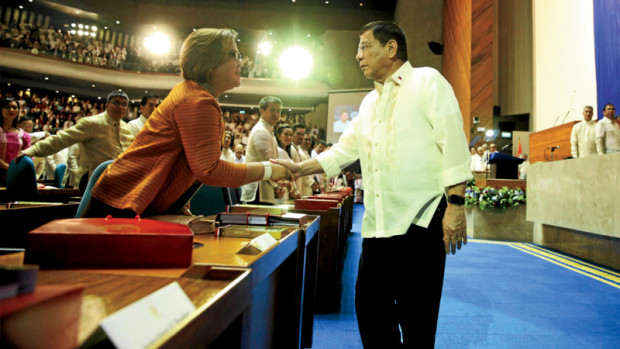
SONA SIDELIGHT Sen. Leila de Lima and President Duterte may be at loggerheads when it comes to the issue of human rights, but a warm handshake just before the President’s first State of the Nation Address on Monday shows there’s nothing personal in their attacks against each other. PRESIDENTIAL PHOTOGRAPHERS DIVISION

PRIVILEGE SPEECH OF SENATOR LEILA DE LIMA
“The Real Crisis We Face: Stop the Killings Now!”
Senate of the Philippines | August 2, 2016

Mr. President, my fellow Senators, mga minamahal kong kababayan:

Magandang araw po sa inyong lahat. I rise on matters of personal and collective privilege concerning a number of issues that now dominate the news and divide our people.

Our nation is in crisis. This crisis is the real and present danger posed by the illegal drug trade overwhelming our national fabric. Drug addiction, drug-pushing, and drug-related crimes, including bribery and corruption of our public officials and the penetration of our institutions by powerful drug syndicates, threaten our government, our people, and our society.
#5210
LGU Philippines / Re: Leila's 3 Questions
August 06, 2016, 04:27:38 AM

The three questions, in other words, define the fundamental issue: How can true justice be served when the accusation is unproven and written on a piece of cardboard, and the accused can no longer plead his case?

http://opinion.inquirer.net/


the links for the video of the senator's speech:

https://www.youtube.com/watch?v=9Uy9UikQtBQ

https://www.youtube.com/watch?v=Onuf2sRDfcI
#5211
LGU Philippines / Re: Leila's 3 Questions
August 06, 2016, 04:23:22 AM

Third: “What if ‘inosente’?” That is, what if the police or the vigilantes who have emerged from the shadows killed the wrong person? The dead cannot come back to life; the grief that visits the innocent victim’s family cannot be undone; the stain on society’s honor cannot be washed away.
#5212
LGU Philippines / Re: Leila's 3 Questions
August 06, 2016, 04:22:29 AM

Second: “What will we say, when future generations ask us?” That is, when our grandchildren ask, what did you do in the time of the killings, what do we say? Do we say we cheered the hundreds killed, because thousands of self-described drug addicts had surrendered and, without any program of rehabilitation, are thereby classified as “saved”? Do we say, well, we made the sign of the cross every time we saw a dead body on the streets? Do we say, we campaigned against the killing spree by clicking on a button on Facebook?
#5213
LGU Philippines / Re: Leila's 3 Questions
August 06, 2016, 04:21:28 AM

First: “What is the threshold?” That is, at what point do we say enough? We have not seen this number of killings since at least the Second World War. There is growing evidence that several of the dead were in fact not connected at all to the illegal drugs trade. De Lima used her privilege speech to reference a few of them. Is the threshold a question of the number of innocent lives, or the sheer total?
#5214
LGU Philippines / Re: Leila's 3 Questions
August 06, 2016, 04:19:55 AM

But it was the dehumanizing effect of about 500 extrajudicial killings in a month that she was most worried about, because of the role vigilantes played in dispensing “cardboard justice.” She said: “My concern is not only the killings tallied by the PNP as the formal law enforcement agency. At least we can put the PNP to task in our official legislative investigations. My gravest concern lies with the vigilantes of the night now operating almost all over the country, those harbingers of death spreading the apocalypse of our dehumanization.”

In the course of an hour-long interview she did that same night on INQ&Aâ€"the new Inquirer question-and-interview program that airs on dzIQ 990, Inquirer 990 Television, and Facebook Liveâ€"she raised three questions which not only summarize the new crisis but provide a focus to our ethical concerns over the spate of killings.
#5215
LGU Philippines / Re: Leila's 3 Questions
August 06, 2016, 03:58:12 AM

But the real impact of the speech came from its impassioned appeal to the conscience of the nation. “We cannot go on being indifferent to the daily executions, without ultimately becoming a nation bound by a collective sociopathy. The day has already come when we can no longer tell who is morally wrong among us: the 9-year-old street child sniffing rugby, or the policeman who shoots the child in the head for sniffing rugby. This is our descent as a nation into the darkness that these men have created for us.”

She spent a considerable amount of time professing her support for President Duterte’s ambitious campaign promise: “I am with President Duterte every step of the way in his war on drugs.” She made a distinction between the President and the men who she said were behind the demolition job: “It is possible that they are merely being peddled these lies about me by agents of vengeance.” And she made her case as antidrugs crusader repeatedly: “On Dec. 15, 2014, I personally led the raid on the drug lords’ dens and took away their power over the rest of the prisoners.”
#5216
LGU Philippines / Leila's 3 Questions
August 06, 2016, 03:56:34 AM

EDITORIAL

Leila’s 3 questions

@inquirerdotnet
Philippine Daily Inquirer
12:32 AM August 5th, 2016
 
Sen. Leila de Lima took to the Senate floor on Tuesday to denounce what she described as the “well-oiled social media operation” to destroy her reputation and, more consequentially, to try to stem the wave of extrajudicial killings that started after Rodrigo Duterte was elected to the presidency.

It was a powerful privilege speech, in part because she was speaking from personal anguish.

“I have been vilified and attacked, not only in social media but also by the President’s men, as a drug lord coddler and protector. I have been ridiculed and called names in social media. Photos are photoshopped, videos are spliced, lies are manufactured …. But the truth is I was the only justice secretary since the 1986 Edsa Revolution who dared to eradicate the dominion of the drug lords inside Bilibid,” the national penitentiary.
#5217

about time. we may even end up having trained young men who can be trusted to defend our country.
#5218

it goes without saying...

our legislators never bothered to pass an anti-dynasty law which is constitutionally mandated in the 1987 constitution. how can the man on the street trust them now to do what is right?
#5219

“If congressman Lagman brings the matter to the Supreme Court, that would delay the work of Congress as a constituent assembly,” Puno said.

Puno said that the matter of voting separately or jointly was not settled when the 1987 Constitution was drafted.

“They rushed it,” he said. “This is the only Constitution with many phrases, ‘as may be provided by law’.”

“If we want radical changes, we need to give our full time, not only our half attention,” he said.

http://interaksyon.com/
#5220

The draft Constitution will need the three-fourths vote of the members of Congress, sitting as a constituent assembly.

One key issue that is likely to crop up with this is how the voting would be treated:  will the Senate and the House of Representatives vote separately or jointly?  Will the 24 senators allow their votes to be merged with the votes of the 292 congressmen?

Albay Representative Edcel Lagman earlier threatened to bring to the Supreme Court the question of whether or not the Senate and the House could vote separately if Congress is convened as a constituent assembly to draft a new Constitution.

Lagman said the senators' insistence on separate voting was a key reason for not pursuing Con-Ass in favor of a constitutional convention.
#5221

“Many of the members of Congress will have conflict of interest when it comes to these issues. How will they deal with these issues?” he asked.

Example: in the process of transforming the form of government to a federal form, Puno said an important facet would be the “reconfiguration of the legislative power.”

“Will they allow their term to be cut short? …How will they allocate the legislative power of the local government units as against the legislative power of the state?  Where will you tilt the balance of power?” he said.

“Whatever their judgment may be will not sit well with our people, that’s one of the biggest problems there,” Puno added.
#5222

Con-Ass never used

Con-ass has never been used as a mode of drafting the country’s past three charters â€" 1935, 1973 and 1987 Constitution.

“You use constituent assembly only when making piecemeal amendments.  The reason for this is that the principal function of Congress is to make laws.  The constituent assembly as a mode is used only for minor amendments, so that their primary function of legislation will not be impeded,” Puno said.

Puno explained why the people charged with amending the Charter should be “impartial.”

“Will they abolish political dynasties, the party-list system?  Will they put in place stricter provisions against monopoly, duopoly and oligopoly?” he said.
#5223

He added that the recommendations of the commission would be “non-binding.”

“This will not take away fears that the constituent assembly will not be an impartial body.  . . . And what the constitutional commission will do will not be binding to the assembly,” Puno said.

The former magistrate’s resistance to Con-Ass is grounded on the fact that members of Congress were not elected to make a Constitution and on a possible conflict of interest, since the Charter they would be drafting affects their political careers.
#5224

“To me, a hybrid con-con is most suitable because what we will do is a radical re-examination of the various parts of the Constitution.  With this mode, there is little possibility of abuse because the members who will be elected are non-partisan,” he said.

Puno is unenthusiastic to the latest idea of Speaker Pantaleon Alvarez for the President to create a 20-member constitutional commission that will draft the new Constitution and submit it for approval of Congress, which will sit as constituent assembly.

Puno was one of the names mentioned by Alvarez as a possible member of the commission.

“The constitutional commission will be just a legal department of the constituent assembly,” he said.
#5225

CJ PUNO ON CHA-CHA | Don't change Constitution in a rush, avoid Con-Ass

By: Lira Dalangin-Fernandez, InterAksyon.com
August 1, 2016 6:52 PM


Former Chief Justice Reynato Puno gestures in an interview with InterAksyon.com. BERNARD TESTA, INTERAKSYON.COM

MANILA, Philippines â€" If you’re in a hurry, don’t touch it. While advocating Charter change, former Supreme Court Chief Justice Reynato Puno gave a fair warning against hastily tinkering with the Constitution, and delegating to Congress the task through a constituent assembly.

“One fundamental rule in Constitution making is that you don’t write the Constitution in a hurry,” he said.

“If you’re in a hurry, don’t touch the Constitution,” he added.

A hybrid constitutional convention â€" with elected and appointed members â€" would be most suitable to the Philippine set-up, Puno said.
#5226

But Lerma also believed his photo delivered the message because Mr. Duterte cared to mention it in his first State of the Nation address: “Napansin ng Presidente.”

If only for putting a spotlight on the extrajudicial killings (“salvagings,” to remember a Marcos-era term) that are said to be pushing the government’s drug war out of control, Lerma said his work has been validated.

He noted: “May purpose ang ginagawa ko, to shed light on this issue. Grabe na talaga! If you will multiply these deaths by six years… Nakakabahala rin ang reaction ng public. We’re a Catholic country, tapos ganito tayo. Kung hindi tayo magre-react, in a way we’re part of it.”

http://lifestyle.inquirer.net/
#5227


INQUIRER front-page photo last Sunday, July 24, that went viral, taken by Lerma while roving on the night shift

But, last week, while roving on the night shift, he was overwhelmed by the body count arising from the drug war: “Hindi bumababa sa lima ang patay bawat araw, minsan 10, may araw na 18. If I will add everything for that week, it would be more than the total for the year when I first did the nightshift in 2005.”

Of his “Pieta”-like photo, he gave credit to the Inquirer editors for having the balls to publish it prominently, when all other media outfits, whose photographers were also on the scene of the crime that night, decided not to use their own shots.

But Lerma was disappointed that Mr. Duterte took a potshot at the photo, branding it as “drama.”

“Sorry, Mr. President,” Lerma said, “totoong tao sila. Sino ba tayo para batikusin sila? This is real life… they have every right to grieve for their loved ones… Ikaw rin iiyak kung mangyari sa pamilya mo yan. Ikaw nga, nung nanalo ka (as President), umiyak ka sa puntod ng parents mo. I mean, give these people some dignity.”
#5228

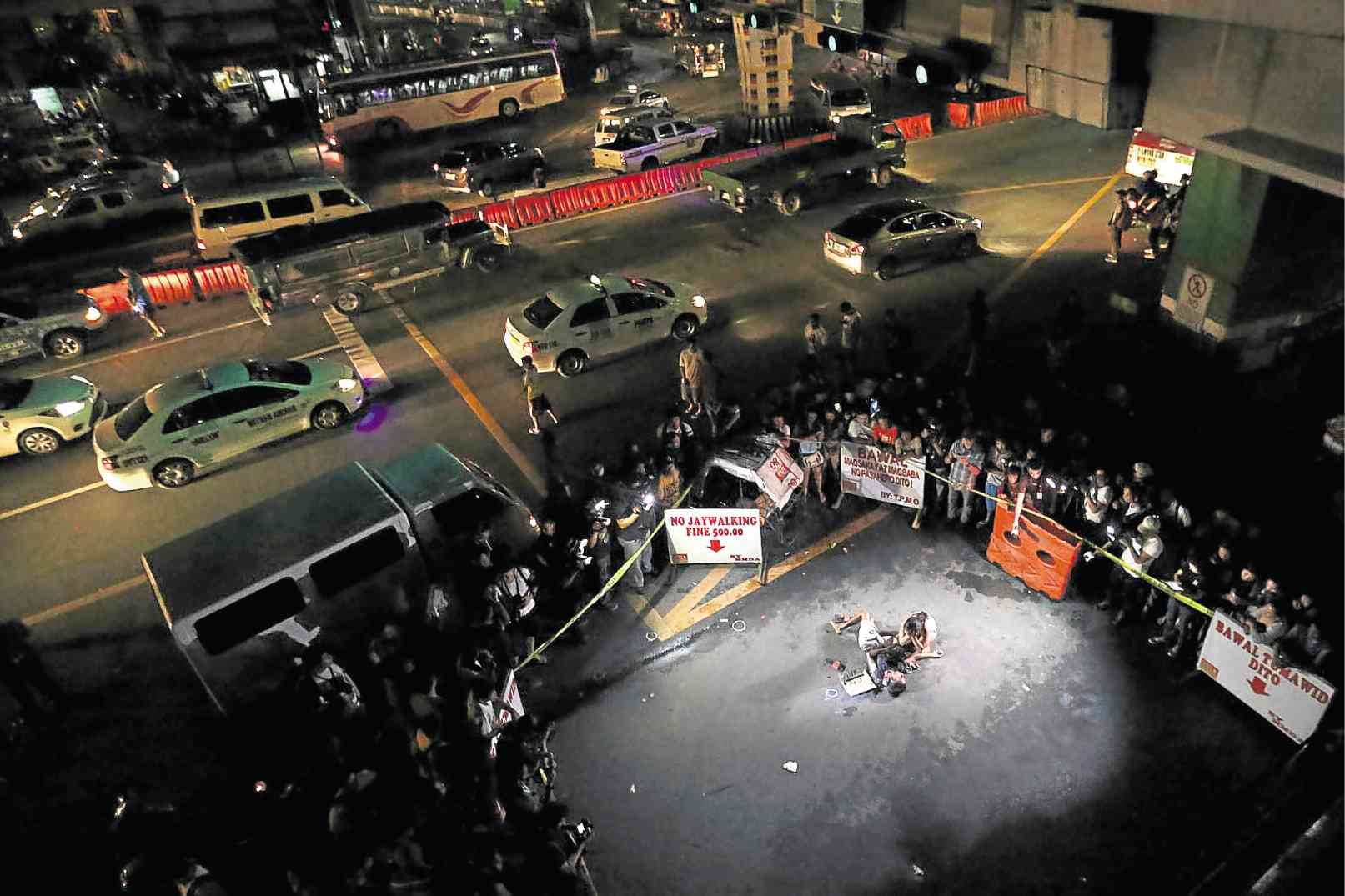
One of these recent “harsh realities” came to light with the publication on the Inquirer’s front page last Sunday, July 24, of a photograph showing a young woman, Jennilyn Olayres, cradling in her arms the lifeless body of her domestic partner, Michael Siaron, who was shot dead, gangland-style, by an unidentified gunman for being a suspected drug pusher.

The photo, taken by the Inquirer’s Raffy Lerma, was very disturbing, spoke louder than words, one that gave face to the anguish of losing a loved one in the bloody drug war being waged by the Duterte administration.

Lerma told Inquirer Lifestyle that, as a photojournalist, he thought he has “seen it all,” especially after covering the devastation of Supertyphoon “Yolanda” in 2013.
#5229

That ‘Pieta’-like photo? ‘Totoong tao sila, Mr. President’

By: Pocholo Concepcion
@inquirerdotnet
Inquirer Lifestyle
05:36 AM July 31st, 2016
 

INQUIRER photographer Raffy Lerma: “‘May’ purpose ‘ang ginagawa ko,’ to shed light on this issue. ‘Grabe na talaga!’” POCHOLO CONCEPCION

PRESIDENT Rodrigo Duterte himself acknowledged the role of mediaâ€"particularly the Inquirerâ€"by way of a tribute to its editor in chief Letty Jimenez Magsanoc (“LJM”) when she passed away.

In an article published in this paper  (“Only LJM can say this to Duterte,” Dec. 27, 2015), he was quoted as saying: “She continued to be a fierce advocate of public accountability and transparency in the post-Edsa period down to her last breath… Unlike many whose constant exposure to the harsh realities of a fallen world has pushed themselves to apathy, she continued to hope in the goodness of people.”
#5230

Prudence

The CPP asked the President “to exercise a little more prudence and display more measured temperament as a way of appreciating the situation from a broader historical perspective.”

By doing this, it said Mr. Duterte would “avoid such impulsive acts as imposing ultimatums by the hour on a conflict that has spanned nearly 50 years.”

It said the military and the police continued to attack and stage combat operations against NPA rebels in different parts of the country even while the ceasefire was in effect.

“The CPP will not allow itself to be browbeaten to order the NPA to go on a ceasefire while operating troops of the [Armed Forces of the Philippines] showed no plans on letting up in their search-and-destroy operations and frenzied offensives that terrorize civilian communities,” it said. With a report from Delfin T. Mallari Jr. /JE/rga/ac

http://newsinfo.inquirer.net/
#5231
 
The CPP said the government and NDFP, as earlier planned, can exchange ceasefire declarations “in order to discuss points for cooperation and coordination and determine ways of preventing armed skirmishes, misunderstandings and miscommunications during the course of the peace talks.”

It expressed hope that despite the revocation of the government ceasefire order, it will not affect preparations for formal resumption of peace negotiations scheduled this month in Norway.

The CPP said it is looking forward to work with Mr. Duterte in securing peace.
#5232
 
“Despite his anticrime bravado, it would seem [Mr. Duterte] has shown the drug lords and protectors of criminal syndicates more flexibility and accommodation,” the CPP said.

On Saturday night, the President recalled his ceasefire order after a 5 p.m. deadline he had set passed without a response from communist insurgents.

Mr. Duterte demanded an explanation from communist leaders following the ambush staged by NPA rebels in Davao del Norte province on Wednesday. A government militiaman was killed while four others were wounded in the attack.
#5233

‘Whimsical,’ ‘capricious’

The CPP described Mr. Duterte’s deadline to communist rebels to issue its own ceasefire declaration as “whimsical” and “capricious.”

“It was quite capricious for [Mr. Duterte] to have imposed such ultimatums of a few hours or several days for the CPP to act in accordance with his whims. It was quite disconcerting that [he] would impose such an inflexible ultimatum on the CPP,” it said.

The CPP said Mr. Duterte seemed more accommodating to suspected drug lords, apparently referring to the controversial meeting between the President and Cebu-based businessman Peter Lim, who had been linked to the illegal drugs trade.
#5234

“We trust, however, that this will not affect preparations for formal resumption of peace negotiations scheduled for August 20-27 in Oslo, Norway, nor will it preclude the GRP President from reissuing such a declaration simultaneously with a similar unilateral declaration by the CPP and NPA on August 20,” the statement read.

The CPP explained why it took days for them to reciprocate Duterte’s ceasefire offer.

“The CPP took the more prudent path of moving slowly in a deliberate effort to observe the situation at the ground even as it ordered the NPA to stay on active defense. The CPP, however, will not allow itself to be browbeaten to order the NPA to go on a ceasefire while operating troops of the AFP showed no plans of letting up in their search-and-destroy operations and frenzied offensives that terrorize civilian communities,” it said.
#5235

Reds to declare unilateral ceasefire on August 20

By: Aries Joseph Hegina
@AHeginaINQ
INQUIRER.net
04:05 PM July 31st, 2016


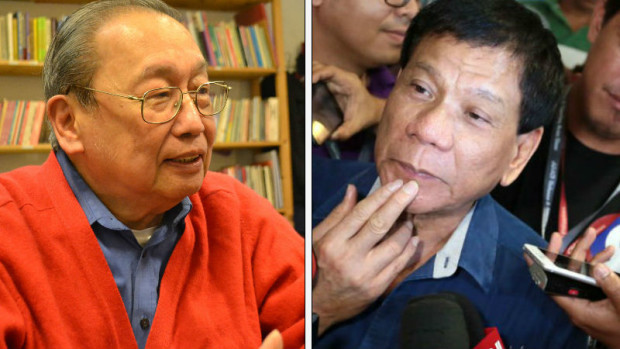
Communist Party of the Philippines (CPP) founder Jose Maria Sison and President Rodrigo Duterte. FILE PHOTOS

The Communist Party of the Philippines (CPP) said on Sunday that it is willing to issue a unilateral ceasefire declaration “separately but simultaneously” with the government on August 20, the first day of the formal resumption of peace talks in Oslo, Norway.

“To further support peace negotiations, the CPP is willing to issue a unilateral ceasefire declaration separately but simultaneously with the Duterte government on August 20. The time-frame can be determined through negotiations,” the CPP said in a statement.

It said that while it is “too bad” that President Rodrigo Duterte has withdrawn the unilateral ceasefire declaration he issued on Saturday, they remain optimistic that it would not derail the preparations for the peace talks.
#5236

...and as some dreams go, they may turn out welcoming to freddy krueger.


;D
#5237

can these extra-judicial killings ever be solved? can the killers ever be punished? are filipino lives that cheap? :(
#5238


Another veteran photographer said, while shaking his head, “I no longer want to be a photographer.” We all had the same feeling of guilt.

We were unsure whether to submit the pictures for publication because we felt guilty for not being able to help the victim and his partner. We only took photographs.

I remember shaking my head, wiping off my sweat and processing what had just transpired in my head.

I told my colleagues: “Let’s file this. It’s our work.”

We may not have helped the victim and his partner but it is our job to show these pictures. We have to show reality as it is and perhaps, get people to react and even take action.

http://opinion.inquirer.net/
#5239


Another report cameâ€"a body was found in Leveriza, Pasay City, the fourth on that shift. Many of my colleagues and I hurried off but we all had a heavy heart.

We were not able to take pictures of the male victimâ€"the fourth in “Patay City” (a play on Pasay City, meaning city of the dead), as a radio reporter jokingly saidâ€"as the body had been removed from the crime scene. The victim, a mute, was shot and killed by a motorcycle-riding gunman, who also left a cardboard message near his body.

We were quiet as we went back to the Manila Police District, the office of graveyard-shift media workers. I lighted a cigarette to calm my nerves. Another photographer took deep breaths. Together, we recounted moments from the scene at Pasay Rotunda.
#5240


The members of the Soco team came several minutes late because they came from the same crime scene we covered earlier outside the Senate Building in Pasay City.

What could I do? It was heartbreaking but I knew I had to do my job. The crime scene still had to be processed. Evidence had to be gathered.

I climbed the overpass and took more shots: an overview of the scene with cars passing along Edsa, with a few motorists stopping and looking at the commotion, a crowd gathering around the body and Olayres laying Siaron down on the pavement and weeping.
#5241


I saw no need to use a flash, as I needed to capture the dark-at-dawn atmosphere.

“That’s enough! And help us!” she cried out to media workers, authorities and onlookers.

I stopped taking pictures and looked for a policeman. I asked him, “What are you waiting for?”

The policeman replied: “We can’t do anything as he is already dead. Let’s wait for the Soco (Scene of the Crime Operatives).”
#5242

An hour had passed after the shooting, according to witnesses. A gunman on a motorcycle driven by an accomplice fired on Siaron and left the cardboard sign beside him. Another person was wounded.

TV floodlights and news cameras popped and flashed as Olayres wept for Siaron while cradling him in her arms like Michelangelo’s world-famous sculpture “Pieta,” a depiction of the Virgin Mary mourning over the body of the dead Christ.

I took many shots from a distance supported by the light from cameras illuminating Siaron and Olayres, which appeared very much like lighting from a theater stage. Hearing her pleading for help was gut-wrenching. I could do nothing but take more shots.
#5243

A NIGHT OF ANGUISH AND TORMENT

The story behind the viral photo

By: Raffy Lerma
@inquirerdotnet
Philippine Daily Inquirer
12:02 AM July 31st, 2016


PHOTOS BY RAFFY LERMA

It was the third extrajudicial killing of suspected drug pushers that I covered on the graveyard shift last week.

Around 1:30 a.m. on July 23, upon arriving on Edsa Taft-Pasay Rotunda from another crime scene, I could already see the picture.

I knew this was different. In the middle of the police line in which photographers and bystanders are not allowed to cross was the lifeless body of suspected drug pusher Michael Siaron, cradled by partner Jennilyn Olayres. A cardboard sign that read “Drug pusher huwag tularan” (I am a drug pusher, don’t emulate) was left near the body.
#5244
QuoteIt was an image that, once seen, could not be unseen.

as this is an article that once read. could not be unread. such a well-written piece.
#5245

She had been the wild child when she was younger and hung out on the streets, as her numerous tattoos attest.  When they fought, he was the one on the receiving end. It was Siaron who had been the taming influence. She learned to cook rice and clean house because of him, she says.

When they had the chance to watch TV, she recalls, he preferred documentaries like those of Jessica Soho and Kara David, or shows about nature and wildlife, a view of the wider world beyond their narrow existence.

When she learned that Siaron had been shot, she ran barefoot from their shack all the way to Pasay Rotonda, and broke through the police cordon to get to his body.

As far as she knows, Siaron had voted for Rodrigo Duterte. TVJ

http://lifestyle.inquirer.net/
#5246

She describes someone who is far from the drug-crazed maniac that his killers wanted the world to believe.

“Joker, mapagbiro sa tao, masayahinâ€"ayaw niya ng gulo (He loved to joke; he was cheerful. He didn’t like trouble),” she says.

Sometimes he would take a broom, pretend it was a microphone and sing to make her laugh.

“Simpleng tao lang ang asawa ko, napakasimple lang ang pamumuhay namin sa araw araw, basta makakain lang kami ng tatlong beses isang araw, OK na po ’yon.  Lagi niyang sinasabi sa akin, ‘Kailangan makuntento ka kung ano meron ka, kasi hindi tayo mayaman, wala tayong pera, wala akong trabahong maganda. (My husband was a simple man. We led a simple life. It was enough that we ate three meals a day. He’d always tell me to be content with what we have, that we have no money, that he had no good job).”
#5247

Jennilyn, five years younger, grew up in the same neighborhood, the fourth in a brood of 10.  Her father also pedals a sidecar for a living.

They had been together for three yearsâ€"“three years and one month noong Lunes,” she says.

They had wanted to have a child of their own, but she had a miscarriage, she explains.

They lived in a shackâ€"actually a tiny storeroom along a garbage-strewn creekâ€"that they rent for P500 a month. Siaron had done his best to fix it up, but the roof still leaks and the walls are full of holes, and there is no toilet and no running water.

On the surface, it looks like a pretty bleak existence. But it wasn’t without its joys.
#5248

Pedaling

He had always been thin, and in poor health from a bout of leptospirosis when he was younger. He sometimes found it hard to breathe.

He had an 11-year-old son named Harry from a previous relationship. His ex has since married, but Siaron tried to remain close to his son.

He had worked for a time in a restaurant, his last steady job. But, since then, he had to work odd jobs to survive. Sometimes he worked as a day laborer. Other times he helped paint houses.


IN THIS shack live Michael Siaron and Jennilyn Olayres, along a garbage-covered creek.

Lately, he had been pedaling a sidecar part-time, taking home a measly P200 at most, of which he had to pay P60 for the “boundary.”
#5249

“Kailangan ho ba paniwalaan kaagad ang nasa karton, na kahit bata kayang isulat (Must we believe instantly what’s written on the cardboard, that even a kid could write)?” she asks.  “Sana tinitingnan muna nila ang background ng tao. Hindi ’yung sa panglabas lang. (They should have looked first into the person’s background. Not only his outward appearance).”

Siaron was the eldest of four children.  His father, Solomon, sells fruits from a pushcart along Taft Avenue. His mother, Emily, has worked in Bahrain for the last 15 years, most recently as a janitress in a mall. But even with the money she sends home, the family is barely scraping by.

He never finished high school, having dropped out in his fourth year.
#5250

Yes, she admits, he did use drugs, methamphetamine or shabu to be exact.  But he was never a pusher, she stresses.

“Ni minsan, hindi siya nang-agrabyado ng tao. Hindi siya nanggugulo, hindi siya nagnanakaw, hindi siya gumagawa ng masama. (Not even once did he abuse people. He didn’t make trouble, he didn’t steal, he didn’t do anything wrong).”

People who are quick to judge, who readily believe the words scrawled on a piece of cardboard, can’t know who her husband really was.
#5251

Under the LRT tracks

Siaron’s 29-year sojourn in this world has ended in a plain white coffin in a cramped barangay hall under the LRT tracks, along the very side streets of Sto. Niño, Pasay City, where he lived and grew up.

It is only now that the bare facts of his relatively short life are becoming known.

It isn’t sympathy or pity that she wants, says Jennilyn Olayres. It’s not even justice.

“Alam ko na hindi ko makukuha ang hustisya para sa asawa ko (I know that I can never have justice for him),” she adds.  “Malinis lang ang pangalan ng asawa ko, malaking bagay na para sa akin. (Just to clear my husband’s name, that’s already a big thing for me).”
#5252

President Duterte certainly saw it. He testified to the power of the image when he mentioned it in his State of the Nation speech the following day:

“And you are portrayed in a broadsheet na parang Mother Mary cradling the dead cadaver of Jesus Christ,” he said, no doubt referring to Michelangelo’s “Pieta.” “E ’yang mga ’yan, magka-dramahan tayo dito.”


Siaron's coffin bears the names of his loved ones.

Now that the photograph has gone viral on the internet, Siaron’s image in death has been seen not only in the country, but globally as the international media picks up on the story, the very real face of Duterte’s war on drugs.
#5253

The unknown gunmen who killed him last July 23 left his bloody corpse on the highway for all to see. They sought to reduce him to a word hastily scribbled on a scrap of cardboard. But, in doing so, they also gave him a face. They made him visible.

It was through Inquirer photographer Raffy Lerma’s lens that many of his fellow Filipinos finally saw Siaron, splashed across the front page the following morning in the indelible image of Siaron’s live-in partner, Jennilyn Olayres, who was hysterical with grief, clutching his lifeless body.

It was an image that, once seen, could not be unseen.
#5254

The death of an invisible man

By: Eric S. Caruncho
@inquirerdotnet
Inquirer Lifestyle
05:40 AM July 31st, 2016


Jennilyn Olayres before the coffin of her partner,Michael Siaron, during the wake at barangay hall in Pasay. RAFFY LERMA

In life, Michael Siaron was all but invisible, just one of the faceless masses barely getting by on the mean streets of Metro Manila.

He belonged to the urban poor, a kind that more fortunate Filipinos run into every day but don’t really see, because they’ve learned to tune it out of their consciousness, along with the smell of open sewers, the noise of traffic and other unpleasant facts of daily life in the city.

Ironically, it was in death that Siaron was finally made visible by those who erased him from his existence.
#5255


“And you are portrayed in a broadsheet na parang Mother Mary cradling the dead cadaver of Jesus Christ,” he said, no doubt referring to Michelangelo’s “Pieta.” “E ’yang mga ’yan, magka-dramahan tayo dito.”
#5256
Photos Unlimited / Re: Sigay nga tapol
July 31, 2016, 05:15:28 PM

just my type. tapol is my favorite color. that pendant is a beauty. i wish it's available in the philippines.
#5257

e. Future Conduct of the Parties

Finally, the Tribunal considered the Philippines’ request for a declaration that, going forward, China shall respect the rights and freedoms of the Philippines and comply with its duties under the Convention. In this respect, the Tribunal noted that both the Philippines and China have repeatedly accepted that the Convention and general obligations of good faith define and regulate their conduct. The Tribunal considered that the root of the disputes at issue in this arbitration lies not in any intention on the part of China or the Philippines to infringe on the legal rights of the other, but rather in fundamentally different understandings of their respective rights under the Convention in the waters of the South China Sea. The Tribunal recalled that it is a fundamental principle of international law that bad faith is not presumed and noted that Article 11 of Annex VII provides that the “award . . . shall be complied with by the parties to the dispute.” The Tribunal therefore considered that no further declaration was necessary.

* *
#5258

d. Aggravation of the Dispute between the Parties

In its Award of 12 July 2016, the Tribunal considered whether China’s recent large-scale land reclamation and construction of artificial islands at seven features in the Spratly Islands since the commencement of the arbitration had aggravated the dispute between the Parties. The Tribunal recalled that there exists a duty on parties engaged in a dispute settlement procedure to refrain from aggravating or extending the dispute or disputes at issue during the pendency of the settlement process. The Tribunal noted that China has (a) built a large artificial island on Mischief Reef, a low-tide elevation located in the exclusive economic zone of the Philippines; (b) caused permanent, irreparable harm to the coral reef ecosystem and (c) permanently destroyed evidence of the natural condition of the features in question. The Tribunal concluded that China had violated its obligations to refrain from aggravating or extending the Parties’ disputes during the pendency of the settlement process.
#5259

c. Chinese Activities in the South China Sea

In its Award of 12 July 2016, the Tribunal considered the lawfulness under the Convention of various Chinese actions in the South China Sea. Having found that Mischief Reef, Second Thomas Shoal and Reed Bank are submerged at high tide, form part of the exclusive economic zone and continental shelf of the Philippines, and are not overlapped by any possible entitlement of China, the Tribunal concluded that the Convention is clear in allocating sovereign rights to the Philippines with respect to sea areas in its exclusive economic zone. The Tribunal found as a matter of fact that China had (a) interfered with Philippine petroleum exploration at Reed Bank, (b) purported to prohibit fishing by Philippine vessels within the Philippines’ exclusive economic zone, (c) protected and failed to prevent Chinese fishermen from fishing within the Philippines’ exclusive economic zone at Mischief Reef and Second Thomas Shoal, and (d) constructed installations and artificial islands at Mischief Reef without the authorization of the Philippines. The Tribunal therefore concluded that China had violated the Philippines’ sovereign rights with respect to its exclusive economic zone and continental shelf.

The Tribunal next examined traditional fishing at Scarborough Shoal and concluded that fishermen from the Philippines, as well as fishermen from China and other countries, had long fished at the Shoal and had traditional fishing rights in the area. Because Scarborough Shoal is above water at high tide, it generates an entitlement to a territorial sea, its surrounding waters do not form part of the exclusive economic zone, and traditional fishing rights were not extinguished by the Convention. Although the Tribunal emphasized that it was not deciding sovereignty over Scarborough Shoal, it found that China had violated its duty to respect to the traditional fishing rights of Philippine fishermen by halting access to the Shoal after May 2012. The Tribunal noted, however, that it would reach the same conclusion with respect to the traditional fishing rights of Chinese fishermen if the Philippines were to prevent fishing by Chinese nationals at Scarborough Shoal.

The Tribunal also considered the effect of China’s actions on the marine environment. In doing so, the Tribunal was assisted by three independent experts on coral reef biology who were appointed to assist it in evaluating the available scientific evidence and the Philippines’ expert reports. The Tribunal found that China’s recent large scale land reclamation and construction of artificial islands at seven features in the Spratly Islands has caused severe harm to the coral reef environment and that China has violated its obligation under Articles 192 and 194 of the Convention to preserve and protect the marine environment with respect to fragile ecosystems and the habitat of depleted, threatened, or endangered species. The Tribunal also found that Chinese fishermen have engaged in the harvesting of endangered sea turtles, coral, and giant clams on a substantial scale in the South China Sea, using methods that inflict severe damage on the coral reef environment. The Tribunal found that Chinese authorities were aware of these activities and failed to fulfill their due diligence obligations under the Convention to stop them.

Finally, the Tribunal considered the lawfulness of the conduct of Chinese law enforcement vessels at Scarborough Shoal on two occasions in April and May 2012 when Chinese vessels had sought to physically obstruct Philippine vessels from approaching or gaining entrance to the Shoal. In doing so, the Tribunal was assisted by an independent expert on navigational safety who was appointed to assist it in reviewing the written reports provided by the officers of the Philippine vessels and the expert evidence on navigational safety provided by the Philippines. The Tribunal found that Chinese law enforcement vessels had repeatedly approached the Philippine vessels at high speed and sought to cross ahead of them at close distances, creating serious risk of collision and danger to Philippine ships and personnel. The Tribunal concluded that China had breached its obligations under the Convention on the International Regulations for Preventing Collisions at Sea, 1972, and Article 94 the Convention concerning maritime safety.
#5260

b. The Status of Features in the South China Sea

In its Award of 12 July 2016, the Tribunal considered the status of features in the South China Sea and the entitlements to maritime areas that China could potentially claim pursuant to the Convention.

The Tribunal first undertook a technical evaluation as to whether certain coral reefs claimed by China are or are not above water at high tide. Under Articles 13 and 121 of the Convention, features that are above water at high tide generate an entitlement to at least a 12 nautical mile territorial sea, whereas features that are submerged at high tide generate no entitlement to maritime zones. The Tribunal noted that many of the reefs in the South China Sea have been heavily modified by recent land reclamation and construction and recalled that the Convention classifies features on the basis of their natural condition. The Tribunal appointed an expert hydrographer to assist it in evaluating the Philippines’ technical evidence and relied heavily on archival materials and historical hydrographic surveys in evaluating the features. The Tribunal agreed with the Philippines that Scarborough Shoal, Johnson Reef, Cuarteron Reef, and Fiery Cross Reef are high-tide features and that Subi Reef, Hughes Reef, Mischief Reef, and Second Thomas Shoal were submerged at high tide in their natural condition. However, the Tribunal disagreed with the Philippines regarding the status of Gaven Reef (North) and McKennan Reef and concluded that both are high tide features.

The Tribunal then considered whether any of the features claimed by China could generate an entitlement to maritime zones beyond 12 nautical miles. Under Article 121 of the Convention, islands generate an entitlement to an exclusive economic zone of 200 nautical miles and to a continental shelf, but “[r]ocks which cannot sustain human habitation or economic life of their own shall have no exclusive economic zone or continental shelf.” The Tribunal noted that this provision was closely linked to the expansion of coastal State jurisdiction with the creation of the exclusive economic zone and was intended to prevent insignificant features from generating large entitlements to maritime zones that would infringe on the entitlements of inhabited territory or on the high seas and the area of the seabed reserved for the common heritage of mankind. The Tribunal interpreted Article 121 and concluded that the entitlements of a feature depend on (a) the objective capacity of a feature, (b) in its natural condition, to sustain either (c) a stable community of people or (d) economic activity that is neither dependent on outside resources nor purely extractive in nature.

The Tribunal noted that many of the features in the Spratly Islands are currently controlled by one or another of the littoral States, which have constructed installations and maintain personnel there. The Tribunal considered these modern presences to be dependent on outside resources and support and noted that many of the features have been modified to improve their habitability, including through land reclamation and the construction of infrastructure such as desalination plants. The Tribunal concluded that the current presence of official personnel on many of the features does not establish their capacity, in their natural condition, to sustain a stable community of people and considered that historical evidence of habitation or economic life was more relevant to the objective capacity of the features. Examining the historical record, the Tribunal noted that the Spratly Islands were historically used by small groups of fishermen from China, as well as other States, and that several Japanese fishing and guano mining enterprises were attempted in the 1920s and 1930s. The Tribunal concluded that temporary use of the features by fishermen did not amount to inhabitation by a stable community and that all of the historical economic activity had been extractive in nature. Accordingly, the Tribunal concluded that all of the high-tide features in the Spratly Islands (including, for example, Itu Aba, Thitu, West York Island, Spratly Island, North-East Cay, South-West Cay) are legally “rocks” that do not generate an exclusive economic zone or continental shelf.

The Tribunal also held that the Convention does not provide for a group of islands such as the Spratly Islands to generate maritime zones collectively as a unit.
#5261

4. The Tribunal’s Decisions on the Merits of the Philippines’ Claims

a. The ‘Nine-Dash Line’ and China’s Claim to Historic Rights in the Maritime Areas of the South China Sea

In its Award of 12 July 2016, the Tribunal considered the implications of China’s ‘nine-dash line’ and whether China has historic rights to resources in the South China Sea beyond the limits of the maritime zones that it is entitled to pursuant to the Convention.

The Tribunal examined the history of the Convention and its provisions concerning maritime zones and concluded that the Convention was intended to comprehensively allocate the rights of States to maritime areas. The Tribunal noted that the question of pre-existing rights to resources (in particular fishing resources) was carefully considered during the negotiations on the creation of the exclusive economic zone and that a number of States wished to preserve historic fishing rights in the new zone. This position was rejected, however, and the final text of the Convention gives other States only a limited right of access to fisheries in the exclusive economic zone (in the event the coastal State cannot harvest the full allowable catch) and no rights to petroleum or mineral resources. The Tribunal found that China’s claim to historic rights to resources was incompatible with the detailed allocation of rights and maritime zones in the Convention and concluded that, to the extent China had historic rights to resources in the waters of the South China Sea, such rights were extinguished by the entry into force of the Convention to the extent they were incompatible with the Convention’s system of maritime zones.

The Tribunal also examined the historical record to determine whether China actually had historic rights to resources in the South China Sea prior to the entry into force of the Convention. The Tribunal noted that there is evidence that Chinese navigators and fishermen, as well as those of other States, had historically made use of the islands in the South China Sea, although the Tribunal emphasized that it was not empowered to decide the question of sovereignty over the islands. However, the Tribunal considered that prior to the Convention, the waters of the South China Sea beyond the territorial sea were legally part of the high seas, in which vessels from any State could freely navigate and fish. Accordingly, the Tribunal concluded that historical navigation and fishing by China in the waters of the South China Sea represented the exercise of high seas freedoms, rather than a historic right, and that there was no evidence that China had historically exercised exclusive control over the waters of the South China Sea or prevented other States from exploiting their resources.

Accordingly, the Tribunal concluded that, as between the Philippines and China, there was no legal basis for China to claim historic rights to resources, in excess of the rights provided for by the Convention, within the sea areas falling within the ‘nine-dash line’.
#5262

3. The Tribunal’s Decisions on the Scope of its Jurisdiction

The Tribunal has addressed the scope of its jurisdiction to consider the Philippines’ claims both in its Award on Jurisdiction, to the extent that issues of jurisdiction could be decided as a preliminary matter, and in its Award of 12 July 2016, to the extent that issues of jurisdiction were intertwined with the merits of the Philippines’ claims. The Tribunal’s Award of 12 July 2016 also incorporates and reaffirms the decisions on jurisdiction taken in the Award on Jurisdiction.

For completeness, the Tribunal’s decisions on jurisdiction in both awards are summarized here together.

a. Preliminary Matters

In its Award on Jurisdiction, the Tribunal considered a number of preliminary matters with respect to its jurisdiction. The Tribunal noted that both the Philippines and China are parties to the Convention and that the Convention does not permit a State to except itself generally from the mechanism for the resolution of disputes set out in the Convention. The Tribunal held that China’s non-participation does not deprive the Tribunal of jurisdiction and that the Tribunal had been properly constituted pursuant to the provisions of Annex VII to the Convention, which include a procedure to form a tribunal even in the absence of one party.

Finally, the Tribunal rejected an argument set out in China’s Position Paper and held that the mere act of unilaterally initiating an arbitration cannot constitute an abuse of the Convention.

b. Existence of a Dispute Concerning Interpretation and Application of the Convention

In its Award on Jurisdiction, the Tribunal considered whether the Parties’ disputes concerned the interpretation or application of the Convention, which is a requirement for resort to the dispute settlement mechanisms of the Convention.

The Tribunal rejected the argument set out in China’s Position Paper that the Parties’ dispute is actually about territorial sovereignty and therefore not a matter concerning the Convention. The Tribunal accepted that there is a dispute between the Parties concerning sovereignty over islands in the South China Sea, but held that the matters submitted to arbitration by the Philippines do not concern sovereignty. The Tribunal considered that it would not need to implicitly decide sovereignty to address the Philippines’ Submissions and that doing so would not advance the sovereignty claims of either Party to islands in the South China Sea.

The Tribunal also rejected the argument set out in China’s Position Paper that the Parties’ dispute is actually about maritime boundary delimitation and therefore excluded from dispute settlement by Article 298 of the Convention and a declaration that China made on 25 August 2006 pursuant to that Article. The Tribunal noted that a dispute concerning whether a State has an entitlement to a maritime zone is a distinct matter from the delimitation of maritime zones in an area in which they overlap. The Tribunal noted that entitlements, together with a wide variety of other issues, are commonly considered in a boundary delimitation, but can also arise in other contexts. The Tribunal held that it does not follow that a dispute over each of these issues is necessarily a dispute over boundary delimitation.

Finally, the Tribunal held that each of the Philippines’ Submissions reflected a dispute concerning the Convention. In doing so, the Tribunal emphasized (a) that a dispute concerning the interaction between the Convention and other rights (including any Chinese “historic rights”) is a dispute concerning the Convention and (b) that where China has not clearly stated its position, the existence of a dispute may be inferred from the conduct of a State or from silence and is a matter to be determined objectively.

c. Involvement of Indispensable Third-Parties

In its Award on Jurisdiction, the Tribunal considered whether the absence from this arbitration of other States that have made claims to the islands of the South China Sea would be a bar to the Tribunal’s jurisdiction. The Tribunal noted that the rights of other States would not form “the very subject-matter of the decision,” the standard for a third-party to be indispensable. The Tribunal further noted that in December 2014, Viet Nam had submitted a statement to the Tribunal, in which Viet Nam asserted that it has “no doubt that the Tribunal has jurisdiction in these proceedings.” The Tribunal also noted that Viet Nam, Malaysia, and Indonesia had attended the hearing on jurisdiction as observers, without any State raising the argument that its participation was indispensable.

In its Award of 12 July 2016, the Tribunal noted that it had received a communication from Malaysia on 23 June 2016, recalling Malaysia’s claims in the South China Sea. The Tribunal compared its decisions on the merits of the Philippines’ Submissions with the rights claimed by Malaysia and reaffirmed its decision that Malaysia is not an indispensable party and that Malaysia’s interests in the South China Sea do not prevent the Tribunal from addressing the Philippines’ Submissions.

d. Preconditions to Jurisdiction

In its Award on Jurisdiction, the Tribunal considered the applicability of Articles 281 and 282 of the Convention, which may prevent a State from making use of the mechanisms under the Convention if they have already agreed to another means of dispute resolution.

The Tribunal rejected the argument set out in China’s Position Paper that the 2002 Chinaâ€"ASEAN Declaration on the Conduct of Parties in the South China Sea prevented the Philippines from initiating arbitration. The Tribunal held that the Declaration is a political agreement and not legally binding, does not provide a mechanism for binding settlement, does not exclude other means of dispute settlement, and therefore does not restrict the Tribunal’s jurisdiction under Articles 281 or 282. The Tribunal also considered the Treaty of Amity and Cooperation in Southeast Asia, and the Convention on Biological Diversity, and a series of joint statements issued by the Philippines and China referring to the resolution of disputes through negotiations and concluded that none of these instruments constitute an agreement that would prevent the Philippines from bringing its claims to arbitration.

The Tribunal further held that the Parties had exchanged views regarding the settlement of their disputes, as required by Article 283 of the Convention, before the Philippines initiated the arbitration. The Tribunal concluded that this requirement was met in the record of diplomatic communications between the Philippines and China, in which the Philippines expressed a clear preference for multilateral negotiations involving the other States surrounding the South China Sea, while China insisted that only bilateral talks could be considered.

e. Exceptions and Limitations to Jurisdiction

In its Award of 12 July 2016, the Tribunal considered whether the Philippines’ Submissions concerning Chinese historic rights and the ‘nine-dash line’ were affected by the exception from jurisdiction for disputes concerning “historic title” in Article 298 of the Convention. The Tribunal reviewed the meaning of “historic title” in the law of the sea and held that this refers to claims of historic sovereignty over bays and other near-shore waters. Reviewing China’s claims and conduct in the South China Sea, the Tribunal concluded that China claims historic rights to resources within the ‘nine-dash line’, but does not claim historic title over the waters of the South China Sea. Accordingly, the Tribunal concluded that it had jurisdiction to consider the Philippines’ claims concerning historic rights and, as between the Philippines and China, the ‘nine-dash line’.

In its Award of 12 July 2016, the Tribunal also considered whether the Philippines’ Submissions were affected by the exception from jurisdiction in Article 298 for disputes concerning sea boundary delimitation. The Tribunal had already found in its Award on Jurisdiction that the Philippines’ Submissions do not concern boundary delimitation as such, but noted that several of the Philippines’ Submissions were dependent on certain areas forming part of the Philippines’ exclusive economic zone. The Tribunal held that it could only address such submissions if there was no possibility that China could have an entitlement to an exclusive economic zone overlapping that of the Philippines and deferred a final decision on its jurisdiction.

In its Award of 12 July 2016, the Tribunal reviewed evidence about the reefs and islands claimed by China in the South China Sea and concluded that none is capable of generating an entitlement to an exclusive economic zone. Because China has no possible entitlement to an exclusive economic zone overlapping that of the Philippines in the Spratly Islands, the Tribunal held that the Philippines’ submissions were not dependent on a prior delimitation of a boundary.

In its Award of 12 July 2016, the Tribunal also considered whether the Philippines’ Submissions were affected by the exception from jurisdiction in Article 298 for disputes concerning law enforcement activities in the exclusive economic zone. The Tribunal recalled that the exception in Article 298 would apply only if the Philippines’ Submissions related to law enforcement activities in China’s exclusive economic zone. Because, however, the Philippines’ Submissions related to events in the hilippines’ own exclusive economic zone or in the territorial sea, the Tribunal concluded that Article 298 did not pose an obstacle to its jurisdiction.

Lastly, in its Award of 12 July 2016, the Tribunal considered whether the Philippines’ submissions were affected by the exception from jurisdiction in Article 298 for disputes concerning military activities. The Tribunal considered that the stand-off between Philippine marines on Second Thomas Shoal and Chinese naval and law enforcement vessels constituted military activities and concluded that it lacked jurisdiction over the Philippines’ Submission No. 14(a)-(c). The Tribunal also considered whether China’s land reclamation and construction of artificial islands at seven features in the Spratly Islands constituted military activities, but noted that China had repeatedly emphasized the non-military nature of its actions and had stated at the highest level that it would not militarize its presence in the Spratlys. The Tribunal decided that it would not deem activities to be military in nature when China itself had repeatedly affirmed the opposite. Accordingly, the Tribunal concluded that Article 298 did not pose an obstacle to its jurisdiction.
#5263

With respect to jurisdiction, the Philippines has asked the Tribunal to declare that the Philippines’ claims “are entirely within its jurisdiction and are fully admissible.”

China does not accept and is not participating in this arbitration but stated its position that the Tribunal “does not have jurisdiction over this case.” In its Position Paper, China advanced the following arguments:

- The essence of the subject-matter of the arbitration is the territorial sovereignty over several maritime features in the South China Sea, which is beyond the scope of the Convention and does not concern the interpretation or application of the Convention;

- China and the Philippines have agreed, through bilateral instruments and the Declaration on the Conduct of Parties in the South China Sea, to settle their relevant disputes through negotiations. By unilaterally initiating the present arbitration, the Philippines has breached its obligation under international law;

- Even assuming, arguendo, that the subject-matter of the arbitration were concerned with the interpretation or application of the Convention, that subject-matter would constitute an integral part of maritime delimitation between the two countries, thus falling within the scope of the declaration filed by China in 2006 in accordance with the Convention, which excludes, inter alia, disputes concerning maritime delimitation from compulsory arbitration and other compulsory dispute settlement procedures;


Although China has not made equivalent public statements with respect to the merits of the majority of the Philippines’ claims, the Tribunal has sought throughout the proceedings to ascertain China’s position on the basis of its contemporaneous public statements and diplomatic correspondence.
#5264

2. The Parties’ Positions

The Philippines made 15 Submissions in these proceedings, requesting the Tribunal to find that:

(1) China’s maritime entitlements in the South China Sea, like those of the Philippines, may not extend beyond those expressly permitted by the United Nations Convention on the Law of the Sea;

(2) China’s claims to sovereign rights jurisdiction, and to “historic rights”, with respect to the maritime areas of the South China Sea encompassed by the so-called “nine-dash line” are contrary to the Convention and without lawful effect to the extent that they exceed the geographic and substantive limits of China’s maritime entitlements expressly permitted by UNCLOS;

(3) Scarborough Shoal generates no entitlement to an exclusive economic zone or continental shelf;

(4) Mischief Reef, Second Thomas Shoal, and Subi Reef are low-tide elevations that do not generate entitlement to a territorial sea, exclusive economic zone or continental shelf, and are not features that are capable of appropriation by occupation or otherwise;

(5) Mischief Reef and Second Thomas Shoal are part of the exclusive economic zone and continental shelf of the Philippines;

(6) Gaven Reef and McKennan Reef (including Hughes Reef) are low-tide elevations that do not generate entitlement to a territorial sea, exclusive economic zone or continental shelf, but their low-water line may be used to determine the baseline from which the breadth of the territorial sea of Namyit and Sin Cowe, respectively, is measured;

(7) Johnson Reef, Cuarteron Reef and Fiery Cross Reef generate no entitlement to an exclusive economic zone or continental shelf;

(8 ) China has unlawfully interfered with the enjoyment and exercise of the sovereign rights of the Philippines with respect to the living and non-living resources of its exclusive economic zone and continental shelf;

(9) China has unlawfully failed to prevent its nationals and vessels from exploiting the living resources in the exclusive economic zone of the Philippines;

(10) China has unlawfully prevented Philippine fishermen from pursuing their livelihoods by interfering with traditional fishing activities at Scarborough Shoal;

(11) China has violated its obligations under the Convention to protect and preserve the marine environment at Scarborough Shoal, Second Thomas Shoal, Cuarteron Reef, Fiery Cross Reef, Gaven Reef, Johnson Reef, Hughes Reef and Subi Reef;

(12) China’s occupation of and construction activities on Mischief Reef

(a) violate the provisions of the Convention concerning artificial islands, installations and structures;
(b) violate China’s duties to protect and preserve the marine environment under the Convention; and
(c) constitute unlawful acts of attempted appropriation in violation of the Convention;

(13) China has breached its obligations under the Convention by operating its law enforcement vessels in a dangerous manner, causing serious risk of collision to Philippine vessels navigating in the vicinity of Scarborough Shoal;

(14) Since the commencement of this arbitration in January 2013, China has unlawfully aggravated and extended the dispute by, among other things:

(a) interfering with the Philippines’ rights of navigation in the waters at, and adjacent to, Second Thomas Shoal;
(b) preventing the rotation and resupply of Philippine personnel stationed at Second Thomas Shoal;
(c) endangering the health and well-being of Philippine personnel stationed at Second Thomas Shoal; and
(d) conducting dredging, artificial island-building and construction activities at Mischief Reef, Cuarteron Reef, Fiery Cross Reef, Gaven Reef, Johnson Reef, Hughes Reef and Subi Reef; and

(15) China shall respect the rights and freedoms of the Philippines under the Convention, shall comply with its duties under the Convention, including those relevant to the protection and preservation of the marine environment in the South China Sea, and shall exercise its rights and freedoms in the South China Sea with due regard to those of the Philippines under the Convention.
#5265

SUMMARY OF THE TRIBUNAL’S DECISIONS
ON ITS JURISDICTION
AND ON THE MERITS OF THE PHILIPPINES’ CLAIMS

1. Background to the Arbitration

The South China Sea Arbitration between the Philippines and China concerned an application by the Philippines for rulings in respect of four matters concerning the relationship between the Philippines and China in the South China Sea. First, the Philippines sought a ruling on the source of the Parties’ rights and obligations in the South China Sea and the effect of the United Nations Convention on the Law of the Sea (“Convention”) on China’s claims to historic rights within its so-called ‘nine-dash line’. Second, the Philippines sought a ruling on whether certain maritime features claimed by both China and the Philippines are properly characterized as islands, rocks, low-tide elevations or submerged banks under the Convention. The status of these features under the Convention determines the maritime zones they are capable of generating. Third, the Philippines sought rulings on whether certain Chinese actions in the South China Sea have violated the Convention, by interfering with the exercise of the Philippines’ sovereign rights and freedoms under the Convention or through construction and fishing activities that have harmed the marine environment. Finally, the Philippines sought a ruling that certain actions taken by China, in particular its large-scale land reclamation and construction of artificial islands in the Spratly Islands since this arbitration was commenced, have unlawfully aggravated and extended the Parties’ dispute.

The Chinese Government has adhered to the position of neither accepting nor participating in these arbitral proceedings. It has reiterated this position in diplomatic notes, in the “Position Paper of the Government of the People’s Republic of China on the Matter of Jurisdiction in the South China Sea Arbitration Initiated by the Republic of the Philippines” dated 7 December 2014 (“China’s Position Paper”), in letters to members of the Tribunal from the Chinese Ambassador to the Kingdom of the Netherlands, and in many public statements. The Chinese Government has also made clear that these statements and documents “shall by no means be interpreted as China’s participation in the arbitral proceeding in any form.”

Two provisions of the Convention address the situation of a party that objects to the jurisdiction of a tribunal and declines to participate in the proceedings:

(a) Article 288 of the Convention provides that: “In the event of a dispute as to whether a court or tribunal has jurisdiction, the matter shall be settled by decision of that court or tribunal.”

(b) Article 9 of Annex VII to the Convention provides that:

If one of the parties to the dispute does not appear before the arbitral tribunal or fails to defend its case, the other party may request the tribunal to continue the proceedings and to make its award. Absence of a party or failure of a party to defend its case shall not constitute a bar to the proceedings. Before making its award, the arbitral tribunal must satisfy itself not only that it has jurisdiction over the dispute but also that the claim is well founded in fact and law.

Throughout these proceedings, the Tribunal has taken a number of steps to fulfil its duty to satisfy itself as to whether it has jurisdiction and whether the Philippines’ claims are “well founded in fact and law”. With respect to jurisdiction, the Tribunal decided to treat China’s informal communications as equivalent to an objection to jurisdiction, convened a Hearing on Jurisdiction and Admissibility on 7 to 13 July 2015, questioned the Philippines both before and during the hearing on matters of jurisdiction, including potential issues not raised in China’s informal communications, and issued an Award on Jurisdiction and Admissibility on 29 October 2015 (the “Award on Jurisdiction”), deciding some issues of jurisdiction and deferring others for further consideration in conjunction with the merits of the Philippines’ claims. With respect to the merits, the Tribunal sought to test the accuracy of the Philippines’ claims by requesting further written submissions from the Philippines, by convening a hearing on the merits from 24 to 30 November 2015, by questioning the Philippines both before and during the hearing with respect to its claims, by appointing independent experts to report to the Tribunal on technical matters, and by obtaining historical records and hydrographic survey data for the South China Sea from the archives of the United Kingdom Hydrographic Office, the National Library of France, and the French National Overseas Archives and providing it to the Parties for comment, along with other relevant materials in the public domain.
#5266

Background to the Permanent Court of Arbitration

The Permanent Court of Arbitration (PCA) is an intergovernmental organization established by the 1899 Hague Convention on the Pacific Settlement of International Disputes. The PCA has 121 Member States. Headquartered at the Peace Palace in The Hague, the Netherlands, the PCA facilitates arbitration, conciliation, fact-finding, and other dispute resolution proceedings among various combinations of States, State entities, intergovernmental organizations, and private parties. The PCA’s International Bureau is currently administering 8 interstate disputes, 73 investor-State arbitrations, and 34 cases arising under contracts involving a State or other public entity. The PCA has administered 12 cases initiated by States under Annex VII to the United Nations Convention on the Law of the Sea.

In July 2013, the Tribunal in the South China Sea Arbitration appointed the PCA to serve as Registry for the proceedings. The Tribunal’s Rules of Procedure provide that the PCA shall “maintain an archive of the arbitral proceedings and provide appropriate registry services as directed by the Arbitral Tribunal.” Such services include assisting with the identification and appointment of experts; publishing information about the arbitration and issuing press releases; organizing the hearings at the Peace Palace in The Hague; and the financial management of the case, which involves holding a deposit for expenses in the arbitration, such as to pay arbitrator fees, experts, technical support, court reporters etc. The Registry also serves as the channel of communications amongst the Parties and the Tribunal and observer States.


Photograph: Hearing in session, July 2015, Peace Palace, The Hague. Clockwise from top left: Registrar and PCA Senior Legal Counsel Judith Levine; Judge Stanislaw Pawlak; Professor Alfred H. A. Soons; Judge Thomas A. Mensah (Presiding Arbitrator); Judge Jean-Pierre Cot; Judge Rüdiger Wolfrum; PCA Senior Legal Counsel Garth Schofield; former Secretary for Foreign Affairs of the Philippines, Mr. Albert F. Del Rosario; former Solicitor General Mr. Florin T. Hilbay, Counsel for the Philippines; Mr. Paul S. Reichler; Professor Philippe Sands; Professor Bernard H. Oxman; Professor Alan E. Boyle; Mr. Lawrence H. Martin.
#5267

An expanded summary of the Tribunal’s decisions is set out below.

The Tribunal was constituted on 21 June 2013 pursuant to the procedure set out in Annex VII of the Convention to decide the dispute presented by the Philippines. The Tribunal is composed of Judge Thomas A. Mensah of Ghana, Judge Jean-Pierre Cot of France, Judge Stanislaw Pawlak of Poland, Professor Alfred H.A. Soons of the Netherlands, and Judge Rüdiger Wolfrum of Germany. Judge Thomas A. Mensah serves as President of the Tribunal. The Permanent Court of Arbitration acts as the Registry in the proceedings.

Further information about the case may be found at www.pcacases.com/web/view/7, including the Award on Jurisdiction and Admissibility, the Rules of Procedure, earlier Press Releases, hearing transcripts, and photographs. Procedural Orders, submissions by the Philippines, and reports by the Tribunal’s experts will be made available in due course, as will unofficial Chinese translations of the Tribunal’s Awards.
#5268

Aggravation of Dispute

Finally, the Tribunal considered whether China’s actions since the commencement of the arbitration had aggravated the dispute between the Parties. The Tribunal found that it lacked jurisdiction to consider the implications of a stand-off between Philippine marines and Chinese naval and law enforcement vessels at Second Thomas Shoal, holding that this dispute involved military activities and was therefore excluded from compulsory settlement. The Tribunal found, however, that China’s recent large-scale land reclamation and construction of artificial islands was incompatible with the obligations on a State during dispute resolution proceedings, insofar as China has inflicted irreparable harm to the marine environment, built a large artificial island in the Philippines’ exclusive economic zone, and destroyed evidence of the natural condition of features in the South China Sea that formed part of the Parties’ dispute.
#5269

Harm to Marine Environment

The Tribunal considered the effect on the marine environment of China’s recent large-scale land reclamation and construction of artificial islands at seven features in the Spratly Islands and found that China had caused severe harm to the coral reef environment and violated its obligation to preserve and protect fragile ecosystems and the habitat of depleted, threatened, or endangered species. The Tribunal also found that Chinese authorities were aware that Chinese fishermen have harvested endangered sea turtles, coral, and giant clams on a substantial scale in the South China Sea (using methods that inflict severe damage on the coral reef environment) and had not fulfilled their obligations to stop such activities.
#5270

Lawfulness of Chinese Actions

The Tribunal next considered the lawfulness of Chinese actions in the South China Sea. Having found that certain areas are within the exclusive economic zone of the Philippines, the Tribunal found that China had violated the Philippines’ sovereign rights in its exclusive economic zone by (a) interfering with Philippine fishing and petroleum exploration, (b) constructing artificial islands and (c) failing to prevent Chinese fishermen from fishing in the zone. The Tribunal also held that fishermen from the Philippines (like those from China) had traditional fishing rights at Scarborough Shoal and that China had interfered with these rights in restricting access. The Tribunal further held that Chinese law enforcement vessels had unlawfully created a serious risk of collision when they physically obstructed Philippine vessels.
#5271
 
Status of Features

The Tribunal next considered entitlements to maritime areas and the status of features. The Tribunal first undertook an evaluation of whether certain reefs claimed by China are above water at high tide. Features that are above water at high tide generate an entitlement to at least a 12 nautical mile territorial sea, whereas features that are submerged at high tide do not. The Tribunal noted that the reefs have been heavily modified by land reclamation and construction, recalled that the Convention classifies features on their natural condition, and relied on historical materials in evaluating the features. The Tribunal then considered whether any of the features claimed by China could generate maritime zones beyond 12 nautical miles. Under the Convention, islands generate an exclusive economic zone of 200 nautical miles and a continental shelf, but “[r]ocks which cannot sustain human habitation or economic life of their own shall have no exclusive economic zone or continental shelf.” The Tribunal concluded that this provision depends upon the objective capacity of a feature, in its natural condition, to sustain either a stable community of people or economic activity that is not dependent on outside resources or purely extractive in nature. The Tribunal noted that the current presence of official personnel on many of the features is dependent on outside support and not reflective of the capacity of the features. The Tribunal found historical evidence to be more relevant and noted that the Spratly Islands were historically used by small groups of fishermen and that several Japanese fishing and guano mining enterprises were attempted. The Tribunal concluded that such transient use does not constitute inhabitation by a stable community and that all of the historical economic activity had been extractive. Accordingly, the Tribunal concluded that none of the Spratly Islands is capable of generating extended maritime zones. The Tribunal also held that the Spratly Islands cannot generate maritime zones collectively as a unit. Having found that none of the features claimed by China was capable of generating an exclusive economic zone, the Tribunal found that it couldâ€"without delimiting a boundaryâ€"declare that certain sea areas are within the exclusive economic zone of the Philippines, because those areas are not overlapped by any possible entitlement of China.
#5272

Historic Rights and the ‘Nine-Dash Line’

The Tribunal found that it has jurisdiction to consider the Parties’ dispute concerning historic rights and the source of maritime entitlements in the South China Sea. On the merits, the Tribunal concluded that the Convention comprehensively allocates rights to maritime areas and that protections for pre-existing rights to resources were considered, but not adopted in the Convention. Accordingly, the Tribunal concluded that, to the extent China had historic rights to resources in the waters of the South China Sea, such rights were extinguished to the extent they were incompatible with the exclusive economic zones provided for in the Convention. The Tribunal also noted that, although Chinese navigators and fishermen, as well as those of other States, had historically made use of the islands in the South China Sea, there was no evidence that China had historically exercised exclusive control over the waters or their resources. The Tribunal concluded that there was no legal basis for China to claim historic rights to resources within the sea areas falling within the ‘nine-dash line’.
#5273

https://pca-cpa.org/wp-content/uploads/sites/175/2016/07/PH-CN-20160712-Press-Release-No-11-English.pdf

PERMANENT COURT OF ARBITRATION
The Hague, The Netherlands

PRESS RELEASE

THE SOUTH CHINA SEA ARBITRATION
(THE REPUBLIC OF THE PHILIPPINES V. THE PEOPLE’S REPUBLIC OF CHINA)

The Hague, 12 July 2016

The Tribunal Renders Its Award

A unanimous Award has been issued today by the Tribunal constituted under Annex VII to the United Nations Convention on the Law of the Sea (the “Convention”) in the arbitration instituted by the Republic of the Philippines against the People’s Republic of China.

This arbitration concerned the role of historic rights and the source of maritime entitlements in the South China Sea, the status of certain maritime features and the maritime entitlements they are capable of generating, and the lawfulness of certain actions by China that were alleged by the Philippines to violate the Convention. In light of limitations on compulsory dispute settlement under the Convention, the Tribunal has emphasized that it does not rule on any question of sovereignty over land territory and does not delimit any boundary between the Parties.

China has repeatedly stated that “it will neither accept nor participate in the arbitration unilaterally initiated by the Philippines.” Annex VII, however, provides that the “[a]bsence of a party or failure of a party to defend its case shall not constitute a bar to the proceedings.” Annex VII also provides that, in the event that a party does not participate in the proceedings, a tribunal “must satisfy itself not only that it has jurisdiction over the dispute but also that the claim is well founded in fact and law.” Accordingly, throughout these proceedings, the Tribunal has taken steps to test the accuracy of the Philippines’ claims, including by requesting further written submissions from the Philippines, by questioning the Philippines both prior to and during two hearings, by appointing independent experts to report to the Tribunal on technical matters, and by obtaining historical evidence concerning features in the South China Sea and providing it to the Parties for comment.

China has also made clearâ€"through the publication of a Position Paper in December 2014 and in other official statementsâ€"that, in its view, the Tribunal lacks jurisdiction in this matter. Article 288 of the Convention provides that: “In the event of a dispute as to whether a court or tribunal has jurisdiction, the matter shall be settled by decision of that court or tribunal.” Accordingly, the Tribunal convened a hearing on jurisdiction and admissibility in July 2015 and rendered an Award on Jurisdiction and Admissibility on 29 October 2015, deciding some issues of jurisdiction and deferring others for further consideration. The Tribunal then convened a hearing on the merits from 24 to 30 November 2015.

The Award of today’s date addresses the issues of jurisdiction not decided in the Award on Jurisdiction and Admissibility and the merits of the Philippines’ claims over which the Tribunal has jurisdiction. The Award is final and binding, as set out in Article 296 of the Convention and Article 11 of Annex VII.
#5274

in its worldwide campaign to have countries on its side, it is said that china paid 3k euros in one european newspaper alone just to have its written statement about its claim printed. :)
#5275

oh, these two artists must have been inspired by the universe and beyond.
#5276

how sensitive naman. maybe that envoy just wanted a conversation?
#5277

this is it, or the likeness of it, goodness me...

#5278

it's a desert of snow besides...

#5280
Health and Food / Re: ACUPRESSURE
July 20, 2016, 02:03:38 PM

arang lisora. can we just press all parts of our hand to cover everything?
#5282

wa ba kaha pod dudahi nga nangawat pod ug stove?
#5283

a similar claim was made by 1980s india prime minister rajiv gandhi. so where's india now? how about if other countries with which we have all sorts of treaties, from defense to economic, will backtrack from those treaties because the signatory from the philippines is not our beloved current president anyway?
#5284
Health and Food / Re: ACUPRESSURE
July 19, 2016, 01:45:07 PM

What else is the K27 point known to help heal?

Besides helping with the thyroid, colds and flu, Herbal Shop points out that K27 may also help relieve anxiety, panic attacks and hiccups. Stimulating the area regularly is supposed to boost your immune system and help you fight off colds and the flu.

What else can you do to relieve chest congestion?

The Home Remedies Shop recommends some other things you can do at home to relieve chest congestion. Drinking two to three cups of black coffee can help clear up extra mucus. Inhaling boiled vinegar, gargling salt water, drinking lemon water and drinking hot tea with lemon and honey are all other ways in which you may be able to clear up some congestion at home without having to take extra medication.

https://youtu.be/LyzGeuYmSr8

http://remedydaily.com/
#5285
Health and Food / Re: ACUPRESSURE
July 19, 2016, 01:41:30 PM

How does the K27 point work?

Located in the indentation between the breast bone and below the collar bone, Acupressure.com recommends pressing this point two to three minutes, three to five times a day. K27 is supposed to relieve "chest congestion, phlegm, coughing, throat spasms, sore throats, shallow or difficult breathing, chest tightness, chest pain . . . and thyroid gland irregularities."


PINTEREST
#5286
Health and Food / Re: ACUPRESSURE
July 19, 2016, 01:40:40 PM

Which acupressure points may help you relieve colds, chest congestion, and balance the thyroid gland?

According to Acupressure Points Guide, three great points for fighting colds are the LI4, LI11, and GV24.5. The LI4 "is situated in between the thumb and the index finger . . . on the back of the hand" and is good for fighting a cold. According to Modern Reflexology, the LI4 may also help in controlling hyperthyroidism. A caution is given to pregnant women to not stimulate this point during pregnancy.

Acupressure Points states that LI11 may help with both a cold and fever from a flu. It is"on the outer ending of the elbow crease." Modern Reflexology reports that it may also help regulate the symptoms of hypothyroidism. GV24.5 "is situated exact in the middle of your eyebrows." When stimulated, this may help relieve congestion, a stuffy nose and hypothyroid symptoms.

The Shangri-La of pressure points for cold and thyroid in the world of acupressure appears to be the K27.
#5287
Health and Food / ACUPRESSURE
July 19, 2016, 01:38:43 PM

Acupressure point for cold, chest congestion, thyroid gland balance

Stacey Mattish
Contributing Writer


Colds are no respecters of people and can attack in both summer and winter. When one comes on, people head to the store to get cold and flu medicine. Besides catching colds throughout the year, the American Thyroid Association states that 20 million Americans suffer from thyroid disease.

For those who want to avoid taking medicine to treat the cold symptoms or thyroid issues, Acupressure may be able to help relieve the annoying symptoms. According to Natural Herbal Remedies, acupressure has been around for thousands of years and has been practiced by the ancient Chinese to treat pain and illness.
#5288
Photos Unlimited / Re: Stop and smell the flowers
July 18, 2016, 07:17:18 PM

#5289
Photos Unlimited / Re: Stop and smell the flowers
July 18, 2016, 07:15:40 PM

#5290
Photos Unlimited / Re: Stop and smell the flowers
July 18, 2016, 07:11:40 PM

#5291
Photos Unlimited / Re: Stop and smell the flowers
July 18, 2016, 06:43:31 PM

#5292
Photos Unlimited / Re: Stop and smell the flowers
July 18, 2016, 06:41:35 PM

#5293
Photos Unlimited / Re: Stop and smell the flowers
July 18, 2016, 06:36:11 PM

#5294
Asia | Middle East / Re: Crying panda
July 13, 2016, 12:43:05 PM

why, why, why? did anyone hurt you? :(
#5295

do these official statements imply that the chinese government believes the rest of the world are idiots? or, are the chinese bureaucrats idiots that they believe their statements can be taken seriously? hello...
#5296

getting tired of china's (and to a certain extent, taiwan's) threats of a "strong reaction". what a piss-off. if they don't threaten countries, they "buy" them with investments and mega-projects. i hope they keep on buying until they go bankrupt. by then, no country like lesotho and vanuatu can be bought. like people, the attitude of some countries towards other countries is as good only as the depth of those other countries' pockets. when money talks, it talks in a language understood by all. sad. :(
#5297

Philippines filed its case in January 2013 following the tense standoff between Chinese and Philippines ships at Scarborough shoal in April 2012.

Since the initiation of the arbitration case, China has conducted several massive reclamation projects to turn submerged reefs into artificial islands capable of hosting military structures and equipment.

China’s reclamation activities have alarmed other Southeast Asian nations, particularly Vietnam, that also have competing claims in the South China Sea. JE

http://globalnation.inquirer.net/
#5298

“The Tribunal further held that Chinese law enforcement vessels had unlawfully created a serious risk of collision when they physically obstructed Philippine vessels,” it said.

The Spratly Islands and its many reefs are being claimed by China under its “nine-dash line” claim that covers nearly the entire South China Sea including parts of the Philippines’ Exclusive Economic Zone (EEZ).

China insists it has “historic rights” in asserting its ownership of the region believed to be rich in natural gas resources and also a vital trade route for international cargo ships.
#5299

“Having found that none of the features claimed by China was capable of generating an exclusive economic zone, the Tribunal found that it couldâ€"without delimiting a boundaryâ€"declare that certain sea areas are within the exclusive economic zone of the Philippines, because those areas are not overlapped by any possible entitlement of China,” it added.

The Tribunal also said that China has violated Philippine sovereign rights.

“Having found that certain areas are within the exclusive economic zone of the Philippines, the Tribunal found that China had violated the Philippines’ sovereign rights in its exclusive economic zone by (a) interfering with Philippine fishing and petroleum exploration, (b) constructing artificial islands and (c) failing to prevent Chinese fishermen from fishing in the zone,” the tribunal statement said.
#5300

Philippines wins arbitration case vs. China over South China Sea

By: Matikas Santos
@MSantosINQ
INQUIRER.net
05:05 PM July 12th, 2016
 

The Philippine delegation argues its case against China’s “nine-dash line” claim in the South China Sea before the International tribunal for the Law of the Sea (ITLOS). Photo: Permanent Court of Arbitration

It has finally been decided that the West Philippines Sea (South China Sea) rightfully belongs to the Philippines and not to China, according to the decision of the United Nations (UN) Arbitral Tribunal.

The Tribunal issued its Award Tuesday, July 12, 2016 after several months of hearings and submission of documents. China was absent throughout the proceedings, refusing to recognize the case.

“The Tribunal concluded that there was no legal basis for China to claim historic rights to resources within the sea areas falling within the ‘nine-dash line.’” the statement said.