Join MikeLigalig.com!

Why Just Read When You Can Join, Post, and Read!

Menu

Show posts

This section allows you to view all posts made by this member. Note that you can only see posts made in areas you currently have access to.

Show posts Menu

Messages - islander

#4301
Talk of the Town / Re: In fear and shock
November 01, 2016, 01:44:43 PM

But there is something even worse: having two family members die the same way. Three months ago, Lauren Rosales was shot in the head in a jeepney by an unknown killer. She was a young woman of 26 who was “most emphatically uninvolved in the drug trade, enjoying her career as an executive assistant at a leading food company, a job she took after working at a call center,” wrote columnist Butch Dalisay, an uncle of Lauren’s boyfriend.

Lauren’s brother Petronio came back from the United Kingdom to join the family in its grief, and decided to stay put for a while to help follow up the investigation of her murder. The other week, he, too, suffered his sister’s fateâ€"shot in the street as he was waiting for a ride home.
#4302
Talk of the Town / In fear and shock
November 01, 2016, 01:44:00 PM

EDITORIAL

In fear and shock

Philippine Daily Inquirer
November 01, 2016

It is that most dreaded knock on the door these days: the news that a family member has died, and in a terrible wayâ€"shot in the streets like a rabid dog. Worse, the unknown killers have defiled the body by adorning it with a crude cardboard sign branding the dead person a drug addict or pusher.

Dead people can’t protest, and so the tag will be murmured about, picked up and spread on the airwaves, and bandied about mindlessly by partisans on social media. The family in grief is lashed twice overâ€"first by the brutal killing of a loved one, second by the cruel accusation that would never be proved or disproved.
#4303

yes, lorenz. his tour of duty has ended. he had already made his official goodbyes.
#4304

Furthermore, some other rather unfriendly pathogenic bacteria like e.coli and klebsiella pneumoniae routinely hitch a ride into our homes on our shoes.

And finally, it causes serious wear and tear to your flooring to wear shoes around inside. More dirt inside means more dirt to have to take outside, so why increase not only the wear and tear on your floors but additionally the amount of cleaning you’re going to have to take on to keep your floors ship-shape?

http://unisoultheory.com/

#4305

First of all, shoes are covered in the detritus of daily trudging around the streets. Gum, cigarette butts, parts of other things that have been in people’s mouths, rotting food, moldering leaves, mildew, just good old-fashioned dirt covers the soles of our shoes all the time. Why would we want to bring all that junk into our lives?

Scientifically, however, it’s really not a good idea to bring our shoes any further inside our homes than absolutely necessary, and that’s because of a little bacteria called clostridium difficile, or “c diff”. C diff is notoriously antibiotic-resistant (hospitals have massive procedures involving cleaning and sanitizing rooms containing patients with C diff) and research by the University of Houston found that up to 40% of shoes entering the home are contaminated with C diff bacteria.

#4306

EXCEPT REALLY, THEY ARE. REALLY, WE ALL NEED TO BE REMOVING OUR SHOES WHEN WE GO INTO OUR HOUSES.


In Asian and European cultures it’s commonplace; in David Sedaris’ wonderful story “The Smoking Section” about moving to Tokyo to quit smoking he is admonished to remove his shoes even though it’s his apartment. There’s even a small shoe tree filled with pairs of slippers in various sizes so that he may traverse his apartment with feet covered by something that, presumably, hasn’t been treading the streets of Tokyo. But shoe-removal at the front door never really caught on in America. It really should, though.
#4307

Take Off Your Shoes Before Entering Your Home (Science explains why)

JULY 27, 2016
BY DONDI LEIGH


At my house, we take off our shoes. I live with two roommates and the no shoes rule was in place when I moved in so I have abided ever since. We have a little area by the front door where we kick off our shoes and we go bare- or stocking-footed around the house most of the time. Sometimes I accidentally wear my cycling cleats around for an extra few minutes; my logic is that the metal cleats are the only part that touches the ground so really, they’re not that bad.
#4308
Jokes and Humor / Re: Funny doormats
November 01, 2016, 01:36:04 AM

waiting for it via express delivery. bantay baya ug botbot ra ni... :P
#4309

i'm following this medical advice too. :)
#4310
Photos Unlimited / Re: Bullies beware
October 31, 2016, 05:46:48 PM

#4311

would someone again say that he didn't really mean what he said?
#4312

would it hurt to study first before opening one's mouth?
#4313
Jokes and Humor / Re: Funny doormats
October 31, 2016, 05:36:33 PM
Quote

i like this best. i wish i can have this. of course, i like all these doormats. unfortunately, i only have 2 doors. :)
#4314

obviously a satire. :)

Andy Borowitz is a New York Times best-selling author and a comedian who has written for The New Yorker since 1998. In 2001, he created the Borowitz Report, a satirical news column that has millions of readers around the world, for which he won the first-ever National Press Club award for humor. The Borowitz Report was acquired by The New Yorker in 2012. (from http://www.newyorker.com/)
#4315

great to see the very busy doctor back. :)
#4317

Resurrecting a Sacred Shrine

The structural integrity of the early 19th-century Edicule has been a concern for decades. It suffered damage during a 1927 earthquake, and British authorities were forced to shore up the building in 1947 with unsightly exterior girders that remain to this day. Difficulties among the Status Quo representatives and a lack of financial resources have hindered its repair.


Church leaders listen to an update on the renovation work from Dr. Antonia Moropoulou, leader of the restoration team.
PHOTOGRAPH BY ODED BALILTY, AP FOR NATIONAL GEOGRAPHIC


In 2015, the Greek Orthodox Patriarchate of Jerusalem, with the agreement of the other two major communities, invited the National Technical University of Athens (which had previously led restoration projects on the Athenian Acropolis and the Hagia Sophia) to study the Edicule. The communities of the Church of the Holy Sepulchre agreed to restore the structure in March 2016, with work to be completed by the spring of 2017. Major donors to the $4-million-plus project include a royal benefaction from Jordan's King Abdullah II, and $1.3-million gift from Mica Ertegun to the World Monuments Fund in support of the project.

The National Geographic Society, with the blessing of the Greek Patriarch of Jerusalem and the other religious communities, formed a strategic alliance with the National Technical University of Athens for cultural heritage preservation. For an exclusive look at the restoration project, watch Explorer on National Geographic Channel, coming in November.

Kristin Romey is a staff writer covering archaeology and paleontology for National Geographic.

http://news.nationalgeographic.com/
#4318

The Church of the Holy Sepulchre (also known as the Church of the Resurrection) is currently under the custody of six Christian sects. Three major groupsâ€"the Greek Orthodox Church, the Roman Catholic Church, and the Armenian Orthodox Churchâ€"maintain primary control over the site, and the Coptic, Ethiopian Orthodox, and Syriac communities also have a presence there. Parts of the church that are considered common areas of worship for all of the sects, including the tomb, are regulated by a Status Quo agreement that requires the consent of all of the custodial churches.

Outside the Edicule, Thephilos III, the Greek Patriarch of Jerusalem, stood watching the events with a serene smile. "I'm glad that the atmosphere is special, there is a hidden joy," said the patriarch. "Here we have Franciscans, Armenians, Greeks, Muslim guards, and Jewish police officers. We hope and we pray that this will be a real message that the impossible can become the possible. We all need peace and mutual respect."
#4319

Moment of Revelation

The doors to the church were shut earlyâ€"hours before normal closing time, leaving a bewildered crowd of pilgrims and tourists standing in front of the towering wooden doors. Inside, a scrum of conservators in yellow hard hats, Franciscans in simple brown robes, Greek orthodox priests in tall black hats, and Copts in embroidered hoods surrounded the entrance to the Edicule, peering into its reaches. Rising above all of them was the façade of the early 19th-century shrine, its elaborate carvings obscured by iron beams and orange safety tape.

Inside the tomb, which usually glows with a faint constellation of wax candles, bright construction lighting filled the small cell, revealing tiny details that are usually overlooked. The marble slab that covers the holy benchâ€"roughly 3 by 5 feet and carved from creamy marbleâ€"had been pulled away from the wall. Beneath it was a grey-beige stone surface. What is it? a conservator was asked. "We don’t know yet," she replied. "It's time to bring in the scientific monitoring tools."


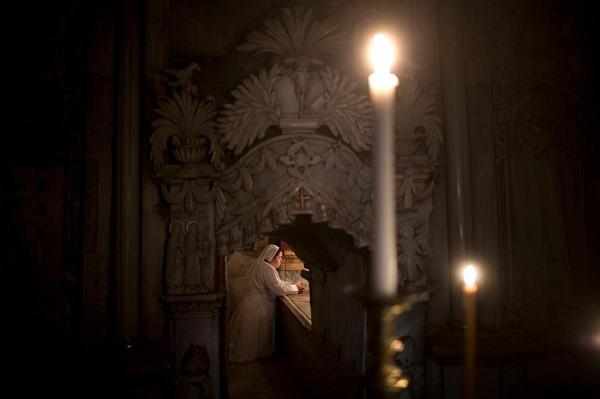
A Christian nun kneels in prayer at the "burial bed" of Christ inside the tomb shrine, known as the Edicule.
PHOTOGRAPH BY ODED BALILTY, AP FOR NATIONAL GEOGRAPHIC
#4320

The exposure of the burial bed is giving researchers an unprecedented opportunity to study the original surface of what is considered the most sacred site in Christianity. An analysis of the original rock may enable them to better understand not only the original form of the tomb chamber, but also how it evolved as the focal point of veneration since it was first identified by Helena, mother of the Roman emperor Constantine, in A.D. 326.

"We are at the critical moment for rehabilitating the Edicule," Moropoulou said. "The techniques we're using to document this unique monument will enable the world to study our findings as if they themselves were in the tomb of Christ."


Workers begin removing the worn marble that has encased the original burial shelf for centuries, exposing a layer of fill material below.
PHOTOGRAPH BY DUSAN VRANIC, AP FOR NATIONAL GEOGRAPHIC
#4321

According to Christian tradition, the body of Jesus Christ was laid on a shelf or “burial bed” hewn from the side of a limestone cave following his crucifixion by the Romans in A.D. 30 or possibly 33. Christian belief says Christ was resurrected after death, and women who came to anoint his body three days after the burial reported that no remains were present.


The shrine that houses the traditional burial place of Jesus Christ is undergoing restoration inside the Church of the Holy Sepulchre in Jerusalem.
PHOTOGRAPH BY ODED BALILTY, AP FOR NATIONAL GEOGRAPHIC


This burial shelf is now enclosed by a small structure known as the Edicule (from the Latin aedicule, or "little house"), which was last reconstructed in 1808-1810 after being destroyed in a fire. The Edicule and the interior tomb are currently undergoing restoration by a team of scientists from the National Technical University of Athens, under the direction of Chief Scientific Supervisor Professor Antonia Moropoulou.
#4322

Exclusive: Christ's Burial Place Exposed for First Time in Centuries

Restorers working in the Church of the Holy Sepulchre in Israel uncover stone slab venerated as the resting place of Jesus Christ.

By Kristin Romey
PUBLISHED OCTOBER 26, 2016

JERUSALEM For the first time in centuries, scientists have exposed the original surface of what is traditionally considered the tomb of Jesus Christ. Located in the Church of the Holy Sepulchre in the Old City of Jerusalem, the tomb has been covered by marble cladding since at least 1555 A.D., and most likely centuries earlier.

"The marble covering of the tomb has been pulled back, and we were surprised by the amount of fill material beneath it,” said Fredrik Hiebert, archaeologist-in-residence at the National Geographic Society, a partner in the restoration project. “It will be a long scientific analysis, but we will finally be able to see the original rock surface on which, according to tradition, the body of Christ was laid."
#4323
Talk of the Town / Re: Bongbong Marcos Slams Comelec
October 29, 2016, 04:56:58 PM

oops, i tried searching for the SC order to stop the submission of the VCMs to smartmatic. no such luck.
#4324

what cayetano as senator must focus on, for which he was elected, is to legislate, not investigate. it looks like he's more for constant media exposure and, ever the talker, being defender-in-chief of the president. that columnist who said that cayetano "loves his own voice" seems to have hit it right.

btw, everyone knows that his biggest bogeyman, his horror clown, is for rival chiz escudero to make it as either vice-president or president one day. that's why in the last election, after escudero became a vice-presidential bet, he also put his hat in the ring, and for a while there he became a veep bet in need of a prexy running mate, until digong picked him up.

meanwhile, he's building his own political dynasty. don't expect him to legislate against political dynasties, which is clearly in our constitution.
#4325

but isn't that what all ambassadors do from all countries, in all countries; observe and make reports about their posts' goings-on. consider the wikileaks exposures ssome years back on the communications of ambassadors...
#4326

Methods

The Philippines was the only country aside from the United States that used the electric chair, due to its being introduced during the US colonial period. Until its first abolition in 1987, the country reverted to using death by firing squad.

After re-introduction of the death penalty in 1993, the country switched to lethal injection as its sole method of execution.

wikipedia/
#4327

Support for reintroduction of capital punishment

Since the death penalty's suspension in 2006, there have been continued public and media calls for its reintroduction, particularly prompted by high-profile murder cases.

During the 2016 election, presidential candidate and frontrunner, Davao City mayor Rodrigo Duterte, campaigned to restore the death penalty in the Philippines.

During the "Yes or No" segment of the second presidential debate on March 20, 2016, Duterte and Senator Grace Poe were the only candidates who said "Yes" when asked about the restoration of the death penalty in the country, favoring the decision.

Duterte, who won the election in May 2016, supports restoration of the death penalty by hanging. It has been reported that he wants capital punishment for criminals involved in illegal drugs, gun-for-hire syndicates and those who commit “heinous crimes” such as rape, robbery or car theft where the victim is murdered, while Poe has stated that the capital punishment should apply to criminals convicted of "drugs and multiple crimes where involved people can no longer be rehabilitated."
#4328

Second suspension

On 15 April 2006, the sentences of 1,230 death row inmates were commuted to life imprisonment, in what Amnesty International believes to be the "largest ever commutation of death sentences".

Capital punishment was again suspended via Republic Act No. 9346, which was signed by President Gloria Macapagal-Arroyo on 24 June 2006. The bill followed a vote held in Congress earlier that month which overwhelmingly supported the abolition of the practise.

The penalties of life imprisonment and reclusion perpetua (detention of indefinite length, usually for at least 30 years) replaced the death penalty. Critics of Arroyo's initiative called it a political move meant to placate the Roman Catholic Church, some sectors of which were increasingly vocal in their opposition to her rule.

Aftermath

President Arroyo controversially pardoned many prisoners during her presidency, including a 2009 pardon for all remaining felons convicted for the 1983 assassination of former Senator and opposition leader Benigno Aquino, Jr..
#4329

Following on a personal appeal by his spiritual advisor, Bishop Teodoro Bacani, Estrada called a moratorium in 2000 to honor the bimillenial anniversary of Christ's birth. Executions were resumed a year later.

Estrada's successor, Gloria Macapagal Arroyo, was a vocal opponent of the death penalty and also approved a moratorium, but later permitted executions and denied pardons.
#4330

Reinstatement and moratorium

President Fidel V. Ramos promised during his campaign that he would support the re-introduction of the death penalty in response to increasing crime rates. The new law, drafted by Ramos, restored capital punishment by defining "heinous crimes" as everything from murder to stealing a car. This law provided the use of the electric chair until the gas chamber (chosen by the government to replace electrocution) could be installed.

Executions resumed in 1999, starting with Leo Echegaray, who was put to death by lethal injection under Ramos' successor, Joseph Estrada, marking the first execution after the reinstatement of the death penalty. The next execution saw an embarrassing mishap when President Estrada decided to grant a last-minute reprieve, but failed to get through to the prison authorities in time to stop the execution.
#4331

The electric chair was used until 1976, when execution by firing squad eventually replaced it as the sole method of execution. Under Marcos' 20-year authoritarian rule, however, countless more people were summarily executed, tortured or simply disappeared for opposition to his rule.[neutrality is disputed]

After Marcos was deposed in 1986, the newly drafted 1987 Constitution prohibited the death penalty but allowed the Congress to reinstate it "hereafter" for "heinous crimes"; making the Philippines the first Asian country to abolish capital punishment.
#4332

In total, 51 people were electrocuted up to 1961. Execution numbers climbed under President Ferdinand Marcos, who was ironically himself sentenced to death in 1939 for the murder of Julio Nalundasanâ€"the political rival of his father, Mariano; the young Ferdinand was acquitted on appeal.

A notorious triple execution took place in May 1972, when Jaime José, Basilio Pineda and Edgardo Aquino were electrocuted for the 1967 abduction and gang-rape of young actress Maggie dela Riva. The state ordered that the executions be broadcast on national television.

Under the Marcos regime, drug trafficking also became punishable by death by firing squad, such as the case with Lim Seng, whose execution in December 1972 was also ordered broadcast on national television. Future President and then Chief of the Philippine Constabulary Gen. Fidel V. Ramos was present at the execution.
#4333

1946-1986

The capital crimes after regaining full sovereignty in July 1946 were murder, rape and treason. However, no executions took place until April 1950, when Julio Gullien was executed for attempting to assassinate President Manuel Roxas.

Other notable cases includes Marciál "Baby" Ama, electrocuted at the age of 16 on October 4, 1961, for murders committed while in prison for lesser charges. Ama notably became the subject of the popular 1976 film, Bitayin si... Baby Ama! (Execute Baby Ama!).

Another famous case was that of former powerful Governor of Negros Occidental Rafael Lacson and 22 of his allies, condemned to die in August 1954 for the murder of a political opponent. Ultimately, Lacson was never executed.
#4334

Spanish and American periods

During Spanish colonial rule, the most common methods of execution were death by firing squad (especially for treason/military crimes, usually reserved for independence fighters) and garrotte (a notable case would be the Gomburza). Death by hanging was another popular method.


A 1901 execution at the Old Bilibid Prison, Manila, Philippines

A prominent example is the national hero, José Rizal, who was executed by firing squad on the morning of December 30, 1896, in the park that now bears his name.

In 1926, the electric chair (Spanish: silla eléctrica; Filipino: silya eléktrika) was introduced by the United States' colonial Insular Government, making the Philippines the only other country to employ this method.

The last colonial-era execution took place under Governor-General Theodore Roosevelt, Jr. in February 1932.

There were no executions under Manuel L. Quezon, the first President of the Commonwealth.
#4335

Capital punishment in the Philippines
From Wikipedia, the free encyclopedia

Capital punishment in the Philippines has a varied history and was suspended on June 24, 2006â€"the second time since 1987.

Filipinos have mixed opinions about the death penalty, with many opposing it on religious and humanitarian grounds, while advocates see it as a way of deterring crimes.
#4336
QuoteNo one in the prison - guard or inmate - wants to see her die. "We're supposed to be in the business of rehabilitation," says superintendent Ruelo. "We can't rehabilitate a dead person."
#4337
QuoteWHAT THE PUBLIC REALLY WANTS TO SEE is a big crime boss go to the chamber. "The chances of that," says FLAG attorney Jose Diokno, "are nil. We haven't even seen those kinds of conviction." New Bilibid Prison has had its share of celebrated inmates, including ex-congressman Romeo Jalosjos. Convicted of raping a minor, he became notorious for his prison lifestyle. The congressman built comfortable quarters in jail, hired bodyguards and constructed the Maximum Tennis Club. His treatment made news worldwide and prompted a clampdown and ban on interviews with Death Row inmates. On the tennis court, attended by guards in special white outfits, well-heeled prisoners continue to hit balls as they await parole. The congressman will not be visiting the Lethal Injection Chamber. He got life.

:(
#4338


Or perhaps the next to die will be Edwin Mendoza and brothers Jury and Ricardo Andal, whose 60-day reprieve for rape and murder runs out next month. Their lives hang in the balance as authorities tussle over $405 DNA tests that may never be done. "My husband was with me when the crime took place," says Modesta Correlos Andal, wife of Ricardo. His sentence is hers, too. The family sold their land to pay for Ricardo's defense. Her four children stay at home, while she spends her life outside the prison gates, waiting. "I'm hoping the truth will prevail," says Modesta. "I cannot think beyond that. If he is acquitted, then we will start a new life."

If not, then one day, soon after sunrise, they will come for Ricardo Andal and tell him to prepare to die. To enjoy one last meal, and pray with a priest, if he desires. Eight hours later, he will be led to a small, metal room, where as many as 33 people will watch through glass windows as lethal poisons are injected into his blood stream. Ricardo will breathe his last. Then the curtains will close, and Modesta will leave weeping. Another widow in the Philippines' ongoing war on crime.

http://www.gluckman.com/Death'Penalty.htm; 1999 
#4339

WHAT THE PUBLIC REALLY WANTS TO SEE is a big crime boss go to the chamber. "The chances of that," says FLAG attorney Jose Diokno, "are nil. We haven't even seen those kinds of conviction." New Bilibid Prison has had its share of celebrated inmates, including ex-congressman Romeo Jalosjos. Convicted of raping a minor, he became notorious for his prison lifestyle. The congressman built comfortable quarters in jail, hired bodyguards and constructed the Maximum Tennis Club. His treatment made news worldwide and prompted a clampdown and ban on interviews with Death Row inmates. On the tennis court, attended by guards in special white outfits, well-heeled prisoners continue to hit balls as they await parole. The congressman will not be visiting the Lethal Injection Chamber. He got life.

Who will be executed next? One candidate is Pablito Andan, convicted of rape and murder, whose initial date passed nearly a year ago. Or perhaps the first woman will go next. Esparas could be executed as early as Aug. 6. She was caught at the airport with a small quantity of shabu (methamphetamine). Some say her husband put the drug in her luggage. No one in the prison - guard or inmate - wants to see her die. "We're supposed to be in the business of rehabilitation," says superintendent Ruelo. "We can't rehabilitate a dead person."
#4340

Little chance of that. Most Asian nations sanction capital punishment. As in the Philippines, more people than not favor executing hardened criminals. Jessica Soto, national director of Amnesty International's Manila office, guesses that two-thirds of Filipinos back the death penalty. That is about the level of support gauged by an informal phone-in survey conducted recently by Adrian Sisson, who hosts a daily radio program, Broadcasters Bureau. "People really have the notion that it's a deterrent," says Sisson, who is also an attorney and death penalty opponent. "But you can go back in time. When they hung pickpockets in England, pickpockets worked the crowds."

Studies worldwide have failed to connect the death penalty with drops in crime. The U.S., with the developed world's largest Death Row population and highest execution rate, also claims some of the greatest rates of homicide, robbery and rape. Philippine records show that the number of robberies and murders fell sharply after peaking in the late 1980s; executions were not re-introduced until 1993. "It's an utter illusion that the problems of society can be solved by executions," says Father Borres, whose group has become a powerful advocate for prisoners and their families. His concern: "The time will come when executions become ordinary and nobody even notices them going on."
#4341

A special panel was established to guide Estrada through the reprieve process. Secretary of Justice Serafin Cuevas sits on the three-member panel. Two days before last week's executions Cuevas was unsure where the review was headed. He has, however, attended all the executions so far, except for Agbayani's on June 25. That was Cuevas's birthday.

In April, Estrada granted a 60-day reprieve for DNA tests that could conclusively prove the innocence or guilt of three men sentenced for a rape they say they did not commit. The defense had been requesting the tests from the start, but the court refused to indulge them. For his part, Cuevas says the tests are unnecessary and, at $405 apiece, a costly precedent. The problem with the execution process, the justice secretary says, is that it takes too long. "There is no need to wait one year for the executions," Cuevas says, "when the judgment is already final." He adds: "But the president wants to be at peace with his conscience, he has said this most clearly. Besides, we worry that the Philippines will be branded as the death-penalty capital of the world."
#4342

Galera is suing for restitution, but the court can't return the years he spent on Death Row. The judicial process was no consolation to Carlos Gorbilla, a corn vendor who last month leapt to his death minutes after being sentenced to death for rape. "This is not like a state with well-defined procedures, standards, safeguards," says attorney Diokno. "Here, it's all in the process of development." Even at the Department of Justice no one can agree on how many men are on Death Row, their status, or how the review process is handled.

Still, to date, far more men have received last-minute stays than lethal injection. The reprieves come from Estrada, who maintains unwavering support for the death penalty even as his daughter Jackie, 32, secretly visits prisons to work for its repeal. Nobody knows how Erap reaches his life-and-death decisions, but the results have become a hot topic internationally. On June 25, Estrada announced that rapist Eduardo Agbayani would die that day. Forty-five minutes later the president wavered. Erap had received an appeal from Bishop Teodoro Bacani. Estrada, at home at the time, called the injection room. He got a busy signal, then a fax tone. By the time an aide raced to the official palace hotline, Agbayani was dead.
#4343

Echegaray wasn't meant to be the first person executed in the Philippines since 1976. Fernando Galera was. Sentenced to die for rape and robbery in April 1994, Galera could have been killed as early as 1997, but at the last minute the Supreme Court ruled that he was innocent. His case is common enough. Capital cases receive automatic review. From 1995 to 1998, the Supreme Court ruled on 55 cases in which the death penalty had been decreed. There were six acquittals, 22 affirmed sentences, 22 reductions and five instances when the case was referred back to the lower court.

Galera is suing for restitution, but the court can't return the years he spent on Death Row. The judicial process was no consolation to Carlos Gorbilla, a corn vendor who last month leapt to his death minutes after being sentenced to death for rape. "This is not like a state with well-defined procedures, standards, safeguards," says attorney Diokno. "Here, it's all in the process of development." Even at the Department of Justice no one can agree on how many men are on Death Row, their status, or how the review process is handled.
#4344

A 1980s crime wave prompted authorities to reinstate the death penalty as a deterrent to murder, kidnapping and treason. Few on Death Row possess such a resume. More than half are in for rape. Anxious to appear tough on crime, lawmakers recently added 46 capital offenses to the books - one of the broadest codes in the civilized world. Possession of 750g of marijuana can be a capital crime; one Death Row resident was convicted for growing seven plants. He fainted upon learning his sentence.

In the Philippines the lowest courts impose the death penalty. Critics say its reintroduction set off a "death rush" among justices eager to appease the public appetite for executions. Rumors circulate of a "Guillotine Club" of justices who hand down death sentences. Its so-called founder, Maximano Asuncion, sentenced the first inmate executed this year, Leo Echegaray. The judge died before the verdict was carried out.

#4345

Everything is available for a price. "Except," says one prisoner, "justice." Actually, that too. Despite the lofty goal of Act 7659 - to attack corruption in high places, target drug lords, murderers and kidnap gangs - enforcement is clearly aiming low. "These are all poor people in Death Row," says Maria Diokno, head of the Free Legal Assistance Group (FLAG), which handles most last-ditch appeals for condemned men. Father Silvino "Jun" Borres, director of the Philippines Jesuit Prison Service, calls the Row a "home for the poor." A survey last year of 425 Death Row inmates showed that most earned less than $6 a day when they were arrested. Three-quarters of them were farmers, truckers, laborers and so on. Few can afford the $30 that attorneys charge to attend the death sentence hearings.

Diokno estimates that only 12%-15% of those charged in capital cases can afford private representation. "And most of these are drug cases or foreigners." Instead, Death Row inmates are served by a severely under-funded Public Attorney's Office (PAO), often with disastrous results. Condemned men say they are railroaded into prison with limited or no representation. FLAG cites cases in which public attorneys advise clients to plead guilty to obtain a lighter sentence, unaware that the charges carry a mandatory death sentence. PAO acknowledges that its 877 attorneys receive no special training on capital cases. It also notes that besides handling death-sentence cases, public defenders are involved in more than 350,000 civil and criminal cases each year, as well as millions of consultations, filings and mediation matters. They earn about $400 a month.
#4346

There is no official Death Row for women, but 18 female convicts are waiting to die. They are incarcerated at a facility in Mandaluyong, a Manila suburb, where they cut each other's hair, work on their makeup and stitch together placemats. Death Row is just another room in what looks like an old high school. Inmates lounge around in pajamas on tiny cots. With its bunk beds and posters of film and basketball stars, the place looks like a sorority sleep-over. The women are mostly young. Soon, some may die. "She talks of it all the time," says attorney Rachel Ruelo, superintendent of the Women's Correctional Institute. She is speaking of Josephina Esparas, who could make history next month as the first woman in the Philippines to be executed. "She says: 'Mom, it's near.' She says that all the time," confides Ruelo. "She cooks, she makes rosaries. But death is wearing on her. She's sick a lot."


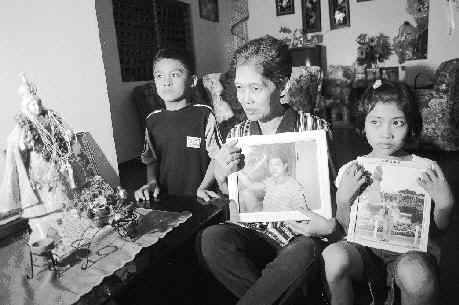
IN THE PHILIPPINES, inmates pay for their crimes in many ways. Cash-rich convicts buy deluxe cells with fans, televisions, stereos. Editha Matignas, 56, president of the Families of Death Row Inmates, has gone into debt to pay for her son Jemreich's trial and to keep him comfortable inside. His cell cost $68, plus $325 for the remodeling. So far she has spent over $3,000 in legal fees, but would gladly shell out a promised $1,350 bonus to the lawyer who can get her only son acquitted.
#4347

While the rest of the maximum-security inmates roam the prison's inner sanctum, shooting pool, playing cards, buying and selling what they can, Death Row is locked down and isolated. Its three-meter-wide concrete veranda is enclosed by chicken wire. There is just enough room to stand among the laundry. Hundreds of men mill about, smoking cigarettes and queuing for water, a precious commodity. Others pass time on the second floor, leaning through the window grates. They can leave only to attend hearings, meet with attorneys and, eventually, die. "We all sit in our cells," says one inmate, "and wait the long wait."

When Rito Guinda was sentenced, he couldn't stop thinking about death. He couldn't eat. He couldn't sleep. "But you change," he says. "There is nothing you can do but wait for your judgment day. On Death Row there is no other way. You learn to accept it and get by. After a while you just become resigned, even if you are innocent." Guinda is one of the lucky ones; his drug conviction was commuted to life.
#4348

There are vegetable gardens, chicken coops, ducks and geese wandering the dirt prison yard. Mothers, wives, girlfriends and children have free rein on visiting days. Except in the dark hole known as Building One - Death Row.


The place reeks of gas burners, sewage, sweat and fear. "I could not ignore the darkness and the stench," one inmate wrote in his diary. "You see, being in Death Row is like being inside a bottle painted black. But you learn to live with it, to search for some light. Otherwise, you will lose your soul." Rueben Montilla, 26, spent three years on death row for a marijuana conviction that was later reduced to life in prison. In his yellow flip-flops and shorts, Montilla looks more like a kid headed to the beach, instead of nowhere, ever again.  "Being closed off," he says, "is the worst thing."
#4349

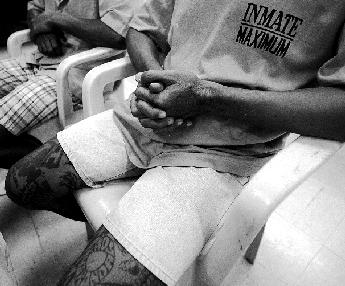
WHILE SOCIETY AT LARGE CANNOT achieve a consensus on the ultimate penalty, there is one place where people are unanimously against capital punishment - a big white building surrounded by fencing a few hundred meters from the death chamber. This is Death Row, where, depending on who you ask, between 897 and 1,069 inmates await their fate.

New Bilibid seems more like a barangay in the Philippines than a prison. In the sprawling prison grounds, vendors sell fruit, produce, eggs and household plastic ware. Burgers sizzle at Golden Hut Hamburger, while Cokes are racked at ramshackle stands beside a dozen rough-hewn pool tables, all handmade by inmates. Soaring voices sing the psalms at no less than 13 churches in the Maximum Security compound alone. They find no shortage of converts. Many convicts credit the supplemental church rations rather than newfound spiritual zeal for the high conversion rate. Hawkers circulate with fake Rayban sunglasses. Guards, sporting the "Cool Hand Luke" look, are customers. Basketballs bounce on prison courts as families munch pansit at adjoining picnic grounds. Benches and tables are painted in proud swirls. Huge murals on the sides of buildings resemble those in every Filipino town, extolling the local leadership, in this case "mayors" and gang bosses who run the various cellblocks. Prison craftsmen offer inventive wares: gaudy Last Supper paintings, wooden cigarette boxes, boats in bottles and remarkable animal figurines made from melted plastic cups.
#4350

Far more was at stake last week than the lives of three men convicted of robbing a jeepney in 1994 and killing a passenger who happened to be an off-duty police officer. The case ignited protests from human-rights groups, in the Philippines and abroad, who charge that the trio - protesting their innocence to the end - were tortured into making confessions, and were improperly tried and represented. Even as Josepha retrieved her husband's body, religious leaders were attacking the punishment as "cheapening the value of human life" and "fomenting the spirit of vengeance and hatred."

Questions about other cases have prompted a small but growing number of congressmen to press for an immediate review of death-penalty laws; they worry about inadequate checks and balances in the judicial system. A day before the triple executions, the Supreme Court overturned the death penalty for a deaf-mute convicted of rape. During his trial, the judge had overlooked the fact that the man could neither hear nor speak. The hubbub has made the president pause. Joseph Ejercito Estrada, who built careers in acting and politics by acting tough on crime, has wavered each time a man is due to die. Since the first execution in February, he has granted seven reprieves.
#4351

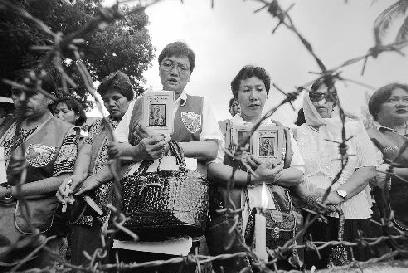
And so, at 3:39 p.m., Jesus Morallos, 32, became the fourth person to be executed in the Philippines this year. Two other convicts also dieddeath1a.jpg (11845 bytes) at in an outbuilding at New Bilibid Prison that day. Dante Piandiong, 27, was terminated 58 minutes earlier. Fifty-eight minutes after Jesus, Archie Bulan, 24, died in the same corrugated metal shack. Outside the prison there were prayers and cheers. A hundred or so death-penalty opponents, led by religious leaders, joined hands with relatives of the doomed and prayed for executions to stop. Others prayed, too. Twenty men and women twirled rosaries, eyes shut, hands clasped to heaven, beseeching the merciful Lord to please, dear God, let the court-sanctioned killings continue. No one knows if the Lord listened, but in the space of less than three hours Manila had executed more convicts than it has in nearly a quarter century.


After watching her husband die, 35-year-old Josepha staggered down the red steps of the Lethal Injection Center, crying hysterically as she grappled with her new status as the nation's latest and - for 58 minutes anyway - most celebrated widow. Her misery soon will be forgotten, probably even before other convicts head to the death chamber, maybe later this month. But the repercussions will continue to reverberate through the devoutly Catholic nation that was the first in Asia to abolish the death penalty in 1987, but one of the few countries anywhere to bring it back, six years later. President after president has advocated the ultimate penalty. Yet despite widespread public support, death sentences have proven far easier to decree than to execute. As a result, the Philippines has a Death Row population that, among democratic nations, is second only to that of the United States.
#4352

Waiting to Go

Three more die, 1,000 more await execution in the deadly lottery resulting from the Philippines' hapless war on crime. After becoming the first country in Asia to abolish the death penalty, the Philippines became one of the few anywhere to bring it back. But so far, many wonder whether Manila has the judicial maturity to manage life and death decisions. An inside look at the depressing Death Row

By Ron Gluckman /Manila

ON JULY 8, JOSEPHA MORALLOS WATCHED HER HUSBAND DIE. He was strapped to a black gurney, his arms stretched out on padded slats, as if bound to a cross. "Have courage for the sake of our children," said Jesus Morallos. His voice, picked up by a dangling microphone, sounded metallic as it crackled through the speakers in the viewing gallery. Seated on a white, plastic chair, Josepha, mother of three, watched her husband's life flicker away as a cocktail of sodium pentothal, pancuronium bromide and potassium chloride coursed through his veins. Jesus's eyes fluttered shut for the last time. The curtains closed.
#4353
Photos Unlimited / Re: The world's weather, in scapes
October 28, 2016, 10:24:43 PM


Bath reflecting an increasingly cloudy sky. UK  [John Wilkes]

http://live.aljazeera.com/
#4354
Photos Unlimited / Re: The world's weather, in scapes
October 28, 2016, 10:24:26 PM


Calmer weather returns to Ponte Verde beach, Florida [Wille J. Allen JR/EPA]
#4355
Photos Unlimited / Re: The world's weather, in scapes
October 28, 2016, 10:24:01 PM


A hoar frost blankets the vegetation in Homokkomaron, Hungary [Gyorgy Varga/EPA]
#4356
Photos Unlimited / Re: The world's weather, in scapes
October 28, 2016, 10:23:37 PM


Sunrise in Blackwell, Oklahoma, USA. [Larry W Smith/EPA]
#4357
Photos Unlimited / Re: The world's weather, in scapes
October 28, 2016, 10:23:12 PM


A damp autumn day in Minsk, Belarus.  [Tatyana Zenkovich/EPA]
#4358
Photos Unlimited / Re: The world's weather, in scapes
October 28, 2016, 10:22:49 PM


The ship of the Fens, Ely Cathedral stands proud as clouds roll across the Cambridgeshire flat lands of eastern England [Faruk Kara]
#4359
Photos Unlimited / Re: The world's weather, in scapes
October 28, 2016, 10:22:25 PM


The sun sets over the Caribbean Sea after another beautiful day in Barbados [Inzamam Malik]
#4360
Photos Unlimited / Re: The world's weather, in scapes
October 28, 2016, 10:22:01 PM


Rain threatens in Monreal, northern Spain [Jesus Diges/EPA]
#4361
Photos Unlimited / Re: The world's weather, in scapes
October 28, 2016, 10:21:37 PM


Snow on the Wallberg Mountain, Germany [Sven Hoppe/EPA]
#4362
Photos Unlimited / Re: The world's weather, in scapes
October 28, 2016, 10:21:13 PM


The rain in Spain falls mainly in Salou, Catalonia [Jaume Sellart/EPA]
#4363
Photos Unlimited / Re: The world's weather, in scapes
October 28, 2016, 10:20:45 PM


Low water levels on the River Rhine in Germany [Frederico Gambarini/EPA]
#4364
Photos Unlimited / Re: The world's weather, in scapes
October 28, 2016, 10:20:20 PM


Paddling in the Mediterranean, without the driver or passengers. Post-storm debris on the beach at beach at Vilassar de Mar, Costa Brava, Spain  [EPA/Alejandro Garcia]
#4365
Photos Unlimited / Re: The world's weather, in scapes
October 28, 2016, 10:19:50 PM


As days get colder and shorter, the autumn colour shows in Hannover, Germany. [Julian StratenshultelEPA]
#4366
Photos Unlimited / Re: The world's weather, in scapes
October 28, 2016, 10:19:17 PM


Residents of Makati City in the Philippines await for the arrival of Typhoon Sarika. [Francis R. Malasig/EPA]
#4367
Photos Unlimited / Re: The world's weather, in scapes
October 28, 2016, 10:18:52 PM


Fine weather in Shirahama, southern Japan. Perfect conditions for the Red Bull Cliff Diving World Series. [Dean Treml/Red Bull/AFP]
#4368
Photos Unlimited / Re: The world's weather, in scapes
October 28, 2016, 10:10:41 PM


The view through a fish eye lens as a plane comes in to land at Manila's international airport, Philippines ahead of Typhoon Sarika [Francis R. Malasig/EPA]
#4369
Photos Unlimited / Re: The world's weather, in scapes
October 28, 2016, 10:05:09 PM


Windmills on the horizon under a dramatically cloudy sky at daybreak near Pamplona, northern Spain [Jesus Diges/EPA]
#4370
Photos Unlimited / Re: The world's weather, in scapes
October 28, 2016, 10:04:43 PM


The fortress of Chinon can't keep out the beautiful weather in central France [Guillaume Souvant/AFP]
#4371
Photos Unlimited / Re: The world's weather, in scapes
October 28, 2016, 10:04:23 PM


The Charles Bridge on a foggy morning in Prague, Czech republic [Michal Cizek/AFP]
#4372
Photos Unlimited / Re: The world's weather, in scapes
October 28, 2016, 10:03:58 PM


A colourful autumn day in Berlin, Germany. [Sophia Kembowski/EPA]
#4373
Photos Unlimited / Re: The world's weather, in scapes
October 28, 2016, 10:03:35 PM


The Red Arrows soar through the skies above Singapore. [Roslan Rahman/AFP]
#4374
Photos Unlimited / Re: The world's weather, in scapes
October 28, 2016, 10:03:09 PM


A surprisingly warm October day in New York. [Spencer Platt/Getty]
#4375
Photos Unlimited / Re: The world's weather, in scapes
October 28, 2016, 09:58:00 PM


Skyscrapers emerge from the fog in the port city of Yantai, China. [Tang Ke/VCG/Getty]
#4376
Photos Unlimited / Re: The world's weather, in scapes
October 28, 2016, 09:57:11 PM


A calm, autumn reflection in Prior Park, Bath, England [Matt Cardy/Getty Images]
#4377
Photos Unlimited / Re: The world's weather, in scapes
October 28, 2016, 09:56:15 PM


Electricity pylons downed by super typhoon Haima along a highway in Cabagan town, Isabela province. [Ted Aljibe / AFP]
#4378
Photos Unlimited / Re: The world's weather, in scapes
October 28, 2016, 09:55:13 PM


It's not usually this muddy - after heavy rain in Villa Solidaridad, Tipitapa, in Managua, Nicaragua [Jorge Torres EPA]
#4379
Photos Unlimited / Re: The world's weather, in scapes
October 28, 2016, 09:54:13 PM


During a typhoon signal eight warning the usually frenetic streets of Hong Kong were deserted. Typhoon Haima was 100km along the coast of China. [Anthony Wallace / AFP]
#4380
Photos Unlimited / Re: The world's weather, in scapes
October 28, 2016, 09:53:10 PM


Enjoying a camel ride in the Wahiba Sands of Oman [Ali Said]
#4381
Photos Unlimited / Re: The world's weather, in scapes
October 28, 2016, 09:52:10 PM


Capital weather on a fine autumn day in England [Richard Mathews]
#4382
Photos Unlimited / Re: The world's weather, in scapes
October 28, 2016, 09:51:04 PM


Sunrise from the top of the Rettenbach glacier, Soelden, Austria [Christian Bruna/EPA]
#4383
Photos Unlimited / Re: The world's weather, in scapes
October 28, 2016, 09:50:10 PM


A dull day at the Peace Bridge, Tiblisi, Georgia [Richard Angwin]
#4384
Photos Unlimited / Re: The world's weather, in scapes
October 28, 2016, 09:49:04 PM


Sydney's sunshine is turned hazy by controlled burning in the nearby countryside, aimed at reducing the hazard of wildfires during the summer. [Dan Himbrechts/EPA]
#4385
Photos Unlimited / Re: The world's weather, in scapes
October 28, 2016, 09:47:59 PM


Intense weather whips up big waves in Nazare, Portugal. [Paulo Cunha/EPA]
#4386
Photos Unlimited / Re: The world's weather, in scapes
October 28, 2016, 09:47:03 PM


Sunny and cool in St Petersburg, Russia on Monday, with a top temperature of just 7C. [Anatoly Maltsev/EPA]
#4387
Photos Unlimited / Re: The world's weather, in scapes
October 28, 2016, 09:46:09 PM


Sunshine and showers produce a rainbow in Madrid Rio Park, Spain. [Susana Vera/Reuters]
#4388
Photos Unlimited / Re: The world's weather, in scapes
October 28, 2016, 09:45:06 PM


Trossachs Church across Loch Achray in autumn colour. Brig O' Turk, Scotland [Jeff J Mitchell/Getty Images]
#4389
Photos Unlimited / Re: The world's weather, in scapes
October 28, 2016, 09:44:02 PM


Surprisingly green in the ski resort of Kitzbuhel, Austria. [O McElwee]
#4390
Photos Unlimited / Re: The world's weather, in scapes
October 28, 2016, 09:43:01 PM


Somosko castle in the eerie mist, near Salgotarjan Hungary [Peter Komka EPA]
#4391
Photos Unlimited / Re: The world's weather, in scapes
October 28, 2016, 09:42:05 PM


Casting the net on a reflection. Near Guwahati city, Assam state, India [EPA]
#4392
Photos Unlimited / Re: The world's weather, in scapes
October 28, 2016, 09:41:07 PM


Somalia's best sunsets and finest sand dunes are said to be in Galhareeri in Galguduud region [Hamza Mohamed]
#4393
Photos Unlimited / The world's weather, in scapes
October 28, 2016, 09:40:09 PM


Autumn arrives in the far north of Pakistan giving a spectacular splash of colour across the Upper Hunza [Kamal Hyder]
#4394

Make ‘em laugh

At the age of 25, Charles Dickens was asked to edit Grimaldi’s memoirs, shortly after the great clown’s death in 1837. Dickens had already written The Pickwick Papers, which featured a character said to be based on Grimaldi’s son: “the glassy eyes, contrasting fearfully with the thick white paint with which the face was besmeared; the grotesquely-ornamented head, trembling with paralysis, and the long skinny hands, rubbed with white chalk â€" all gave him a hideous and unnatural appearance”.

Stott has written that, through these memoirs, “laughter and misery becomes the balance-beam on which Grimaldi’s existence is constantly weighed as every career triumph is paid for with a proportionate personal agony, and every moment of joy countered by grief.”

It’s the belief that clowns are meant to be harmless that is recent, not the idea that they are unsettling. “There’s an ambiguity about what kind of thing they are,” says Livingstone Smith. “If clowns reconfigured themselves such that the ambiguity was diminished, they wouldn’t be as disturbing.” But arguably, they’d also no longer be clowns.

http://www.bbc.com/culture/
#4395

The potential for clowns to invoke fear was widely recognised at that time. In 1879, the French writer Edmond de Goncourt wrote that clowns’ “frolicking and jumping doesn’t try to amuse the eye, but rather manages to give birth to troubled astonishment and emotions of fear and almost painful surprises from this strange and unhealthy motion of body and muscle [with] visions of Bedlam, of the amphitheatre of anatomy, of the morgue.” He calls clowns “modern phantoms of the night”, whose actions are “idiotic gesticulations, the agitated mimicry of a band of madmen”.


Serial killer John Wayne Gacy dressed as ‘Pogo the clown’ at children’s parties: this is one of the paintings he made while on death row (Credit: Alamy)

Madness was arguably part of the appeal of Grimaldi. Trained in clowning by an abusive, tyrannical father, he retreated into childhood with the character Joey. According to Stott however, this “was categorically not a return to innocence â€" there was little comfort to be had in revisiting a period of his life that had been unrelentingly complex and traumatic”. Grimaldi had been left crippled by injuries from decades of slapstick tumbling, and was in constant pain. “I am ‘Grim all day’,” he joked, “but I make you laugh at night.” Prone to depression, with an alcoholic son who died at the age of 30, Grimaldi took to the bottle himself and died in poverty.
#4396

The fears of a clown

This inherent creepiness was taken to an extreme with the idea of the ‘killer clown’: the character that pranksters are currently bringing into streets and alleyways across the globe. Some argue that this began with the arrest of serial killer John Wayne Gacy in 1978. Gacy had dressed as ‘Pogo the Clown’ at children’s parties, and made a series of clown paintings while on death row. He is often touted as the inspiration for Pennywise in Stephen King’s 1986 horror novel It (King has recently spoken out about the ‘killer clown’ trend, saying: “time to cool the clown hysteria â€" most of ‘em are good, cheer up the kiddies, make people laugh”.)


Stephen King’s 1986 horror novel It featured a killer clown, Pennywise, played by Tim Curry (pictured) in a TV adaptation (Credit: Alamy)

Yet it’s a strand of popular culture that extends back far beyond Pennywise. Ruggero Leoncavallo’s 1892 opera Pagliacci (which means ‘clowns’ in Italian) features a clown who discovers his wife is cheating on him, and murders her on stage. In one of the opera’s arias, the clown laments that his job is to make the audience laugh, even if he is crying inside â€" he later sings “Se il viso è pallido, è di vergogna”: “if my face is white, it is for shame”. French playwright Catulle Mendes claimed Leoncavallo stole the plot from his 1887 play La Femme de Tabarin, in which a clown also murders his cheating wife on stage: as she is dying, she smears her husband’s lips with her blood.
#4397

“Clowns are peculiar because they’re meant to be delightful and amusing but a lot of people find them disturbing,” he tells BBC Culture, referencing the 2016 research paper On the Nature of Creepiness. Psychologists Francis McAndrew and Sara Koehnke of Knox College in Illinois asked more than 1,000 people to rate the creepiness of a list of occupations as part of a wider survey. “Clowns won the creepiness jackpot,” says Livingstone Smith.

The study concluded that “being ‘creeped out’ is an evolved adaptive emotional response to ambiguity about the presence of threat”: in other words, as Smith wrote on the website Aeon, “a person is creepy if we are uncertain about whether he or she is someone to fear”.
#4398

This is the tightrope walked by the clown: anarchy contained just enough to allow for laughter

There is humour as well as menace in the ritual. For the main part, each masked man “performs awkward and grotesque steps, as if he were a clumsy white man trying to imitate Indian dancing”. This continues “until all the masked visitors have competed in drawing applause by their obscene names and clowning”. At the arrival of the Boogers, Speck notes, “when the first invader was questioned about his nationality and identity, he resoundingly broke wind and this was greeted by risible applause”.

This is the tightrope walked by the clown: anarchy contained just enough to allow for laughter, a threat that dissolves into an object of ridicule. When that balance tips the wrong way, it’s a quick slide into horror. Philosophy professor David Livingstone Smith believes the mismatch between appearance and action is what makes clowns creepy.


Psychologists have found that people find clowns creepy because they can’t see their real expressions (Credit: Alamy)
#4399

Masking fears

In his research, Radford was surprised by the range of places in which the archetype appears. “Once you begin picking up the threads and identify common themes in the evil clown character, they pop out,” he says.

For centuries, the Cherokee people of North America have performed a ritual reacting against outsider intrusion. The Booger Dance begins with a prelude in which tribe members dance together for around 30 minutes; then a group of up to 10 males arrive, wearing masks representing foreigners â€" often disfigured as though infected with smallpox. American anthropologist Dr Frank Gouldsmith Speck observed performances in 1935 and 1936 at a Cherokee reservation in western North Carolina. In his book Cherokee Dance and Drama, he describes how the masked company “boisterously enters the house where the night dance party is held. The maskers are systematically malignant. On entering, some of them act mad, fall on the floor, hit at the spectators… and chase the girls.”


Booger masks of the Cherokee people of North Carolina are worn to represent outsiders during the performance of a ritual dance (Credit: Mathers Museum of World Cultures/Flickr)
#4400

It’s a mistake to ask when did clowns go bad â€" because they were never ‘good’ to begin with â€" Benjamin Radford

“If you take a broader look at the history of the clown, they have always been an ambiguous figure. Sometimes they’re laughing at themselves, sometimes they’re laughing at you â€" sometimes they’re the victim, sometimes you’re the victim. It’s a mistake to ask when did clowns go bad â€" because they were never ‘good’ to begin with,” he says. “You see this in the harlequin character, and of course in Mr Punch â€" that is a classic evil clown archetype which has been performed in England for more than 300 years. It’s this beloved character who is both funny and evil. That’s an irresistible stew to many people.”


Created in the Italian commedia dell’arte, the Harlequin character took on a different role as pantomime developed in England in the 18th Century (Credit: Shutterstock)

Radford sees echoes today. “Donald Trump has exploited aspects of the evil clown perfectly â€" he’s a showman, a performer, he insults people and then when called on it, he says ‘I was just joking’ â€" he does it for attention, as clowns do. Regardless of how you feel about Trump, there are many clear parallels to the evil clown character.”