Join MikeLigalig.com!

Why Just Read When You Can Join, Post, and Read!

Menu

Show posts

This section allows you to view all posts made by this member. Note that you can only see posts made in areas you currently have access to.

Show posts Menu

Messages - hofelina

#4101
Bible Study / Re: Saints of the Day
June 26, 2010, 08:08:25 PM
June 26, 2010


Blessed Raymond Lull


(1235-1315)


Raymond worked all his life to promote the missions and died a missionary to North Africa.
Raymond was born at Palma on the island of Mallorca in the Mediterranean Sea. He earned a position in the king’s court there. One day a sermon inspired him to dedicate his life to working for the conversion of the Muslims in North Africa. He became a Secular Franciscan and founded a college where missionaries could learn the Arabic they would need in the missions. Retiring to solitude, he spent nine years as a hermit. During that time he wrote on all branches of knowledge, a work which earned him the title "Enlightened Doctor."

Raymond then made many trips through Europe to interest popes, kings and princes in establishing special colleges to prepare future missionaries. He achieved his goal in 1311 when the Council of Vienne ordered the creation of chairs of Hebrew, Arabic and Chaldean at the universities of Bologna, Oxford, Paris and Salamanca. At the age of 79, Raymond went to North Africa in 1314 to be a missionary himself. An angry crowd of Muslims stoned him in the city of Bougie. Genoese merchants took him back to Mallorca where he died. Raymond was beatified in 1514.

Comment:

Raymond worked most of his life to help spread the gospel. Indifference on the part of some Christian leaders and opposition in North Africa did not turn him from his goal.

Three hundred years later Raymond’s work began to have an influence in the Americas. When the Spanish began to spread the gospel in the New World, they set up missionary colleges to aid the work. Blessed Junipero Serra belonged to such a college.

Quote:
Thomas of Celano wrote of St. Francis: "In vain does the wicked man persecute one striving after virtue, for the more he is buffeted, the more strongly will he triumph. As someone says, indignity strengthens a generous spirit" (I Celano, #11).

#4102
I´m enjoying facebook, but Tubag Bohol has the intimacy of friendship.
#4103
During my time in ateneo, daghang mga arabo nangiskwela ug AB for pre medicine, I met one after 22 years in Paris, I never thought he would still recognize me.
#4104
God shares everything
with us,
including the spark
of divine life.


taghuwat sa ang foto
#4105
Bible Study / Re: Saints of the Day
June 26, 2010, 05:10:05 AM
St. Anthelm

26 June

Carthusian monk and bishop, defender of papal authority. Anthelm was born in 1107 in a castle near Chambery, in Savoy, France. He was ordained a priest and visited the Carthusian Charterhouse at Portes, where he entered the Order at the age of thirty. Two years later, in 1139, he was appointed abbot of Le Grande Chartreuse, which had been damaged. Anthelm made the monastery a worthy motherhouse of the Carthusians, constructing a defensive wall and an aqueduct. As minister-general, Anthelm also united the various charterhouses of the Order. Rules were standardized, and women were given the opportunity to enter the Carthusians in their own charterhouses. After a few years as a hermit, starting in 1152, Anthelm returned to Le Grande Chartreuse and defended Pope Alexander III against the antipope Victor IV. In 1163, the pope appointed him as bishop of Belley, France. Anthelm reformed the clergy and regulated affairs, going as far as to excommunicate a local noble, Count Humbert of Maurienne, who had taken one priest captive and murdered another priest trying to free him. When Humbert appealed to Rome and won a reversal, Anthelm left Belley in protest. Pope Alexander then sent Anthelm to England to mediate the dispute between Henry II and St. Thomas Becket. Anthelm was unable to undertake that journey. He returned to Belley to care for the poor and for the local lepers. On his deathbed, Anthelm received a penitent Count Humbert. Anthelm died on June 26, 1178. His feast has been celebrated by the Carthusians since 1607. His relics were enshrined in Belley. In liturgical art, Anthelm is depicted with a lamp lit by a divine hand.


#4106
Bible Study / Re: Minute Meditations
June 26, 2010, 05:08:05 AM
Blood of the New Covenant   

The Eucharist is a renewal of the new covenant, established by Jesus and sealed with the shedding of his blood (the “blood of the new covenant”). 
#4107
Philippine Travel and Tourism / Re: Garden Cafe
June 26, 2010, 03:26:08 AM
kon adunay lain nga suggestion pls say so, aron maka -adjust mi sa schedule, basta bakasyon ang 4 ka semana dali ra molabay.

also suggest an ideal venue.
#4108
Philippine Education / Re: UB Anybody?
June 25, 2010, 02:49:45 PM
pangita-a sa Facebook!
#4109
Philippine Travel and Tourism / Re: Garden Cafe
June 25, 2010, 02:31:32 PM
We will adjust to your schedule Ondoy, would you like before or after, ikaw ang among agdon?
kon maka agwanta mo sa ahong bay sa Booy, gamay apan ako ang mag-andam sa pagkaon aron dili kaas ug gastos. Pls we try to meet a good date so we are mostly together, Mike was there already kanang inato kay aron ang uban maka tapok.

ps

I don´t trust restaurants in Pinas.
#4110
Philippine Travel and Tourism / Re: Garden Cafe
June 25, 2010, 02:07:41 PM
mga higala kinsa kadtong manguli anha ta magtapok! Sogot mo? Kataposan sa Hulyo ang akong suggestion.
#4111
little knowledge is very dangerous.
#4112
Bible Study / Re: Saints of the Day
June 25, 2010, 06:18:35 AM
 June 25

William of Vercelli, Saint 1085-1142. founder, born in Vercelli Italy he was brought up as an orphan became a hermit on Monte Vergine, Italy after a pilgrimage to Compostella and attracted so many followers that a monastery was buillt. By 1119 his followers were united in the Benedictine congregation, the Hermits of Monte Vergine (Williamites) which he headed. The austerity of his rule led to dissension among his monks to restore peace he left and was taken under the protection of Roger I of Naples who built a monastery for him in Salerno. He founded monasteries through out Naples, and died at the Guglielmo monastery near Nusco Italy. He is also called William of Monte Vergine. Feast day June 25.
#4113
Bible Study / Re: Minute Meditations
June 25, 2010, 06:16:36 AM
Share in the Nature of Christ     

With the coming of Jesus Christ, each person has the opportunity to enter into, to accept, and to claim that initial renewalâ€"“putting on” or sharing in the nature of Christâ€"through faith and baptism.
#4114
There are more than half million Pinoy seamen all over the world per statistics in Hamburg Seafarer Labor Union.
#4115
Talk of the Town / Re: Walay Kasilyas sa Bohol?
June 24, 2010, 02:20:00 PM
Aw, kon maka-oli ko pohon sa Bohol kada kitah sa bonot maghandom ko sa buhok ni MdB! ha ha ha
#4116
Bible Study / Re: Saints of the Day
June 24, 2010, 05:44:39 AM
June 24


John the Baptist was the son of Zachary, a priest of the Temple in Jerusalem, and Elizabeth, a kinswoman of Mary who visited her. He was probably born at Ain-Karim southwest of Jerusalem after the Angel Gabriel had told Zachary that his wife would bear a child even though she was an old woman. He lived as a hermit in the desert of Judea until about A.D. 27. When he was thirty, he began to preach on the banks of the Jordan against the evils of the times and called men to penance and baptism "for the Kingdom of Heaven is close at hand". He attracted large crowds, and when Christ came to him, John recognized Him as the Messiah and baptized Him, saying, "It is I who need baptism from You". When Christ left to preach in Galilee, John continued preaching in the Jordan valley. Fearful of his great power with the people, Herod Antipas, Tetrarch of Perea and Galilee, had him arrested and imprisoned at Machaerus Fortress on the Dead Sea when John denounced his adultrous and incestuous marriage with Herodias, wife of his half brother Philip. John was beheaded at the request of Salome, daughter of Herodias, who asked for his head at the instigation of her mother. John inspired many of his followers to follow Christ when he designated Him "the Lamb of God," among them Andrew and John, who came to know Christ through John's preaching. John is presented in the New Testament as the last of the Old Testament prophets and the precursor of the Messiah. His feast day is June 24th and the feast for his beheading is August 29th.


#4117
Bible Study / Re: Minute Meditations
June 24, 2010, 05:42:36 AM
We Are the Church   

The result of the new covenant that Jesus established through his teaching, his ministry, and the shedding of his blood is the formation of a new peopleâ€"the Church. 
#4118
Photos Unlimited / Re: Sexy Swimmer
June 24, 2010, 03:22:25 AM
Gi-panohot!
#4119
I look for second hand appliances, kanang utangon unya dili na maapas ug bayad, ibaligya nila ug barato pag-ayo.
#4120
Music and Video / Re: Emotions
June 23, 2010, 06:54:14 PM
one of my favorites!
#4121
We are self-sufficient if the farmers were given proper help and incentives.
#4122
Bible Study / Re: Saints of the Day
June 23, 2010, 02:27:28 PM
St. John Fisher
(1469-1535)


John Fisher is usually associated with Erasmus, Thomas More and other Renaissance humanists. His life, therefore, did not have the external simplicity found in the lives of some saints. Rather, he was a man of learning, associated with the intellectuals and political leaders of his day. He was interested in the contemporary culture and eventually became chancellor at Cambridge. He had been made a bishop at 35, and one of his interests was raising the standard of preaching in England. Fisher himself was an accomplished preacher and writer. His sermons on the penitential psalms were reprinted seven times before his death. With the coming of Lutheranism, he was drawn into controversy. His eight books against heresy gave him a leading position among European theologians.
In 1521 he was asked to study the problem of Henry VIII’s marriage. He incurred Henry’s anger by defending the validity of the king’s marriage with Catherine of Aragon and later by rejecting Henry’s claim to be the supreme head of the Church of England.

In an attempt to be rid of him, Henry first had him accused of not reporting all the “revelations” of the nun of Kent, Elizabeth Barton. John was summoned, in feeble health, to take the oath to the new Act of Succession. He and Thomas More refused because the Act presumed the legality of Henry’s divorce and his claim to be head of the English Church. They were sent to the Tower of London, where Fisher remained 14 months without trial. They were finally sentenced to life imprisonment and loss of goods.

When the two were called to further interrogations, they remained silent. Fisher was tricked, on the supposition he was speaking privately as a priest, and declared again that the king was not supreme head. The king, further angered that the pope had made John Fisher a cardinal, had him brought to trial on the charge of high treason. He was condemned and executed, his body left to lie all day on the scaffold and his head hung on London Bridge. More was executed two weeks later.


Comment:

Today many questions are raised about Christians' and priests' active involvement in social issues. John Fisher remained faithful to his calling as a bishop. He strongly upheld the teachings of the Church; the very cause of his martyrdom was his loyalty to Rome. He was involved in the cultural enrichment circles as well as in the political struggles of his time. This involvement caused him to question the moral conduct of the leadership of his country. "The Church has the right, indeed the duty, to proclaim justice on the social, national and international level, and to denounce instances of injustice, when the fundamental rights of man and his very salvation demand it" (Justice in the World, 1971 Synod of Bishops).


Quote:

Erasmus said of John Fisher: "He is the one man at this time who is incomparable for uprightness of life, for learning and for greatness of soul."
#4123
Bible Study / Re: Minute Meditations
June 23, 2010, 02:26:47 PM
God's Covenant With Us

The Eucharist itself is a renewal of the covenant between God and humanity that draws those who partake of it into the insistent love of Christ and “sets them aflame.”
#4124
This is highly ambitious, I have some doubt if every family has student who got the potentials to finish college (intellectual capacity).
#4125
Talk of the Town / Re: Walay Kasilyas sa Bohol?
June 23, 2010, 04:54:38 AM
gikan mi sa Manila ang among na-abtan nga ang kasilyas kinobkob juta ang tonoban troso, inamakan ang bong-bong, ang ilo bunot sa lubi! ;D ;D ;D
#4126
Talk of the Town / Re: Walay Kasilyas sa Bohol?
June 22, 2010, 06:42:44 PM
pag bantay ang kasilyas nga tapik, nahimong buga-ong, dayon ginamos!
#4127
independent tate man ang Bohol, wala ka masayod Doy? ;D
#4128
abi nimo Mike, kaming mga taga gawas, tig-exchange ug mga experiences sa among mga biyahe og soroy soroy, kasagaran ang feedback sa Cebu pacific negative plus ang ilang serbisyo. Naigo kini sa usa ka economic law; sub-standard pay equals sub-standard work.
#4129
Sama  kini sa kaagi sa akong Oyo-an, tig salida ug sine sa Zamboanga, kinhanglan ang main actor maka daog ug adunay happy ending , kay kon dili mang-luwah  ang mga manan-away  ug mangasaba.
#4130
hinay ang serbisyo, maintenance is questionable.
#4131
Bible Study / Re: Saints of the Day
June 22, 2010, 05:40:04 AM
June 22
Patron of Lawyers
1535

St. Thomas More, Martyr (Patron of Lawyers) St. Thomas More was born at London in 1478. After a thorough grounding in religion and the classics, he entered Oxford to study law. Upon leaving the university he embarked on a legal career which took him to Parliament. In 1505, he married his beloved Jane Colt who bore him four children, andwhen she died at a young age, he married a widow, Alice Middleton, to be a mother for his young children. A wit and a reformer, this learned man numbered Bishops and scholars among his friends, and by 1516 wrote his world-famous book "Utopia". He attracted the attention of Henry VIII who appointed him to a succession of high posts and missions, and finally made him Lord Chancellor in 1529. However, he resigned in 1532, at the height of his career and reputation, when Henry persisted in holding his own opinions regarding marriage and the supremacy of the Pope. The rest of his life was spent in writing mostly in defense of the Church. In 1534, with his close friend, St. John Fisher, he refused to render allegiance to the King as the Head of the Church of England and was confined to the Tower. Fifteen months later, and nine days after St. John Fisher's execution, he was tried and convicted of treason. He told the court that he could not go against his conscience and wished his judges that "we may yet hereafter in heaven merrily all meet together to everlasting salvation." And on the scaffold, he told the crowd of spectators that he was dying as "the King's good servant-but God's first." He was beheaded on July 6, 1535. His feast day is June 22nd.

#4132
Bible Study / Re: Minute Meditations
June 22, 2010, 05:38:11 AM
Priorities   

If birth is so important that it marks a major touchstone every year, shouldn't our rebirth in Christ at baptism be even more important? 
#4133
kinahanglan i-document,   dayon pasaka ug complaint sa Dept of Health.
#4134
Rald palihug, pag tukod ug inyong Booth, this is really wonderful .

This photo was taken 1968, partly damaged by typhoon Nitang, this is really memorable since we are going to have a class reunion May next year and some of the persons in this pictures had passed away. To those whom you know please inform them of the coming activitiy and to those who might be in this picture and still possess a good copy, please post a better one, thank you from the bottom of my heart.


hofelina is at the left side of our adviser Miss Castro

#4135
General Topic / Who invented Karaoke?
June 21, 2010, 04:34:00 PM


Wikipedia;
The music is typically a well-known pop song minus the lead vocal. Lyrics are usually displayed on a video screen, along with a moving symbol or changing color and/or music video images, to guide the singer. In some countries, a karaoke box is called a KTV. Due to its English pronunciation, it is sometimes incorrectly spelled "kareoke". It is also a term used by recording engineers translated as "empty track" meaning there is no vocal track.

The concept of creating studio recordings that lack the lead vocal has been around for probably nearly as long as recording itself. Many artists, amateur and professional, perform in situations where a full band/orchestra is either logistically or financially impractical and so they use a "karaoke" recording, but they are actually the original artists. (This is not to be confused with "lip synching" in which a performer mimes to a previously produced studio recording with the lead vocal intact.)

From 1961â€"1966, the American TV network NBC carried a karaoke-like series, Sing Along with Mitch, featuring host Mitch Miller and a chorus with the lyrics to their songs superimposed near the bottom of the TV screen for home audience participation.[2] The primary difference between Karaoke and sing-along songs is the absence of the lead vocalist. This renders most forms of sing-along songs as footnotes to Karaoke rather than precursors.

Sing-alongs (present since the beginning of singing) fundamentally changed with the introduction of new technology. In the late 1960s well into the 1970s, storage of audible materials started to dominate the music recording era and revolutionized the portability and ease of use of band and instrumental music by musicians and entertainers as the demand for entertainers increased globally. This may have been attributable to the introduction of music cassette tapes, something that resulted from the demand of customizing one's music recording and the 'handiness' and 'duplicability' of one's music in a faster, convenient way to match entertainers' lifestyle and 'footlooseness' nature of the entertainment industry.

[edit] 1971: Development in Japan
There are various disputes about who first invented the name karaoke. One claim is that the karaoke styled machine was invented by Japanese musician Daisuke Inoue[3] in Kobe, Japan, in 1971.[4][5] After becoming popular in Japan, karaoke spread by Hideo to East and Southeast Asia during the 1980s and subsequently to other parts of the world.

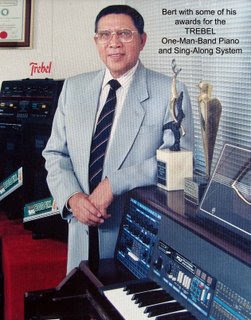
1980s: Filipino patent
Inoue never bothered to patent his invention, losing his chance to become one of Japan's richest men. Roberto del Rosario, a Filipino inventor who developed a sing along system in 1975 and patented it in the 1980s called his sing-along system "Minus-One", now holds the patent for the device now commonly known as the "karaoke machine". The spread of "Minus-One" music would have been attributed to a few Filipinos who brought with them their music, as mentioned above in the late 1960s through to the 1970s, wherever they go and within which period a few started going to Japan as entertainers. Following a court battle with a Japanese company which claimed to have invented the system, del Rosario's patents were issued in 1983 and 1986, a decade after the device was supposedly invented.
Patent Issues Continued On
Yet again another battle on patent infringement continued on with another company.[8] Posthumously awarded in favour of Roberto del Rosario under G.R. No. 115106, March 15, 1996 of the Philippine Supreme Court filed on January 18, 1993, it was a final victory for his family members a couple of decades after the first patent was enforced.


#4136
barato man kaha, serbisyo barato pod. why don´t they put their complains in papers?
#4137
mao naman ang atong na-andan, unsa man ang kaayohan kon ibalhin, gawas pa kining petsaha pabor sa mga taga gawas kay panahon man sa bakasyon.
#4138
Bible Study / Re: Saints of the Day
June 21, 2010, 02:30:38 PM
St. Aloysius Gonzaga
(1568-1591)


The Lord can make saints anywhere, even amid the brutality and license of Renaissance life. Florence was the “mother of piety” for Aloysius Gonzaga despite his exposure to a “society of fraud, dagger, poison and lust.” As a son of a princely family, he grew up in royal courts and army camps. His father wanted Aloysius to be a military hero.
At age seven he experienced a profound spiritual quickening. His prayers included the Office of Mary, the psalms and other devotions. At age nine he came from his hometown of Castiglione to Florence to be educated; by age 11 he was teaching catechism to poor children, fasting three days a week and practicing great austerities. When he was 13 years old he traveled with his parents and the Empress of Austria to Spain and acted as a page in the court of Philip II. The more Aloysius saw of court life, the more disillusioned he became, seeking relief in learning about the lives of saints.

A book about the experience of Jesuit missionaries in India suggested to him the idea of entering the Society of Jesus, and in Spain his decision became final. Now began a four-year contest with his father. Eminent churchmen and laypeople were pressed into service to persuade him to remain in his “normal” vocation. Finally he prevailed, was allowed to renounce his right to succession and was received into the Jesuit novitiate.

Like other seminarians, Aloysius was faced with a new kind of penanceâ€"that of accepting different ideas about the exact nature of penance. He was obliged to eat more, to take recreation with the other students. He was forbidden to pray except at stated times. He spent four years in the study of philosophy and had St. Robert Bellarmine (September 17) as his spiritual adviser.

In 1591, a plague struck Rome. The Jesuits opened a hospital of their own. The general himself and many other Jesuits rendered personal service. Because he nursed patients, washing them and making their beds, Aloysius caught the disease himself. A fever persisted after his recovery and he was so weak he could scarcely rise from bed. Yet, he maintained his great discipline of prayer, knowing that he would die within the octave of Corpus Christi, three months later, at the age of 23.


Comment:

As a saint who fasted, scourged himself, sought solitude and prayer and did not look on the faces of women, Aloysius seems an unlikely patron of youth in a society where asceticism is confined to training camps of football teams and boxers, and sexual permissiveness has little left to permit. Can an overweight and air-conditioned society deprive itself of anything? It will when it discovers a reason, as Aloysius did. The motivation for letting God purify us is the experience of God loving us, in prayer.


Quote:

"When we stand praying, beloved brethren, we ought to be watchful and earnest with our whole heart, intent on our prayers. Let all carnal and worldly thoughts pass away, nor let the soul at that time think on anything except the object of its prayer" (St. Cyprian, On the Lord's Prayer, 31).


Patron Saint of:

Catholic youth
Teenagers
Youth
#4139
Bible Study / Re: Minute Meditations
June 21, 2010, 02:28:55 PM
Think Young   

One thing that can make us old fast is thinking that we are getting old. 
#4140
CNN
South African Dr. Sonnet Ehlers was on call one night four decades ago when a devastated rape victim walked in. Her eyes were lifeless; she was like a breathing corpse.
Forty years later, Rape-aXe was born.

The woman inserts the latex condom like a tampon. Jagged rows of teeth-like hooks line its inside and attach on a man's penis during penetration, Ehlers said.

Once it lodges, only a doctor can remove it -- a procedure Ehlers hopes will be done with authorities on standby to make an arrest.

"It hurts, he cannot pee and walk when it's on," she said. "If he tries to remove it, it will clasp even tighter... however, it doesn't break the skin, and there's no danger of fluid exposure."

#4141
is he prominent?
#4142
Health and Food / Living longer- the Roseto Effect!
June 21, 2010, 04:14:46 AM
Sharing this longish but interesting article which points to certain factors that contribute to longer life expectancy -

"The Roseto Effect"

I. HEALTH AND CULTURE

People are nourished by other people. The importance of social networks in health and longevity has been confirmed again by study of a close-knit Italian-American community in Roseto, Pennsylvania. At first blush, Roseto seems a diorama of what once was the nation's ideal lifestyle-neighbors who looked after one another, civic-minded joiners and doers who formed the grass roots of American-style democracy. It seems to showcase those virtues that have all but disappeared elsewhere in what has become what we are now--a nation of strangers.

At one time the village came to be a living laboratory demonstrating that neighborliness is good not just for the body politic (community) for the human body (self) as well. Now Roseto is changing, becoming a community of suburban commuters with satellite dishes, fenced-in yards, and expensive cars.

Thirty years earlier, medical researchers were drawn to Roseto by a bewildering statistic: in defiance of medical logic, Rosetans seemed nearly immune to one of the most common causes of death. They died of heart attacks at a rate only half of the rest of America. Doctors were mystified in that residents led what medical textbooks predicted would be short lives.

The men of the village smoked and drank wine freely. They spent their days in backbreaking, hazardous labor, working 200 feet down in nearby slate quarries. At home, the dinner tables each evening were laden with traditional Italian food, modified for local ingredients in ways that would drive a dietitian to despair.

The Mediterranean diet, with its use of olive oil rather than animal fat, has been touted lately for health benefits. But, poor immigrants couldn't afford to import cooking oil from their homeland and instead fry their sausages and brown their meatballs in lard. Yet, the resulting hefty bodies contained unusually health hearts. Why?

.....

II. A RESEARCH OPPORTUNITY

Study of the "Roseto Effect" began with a chance conversation over a couple of beers. A local physician happened to mention to the head of medicine at the University of Oklahoma that heart disease seemed much less prevalent in Roseto than in adjoining Bangor, occupied by non-Italians.

When first studied in 1966, Roseto's cardiac mortality traced a unique graph. Nationally, the rate rises with age. In Roseto, it dropped to near zero for men aged 55-64. For men over 65, the local death rate was half the national average.

The study quickly went beyond death certificates, to poke, prod, and extensively interview the Rosetans. Instead of helping to solve the puzzle, all the data simply ruled out any genetic or other physical sources of the Rosetan's resistance to heart disease. Two statistics about Roseto were eye-catching: Both the crime rate and the applications for public assistance were zero.

.....

III. HEALTH AND SOCIAL RELATIONSHIPS

Subsequent study showed that all of the houses contained three generations of the family. Rosetans took care of their own. Instead of putting the elderly "on the shelf," they were elevated "to the Supreme Court." The scientists were led to conclude that the Roseto Effect was caused by something that could not be seen through the microscope, something beyond the usual focus of medical researchers.

It seemed that those groaning dinner tables offered nourishment for the human spirit as well as the body. In fact, all of the communal rituals--the evening stroll, the many social clubs, the church festivals that were occasions for the whole community to celebrate--contribu ted to the villagers' good health.

In "The Power of Clan," an updated report on studies by Stewart Wolf, a physician, and John Bruhn, a sociologist, cover a broad period of time from 1935 to 1984. They found that mutual respect and cooperation contribute to the health and welfare of a community and its inhabitants, and that self indulgence and lack of concern for others exert opposite influences.

Tracing the history of Roseto, the sociologists found that early immigrants were shunned by the English and Welsh who dominated this little corner of eastern Pennsylvania. According, the Rosetans turned inward and built their own culture of cooperation and as Wolf and Bruhn noted, "radiated a kind of joyous team spirit as they celebrated religious festivals and family landmarks."

"People are nourished by other people," said Wolf, noting that the characteristics of tight-knit community are better predictors of healthy hearts than are low levels of serum cholesterol or tobacco use. He explained that an isolated individual may be overwhelmed by the problems of everyday life. Such a person internalized that feeling as stress which, in turn, can adversely affect everything from blood pressure to kidney function. That, however, is much less likely to be the outcome when a person is surrounded by caring friends, neighbors and relatives. The sense of being supported reduces stress and the disease stress engenders.

"We looked at the social structure of healthy communities," Wolf said, "and found that they are characterized by stability and predictability. In those communities, each person has a clearly defined role in the social scheme."

Into the 1960s, Roseto was the epitome of predictability and conformity. In clothing, housing or automobiles, any display of wealth was taboo. Women knew that, from their teens on, they would work in one of the many small blouse factories scattered throughout the village. Even the evening meal followed a rigid cycle.

"Monday" recalled 66-year old Angie Martocci, "almost everyone in town ate spezzati (a spinach and egg soup). Tuesdays, it was spaghetti and gravy (tomato sauce). Wednesday was roast chicken and potatoes. Thursday, spaghetti again. Fish on Fridays, of course. Veal and peppers on Saturday; and antipasto, meatballs and spaghetti on Sunday."

All of that conformity reduced the distance between the haves and have-nots, thereby reinforcing everyone's sense of conformity also spared Rosetans the stress that comes with freedom of choice. (My comment: the anthropologist David Maybury-Lewis in his video series Millenium that individuals in a tribal society grow up in a defined world where people know their place and their relationship to others. We grow up with freedom, he says, in a limitless world where we are often lost and terribly alone.)

Possibly the strongest conformity in the village was the work ethic. No only did everyone work here, they worked toward a common goal--a better life for their children. The reverence for work was the legacy of Roseto's first priest, Rev. Pasquale de Nisco. Arriving in 1896, De Nisco practiced what he preached. Taking up a pick and shovel, he started clearing ground next to the church to build the graveyard, where he now lies. Above all, De Nisco, whose influence is still strong in Roseto, preached education.

.....

IV. THE EFFECT FADES

In the slate quarries and blouse factories, the men and women of Roseto labored to be able to send their children to college, which they did at a rate far above the national average. By World War II, Roseto had a small white-collar class and was prospering. And of course with that, life began to change.

Wolf and Bruhn's study took place just as Roseto's golden age of community was drawing to a close. They were able to predict that Rosetans then under 30 would not long be content with their rigid, traditional lifestyle. By the '70s, homes on the outskirts of town were in the suburbanized style that had become the American norm: large single family houses, swimming pools, fenced years, country clubs, and churches outside of the community.

As people moved and achieved material success, they found those gains at the expense of traditional communal values with which they have been raised. One person said, "I'm sorry we moved; everything is modern here and we have everything I need here, except people."

The principal of the elementary school said that children's lives changed. They went from days filled with activities to lives of watching from the sidelines. She found she had to teach children how to play jacks and marbles. The strongest evidence that change had come to Roseto was in 1985 when the town's coronet band, founded in 1890, demanded for the first time to be paid for playing at the church's big festival.

As Wolf and his colleagues continued to monitor the health of the community, they noted that social change in the village was accompanied by increasing health problems. In 1971, the first heart attack death of a person less than 45 occurred in Roseto.

Nationally, the Americans' vulnerability to heart attack began to decline because of the widespread adoption of exercise programs and healthier diet. At the same time, the Rosetan's rate rose to the national average.

Roseto has lost its statistical uniqueness. Yet, it makes clear to a visitor that it retains a sense of community--one that would be the envy of almost any place else in the nation. For many families, eating remains a ritual of the communal nature of life here. On Sundays, extra chairs are drawn up and leaves are added to dinner tables all over town for a ceremony that satisfies both physical hunger and the hunger to be surrounded by people who share our lives.

At Rose's Cafe, the only restaurant remaining in town, proprietor Rose Pavan calls everyone by name. Anyone with questions about menu items is swept into the kitchen for a sample. Children, most in Catholic school uniforms, flock in for an after-school snack--just as parents did back when Rose's was Mary's Luncheonette.

A visitor is bound to come away from Rose's with a full stomach and even fuller appreciation how far the rest of us have drifted from the civic-mindedness that marked much of the nation's history.

(My comment: this article is drawn from a series done by The Chicago Tribune on America's loss of community. Other articles focused on our changing urban/suburban social fabric. They noted the social changes implied by suburban homes where the garage is in front and both parents are employed, often an hour drive away. This article was especially relevant for medical anthropology's emphasis on bio culture, the interrelationship between culture, health and disease.)

If older Rosetans are concerned that they have traveled too far down the path of materialistic fulfillment- -a path that seems never to end in lasting contentment- -shouldn't other Americans be at least as concerned?

We now know that people's reaction's to the same stressful experience vary widely and those who have a greater sense of control, support and satisfaction in their lives are less at risk of illness. Those who get sick most seem to view the world and their lives as unmanageable while those who stay healthy have a greater sense of coherence and control through faced with the same problems. The Rosetans, to put it in Darwinian terms, were a successful adaptation.

A wide range of illness reflects the role that ineffective coping and inadequate support play. The highest rates of tuberculosis have been found among isolated and marginal people who have little social support, although they may live in affluent neighborhoods. This article focused on heart disease, others are indicators of social life as well. These include respiratory diseases, accidents, and mental illness. Studies in England have shown that civil servants with the highest rate of death from coronary heart disease occurs amongst those with little social support. We are indeed nourished by contact with others.

.....

V. SOCIALIZING AND LONGEVITY

A study published in the British Medical Journal in 1999 found that people more than 65 who like to eat out, play cards, go to movies and take part in other social activities live an average of two ½ years longer than more reclusive people. Simply mixing with people seems to offer as great a benefit as regular exercise. Social and productive pursuits are equivalent to and independent of the merits of exercise.

In a similar study at Harvard, it was found that those who were most engaged in productive pursuits were 23 percent less likely to die than those least involved in such pursuits. When each activity was examined individually, doing a lot as opposed to not much, extended live in almost every case regardless of the activity.

Does humor matter? While it is popularly accepted that laughter speeds healing and fights disease, some researchers say that laugher isn't the best medicine after all. A review of humor research does not confirm a direct therapeutic effect of laughter.

Does love matter? In a study of 10,000 married men, it was found that-in the subsequent five years-men who felt love from their wife had significantly less angina that those that felt no love.

People who perceived themselves as socially isolated were found to be two to five times more at risk for premature death from all causes. Persons with low interpersonal conflict in their lives do best.

..... CJ '99

Resources

Condor, B. "Romantic Rx Studies link love and intimacy to improved cardiovascular health" Chicago Tribune April 2, 1998.

Grossman and Leroux "A New Roseto Effect" Chicago Tribune October 11, 1996.

Justice, B. Who Gets Sick New York: Tarcher/Putnam Books, 1987.

McFarling, U "Humor's touted medical value faces skepticism" Chicago Tribune July 7, 1999.

Shaffer, C. and Anundsen, K. "The Healing Powers of Community" Utne Reader September-October, 1995.

"Whether bingo or brunch, study touts socializing" Chicago Tribune August 20, 1999.


__._,_.___
#4143
Anonymous Diary Blog / Re: What Did You Do Today?
June 21, 2010, 02:14:59 AM
I met the parents of my daughter´s boyfriend, they are a wonderful couple.
#4144
Bible Study / Re: Saints of the Day
June 20, 2010, 05:08:10 PM
St. Paulinus of Nola
(354?-431)

Anyone who is praised in the letters of six or seven saints undoubtedly must be of extraordinary character. Such a person was Paulinus of Nola, correspondent and friend of Augustine, Jerome, Melania, Martin, Gregory and Ambrose.
Born near Bordeaux, he was the son of the Roman prefect of Gaul, who had extensive property in both Gaul and Italy. Paulinus became a distinguished lawyer, holding several public offices in the Roman Empire. With his Spanish wife, Therasia, he retired at an early age to a life of cultured leisure.

The two were baptized by the saintly bishop of Bordeaux and moved to Therasia’s estate in Spain. After many childless years, they had a son who died a week after birth. This occasioned their beginning a life of great austerity and charity, giving away most of their Spanish property. Possibly as a result of this great example, Paulinus was rather unexpectedly ordained a priest at Christmas by the bishop of Barcelona.

He and his wife then moved to Nola, near Naples. He had a great love for St. Felix of Nola, and spent much effort in promoting devotion to this saint. Paulinus gave away most of his remaining property (to the consternation of his relatives) and continued his work for the poor. Supporting a host of debtors, the homeless and other needy people, he lived a monastic life in another part of his home. By popular demand he was made bishop of Nola and guided that diocese for 21 years.

His last years were saddened by the invasion of the Huns. Among his few writings is the earliest extant Christian wedding song.


Comment:

Many of us are tempted to "retire" early in life, after an initial burst of energy. Devotion to Christ and his work is waiting to be done all around us. Paulinus's life had scarcely begun when he thought it was over, as he took his ease on that estate in Spain. "Man proposes, but God disposes."


#4145
Bible Study / Re: Minute Meditations
June 20, 2010, 05:07:02 PM
Our Model   

God entered history through a family in order to make family life holy and show us how to live in our homes. 


#4146
Bible Study / Re: Saints of the Day
June 20, 2010, 12:48:42 AM
June 19, 2010


St. Romuald


(950?-1027)


After a wasted youth, Romuald saw his father kill a relative in a duel over property. In horror he fled to a monastery near Ravenna in Italy. After three years some of the monks found him to be uncomfortably holy and eased him out.
He spent the next 30 years going about Italy, founding monasteries and hermitages. He longed to give his life to Christ in martyrdom, and got the pope’s permission to preach the gospel in Hungary. But he was struck with illness as soon as he arrived, and the illness recurred as often as he tried to proceed.

During another period of his life, he suffered great spiritual dryness. One day as he was praying Psalm 31 (“I will give you understanding and I will instruct you”), he was given an extraordinary light and spirit which never left him.

At the next monastery where he stayed, he was accused of a scandalous crime by a young nobleman he had rebuked for a dissolute life. Amazingly, his fellow monks believed the accusation. He was given a severe penance, forbidden to offer Mass and excommunicated, an unjust sentence he endured in silence for six months.

The most famous of the monasteries he founded was that of the Camaldoli (Campus Maldoli, name of the owner) in Tuscany. Here he founded the Order of the Camaldolese Benedictines, uniting a monastic and hermit life.

His father later became a monk, wavered and was kept faithful by the encouragement of his son.

Comment:

Christ is a gentle leader, but he calls us to total holiness. Now and then men and women are raised up to challenge us by the absoluteness of their dedication, the vigor of their spirit, the depth of their conversion. The fact that we cannot duplicate their lives does not change the call to us to be totally open to God in our own particular circumstances.


#4147
Bible Study / Re: Minute Meditations
June 20, 2010, 12:47:13 AM
Shout it Out!

We cannot be Christians and remain silent or fearful. The message of Christ must be shouted out to others.
#4148
Bible Study / Re: Minute Meditations
June 19, 2010, 04:14:51 PM
It's All About Time

If we never make the time or take time to be with the Lord, nothing spiritual can happen in our lives.
#4149
Bible Study / Re: Saints of the Day
June 19, 2010, 04:13:53 PM
June 18, 2010


Venerable Matt Talbot


(1856-1925)


Matt can be considered the patron of men and women struggling with alcoholism.
Matt was born in Dublin, where his father worked on the docks and had a difficult time supporting his family. After a few years of schooling, Matt obtained work as a messenger for some liquor merchants; there he began to drink excessively. For 15 yearsâ€"until he was 30â€"Matt was an active alcoholic.

One day he decided to take "the pledge" for three months, make a general confession and begin to attend daily Mass. There is evidence that Matt’s first seven years after taking the pledge were especially difficult. Avoiding his former drinking places was hard. He began to pray as intensely as he used to drink. He also tried to pay back people from whom he had borrowed or stolen money while he was drinking.

Most of his life Matt worked as a builder’s laborer. He joined the Secular Franciscan Order and began a life of strict penance; he abstained from meat nine months a year. Matt spent hours every night avidly reading Scripture and the lives of the saints. He prayed the rosary conscientiously. Though his job did not make him rich, Matt contributed generously to the missions.

After 1923 his health failed and Matt was forced to quit work. He died on his way to church on Trinity Sunday. Fifty years later Pope Paul VI gave him the title venerable.

Comment:

In looking at the life of Matt Talbot, we may easily focus on the later years when he had stopped drinking for some time and was leading a penitential life. Only alcoholic men and women who have stopped drinking can fully appreciate how difficult the earliest years of sobriety were for Matt.

He had to take one day at a time. So do the rest of us.

Quote:
On an otherwise blank page in one of Matt’s books, the following is written: "God console thee and make thee a saint. To arrive at the perfection of humility four things are necessary: to despise the world, to despise no one, to despise self, to despise being despised by others."


#4150
okay sumbohan, salamat kay napad-pad ka sa atong payag!
#4151
Anonymous Diary Blog / Re: Docking to port June 30
June 18, 2010, 06:50:40 AM
Yes Attorney, we are almost in the middle of 2010, pas-pas ang panahon, carpe diem!
#4152
World Daily News / The Royal Wedding of the Year!
June 18, 2010, 05:54:40 AM
Der Spiegel
By Matthias Matussek

On Saturday, Sweden's Crown Princess Victoria will marry her fiancé, a former fitness instructor. The event is expected to be a boon to both the monarchy and that part of the media that thrives on sentimental stories. Princess Victoria is the opposite of Lady Di: She, her love and her fiancé are all authentic.

A Feat of Courtship Endurance

Unlike Norwegian Crown Princess Mette-Marit, who also comes from a middle-class family, and who had a somewhat checkered past before meeting and marrying Prince Haakon, Victoria took her time after seeing Daniel working out on a strength-training machine for the first time. But then the relationship grew.

She was as single-minded in developing her relationship as tennis legend Björn Borg once was on the baseline. She set her sights on her Daniel and, in a long, grueling match, finally got him. The entire country took an interest in this world record for endurance, and now the global media want to at least benefit from it.

Some 2,300 journalists are expected in Stockholm. The royal court is almost worried that media representatives will outnumber the ordinary people lining the streets. All good camera angles have already been determined. There are no exclusive rights. After all, this isn't some show-business or country-gentry wedding. In Germany, the ZDF public television network alone will be broadcasting live, on Saturday from 2:30 to 7:00 p.m. A documentary the station already aired about the wedding had outstanding viewer ratings. German television station Phoenix will also be involved, and private broadcaster RTL will follow up with a summary.
But if there is anything to marvel at when it comes to this wedding -- which, with an anticipated 500 million TV viewers, promises to be another royal TV blockbuster -- it is not about Snow White's quick charm, but instead the triumph of a tough will. Because Victoria is the opposite of Lady Di.

Westling, though no shining light in an academic sense, was an outstanding athlete. He comes from Ockelbo, a town of 3,000 people living in red wooden houses in a remote forested area north of Stockholm -- bear and elk country. Last year, remote farms in the region were plagued by hungry wolves roaming through the area and killing house pets.

The mother of the groom worked at the post office and the father for the social security office. The only prominent member of the family is former weightlifting world champion Susanne Formgren, who now runs the local gym. That was the world of Daniel Westling. And it was the challenge faced by a team of specialists consisting of teachers and etiquette consultants, whose job was to turn the jewel of the princess's heart into a diamond suitable for gala appearances.
#4153
Bible Study / Re: Saints of the Day
June 18, 2010, 05:44:47 AM
June 18
1697


St. Gregory Barbarigo was born in 1625, of a very old and distinguished Venetian family. A brilliant student, he embraced a diplomatic career and accompanied the Venetian Ambassador, Contarini, to the Congress of Munster in 1648. Then he became a priest and was soon thereafter consecrated as the first Bishop of Bergamo by Pope Alexander VII. Later on he was elevated to the rank of Cardinal and also given authority over the diocese of Padua. He guided his flock with pastoral wisdom and deep understanding. St. Gregory Barbarigo worked unceasingly in carrying out the reforms set forth by the Council of Trent. Through his efforts the seminaries of both Bergamo and Padua were substantially enlarged. At Padua he also added a library and a printing press. He died in 1697. His feast day is June 18th.


#4154
Bible Study / Re: Minute Meditations
June 18, 2010, 05:43:10 AM
It's All About Time   

If we never make the time or take time to be with the Lord, nothing spiritual can happen in our lives. 
#4155
Hindi gawang biro ang magdesisyon, dahil tayo ay mapagmahal sa pamilya, nais nating mabigyan sila ng kaginhawa-an, kay ang pag-abroad ay hindi maiiwasan.
#4156


Best wishes on your birthday and a toast to your health!
#4157
Buwadskie,  kanang okra, imong tungaon unya ihomol sa 1 liter water maoy imong imnon ( overnight soaking).
#4158
Kaliwat Bol-anon / Re: Galia Clan from Jagna..
June 17, 2010, 06:56:43 PM
kanang mga Galia sa Tagbi, Doy imong pepol?
#4159
Bible Study / Re: Saints of the Day
June 17, 2010, 06:47:27 PM
St. Joseph Cafasso
(1811-1860)

Even as a young man, Joseph loved to attend Mass and was known for his humility and fervor in prayer. After his ordination he was assigned to a seminary in Turin. There he worked especially against the spirit of Jansenism, an excessive preoccupation with sin and damnation. Joseph used the works of St. Francis de Sales and St. Alphonsus Liguori to moderate the rigorism popular at the seminary.
Joseph recommended membership in the Secular Franciscan Order to priests. He urged devotion to the Blessed Sacrament and encouraged daily Communion. In addition to his teaching duties, Joseph was an excellent preacher, confessor and retreat master. Noted for his work with condemned prisoners, Joseph helped many of them die at peace with God.

St. John Bosco was one of Joseph’s pupils. Joseph urged John Bosco to establish the Salesians to work with the youth of Turin. Joseph was canonized in 1947.


Comment:

Devotion to the Eucharist gave energy to all Joseph's other activities. Long prayer before the Blessed Sacrament has been characteristic of many Catholics who have lived out the gospel well, St. Francis, Bishop Sheen, Cardinal Bernardin and Mother Teresa among them.


Quote:

“O admirable heights and sublime lowliness! O sublime humility! O humble sublimity! That the Lord of the universe, God and the Son of God, so humbles Himself that for our salvation He hides Himself under the little form of bread! Look, brothers, at the humility of God and pour out your hearts before Him! Humble yourselves, as well, that you may be exalted by Him. Therefore, hold back nothing of yourselves for yourselves so that He Who gives Himself totally to you may receive you totally” (Saint Francis, Letter to the Entire Order).


Patron Saint of:

Prisoners
Prussia
#4160


after 8 years of living together, they finally tied the knot.
#4161
Bible Study / Re: Saints of the Day
June 17, 2010, 06:09:31 AM
St. Emily de Vialar, Virgin, Foundress of the Sisters of St. Joseph "of the Apparition"

Anne Marguerite Adelaide Emily de Vialar was the eldest child and only daughter of Baron James Augustine de Vialar and his wife Antoinette, daughter of that Baron de Portal who was physician-in-ordinary to Louis XVIII and Charles X of France. She was born at Gaillac in Languedoc in 1797. At the age of fifteen she was removed from school in Paris to be companion to her father, now a widower, at Gaillac; but unhappily, differences arose between them because of Emily's refusal to consider a suitable marriage.

For fifteen years, Emily was the good angel of Gaillac, devoting herself to the care of children neglected by their parents and to the help of the poor generally. In 1832, her maternal grandfather died, leaving her a share of his estate which was a quite considerable fortune. She bought a large house at Gaillac and took possession of it with three companions. Others joined them and three months later, the archbishop authorized the Abbe to clothe twelve postulants with the religious habit. They called themselves the Congregation of Sisters of St. Joseph of the Apparition. Their work was to be the care of the needy, especially the sick, and the education of children. In 1835, she made her profession with seventeen other sisters, and received formal approval for the rule of the Congregation.

The foundress, in the course of twenty-two years, saw her Congregation grow from one to some forty houses, many of which she had founded in person. The physical energy and achievements of St. Emily de Vialar are the more remarkable in that from her youth she was troubled by hernia, contracted characteristically in doing a deed of charity. From 1850 this became more and more serious, and it hastened her end, which came on August 24, 1856. The burden of her last testament to her daughters was "Love one another". Her canonization took place in 1951; her feast is June 17th.


#4162
Bible Study / Re: Minute Meditations
June 17, 2010, 06:06:52 AM
Our Role   

Our highest role as creatures is to offer worship and to share a oneness with our Creator. 
#4163
Sub prof  eligibility was heaven sent to me, I got a permanent job in Davao cityhall.
#4164
walay praticum diha let him learn a music instrument.
#4165
Kaliwat Bol-anon / Re: Ligalig Roots in Anda, Bohol
June 16, 2010, 02:29:04 PM
Migration was strong when people seeks greener pastures, this is the main motive. What an herculian task to trace back your name! Good luck. :)
#4166
Doy Bugs, mag-ampo nalang kita siya mahayagan ug makalahutay. God bless buotan nga amahan, buotan nga anak! ;)
#4167
Bible Study / Re: Saints of the Day
June 16, 2010, 01:41:18 PM
St. John Francis Regis
(1597-1640)

Born into a family of some wealth, John Francis was so impressed by his Jesuit educators that he himself wished to enter the Society of Jesus. He did so at age 18. Despite his rigorous academic schedule he spent many hours in chapel, often to the dismay of fellow seminarians who were concerned about his health. Following his ordination to the priesthood, he undertook missionary work in various French towns. While the formal sermons of the day tended toward the poetic, his discourses were plain. But they revealed the fervor within him and attracted people of all classes. Father Regis especially made himself available to the poor. Many mornings were spent in the confessional or at the altar celebrating Mass; afternoons were reserved for visits to prisons and hospitals.
The Bishop of Viviers, observing the success of Father Regis in communicating with people, sought to draw on his many gifts, especially needed during the prolonged civil and religious strife then rampant throughout France. With many prelates absent and priests negligent, the people had been deprived of the sacraments for 20 years or more. Various forms of Protestantism were thriving in some cases while a general indifference toward religion was evident in other instances. For three years Father Regis traveled throughout the diocese, conducting missions in advance of a visit by the bishop. He succeeded in converting many people and in bringing many others back to religious observances.

Though Father Regis longed to work as a missionary among the North American Indians in Canada, he was to live out his days working for the Lord in the wildest and most desolate part of his native France. There he encountered rigorous winters, snowdrifts and other deprivations. Meanwhile, he continued preaching missions and earned a reputation as a saint. One man, entering the town of Saint-Andé, came upon a large crowd in front of a church and was told that people were waiting for "the saint" who was coming to preach a mission.

The last four years of his life were spent preaching and in organizing social services, especially for prisoners, the sick and the poor. In the autumn of 1640, Father Regis sensed that his days were coming to a conclusion. He settled some of his affairs and prepared for the end by continuing to do what he did so well: speaking to the people about the God who loved them. On December 31, he spent most of the day with his eyes on the crucifix. That evening, he died. His final words were: "Into thy hands I commend my spirit."

He was canonized in 1737.


Comment:

John longed to travel to the New World and become a missionary to the Native Americans, but he was called instead to work among his own compatriots. Unlike many famous preachers, he isn’t remembered for golden-tongued oratory. What people who listened to him heard was his own fervent faith, and it had a powerful effect on them. We can recall homilists who impressed us for the same reason. More importantly for us, we can also remember ordinary people, neighbors and friends, whose faith and goodness touched us and brought us to deeper faith. That is the calling most of us must follow.


#4168
Kaliwat Bol-anon / Re: Ligalig Roots in Anda, Bohol
June 16, 2010, 06:35:35 AM
Ikaw ra ang Ligalig nga akong na-ilhan Mike.

Ortega is familiar in Luzon, Tagalog area.
#4169
Bible Study / Re: Minute Meditations
June 16, 2010, 06:08:56 AM

It's About Faith   


We need to have faith in the power of Jesus over death. Life and death are in God's loving hands. 


#4170
no one can beat our versatile Nora Aunor!
#4171
It is not anchored in the German constitution that national army can be deployed in foreign country to defend economic interest.
#4173
hidden  agenda kini ngano nga ang Germany nagpadala ug contingent,  pag interview sa German president ingon man siya nga justifiable ang presence sa Bundeswehr to preserve german economic interest, mao kadto nga gi-uwan siya ug criticism, resign lagi sya.
#4174
Cases like this are taken care of a proper psychological therapy.
#4175
Hi Pressy, you talked to much again!  Kamusta?
#4176
Bible Study / Re: Saints of the Day
June 15, 2010, 02:25:58 PM
Servant of God Orlando Catanii

An unexpected encounter with St. Francis of Assisi in 1213 was to forever changeâ€"and enrichâ€"the life of Count Orlando of Chiusi.
On the day a festival was being organized for a huge throng, St. Francis, already well known for his sanctity, delivered a dramatic address on the dangers of worldly pleasures. One of the guests, Orlando (also known as Roland) was so taken by Francis' words that he sought out the saint for advice on how best to lead a life pleasing to God.

A short time later, Francis visited Count Orlando in his own palace, located at the foot of Mount La Verna. Francis spoke again of the dangers of a life of wealth and comfort. The words prompted Orlando to rearrange his life entirely according to the principles outlined by Francis. Furthermore, he resolved to share his wealth by placing at Francis' disposal all of Mount La Verna, which belonged to Orlando. Francis, who found the mountain's wooded recesses and many caves and ravines especially suitable for quiet prayer, gratefully accepted the offer. Orlando immediately had a convent as well as a church built there; later, many chapels were added. In 1224, two years before the death of Francis, Mount La Verna was the location where Francis received the holy wounds of Christ.

In return for his generous gift, Orlando desired only to be received into the Third Order and to have St. Francis as his spiritual director. Under Francis' guidance, Orlando completely detached himself from worldly goods. He zealously performed acts of charity as a Christian nobleman. After his happy death Orlando was laid to rest in the convent church on Mount La Verna.


Comment:

Even Francis, Lady Poverty’s favorite knight, needed a suitable place to pray. Captivated by Francis’ preaching, Orlando restructured his life. One of the possessions he parted with was Mt. La Verna, which he offered to the Little Poor Man. There Francis found the solitude he sought. In one mountainside cave, he was branded with Christ’s own wounds. We may not be as wealthy as Orlando, but we have enough to spare. Only God can know who in Lady Poverty’s realm will be nurtured in sanctity because we imitate Orlando in generosity.
#4177
There has been a study here in Germany  especially in the hospitals where an acute lung infections happen, and they try to see the correlation to taking hot showers.

I was urged to take a shower after 2 days of my caesarian operation, in that evening I got high fevers, ambot kon adunay kamatooran ni-ani.
#4178
Showering may be bad for your health, say US scientists, who have shown that dirty shower heads can deliver a face full of harmful bacteria.

Tests revealed nearly a third of devices harbour significant levels of a bug that causes lung disease.

Levels of Mycobacterium avium were 100 times higher than those found in typical household water supplies.

M. avium forms a biofilm that clings to the inside of the shower head, reports the National Academy of Science.


  If you are getting a face full of water when you first turn your shower on, that means you are probably getting a particularly high load of Mycobacterium avium, which may not be too healthy

Researcher Professor Norman Pace
In the Proceedings journal, the study authors say their findings might explain why there have been more cases of these lung infections in recent years, linked with people tending to take more showers and fewer baths.

Water spurting from shower heads can distribute bacteria-filled droplets that suspend themselves in the air and can easily be inhaled into the deepest parts of the lungs, say the scientists from the University of Colorado at Boulder.

Potential threat

Lead researcher Professor Norman Pace, said: "If you are getting a face full of water when you first turn your shower on, that means you are probably getting a particularly high load of Mycobacterium avium, which may not be too healthy."

While it is rarely a problem for most healthy people, those with weakened immune systems, like the elderly, pregnant women or those who are fighting off other diseases, can be susceptible to infection.

They may develop lung infection with M. avium and experience symptoms including tiredness, a persistent, dry cough, shortness of breath and weakness, and generally feel unwell.

When the researchers swabbed and tested 50 shower heads from nine cities in seven different states in the US, including New York City and Denver, they found 30% of the devices posed a potential risk.

Since plastic shower heads appear to "load up" with more bacteria-rich biofilms, metal shower heads may be a good alternative, said Professor Pace.

Showers have also been identified as a route for spreading other infectious diseases, including a type of pneumonia called Legionnaires' disease and chest infections with a bacterium called Pseudomonas aeruginosa.

Hot tubs and spa pools carry a similar infection risk, according to the Health Protection Agency.

A HPA spokesperson said: "This is an interesting paper which provides further information about the occurrence of opportunist organisms - germs which do not usually cause infections in humans - in the environment.

"These bacteria, which belong to the same family as TB, can be found in the environment and occasionally in water supplies but rarely cause disease in healthy people.

"Further work will need to look at whether finding these organisms is associated with any increased risk of infection."

#4179
now you know why Bush and Cheney interferes.
#4180
Bible Study / Re: Saints of the Day
June 15, 2010, 06:09:17 AM
St. Germaine Cousin
June 15
Patron victims of child abuse
b. 1579 d. 1601

St. Germaine Cousin â€" June 15

Prof. Plinio Corrêa de Oliveira

Biographical selection:

To find a sad, useless, and miserable existence, one need look no further than the life of St. Germaine Cousin. She had a deformed and partially paralyzed hand and wretched health. She lacked any education, and had only a spinning wheel to spin wool and a crook to lead her sheep. She died at age 22. This is all that the world saw in St. Germaine Cousin.

La Petite Bergere, by Jean F. Millet
Germaine was from the village of Pibrac near Toulouse, France (1579-1601). She was born with a paralyzed right hand and afflicted with scrofula. Germaine passed her life under the authority of a stepmother, who detested her, beat her, mistreated her, and kept her apart from her brothers and sisters. Her father, Laurent Cousin, had no special affection for his daughter and ignored her sufferings. Since she was not considered good enough to stay in the house with the family, he gave her a small five-foot spot under the stairway of the barn as a place to sleep. Her bed was leaves and twigs on the floor, and her food only black bread and water. She was in charge of watching the family’s flock during the day. She was also given an allotment of wool to spin while the sheep were grazing. If she did not meet the expected quota, she was severely punished.

As a shepherdess, Germaine spent much time praying. Often the villagers laughed at her devotions, and mocked her for her misery. Her only answer was silence.

She took a great care to never lose her pleasant composure in face of her sufferings and misery. She never asked God to free her from that difficult situation, even when she knew that He would listen to her prayers. In fact, God worked many miracles through her to show His pleasure with her.

During her working day, she always went to Mass. When she heard the bells ringing, she would set her crook in the ground and run to the church, leaving the care of her flock to the Divine Shepherd. Her trust was never betrayed: not one of her sheep was ever lost or caused any damage to the neighbors’ lands. Further her flock was the healthiest and best looking in the area.

One day, after a strong rain the creek had become a raging stream, making it impossible for her to reach the church. Two peasants of the region who knew her custom to attend daily Mass came to laugh at her predicament. Instead of mocking her however, they saw the poor shepherdess walk straight toward the river without any hesitation. As she set her foot in the raging stream, the waters separated, allowing her to cross, just as the waters of the Jordan had opened for the Ark of the Covenant to pass. After she reached the other side, the waters returned to their tumultuous course. The peasants watched this with awe and fear, and then reported the miracle to the whole village.

Germaine also multiplied loaves of bread, as Our Lord did.


One winter day, she put some small pieces of bread in her apron to give to the poor. Accusing her of theft, her stepmother stopped her and threatened to beat her with a rod. In a great fury, she approached the girl, hurling every insult at her. Two inhabitants of Pibrac saw what was happening and went to protect the girl against the stepmother’s fury. They saw her stepmother order Germaine to open her apron, and instead of pieces of bread, a magnificent bouquet of beautiful and flagrant flowers tumbled out. No garden in Pibrac had every produced such flowers, and this was in the dead of winter.

One night, two traveling monks decided to take refuge for the night in a forest near Pibrac. They were sleeping when they were suddenly awakened by the sound of a marvelous singing. They looked and saw a group of virgins amidst a splendorous light who were passing through the forest toward Pibrac. The vision disappeared, but after a while the group appeared again. This time the cortege of virgins was coming from Pibrac, but one more virgin had joined the group.

It was Germaine, wearing on her forehead a crown of fresh flowers. The monks were charmed by this heavenly vision and spread news of it everywhere.

The following morning, Germaine did not appear to take charge of the sheep. Her father went to seek her in the cubicle, and found her dead on her simple pallet under the stairs. She had fallen into her final earthly sleep.
Today the relics of St. Germaine of Cousin are venerated in the Chapel of St. Francis de Sales in Pibrac. More than 400 miracles were credited to her intercession in the processes of canonization. The site with her relics became the object of frequent pilgrimage, and the deliverance of two Popes from their captivities â€" Pius VII and Pius IX â€" are attributed to her intercession.


Comments of Prof. Plinio:

What is the great lesson from the life of St. Germaine Cousin?

As you saw, she was born at the end of the 16th century. There was a stark contrast between her life and the spirit of the century in which she lived. That century was deeply marked by the errors of the Renaissance that dictated men should be completely turned to the pleasures of life and earthly glory. Certainly its quest for glory was less vile than the frenetic lust for money that we witness today. Still, it was a very censurable aim because it was turned only toward self-love. Real glory, which is celestial glory, was despised. It was a century that made vainglory one of its idols.

In that century a Saint was born who became venerable because she represented the opposite of that vainglory. Her life was filled with all kinds of humiliations. She had a very bad health; she was handicapped; she was treated cruelly by her own family. Presumably she did not know how to read, lacked any education, and had no special intelligence. She had everything that would make her despicable in the eyes of the world.

It so pleased Divine Providence to amass in St. Germaine every cause for humiliation that one can imagine. This is one aspect of her life.


The relics of Germaine in the St. Francis de Sales Chapel
in the village of Pibrac

Another aspect is that God worked the most extraordinary miracles on her behalf to show how He was pleased with her sanctity. One of the miracles was to open the waters for her to pass, just as the waters of the Red Sea separated to save the Chosen People and the Jordan separated to make a path for the Ark of the Covenant.

Another miracle was to transform bits of bread into flowers, just as He did for St. Elizabeth of Hungary. Yet another, for which the selection gives no details, was the multiplication of loaves as it occurred with Our Lord. That is, these were first class miracles which could give her reason to be proud. But she did not become proud; she was perfectly humble, even after the fame of the miracles spread throughout the area.

It is sad to see her family’s cruelty toward her. Since the family lacked mercy, its members were chastised and became blind with regard to her sanctity. They did not see her extraordinary qualities. Certainly they knew of her fame for working miracles, but they were indifferent and continued to persecute her. Their hardness of heart was plainly evident in the episode of her stepmother threatening her with the rod.

St. Germaine’s extraordinary composure is shown in the patience with which she bore her situation. If she had prayed and asked God to cure her and free her from those humiliations, He most probably would have granted her request. But she did not do this. She also could have confronted the family and said: “You are fools for treating me like this, because if you need a miracle from God tomorrow, I may not ask it for you.” But she did not say anything of the sort.

Her humility was perfect and twofold: First, because she accepted the humiliations that Divine Providence had sent to her, and second, because she refused to attribute to herself the inebriating perfume of the miracles that she was working. Nor did she become proud because of the fame they earned her.

In this attitude, you see the exact opposite of the mentality of her century. In that century of vainglory, God sent a Saint who practiced an extreme degree of humility and flew in face of worldly models. She did not heed those models and, for that reason, she was glorified by God.

God allowed her fame to spread in large circles around her. One can imagine the news of the miracles she worked reaching the palaces, the convents and monasteries, the milieus of the high bourgeoisie, inviting everyone to admire her and say a prayer through her intercession. This was the message for the world: “The prayer of those who do not have vainglory is heard by God,” which translates into this: “If you want to please God, abandon vainglory.” It was, therefore, a profoundly counter-revolutionary message. It was an exhortation to humility contrary to the pride of the Revolution; it was an exaltation of virginity in opposition to the sensuality of the revolutionary world.

Later, her fame spread so far that even two Popes â€" Pius VII and Pius IX â€" asked her intercession to be freed of their captivities. That is, the poor shepherdess became the protectress of the most glorious institutions that exist, the Holy See and the Papacy. This shows to what great heights God brought her.

What is the special lesson for us in this life? It is this: we should practice the same kind of virtue that St. Germaine did. The counter-revolutionary soul is, from a certain point of view, a combatant for the highest cause; but in another respect, he is a kind of Saint Germaine Cousin of our century. He is mocked, isolated, the recipient of unjustifiable bad treatment and considered outlandish by the world. He is not despised per se, but he is hated for the cause that he represents. We who are counter-revolutionaries should learn from St. Germaine how to endure this hatred just as she endured her humiliation.

131_Germaine_death.jpg - 40051 Bytes

Germaine was found dead on her poor pallet at the age of 22

We should humbly receive personal injuries and patiently accept them for the glory of God, like meek lambs. Every affront that is personal â€" touching our self-love, self-interest, personal needs â€" should not raise our indignation. We should be silent regarding these points just as she was silent in face of the offenses she suffered. On the other hand, if someone should offend God and the Catholic Church, we should raise up like lions in Their defense. She would have done the same if circumstances had demanded it.

At the end of her life, you heard about the marvelous miracle of the apparition of a choir of virgins to two traveling monks. Nothing is more beautiful and poetic than the woods of France, which are very hospitable to men: no swamps, no flies or mosquitoes, and no snakes. They are woods made for man to rest. You can imagine the beautiful scene of two monks in their habits and sandals, with their beards and staffs, making a long trip by foot, recollected and praying. Night came upon them and they decided to sleep in the forest, tranquil in the peace of God, waiting for the coming dawn. They lay down on the bare ground innocently sleeping with their rosaries in their hands.

Suddenly the pair were awakened by a supernatural phenomenon. They saw a group of virgins walking in the woods, unencumbered by any material obstacles in their way. The leaves below their feet did not bend from their weight; they passed through the trees as if they were nonexistent; their voices filled the forest with a beautiful and heavenly song. The monks fell to their knees, and watched everything with rapt attention. The choir of virgins passed; then, a short time later, it returned with increased joy because they had been joined by another virgin. Their new companion no longer had a paralyzed hand; her skin was pure, free from scrofula; her humiliations had ended. She passed in glory with a crown of flowers on her forehead. Just as in a fairy tale, the shepherd girl had become a queen. She was surrounded by her ladies of honor and walked like a princess, stately, noble, and joyful. She was on her way to Heaven to receive her glorification. It is a wonderful ending.

It was a kind of canonization in life that God wanted to give her, indicating to the world that He deposuit potentes de sede et exaltavit humiles â€" He put down the mighty from their seat and exalted the humble. He wanted to show that exemplary humility is crowned with glory in Heaven.

#4181
Bible Study / Re: Minute Meditations
June 15, 2010, 05:57:40 AM
Family Education   

The family is the great catechism God has given the world. The work of our lifetime is to learn how to read it and then study it prayerfully. 


#4182
I think what I learned is passé , you are right Bran that there are techniques to do CPR.
#4183
It is an obligation to assist help especially in this case, failure to do so is punishable in German laws.
#4184
obligatory ang CPR dinhe kon magkuha ug drivers license, the person who taught us told me not to do it since I´m a small person and I can not help a German weighing 120 kilos since the difference of our lung volume is great.

Kinahanglan tabangan kay ang kinabuhi sa tawo bili-hon.
#4185


These ladies were not included in the group picture since  Valery and Zenaida were busy tending to the barbecue and Lolit took the picture.

#4186
Mga badlongon Felix, ha ha ha.
Karong sonod namo nga party kami ra ang magdala ug pagka-on, busa mag andam pod mi para sa mga aleman nga bisita, apan aduna magdala ug pag-kaon para sa mga bol-anon sama sa buwad, dinogoan, adobong nokos, adunay mopalit ug lab-as nga isda kilawon, kining si Miraver maoy hanas.

We are happy that we had had 22 projects so far, we still have money almost 2,000 euro and we are telling members to take a look in their own town or barrio to invest 500 Euro as a project (30,000 pesos). Please visit our website it is new and we are still working on this ;

http://boholhilfe.com/projects/
#4187
Members posed for a souvenir photo, Bol-anon sa Germany general meeting & salo-salo.


photo taken by Ms Lolit Aba Adler

left-right ( Eden Ayuban Reisch from Alicia, Cita Felecio Schneider from Mabini,  Esper Baluma Schawag from Calape,  Miraver Flores Monserrat from Cortes,  hofelina, Esther Salarda Briggs from Sierra Bullones,  Annie Ladra Acapulco from Estaca Garcia-Hernandez,  Conchita Gumapac Llorente from Loboc,  Vicky Tejano Rietzel from Loay,  Betty Gohitia Koch from Calape,  Rexie Egagamao Schuetzler from Sierra Bullones,  Judith Apolinaris Walpuski from Antequera,  Maria Fe Pepito Ollesch from Loboc,  Vicky Ente Honselmann from Loboc,  Jovie Baluma Goltz from Calape, not in the picture, Lolit Aba Adler from Baclayon, Valery "Queen" Galendez  Mendez from Garcia-Hernandez, Zenaida Mesagrande Hinricher from Carmen)
#4188
Bible Study / Re: Saints of the Day
June 14, 2010, 05:39:08 PM
St. Albert Chmielowski
(1845-1916)

Born in Igolomia near Kraków as the eldest of four children in a wealthy family, he was christened Adam. During the 1864 revolt against Czar Alexander III, Adam’s wounds forced the amputation of his left leg.
His great talent for painting led to studies in Warsaw, Munich and Paris. Adam returned to Kraków and became a Secular Franciscan. In 1888 he took the name Albert when he founded the Brothers of the Third Order of Saint Francis, Servants to the Poor. They worked primarily with the homeless, depending completely on alms while serving the needy, regardless of age, religion or politics. A community of Albertine sisters was established later.

Pope John Paul II beatified him in 1983 and canonized him six years later.


Comment:

Reflecting on his own priestly vocation, Pope John Paul II wrote in 1996 that Brother Albert had played a role in its formation "because I found in him a real spiritual support and example in leaving behind the world of art, literature and the theater, and in making the radical choice of a vocation to the priesthood" (Gift and Mystery: On the Fiftieth Anniversay of My Priestly Ordination, p. 33). As a young priest, Karol Wojtyla repaid his debt of gratitude by writing The Brother of Our God, a play about Brother Albert’s life.


Quote:

The first reading at the canonization included Isaiah 58:6 (“Is not this the fast that I choose: to loose the bonds of injustice, to undo the thongs of the yoke, to let the oppressed go free, and to break every yoke?”). The pope referred to this passage and said: “This is the theology of messianic liberation, which contains what we are accustomed to calling today the ‘option for the poor’.... In this tireless, heroic service on behalf of the marginalized and the poor, he [Albert] ultimately found his path. He found Christ. He took upon himself Christ’s yoke and burden; he did not become merely ‘one of those who give alms,’ but became the brother to those he served....” (L'Osservatore Romano 1989, Vol. 49, No. 9).


#4189
Bible Study / Re: Minute Meditations
June 14, 2010, 05:38:23 PM
At Our Side   

Peter needed Jesus to pull him up when he tried walking on water. We may fall as we learn to walk in faith, but Jesus is there to help us up. 


#4190
tinood nga aduna medicinal applications for marijuana.

by Dale H. Gieringer, Ph.D.
August 1996

California NORML
2215-R Market St. #278
San Francisco CA 94114
(415) 563-5858 / canorml@igc.apc.org

Summary: Human Studies on Medical Uses of Marijuana

There have been hundreds of studies on the medical uses of cannabis since its introduction to western medicine in the early nineteenth century. A review of the literature reveals over 65 human studies, most of them in the 1970s and early ‘80s.

    * The best established medical use of smoked marijuana is as an anti-nauseant for cancer chemotherapy. Marijuana's efficacy was demonstrated in studies by half a dozen states, involving hundreds of subjects. Most research has found smoked marijuana superior to oral THC (Marinol). Many oncologists are currently recommending marijuana to their patients.
    * Marijuana is widely used to treat nausea and appetite loss associated with AIDS, but the government has blocked research in this area. Studies have shown that marijuana helps improve appetite, and Marinol has been FDA approved for treatment of AIDS wasting syndrome. Nearly 10,000 PWAs were reported to be using marijuana through the San Francisco Cannabis Buyers' Club. However, the government has blocked efforts by Dr. Donald Abrams of the University of California at San Francisco to proceed with an FDA-approved study of marijuana and AIDS wasting syndrome, by refusing to grant him access to research marijuana. Research is badly needed on the relative merits of smoked and oral marijuana versus Marinol.
    * There is much evidence, largely anecdotal, that marijuana is useful as an anti-convulsant for spinal injuries, multiple sclerosis, epilepsy, and other diseases. Similar evidence suggests marijuana may be useful as an analgesic for chronic pain from cancer and migraine as well as for rheumatism and a variety of auto-immune diseases. There is a conspicuous lack of controlled studies in this area; further research is needed.
    * Cannabidiol, a constituent of natural marijuana not found in Marinol, appears to have distinctive therapeutic value as an anti-convulsant and hypnotic, and to counteract acute anxiety reactions caused by THC.
    * It has been established that marijuana reduces intra-ocular pressure, the primary object of glaucoma therapy. Due to its psychoactivity, however, marijuana has not gained widespread acceptance in this application.
    * Many patients report using marijuana as a substitute for more addictive and harmful psychoactive drugs, including prescription painkillers, opiates, and alcohol. Marijuana and Marinol have also been found useful as a treatment for depression and mood disorders in Alzheimer's and other patients. More research is needed.
#4191
Bible Study / Re: Saints of the Day
June 13, 2010, 06:51:18 PM
Sunday, June 13, 2010
St. Anthony of Padua
(1195-1231)
 
The gospel call to leave everything and follow Christ was the rule of Anthony’s life. Over and over again God called him to something new in his plan. Every time Anthony responded with renewed zeal and self-sacrificing to serve his Lord Jesus more completely.


<>His journey as the servant of God began as a very young man when he decided to join the Augustinians in Lisbon, giving up a future of wealth and power to be a servant of God. Later, when the bodies of the first Franciscan martyrs went through the Portuguese city where he was stationed, he was again filled with an intense longing to be one of those closest to Jesus himself: those who die for the Good News.

So Anthony entered the Franciscan Order and set out to preach to the Moors. But an illness prevented him from achieving that goal. He went to Italy and was stationed in a small hermitage where he spent most of his time praying, reading the Scriptures and doing menial tasks.

The call of God came again at an ordination where no one was prepared to speak. The humble and obedient Anthony hesitantly accepted the task. The years of searching for Jesus in prayer, of reading sacred Scripture and of serving him in poverty, chastity and obedience had prepared Anthony to allow the Spirit to use his talents. Anthony’s sermon was astounding to those who expected an unprepared speech and knew not the Spirit’s power to give people words.

Recognized as a great man of prayer and a great Scripture and theology scholar, Anthony became the first friar to teach theology to the other friars. Soon he was called from that post to preach to the Albigensian in France, using his profound knowledge of Scripture and theology to convert and reassure those who had been misled.

After he led the friars in northern Italy for three years, he made his headquarters in the city of Padua. He resumed his preaching and began wrtiting sermon notes to help other preachers.


Comment:

Anthony should be the patron of those who find their lives completely uprooted and set in a new and unexpected direction. Like all saints, he is a perfect example of turning one's life completely over to Christ. God did with Anthony as God pleasedâ€"and what God pleased was a life of spiritual power and brilliance that still attracts admiration today. He whom popular devotion has nominated as finder of lost objects found himself by losing himself totally to the providence of God.


Quote:

In his semon notes, Anthony writes: "The saints are like the stars. In his providence Christ conceals them in a hidden place that they may not shine before others when they might wish to do so. Yet they are always ready to exchange the quiet of contemplation for the works of mercy as soon as they perceive in their heart the invitation of Christ."


Patron Saint of:

Lost items
Poor
Travelers
#4192
General Topic / Re: Anybody doing ebay?
June 13, 2010, 09:23:25 AM
how come you came to this conclusion if you haven´t tried one? I think it is not wise to depend on the past experiences of others,am I right?
#4193
General Topic / Re: Anybody doing ebay?
June 13, 2010, 09:17:37 AM
Ebay is so common here in Germany and the consumers are protected by stricht German laws, usahay aduna pod makalosot.
I´ll refrain ebay in Pinas, lisod gokdon kon sipyat ang object nga i-offer.
#4194
It has lots of surprises, relatives and their families that I have not seen for  more than 30 years.
#4195
Bible Study / Re: Saints of the Day
June 12, 2010, 02:54:06 PM
Blessed Jolenta (Yolanda) of Poland
(d. 1298)

Jolenta was the daughter of Bela IV, King of Hungary. Her sister, St. Kunigunde, was married to the Duke of Poland. Jolenta was sent to Poland where her sister was to supervise her education. Eventually married to Boleslaus, the Duke of Greater Poland, Jolenta was able to use her material means to assist the poor, the sick, widows and orphans. Her husband joined her in building hospitals, convents and churches so that he was surnamed "the Pious."
Upon the death of her husband and the marriage of two of her daughters, Jolenta and her third daughter entered the convent of the Poor Clares. War forced Jolenta to move to another convent where, despite her reluctance, she was made abbess.

So well did she serve her Franciscan sisters by word and example that her fame and good works continued to spread beyond the walls of the cloister. Her favorite devotion was the Passion of Christ. Indeed, Jesus appeared to her, telling her of her coming death. Many miracles, down to our own day, are said to have occurred at her grave.


Comment:

Jolenta’s story begins like a fairy tale. But fairy tales seldom include the death of the prince and never end with the princess living out her days in a convent. Nonetheless, Jolenta’s story has a happy ending. Her life of charity toward the poor and devotion to her Franciscan sisters indeed brought her to a “happily ever after.” Our lives may be short on fairy-tale elements, but our generosity and our willingness to serve well the people we live with lead us toward an ending happier than we can imagine.
#4196
I did, I met my long friends who are now in far-flung countries.
#4197
Bible Study / Re: Saints of the Day
June 12, 2010, 05:03:00 AM
June 12


St. John of Sahagun

John Gonzales de Castrillo was born at Sahagun, Leon Spain. He was educated by the Benedictine monks of Fagondez monastery there and when twenty, received a canonry from the bishop of Burgos, though he already had several benefices. He was ordained in 1445; concerned about the evil of pluralism, he resigned all his benefices except that of St. Agatha in Burgos. He spent the next four years studying at the University of Salamanca and then began to preach. In the next decade he achieved a great reputation as a preacher and spiritual director, but after recovering after a serious operation, became an Augustinian friar in 1463 and was professed the following year. He served as master of novices, definitor, prior at Salamanca, experienced visions, was famous for his miracles, and had the gift of reading men's souls. He denounced evil in high places and several attempts were made on his life. He died at Sahagun on June 11, reportedly poisoned by the mistress of a man he had convinced to leave her. He was canonized in 1690 as St. John of Sahagun. His feast day is June 12th.


#4198
Bible Study / Re: Minute Meditations
June 12, 2010, 04:59:51 AM
Taking Time   

What kind of relationships would you have with people if you never spent any time with them? 
#4199
gigamit nga lawog sa baboy kono, unsay lami sa karne?
#4200
Question and Answer / Re: Random Thoughts
June 12, 2010, 04:50:29 AM
the best materials for making fine porcelane is here.