Join MikeLigalig.com!

Why Just Read When You Can Join, Post, and Read!

Menu

Show posts

This section allows you to view all posts made by this member. Note that you can only see posts made in areas you currently have access to.

Show posts Menu

Messages - hofelina

#3701
Bible Study / Re: Minute Meditations
September 20, 2010, 02:30:12 PM
Pleasing God     

My Lord God, I believe that the desire to please you does in fact please you. And I hope I have that desire in all that I am doing.
#3702
Nilo Sapong used the winning photos as his profile in facebook.
#3703
nauso kining  pa-puti sa nawong, daghang mga aping nga morag gi pang-buti sa kadagko sa acne, ug nagbilin ug lawom ng  uwat, naay daghang mga nag-gamit sa Tagbilaran.
#3704
Philippine History / Re: Happy birthday Topac (Calle)
September 20, 2010, 05:00:20 AM
he is    always counting money and bundle them-up!
#3705
he had consulted a lawyer, so it is assumed that there will be no loopholes in this new business adventures or else headache lies not far-away.
#3706
Bohol Directory / Re: Broas and Biscochos in Bohol
September 19, 2010, 04:06:14 PM
Tam-is jamo! This is an unhealthy food.
#3707
Philippine History / Happy birthday Topac (Calle)
September 19, 2010, 03:54:57 PM
On your birthday celebrate your present, your past, your dreams for the future.

#3708
Bible Study / Re: Saints of the Day
September 19, 2010, 03:12:52 PM
St. Januarius
(d. 305?)


Little  is known of Januarius's life. He is believed to have been martyred in the Diocletian persecution of 305. Legend has it that after Januarius was thrown to the bears in the amphitheater of Pozzuoli, he was beheaded, and his blood ultimately brought to Naples.

Comment:

It is defined Catholic doctrine that miracles can happen and can be recognizedâ€"hardly a mind-boggling statement to anyone who believes in God. Problems arise, however, when we must decide whether an occurrence is unexplainable in natural terms, or only unexplained. We do well to avoid an excessive credulity, which may be a sign of insecurity. On the other hand, when even scientists speak about "probabilities" rather than "laws" of nature, it is something less than imaginative for Christians to think that God is too "scientific" to work extraordinary miracles to wake us up to the everyday miracles of sparrows and dandelions, raindrops and snowflakes.

Quote:

“A dark mass that half fills a hermetically sealed four-inch glass container, and is preserved in a double reliquary in the Naples cathedral as the blood of St. January, liquefies 18 times during the year.... This phenomenon goes back to the 14th century.... Tradition connects it with a certain Eusebia, who had allegedly collected the blood after the martyrdom.... The ceremony accompanying the liquefaction is performed by holding the reliquary close to the altar on which is located what is believed to be the martyr's head. While the people pray, often tumultuously, the priest turns the reliquary up and down in the full sight of the onlookers until the liquefaction takes place.... Various experiments have been applied, but the phenomenon eludes natural explanation. There are, however, similar miraculous claims made for the blood of John the Baptist, Stephen, Pantaleon, Patricia, Nicholas of Tolentino and Aloysius Gonzagaâ€"nearly all in the neighborhood of Naples” (Catholic Encyclopedia).
#3709
Bible Study / Re: Minute Meditations
September 19, 2010, 03:11:03 PM
God Be With Me!     

God be in my head and in my understanding. God be in mine eyes and in my looking. God be in my mouth, and in my speaking.
#3710
Bible Study / Re: Saints of the Day
September 18, 2010, 04:02:27 PM
St. Joseph of Cupertino
(1603-1663)


Joseph is most famous for levitating at prayer.

Already as a child, Joseph showed a fondness for prayer. After a short career with the Capuchins, he joined the Conventuals. Following a brief assignment caring for the friary mule, Joseph began his studies for the priesthood. Though studies were very difficult for him, Joseph gained a great deal of knowledge from prayer. He was ordained in 1628.

Joseph’s tendency to levitate during prayer was sometimes a cross; some people came to see this much as they might have gone to a circus sideshow. Joseph’s gift led him to be humble, patient and obedient, even though at times he was greatly tempted and felt forsaken by God. He fasted and wore iron chains for much of his life.

The friars transferred Joseph several times for his own good and for the good of the rest of the community. He was reported to and investigated by the Inquisition; the examiners exonerated him.

Joseph was canonized in 1767. In the investigation preceding the canonization, 70 incidents of levitation are recorded.


Comment:

While levitation is an extraordinary sign of holiness, Joseph is also remembered for the ordinary signs he showed. He prayed even in times of inner darkness, and he lived out the Sermon on the Mount. He used his "unique possession" (his free will) to praise God and to serve God’s creation.

Quote:

"Clearly, what God wants above all is our will which we received as a free gift from God in creation and possess as though our own. When a man trains himself to acts of virtue, it is with the help of grace from God from whom all good things come that he does this. The will is what man has as his unique possession" (St. Joseph of Cupertino, from the reading for his feast in the Franciscan breviary).

Patron Saint of:

Air travelers
Astronauts
Pilots
#3711
Bible Study / Re: Minute Meditations
September 18, 2010, 04:01:05 PM
He Is My Redeemer     

It is he who forgives all your guilt, who redeems your life from the grave, who crowns you with love and compassion, renewing your youth like an eagle’s.
#3712
aduna niani akong na-agi-an and some are baloney.
#3713
World Daily News / Same sex marriage in Germany
September 18, 2010, 02:46:36 AM


German Foreign Minister Guido Westerwelle(48) and his longtime boyfriend/partner Michael Mronz(43)  said I do´s in a civil wedding ceremony in Bonn. The affair was attended by close family members.

#3714
Bible Study / Re: Saints of the Day
September 17, 2010, 04:13:23 PM
St. Robert Bellarmine
(1542-1621)


When Robert Bellarmine was ordained in 1570, the study of Church history and the fathers of the Church was in a sad state of neglect. A promising scholar from his youth in Tuscany, he devoted his energy to these two subjects, as well as to Scripture, in order to systematize Church doctrine against the attacks of the Protestant Reformers. He was the first Jesuit to become a professor at Louvain.

His most famous work is his three-volume Disputations on the Controversies of the Christian faith. Particularly noteworthy are the sections on the temporal power of the pope and the role of the laity. He incurred the anger of monarchists in England and France by showing the divine-right-of-kings theory untenable. He developed the theory of the indirect power of the pope in temporal affairs; although he was defending the pope against the Scottish philosopher Barclay, he also incurred the ire of Pope Sixtus V.

Bellarmine was made a cardinal by Pope Clement VIII on the grounds that "he had not his equal for learning." While he occupied apartments in the Vatican, Bellarmine relaxed none of his former austerities. He limited his household expenses to what was barely essential, eating only the food available to the poor. He was known to have ransomed a soldier who had deserted from the army and he used the hangings of his rooms to clothe poor people, remarking, "The walls won't catch cold."

Among many activities, he became theologian to Pope Clement VIII, preparing two catechisms which have had great influence in the Church.

The last major controversy of Bellarmine's life came in 1616 when he had to admonish his friend Galileo, whom he admired. Bellarmine delivered the admonition on behalf of the Holy Office, which had decided that the heliocentric theory of Copernicus (the sun as stationary) was contrary to Scripture. The admonition amounted to a caution against putting forwardâ€"other than as a hypothesisâ€"theories not yet fully proved. This shows that saints are not infallible.

Bellarmine died on September 17, 1621. The process for his canonization was begun in 1627 but was delayed until 1930 for political reasons, stemming from his writings. In 1930, canonized him and the next year declared him a doctor of the Church.


Comment:

The renewal in the Church sought by Vatican II was difficult for many Catholics. In the course of change, many felt a lack of firm guidance from those in authority. They yearned for the stone columns of orthodoxy and an iron command with clearly defined lines of authority.

Vatican II assures us in The Church in the Modern World, "There are many realities which do not change and which have their ultimate foundation in Christ, who is the same yesterday and today, yes, and forever."

Robert Bellarmine devoted his life to the study of Scripture and Catholic doctrine. His writings help us understand that not only is the content of our faith important, it is Jesus' living personâ€"as revealed by his life, death and resurrectionâ€"that is the source of revelation.

The real source of our faith is not merely a set of doctrines but rather the person of Christ still living in the Church today.

When he left his apostles, Jesus assured them of his living presence: "When the Spirit of truth comes, he will lead you to the complete truth" (see John 16:30).


Quote:

"Sharing in solicitude for all the Churches, bishops exercise this episcopal office of theirs, received through episcopal consecration, in communion with and under the authority of the Supreme Pontiff. All are united in a college or body with respect to teaching the universal Church of God and governing her as shepherds" (Decree on the Bishops' Pastoral Office, 3).

Patron Saint of:

Catechists
Catechumens
#3715
Bible Study / Re: Minute Meditations
September 17, 2010, 04:11:34 PM
Praise God!     

The Lord is faithful in all his words and loving in all his deeds. The lord supports all who fall and raises all who are bowed down.
#3716
General Topic / Re: PRO and Amateurs Photography 101
September 17, 2010, 02:47:26 AM
nindot ning ilang lugar Raqs, dako kaayo ug kanataran daghang mga prutas nga tanom! Pagbisita namo ni Koddi, diha iyang Mama ( Virgilio) nagtuwang-tuwang, kapin na kono sa 90 ang pangedaron! Wow!
If ever I visited a house for the first time,I try to feel the vibrations, and  here in their house in Baclayon, there is warmth in the air, good vibrations.
   
#3717
Bible Study / Re: Saints of the Day
September 16, 2010, 01:39:25 PM
Sts. Cornelius and Cyprian
(d. 253)


Cornelius (d. 253). There was no pope for 14 months after the martyrdom of St. Fabian (January 20) because of the intensity of the persecution of the Church. During the interval, the Church was governed by a college of priests. St. Cyprian, a friend of Cornelius, writes that Cornelius was elected pope "by the judgment of God and of Christ, by the testimony of most of the clergy, by the vote of the people, with the consent of aged priests and of good men."

The greatest problem of Cornelius's two-year term as pope had to do with the Sacrament of Penance and centered on the readmission of Christians who had denied their faith during the time of persecution. Two extremes were finally both condemned. Cyprian, primate of Africa, appealed to the pope to confirm his stand that the relapsed could be reconciled only by the decision of the bishop.

In Rome, however, Cornelius met with the opposite view. After his election, a priest named Novatian (one of those who had governed the Church) had himself consecrated a rival bishop of Romeâ€"one of the first antipopes. He denied that the Church had any power to reconcile not only the apostates, but also those guilty of murder, adultery, fornication or second marriage! Cornelius had the support of most of the Church (especially of Cyprian of Africa) in condemning Novatianism, though the sect persisted for several centuries. Cornelius held a synod at Rome in 251 and ordered the "relapsed" to be restored to the Church with the usual "medicines of repentance."

The friendship of Cornelius and Cyprian was strained for a time when one of Cyprian's rivals made accusations about him. But the problem was cleared up.

A document from Cornelius shows the extent of organization in the Church of Rome in the mid-third century: 46 priests, seven deacons, seven subdeacons. It is estimated that the number of Christians totaled about 50,000.

Cornelius died as a result of the hardships of his exile in what is now Civitavecchia (near Rome).

Cyprian (d. 258). Cyprian is important in the development of Christian thought and practice in the third century, especially in northern Africa.

Highly educated, a famous orator, he became a Christian as an adult. He distributed his goods to the poor, and amazed his fellow citizens by making a vow of chastity before his baptism. Within two years he had been ordained a priest and was chosen, against his will, as Bishop of Carthage (near modern Tunis).

Cyprian complained that the peace the Church had enjoyed had weakened the spirit of many Christians and had opened the door to converts who did not have the true spirit of faith. When the Decian persecution began, many Christians easily abandoned the Church. It was their reinstatement that caused the great controversies of the third century, and helped the Church progress in its understanding of the Sacrament of Penance.

Novatus, a priest who had opposed Cyprian's election, set himself up in Cyprian's absence (he had fled to a hiding place from which to direct the Churchâ€"bringing criticism on himself) and received back all apostates without imposing any canonical penance. Ultimately he was condemned. Cyprian held a middle course, holding that those who had actually sacrificed to idols could receive Communion only at death, whereas those who had only bought certificates saying they had sacrificed could be admitted after a more or less lengthy period of penance. Even this was relaxed during a new persecution.

During a plague in Carthage, he urged Christians to help everyone, including their enemies and persecutors.

A friend of Pope Cornelius, Cyprian opposed the following pope, Stephen. He and the other African bishops would not recognize the validity of baptism conferred by heretics and schismatics. This was not the universal view of the Church, but Cyprian was not intimidated even by Stephen's threat of excommunication.

He was exiled by the emperor and then recalled for trial. He refused to leave the city, insisting that his people should have the witness of his martyrdom.

Cyprian was a mixture of kindness and courage, vigor and steadiness. He was cheerful and serious, so that people did not know whether to love or respect him more. He waxed warm during the baptismal controversy; his feelings must have concerned him, for it was at this time that he wrote his treatise on patience. St. Augustine (August 28) remarks that Cyprian atoned for his anger by his glorious martyrdom.


Comment:

Cornelius: It seems fairly true to say that almost every possible false doctrine has been proposed at some time or other in the history of the Church. The third century saw the resolution of a problem we scarcely considerâ€"the penance to be done before reconciliation with the Church after mortal sin. Men like Cornelius and Cyprian were God's instruments in helping the Church find a prudent path between extremes of rigorism and laxity. They are part of the Church's ever-living stream of tradition, ensuring the continuance of what was begun by Christ, and evaluating new experiences through the wisdom and experience of those who have gone before (Roliner).

Cyprian: The controversies about baptism and penance in the third century remind us that the early Church had no ready-made solutions from the Holy Spirit. The leaders and members of the Church of that day had to make the best judgments they could, following the entire teaching of Christ without being diverted by exaggerations to the right or left.


Quote:

Cornelius: "There is one God and one Christ and but one episcopal chair, originally founded on Peter, by the Lord's authority. There cannot, therefore, be set up another altar or another priesthood. Whatever any man in his rage or rashness shall appoint, in defiance of the divine institution, must be a spurious, profane and sacrilegious ordinance" (St. Cyprian, The Unity of the Catholic Church).

Cyprian: “You cannot have God for your Father if you do not have the Church for your mother.... God is one and Christ is one, and his Church is one; one is the faith, and one is the people cemented together by harmony into the strong unity of a body.... If we are the heirs of Christ, let us abide in the peace of Christ; if we are the sons of God, let us be lovers of peace” (St. Cyprian, The Unity of the Catholic Church).

#3718
Bible Study / Re: Minute Meditations
September 16, 2010, 01:38:07 PM
The Truth Will Set Us Free     

If we stick with the Church, we’ll become part of that great cloud of witnesses who testify to the truth. And the truth will set us free, with many of our neighbors, our coworkers and our friends.
#3719
Bible Study / Re: Saints of the Day
September 15, 2010, 02:35:51 PM
Our Lady of Sorrows


For a while there were two feasts in honor of the Sorrowful Mother: one going back to the 15th century, the other to the 17th century. For a while both were celebrated by the universal Church: one on the Friday before Palm Sunday, the other in September.

The principal biblical references to Mary's sorrows are in Luke 2:35 and John 19:26-27. The Lucan passage is Simeon's prediction about a sword piercing Mary's soul; the Johannine passage relates Jesus' words to Mary and to the beloved disciple.

Many early Church writers interpret the sword as Mary's sorrows, especially as she saw Jesus die on the cross. Thus, the two passages are brought together as prediction and fulfillment.

St. Ambrose (December7) in particular sees Mary as a sorrowful yet powerful figure at the cross. Mary stood fearlessly at the cross while others fled. Mary looked on her Son's wounds with pity, but saw in them the salvation of the world. As Jesus hung on the cross, Mary did not fear to be killed but offered herself to her persecutors.


Comment:

John's account of Jesus' death is highly symbolic. When Jesus gives the beloved disciple to Mary, we are invited to appreciate Mary's role in the Church: She symbolizes the Church; the beloved disciple represents all believers. As Mary mothered Jesus, she is now mother to all his followers. Furthermore, as Jesus died, he handed over his Spirit. Mary and the Spirit cooperate in begetting new children of God—almost an echo of Luke's account of Jesus' conception. Christians can trust that they will continue to experience the caring presence of Mary and Jesus' Spirit throughout their lives and throughout history.

Quote:

"At the cross her station keeping,
Stood the mournful mother weeping,
Close to Jesus to the last.
Through her heart, his sorrow sharing,
All his bitter anguish bearing,
Now at length the sword has passed."
(Stabat Mater)


Our Lady of Sorrows - The Virgin Mary is commemorated with the title of Our Lady of Sorrows to signify her spiritual martyrdom and her compassion with the sufferings of Jesus.  Tradition has identified seven times of special sorrow for the Virgin Mary. 1) The prophecy of Simeon in the Temple; 2) The flight into Egypt; 3) The disappearance of the child Jesus in the Temple; 4) The carrying of the cross on Mount Calvary; 5) The crucifixion; 6) The taking down from the cross; 7) The burial of Jesus.
     The feast of the Seven Sorrows of the Virgin Mary was initiated by the Servants of Mary in 1668, and extended by Pius VII in 1814 to the whole Church.  It is celebrated on the 15th of September to signify the participation of the Virgin Mary in the passion of Jesus, whose glorious cross is celebrated on the 14th.  Closely connected with the seven sorrows is the Saturday celebration in honor of the Virgin Mary, who was the only person to keep alive the flame of faith while Jesus was lying on the tomb.
#3720
Bible Study / Re: Minute Meditations
September 15, 2010, 02:35:12 PM
Set A Good Example     

Tradition isn't just the past. It's what we pass on to the future as well. We are the witnesses future generations will turn to.
#3721
Hardware and Gadgets / Re: Sound card
September 14, 2010, 05:26:04 PM
I don´t know if you have one already but try to contact this email address, he got a computer business in Tagbi, a nice person;

kulasklaus@yahoo.com
#3722
Bible Study / Re: Saints of the Day
September 14, 2010, 02:45:55 PM
Exaltation of the Holy Cross


Early in the fourth century St. Helena, mother of the Roman Emperor Constantine, went to Jerusalem in search of the holy places of Christ's life. She razed the Temple of Aphrodite, which tradition held was built over the Savior's tomb, and her son built the Basilica of the Holy Sepulcher over the tomb. During the excavation, workers found three crosses. Legend has it that the one on which Jesus died was identified when its touch healed a dying woman.

The cross immediately became an object of veneration. At a Good Friday celebration in Jerusalem toward the end of the fourth century, according to an eyewitness, the wood was taken out of its silver container and placed on a table together with the inscription Pilate ordered placed above Jesus' head: Then "all the people pass through one by one; all of them bow down, touching the cross and the inscription, first with their foreheads, then with their eyes; and, after kissing the cross, they move on."

To this day the Eastern Churches, Catholic and Orthodox alike, celebrate the Exaltation of the Holy Cross on the September anniversary of the basilica's dedication. The feast entered the Western calendar in the seventh century after Emperor Heraclius recovered the cross from the Persians, who had carried it off in 614, 15 years earlier. According to the story, the emperor intended to carry the cross back into Jerusalem himself, but was unable to move forward until he took off his imperial garb and became a barefoot pilgrim.


Comment:

The cross is today the universal image of Christian belief. Countless generations of artists have turned it into a thing of beauty to be carried in procession or worn as jewelry. To the eyes of the first Christians, it had no beauty. It stood outside too many city walls, decorated only with decaying corpses, as a threat to anyone who defied Rome's authorityâ€"including Christians who refused sacrifice to Roman gods. Although believers spoke of the cross as the instrument of salvation, it seldom appeared in Christian art unless disguised as an anchor or the Chi-Rho until after Constantine's edict of toleration.

Quote:

"How splendid the cross of Christ! It brings life, not death; light, not darkness; Paradise, not its loss. It is the wood on which the Lord, like a great warrior, was wounded in hands and feet and side, but healed thereby our wounds. A tree has destroyed us, a tree now brought us life" (Theodore of Studios).
#3723
Bible Study / Re: Minute Meditations
September 14, 2010, 02:45:05 PM
The Rule of Truth     

For the rule of truth is to do nothing to advance yourself that actually makes you go backward, and not to use whatever good you have to disgrace or blame someone else.
#3724
Bible Study / Re: Saints of the Day
September 13, 2010, 01:46:21 PM
St. John Chrysostom
(d. 407)

The ambiguity and intrigue surrounding John, the great preacher (his name means "golden-mouthed") from Antioch, are characteristic of the life of any great man in a capital city. Brought to Constantinople after a dozen years of priestly service in Syria, John found himself the reluctant victim of an imperial ruse to make him bishop in the greatest city of the empire. Ascetic, unimposing but dignified, and troubled by stomach ailments from his desert days as a monk, John became a bishop under the cloud of imperial politics.

If his body was weak, his tongue was powerful. The content of his sermons, his exegesis of Scripture, were never without a point. Sometimes the point stung the high and mighty. Some sermons lasted up to two hours.

His lifestyle at the imperial court was not appreciated by many courtiers. He offered a modest table to episcopal sycophants hanging around for imperial and ecclesiastical favors. John deplored the court protocol that accorded him precedence before the highest state officials. He would not be a kept man.

His zeal led him to decisive action. Bishops who bribed their way into office were deposed. Many of his sermons called for concrete steps to share wealth with the poor. The rich did not appreciate hearing from John that private property existed because of Adam's fall from grace any more than married men liked to hear that they were bound to marital fidelity just as much as their wives were. When it came to justice and charity, John acknowledged no double standards.

Aloof, energetic, outspoken, especially when he became excited in the pulpit, John was a sure target for criticism and personal trouble. He was accused of gorging himself secretly on rich wines and fine foods. His faithfulness as spiritual director to the rich widow, Olympia, provoked much gossip attempting to prove him a hypocrite where wealth and chastity were concerned. His actions taken against unworthy bishops in Asia Minor were viewed by other ecclesiastics as a greedy, uncanonical extension of his authority.

Two prominent personages who personally undertook to discredit John were Theophilus, Archbishop of Alexandria, and Empress Eudoxia. Theophilus feared the growth in importance of the Bishop of Constantinople and took occasion to charge John with fostering heresy. Theophilus and other angered bishops were supported by Eudoxia. The empress resented his sermons contrasting gospel values with the excesses of imperial court life. Whether intended or not, sermons mentioning the lurid Jezebel (see 1 Kings 9:1â€"21:23)  and impious Herodias (see Mark 6:17-29) were associated with the empress, who finally did manage to have John exiled. He died in exile in 407.


Comment:

John Chrysostom's preaching, by word and example, exemplifies the role of the prophet to comfort the afflicted and to afflict the comfortable. For his honesty and courage he paid the price of a turbulent ministry as bishop, personal vilification and exile.

Quote:

Bishops "should set forth the ways by which are to be solved very grave questions concerning the ownership, increase and just distribution of material goods, peace and war, and brotherly relations among all people" (Decree on the Pastoral Office of Bishops, 12).

Patron Saint of:

Orators
Preachers
Speakers
#3725
Bible Study / Re: Minute Meditations
September 13, 2010, 01:45:29 PM
Lord, Help Me to Be Humble     

Everyone should be praised by the lips of his neighbor, and not by his own mouth. Everyone should be commended by the work he has done, not by what he wanted to do.
#3726
Virgilio, apil kadtong imong mga kuha!
#3727
Bible Study / Re: Saints of the Day
September 12, 2010, 06:23:18 PM
September 12, 2010


Holy Name of Mary


This feast is a counterpart to the Feast of the Holy Name of Jesus (January 3); both have the possibility of uniting people easily divided on other matters.
The feast of the Most Holy Name of Mary began in Spain in 1513 and in 1671 was extended to all of Spain and the Kingdom of Naples. In 1683, John Sobieski, king of Poland, brought an army to the outskirts of Vienna to stop the advance of Muslim armies loyal to Mohammed IV in Constantinople. After Sobieski entrusted himself to the Blessed Virgin Mary, he and his soldiers thoroughly defeated the Muslims. Pope Innocent XI extended this feast to the entire Church.

Comment:

Mary always points us to God, reminding us of God's infinite goodness. She helps us to open our hearts to God's ways, wherever those may lead us. Honored under the title "Queen of Peace," Mary encourages us to cooperate with Jesus in building a peace based on justice, a peace that respects the fundamental human rights (including religious rights) of all peoples.

Quote:
"Lord our God, when your Son was dying on the altar of the cross, he gave us as our mother the one he had chosen to be his own mother, the Blessed Virgin Mary; grant that we who call upon the holy name of Mary, our mother, with confidence in her protection may receive strength and comfort in all our needs" (Marian Sacramentary, Mass for the Holy Name of the Blessed Virgin Mary).

#3728
Bible Study / Re: Minute Meditations
September 12, 2010, 06:22:38 PM
Among the Saints

Wherever we go we have the company of people whose lives showed the truth of God's Word. Christians who died in the faith became part of that illustrious company.
#3729
How To Tips / ICE; In Case of Emergency
September 12, 2010, 03:08:42 AM
from a friend´s email which really makes sense;

We all carry our mobile phones with names & numbers stored in its memory but nobody, other than ourselves, knows which of these numbers belong to our closest family or friends.

If we were to be involved in an accident or were taken ill, the people attending us would have our mobile phone but wouldn't know who to call. Yes, there are hundreds of numbers stored but which one is the contact person in case of an emergency? Hence this "ICE" (In Case of Emergency) Campaign

The concept of "ICE" is catching on quickly. It is a method of contact during emergency situations. As cell phones are carried by the majority of the population, all you need to do is store the number of a contact person or persons who should be contacted during emergency under the name "ICE" ( In Case Of Emergency).

The idea was thought up by a paramedic who found that when he went to the scenes of accidents, there were always mobile phones with patients, but they didn't know which number to call. He therefore thought that it would be a good idea if there was a nationally recognized name for this purpose. In an emergency situation, Emergency Service personnel and hospital Staff would be able to quickly contact the right person by simply dialing the number you have stored as "ICE."

For more than one contact name simply enter ICE1, ICE2 and ICE3 etc. A great idea that will make a difference!

Let's spread the concept of ICE by storing an ICE number in our Mobile phones today!

Please forward this. It won't take too many "forwards" before everybody will know about this It really could save your life, or put a loved one's mind at rest .

Remember:-
ICE will speak for you when you are not able to
#3730
Ingon si Betty hawod ka sa ballroom dancing! ;)
#3731
korek, kanang adunay taob , ug hunas, kon anus-a ang buwanon ug himatyon! ;D
#3732
Paskona?  Aduna kay give-aways?
#3733
Bible Study / Re: Saints of the Day
September 11, 2010, 02:02:01 PM
St. Cyprian
(d. 258)


Cyprian (d. 258). Cyprian is important in the development of Christian thought and practice in the third century, especially in northern Africa.

Highly educated, a famous orator, he became a Christian as an adult. He distributed his goods to the poor, and amazed his fellow citizens by making a vow of chastity before his baptism. Within two years he had been ordained a priest and was chosen, against his will, as Bishop of Carthage (near modern Tunis).

Cyprian complained that the peace the Church had enjoyed had weakened the spirit of many Christians and had opened the door to converts who did not have the true spirit of faith. When the Decian persecution began, many Christians easily abandoned the Church. It was their reinstatement that caused the great controversies of the third century, and helped the Church progress in its understanding of the Sacrament of Penance.

Novatus, a priest who had opposed Cyprian's election, set himself up in Cyprian's absence (he had fled to a hiding place from which to direct the Churchâ€"bringing criticism on himself) and received back all apostates without imposing any canonical penance. Ultimately he was condemned. Cyprian held a middle course, holding that those who had actually sacrificed to idols could receive Communion only at death, whereas those who had only bought certificates saying they had sacrificed could be admitted after a more or less lengthy period of penance. Even this was relaxed during a new persecution.

During a plague in Carthage, he urged Christians to help everyone, including their enemies and persecutors.

A friend of Pope Cornelius, Cyprian opposed the following pope, Stephen. He and the other African bishops would not recognize the validity of baptism conferred by heretics and schismatics. This was not the universal view of the Church, but Cyprian was not intimidated even by Stephen's threat of excommunication.

He was exiled by the emperor and then recalled for trial. He refused to leave the city, insisting that his people should have the witness of his martyrdom.

Cyprian was a mixture of kindness and courage, vigor and steadiness. He was cheerful and serious, so that people did not know whether to love or respect him more. He waxed warm during the baptismal controversy; his feelings must have concerned him, for it was at this time that he wrote his treatise on patience. St. Augustine (August 28) remarks that Cyprian atoned for his anger by his glorious martyrdom.


Comment:

The controversies about Baptism and Penance in the third century remind us that the early Church had no ready-made solutions from the Holy Spirit. The leaders and members of the Church of that day had to move painfully through the best series of judgments they could make in an attempt to follow the entire teaching of Christ and not be diverted by exaggerations to right or left.

Quote:

“You cannot have God for your Father if you do not have the Church for your mother.... God is one and Christ is one, and his Church is one; one is the faith, and one is the people cemented together by harmony into the strong unity of a body.... If we are the heirs of Christ, let us abide in the peace of Christ; if we are the sons of God, let us be lovers of peace” (St. Cyprian, The Unity of the Catholic Church).

Patron Saint of:

North Africa
#3734
Bible Study / Re: Minute Meditations
September 11, 2010, 02:01:22 PM
Make Reparation for Sin     

Confession is the necessary prerequisite to Communion. And not only confession but also making things right. It's not enough to confess the sin: The sin has to stop, and the damage has to be undone.
#3735
Bible Study / Britain's only gay Mass
September 10, 2010, 06:51:19 PM
Britain's only gay Mass
By Mark Dowd BBC Radio 4, The Pope's British Divisions

As Britain prepares for a visit from the Pope, there is opposition from some gay people who believe the Roman Catholic church is intolerant of their sexuality. But in one London church homosexuals are attending a "gay Mass" with the blessing of senior clergy.

"I searched for a Mass with a positive message about things you should do, not someone telling me all the things I shouldn't do," he says.

Paul, who sports a black leather biker's jacket, is one of a number who have transformed the church of Our Lady of the Assumption and St Gregory in London's West End.

They sing hymns at the top of their voices. Many are aged under 30. Some have dyed hair. Suddenly, Catholicism seems be all the rage in this part of central London .

If you think this is a bit strange - well, it is. Catholic Church teaching on homosexuality is tough. Lesbian and gay Catholics are called to live chaste lives.
The Church hierarchy wanted assurances that the services would not become a platform for challenging Catholic teaching. So one of the "underlying principles" of staging the service is: "Information about the Mass will be sensitive to the reality that the celebration of Mass is not to be used for campaigning for any change to, or ambiguity about, the Church's teaching."

"The emphasis is on pastoral care. Sometimes people come here and have tears in their eyes, because for the first time, two really important parts of their lives have come together: their Catholicism and their sexual identity."

Renate Rothwell is another stalwart. "My life without the Soho Mass would be bleaker, lonelier and less joyful," she says.
But not all are happy in the Catholic family. Twice a month a small group of traditionalists line the pavement opposite the church.
They pray the rosary on their knees, sing hymns and have petitioned the Archdiocese of Westminster to scrap the Mass.
And I think that's the right thing to do because it offers slowly, and it is slow, a chance for those who as it were feel they live under a great pressure of an identity to perhaps shake that a bit looser and to say no, first of all I'm a Catholic and as a Catholic I want to come to Mass."

And in a hard hitting riposte to critics of the mass, the Archbishop says "anybody who is trying to cast a judgement on the people who come forward for communion really ought to learn to hold their tongue".
Some see this as an opportunity while others resist change. On the eve of Pope Benedict's visit, that is what makes the four and a half million UK Catholics so fascinating.
#3736
Bible Study / Re: Saints of the Day
September 10, 2010, 02:41:48 PM
St. Thomas of Villanova
(1488-1555)


St. Thomas was from Castile in Spain and received his surname from the town where he was raised. He received a superior education at the University of Alcala and became a popular professor of philosophy there.

After joining the Augustinian friars at Salamanca he was ordained and resumed his teaching, despite a continuing absentmindedness and poor memory. He became prior and then provincial of the friars, sending the first Augustinians to the New World. He was nominated by the emperor to the archbishopric of Granada, but refused. When the see again became vacant he was pressured to accept. The money his cathedral chapter gave him to furnish his house was given to a hospital instead. His explanation to them was that "our Lord will be better served by your money being spent on the poor in the hospital. What does a poor friar like myself want with furniture?"

He wore the same habit that he had received in the novitiate, mending it himself. The canons and domestics were ashamed of him, but they could not convince him to change. Several hundred poor came to Thomas's door each morning and received a meal, wine and money. When criticized because he was at times being taken advantage of, he replied, "If there are people who refuse to work, that is for the governor and the police to deal with. My duty is to assist and relieve those who come to my door." He took in orphans and paid his servants for every deserted child they brought to him. He encouraged the wealthy to imitate his example and be richer in mercy and charity than they were in earthly possessions.

Criticized because he refused to be harsh or swift in correcting sinners, he said, "Let him (the complainer) inquire whether St. Augustine and St. John Chrysostom used anathemas and excommunication to stop the drunkenness and blasphemy which were so common among the people under their care."

As he lay dying, Thomas commanded that all the money he possessed be distributed to the poor. His material goods were to be given to the rector of his college. Mass was being said in his presence when after Communion he breathed his last, reciting the words: "Into your hands, O Lord, I commend my spirit."

Thomas of Villanova was already called in his lifetime "the almsgiver" and "the father of the poor." He was canonized in 1658.


Comment:

The absent-minded professor is a stock comic figure. This absent-minded professor earned even more derisive laughs with his determined shabbiness and his willingness to let the poor who flocked to his door take advantage of him. He embarrassed his peers, but Jesus was enormously pleased with him. We are often tempted to tend our image in others’ eyes without paying sufficient attention about how we look to Christ. Thomas still urges us to rethink our priorities.
#3737
Bible Study / Re: Minute Meditations
September 10, 2010, 02:40:40 PM
Father, Forgive Me

Jesus breathed on the apostles and gave them the power to forgive sins and also to retain themâ€"an awesome responsibility and one they saw as central to their mission.
#3738
General Topic / Re: Many Americans Are Pedophiles?
September 10, 2010, 06:55:15 AM
you are opinionated, you bigot!
#3739
World Daily News / A courageous woman Angela Merkel!
September 09, 2010, 05:48:34 PM
Chancellor Angela Merkel has paid tribute to the courage of the Danish cartoonist Kurt Westergaard, whose caricature of the Prophet Muhammad sparked global protests by Muslims. She also condemned the planned burning of Korans by pastor Terry Jones, saying it was "disrespectful, even repugnant."

The Secret of Freedom Is Courage'

"The consequences for the artist should act as a warning for us," said Merkel at the ceremony, which took place under tight security. She called for more tolerance. As an artist, Westergaard was entitled to produce such cartoons, she said, adding that European countries are one place where such caricatures are possible. "The secret of freedom is courage," said the chancellor.

Press freedom was one of the essential features of a liberal democracy, she said. "In these months, we Germans are remembering the overcoming of the East German Communist dictatorship and the reunification of our country 20 years ago. We still know what it means not to have freedom and therefore we should never forget how precious freedom is."

Westergaard 'Trampled on all Muslims'

The Central Council of Muslims in Germany criticized the award ceremony. "Merkel is honoring the cartoonist who in our view trampled on our prophet and trampled on all Muslims," the group's secretary-general, Aiman Mazyek, said on Wednesday, adding the caricatures unfairly labeled all Muslims as terrorists. He said the award was highly problematic, coming as it did at a time of such heated discussion. Germany is currently roiled in a debate about the integration of Muslim immigrants as a result of a controversial new book by Thilo Sarrazin, a member of the board at the Bundesbank, the country's central bank.

"It's a symbolic gesture -- but what a gesture," the newspaper wrote in an editorial. "Merkel is not indifferent to what the reaction in the Muslim world (to the award ceremony) will be. But she doesn't let that dictate her behavior. That's something not many of her fellow European leaders do. Kudos to her!" der Spiegel

#3740
Gwargz, sinaw naba ang imong simod sa homemade torta?
#3741
I was not much encouraged to pursue my studies in my younger years  since my mother always told me that I will stay at home to be a homemaker.
#3742
Bible Study / Re: Saints of the Day
September 09, 2010, 01:30:21 PM
St. Peter Claver
(1581-1654)


A native of Spain, young Jesuit Peter Claver left his homeland forever in 1610 to be a missionary in the colonies of the New World. He sailed into Cartagena (now in Colombia), a rich port city washed by the Caribbean. He was ordained there in 1615.

By this time the slave trade had been established in the Americas for nearly 100 years, and Cartagena was a chief center for it. Ten thousand slaves poured into the port each year after crossing the Atlantic from West Africa under conditions so foul and inhuman that an estimated one-third of the passengers died in transit. Although the practice of slave-trading was condemned by Pope Paul III and later labeled "supreme villainy" by Pius IX, it continued to flourish.

Peter Claver's predecessor, Jesuit Father Alfonso de Sandoval, had devoted himself to the service of the slaves for 40 years before Claver arrived to continue his work, declaring himself "the slave of the Negroes forever."

As soon as a slave ship entered the port, Peter Claver moved into its infested hold to minister to the ill-treated and exhausted passengers. After the slaves were herded out of the ship like chained animals and shut up in nearby yards to be gazed at by the crowds, Claver plunged in among them with medicines, food, bread, brandy, lemons and tobacco. With the help of interpreters he gave basic instructions and assured his brothers and sisters of their human dignity and God's saving love. During the 40 years of his ministry, Claver instructed and baptized an estimated 300,000 slaves.

His apostolate extended beyond his care for slaves. He became a moral force, indeed, the apostle of Cartagena. He preached in the city square, gave missions to sailors and traders as well as country missions, during which he avoided, when possible, the hospitality of the planters and owners and lodged in the slave quarters instead.

After four years of sickness which forced the saint to remain inactive and largely neglected, he died on September 8, 1654. The city magistrates, who had previously frowned at his solicitude for the black outcasts, ordered that he should be buried at public expense and with great pomp.

He was canonized in 1888, and Pope Leo XIII declared him the worldwide patron of missionary work among black slaves.


Comment:

The Holy Spirit's might and power are manifested in the striking decisions and bold actions of Peter Claver. A decision to leave one's homeland never to return reveals a gigantic act of will difficult for us to imagine. Peter's determination to serve forever the most abused, rejected and lowly of all people is stunningly heroic. When we measure our lives against such a man's, we become aware of our own barely used potential and of our need to open ourselves more to the jolting power of Jesus' Spirit.

Quote:

Peter Claver understood that concrete service like the distributing of medicine, food or brandy to his black brothers and sisters could be as effective a communication of the word of God as mere verbal preaching. As Peter Claver often said, "We must speak to them with our hands before we try to speak to them with our lips."

Patron Saint of:

African-Americans
Colombia
#3743
Bible Study / Re: Minute Meditations
September 09, 2010, 01:29:32 PM
Our Relationship With God

God offers us, again and again unfailingly, what our first parents were so ready to throw away: a relationship with him, that is, our happiness.
#3744
There is high illiteracy among women especially in moslem countries because there exist a culture where boys are placed in a pedestral and the girls stays in the kitchen or farm.
#3745
Cars and Automotive / Re: Balzahan-Bukid Cabriolet
September 09, 2010, 02:02:27 AM
usa ka semana nakong gi-abangan ang bawsa, apil ang tag-iya sa kabaw ug usa ka damang tuba! Nabuwad sa init ang akong anak,  pag-abot sa Germany ang iyang olo puno sa kuto!
#3746
Cars and Automotive / Re: Balzahan-Bukid Cabriolet
September 09, 2010, 12:04:39 AM
Sa akong primerang bakasyon koyog si Mayumi, mao jud ni ang iyang kalipay, sakay-sakay sa bawsa. ;D
#3747
Weird and Extreme / Re: Multi-purpose briefcase
September 08, 2010, 11:48:22 PM
basta dili malibang ug kwarta, kanang sinsilyo! ;D
#3748
Bible Study / Re: Happy Birthday Mama Mary!
September 08, 2010, 11:47:11 PM
dungan sa Guindulman!
#3749
Dr Nick Neave looks at the difference between "good" and "bad" dancing

Scientists say they've carried out the first rigorous analysis of dance moves that make men attractive to women.

The researchers say that movements associated with good dancing may be indicative of good health and reproductive potential.
Continue reading the main story
Related stories


Their findings are published in the Royal Society journal Biology Letters.

"When you go out to clubs people have an intuitive understanding of what makes a good and bad dancer," said co-author Dr Nick Neave, an evolutionary psychologist at Northumbria University, UK.

"What we've done for the very first time is put those things together with a biometric analysis so we can actually calculate very precisely the kinds of movements people focus on and associate them with women's ratings of male dancers."

Dr Neave asked young men who were not professional dancers, to dance in a laboratory to a very basic drum rhythm and their movements with 12 cameras.

These movements were then converted into a computer-generated cartoon - an avatar - which women rated on a scale of one to seven. He was surprised by the results.

"We thought that people's arms and legs would be really important. The kind of expressive gestures the hands [make], for example. But in fact this was not the case," he said.
Continue reading the main story
“Start Quote

    We found that (women paid more attention to) the core body region: the torso, the neck, the head”

End Quote Dr Nick Neave Northumbria University

"We found that (women paid more attention to) the core body region: the torso, the neck, the head. It was not just the speed of the movements, it was also the variability of the movement. So someone who is twisting, bending, moving, nodding."

Movements that went down terribly were twitchy and repetitive - so called "Dad dancing".

Dr Neave's aim was to establish whether young men exhibited the same courtship movement rituals in night clubs as animals do in the wild. In the case of animals, these movements give information about their health, age, their reproductive potential and their hormone status.

"People go to night clubs to show off and attract the opposite sex so I think it's a valid way of doing this," Dr Neave explained.

"In animals, the male has to be in good physical quality to carry out these movements. We think the same is happening in humans and certainly the guys that can put these movements together are going to be young and fit and healthy."

Dr Neave also took blood samples from the volunteers. Early indications from biochemical tests suggest that the men who were better dancers were also more healthy.

By Pallab Ghosh  Science correspondent, BBC News 
#3750
Workplace & Productivity / Re: No More Retirement
September 08, 2010, 06:25:04 PM
This is a prognosis, we think so much about money, so we are forced to work longer, here in Germany they are planning to extend the retirement age to 67.
#3751
Bible Study / Happy Birthday Mama Mary!
September 08, 2010, 01:29:42 PM
Today we Celebrate the the Feast of the Birth of the Blessed Virgin Mary : The Virgin Mary was born at Nazareth in Galilee from Joachin and Ann about 16 years before the birth of Christ.  They were already old, and had almost lost hope that God would bless them with a child.  In answer to their prayers, the Lord granted them a daughter, who was to be the Mother of the Messiah.  The Feast of the Birthday of Mary originated at Jerusalem in early times, and was extended to the whole Church in 687 by Pope Sergius I.  The Birth of Mary is closely related with her Immaculate Conception, which is celebrated on December 8, exactly nine months earlier.  Many religious congregations, including the Sons of Holy Mary Immaculate, profess their religious vows on this day to signify their total love and commitment for the Virgin Mary.

My First Book of Saints.

PRAYER:

     Father of mercy, give your people help and strength from heaven.  The birth of the Virgin Mary's Son was the dawn of our salvation.  May this celebration of her birthday bring us closer to lasting peace.  Grant this through the same Christ our Lord who lives and reigns with You and the Holy Spirit, one God, forever and ever, Amen!
#3752
Nakapamista nako diha ,kay daghang kong mga barkadang taga Loon. Balik ko sa Tagbi pikas patos nalang sa sobrang kahobog!
#3753
Bible Study / Re: Saints of the Day
September 08, 2010, 01:23:20 PM
Nativity of the Blessed Virgin Mary


The Church has celebrated Mary's birth since at least the sixth century. A September birth was chosen because the Eastern Church begins its Church year with September. The September 8 date helped determine the date for the feast of the Immaculate Conception on December 8 (nine months earlier).

Scripture does not give an account of Mary's birth. However, the apocryphal Protoevangelium of James fills in the gap. This work has no historical value, but it does reflect the development of Christian piety. According to this account, Anna and Joachim are infertile but pray for a child. They receive the promise of a child that will advance God's plan of salvation for the world. Such a story (like many biblical counterparts) stresses the special presence of God in Mary's life from the beginning.

St. Augustine connects Mary's birth with Jesus' saving work. He tells the earth to rejoice and shine forth in the light of her birth. "She is the flower of the field from whom bloomed the precious lily of the valley. Through her birth the nature inherited from our first parents is changed." The opening prayer at Mass speaks of the birth of Mary's Son as the dawn of our salvation and asks for an increase of peace.


Comment:

We can see every human birth as a call for new hope in the world. The love of two human beings has joined with God in his creative work. The loving parents have shown hope in a world filled with travail. The new child has the potential to be a channel of God's love and peace to the world.

This is all true in a magnificent way in Mary. If Jesus is the perfect expression of God's love, Mary is the foreshadowing of that love. If Jesus has brought the fullness of salvation, Mary is its dawning.

Birthday celebrations bring happiness to the celebrant as well as to family and friends. Next to the birth of Jesus, Mary's birth offers the greatest possible happiness to the world. Each time we celebrate her birth we can confidently hope for an increase of peace in our hearts and in the world at large.


Quote:

"Today the barren Anna claps her hands for joy, the earth radiates with light, kings sing their happiness, priests enjoy every blessing, the entire universe rejoices, for she who is queen and the Father's immaculate bride buds forth from the stem of Jesse" (adapted from Byzantine Daily Worship).


Happy Birthday Blessed Mother of God
#3754
Bible Study / Re: Minute Meditations
September 08, 2010, 01:18:44 PM
The Immaculate Conception     

God gives us the mystery of Mary the Immaculate Conception so that we will have the right way to approach all of reality. For everything that we do depends on how we conceive of things.
#3755
so this is the reason why men are not responding well when scolded by their partners, sa Bol-anon pa,   pa bongol-bongol!
#3756
this is a very interesting thread, kindly complete this with your price listings, I´m planning to go to Vietnam next year.
#3757
Travel and Tours / Re: US Tourist Tax for Visiting America
September 07, 2010, 08:57:25 PM
It was in the news this morning, germans are not amused with this new regulations.
#3758
Anne sakto jud ka! ha ha ha, wala jud ko kaila nila bisan mausa unya, molagbas kining hinampak out of the blue?
He was a retired am.navy, and I don´t care,  natiguwang siya nga walay maayong pamatasan. Kini sa ato kay ang tigulang morag sila ang priority bahin sa pagtahod.
Nisombong siya ni Nanay wala nako tagda. Nangasabah siya ug Sanna maggan! ;D
#3759
all of my ninongs and ninangs are big shots as what my father told me. 4 pairs in bunyag and 4 pairs in kumpil. I can´t remember their names, Libres, Palac, Piezas, engineers, doctors etc. 18 years ago I met one, during a burial of a distant relative (bakasyon ko sa Bohol), he approached me and said Hoy, amen, imong maninoy! Karong tua kana sa gawas dili kana kai-la? Ha ha ha , guess what I said?
#3760
Weird and Extreme / Re: Kolera! Mako Jamo!
September 07, 2010, 06:11:15 PM
This was a serious issue in Germany, women who have gotten their breast augmented checked their "bola-bola" to make sure it woun´t happen to them.
#3761
Weird and Extreme / Re: Kolera! Mako Jamo!
September 07, 2010, 05:23:58 PM
linte Ne! Kon masipyat ko ang imong bola molanay, kini nang hitabo kayng Toni Braxton, she panicked and cancelled her European tour a couple of years ago. she was sued, karon pordoy na jamo dahil sa kanyang mga bola-bola!
#3762
Bible Study / Re: Saints of the Day
September 07, 2010, 02:29:21 PM
Blessed Frederick Ozanam
(1813-1853)

A man convinced of the inestimable worth of each human being, Frederick served the poor of Paris well and drew others into serving the poor of the world. Through the St. Vincent de Paul Society, his work continues to the present day.

Frederick was the fifth of Jean and Marie Ozanam’s 14 children, one of only three to reach adulthood. As a teenager he began having doubts about his religion. Reading and prayer did not seem to help, but long walking discussions with Father Noirot of the Lyons College clarified matters a great deal.

Frederick wanted to study literature, although his father, a doctor, wanted him to become a lawyer. Frederick yielded to his father’s wishes and in 1831 arrived in Paris to study law at the University of the Sorbonne. When certain professors there mocked Catholic teachings in their lectures, Frederick defended the Church.

A discussion club which Frederick organized sparked the turning point in his life. In this club Catholics, atheists and agnostics debated the issues of the day. Once, after Frederick spoke on Christianity’s role in civilization, a club member said: "Let us be frank, Mr. Ozanam; let us also be very particular. What do you do besides talk to prove the faith you claim is in you?"

Frederick was stung by the question. He soon decided that his words needed a grounding in action. He and a friend began visiting Paris tenements and offering assistance as best they could. Soon a group dedicated to helping individuals in need under the patronage of St. Vincent de Paul formed around Frederick.

Feeling that the Catholic faith needed an excellent speaker to explain its teachings, Frederick convinced the Archbishop of Paris to appoint Father Lacordaire, the greatest preacher then in France, to preach a Lenten series in Notre Dame Cathedral. It was well attended and became an annual tradition in Paris.

After Frederick earned his law degree at the Sorbonne, he taught law at the University of Lyons. He also earned a doctorate in literature. Soon after marrying Amelie Soulacroix on June 23, 1841, he returned to the Sorbonne to teach literature. A well-respected lecturer, Frederick worked to bring out the best in each student. Meanwhile, the St. Vincent de Paul Society was growing throughout Europe. Paris alone counted 25 conferences.

In 1846, Frederick, Amelie and their daughter Marie went to Italy; there Frederick hoped to restore his poor health. They returned the next year. The revolution of 1848 left many Parisians in need of the services of the St. Vincent de Paul conferences. The unemployed numbered 275,000. The government asked Frederick and his co-workers to supervise the government aid to the poor. Vincentians throughout Europe came to the aid of Paris.

Frederick then started a newspaper, The New Era, dedicated to securing justice for the poor and the working classes. Fellow Catholics were often unhappy with what Frederick wrote. Referring to the poor man as "the nation’s priest," Frederick said that the hunger and sweat of the poor formed a sacrifice that could redeem the people’s humanity

In 1852 poor health again forced Frederick to return to Italy with his wife and daughter. He died on September 8, 1853. In his sermon at Frederick’s funeral, Lacordaire described his friend as "one of those privileged creatures who came direct from the hand of God in whom God joins tenderness to genius in order to enkindle the world."

Frederick was beatified in 1997. Since Frederick wrote an excellent book entitled Franciscan Poets of the Thirteenth Century and since Frederick’s sense of the dignity of each poor person was so close to the thinking of St. Francis, it seemed appropriate to include him among Franciscan "greats."


Comment:

"Those who mock the poor insult their Maker" (Proverbs 17:5). Frederick Ozanam never demeaned the poor in offering whatever service he could. Each man, woman and child was too precious for that. Serving the poor taught Frederick something about God that he could learn only there.

Quote:

Professor Bailly, the spiritual leader of the first St. Vincent de Paul conference, told Frederick and his first companions in charity, "Like St. Vincent, you, too, will find the poor will do more for you than you will do for them."
#3763
Bible Study / Re: Minute Meditations
September 07, 2010, 02:28:09 PM
The Path to Christ     

"Mary is the way which leads to Christ, and that filial devotion to her takes nothing away from intimacy with Jesus. Indeed, it increases it and leads to the highest levels of perfection." â€"Pope John Paul II
#3764
Mapalit man na dinhe sa fish section 7 Euro ang kilo.
#3765
way hinungdan ang itom nga kolor, nakurat jud ko, ug wala ko magdogay, igo lang kong nag post sa akong regular threads.
#3766
Sakto jud ka kan-ogong, unya ang mga bisaya ilang biay-biayon! Asa na si Madam Diaz?
#3767
Yes, here is from Wikipedia;

Laguna de Bay (Filipino: Lawa ng Bay; English: Lake of Bay) is the largest lake in the Philippines and the third largest freshwater lake in Southeast Asia (in terms of surface area) after Tonle Sap in Cambodia and Lake Toba in Sumatra, Indonesia. It is on the island of Luzon between the provinces of Laguna to the south and Rizal to the north. Metro Manila  lies on its western shore. Its surface area is 949 square kilometers and has an average depth of only about 2 meters. The lake is shaped like a stylised 'W', with two peninsulas jutting out from the northern shore. Between these peninsulas, the middle lobe fills a large volcanic caldera. Laguna de Bay drains to Manila Bay via the Pasig River. The lake is one of the primary sources of freshwater fish in the country.

There is a large island in the lake, Talim Island, which is under the jurisdiction of the towns of Binangonan and Cardona in Rizal province.

wikipedia
#3768
Philippine Daily News / Re: NPA Burns Globe Cellsites
September 07, 2010, 03:45:06 AM
NPA  folks can not afford to wear camouflage uniforms.
#3769
Love Talk / Re: Why Women Don't Give Flowers to Men?
September 06, 2010, 03:27:20 PM
I do give flowers to my lover. He was really thrilled at the start.
#3770
Learn English Online / Re: Do u know Englisch Canada?
September 06, 2010, 03:24:18 PM
I reviewed this thread, there is nothing new here, it is about learning english and passing TOEFL, Test on English as a Foreign Language. Here in Germany it is recognize by the IHK ( Industire & Handels Kammer) Chamber of commerce and in privately gives you the chance to teach english.
#3771
Bible Study / Re: Saints of the Day
September 06, 2010, 03:06:34 PM
Blessed Claudio Granzotto
(1900-1947)


Born in Santa Lucia del Piave near Venice, Claudio was the youngest of nine children and was accustomed to hard work in the fields. At the age of nine he lost his father. Six years later he was drafted into the Italian army, where he served more than three years.

His artistic abilities, especially in sculpture, led to studies at Venice’s Academy of Fine Arts, which awarded him a diploma with the highest marks in 1929. Even then he was especially interested in religious art. When Claudio entered the Friars Minor four years later, his parish priest wrote, "The Order is receiving not only an artist but a saint." Prayer, charity to the poor and artistic work characterized his life, which was cut short by a brain tumor. He died on the feast of the Assumption and was beatified in 1994.


Comment:

Claudio developed into such an excellent sculptor that his work still turns people toward God. No stranger to adversity, he met every obstacle courageously, reflecting the generosity, faith and joy that he learned from Francis of Assisi.

Quote:

In the beatification homily, Pope John Paul II said that Claudio made his sculpture "the privileged instrument" of his apostolate and evangelization. "His holiness was especially radiant in his acceptance of suffering and death in union with Christ’s Cross. Thus by consecrating himself totally to the Lord’s love, he became a model for religious, for artists in their search for God’s beauty and for the sick in his loving devotion to the Crucified" (L’Osservatore Romano, Vol. 47, No. 1, 1994).
#3772
Bible Study / Re: Minute Meditations
September 06, 2010, 03:05:50 PM
His Gifts To Us    

Christ reserved his best, his most powerful and most effective gifts, for the end: the gift of himself in the Eucharist and the gift of his Blessed Mother.
#3773
Si Ondoy Gwargz sakay na ug barko padolong mamiyesta, happy bring house Doy!
#3774
Bible Study / Re: Saints of the Day
September 05, 2010, 04:41:52 PM
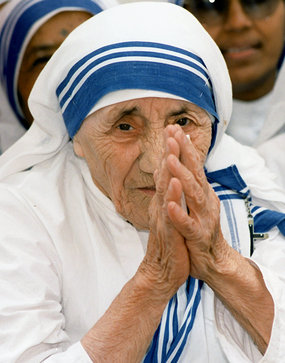
Blessed Mother Teresa of Calcutta
(1910-1997)


Mother Teresa of Calcutta, the tiny woman recognized throughout the world for her work among the poorest of the poor, was beatified October 19, 2003. Among those present were hundreds of Missionaries of Charity, the Order she founded in 1950 as a diocesan religious community. Today the congregation also includes contemplative sisters and brothers and an order of priests.

Born to Albanian parents in what is now Skopje, Macedonia (then part of the Ottoman Empire), Gonxha (Agnes) Bojaxhiu was the youngest of the three children who survived. For a time, the family lived comfortably, and her father's construction business thrived. But life changed overnight following his unexpected death.

During her years in public school Agnes participated in a Catholic sodality and showed a strong interest in the foreign missions. At age 18 she entered the Loreto Sisters of Dublin. It was 1928 when she said goodbye to her mother for the final time and made her way to a new land and a new life. The following year she was sent to the Loreto novitiate in Darjeeling, India. There she chose the name Teresa and prepared for a life of service. She was assigned to a high school for girls in Calcutta, where she taught history and geography to the daughters of the wealthy. But she could not escape the realities around herâ€"the poverty, the suffering, the overwhelming numbers of destitute people.

In 1946, while riding a train to Darjeeling to make a retreat, Sister Teresa heard what she later explained as “a call within a call. The message was clear. I was to leave the convent and help the poor while living among them.” She also heard a call to give up her life with the Sisters of Loreto and, instead, to “follow Christ into the slums to serve him among the poorest of the poor.”

After receiving permission to leave Loreto, establish a new religious community and undertake her new work, she took a nursing course for several months. She returned to Calcutta, where she lived in the slums and opened a school for poor children. Dressed in a white sari and sandals (the ordinary dress of an Indian woman) she soon began getting to know her neighborsâ€"especially the poor and sickâ€"and getting to know their needs through visits.

The work was exhausting, but she was not alone for long. Volunteers who came to join her in the work, some of them former students, became the core of the Missionaries of Charity. Other helped by donating food, clothing, supplies, the use of buildings. In 1952 the city of Calcutta gave Mother Teresa a former hostel, which became a home for the dying and the destitute. As the Order expanded, services were also offered to orphans, abandoned children, alcoholics, the aging and street people.

For the next four decades Mother Teresa worked tirelessly on behalf of the poor. Her love knew no bounds. Nor did her energy, as she crisscrossed the globe pleading for support and inviting others to see the face of Jesus in the poorest of the poor. In 1979 she was awarded the Nobel Peace Prize. On September 5, 1997, God called her home.


Comment:

Mother Teresa's beatification, just over six years after her death, was part of an expedited process put into effect by Pope John Paul II. Like so many others around the world, he found her love for the Eucharist, for prayer and for the poor a model for all to emulate.


Quote:

Speaking in a strained, weary voice at the beatification Mass, Pope John Paul II declared her blessed, prompting waves of applause before the 300,000 pilgrims in St. Peter's Square. In his homily, read by an aide for the aging pope, the Holy Father called Mother Teresa “one of the most relevant personalities of our age” and “an icon of the Good Samaritan.” Her life, he said, was “a bold proclamation of the gospel.”
#3775
Bible Study / Re: Minute Meditations
September 05, 2010, 04:40:34 PM
Our Affection for Mary

We do not love the Blessed Virgin specifically because of what we obtain or hope to obtain from her; but we love her because she is worthy of our love.
#3776
this is wonderful, such sensational things published will make us mature and help improve our character, more like this please.
#3777
It was a very hot day, i´ll share mine next time.
#3778
Si Virgilio kay business and pleasure, bag-o ug kabajo, lingaw jud siya ug suroy suroy, bilib sab ko sa iyang misis si Inday Betty kay maayo ug gawi, they are truly a wonderful couple.
#3779
Anda - Bohol / Re: Photos: Mercado sa Anda
September 04, 2010, 10:13:52 PM
that is not true, toyo-on ni Ondoy! Nisimang mo padolong Alicia, hoy balik sa sonod aron kita magkoyog.
#3780
Eyeball / Re: The EB of Manay Tess and Bran Lorenzo
September 04, 2010, 10:10:56 PM
lahi jamo ang Tubag Bohol hinigala-ay ug ang personal nga meeting, kay sa mga komentaryo morag aduna kay ma-imagine sa pagkatawo, apan ang mag himamat,natural flow ang conversations.
I didn expect to meet Lorenzo personally, thinking all the while all his stop-overs, Leyte, Cebu and Bohol`(hectic na kaayo). Mora man kini siya ug nag sentimental journey, plus mas eager siya ma-met si Fr Lungay ( Chicogon). Si Inday Lumine ang nag follow up nga nia sa Bohol si Ondoy busa, nag kahigayon mi ug kita. Dinhe pako sa Germany daghan nakong gi-isip buhaton, apan sa Bohol, lahi ang sitwasyon ug usahay adunay mga kakuli-an nga dili malikayan sama sa kay Prescila Richards, naglisod ko ug coordinate. Pressy better luck next time, I´ll try to make it up.
#3781
Health and Food / Danish research shows andropause
September 04, 2010, 06:06:39 PM
Research on 40,000 Danish men and women shows that the strong sex often ends up as the weaker sex.


The conclusions of a Danish report on female as opposed to male longevity, suggest that an andropausal reduction in the hormone testosterone in men in mid-life is the main reason why males become gradually weaker than females in later life.

According to researchers Tom Skyhøj Olsen and Klaus Kaae Andersen, the fact that women live longer than men has more to do with a developing male physical inferiority, than female superiority.

“Our findings dispute the effects of female sex hormones as the underlying cause of female survival superiority over men. Instead we propose that the progressive deficiency of male sex hormones (testosterone) beginning in men in middle age is the underlying cause of the gap in survival rates between men and women,” the two say in a survey in Gender Medicine.

“Accordingly the female survival advantage is rooted in male inferiority rather than innate female superiority,” the conclusions of the report say.

“We do realise that not everyone agrees that men have an andropause. But our research suggests, in fact, that they do â€" and that it is a sort of boundary between their biologically strong and weak period,” says Frederiksberg Hospital Apoplexy Department Chief Physician Tom Skyhøj Olsen.

The two men have investigated the survival of some 40,000 Danish men and women following brain haemorrhages. Results showed that prior to the age of 50, men survived apoplexy better than women. After the age of 50, however, women survived better than men.

“Once men and women have passed the menopause/andropause it is significant that women are better at surviving the effects of apoplexy â€" and other serious illnesses - than men,” says Skyhøj Olsen.

“Hitherto when there has been talk of an andropause, it has been a question a gradual weakening of sexual desire, a weakening of musclepower, a tendency to abdominal fat, tiredness and depression,” he says.

“Our result, that men in their 50s go from being the biologically strong to becoming the weaker sex, is a completely new discovery,” Skyhøj Olsen says.

Testosterone
Although the survey cannot provide reasons for the change in men after the andropause, researchers suggest that a gradual reduction in testosterone may play a role.

“We don’t know whether it would help middle-aged men and older men to be given testosterone if they become seriously ill. But the result of our survey will undoubtedly raise speculations in that direction,” Skyhøj Olsen says.

Edited by Julian Isherwood
politiken.dk
#3782
Philippine Daily News / Re: Filipino Workers Remittance
September 04, 2010, 05:52:13 PM
This is the sector that holds the Philippine economy afloat. Asa ra kadtong taga Valencia? He know a lot of this.
#3783
Philippine Daily News / Re: Tourist Bus Hostage
September 04, 2010, 05:49:10 PM
Regular drug control among the police force must be imposed since it is no secret that a lot of them are junkies.
The police force must also be physically fit, daghang dagko ug tiyan. How could they show endurance and stamina which a necessity to those who belongs to this profession.
#3784
Question and Answer / Re: Have you ever fired a gun?
September 04, 2010, 05:28:47 PM
Wow tinood DAy, apan barbas serado ma kadto si George!
#3785
Salamat Padre sa imong mga litrato. This year´s vacation was fine.
I was able to sleep and eat well. I lost 2 kilos but it was my first bakasyon where I truly rested.
Si Pressy wala jud mi magkita.
#3786
Question and Answer / Re: Have you ever fired a gun?
September 04, 2010, 05:16:50 PM
Quote from: vrglguapo on September 04, 2010, 12:48:35 AM
I started firing guns when i was 16 years old.,vrglguapo at 16 years old..wearing my bell bottom blues and my favorite sweet shirt..Pogi pa akong pangalan sa una kay bata pa man karon guapo na kay edaran na.. ;D ;D

Morag pinangita kining dagwaya! Way kalibotan mogonit kay ihikling man lang.
#3787
Bible Study / Re: Saints of the Day
September 04, 2010, 05:11:07 PM
St. Rose of Viterbo
(1233-1251)


Rose achieved sainthood in only 18 years of life. Even as a child Rose had a great desire to pray and to aid the poor. While still very young, she began a life of penance in her parents’ house. She was as generous to the poor as she was strict with herself. At the age of 10 she became a Secular Franciscan and soon began preaching in the streets about sin and the sufferings of Jesus.
Viterbo, her native city, was then in revolt against the pope. When Rose took the pope’s side against the emperor, she and her family were exiled from the city. When the pope’s side won in Viterbo, Rose was allowed to return. Her attempt at age 15 to found a religious community failed, and she returned to a life of prayer and penance in her father’s home, where she died in 1251. Rose was canonized in 1457.


Comment:

The list of Franciscan saints seems to have quite a few men and women who accomplished nothing very extraordinary. Rose is one of them. She did not influence popes and kings, did not multiply bread for the hungry and never established the religious order of her dreams. But she made a place in her life for God’s grace, and like St. Francis before her, saw death as the gateway to new life.


Quote:

Rose's dying words to her parents were: "I die with joy, for I desire to be united to my God. Live so as not to fear death. For those who live well in the world, death is not frightening, but sweet and precious."


#3788
Bible Study / Re: Minute Meditations
September 04, 2010, 05:08:51 PM
Due Reverence     

"My goodness has decreed that anyone at all, just or sinner, who holds Mary in due reverence will never be snatched or devoured by the infernal demon." -God's pledge through St. Catherine of Siena 

#3789
Question and Answer / Re: Have you ever fired a gun?
September 03, 2010, 07:08:12 PM
lately I was able to fire a gun because my bf is a gun collector.
#3790
Bible Study / Re: Saints of the Day
September 03, 2010, 02:23:22 PM
St. Gregory the Great
(540?-604)


Coming events cast their shadows before: Gregory was the prefect of Rome before he was 30. After five years in office he resigned, founded six monasteries on his Sicilian estate and became a Benedictine monk in his own home at Rome.

Ordained a priest, he became one of the pope's seven deacons, and also served six years in the East as papal representative in Constantinople. He was recalled to become abbot, and at the age of 50 was elected pope by the clergy and people of Rome.

He was direct and firm. He removed unworthy priests from office, forbade taking money for many services, emptied the papal treasury to ransom prisoners of the Lombards and to care for persecuted Jews and the victims of plague and famine. He was very concerned about the conversion of England, sending 40 monks from his own monastery. He is known for his reform of the liturgy, for strengthening respect for doctrine. Whether he was largely responsible for the revision of "Gregorian" chant is disputed.

Gregory lived in a time of perpetual strife with invading Lombards and difficult relations with the East. When Rome itself was under attack, he interviewed the Lombard king.

An Anglican historian has written: "It is impossible to conceive what would have been the confusion, the lawlessness, the chaotic state of the Middle Ages without the medieval papacy; and of the medieval papacy, the real father is Gregory the Great."

His book, Pastoral Care, on the duties and qualities of a bishop, was read for centuries after his death. He described bishops mainly as physicians whose main duties were preaching and the enforcement of discipline. In his own down-to-earth preaching, Gregory was skilled at applying the daily gospel to the needs of his listeners. Called "the Great," Gregory has been given a place with Augustine, Ambrose and Jerome as one of the four key doctors of the Western Church.


Comment:

Gregory was content to be a monk, but he willingly served the Church in other ways when asked. He sacrificed his own preferences in many ways, especially when he was called to be Bishop of Rome. Once he was called to public service, Gregory gave his considerable energies completely to this work.

Quote:

"Perhaps it is not after all so difficult for a man to part with his possessions, but it is certainly most difficult for him to part with himself. To renounce what one has is a minor thing; but to renounce what one is, that is asking a lot" (St. Gregory, Homilies on the Gospels).

Patron Saint of:

England
Teachers
#3791
Bible Study / Re: Minute Meditations
September 03, 2010, 02:22:37 PM
The Wish of Jesus 

"It is the most decided wish of her Son that we should come to Him through His Blessed Mother." -St. Louis de Montfort
#3792
Photos Unlimited / Re: The Euro-Asian Trend
September 03, 2010, 03:28:25 AM
Wow, mahilig pod sa ballroom dancing?
#3793
China should read this one;

Something to think about: Filipino and Chinese tourist
The known facts are these:

On August 19, 2005, Emmanuel "Bong" Madrigal, a Manila-based Filipino
executive of the multinational Shell, was visiting Beijing on vacation with
his wife Vivian, his daugher Regina Mia, and two younger daughters. That
day, they rode a tourist bus to Tiananmen Square, the heart of the capitol.

Upon arriving at the square, Emmanuel Madrigal was the first to descend
from the bus, followed by Vivian and Regina Mia. A Chinese man wielding a
scythe--in some reports it was described as a sword--suddenly appeared out
of nowhere and hacked Emmanuel across his torso. He died on the spot. The
man also attacked and seriously wounded Vivian. He then slashed at and
killed Regina Mia. By this time, bystanders were trying to subdue the man,
and Vivian shouted to her two other daughters to get away and save
themselves. Somehow the girls made their way back to the hotel. Vivian was
brought to a Beijing hospital, where she died several days later of her
injuries.

An Associated Press report still circulating on the internet states that
the killer was Wang Gongzuo, 25, a farmer from eastern China's Jiangsu
province. He was sentenced to death for the murder of the Madrigals and
executed a few weeks later, in September. The AP report states: 'Wang's
motive for killing the two is unclear. After the incident occurred the
Beijing Morning Post reported that he had wanted to 'affect society using
extreme actions,' but didn't elaborate."

Reflect on the parallels. A family of vacationers on a tourist bus: the
Leungs and the Madrigals. A killer out to "affect society using extreme
actions": Mendoza and Wang. A massacre in a public place of symbolic
significance: The Quirino grandstand, where the presidential inauguration
had been held just weeks before, and site of the civil society protests
against the Marcos regime; and Tiananmen Square, since ancient times the
symbol of the centralized power of the Chinese state, and site of the 1991
civil protests against the government.

In both incidents, the state failed miserably in protecting innocent
tourists.

And there the parallels end.

President Aquino has apologized to the families of Mendoza’s victims and
conveyed his sorrow to the people of Hongkong, Chief Executive Donald
Tsang, and Ambassador Lin Jian Chao. The Philippine National Police
acknowledge that they botched matters beyond comprehension. Philippine
legislators, ahead of their Hongkong counterparts, called for a full
investigation. Philippine media organizations are looking to their own
culpability in the affair. And masses of ordinary Filipinos, on TV, radio,
print, and the Internet, are expressing collective horror, remorse and pity
over the terrible fate of the innocent tourists, and bow their heads in
shame before the Hong Kong people's sorrow and anger.

That is how it should be, that is only right. But.

To this day, five years after it happened, there is no public record of any
Chinese official acknowledging the tourist killings in Tiananmen Square and
apologizing to the Madrigals, much less the Filipino people, for the murder
of Emmanuel, Regina Mia and Vivian. Not a single expression of regret that
the Chinese police failed in their duty to protect the lives of innocent
tourists in the very heart of Beijing, in the symbolic center of a state
that prides itself most of all for its ability to control and contain
disorder. There was a total blackout on the part of the Chinese press, and,
according to another news report, government censors quickly blocked many
internet sites where Chinese users had begun to post comments about the
killing. So we will likely never know what ordinary Chinese citizens had to
say about about the incident. Maybe some of them were actually sorry for
what happened.

The closest thing to expressed regret was in fact the final reported action
of the killer Wang, who waived his right to appeal the sentence of
execution, and got a bullet in the back of his head.

To add to the horror, it would appear that the Arroyo administration was
complicit in the silence. No public statement was ever made by the
Philippine government regarding the incident. Unlike in Hongkong, no flags
were flown at half-mast in Manila, and no three-minute silence was observed
to mark the deaths of the innocent Filipino tourists. No demand has ever
been made by any Filipino official for an apology, and for an accounting.

A full investigation of the Quirino Grandstand killing is ongoing. But what
of that other killing, also in August, five years ago in Tiananmen Square?
#3794
Talk of the Town / Re: Fiber optic cable around Panglao.
September 02, 2010, 06:59:08 PM
high speed internet of course, but this is not new.
#3795
Bible Study / Re: Saints of the Day
September 02, 2010, 02:10:58 PM
Blessed John Francis Burté and Companions
(d. 1792; d. 1794)


These priests were victims of the French Revolution. Though their martyrdom spans a period of several years, they stand together in the Church’s memory because they all gave their lives for the same principle. The Civil Constitution of the Clergy (1791) required all priests to take an oath which amounted to a denial of the faith. Each of these men refused and was executed.

John Francis Burté became a Franciscan at 16 and after ordination taught theology to the young friars. Later he was guardian of the large Conventual friary in Paris until he was arrested and held in the convent of the Carmelites.

Appolinaris of Posat was born in 1739 in Switzerland. He joined the Capuchins and acquired a reputation as an excellent preacher, confessor and instructor of clerics. Sent to the East as a missionary, he was in Paris studying Oriental languages when the French Revolution began. Refusing the oath, he was swiftly arrested and detained in the Carmelite convent.

Severin Girault, a member of the Third Order Regular, was a chaplain for a group of sisters in Paris. Imprisoned with the others, he was the first to die in the slaughter at the convent.

These three plus 182 othersâ€"including several bishops and many religious and diocesan priestsâ€"were massacred at the Carmelite house in Paris on September 2, 1792. They were beatified in 1926.

John Baptist Triquerie, born in 1737, entered the Conventual Franciscans. He was chaplain and confessor of Poor Clare monasteries in three cities before he was arrested for refusing to take the oath. He and 13 diocesan priests were guillotined in Laval on January 21, 1794. He was beatified in 1955.


Comment:

"Liberty, Equality, Fraternity" was the motto of the French Revolution. If individuals have "inalienable rights," as the Declaration of Independence states, these must come not from the agreement of society (which can be very fragile) but directly from God. Do we believe that? Do we act on it?

Quote:

“The upheaval which occurred in France toward the close of the 18th century wrought havoc in all things sacred and profane and vented its fury against the Church and her ministers. Unscrupulous men came to power who concealed their hatred for the Church under the deceptive guise of philosophy.... It seemed that the times of the early persecutions had returned. The Church, spotless bride of Christ, became resplendent with bright new crowns of martyrdom” (Acts of Martyrdom).
#3796
Bible Study / Re: Minute Meditations
September 02, 2010, 02:10:05 PM
The Intercession of Mary     

"Let us venerate Mary with every fiber of our being, from the deepest part of our heart, because this is the will of him who wanted us to receive everything through Mary." -St. Bernard of Clairvaux
#3797
Love Talk / Re: For women only: kinsay imong pilion?
September 02, 2010, 05:12:54 AM
pareho ta daBins, cat lang ang ako kay dili baho ug tiil!
#3798
Jokes and Humor / Re: This Position is now Prohibited?
September 02, 2010, 05:10:10 AM
This is not true, some prefers this position because it can penetrate deeper.
#3799
Ambot kon kinsa ang naghimo, ijahay ug assignment.
#3800
Dili jud intawon, ginger is an asian spice.