Join MikeLigalig.com!

Why Just Read When You Can Join, Post, and Read!

Menu

Show posts

This section allows you to view all posts made by this member. Note that you can only see posts made in areas you currently have access to.

Show posts Menu

Messages - islander

#301

Eat This: Lean Protein

Beef, chicken and other lean meats contain riboflavin and coenzyme Q10 (CoQ10), two important vitamins that keep the body's energy supply flowing.

"The exact mechanism is unknown, but research is coming out supporting that migraine sufferers may have a problem with energy metabolism in the brain," Wellenstein said, so this could explain why these vitamins help with migraines ― and headaches generally.
#302

Avoid: Fermented Foods

Tyramine, an amino acid found in fermented foods like sauerkraut and kimchi, can be a headache trigger, too.

"Some people have a hard time breaking down tyramine, causing them to be more prone to headaches associated with foods containing high levels [of tyramine]," Wellenstein said.

Eating those foods can cause a chain reaction that results in the constriction and dilation of blood vessels in the brain, cueing up a throbbing headache.
#303

When You Have A Headache

Avoid: Aged Cheeses


PROSOT-PHOTOGRAPHY VIA GETTY IMAGES
Skip the Parmesan cheese when you have a headache. It can cause the blood vessels in your brain to dilate.


The longer foods age, the more histamine they produce, with cheeses like Gouda, Swiss, and Parmesan topping the list of offenders. The histamine consumed in those cheeses may cause the blood vessels in the brain to dilate, triggering a headache (or worsening one).
#304

Eat This: Chicken Soup Or Broth

Studies hint that chicken soup contains compounds that have an anti-inflammatory effect, making it an ideal food to eat in the fight against cold and flu symptoms.

One of these compounds, carnosine, is found in chicken and could be helpful when combatting the early stages of a cold or flu, according to a 2012 study published in the American Journal of Therapeutics.

But if the thought of eating a chunky soup gives you a case of the queasies, chicken broth can help you out in the meantime. Broth contains electrolyte minerals, such as potassium and sodium, Ghannoum said, which are important to keeping your body hydrated.
#305

Eat This: Mushrooms

Cytokines are small proteins that head up the immune system department of the body. They regulate the immune response by sounding the alarm when you're sick and initiating sleep mode when you're well.

Research suggests that mushrooms, such as shiitake, reishi, and cordyceps, can increase cytokines and help the immune system fight infection, Wellenstein said.
#306

Eat This: Red Peppers


BAIBAZ VIA GETTY IMAGES
Eat red peppers for their anti-viral and anti-inflammatory properties when you have a cold.


Red peppers contain a compound called quercetin, a powerful antioxidant that's also anti-viral and anti-inflammatory. "Quercetin can help with preventing the virus from duplicating itself, repairing oxidative tissue damage as a result of the infection and calming the inflammation associated with the illness," Wellenstein said.

They're also rich in vitamin C, a powerful antioxidant that's thought to shorten the duration of cold symptoms, yet aren't as acidic as citrus fruits — a bonus if a scratchy throat has got you down.
#307

Avoid: Broccoli

"While broccoli is quite beneficial, as it contains immune-boosting nutrients like vitamins A and C, it's also high in fiber, which can be difficult to digest when you're ill," said Mahmoud Ghannoum, gut health expert and author of "Total Gut Balance."

To avoid irritating your gastrointestinal tract, go with foods that are lower in fiber and easier to digest so that your body can focus its attention on evicting the infection from your system.
#308

Avoid: Nuts

Nuts contain important nutrients to help the body fight off infection, such as zinc and vitamin E. But you may want to refrain from eating them during the beginning stages of an illness, especially if your stomach's flip-floppy or you have a fever.

Because nuts are high in (healthy) fats, your body will have to work harder to digest them. This could cause an upset stomach and sap your body of the energy it needs to fight off the infection instead.

Nuts are thought to be a histamine liberator too, which could amp up your congestion.
#309

When You Have A Cold, Flu Or Fever

Avoid: Spinach


CLARKANDCOMPANY VIA GETTY IMAGES
That bed of spinach will only release histamines and make a cold worse, but the egg can actually be good for a sore throat.


Histamine is a chemical produced in the body whose release triggers allergy symptoms, but it's also found in many foods — and some foods, even though they're not high in histamine themselves, are considered histamine liberators.

"They trigger cells, called mast cells, to release histamine and activate an inflammatory response," said Renee Wellenstein, a board-certified physician specializing in functional medicine. "This response may further worsen congestion, fatigue and other symptoms often associated with a cold or flu."

It's thought that spinach might be a histamine liberator, along with strawberries, tomatoes and citrus fruits (among others).
#310

10 Healthy Foods To Avoid Eating When You're Sick

Whether you have a cold, a headache or a stomachache, these are the ingredients to avoid (and what to eat instead).

By Krissy Brady
01/28/2020

When your sniffles and scratchy throat turn into a full-blown bodily fluid extravaganza, one thing's for sure: Feeling sick sucks.

But you know the drill. Drink plenty of fluids. Add ginger to the menu when nausea strikes. Get as many nutrients into your body as you can, even if they're only in liquid form at first. And once you finally work your way back to solid foods again, make sure they're not processed or sugary. Easy peasy, right?

Well, not so much. There are some otherwise healthy foods that have a reputation for making an already sick person feel worse because they exacerbate or prolong symptoms in some way.

Which healthy foods are the biggest offenders, and what should you eat instead? Read on to find out, but keep one caveat in mind: Everyone reacts to foods differently, even when sick.

If there's a food (or several) that made this list, yet don't bother you when you're sick, then listen to your body and keep enjoying them.
#311

Chien-Shiung Wu (1912-1997)


Chinese-American physicist Chien-Shiung Wu is credited with disproving one of the basic laws of physics, called conservation of parity. Prior to Wu's work, the laws of physics stated that all objects and their mirror images behaved in the same way, symmetrically, meaning that nature could not distinguish between right and left. Wu's breakthrough research revealed that during the process of radioactive decay, decaying identical nuclear particles didn't always behave symmetrically.

She also worked on the Manhattan Project, helping develop the process for separating uranium metal and developing better instruments to measure nuclear radiation.

In 1973, Wu became the first woman to lead the American Physical Society, and in 1975 she received the National Medal of Science. Her book "Beta Decay" remains a standard textbook for nuclear physics students.

https://edition.cnn.com/
#312

Maria Winkelmann (1670-1720)

Maria Winkelmann was a pioneer in German astronomy. In 1902, she became the first woman to discover a new comet. Sadly, her husband Gottfried Kirch published the discovery in his own name and did not publicly reveal her as the true source of the comet discovery until years later.

However, Winkelmann was still widely recognized as an accomplished scientist during her time, and her research and observations on sunspots, Aurora Borealis and comets were met with high regard. She also took on an active role in improving the Berlin Academy of Science, where her husband served as the principal astronomer.

But years later the Academy turned on her. While serving as an assistant to her son at the Berlin Observatory, Academy members complained she took on too prominent of a role and forced her into retirement -- ending her astronomy career in 1716, aged 46.
#313

Tu Youyou (1930-present)


Pharmaceutical chemist Tu Youyou's discovery of a new malaria treatment has saved millions of lives. Tu, who studied traditional Chinese and herbal medicines, found a reference in ancient medical texts to using sweet wormwood to treat intermittent fevers -- a symptom of malaria.

Tu and her research team were able to extract a malaria-inhibiting substance called artemisinin (or qinghaosu in Chinese) from wormwood. She even volunteered to be the first human subject to test the substance. Since her discovery of artemisinin in the 1970s, antimalarial drugs based on the substance have saved millions of lives.

Tu is now chief scientist at the China Academy of Traditional Chinese Medicine -- a position she reached without a medical degree, a PhD, or research training abroad. She won the 2015 Nobel Prize in Physiology or Medicine for her discovery, which has been deemed "arguably the most important pharmaceutical intervention in the last half-century" by the Lasker Foundation for medical research.
#314

Sally Ride (1951-2012)


NASA astronaut Sally Ride became the first American woman in space, serving as a mission specialist on the space shuttle Challenger in 1983. At 32 years old, she was also the youngest American to ever leave the atmosphere. (She wasn't the first woman in space, though -- that title belongs to Soviet cosmonaut Valentina Tereshkova.)

After the Challenger disaster in 1986, in which an explosion occurred shortly after takeoff and claimed the lives of seven astronauts, Ride served on the Rogers Commission, which investigated the tragedy. She also helped investigate the space shuttle Columbia disaster in 2003, during which the shuttle disintegrated as it re-entered the atmosphere, making Ride the only person to serve on both investigation commissions.

Ride went on to have an award-winning career as a public servant and as a physics professor at the University of California, San Diego. She also founded "Sally Ride Science," an organization that aims to inspire young people in STEM, and she wrote several books about her experience in space to teach kids about science.
#315

Lise Meitner (1878-1968)


Austrian physicist Lise Meitner contributed significant advancements to the field of nuclear physics. She was also the first woman to become a physics professor in Germany.

Meitner's work on nuclear fission was instrumental in her longtime research collaborator Otto Hahn winning the 1944 Nobel Prize in Chemistry, so much so that many scientists later argued it was unfair for her contributions to not have been recognized equally by the Nobel Committee. Meitner was also an advocate for the peaceful use of atomic energy and flatly refused to work on the Manhattan Project because she strongly opposed using fission to create an atom bomb.

Today, multiple prestigious awards in physics are named in honor of Meitner and she even has a chemical element -- meitnerium -- named after her.
#316

Barbara McClintock (1902-1992)


American botanist Barbara McClintock was responsible for several groundbreaking discoveries in the field of genetics following her decades-long career studying the genetic structure of maize. McClintock studied how genetic characteristics are passed down through generations, eventually uncovering that some genes could be mobile.

In the 1940s and 1950s, McClintock's research revealed that genetic elements could sometimes move on a chromosome and thus cause nearby genes to activate. But it wasn't until decades later that scientists apart from maize specialists understood and recognized the immense value of her discovery.

McClintock was awarded the National Medal of Science in 1971 and won the Nobel Prize in Physiology or Medicine in 1983 "for her discovery of mobile genetic elements," now called transposons.
#317

Grace Hopper (1906-1992)


Grace Hopper was a trailblazing computer programmer who helped develop multiple computer languages and is considered one of the first programmers of the modern computing age.

Armed with a master's degree and PhD in mathematics from Yale, Hopper went on to have an influential career in the private sector and the US Navy. She joined the US Naval Reserve in 1943 to help with the American war effort, and throughout WWII she worked in a prestigious lab responsible for top-secret calculations such as calibrating minesweepers, calculating the ranges of anti-aircraft guns and checking the math behind the creation of the plutonium bomb.

Her career also contributed to modern computer vernacular. While Hopper was developing some of the earliest electromechanical computers -- MARK I and MARK II -- she dismantled a malfunctioning computer to find that a dead moth was causing the problem. She became the first person to call computer problems "bugs" in the system.
#318

Dorothy Hodgkin (1910-1994)


Dorothy Hodgkin was a British chemist on the cutting edge of X-ray crystallography. In 1964, Hodgkin became the first and only British woman to win the Nobel Prize in Chemistry "for her determinations by X-ray techniques of the structures of important biochemical substances."

Throughout her career, she made numerous breakthrough discoveries, including the atomic structure of penicillin, the structure of vitamin B12 and the structure of insulin. Hodgkin also spent decades improving X-ray crystallography techniques, which made it possible for her to complete her innovative research on insulin and improve treatments for diabetes.

She also became the second woman to win the UK's prestigious Order of Merit in 1965. While Hodgin was a professor at Oxford University, she even mentored Prime Minister Margaret Thatcher, who would go on to win the Order of Merit herself.
#319

Rosalind Franklin (1920-1958)


Legend has it that British chemist and DNA researcher Rosalind Franklin knew she wanted to be a scientist since she was 15 years old. That dream went on to become a reality when she was offered a prestigious scholarship to King's College London, where she became an expert in the X-ray crystallography unit.

Franklin's research data was the first to demonstrate the basic dimensions of DNA strands and reveal the molecule was in two matching parts, running in opposite directions. Her data was used by James Watson and Francis Crick to get their research on the DNA model across the finish line and was published separately as supporting data alongside Watson, Crick and Maurice Wilkins' research articles in Nature.

Many people in the scientific community argue that Franklin should have been awarded a Nobel Prize alongside Watson, Crick and Maurice Wilkins, who won the 1962 Nobel Prize in Physiology or Medicine "for their discoveries concerning the molecular structure of nucleic acids and its significance for information transfer in living material." Unfortunately, Franklin died from ovarian cancer in 1958, just four years before the prize was awarded, even though at the time the organization could have awarded it posthumously.
#320

Alice Ball (1892-1916)


American chemist Alice Ball was the first woman and first African American to receive a master's from the University of Hawaii and went on to become the university's first female chemistry professor. At just 23 years old, Ball developed a groundbreaking treatment for leprosy -- a disease which previously had little chance of recovery and forced victims into exile.

Prior to Ball's research on leprosy, the best treatment available was chaulmoogra oil, which was difficult for patients to ingest or apply topically and too thick to inject. While working as a research assistant at Kalihi Hospital in Hawaii, Ball developed an easily injectable form of the oil that ultimately saved countless lives and became the best treatment for leprosy until the 1940s.

Unfortunately, she died before she was able to publish the findings, and the president of the University of Hawaii attempted to claim the research as his own until Ball's former supervisor publicly spoke out that she deserved the credit for the lifesaving injection. It wasn't until the 21st century that her achievements were fully recognized and the governor of Hawaii declared February 29 "Alice Ball Day."
#321

The heroines STEM: Ten women in science you should know


By Lauren Kent, CNN
January 27, 2020

(CNN)Science is often considered a male-dominated field.

In fact, according to United Nations data, less than 30% of scientific researchers worldwide are women.

Studies have shown that women are discouraged from, or become less interested in, entering the fields of science, technology, engineering and math (STEM) beginning at a young age. And according to the Pew Research Center, women remain underrepresented in engineering, computer science, and physical science.

But despite challenges of gender discrimination and lack of recognition in the scientific community, countless inspiring women in these fields have made historic contributions to science and helped advance understanding of the world around us. Many were not recognized in their own lifetimes, but their achievements have helped generations of female scientists to come.

We all learned about Marie Curie and Jane Goodall, but here are 10 more women in science you should know.
#322

This fat can be turned into cholesterol that can start collecting along and hardening your arteries, perhaps ultimately leading to a heart attack or stroke.

"In women, it is thought that a greater portion of the abdominal fat is constituted by subcutaneous fat which is relatively harmless," she said.

However, the lower numbers of women included in the study meant the findings had less "statistical power" and more research was needed to draw definite conclusions, Mohammadi said.

The risk of cardiovascular disease like heart attacks or strokes is considered to be higher in those with a waist measurement of above 94 cm in men and above 80 cm in women, according to the World Health Organization. The risk is thought to be substantially increased in men with a waist wider than 102 cm and 88 cm in women.

The authors said that belly fat was best tackled by a healthy diet and regular exercise. Earlier studies have shown that regular moderate cardio, like walking for at least 30 minutes a day, can help fight a widening waistline. Strength training with weights may also help but spot exercises like sit-ups that can tighten abs won't touch visceral fat.

https://edition.cnn.com/
#323


The study found that belly fat was associated with heart attacks and stroke independent of other risk factors like smoking, diabetes, hypertension, body mass index and prevention treatments. The researchers stressed that waist circumference was a more important marker than overall obesity and advised doctors to measure their patient's waists to identify those at risk.

However, they said that the link was stronger and more linear in men, who made up nearly three-fourths of the patients included in the study, than women.

In women, Mohammadi said the relationship was "U-shaped" rather than linear, meaning that the mid-range waist measurement, rather than the narrowest, was least risky. What's more, the mid-range waist measurement was in the range traditionally recognized as at risk for abdominal obesity: more than 80 cm wide.

The reason for this could be down to the type of fat that tends to hang out on men's and women's bellies. Mohammadi said some studies have suggested that men may have more visceral fat that goes deep inside your body and wraps around your vital organs.
#324

"Maintaining a healthy waist circumference is important for preventing future heart attacks and strokes regardless of how many drugs you may be taking or how healthy your blood tests are."

The study tracked more than 22,000 Swedish patients after their first heart attack and looked at the link between their waist circumference and events caused by clogged arteries like fatal and non-fatal heart attacks and stroke. Patients were followed for nearly four years, with 1,232 men (7.3%) and 469 women (7.9%) experiencing a heart attack or stroke.

Most patients — 78% of men and 90% of women — had abdominal obesity, defined as a waist circumference of 94 cm (37.6 inches) or above for men, and 80 cm (32 inches) or above for women.

The study found that belly fat was associated with heart attacks and stroke independent of other risk factors like smoking, diabetes, hypertension, body mass index and prevention treatments. The researchers stressed that waist circumference was a more important marker than overall obesity and advised doctors to measure their patient's waists to identify those at risk.
#325

Your waist size may be more important than weight for multiple heart attack risk

By Katie Hunt, CNN

January 21, 2020


(CNN)Heart attack survivors who carry extra weight around their belly are at greater risk of another heart attack, new research has found, another reason why measuring your waist may be more important than stepping on the scale.

It's been known for a while that having a pot belly, even if you are slim elsewhere, increases the odds of having a first heart attack, but the latest study, which published Monday in the European Journal of Preventative Cardiology, is the first time researchers have found a link between belly fat and the risk of a subsequent heart attack or stroke.

The link was particularly strong in men, researchers said.

"Abdominal obesity not only increases your risk for a first heart attack or stroke, but also the risk for recurrent events after the first misfortune," said Dr. Hanieh Mohammadi of the Karolinska Institute in Stockholm, in a news release.
#326
Learn English Online / Selenophile
January 21, 2020, 04:16:19 PM

#327

Origins

We don't know exactly where 'the' comes from – it doesn't have a precise ancestor in Old English grammar. The Anglo Saxons didn't say 'the', but had their own versions. These haven't completely died out, according to historical linguist Laura Wright. In parts of Yorkshire, Lancashire and Cumberland there is a remnant of Old English inflective forms of the definite article – t' (as in "going t' pub").

The letter y in terms like 'ye olde tea shop' is from the old rune Thorn, part of a writing system used across northern Europe for centuries. It's only relatively recently, with the introduction of the Roman alphabet, that 'th' has come into being.

'The' deserves to be celebrated. The three-letter word punches well above its weight in terms of impact and breadth of contextual meaning. It can be political, it can be dramatic – it can even bring non-existent concepts into being.

http://www.bbc.com/
#328

Deborah Tannen, a US linguist,
has a hypothesis that men
deal more in report
and women more in rapport
– this could explain why men use 'the' more often


According to Culpeper, men say 'the' significantly more frequently. Deborah Tannen, an American linguist, has a hypothesis that men deal more in report and women more in rapport – this could explain why men use 'the' more often. Depending on context and background, in more traditional power structures, a woman may also have been socialised not to take the voice of authority so might use 'the' less frequently. Though any such gender-based generalisations also depend on the nature of the topic being studied.

Those in higher status positions also use 'the' more – it can be a signal of their prestige and (self) importance. And when we talk about 'the prime minister' or 'the president' it gives more power and authority to that role. It can also give a concept credibility or push an agenda. Talking about 'the greenhouse effect' or 'the migration problem' makes those ideas definite and presupposes their existence.

'The' can be a "very volatile" word, says Murphy. Someone who refers to 'the Americans' versus simply 'Americans' is more likely to be critical of that particular nationality in some capacity. When people referred to 'the Jews' in the build-up to the Holocaust, it became othering and objectifying. According to Murphy, "'The' makes the group seem like it's a large, uniform mass, rather than a diverse group of individuals." It's why Trump was criticised for using the word in that context during a 2016 US presidential debate.
#329

Atlantic divide

Even within the language, there are subtle differences in how 'the' is used in British and American English, such as when talking about playing a musical instrument. An American might be more likely to say 'I play guitar' whereas a British person might opt for 'I play the guitar'. But there are some instruments where both nationalities might happily omit 'the', such as 'I play drums'. Equally the same person might interchangeably refer to their playing of any given instrument with or without the definite article – because both are correct and both make sense.

And yet, keeping with the musical vibe, there's a subtle difference in meaning of 'the' in the phrases 'I play the piano' and 'I clean the piano'. We instinctively understand the former to mean the piano playing is general and not restricted to one instrument, and yet in the latter, we know that it is one specific piano that is being rendered spick and span.

Culpeper says 'the' occurs about a third less in spoken language. Though of course whether it is used more frequently in text or speech depends on the subject in question. A more personal, emotional topic might have fewer instances of 'the' than something more formal. 'The' appears most frequently in academic prose, offering a useful word when imparting information – whether it's scientific papers, legal contracts or the news. Novels use 'the' least, partly because they have conversation embedded in them.
#330

Lynne Murphy, professor of linguistics at the University of Sussex, spoke at the Boring Conference in 2019, an event celebrating topics that are mundane, ordinary and overlooked, but are revealed to be fascinating. She pointed out how strange it is that our most commonly used word is one that many of the world's languages don't have. And how amazing English speakers are for getting to grips with the myriad ways in which it's used.

Scandinavian languages such as Danish or Norwegian and some Semitic languages like Hebrew or Arabic use an affix (or a short addition to the end of a word) to determine whether the speaker is referring to a particular object or using a more general term. Latvian or Indonesian deploy a demonstrative – words like 'this' and 'that' – to do the job of 'the'. There's another group of languages that don't use any of those resources, such as Urdu or Japanese.

Function words are very specific to each language. So, someone who is a native Hindi or Russian speaker is going to have to think very differently when constructing a sentence in English. Murphy says that she has noticed, for instance, that sometimes her Chinese students hedge their bets and include 'the' where it is not required. Conversely, Smith describes Russian friends who are so unsure when to use 'the' that they sometimes leave a little pause: 'I went into... bank. I picked up... pen.' English speakers learning a language with no equivalent of 'the' also struggle and might overcompensate by using words like 'this' and 'that' instead.
#331

This simplest of words can be used for dramatic effect. At the start of Hamlet, a guard's utterance of 'Long live the King' is soon followed by the apparition of the ghost: 'Looks it not like the King?' Who, the audience wonders, does 'the' refer to? The living King or a dead King? This kind of ambiguity is the kind of 'hook' that writers use to make us quizzical, a bit uneasy even. "'The' is doing a lot of work here," says Rosen.

Deeper meaning

'The' can even have philosophical implications. The Austrian philosopher Alexius Meinong said a denoting phrase like 'the round square' introduced that object; there was now such a thing. According to Meinong, the word itself created non-existent objects, arguing that there are objects that exist and ones that don't – but they are all created by language. "'The' has a kind of magical property in philosophy," says Barry C Smith, director of the Institute of Philosophy, University of London.


'The' adds substance to phrases like 'the man in the Moon', implying that he exists (Credit: Alamy)

The British philosopher Bertrand Russell wrote a paper in 1905 called On Denoting, all about the definite article. Russell put forward a theory of definite descriptions. He thought it intolerable that phrases like 'the man in the Moon' were used as though they actually existed. He wanted to revise the surface grammar of English, as it was misleading and "not a good guide to the logic of the language", explains Smith. This topic has been argued about, in a philosophical context, ever since. "Despite the simplicity of the word," observes Thoms, "it's been evading definition in a very precise way for a long time."
#332

'Scoring the goal' seems more important than 'scoring a goal' (Credit: Alamy)
But although 'the' has no meaning in itself, "it seems to be able to do things in subtle and miraculous ways," says Michael Rosen, poet and author. Consider the difference between 'he scored a goal' and 'he scored the goal'. The inclusion of 'the' immediately signals something important about that goal. Perhaps it was the only one of the match? Or maybe it was the clincher that won the league? Context very often determines sense.

There are many exceptions regarding the use of the definite article, for example in relation to proper nouns. We wouldn't expect someone to say 'the Jonathan' but it's not incorrect to say 'you're not the Jonathan I thought you were'. And a football commentator might deliberately create a generic vibe by saying, 'you've got the Lampards in midfield' to mean players like Lampard.

The use of 'the' could have increased as trade and manufacture grew in the run-up to the industrial revolution when we needed to be referential about things and processes. 'The' helped distinguish clearly and could act as a quantifier, for example, 'the slab of butter'.

This could lead to a belief that 'the' is a workhorse of English; functional but boring. Yet Rosen rejects that view. While primary school children are taught to use 'wow' words, choosing 'exclaimed' rather than 'said', he doesn't think any word has more or less 'wow' factor than any other; it all depends on how it's used. "Power in language comes from context... 'the' can be a wow word," he says.
#333

The most commonly used word in English might only have three letters – but it packs a punch.

By Hélène Schumacher
10 January 2020

'The'. It's omnipresent; we can't imagine English without it. But it's not much to look at. It isn't descriptive, evocative or inspiring. Technically, it's meaningless. And yet this bland and innocuous-seeming word could be one of the most potent in the English language.

'The' tops the league tables of most frequently used words in English, accounting for 5% of every 100 words used. "'The' really is miles above everything else," says Jonathan Culpeper, professor of linguistics at Lancaster University. But why is this? The answer is two-fold, according to the BBC Radio 4 programme Word of Mouth. George Zipf, a 20th-Century US linguist and philologist, expounded the principle of least effort. He predicted that short and simple words would be the most frequent – and he was right.

The second reason is that 'the' lies at the heart of English grammar, having a function rather than a meaning. Words are split into two categories: expressions with a semantic meaning and functional words like 'the', 'to', 'for', with a job to do. 'The' can function in multiple ways. This is typical, explains Gary Thoms, assistant professor in linguistics at New York University: "a super high-usage word will often develop a real flexibility", with different subtle uses that make it hard to define. Helping us understand what is being referred to, 'the' makes sense of nouns as a subject or an object. So even someone with a rudimentary grasp of English can tell the difference between 'I ate an apple' and 'I ate the apple'.
#334

Soleimani did more to shape then re-shape the region than any king or prince or sultan or president or prime minister.

The man, quite simply, was a force of history.

He just wasn't on our side.

Will his assassination alter Iran's strategic ambitions? No.

Will it slow them down? Maybe.

https://edition.cnn.com/

#335

And he ran rings around all of us: Americans, Arabs, Israelis, Brits.
Let us be very, very clear: this man was opposed to America and absolutely everything it stands for.

He ached to destroy Israel itself, to take it out of existence, and he was opposed to the current balance of power in the Middle East.

His entire life was devoted to bringing all of it, and us, down.

If you doubt Soleimani's significance, his very assassination should tell you differently.

Washington understood his value, that is why President Trump ordered the drone strike.
#336

Soleimani rose up the ranks of the military until he came to head, arguably, the most elite special forces outfit in the region, if not the world, called the Quds Force, which translates as the Jerusalem Force.

Iran has two armies, navies, and air forces. One, to protect the country. The other, the Iranian Revolutionary Guards Force (IRGC), to protect the country's religious revolution.

And among the IRGC the Quds are the elite of the elite. Its members speak multiple languages.

They are spies, soldiers, and technical experts. In Western terms, they are a hybrid of Green Berets, SAS commandos and Delta Force operators all fused into one.

And Soleimani was their commander. For more than 20 years.

#337

A killer, but not a terrorist

Make no mistake, Soleimani was a killer. A calculating, patient, sophisticated killer. He was, most surely, plotting the deaths of many Americans.

But, despite what President Trump says, he was no terrorist. He sponsored them. He trained them. He armed them. But Soleimani was a military man to his bootstraps.

He fought in the horror of the 1980s Iran-Iraq war. The modern world's version of World War I; chemical gas attacks, suicidal human wave assaults, and a bloodletting we should hope the world never sees again.


Will it slow them down? Maybe.
#338

But when the US government checked and confirmed the bomber of their embassy was, in fact, in parliament, al-Muhandis fled Baghdad for the border crossing to Iran.

Al-Muhandis was there to greet Soleimani on Friday at Baghdad airport in Iraq -- a country the Iranian general virtually ran and controlled.

Soleimani's plane had just landed and he was with al-Muhandis in the convoy leaving the airport when the drone struck, killing them both.

#339

Al-Muhandis, also known as Jamal Jafaar Mohammed, was twice elected to the democratic Iraqi Parliament the US created after the fall of the dictator Saddam Hussein.


He was Soleimani's number one man in Iraq. In Parliament. Right under the noses of the US military.

It was CNN who revealed al-Muhandis' identity. At first, an unwitting US government did not believe CNN.
#340

That same year an Iraqi man called Abu Mahdi al-Muhandis car-bombed the US Embassy in Kuwait.


Abu Mahdi al-Muhandis

Though he escaped, with Iran's help, he was sentenced to death in absentia in Kuwait for the bombing. It's believed he then went on to help hijack passenger planes.

Western intelligence agencies also accuse him of involvement in the hijacking of a Kuwaiti airliner in 1984 and the attempted assassination of a Kuwaiti prince.

Do you want to know who was in the same convoy as General Soleimani on Friday when that drone missile struck? It was that same car-bomber, al-Muhandis.
#341

When the Iranians revolted against the Shah, they overran the US Embassy in Tehran, taking dozens of American diplomats and Marines hostage, parading them on international television, as seen in the 2012 Hollywood movie "Argo."

In 1983, Iran blew up a Marine barracks at the US Embassy in Beirut, killing dozens.


President Ronald Reagan abandoned Lebanon and it appeared Iran had chased the US out of the region.
#342

It is a war with an origin story that dates all the way back to 1953. That's when the Iranians believe America truly picked this fight.


For, in 1953, the US staged a coup d'etat in Iran to take down a popular, secular and nationalist prime minister, only to put an indulgent monarch, known as the Shah, in charge.

It's that American coup that led to the 1979 revolution that placed an ayatollah on the throne and the rule of the mullahs still in power today. The very same mullahs that the now-dead General Soleimani served.
#343

A decades-long war

Why? Because the war between the United States of America and Iran has been underway for more than 40 years.

None of this is a secret. It's just that most Americans don't know they've been at war with Iran.

It's been out of their sight and, so, out of their minds.

Friday's drone strike that took out Soleimani is but merely one more bump on a well-worn, long, and winding road of a conflict that's been killing people for generations.
#344

The killing of Iran's top general won't stop a war. The US and Iran have already been fighting for more than 40 years

Opinion by Michael Ware

Michael Ware is a former Time magazine and CNN correspondent who was based in Baghdad from 2003 to 2009.

(CNN)US President Donald Trump says he ordered the assassination on Friday of Iran's top general, Qasem Soleimani, "to stop a war." But that's simply not true.

Rather than stop a war, Trump just called Tehran's bluff and wagered all in with the single most daring American act in a conflict that's been raging for years.

No American president has ever taken the fight to Tehran like this. It's bold. It's provocative.

And it could set the Middle East aflame -- but it is most definitely not stopping a war.


The coffins containing Qasem Soleimani and others killed in the US drone strike are carried in the city of Mashhad, Iran on Sunday.
#345

Soleimani's significance: Soleimani did more to shape then re-shape the region than any king, prince, sultan, president, or prime minister.

For more than 20 years, he commanded the Quds Force -- arguably, the most elite special forces outfit in the region, if not the world. They are spies, soldiers, and technical experts. In Western terms, they are a hybrid of Green Berets, SAS commandos and Delta Force operators all fused into one.

Washington understood his value -- that is why Trump ordered the drone strike.

Will his assassination alter Iran's strategic ambitions? No. But will it slow them down? Maybe.


https://edition.cnn.com/

(full op-ed in another thread)
#346


Decades-long war: The war between the United States of America and Iran dates all the way back to 1953 when the US staged a coup d'etat in Iran to take down a popular, secular and nationalist prime minister.

This coup then led to the 1979 revolution that placed an ayatollah on the throne and the rule of the mullahs still in power today -- the very same mullahs that Soleimani served.

When the Iranians revolted, they overran the US Embassy in Tehran, taking dozens of American diplomats and Marines hostage, as seen in the 2012 movie "Argo."

That is when this war began. Not with this week's drone strike.
#347

OPINION: Soleimani's death won't stop a war that's been going on for more than 40 years

Opinion by Michael Ware

Editor's note: Michael Ware is a former Time magazine and CNN correspondent who was based in Baghdad from 2003 to 2009. The views expressed in this commentary are his own.

President Donald Trump says he ordered the killing of Iranian top general Qasem Soleimani "to stop a war." But that's simply not true.

Rather than stop a war, Trump just called Tehran's bluff and wagered all in with the single most daring American act in a conflict that's been raging for years.
#348


It's still early in the year and there's no evidence yet that anyone has been scammed in this manner. But it's better to be safe than sorry.

"It's just another precaution, another chance to warn people that there are folks out there who will take advantage of you," Rheingold said.

https://edition.cnn.com/
#349

Or, let's say you sign a credit contract — an agreement between a borrower and a lender — and date it 1/4/20. Say you then miss a month or two of payments, and the lender goes to collect the debt that's owed. Theoretically, they could add "19" to the end of that date and argue that you owe more than a year's worth of payments, Rheingold said.

We could go on, but far be it for us to give any scammers out there more bright ideas.

We'll just leave you with a PSA that consumer advocates, auditors and police departments around the country have been issuing: When you write a date on a document, don't shorthand the year 2020 to just "20." Write out the whole thing (it's only two more numbers, after all).
#350

When the year 2020 is abbreviated on official forms and documents, those looking to exploit unsuspecting people can easily manipulate those numbers and leave people potentially vulnerable to fraud.

For example, a document dated 1/4/20 can easily be changed to 1/4/2021 by adding two numbers at the end.

There are several ways that could pose a problem. Rheingold cited the example of a stale check or one that was written more than six months or so ago. If you have an old check lying around that's dated 1/4/20 and someone finds it, they could add "21" to the end of that date, and voila, the check is no longer stale.

#351

Don't abbreviate 2020. It's for your own good

By Harmeet Kaur, CNN
January 4, 2020

(CNN)2020 is finally here, and it's coming with its own set of challenges.

Not only do we have to break the habit of writing 2019, when we really mean 2020, but the dawn of a new decade also creates a unique opportunity for scammers, says Ira Rheingold, executive director for the National Association of Consumer Advocates.

How exactly, you ask?
#352

We are sailing


Image copyright PLANETARY SOCIETY

LightSail is a project developed by the non-profit organisation The Planetary Society. Its purpose is to demonstrate solar sailing in low-Earth orbit. Solar sails are a long-discussed way of propelling spacecraft. The sails exploit the fact that sunlight exerts pressure on a mirrored surface. This can, in theory, be used for propulsion in a way that's akin to a sail being blown by the wind.

LightSail 2 was launched on 25 June 2019. This image shows the sail after its deployment on 23 July.

Follow Paul on Twitter.

https://www.bbc.com/
#353

A galactic rival


Image copyright EPA/HUBBLE & NASA, A. SETH ET AL.

This image taken by the Hubble telescope shows a spiral galaxy called NGC 772, which lies 130 million light-years away. NGC 772 has much in common with our own Milky Way galaxy. For instance, both the Milky Way and NGC 772 have small satellite galaxies, which closely orbit their parent galaxies.

However, the two are also different in a few key ways. For example, NGC 772 lacks a central feature called a bar, which is built of gas and stars and is thought to help funnel material through the core of a galaxy - perhaps fuelling star formation.
#354

Far side of the Moon


Image copyright CLEP

On 3 January this year, China's Chang'e-4 spacecraft became the first mission to perform a soft landing on the far side of the Moon. A few days after the touchdown, cameras on the robotic rover and its lander were commanded to take photos of one another.


Image copyright CLEP

The spacecraft was carrying cameras, a radar to probe beneath the lunar surface, a spectrometer for identifying minerals and a live experiment to grow plants in a mini-biosphere. In May, Chinese scientists reported that Chang'e-4 had confirmed a longstanding idea about the origin of a vast crater on the Moon's far side where the mission landed.
#355

Martian selfie


Image copyright NASA/JPL-CALTECH/MSSS

Nasa's Curiosity rover has been exploring Gale Crater on Mars since 2012. The robot took this "selfie" as it explored the slopes of Mount Sharp - a mountain that forms the central peak of the impact depression.

Two samples of rock drilled from this site showed exceptionally high amounts of clay minerals. Clay often forms in the presence of water, which is a key ingredient for life. Previous evidence had shown that water once pooled in Gale Crater.
#356

Stellar fireworks


Image copyright NASA/ESA/N. SMITH/J. MORSE

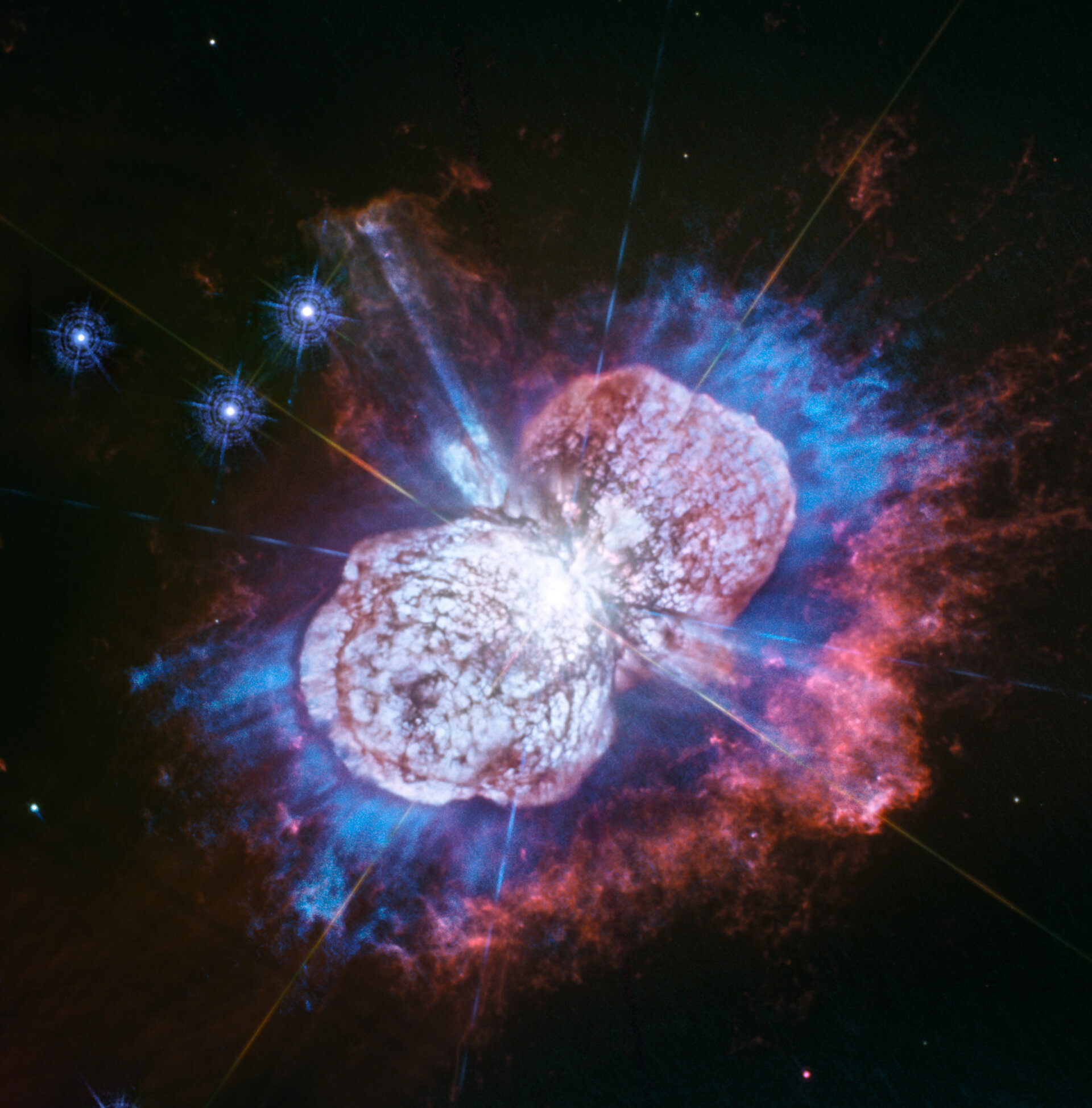
Eta Carinae is a star system located around 7,500 light-years away. It consists of at least two stars that, combined, emit about five million times more energy than our Sun. One of the stars has been releasing hot gas that has expanded into a pair of ballooning lobes. For decades, astronomers have wondered whether it is on the brink of destruction, and will erupt in a violent supernova. This latest image of the stellar fireworks display was released this year and was taken by the Wide Field Camera 3 on the Hubble Space Telescope.
#357

The snowman


Image copyright NASA/JHUAPL/SWRI/T. APPERE

After its swing-by exploration of Pluto in 2015, Nasa's New Horizons spacecraft was sent after a different target in the distant Kuiper Belt, which lies beyond the orbit of Neptune. This belt is populated by thousands of primitive, icy objects that provide insights into the very beginnings of our Solar System.

Scientists settled on an object called MU 69, which had only been discovered in 2014. MU 69 (later called Ultima Thule, and now Arrokoth) turned out to be a 39km-long "contact binary", composed of two different icy balls that collided at low speed. The reddish coloration is caused by organic compounds called tholins on the surface.
#358
Science and Research / The best space images of 2019
December 30, 2019, 06:11:52 PM

The best space images of 2019

By Paul Rincon
Science editor, BBC News website
30 December 2019

With some blockbuster space missions underway, 2019 saw some amazing images beamed back to Earth from around the Solar System. Meanwhile, some of our most powerful telescopes were trained on the Universe's most fascinating targets. Here are a few of the best.

Up in the clouds


Image copyright NASA/JPL-CALTECH/SWRI/MSSS/KEVIN M. GILL

Nasa's Juno spacecraft has been sending back stunning images of Jupiter's clouds since it arrived in orbit around the giant planet in 2016. This amazing, color-enhanced view shows patterns that look like they were created by paper marbling. The picture was compiled from four separate images taken by the spacecraft on 29 May.

At the time, Juno was making a close pass of the fifth world from the Sun, approaching to between 18,600km (11,600 miles) and 8,600km (5,400 miles) of the swirling cloud tops.


KEVIN MCGILL/NASA/JPL-CALTECH/SWRI/MSSS

The image above shows swirling clouds that surround a circular feature within a jet stream region on Jupiter.
#359
Health and Food / Re: Fasting might help you live longer
December 26, 2019, 07:12:38 PM

You should talk to a doctor before trying a fasting diet

Your personality is just one factor to consider before you try IF; your overall health is another.

"Whether you're thinking about trying a fasting system for preventive reasons or as a treatment, the doctor should be involved," Longo says. "There are many factors that must be considered, like your current diet, or whether you have diabetes or a metabolic disorder."

Also, it's important to determine with a health or nutrition professional what sort of system makes sense for your lifestyle.

"An athlete with a perfect pescatarian diet may benefit from only fasting twice a year," Longo explains. "But someone with high cholesterol and excess abdominal fat may see more improvement by doing it more regularly."

The long-term effects of fasting diets aren't well understood. Much of the research on the topic has been done across short time frames. And while experts have done some studies in humans and are doing more, a lot of the current info is from animal samples.

A lot more research needs to be done, Mills says. But if you are curious about incorporating fasting into your eating plan, you should ask a health professional to help you design a plan that ensures you are eating the right foods on both fasting and non-fasting days to guarantee you stay in good health.


https://edition.cnn.com/
#360
Health and Food / Re: Fasting might help you live longer
December 26, 2019, 07:09:26 PM

It can help with weight loss, but it may not work for everyone

Hey, it helped Kimmel and Jackman shape up. But Mills warns that while a fasting program may aid weight loss, it's not a plan that is practical or sustainable for everyone.

"It's not something that I personally recommend in my practice because I think there are lots of ways to get a jumpstart on weight loss without going cold turkey with food," she explains. "You can instead focus on eating more vegetables and fruits. That way you're focusing on picking healthy calories and adding nutrients. It's a positive change as opposed to an all-or-nothing mindset."

You also don't know how you will react physically and mentally to calorie restriction, she adds. "You may not know how your body will respond to, say, low blood sugar," Mills says. "Or, some people find that fasting seems like a piece of cake until around 3 o'clock, and then suddenly cravings come on and you end up eating all sorts of things you normally wouldn't."

The bottom line? "You have to consider how you personally are affected by restriction," she says.

#361
Health and Food / Re: Fasting might help you live longer
December 26, 2019, 07:07:02 PM

It typically focuses on when to eat, not necessarily what to eat

There's no one-size-fits-all fasting diet; plans can be highly individualized. Some folks allow themselves to drink black coffee and green juice during the no-food period, while others may give themselves a cap of 500 calories on fasting days.

For instance, Kimmel told Men's Journal that on fasting days his "meals" might consist of peanut butter and an apple, the whites of hard-boiled eggs, or possibly a bowl of oatmeal. "The rest of the week I'm a glutton—pizza and pasta and steak," he told the mag.

But here, Kimmel reveals one of the issues with fasting diets, says Libby Mills, RD, a spokesperson for the Academy of Nutrition and Dietetics. "The focus isn't always on nutrition," she says. "A lot of the time it's just about calories."

"Some people may also interpret the normal eating time as free rein to go calorie crazy," Mills adds, "which can backfire."

#362
Health and Food / Re: Fasting might help you live longer
December 26, 2019, 07:04:28 PM

The health benefits of fasting go beyond weight loss

Fasting may improve your overall health and extend your life, likely due to the ways that it affects cell and hormone function, according to several studies. In one recent study in Cell Metabolism, for example, periodic fasting was linked to lower risks of heart disease, diabetes, cancer, and aging.

So why does fasting have such a positive health impact? During the fasting phase, many cells die and stem cells turn on, which starts a regeneration process and gives rise to new, younger cells, study author Valter Longo, PhD, recently explained to Health. "It sounds too good to be true, but it's not," he said.

Other studies have shown that intermittent fasting may decrease low-density lipoprotein (LDL), or "bad" cholesterol, as well as inflammation. Additionally, IF may improve insulin resistance, which, in turn, helps stabilize blood sugar levels.

#363
Health and Food / Re: Fasting might help you live longer
December 26, 2019, 06:56:20 PM

Fasting isn't one size fits all

IF may mean something different depending on who you talk to. One of the more commonly known fasting systems is the 5:2 diet, which involves restricting calories for two non-consecutive days a week and eating without calorie restraints on the other five days. (Jimmy Kimmel credited the 5:2 diet with his weight loss in a Men's Journal story last year.)

Others may fast on a day-to-day basis by eating only during a specific time window. Mark Mattson, a neuroscientist at the National Institute on Aging in Maryland who has researched the subject extensively, shared with the New York Times that most days he skips breakfast and lunch and eats all of his calories within a six-hour window starting in the afternoon. And, Hugh Jackman revealed that he fasted for 16 hours and ate within an 8-hour window to get in shape for his role as Wolverine in 2013.

#364
Health and Food / Re: Fasting might help you live longer
December 26, 2019, 06:52:45 PM

What is intermittent fasting, and is it healthy?

By Jacqueline Andriakos, Health.com
June 8, 2016


Story highlights

Intermittent fasting is occasional starvation done in a strategic way

Experts say it can improve your overall health, but talk to your doctor before trying it


When you hear the word "fasting," you probably think of gimmicky diets—and, um, feeling "hangry." But a growing body of research suggests that cycling super low-calorie days into your normal eating plan could potentially improve your health (more on that later). But before you skip lunch and let your gut start growling, read on for everything you need to know about intermittent fasting.

What is intermittent fasting (IF)?

In very basic terms, IF is occasional starvation done in a strategic way. The idea is to cycle between periods of regular eating and fasting, during which you severely restrict your calorie intake or don't consume any food at all. Some people fast for hours, while some may go for a full day or longer.
#365
Health and Food / Re: Fasting might help you live longer
December 26, 2019, 06:46:50 PM

"It's human nature for people to want to reward themselves after doing very hard work, such as exercise or fasting for a long period of time," he said. "So there is a danger of indulging in unhealthy dietary habits on non-fasting days."

When the brain is deprived of food, appetite hormones in the hypothalamus, the brain's "hunger center," are released in a flurry and can trigger overeating.

But Mattson said the pain is temporary.

"Patients should be advised that feeling hungry and irritable is common initially and usually passes after two weeks to a month as the body and brain become accustomed to the new habit," he said.

https://edition.cnn.com/
#366
Health and Food / Re: Fasting might help you live longer
December 26, 2019, 06:45:51 PM

The limitations

The long-term effects of intermittent fasting require more research that isn't available yet, and the studies that do exist are narrow. The clinical trials focused on overweight young and middle-aged adults, so the benefits and safety can't be generalized to other groups, the authors said.

Another thing: It's a difficult diet to stick to, particularly in the United States, where the concept of three meals a day is "so ingrained in our culture" that a change in eating pattern often doesn't cross doctors' or patients' minds, Mattson wrote.

It'll almost definitely leave participants hungry, irritable and less able to concentrate, the study said.

Almost 40% of people who were assigned to a fasting diet dropped out of a 2017 JAMA study -- one of the drawbacks of intermittent fasting as a weight-loss regimen, Dr. Frank Hu, chairman of the Department of Nutrition at Harvard University's T.H. Chan School of Public Health, noted to Harvard Health Publishing.
#367
Health and Food / Re: Fasting might help you live longer
December 26, 2019, 06:42:16 PM

The benefits

Findings on intermittent fasting range in the diet's effectiveness, but some studies in animals and humans have linked the practice to longer lives, healthier hearts, and improved cognition.

The article points to the residents of Okinawa, known for their extreme longevity and low-calorie, nutrient-rich diet. Their intermittent fasting might contribute to their life spans and keep obesity at bay, the authors posited.

Intermittent fasting is thought to improve insulin resistance, which can stabilize blood sugar levels. Findings from a small 2018 study found that three men with type 2 diabetes, also known as adult-onset diabetes, were able to stop taking insulin after losing weight from intermittent fasting -- findings that clash with the widely-held belief that diabetes is incurable.

A previous study (that Mattson co-authored) showed the switch can increase resistance to stress by optimizing brain function and neuroplasticity, or the brain's ability to adapt to develop throughout one's life. And older adults who were put on a restricted-calorie diet showed improved verbal memory compared to two other groups who hadn't fasted, a 2009 study found.

Physical function even improved for some patients. A study of young men who fasted every day for 16 hours lost fat and retained muscle while resistance training for two months.
#368
Health and Food / Re: Fasting might help you live longer
December 26, 2019, 06:40:42 PM

How it works

Intermittent fasting has been studied in rodents and overweight adults to improve health across the spectrum, though it's not clear if those benefits are the result of weight loss.

Alternating between fasting and eating can improve cellular health, Mattson said, most likely by triggering metabolic switching. In metabolic switching, cells use up their fuel stores and convert fat to energy -- "flipping a switch" from fat-storing to fat-saving.
#369
Health and Food / Re: Fasting might help you live longer
December 26, 2019, 06:39:27 PM

Study author Mark Mattson, a professor of neuroscience at Johns Hopkins University, hones in on two types: Daily time-restricted feeding (eating 6-8 hours a day and fasting for 16-18 hours) and 5:2 intermittent fasting (fasting two days a week, usually capping a fasting day at 500 calories).

The catch? Most Americans don't intermittently fast (the norm is three meals a day plus snacks) and thus physicians are less inclined to consider fasting a solution to a broad range of health conditions, according to the review.

Because the research is relatively new, the report advises physicians to monitor their patients throughout intermittent fasting and gradually increase the duration and frequency of fasting to guide their transition.
#370
Health and Food / Fasting might help you live longer
December 26, 2019, 06:38:53 PM

Eating in a 6-hour window and fasting for 18 hours might help you live longer

By Scottie Andrew, CNN
December 25, 2019


(CNN) Abstaining from food for 16 to 18 hours a day could be key to treating a variety of health conditions -- even if you've got to train yourself to push past the hunger.

A review of past animal and human studies in The New England Journal of Medicine suggests that intermittent fasting can reduce blood pressure, aid in weight loss and improve longevity.

The report functions as a road map of sorts for physicians to prescribe fasting as a method of prevention or treatment for obesity, cancer, diabetes and heart disease.
#371
Tira-Pasagad | Saksak-Sinagol / Re: Apparent explanations
December 26, 2019, 06:31:22 PM

#372
Tira-Pasagad | Saksak-Sinagol / Re: Apparent explanations
December 26, 2019, 06:29:28 PM

#373
Tira-Pasagad | Saksak-Sinagol / Re: Apparent explanations
December 26, 2019, 06:25:42 PM

;D kinabraytan si botoy sa kabuing. ;D
#374
Photos Unlimited / Tribute to animals lost in WWI
December 22, 2019, 12:11:37 PM


A rare photo of World War I soldiers paying tribute to 8 million horses, mules, and donkeys lost in World War I.
#375
Photos Unlimited / Re: Happy birthday, kitty!
December 22, 2019, 12:05:21 PM

lahi ra ani, but more's the surprise and meaning in the birthday fish.

#376
Photos Unlimited / Re: Happy birthday, kitty!
December 22, 2019, 12:01:04 PM

cute! :)
#377

Round 3: Shopping sprees

In 1983, Imelda reportedly spent:

― US$7 million in 90 days, according to People.

― US$3 million in a single day in New York, including US$2 million on fine jewellery and US$35,000 on limousines.

― In Rome, Imelda bought a US$3.5 million Michelangelo painting.

― She once bought US$2,000 worth of chewing gum.

― In Rome, she made her aircraft do a mid-air U-turn because she forgot to buy cheese.

Here's what The Wall Street Journal (WSJ) said about Mr Najib's alleged holiday expenses:

― The Wall Street Journal reported that US$130,625 was spent at a Chanel store in Honolulu in 2014.

― The WSJ also revealed that more than US$14 million was transferred to Malaysian clothing store Jakel.

― €750,000 (S$1.2 million today) spent at a Swiss jewellery store in August 2014.

― In 2011, the couple spent US$56,000 at a car dealership in Kuala Lumpur.

The winner: The Philippines. The cheese U-turn definitely takes the cake.


*Inflation figures obtained via CPI Inflation Calculator

MALAY MAIL
https://www.todayonline.com/
#378

Round 2: Bags and shoes

While Imelda was known for her colossal shoe collection, Birkin bags in recent years became a favourite talking point among Malaysians for their eye-watering price tags and symbol of wealth.

The former Philippine First Lady's shoe haul included:

― 3,000 pairs of shoes, including brands such as Gucci, Charles Jourdan, Christian Dior, Salvatore Ferragamo, Chanel, Pierre Cardin, Prada and Bally.

― Though the total value of Imelda's shoes is not known, museum staff Jimmy de la Rosa told ABC News that in the 80s, a pair of Filipino-made shoes cost between US$6 to US$11, while imported shoes cost US$100 or more.

The Malaysian police seized from Najib-linked home:

― 567 handbags from 37 high-end brands, including Hermes, Prada, Chanel and the notoriously exclusive Bijan.

― The value of the Hermes bags alone was RM51.3 million, while some of the custom-made Bijan bags were valued at RM1.6 million.

The winner: Malaysia. You don't have to be a math genius to figure this one out.
#379

Round 1: Jewellery

Two years ago, CNN reported that Imelda's jewellery collection was worth approximately US$21 million (S$30.4 million today).

Some of the luxury items US Customs impounded in 1986 when the Marcos family fled to Hawaii:

― a 150-carat Burmese ruby with diamond brooch valued at US$290,000

― a 30-carat Bulgari diamond bracelet valued at US$1 million

― one tiara with Mabe pearl, diamonds and rubies valued at US$47,105

― a sapphire, ruby and diamond set comprised of a bracelet, a pair of earrings and one brooch consisting of sapphires, rubies, diamonds valued at US$1.5 million

― rare 25-carat pink diamond, worth approximately US$5 million

The Malaysian police seized from Najib-linked homes:

― a yellow-and-gold necklace valued at RM6.4 million, which was the single most expensive item.

― Earrings — 2,800 set pieces

― Rings — 2,200 pieces

― Bangles — 2,100 pieces

― Brooches — 1,600 pieces

― Necklaces — 1,400 pieces

― Tiaras — 14 pieces

The winner: Malaysia. Fourteen tiaras against one is pretty hard to top. Plus, the market value of the jewellery was estimated to exceed RM500 million, at between RM660 million and RM880 million.
#380

Rosmah Mansor vs Imelda Marcos: Who spent more?


Ms Rosmah Mansor (left), the wife of former Malaysian prime minister Najib Razak, and former Philippine First Lady Imelda Marcos.

28 JUNE, 2018

PETALING JAYA — After the reveal of the value of luxury items seized in police raids on properties linked to former Malaysian prime minister Najib Razak, as part of the probe into state investment firm 1Malaysia Development Berhad, comparisons to former Philippines president Ferdinand Marcos and his wife Imelda Marcos were inevitable.

In the 1980s, during the Marcoses two-decade rule, they made headlines for corruption and kleptocracy scandals, similar to the current controversies surrounding former Malaysian prime minister Najib Razak and his wife Rosmah Mansor.

Former Philippine First Lady Imelda Marcos was known for her colossal shoe collection and opulent spending, which eventually led to her and her husband's exile.

The Malaysian authorities said the total market value of luxury watches, jewellery, high-end handbags, and cash recently seized at properties linked to Datuk Seri Najib amounted to a jaw-dropping RM1.1 billion (S$372 million).

The jewellery alone was worth between RM660 million to RM880 million.

Which "First Lady" and her husband spent more? Find out in the face-off below.
#381
Tira-Pasagad | Saksak-Sinagol / Re: Apparent explanations
December 20, 2019, 08:59:53 PM

;D brayt!
#382
Photos Unlimited / Re: Thieving Paw strikes again
December 17, 2019, 12:20:56 AM

#383
Photos Unlimited / Re: Pure joy
December 17, 2019, 12:11:00 AM

1946 | LIFE IS A NEW PAIR OF SHOES

Werfel, a 6-year old Austrian orphan, beams with unbounded joy as he clasps a new pair of shoes presented to him by the American Red Cross.

LIFE magazine | Original caption
December 30, 1946

#384

#385
Photos Unlimited / Re: Nagpanilap
December 16, 2019, 11:58:26 PM

#386
Photos Unlimited / Re: Nagpanilap
December 16, 2019, 11:55:07 PM

;D :P :P :P :P :P :P 8)
#387
Health and Food / Re: Epstein-Barr Virus (EBV)
December 15, 2019, 11:04:57 PM

"She got up to go to the bathroom. All of a sudden she couldn't feel part of her legs, and she felt like her legs were just giving out," Delfs said. Her doctors thought she was having a stroke, and Ariana was airlifted to a hospital.

"Her words were very slurred at times. She was just talking gibberish, and the damage was already beginning at that point, which we just didn't know," Delfs said. Just before she died, her doctors discovered that the teen had mononucleosis and Epstein-Barr.

Three days after she was hospitalized, Ariana died. "Her brain swelled to the point where it couldn't function and brain damage did occur," Delfs said. "And we just made the decision that it was time to let her go."

more at https://www.yahoo.com/lifestyle/17-old-girl-died-just-170600198.html
#388
Health and Food / Re: Epstein-Barr Virus (EBV)
December 15, 2019, 11:03:58 PM

Her father, Mark Delfs, told WJAX-TV that Ariana started having typical cold-like symptoms and "seem to always have a headache" at first. Ariana's parents took her to the doctor, where she was given a lot of tests, but doctors couldn't figure out what was wrong. Meanwhile, Ariana got even more sick.

"One evening, not too long ago, she started throwing up just constantly. We got very nervous, so the next morning at 7 a.m. we said we're going to take her to the hospital," Delfs said. Still, Ariana got worse.

At just 17, Ariana died of Epstein-Barr virus, better known as mono.
#389
Health and Food / Re: Epstein-Barr Virus (EBV)
December 15, 2019, 11:02:44 PM

A 17-Year-Old Girl Has Died Just Weeks After Developing Mono Symptoms

December 13, 2019


Photo credit: GoFundMe/Mark H. Delfs

Ariana Rae Delfs, 17, has died after contracting mononucleosis three weeks ago.

Her parents took her to the doctor, but they couldn't figure out what was wrong as her symptoms continued to worsen.

While it is uncommon for mono to be fatal, a doctor explains how to spot serious complications.

A family in Florida is mourning the loss of their teenage daughter after she developed a rare complication from the contagious disease mononucleosis. Ariana Rae Delfs, 17, died after contracting mono three weeks ago.
#390
Health and Food / Re: Epstein-Barr Virus (EBV)
December 15, 2019, 10:52:22 PM

Other Diseases Caused by EBV

EBV is best known for causing mononucleosis, but less often it can lead to other diseases, including:

-Ear infections and diarrhea in children

-Guillain-Barre syndrome

-Certain cancers, including Burkitt's lymphoma and cancers of the nose and throat


Studies also show a link between EBV and multiple sclerosis (MS), but more research is needed to determine if the virus can lead to MS.

WebMD Medical Reference
Reviewed by Carol DerSarkissian on July 08, 2019
Sources© 2019 WebMD, LLC. All rights reserved.


https://www.webmd.com/
#391
Health and Food / Re: Epstein-Barr Virus (EBV)
December 15, 2019, 10:48:55 PM

Prevention

No vaccine can protect you against the EBV virus. The best way to avoid catching it is to stay away from anyone who has mono.

Don't share any items, including glasses, silverware, and toothbrushes, with someone who is infected. Also avoid kissing or having sex with an infected person.

When to See Your Doctor

There are some rare complications of mono, so see your doctor if you or your child has any of these symptoms:

-Sudden, sharp pain on the left side of the belly, which could mean a problem with your spleen

-Very little urine, a sign of dehydration

-Trouble breathing or swallowing -- call 911 immediately


Also call if your symptoms don't go away after 4 to 6 weeks. You could have another type of infection besides mononucleosis.
#392
Health and Food / Re: Epstein-Barr Virus (EBV)
December 15, 2019, 10:45:14 PM

Treatment

Like other viruses, Epstein-Barr can't be treated with antibiotics. Mono should clear up on its own without treatment in a few weeks.

What You Can Do at Home

Although no medicine can cure an EBV infection, you can take these steps at home to ease your symptoms:

-Get plenty of rest.

-Drink a lot of water and other liquids to stay hydrated.

-Suck on lozenges or ice pops, or gargle with warm salt water, to make your sore throat feel better.

-Take painkillers like acetaminophen or ibuprofen to bring down fever and relieve body aches. (Don't give aspirin to children under 19 years of age because of the risk of a rare but serious condition called Reye's syndrome.)


Ease back into work or school, taking things slowly until you feel better. For a month or so, avoid sports, heavy lifting, or other vigorous activities in which you could injure your spleen.
#393
Health and Food / Re: Epstein-Barr Virus (EBV)
December 15, 2019, 10:40:39 PM

Diagnosis

It's hard to tell whether you have mononucleosis just by your symptoms. Fever, fatigue, and sore throat could also be signs of other illnesses, like the flu or a cold.

See your doctor for an exam to learn for sure what's making you sick. He might find signs that you have mono, such as an enlarged spleen, an organ in your belly that filters blood. Your doctor will also check to see if you have a swollen liver and white patches on your tonsils.

You may also need to get some blood tests. One test looks for antibodies, substances your immune system makes in response to the EBV virus. Another test looks for a type of white blood cell your body uses to fight off the EBV infection.
#394
Health and Food / Re: Epstein-Barr Virus (EBV)
December 15, 2019, 10:39:15 PM
How It Spreads

The virus is found in saliva, so you can catch mono from kissing someone who's infected. You can also get it from drinking from the same glass or using an infected person's toothbrush. It's also found in blood and semen, so it's possible to get mono from sex, a blood transfusion, or an organ transplant.

You don't have to be sick to pass the virus to someone else. EBV stays in your body long after you get over mono. The virus can become active again months or years later, making you contagious once more.
#395
Health and Food / Re: Epstein-Barr Virus (EBV)
December 15, 2019, 10:36:38 PM

Symptoms

Once you're infected with EBV, symptoms can take 4 to 6 weeks to show up. When they do, they're often mild, especially in young children. Kids' symptoms may be more like those of a cold or flu. Teens often have more obvious symptoms of mono.

If you do get symptoms, most likely you'll have:

-Fatigue

-Fever

-Lack of appetite

-Rash

-Sore throat

-Swollen glands in the neck

-Weakness and sore muscles


Although you should start feeling better in 2 to 4 weeks, the fatigue can stick around much longer. You may still feel tired a couple of months later.
#396
Health and Food / Epstein-Barr Virus (EBV)
December 15, 2019, 10:34:49 PM

Epstein-Barr Virus (EBV)

Epstein-Barr is the virus that causes mononucleosis. You might know this disease better by its nickname, "mono." It's also called the "kissing disease" because of one way you can spread it to someone else.

Even though Epstein-Barr virus (EBV) isn't a household name, you've probably been infected without knowing it. Lots of people carry the virus but don't get sick.
#397

comparing the cebuano and tagalog lyrics of the song:

Kasadya Ning Taknaa
AngPasko ay Sumapit


Kasadya ning taknaa
Ang Pasko ay sumapit

Dapit sa kahimayaan
Tayo ay mangagsiawit

Mao ray atong makita
Ng magagandang himig

Ang panagway nga masanagon
Dahil sa Diyos ay pag-ibig

Bulahan ug bulahan
Nang si Kristo'y isilang

Ang tagbalay nga giawitan
May tatlong haring nagsidalaw

Awit nga halandumon sa tanang Pasko
At ang bawat isa ay nasipaghandog

Magmalipayon!
Ng tanging alay.

Chorus: Repeat *** then...

Bag-ong tuig
Bagong taon

Bag-ong kinabuhi
ay magbagong buhay

Duyog sa atong mga pagbati
Upang lumigaya ang ating bayan

Atong awiton ug atong laylayon
Tayo'y magsikap upang makamtan

Aron magmalipayon!
Natin ang kasaganaan.

Repeat ***
then Chorus
then ***


(additional tagalog paragraph):

Tayo'y mangagsi-awit
Habang ang mundo'y tahimik
Ang araw ay sumapit
Ng Sanggol na dulot ng langit
Tayo ay magmahalan
Ating sundin ang gintong aral
At magbuhat ngayon
Kahit hindi Pasko ay magbigayan.
#398

For songs that are supposed to be about generosity and unity during the most festive time of the year, they have ironically become divisive and reflective of our centuries-long rivalries between regions. The Bisayas will always claim that they had the song first and that Imperial Manila had taken advantage of something that was theirs and bastardized it, as go some conversations in social media. The melodies are indeed eerily similar but is this enough evidence that it was plagiarized? Or is this a coincidence?

A similar, more recent case that you may recall involves pop stars Katy Perry and Sara Bareilles. In 2013, Perry released "Roar" as a single, and was accused of ripping off parts of Bareilles's "Brave." Fans even spliced clips from both songs together to demonstrate how similar they were. However, both singers have avoided commenting on the matter.

When it comes to Rubi and Cenizal, the real composer or composers of the song should still be given their due credit—but in the absence of the possibility of certainty, how about we celebrate both, and be happy that we got two incredible, timeless Christmas songs instead of just one?

https://www.esquiremag.ph/
#399

The letter further says: "Cenizal claimed he composed it, inspired by the strains from carolers on the Bantayan shorelines while he was passing through in a banca in Cebu where he evacuated during the war (1942), about a decade after it was copyrighted by Rubi and Vestil." Even if Cenizal did go to Cebu in 1942, he would have already composed the music by then since the movie came out in 1938. Was there any other chance that Cenizal could have heard or known the melody since the time of its inception in 1933 until he created it for the movie? That's the question Gica and other claimants should have asked to get to the bottom of this mystery.

Despite these claims from Gica, Cenizal and his descendants remain adamant in their interviews that "Ang Pasko Ay Sumapit" is Cenizal's original composition. In a Kapuso Mo Jessica Soho Christmas special in 2014, Cenizal's daughter said that she wasn't aware of "Kasadya" and that it was a Christmas song.

In the meantime, Celerio was a National Artist laureate, passing the strict—if sometimes flawed—selection process. Was he a plagiarist? Even the Wikipedia entry for "Kasadya Ning Taknaa" contains a dig at Celerio for the lack of acknowledgment to Rubi and Vestil, though the translation of the lyrics shows that Celerio's simplified carol is not similar to Vestil's grand lyrics.
#400

Ceniza did not give up. In 1979, he filed another case before the Cebu court. Rubi was exempt from paying litigation fees since he couldn't afford it. The case was resolved nearly two decades later, in 1998, when the court ruled that Mareco owed Rubi P1,884.34, the balance of his full payment from 1966 to 1975. Sadly, Rubi had already died eight years prior, having lost his battle with prostate cancer. Ludivina said that her father never stopped composing and that on his death bed, he requested her to pursue the case in court.

The Question of Right

After his death, Rubi garnered posthumous awards for his contribution in music, and fellow Bisaya never stopped spreading the story of how Rubi was robbed of both merit and money for the melody of this popular Christmas carol. One of these advocates is Ivar Tulfo Gica, the founder-trustee of the Kultura Bisaya Foundation, Inc. In 2014, he wrote a letter to Ricky Lee about "setting the record straight" on the real composer of the favorite holiday song. Lee posted the letter in its entirety in his column in the Philippine Star, repeating what other sources already claim, with a few differences.

For one, the letter stated that it was Villar Records who "bought its rights, recorded, and credited the entire work" to the two Cebuanos in 1950. The letter went on to state that the song was used as background music in "the film that starred Darmo von Frazier Acosta", though it did not mention the date—perhaps implying that the film was made after 1950, when in fact it was shown in 1938.