Join MikeLigalig.com!

Why Just Read When You Can Join, Post, and Read!

Menu

Show posts

This section allows you to view all posts made by this member. Note that you can only see posts made in areas you currently have access to.

Show posts Menu

Messages - islander

#2901

8. Excessive use of funds

GADON: Sereno had excessively used court funds in her purchase of a P5-million Toyota Land Cruiser, the booking of a presidential villa in Boracay for P200,000 a night, her business class travels, and her inclusion of a “huge entourage of lawyers” in official trips.

SERENO: Every expense is within bounds.

On the land cruiser, Sereno cited a budget circular that expressly allows the Chief Justice to buy a luxury vehicle for security purposes.

On the presidential villa, Sereno said the SC approved the budget to book the villa for the all-day use of the ASEAN chief justices who had come to Boracay for the 3rd meeting of ASEAN chief justices.

Sereno, her staff, and part of the event secretariat then used the villa overnight at no additional cost. Booking separate rooms for the purpose of sleeping in them would have cost the SC more, said Sereno.

Sereno said that the SC Human Resource Manual “expressly allowed the Chief Justice to travel on full business class.” The reason why other justices don’t is because the same manual prohibits them from doing so.

Sereno said the lawyers who join her on office trips were necessary for her to do her job. “There is no rule (and the Complainant has cited none) which prohibits the Chief Justice from bringing her staff on foreign trips.”

Sereno said that in 16 of her foreign trips, she traveled alone on 4 occasions, brought one lawyer on 9 trips, two lawyers on two trips, and 3 lawyers on one trip.

Gadon’s complaint has been declared sufficient in form and substance by the House committee on justice voting 30-4. The next step is to put it through another round of votes to decide if there is probable cause.

Hearings would then be conducted after which a third of the House of 97 members should vote to transmit the complaint to the Senate which will sit as an impeachment court.

Sereno’s lawyers are moving to be allowed to cross-examine Gadon and witnesses during the House hearings. â€" Rappler.com
#2902

7. Clustering in the JBC

GADON: Sereno manipulated the short list of the JBC for 6 vacancies at the anti-graft court Sandiganbayan to accommodate her favored nominees.

In 2015, 6 vacancies opened up at the same time and the JBC decided, by a majority vote (Senator Koko Pimentel was the lone dissenting vote) to cluster the nominees. Clustering was an issue for some because it could be used to put the favored nominee in a group of perceived weak nominees to increase the chances of getting the appointment.

Zaldy Trespeses, Sereno’s chief protocol officer at the time, would eventually get one of these 6 appointments.

SERENO: “The JBC has been clustering nominees since 2013 without anyone objecting to its validity.” Sereno insisted she did not manipulate the JBC because the members voted on their own.

She pointed out that clustering had always been done in good faith whenever there were multiple vacancies. Sereno cited Section 9, Article VIII of the Constitution which says: “The members of the Supreme Court and lower courts shall be appointed by the President from a list of at least 3 nominees prepared by the JBC for every vacancy.”

Sereno also pointed out that former president Benigno Aquino III still ended up choosing his appointments not from the clusters, but from his own preferences. For example, not one on the cluster for the 16th Sandiganbayan justice was appointed. Furthermore, two appointed justices â€" Michael Frederick Musngi and Geraldine Faith Econg â€" belonged to one cluster.

In February 2017, the SC â€" acting on the petition of the short-listed judges who were bypassed in that set of appointments â€" declared clustering unconstitutional.

Poblador said that the February 2017 ruling was not retroactive and cannot be used against Sereno because the questioned clustering happened in 2015 or two years before.
#2903

6. The Jardeleza appointment

GADON: Sereno manipulated the short list of the Judicial and Bar Council (JBC) to exclude Associate Justice Francis Jardeleza for “personal and political reasons, and curtailing the President’s power to appoint him."

Gadon said Sereno manipulated the JBC into excluding Jardeleza from the short list even though he already had sufficient votes. Sereno imposed the unanimity rule, ordinarily not required for short-listed nominees. Jardeleza contested his exclusion before the SC. He won that petition and was eventually appointed. (READ: The inside story: Jardeleza accused of disloyalty to PH)

Retired justice Arturo Brion wrote a scathing concurring opinion which reads in part: “The manipulation was a purposive campaign to discredit and deal Jardeleza a mortal blow at the JBC level to remove him as a contender at the presidential level of the appointing process."

SERENO: “The Chief Justice did not manipulate anything. Complainant is simply echoing language from the separate concurring opinion of former Associate Justice Arturo Brion in Jardeleza vs Sereno. In other words, complainant is relying on opinion, instead of facts, the law and doctrine.”

Sereno, as ex-officio chairman of the JBC, contested Jardeleza’s nomination because of integrity issues. Sereno questioned Jardeleza’s deletion of a portion in the memorandum submitted to the United Nations during the arbitration case over the West Philippine Sea. Jardeleza was solicitor general at the time.

Citing Section 2, Rule 10 of the JBC rules, Sereno said a unanimous vote is required of a nominee if his or her integrity is challenged. “Her expression of such opinion within the confines of the existing JBC rules cannot amount to a violation of the Constitution, much less one which is culpable in nature and for which she deserves to be impeached,” said her verified answer.
#2904

5. Piatco fees

GADON: Sereno did not truthfully disclose her earnings from defending â€" and then winning â€" a government arbitration case against Philippine International Air Terminals Co. Inc. (Piatco) in her Statement of Assets, Liabilities, and Net Worth (SALN). This amounted to P37 million.

The issue over Piatco earnings is one of Gadon’s more interesting allegations, according to court observers, if only because of the precedent set by the impeachment of the late former chief justice Renato Corona.

SERENO: Then a private lawyer, she earned P30 million, not P37 million, from the Piatco case. She received the fees in a span of 5 years from 2004 to 2009 or during the whole process.

She was appointed to the SC as an Associate Justice in 2010 and as a public official, was required to declare her assets in her SALN. What she declared that year was what remained of her Piatco earnings, as well as properties she had acquired through the years with that money.

Of the P39 million, P8.67 million was paid as taxes, P14.7 million was spent on medical expenses and procurement of a house and lot in Filinvest and a Toyota Altis, and the remaining P6.9 million went to her family’s living expenses from 2004 to 2009. All the properties and investments are declared in her SALN.

Sereno's 2016 SALN shows her net worth at P24.2 million, more than P2.76 million compared to her net worth in 2015.
#2905

4. Falsification of order to Medialdea?

GADON: It was another culpable violation of the Constitution when Sereno allegedly falsified an SC resolution which directed Executive Secretary Salvador Medialdea to submit complaint affidavits against 4 trial court judges allegedly involved in the drug trade.

The SC would eventually issue a resolution which did not issue a directive to Medialdea but instead invited pertinent officials to submit the complaint affidavits.

SERENO: All a matter of miscommunication. According to her verified answer, the “directive” was contained in a draft resolution. On August 8, 2016, even though the full version of the resolution was still up for revision, the dispositive portion was already final. The SC’s Public Information Office (PIO) released the dispositive portion of the resolution on the same day.

“This is what happened here, with the PIO reporting that the Court had directed the Executive Secretary to submit complaints.” The directive part, however, was removed from the final version of the resolution, which was what was signed by the justices.

“The revision does not prove that the first version of the resolution was fake. The complainant’s allegations that the Chief Justice authorized the release of a ‘fake resolution' were a product of his own malicious understanding of matters over which he has no personal knowledge of.”
#2906

3. Blanket TRO on 2013 party-list proclamations

GADON: Sereno “tampered with and altered the contents of the draft temporary restraining order (TRO) sent by Justice de Castro.” Gadon is referring to the SC’s TRO on party-list proclamations during the 2013 elections as a response to the petition of disqualified Coalition of Association of Senior Citizens party-list.

De Castro wanted a TRO on the proclamation of Senior Citizens party-list only. “It was only after Sereno endured a harsh tongue-lashing from De Castro, the original ponente of the tampered TRO was the TRO rectified and re-released,” Gadon said.

SERENO: Because the petition was filed during recess, SC internal rules authorized the Chief Justice to act on urgent cases such as those pleading for a TRO. Therefore, she said, she was within her power to issue a TRO.

“She simply did not fully adopt the recommended draft order submitted to her for approval. The Chief Justice cannot possibly falsify, tamper with or alter a TRO issued under her own authority.”

But a week later, the SC issued a status quo ante order which, in effect, applied De Castro’s recommendations. Sereno insisted this was not a revocation of her earlier TRO, but just the en banc acting on its power to review the Chief Justice’s TRO decisions while on recess.
#2907

2. RCAO revival

GADON: Sereno committed culpable violation of the Constitution when she falsified a resolution in 2012 reviving the Regional Court Administration Office in Region 7 or RCAO 7.

Gadon cited a December 3, 2012 memorandum by Associate Justice Teresita Leonardo de Castro saying that Sereno’s resolution was not ratified by the en banc. This is proven, Gadon said, by the SC eventually issuing a corrective resolution in January 2013.

SERENO: The SC had authorized the piloting of RCAO 7 as early as 2006. Then in 2008, the SC issued a resolution which designates the chief justice to, “acting on his or her own,” designate the Regional Court Administrator to pilot RCAO 7.

For 6 years, the RCAO 7 was never piloted until 2012, when as newly-appointed Chief Justice, she appointed Geraldine Faith Econg (now Sandiganbayan justice) as head of the judiciary decentralized region (JDO) in the 7th Judicial Region, which, in effect, revived the RCAO 7.

The subsequent resolution, Sereno said, was not a corrective resolution or a recall of the first one. “The resolution was meant to address the concerns raised by some members of the court regarding the problems encountered during the pilot testing of RCAO 7.”

“It is obvious that the acts of the Chief Justice regarding the revival of the RCAO 7, even if disagreed to by Associate Justice Teresita Leonardo de Castro, do not constitute impeachable offenses.”
#2908

1. Psychological reports

GADON: “An applicant to any position in the judiciary with a grade of 4 is unfit for the job.” Citing a report from Manila Times, Gadon said Sereno got a 4 out of 5 grade in her psychological examination when she applied for the SC.

SERENO: “There is no such provision whatsoever in JBC-009, or the Rules of the JBC in effect when the Chief Justice applied for a position in the Judiciary.”

The Chief Justice added that psychological examination results are used solely for evaluation purposes. Whether or not she got a score of 4, Sereno said that “even if true a 4 in the alleged evaluation is not an offense, let alone an impeachable one.”
#2909

“They belong to the garbage,” lawyer Alex Poblador added, referring to the newspaper reports heavily cited by Gadon in his complaint. News reports, Poblador said, are hearsay and inadmissible evidence in a court proceeding.

Poblador added that Gadon’s documents, provided to him by the SC itself, may be authentic but they do not support his allegations.

Here is how the Chief Justice answered the impeachment complaint:
#2910

How Sereno answered her impeachment complaint

None of Larry Gadon’s documents, though authentic, support his allegations, according to Sereno’s chief lawyer Alex Poblador

Lian Buan
September 26, 2017


VERIFIED ANSWER. Chief Justice Maria Lourdes Sereno files an 85-page verified answer before the House of Representatives explaining point-by-point why the impeachment complaint against her must be dismissed.

MANILA, Philippines â€" Supreme Court (SC) Chief Justice Maria Lourdes Sereno faces a tough battle ahead, at least in the House of Representatives. Rumors in political circles indicate her impeachment complaint will go far in the lower chamber, but her band of high-caliber lawyers remains confident about her case.

On Monday, September 25, they filed and presented before media their 85-page verified answer to the allegations. “This is just fake news,” said one of Sereno’s spokespersons, lawyer Jojo Lacanilao.
#2911
World Daily News / Re: The Lamps are Going Out in Asia
September 26, 2017, 07:00:06 PM

this reminds me of a german young man in the 1990s who had to go on furlough after graduating from senior high. he chose to spend it in the   military.

so are you going to the balkans? of course not, he answered. if helmut kohl (germany's chancellor then) wants war, let him go himself.

so there. why don't donald trump and kim jong un have a face-off themselves, like a western style gun duel or, better yet, fencing? they both have great hair anyway. >:(
#2912
World Daily News / Re: The Lamps are Going Out in Asia
September 26, 2017, 06:52:59 PM

omg. why should humanity suffer for the foibles of two unstable leaders?
#2913

In a report, the Philippine Center for Investigative Journalism (PCIJ) showed that there was an “epidemic” of redactions made on the December 2016 SALNs of 29 Cabinet officials.

Responding to the PCIJ report, Abella said over the weekend that members of the Caninet still had the right to privacy as he invoked the Data Privacy Act.

/atm

http://newsinfo.inquirer.net/
#2914

“In other words, if investigation is [needed] to be done, it may be done,” he added.

He said the summarized amounts in the SALNs of some Cabinet officials were “deemed sufficient by the law.”

“The full disclosure has been made regarding the summarized amounts,” Abella said. “These disclosures are not meant to be the total disclosure of the thing.”
#2915

Palace open to having redacted SALNs of Cabinet officials investigated

Nestor Corrales
September 25, 2017


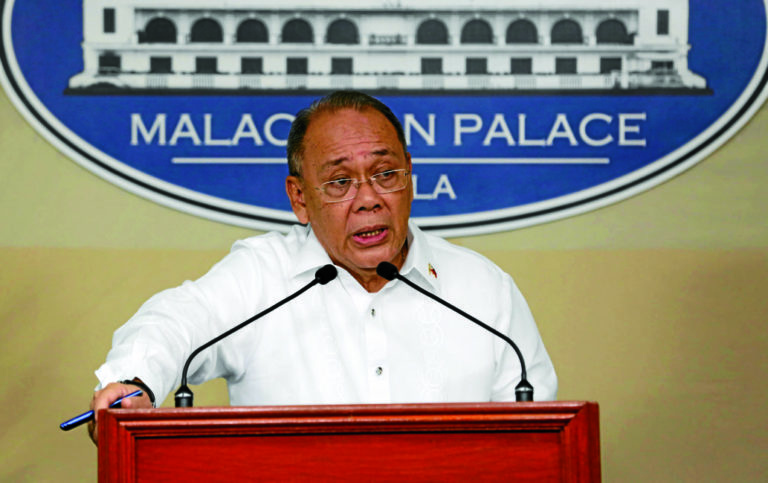
Presidential spokesperson Ernesto Abella (File photo by JOAN BONDOC / Philippine Daily Inquirer)

Malacañang insisted Monday that the details redacted from the statements of assets, liabilities, and net worth (SALNs) of Cabinet officials were for their privacy and was allowed by law.

But despite this, presidential spokesperson Ernesto Abella said Malacañang was open to an investigation on the redacted SALNs if needed.

“Again, I go back to the argument, to the reason given behind that certain items need to be kept private,” Abella said in a Palace briefing. “If indeed there is an investigation that needs to be done, then it can be followed through, if these things are deemed suspect.”
#2916

Through the pamphlet, Filipinos, often the poorest and most marginalized among us, are induced to literally buy into the Marcos propaganda. In the case of the Solicitor General, such fraud, like Marcos being the recipient of so many war medals, has now found its way into our jurisprudenceâ€"a Marcos myth attempting to pass itself off as established fact.

(Joel F. Ariate Jr. is a university researcher at the Third World Studies Center of the University of the Philippines Diliman. This article is based on a paper he presented at the opening of “The Remains of a Dictatorship: An International Conference on the Philippines under Marcos” organized by Philippine Studies: Historical and Ethnographic Viewpoints and the Dean’s Office, School of Social Sciences, Ateneo de Manila University on August 3 to 4, 2017.)

http://verafiles.org/
#2917

Annex 13 of Calida’s Consolidated Comment on the case bears an odd pagination: 165. The Consolidated Comment is only 159 pages long. Page 165 comes from Let the Marcos Truth Prevail, the book that the Solicitor General used in arguing for the burial. This is literally the Solicitor General taking a page from the Marcos playbook.

In his submission to the Supreme Court, the Solicitor General did not bother to secure another certification from the AFP regarding Marcos’s military record nor did he have it authenticated. He merely submitted a photocopy of a page from Let the Marcos Truth Prevail. Not one of the oppositors in this case noticed it, not even the justices.

What we have then are replications of texts that carry the untruths of the Marcoses. In each and every replication, the Marcos myth survives and is passed on. The case of Bullion Buyer Ltd, and its new iteration One Social Family are instances of the trafficking in historical fraud.
#2918

Also, a journalist from the Marcos crony press known for her closeness to Imelda Marcos distributed copies of this book to those who were interested. The BBL pamphlet is an abridged version of this compendium.

Pages 5 and 6 of the pamphlet mention Ferdinand Marcos's record of military service and the honors he received, many of which have been proven to be mere fabrications by Marcos. The entry is just a retyped version of a March 4, 1996 certification from the General Headquarters of the Armed Forces of the Philippines regarding Marcos’s military service. The one who encoded the certification from the AFP into the pamphlet was so faithful to the AFP text, even copying the line breaks from the original.

This AFP certification that is in both the pamphlet and the compendium lately resurfaced in the most unlikely of documents: the submission to the Supreme Court of Solicitor General Jose Calida arguing for the burial of Marcos at the Libingan ng mga Bayani.
#2919

Trafficking in falsehoods

So what does that UPLB gathering have to do with anything?

In 2004, unnamed publishers reworked an undated, earlier edition of a compendium of Marcos propaganda entitled Let the Marcos Truth Prevail. The 2004 publication bore the same title, was 855 pages long and distributed for free to various public schools and universities, mostly in the provinces. In the online catalogues of some universities, the bibliographic entry for this book cites Imelda Marcos as the author.


Photocopy of the cover of an 855-page book titled Let the Marcos truth prevail distributed to different universities all over the country. The publication had neither author nor editor, neither date nor publisher.

Authorship could only be inferred, as the book had neither author nor editor. And as is common in Marcos propaganda material, there is also no stated date of publication nor a publisher. But it contains scanned copies of Imelda’s checks as a widow of a war veteran, material that cannot simply be found in public records. The presence of the check strongly suggests that the Marcoses had direct knowledge in compiling and publishing Let the Marcos Truth Prevail.
#2920

“President Duterte cannot do all his good plans for the country without unity. Can we now blame President Duterte if he declares Martial Law in the future if that is the only way in order to achieve peace, unity and prosperity,” the pamphlet continues.

Quite coincidentally, Duterte announced less than a month ago that the Marcoses were willing to return the wealth that rightfully belonged to the Filipino people. “The Marcoses â€" I will not name the spokesman â€" said that they'll open everything and probably return those that had been discovered,” Duterte said.

Former senator Bongbong Marcos has distanced his family from the BBL. He similarly denied any involvement in the gathering at UPLB. “We do not know of nor have any involvement of any of these gatherings. It's a scam pure and simple,” he said. “I have repeatedly warned the public against unscrupulous individuals who have been using our family to advance their personal interests.”
#2921

Not one participating leader was ever paid a centavo, much less the millions of pesos and dollars promised. Some of these disaffected participating leaders were the ones who brought the charge of syndicated estafa against the leaders of BBL in 2013.

The sale of the Marcos pamphlet is a recent addition to the modus, and may have shifted the dynamics within the BBL. The participating leaders may have managed to find a way to recoup their contribution while waiting for the millions of pesos and dollars supposedly due them by selling the pamphlet.

When did the pamphlet become part of the package? The outright answer drawn from the pamphlet itself would be: after Rodrigo Duterte became president. The preface in the pamphlet says, “Can we blame President Marcos in (sic) declaring Martial Law? He only needs peace of mind in the same manner as President Duterte so that he can do all his good plans for the Filipino people.”
#2922

Pyramiding scheme?

Destura and Cantos went into hiding after a charge of syndicated estafa was filed against them in 2013. Destura is said to be a son of Pedro Destura, a mayor of Prieto Diaz, Sorsogon from 1969 to 1971. The younger Destura claimed that Marcos entrusted to his father a still undetermined tonnage of gold deposits in Switzerland.

Emmanuel Destura surfaced at Los Baños yesterday, this time identifying himself as the chair of the One Social Family Credit Cooperative.

The continuing presence of BBL in various parts of the country prodded the Securities and Exchange Commission to issue an advisory on April 6, 2017 warning all local government authorities that the company is unregistered, and that its modus operandi violates the Securities Regulation Code.

From the syndicated estafa charge sheet, it appears that the group’s modus operandi is rather straightforward. The initial recruits were tasked to organize events in the different localities in the country and were initially called participating leaders. They also had to pay the organization P2,000. They were told they would be prioritized once the Marcos wealth is distributed. In exchange for their contribution, they would first receive P1 million and then 30 days later, $1 million.
#2923

What is meant by “one social family” can be gleaned from BBL’s mission statement: “The ‘family’ being the unit of government will be strengthened by providing them the Livelihood and Investment program thru the cooperatives….. intended to promote the ‘self-reliance’ as embodied in the Letter of Instruction of Pres. Ferdinand E. Marcos, as his ‘Immortal Legacy’ to his beloved countrymen.”

According to one former member, BBL’s founding date is Sept. 11, 2011, Marcos’ birthday. The supposed first organizational meeting was held at Max’s restaurant in Parañaque. Imelda Marcos was supposed to have graced the occasion had a typhoon not stood in her path.

There is even an online video clip of the meeting where two persons spoke. They were identified as “Red Dragon” and “Pink Diamond,” supposedly the pseudonyms of founders Emmanuel Destura and Felicisima Cantos.
#2924

The BBL claims that the organization was “established in 2004 which has about 3,100 officers and participating leaders nationwide.” It claims to have the humanitarian objective “of creating one social family and brotherhood of hearts.”

The organizer of the gathering at the UPLB is called One Social Family Credit Cooperative.


People who went to the UP Los Baños campus on Sept. 23 brought with them a pamphlet purchased for P30 produced by a group called Bullion Buyers Ltd. The pamphlet was a collection of propaganda materials on former president Ferdinand Marcos. Photo by Luis Liwanag.
#2925

Propaganda pamphlet


The BBL pamphlet mentions Ferdinand Marcos's record of military service and the honors he received, many of which have been proven to be mere fabrications.

I eventually got hold of the pamphlet that belonged to my mother’s friend, who lent it to me with a caveat that should the promise of a bounty be true, I was to return it to her and we would split the promised amount. She herself is quite sure now that it was a scam, but she spent a mere P30 on it anyway, the cost of less than a jueteng bet.

The cover of the 30-page pamphlet is a portrait of Marcos in full color. The first page of the pamphlet bears its supposed title, Life and Achievements of Ferdinand E. Marcos, President of the Republic of the Philippines (1965-1986). The back cover is a copyright claim: Bullion Buyer Ltd, copyright 2016.

In my copy, the first page contains the name of the coordinator from whom the pamphlet was bought, and the participating leader the coordinator reports to. Stamped on the upper right hand corner of the first page is the name of the member of the national inspectorate to whom the participating leader reports.
#2926

Through a friend who attended that program, my mother would learn that the speakers ended their event by convincing the crowd to provide details of their personal information and to buy a pamphlet, initially priced at P50, but later reduced to P30.

Marcos, the speakers told the crowd, bequeathed his wealth to the Filipino people in his last will and testament. The Marcos family was planning to honor the patriarch’s will. But the wealth could not simply be distributed to anyone. Each person’s identity had to be verified. So the people present were told to fill up personal information forms and to submit copies of their voter’s ID, birth certificate, marriage certificate driver’s license, or any such document that could prove who they are. With the pamphlet and their verified personal information, they would be entitled to an outright grant of P50,000.

Those gathered at the resort were asked to refer other interested beneficiaries. Designated coordinators handled the filling up of forms, the sales of the pamphlets, and the gathering of photocopies of the required documents. My mother later learned that the group that organized the event went by the name Bullion Buyer Ltd or BBL.
#2927

‘Bagong Lipunan’ in Bicol

In the first week of December 2016, my mother attended a Christmas party at a beach resort in our town in Sorsogon. Taking place at the same resort was a bigger gathering of about 100 people.

Nearing noon, someone from that group started praying over the loud speaker, prompting my mother to think that it was an evangelical event. But then the national anthem was played, signalling the start of a formal program. It was the next song, however, that jolted my mother’s memory: “Hymn of the Bagong Lipunan.” She knew the lyrics. My mother, 70 years old and widowed, said she used to hear it all the time over the radio during the martial law years.

After singing the hymn, she said, a handful of speakers started praising the life and accomplishments of Ferdinand Marcos, talking about how the country did so much better during martial law.
#2928

Scammers sell Marcos ‘legacy’ to poor Pinoys

JOEL F. ARIATE JR.
SEPTEMBER 25, 2017


P30 DREAMS Thousands throng the University of the Philippines Los Baños campus to claim the million pesos promised them by a cooperative, in exchange for a P30 booklet on Marcos’ “achievements” they had to buy. â€"PHOTO BY KIMMY BARAOIDAN

In the morning of Sept. 23, 2017, the 45th anniversary of the actual declaration of martial law by former president Ferdinand Marcos, thousands gathered at the University of the Philippines Los Baños (UPLB) Freedom Park in Laguna.

They said they came to collect the P10,000 they were promised every month for the next four years as claimants to their share of the Marcos wealth. The proof of their claim: a pamphlet purchased for P30, extolling Marcos for his ‘immortal legacy.’

Behind the pamphlet was an organization that had already been discredited by the Securities and Exchange Commission and whose leaders had already been charged with estafa by the National Bureau of Investigation way back in 2013.

So what was this gathering all about? Was there a hidden hand and a hidden agenda that set this in motion? To find some answers to these questions, I go back to my hometown and to a story my mother told me.
#2929

It’s a constitutional duty

By contrast, the CSC’s Ronquillo is crystal on the matter: The SALN Law must prevail in regard to the SALN.

Remarks Ronquillo: “This is a constitutional duty so all of us are doing this on a yearly basis and so therefore we also have to be prepared when someone looks at our SALN and someone scrutinizes it. If we are sincere in all our obligations as government people, we should not worry with what is reflected in our SALN. Otherwise, if you do not want that kind of practice, then you have to leave government.”

“You have to leave government,” he repeats. “This is part and parcel of being with government.” â€" With additional research and reporting by John Reiner Antiquerra and Vino Lucero, PCIJ, September 2017

http://pcij.org/
#2930

Spooked by Privacy Act

PCIJ had also interviewed Liboro prior to the meetings held between PCIJ and the NPC and OP Family Clearinghouse.

PCIJ told Liboro that data privacy officers at the Palace seem to have been spooked by the huge penalties that could be imposed on them for “breach” of the Data Privacy Act, but also seem unaware that they may be violating The SALN Law by redacting or withholding information they are obliged to disclose under transparency and accountability laws.

Liboro sounded reassuring at one point, saying, “The Data Privacy Law does not protect government officials, agencies, contractors or companies. It does not proscribe other laws.”

But, of course, he said there is “a difficult balancing that must be made between data privacy and FOI.”

“Data privacy separates government data,” he said. “Hindi kampi sa gobyerno ito, kaya mahirap gamitin para sa gobyerno (It’s not on the side of the government, so it’s hard to use it for the government).”
#2933

Privacy, not secrecy?

“We are not trying to hide anything,” Ablan insisted. The concern of committee is we have to protect privacy of our principals.”

“Our unwritten policy also is we will wait for request for reconsideration from requestor, and if needed, we can unredact,” he said. “I hope you understand where we are coming from.”

The MRO chief, lawyer Concepcion Zeny E. Ferrolino-Enad, was, according to Ablan, “willing to disclose but there has to be a middle ground because there could be irresponsible people who will use the info in the SALNs.” Asked if the redactions on the SALNs of the Cabinet members imply special protection for senior officials of the Duterte administration, Ablan replied, “The plan is, even the SALNs of the rank-and-file, we will redact.”

He said that there is “no policy yet from the National Privacy Commission but we have asked for comment. If they tell us we cannot redact, we have to find proper authorities or forum to clarify. I hope you understand our concern is to protect people from harassment.” This much he assured PCIJ: “We can call for an emergency meeting for you with the Clearinghouse.”
#2934

‘Avoiding harassment’

When PCIJ asked Ablan for the first time last August about the redactions, he said: “Informal rules were outlined by the Clearinghouse of the OP family. News reports about the relatives of Secretary Martin Andanar triggered it.”

“We are just looking after our principal,” Ablan said. “Under FOI, there is fear that the information disclosed might lead to harassment and identity theft.”

To see what kind of news reports may have been the cause of concern for Andanar, PCIJ checked out media stories and photos about his relatives. But it found just a few featuring his wife, Alelee Aguilar Andanar, a daughter of Las Pinas Mayor Imelda ‘Mel’ Tobias Aguilar and former Mayor Vergel ‘Nene’ Aguilar.

In any case, Ablan told PCIJ that the Clearinghouse composed of assistant secretaries â€" who serve as “data privacy officers” but often also as the FOI receiving officers of their agencies â€" had set “an unwritten rule that it is okay to redact names of children, address, plate number (of vehicles), the signature on and the number of government-issued IDs.”
#2935

Some results

The meetings with PCIJ have clarified a few points only. For one, the NPC and the PCOO have now included the CSC and the Ombudsman in the discussions on the redactions being made. The NPC has decided to hold off on issuing the advisory requested by PCOO, until after full consultations with other agencies and stakeholders. Too, the NPC and the PCOO have agreed to call a meeting on Sept. 25 of the SALN repository agencies to align practices in compliance with the law.

Apart from the CSC, the Ombudsman, the Office of the President, the Supreme Court (en banc and Office of the Court Administrator), the Office of the Secretary of the Senate, and the Office of the Secretary-General of the House of Representatives are also SALN repositories or custodian agencies.

In a way, the situation boils down to which should be the greater concern or obligation of public officials: privacy or transparency?

Then again, the expectation of privacy, once one enters public service, seems unwarranted at the very least.
#2937

“That act of hiding those information can even give an impression that they are hiding something from the public that will give the public more reason to do deeper investigation about the accumulation of their wealth and that will generate more interest about them,” he says.

“The moment you hide them, it would really give an impression that you are hiding something and that the acquisition or the accumulation of wealth was not that legitimate that you do not want the public to look at it. So I think that would be contrary first to the principle of transparency and to the very reason why we are executing SALNs.”
#2938

Unwanted effects

“Through the SALN,” according to Ronquillo, “we are actually telling the public I am not hiding anything; I am not enriching myself at the expense of the government. So if you want to inspect my properties, go ahead and inspect. And just to prove to you that everything is legitimately acquired, then go ahead and inspect all those properties wherever they are from. That’s why even those information should be open to the public or whoever requests the SALN of that particular government official or employee.”

Redacting or hiding some data about a filer’s properties may even trigger unwanted results for the filer, he says.

Ronquillo agrees that public officials “should be allowed to protect themselves from harassment and from all other dangers” but also notes that, “there is no assurance that by hiding those information, the protection sought will be achieved. I think that is not the proper way of protecting themselves from harm.”
#2939

CSC has mandate

Says Ronquillo: “Kami yung may mandate under (R.A. No.) 6713 to issue the guidelines. So kapag sinabi naming na available iyan for public scrutiny, they cannot, even if they rule otherwise, they cannot prevail. Dapat kami masusunod. (We have mandate under RA 6713 to issue the guidelines. So when we say that should be available for public scrutiny, even if they rule otherwise, they cannot prevail. Our orders must be followed.)”

By all indications though, the OP Family Clearinghouse might have crossed over to prohibited territory when it redacted multiple data fields in the SALNs of the Cabinet members.

Ronquillo says blackening out the home address of the filer is all that the CSC guidelines allow, nothing more, nothing less. “Yung pag-cross out ng mga material information in the SALN such as the statement of properties as well as the different amounts involved, ‘yun nga ang dapat ipakita (that is what should be disclosed),” he says. “So I don’t think it is covered by the Data Privacy Act because the SALN is an instrument of transparency. If you will not disclose that to the public that will defeat the very purpose why people in government are required to fill out SALNs.”

“Without necessarily ruling on whether the action is correct or not,” Ronquillo says, “our guidelines actually require the statement of the exact place of the property that is reflected in the SALN and that is necessary again for purposes of transparency. If the public looks at any government official’s or employee’s SALN, and the public should also be given information as to where those properties can be found for purposes of verification.”

Transparency is the spirit that should drive the filing of SALNs, he says.
#2940

PDS another matter

Ronquillo makes a distinction, however, between the SALN and personal data sheets or PDS.

“If the matter is purely private to the person whether he is in government or not it may still come under the scope,” Ronquillo says. “For example, personal data sheets (that) are required for any government official or employee upon entry to the government.”

He notes that the PDS “strictly contains personal information” and “before you can access the personal data sheet of a government official or employee, you have to seek the consent of the person.”

But that is not the case with the SALN, says Ronquillo. According to the CSC official, privacy may apply to PDS “but not with respect to the SALN.”

“Our stand with respect to the SALN is that it is an instrument of transparency and therefore it should be available to the public upon request,” he adds.

In Ronquillo’s view, The SALN Law and the CSC should prevail as the reference law and mandated agency in regard to the SALN matters.
#2941

But, he adds, “I have made a brief reading of the law as well as the implementing rules and then I made a review of our own guidelines, and honestly based on my reading, I didn’t see any inconsistency. Yeah, so those two laws can go hand in hand. So when it comes to SALN, I think we have to apply the guidelines on the SALN. When it comes to other matters that are clearly within the coverage of the Data Privacy Act then they can apply those regulations issued by the Privacy Commission. I think that’s how to approach it.”

Under the Data Privacy Act, he notes that an exception of coverage has been specified for “any individual who is or was an officer or employee of a government institution that relates to the functions or position of the individual.”
#2942

CSC: SALN law stays

CSC Assistant Commissioner Ariel G. Ronquillo, who heads the Technical Working Group on the SALN Law â€" composed of representatives of the Office of the President, the Ombudsman, and other SALN repository agencies â€" says that the CSC guidelines must prevail as the reference in the filing of SALNs.

Interviewed by PCIJ, Ronquillo says that he finds no discrepancy or dissonance between provisions of R.A. No. 6713 (SALN Law) and R.A. No. 10173 (Data Privacy Act).

“I don’t think at this point we have to determine which one will prevail,” Ronquillo says, “because in any instances where there is an apparent inconsistency, just an apparent inconsistency between two laws or between two issuances, the first order of the day is to find a way to reconcile these inconsistencies. In other words, to find that situation where those inconsistencies will not be there. We have to interpret these two laws in a way that they will be harmonized. “
#2943

First massive redaction

By the reckoning of both the Ombudsman and the CSC, this is the first time that multiple redactions on the SALNs of Cabinet members had been made. The SALNs of Duterte, the senators, and officers of the constitutional commissions, and civil servants across the board do not bear any redactions, except in some cases, and only involving the home address of the declarant, as CSC has so allowed.

Says a lawyer from the Office of the Ombudsman: “Redaction gives you no protection at all. It may even trigger suspicion you are hiding something.” The lawyer does not recall any case of an official exposed to security problems on account of the SALNs, even as he cited the value of these documents for pursuing cases of corruption and unexplained wealth.

Redacting SALNs, if deliberate, “may constitute tampering of public documents,” says the Ombudsman lawyer, and if done on orders of higher officials, the latter could be culpable, too. The lawyer notes that the Data Privacy Act has not expressly or explicitly repealed the SALN law, and thus, “repeal by implication or redaction cannot be allowed.”
#2945

Ramos said the SALN serves as “an initiatory tool, a wealth-tracker document” in discerning:

• "Public Accountability, as the fundamental laws in which the system is rooted invariably emphasize upholding the time-honored principle that public office is a public trust;

• Conflict of Interest Control, as can be construed from the disclosure requirement of business interest and financial connection including naming and identifying relatives in the government; and

• Wealth Monitoring, as asset disclosure is currently being employed as a tool for detecting possible cases of misuse of public office for self-enrichment.”
#2946

Pushback from e-SALN?


The Office of the Ombudsman, meanwhile, had even launched last year the pilot run of its e-SALN project, which would usher in the electronic filing of SALNs with over a million public officials and employees as targeted filers.

The SALN template has been coded under the e-SALN project, and its full rollout is expected to take a few more years. The matter of digital signature, and minor tweaks to the coded template are now being addressed.

Recently, Deputy Ombudsman Cyril Ramos, project head, had stressed in a public presentation that the filing of “true and detailed” SALNs by all public officials and employees upholds the principles of transparency and accountability in public service.
#2947

• “Relatives in the second degree of consanguinity include the declarant’s brother, sister, grandmother, grandfather, grandson and granddaughter. Relatives in the second degree of affinity include the declarant’s brother-in-law, sister-in-law, grandmother-in-law, grandfather-in-law, granddaughter-in-law and grandson-in-law.

• “Relatives in the third degree of consanguinity include the declarant’s nephew, niece, uncle and aunt. Relatives in the third degree of affinity include declarant’s nephew-in-law, niece-in-law, uncle- in-law, auntie-in-law.

• “Relatives in the fourth degree of consanguinity include the declarant’s first cousin.”
#2948

• “The outstanding balance of liabilities as of December 31 of the preceding year shall be declared, including personal loans and the names of creditors.

• “Business interests refer to declarant’s existing interest in any business enterprise or entity, aside from his/her income from government while financial connections refer to declarant’s existing connections with any business enterprise or entity, whether as a consultant, adviser and the like, with an expectation of remuneration for services rendered.

• “Relatives in the first degree of consanguinity include the declarant’s father, mother, son and daughter. Relatives in the first degree of affinity include the declarant’s father-in-law and mother- in-law.
#2949

• “Shares of stock are personal properties that must be declared. The acquisition cost shall be the total value of the shares of stocks as of December 31 of the preceding year.

• “Earnings and income from other sources must be declared as these either form part of the declarant’s cash on hand or in bank, which shall be determined as of December 31 of the preceding year.

• “Inherited properties are transferred to the heirs by operation of law. Hence, even without a transfer of the property under the name of the declarant, the latter shall declare his/her share in the inherited properties as his/her assets. For the acquisition cost, the declarant shall state zero (0). For real properties inherited, the declarant is required to provide the assessed value and current fair market value found in the tax declaration of the real properties concerned.

• “Minimal valued properties collectively must be declared, according to the nature/kind of the personal property like books; and the declarant may use “various years” as year acquired “in group/bulk.” R.A. No. 6713 does not provide for a ceiling on properties to be declared.
#2950

• “In case of joint filing, all real and personal properties shall be declared including their respective paraphernalia and capital properties, if there are any.

• “Mortgaged properties are already under the name of the declarant. Hence, the mortgaged properties shall be declared either under real or personal properties. The acquisition cost to be declared shall be the actual purchase price. However, the declarant should declare the outstanding balance of the mortgage loan as of December 31 of the preceding year under Liabilities.

• “Insurance properties should be declared under personal properties. The amount to be disclosed under acquisition cost shall be the amount already paid.

• “Pensions received for the year of declaration should be declared as personal property either cash on hand or cash in bank, as the case may be.
#2951

It must be noted though that the last two provisions cited here from the 2011 CSC guidelines were later removed by CSC Memorandum Circular No. 5, series of 2012/Resolution No. 1200480, after several government agencies raised concerns about the 2011 SALN format.

In 2015, the CSC again instituted a new SALN form. This was followed by the 2016 guidelines that, apart from requiring its use across all agencies, further clarified that:

• “In the declaration of real properties, the form requires the exact location of the property.

• “The Value and the Current Fair Market Value should be based on what is stated in the Tax Declaration of Real Property.

• “The identification of relatives is required to be ‘to the best of my knowledge.’

• “All other declarations are required to be ‘true and detailed.’
#2952

• “On ASSETS. Assets including those within or outside of the Philippines, whether real or personal, should be declared as well as description of real properties as to the kind, nature, exact location, acquisition mode and year, assessed value, fair market value, acquisition cost of land and/or building, including improvements made.

• Assets whether tangible (i.e. cash on hand, cars, appliances, jewelry, mobile phones) or intangible such as stocks, bond certificates, and the like, denominated in foreign currency shall be converted into the corresponding Philippine currency equivalent at the exchange rate prevailing as of 31 December of the preceding calendar year.

• On LIABILITIES. Nature of liability and name of creditors should be indicated. The declarant must disclose the outstanding balance as of 31 December of the preceding calendar year.

• Disclosure of ALL sources of gross income. For both single and joint filing, declarant must disclose all sources of income whether derived from practice of profession, business, and the like for the preceding calendar year.

• Declaring of Personal and Family Expenses. A new feature of the revised SALN form is the disclosure of the estimated amount of the declarant’s personal and family expenses. In case of joint filing, the declarant and his/her spouse shall declare the estimated amount of their personal and family expenses for the preceding calendar year.”
#2953

CSC guidelines

Under circulars it issued in 2011, 2013, and 2016 on the filing of SALNs, the CSC had prescribed more than explicitly that the SALN “should state true and complete declaration of assets, liabilities and net worth, including disclosure of business interests and financial connections of the declarant.”

In 2013 the CSC said that while the declarant shall provide information on his/her address, “whenever a third party request for a copy of the SALN…the agency has the option to shade the declarant’s address for purposes of security.” In short, there is only a conditional authority from CSC for repository agencies to redact just one and only one information in the SALN â€" the filer’s address.

The 2011 guidelines of the CSC spelled out that:
#2954

Deal-breaker for FOI EO

On advise of lawyers, and from interviews with CSC and the Office of the Ombudsman, PCIJ informed Ablan and the NPC that the redactions made might have resulted in “defacing” public documents on multiple counts, and constituted a “repeal by implication” of the SALN law.

Because they mock the authenticity of the FOI EO that the Duterte administration had issued in July 2016, PCIJ told the NPC and the OP Family Clearinghouse that the redactions are a clear deal-breaker for the CSOs that had been engaged in pushing the bounds of the FOI executive order.

To be sure, if only the OP Family Clearinghouse had checked out the relevant laws, the redactions should not have been made in the first place.
#2956

Meetings with PCIJ

PCIJ registered its opposition to the redactions made on the SALNs of the Cabinet members with NPC’s Liboro and with Ablan â€" whose team of three persons had diligently monitored implementation of President Duterte’s Executive Order No. 2 that instituted a Freedom of Information policy in the Executive Branch.

Three meetings with PCIJ, the NPC and the OP Family Clearinghouse officers and lawyers held in recent weeks revealed, among others, that the latter seemed oblivious to the fact that it is not the Data Privacy Act (Republic Act No. 10173) that should apply in the situation.

Instead, it is Republic Act No. 6713, the Code of Conduct and Ethical Standards for Public Officials and Employees, or by shorthand, The SALN Law, that should be the reference in the filing of SALNs.

Too, the meetings clarified that it is not the National Privacy Commission but the Civil Service Commission that is the chief enforcer of guidelines on the proper filing of SALNs, and of the constitutional and statutory provisions on public disclosure.
#2957

More redactions

In his request letter for an NPC advisory, Ablan said the data that the OP Family Clearinghouse had wanted NPC to approve on grounds of “the right to security and privacy”. Ablan’s letter also had offered “Remarks/Recommendation that the OP Family wants NPC to approve. These include:

• “Family and Home Address; Name of Spouse including Agency/Office; Office Address and Position; Name of minor children. Remarks/Recommendations: Disclosure of this information may expose the Official’s family to violence and harassment, especially for officers in law enforcement.

• “Exact location of real properties, Transfer Certificate of Title {TCT) No., and plate number of vehicles. Remarks/Recommendations: We propose to redact the exact address and the TCT No., and only disclose the barangay and city/municipality where the property is located including the type description, kind, assessed value, current fair market value, acquisition year, mode of acquisition and acquisition cost. Further, we propose to redact the plate number and conduction number of the vehicle/s for security reason.

• “Business interests and financial connections. Remarks/Recommendations: “We propose that the exact address and name of the business shall be redacted to avoid harassment and disclose only general information related to business interest and financial connections of the declarant.

• “ID number and signature: Request/Recommendation: “We propose to redact these information, which form part of sensitive personal information under the Data Privacy Act of 2012.”
#2958

“To balance the right to information of the citizenry and the right to security and privacy of government officials,” Ablan sought an “advisory” from Liboro’s NPC on “Remarks/Recommendations” of the OP Family Clearinghouse to withhold dozens of data that the law and the CSC guidelines prescribe must be disclosed the SALN.

Then again, clear answers to the query and the NPC advisory would come post-facto, or a month after the MRO had already made redactions on the SALNs of Cabinet members that it sent out to the media.

PCOO-Letter-to-NPC-re-redactions.4-August-2017.pdf.html
#2959

Right to security, privacy?


Multiple redactions had been made in fact on the SALNs that Malacañang released to journalists last August 16. Days earlier on Aug. 4, Ablan wrote Chairman Raymund E. Liboro of the National Privacy Commission requesting “clarification on the disclosure of information in relation to the sworn (SALN) of government officials.”

In it, Ablan said that he was writing on behalf of the PCOO, the Office of the President, the Office of the Cabinet Secretary, and the Presidential Management Staff. Altogether, these agencies make up what Ablan told the PCIJ is called “the Clearinghouse of the OP Family.”

Ablan wrote the NPC: “Pursuant to Executive Order No. 2, s. 2016 or the Freedom of Information in the Executive Branch, all public officials are reminded to make their SALNs available for scrutiny, in accordance with existing laws, rules and regulations. However, we have received valid security concerns during our inter-agency meeting on the disclosure of information in the SALNs of government officials to the public.
#2960

What to redact, why?

Yet now the Cabinet members of the Duterte administration and data-privacy officers in state agencies seem to want to keep under lock and key the most important details of their wealth.

Last Aug. 16, the Malacañang Records Office (MRO) released to data journalists of Entrepreneur Philippines â€" an online business news and features web site under Summit Media â€" copies of the SALNs of 28 Cabinet members appointed by Duterte administration. The SALNs provided were invariably outstanding for the details they blacked out, than for the details that they revealed, or must reveal, according to guidelines of the Civil Service Commission (CSC).

It is not clear whether some or all of the redactions on these SALNs were made on request of the filers â€" the Cabinet members â€" or on decision of the personnel of MRO, Presidential Communications Operations Office (PCOO), and Office of the President who have been designated as “data privacy officers” of their agencies. The latter â€" supposedly called “the Clearinghouse of the OP Family” â€" made the actual redactions.

They supposedly want to protect the “right to security and privacy” of the Cabinet members, citing as basis the Data Privacy Act or Republic Act No. 10173. But then they seem impervious to the fact that the redactions are clear violations â€" even an act of “repeal by implication” â€" of The SALN Law or Republic Act No. 6713, which upholds and the principles of transparency and accountability in public service.

PCOO Assistant Secretary Kris Ablan told PCIJ though that some secretaries, including his boss, Communications Secretary Martin Andanar, had expressed concern that certain data in the SALN could invite malefactors to harass the filers or their family members.
#2961

Fast forward to today: The allies of President Rodrigo R. Duterte in the House of Representatives recently endorsed an impeachment complaint against another chief justice. She, too, the complainant averred, did not enroll the true and complete details of multimillion pesos in fees she received as a co-counsel in the government’s case against a multinational contractor, before she was appointed top jurist in August 2012.

Threat of impeachment lurked as well for the chairman of the Commission on Elections, who, by his estranged wife’s claims, did not report multimillion pesos he has raised from a currency trading business. (The Ombudsman has also been named as a target for impeachment for other reasons, however.)

In all these cases gone, going, or coming still, a four-letter acronym of a document has served as the top trigger: SALN, or the Statement of Assets, Liabilities, and Net Worth that all public officials and employees must file upon entry into public service, every year before the April 30 deadline, and upon exit from office.

http://unpan1.un.org/intradoc/groups/public/documents/apcity/unpan038895.html
#2962

CAN 'PRIVACY' TRUMP TRANSPARENCY?

SALNs to impeach CJ, other execs
but Palace redacts Cabinet SALNs


by Malou Mangahas
FRIDAY, SEPTEMBER 22ND, 2017


A CHIEF JUSTICE was impeached in 2012 for failure to declare the true and detailed list of condo units he owned, and pesos and dollars he had in banks.

Ten years prior, a President was forced out of the Palace for collecting millions in kickbacks and commissions from state contracts and excise taxes, as well as for building scandalously opulent mansions for his mistresses. He, too, kept hidden the facts of his wealth, and would be exposed later to have used a fake name to open a fat bank account.
#2963

Former National Irrigation Administration (NIA) chief Peter Laviña also failed to indicate his post as of December 31, 2016 when he filed a joint SALN with his wife for the end of 2016. The Laviñas filed their December 2016 SALN on April 26, 2017, or almost two months after Peter Laviña resigned from NIA.

There was also Energy Secretary Alfonso Cusi, who erroneously dated his December 2016 SALN as “December 1, 2016” instead of “December 31, 2016.” Cusi started his stint as secretary in July 2016, according to the Department of Energy website. â€" With research by Malou Mangahas, Steffi Sanchez, and John Reiner Antiquerra, PCIJ, September 2017

http://pcij.org/
#2964

The older form also cited both the Republic Act No. 3019 or the Anti-Graft and Corrupt Practices Act and Republic Act No. 6713 or the Code of Conduct and Ethical Standards for Public Officials and Employees on its header. The newer form, meanwhile, only cited the latter.

Former Philippine Drug Enforcement Agency (PDEA) chief Isidro Lapeña, for his part, attached annexes dated December 31, 2015 to his July 1, 2016 SALN. All the pages of the SALN and the annexes except the page that included the signature of declarant showed a stamp of “Isidro S. Lapeña, PhD, CSEE. Director General.”

Presidential Adviser on the Peace Process Jesus Dureza, meanwhile, indicated “Cabinet Secretary, Office of the President of the Philippines” for his position and office instead of his more specific role. Also, it can be confused with the role of Leoncio Evasco, Jr., which is currently the Cabinet Secretary, according to the Office of the President website.
#2965

Tugade: Wrong SALN form

For one, Transportation Secretary Arthur Tugade used outdated SALN forms in his recent filings. For both his June 30, 2016 and December 31, 2016 SALN declarations, Tugade used the SALN form mandated by Civil Service Commission Resolution No. 1100902, promulgated on July 8, 2011.

CSC, however, declared through its Resolution No. 1500088, promulgated on Jan. 23, 2015, that a revised SALN form be used from then on.

The 2015 form, compared to the one used by Tugade, did not have the parts on “Amount and Sources of Gross Income,” “Amount of Personal and Family Expenses,” and “Amount of Income Taxes Paid.”
#2966


And yet the SALNs of Duterte-appointed GOCC appointees â€" also recently released by the Civil Service Commission (CSC) â€" did not bear any kind of redactions. In fact, each page even had a “Certified True Copy” stamp of CSC’s Communications Management Division.

Aside from the issue of redaction, though, PCIJ observed a few blunders in the filed SALNs of the listed high-ranking appointed officials.
#2968

GOCC appointees, too

The five-detail redaction checklist also applied to SALNs of Government-Owned and Controlled Corporations that were released on Sept. 18 as well. A total of 65 SALNs of Duterte GOCC appointees had blacked-out Filer’s Address, Name, Date of Birth, and Age of Unmarried Minor Children; Exact Location of Real Properties; ID No. of Filer and/or Spouse; and Signature of Declarant and/or Spouse.

#2969


Redactions in this batch were kept within a five-item list: Filer’s Address; Name, Date of Birth, and Age of Unmarried Minor Children; Exact Location of Real Properties; ID No. of Filer and/or Spouse; and Signature of Declarant and/or Spouse.

All 46 SALNs had redacted Filer’s Address and Signature of Declarant and/or Spouse. Blacking out of the declarant’s and their spouse’s signatures were made on all pages, as some filers signed each page of their SALN.

Seven out of the 46 SALNs have five redacted details, 28 or 60 percent of the total have four redacted details, and 11 have three redacted details.
#2970

Of late, though, the redaction frenzy seems to have calmed down somewhat. The bad news is that it looks like the items to be redacted in released copies of SALNs to the public are now being set and made part of the process.

On September 18, the Malacañang Records Office (MRO) released to PCIJ a fresh batch of SALNs, among which were those of Cabinet members and other high-ranking officials.

The batch included the latest SALNs on file at the repository agency and was made up of a total of 46 SALNs filed by some 45 appointed officials, some of whom are still in office, while a few others have already resigned or have been removed. Department of National Defense Undersecretary Eduardo D. Del Rosario had two of his SALNs in the pile, one as of July 1, 2016 and the other as of Dec. 31, 2016.
#2972

DU30: Address only

Interestingly, the President’s own December 31, 2016 SALN has even less redactions than Mariano and Teo. Released by the Office of the Ombudsman, Duterte’s address is the only portion blacked out by the repository agency.

His four-page SALN declaration also did not shy away from providing details, with the addresses of his real properties complete up to the lot and block number.
#2973

5 to 9 redactions each

Two of his Cabinet colleagues â€" Justice Secretary Vitaliano Aguirre II and Health Secretary Paulyn Jean Ubial â€" meanwhile had nine types of detail redacted. These were blacked out in the SALNs of both Aguirre and Ubial: Filer’s Address; ID No. of Filer and/or Spouse; Acquisition Costs of Real Properties; Acquisition Costs/Amounts of Personal Properties; Exact Location of Real Properties; Outstanding Balance of Liabilities; and Spouse’s Office Address.

Redacted in Aguirre’s SALN as well were Business Address of Business Interests and Financial Connections and Description of Real Properties. In Ubial’s these were also blacked out: Name of Creditor and Name, Date of Birth, and Age of Unmarried Minor Children.

Eighteen or 60 percent of the SALNs reviewed each had between five and eight types of detail redacted. Agrarian Reform Secretary Rafael Mariano and Tourism Secretary Wanda Teo meanwhile had the least redactions on their SALNs: two each, the Filer’s Address and Amount of Personal Properties.
#2975

To determine which among the 29 officials had the most redactions, PCIJ decided to count the types of details redacted per Cabinet member instead of tallying the actual number of details blacked out. This was to minimize the risk of a skewed count, since the number of items declared by the officials varied widely. In all, the details could be grouped into 14 different categories. (See Table: A Tally of Redactions)

Andanar â€"- an early supporter of the FOI executive order â€"- emerged as having the most types of detail redacted on his SALN: 10, namely Filer’s Address; Spouse’s Office Address; Name, Date of Birth, and Age of Unmarried Minor Children; Description of Real Properties; Exact Location of Real Properties; Acquisition Costs of Real Properties; Acquisition Costs/Amounts of Personal Properties; Outstanding Balance of Liabilities; Business Address of Business Interests and Financial Connections; and ID No. of Filer and/or Spouse.
#2976

Property in ‘Mindanao’

But redactions on details regarding real properties and business interests of some of the officials took a turn for the ridiculous, with only the cities or provinces left readable out of the addresses. For instance, the redaction done on the details on one of Communications Secretary Martin Andanar’s real estate holdings left only “Mindanao” as its location.

The specific value of each item declared in real properties, personal properties, and liabilities was also redacted in all the 29 SALNs reviewed. Only the total value of the items under each of these categories was left untouched.
#2977

Mocks FOI EO?

The practice â€" which can only be described as a deviation from the FOI EO’s push for transparency â€" is apparently new. Some Cabinet officials had filed SALNs earlier as of June 30, 2016, or upon assumption into office, and these came without any redactions. Neither do pre-2016 SALNs of the same individuals. Their December 2016, as well as of those more recently appointed to their current offices, bore significant redactions, however.

Among the 29 SALNs reviewed by PCIJ, there was a total of 167 redacted details, the entries replaced by long, black, and blotchy rectangles. Twenty-eight of the SALNs had the acquisition costs or amounts of personal properties blacked out while in 24 the exact locations of real properties were redacted; 23 SALNs had blacked-out acquisition costs of real properties as well.
#2978

More importantly, the redacted details included some of the most crucial ones â€" and at the very heart of the reason why public officials were required by law to file the integrity document in the first place.
The intense redaction was done on the SALNs of current and former Cabinet members that were filed as of December 31, 2016, or earlier this year for those appointed in their offices more recently. On these redacted SALNs, details regarding real and personal properties, asset values, business interests, and liabilities were blacked out, most probably with a marker.
#2979

MORE THAN a year after President Rodrigo R. Duterte signed the Freedom of Information executive order, a practice completely reverse of the policy has been creeping onto some documents requested by the public. The likely tool for the unexpected move: a black marker.

Redactions on items declared by Cabinet officials in their Statements of Assets, Liabilities, and Net Worth (SALN) released by the Malacañang Records Office have recently been noted by media outfits requesting these as material for stories.
#2980

SALNs of Cabinet members: An epidemic of redactions

by Vino Lucero
FRIDAY, SEPTEMBER 22ND, 2017

#2982

#2983

#2984

#2985

#2986


#2987
Photos Unlimited / King penguins marching in the sunset
September 23, 2017, 01:14:27 PM

Breathtaking shots of king penguins marching in golden sunrise
King penguins marching during sunrise, Falkland Islands. (Photo: Wim van den Heever/Caters News)


#2988
Question and Answer / Re: What is a 'dotard'?
September 23, 2017, 11:15:16 AM

curious here. what's the opposite of dotard? babytard?

a toast of turd to the battle between a dotard and a babytard!
#2989
General Topic / Re: Context, anyone?
September 23, 2017, 03:57:48 AM

thus, it is advisable to take in context the following, as examples:

1. the fake news blogs of undersecretary mocha uson

context: hey, she wrote these while gyrating and twerking. hold on to your libido and use your head more for those figures of speech you learned in college!

2. the made-up singapore bank account of senator trillanes

context: come on, folks, don't you have a sense of humor? look at trillanes who's but a humorless not-so-young-anymore guy, he had to go to singapore to check with the bank, hahaha!

3. "Forget the laws on human rights. If I make it to the presidential palace, I will do just what I did as mayor. You drug pushers, hold-up men and do-nothings, you better go out. Because I'd kill you. I'll dump all of you into Manila Bay, and fatten all the fish there."

context: it's nothing but a campaign promise that go the way of campaign promises--dumped into a black hole. no body was ever dumped into manila bay, right?  :P
#2990
General Topic / Re: Context, anyone?
September 23, 2017, 03:33:23 AM

con·text (käntekst; noun) - the circumstances that form the setting for an event, statement, or idea, and in terms of which it can be fully understood and assessed
#2991
General Topic / Context, anyone?
September 23, 2017, 03:30:21 AM

context seems to be the favorite word of palace officials in explaining just about anything negative about the administration, as in:

“The Philippines is going through one of its critical moments, due to the increase of violence related with organized crime and increased terrorist activities from local gangs linked with the Islamic State,” the GII said.

But Abella said the report of the Universidad de las Americas in Mexico showing that the Philippines has a very high impunity index must be taken in its proper context.”

The Palace official said previous administrations have faced these same problems but said it was only under the Duterte administration that crime and terrorism were “being decisively addressed.” /jpv

(Read more: http://newsinfo.inquirer.net/932707/palace-wants-a-robust-justice-system-to-address-issues-of-impunity-palace-justice-judiciary-udlap#ixzz4tRBg5JED)
#2992
Photos Unlimited / Re: Creative Vandals
September 23, 2017, 03:05:57 AM
#2993
Photos Unlimited / Re: Creative Vandals
September 23, 2017, 03:04:00 AM

#2994
Photos Unlimited / Re: Creative Vandals
September 23, 2017, 03:02:37 AM


#2995
Photos Unlimited / Re: Creative Vandals
September 23, 2017, 03:00:07 AM

#2996
Photos Unlimited / Re: Creative Vandals
September 22, 2017, 01:30:43 AM

#2997
Photos Unlimited / Re: Creative Vandals
September 22, 2017, 01:25:12 AM

#2998
Photos Unlimited / Re: Creative Vandals
September 22, 2017, 01:24:22 AM

#2999
Photos Unlimited / Re: Creative Vandals
September 22, 2017, 01:18:36 AM

#3000
Photos Unlimited / Re: Creative Vandals
September 22, 2017, 01:17:10 AM