Quote from: U.S. of America on October 24, 2010, 09:41:26 PM
Published by the Bohol Chronicle
A supposedly mega project of former governor, now 2nd District Congressman
Erico Aumentado is mired in controversy following allegations of blatant procedural lapses and even serious constitutional issues.
A public consultation called last Thursday practically unearthed a veritable
trove of revelations straight from those supposed beneficiaries of the project
and officials who had a hand in the dubious manner in which the project was laid
out.
The output of the consultation will be presented during a meeting on
Wednesday with visiting Korean officials.
The consultation was conducted by a joint committee on Agriculture,
Natural Resources and Environmental Protection, Good Government, Justice and
Human Rights headed by Board Members Abeleon Damalerio and Vencenzo Arcamo
respectively together with Cezar Lopez., vice chair of the Finance, Budget and
Appropriations committee Dubbed as the "Bioethanol Research Center Project", a joint venture between
Biolsystems Co. Ltd. or "Biol" of the Republic of Korea and the Province of
Bohol, is focused on seaweed aquaculture, ethanol production and post-harvest.
Mounting public clamor from affected seaweed growers for the new provincial
leaders to conduct a probe on the marine aquaculture project which was kept
under wraps during the previous administration triggered the ongoing review by
the Sangguniang Panlalawigan (SP).
According to the assailed MOU, the Province of Bohol will set aside for the
exclusive operation of the Korean company 3 has. as test area for aquaculture,
500 has. for seedling plantation, 25,000 up to 100,000 has. for the aquaculture
site proper. Another 60 has. will be guaranteed by the province for an ethanol
production factory and residential area for workers.
The project will not only be in the waters of Bohol but also a possible tie-up with neighboring provinces that would cover one million hectares.
The term contract is for a period of 50 years with a planned extension of 25
years.
The MOU further stated that security around the aquaculture and factory areas
will be provided by the PNP and the AFP.
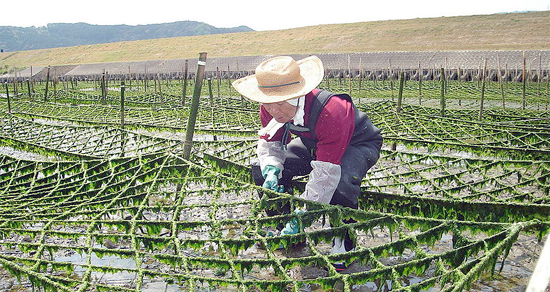
Seaweed farmers feared the day when they would turn into mere laborers of these
giant foreign corporations instead of producers of seaweeds.
Seaweed farmers get P25T gross from seaweeds in a 2,500 sq. meter area five
times a year. Sales from abalone at P470/kilo, "tihi-tihi", sea cucumber at
P2,000/kilo and rare shells adds up to a tidy sum for the seaweed farmers.
Representatives from the Seaweed Investors Association of the Philippines (SIAP)
condemned the brazenness of these foreign corporations for threatening the
livelihood of the Filipino fisherfolks.
They voiced their suspicion that this MOU is now peddled in roadshows abroad to
entice investors for the project.
The marine aquaculture project, according to Atty. Titus Vistal of the
Provincial Planning and Development Office (PPDO) was never formally discussed
in the Provincial Development Council (PDC) but was taken up only as an
exploratory project.
Questions were also raised on the need for the Sangguniang Panglalawigan (SP) to
have been consulted on such an ambitious project even if the joint venture
project was in the nature of an Memorandum of Understanding (MOU).
During the meeting, seaweed growers associations, non-government organizations
(NGO's), People's organizations (PO's) engaged in marine protection were one in
denouncing not only the past administration but the Korean government for
deliberately ignoring a basic requirement for such a big project - public
consultation with the stakeholders.
Letters sent to the Korean government by the seaweed growers were ignored.
Even the municipality of Talibon which granted, upon the request of Aumentado,
50 has. in the islands of Sag and Bansan islands never informed the seaweed
growers about the areas reserved for the bioethanol project.
But stakeholders later found out that instead of Biol Co., the signatory of the
MOU, a firm by the name of Algahol, set up operations in Talibon.
Another firm, Metallic Ore Harvester Corporation identified as a Taiwanese
company is also into seaweeds farming in a 1200 has area also in Nocnocan isled
in Talibon.
Heavily armed security guards has been driving out local fishermen from their
farm area.
Leandres Artiaga, Fisheries Technician of the Provincial Agriculture Office (PAO), who was privy to the entry of Algahol in Talibon, told the Chronicle that he was pressured by a certain Ho Jea Lee, a Korean investor to sign the incorporation papers as an investor and a member of the board of directors for 50 shares valued at P1,861.
He further said that June Blanco, a former executive assistant of the Governor
also signed as an incorporator of Algahol.
Artiaga added that he submitted to the Provincial Legal Office an affidavit
withdrawing as member of the board of Algahol.
Meanwhile, June Blanco confirmed to the Chronicle that she signed as an
incorporator and secretary of Algahol to complete a corporation requirement.
Atty. Cathy Jamila of the Provincial Legal Office raised a constitutional issue
on a corporation exploiting our natural resources.
Initial findings showed that Algahol is a foreign corporation engaged in the
exploitation of our fisheries and aquatic resources which are reserved
exclusively for Filipinos.
A review of the registration papers of Algahol is now underway.
Atty. Handel Lagunay, former Provincial Legal Officer told the Chronicle that
Algohol is a foreign corporation incorporated domestically in the Philippines.
He also said that Algohol is not into actual seaweed farming but engaged in
research and development of marine aquaculture, procurement and marketing of
seaweed produce of the local seaweed farmers.
The 13 has. reported to be found planted with seaweeds was a pilot area to test
if certain varieties would thrive in the area, explained Lagunay.
The MOU between Biolsystems Co., Ltd. of the Republic of Korea and the Province
of Bohol were signed by 28 of the 30 Mayors of the coastal municipalities in
Bohol last July 16, 2009.
Inputs gathered from the public consultation will be collated and presented to
the Korean party on Wednesday, at the Bohol Tropics Hotel.
A few questions:
1. Who decided that the contract be for 50 years? Why so long?
2. Since the project will not be directly in Bohol waters, and since it was mentioned that it would be in cooperation with other province(s), which provinces are going to be involved aside from Bohol?
3. Why did the former provincial administration keep this on a low profile?
4. Where there other dealings with other foreign investors, aside from the Republic of Korea?
5. What is the current provincial government's plans with sea-weed farming? Is it even included?
Thanks.