Join MikeLigalig.com!

Why Just Read When You Can Join, Post, and Read!

Menu

Show posts

This section allows you to view all posts made by this member. Note that you can only see posts made in areas you currently have access to.

Show posts Menu

Messages - hubag bohol

#25101
By Associated press (Associated Press) | Updated May 4, 2013 - 7:02am


Lamb kebabs are seen in this photo. Lamb is a popular dish in the western China region of Xinjiang, which is predominantly Muslim. Spices like cumin, not common in other areas of China, are featured in these kebabs. (AP Photo/Larry Crowe)


BEIJING  -- Chinese police have broken up a criminal ring accused of taking meat from rats and foxes and selling it as lamb in the country's latest food safety scandal.

The Ministry of Public Security released results of a three-month crackdown on food safety violators, saying in a statement that authorities investigated more than 380 cases and arrested 904 suspects.
#25102
Photos Unlimited / Re: I'm sexy and I know it!
May 04, 2013, 11:03:46 AM

#25103
Facts and Trivia / Re: OPTICAL ILLUSIONS GALLERY
May 04, 2013, 10:55:32 AM


Unsa man ni? :-\
#25104
Quotable Quotes / Pour memoire
May 04, 2013, 10:49:51 AM


8)
#25105


8)
#25106
Cars and Automotive / Re: A war freak's pickup
May 04, 2013, 10:31:26 AM
Puno galing ni og high-powered weapons... :P
#25107
Cars and Automotive / A war freak's pickup
May 04, 2013, 10:30:42 AM

#25108
Quote from: hubag bohol on May 04, 2013, 10:23:10 AM
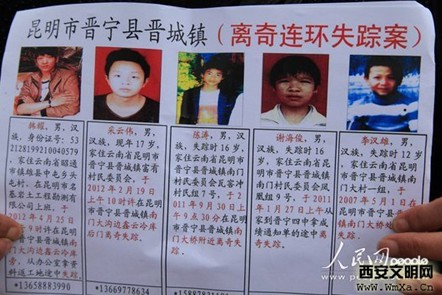
Yongming ate his victims. He also dried and cured the leftover human flesh and sold it....

Kusahos? :(
#25109


Missing chidren who were likely Yongming's victims
#25110


Cannibalism was also practiced on a massive scale during the 1950s in China, which is documented in “The Black Book of Communism” by Stephane Courtis and Nicolas Werth. During the ill-planed Great Leap Forward, tens of millions of Chinese inhabitants died of starvation due to an ill-fated industrialization project that the Chinese government attempted to implement at the time. Exact figures remain murky, but cannibalism was practiced to ward off starvation among perhaps millions.

The death penalty is also commonly practiced in China. According to Amnesty International, China executes “thousands” of its citizens every year. But while Yongming was one of many Chinese to be executed in China every year, his crimes will definitely stand out as one of the most heinous in a country of 1.35 billion people.
#25111
Police were able to conclusively tie Yongming to one of the victims when they found ID, a phone card, and other items belonging to a missing 19-year-old inside Yongming’s house.

Despite the sensationalist aspects of Yongming’s crimes and his execution, the practice of cannibalism has occurred frequently throughout China’s history. Cannibalism was a common practice during the Tang Dynasty in the seventh and eighth centuries when soldiers would eat their enemies after an attack.
#25112
Witnesses reported that Yongming began selling meat at the local market, which he had never done before, after 1997. The meat, which he sold as ostrich meat, was cured and dried.

When police finally searched Yongming’s house, they found strips of human flesh that were hung up to dry around his house. He kept dozens of human eyeballs preserved in alcohol in bottles, which police said looked like “snake wine.”  Investigators said Yongming likely fed human remains to his dogs. In a nearby vegetable garden, police found bones believed to be human. According to the Daily Mirror, witnesses reported seeing garbage bags overflowing with bones hanging from his house.
#25113
Prior to his arrest, Yongming, 57, attempted to capture a 17-year-old boy from behind by putting a leather belt around his neck. The teenager screamed for help, which prompted Yongming to release him after several local villagers came to his aid. Police arrested Yongming after the incident, but released him after Yongming convinced them that he was only playing with the boy. Police also dismissed Yongming as a local lunatic who they claimed was not a threat when prompted to investigate him in connection to the missing persons reports.
#25114
Local police were criticized for taking so long to question Yongming, who previously served 18 years in prison for a murder which involved bodily mutilation. Police were slow to search Yongming’s house or even question him when at least 20 people went missing (of which seven were teenagers) in or around Kunming since 2007. While 20 people within a two-mile radius of Yongming have been reported missing, police were only able to tie Yongming to 11 of the victims.
#25115
http://www.trutv.com/
January 15, 2013 11:51 AM By Bruce Gain


Zhang Yongming


When Chinese cannibal Zhang Yongming was executed, it was for murder, but his acts go far beyond just killing. Yongming ate his victims. He also dried and cured the leftover human flesh and sold it in the southwestern village market of Kunming as ostrich meat, according to Hong Kong newspaper The Standard.
#25116
Quote from: bugsay on May 03, 2013, 08:49:58 AM
dia ra ko's valencia nangita'g signal...;D

Agoi, di na man tingali ka makabalik sa imong home galaxy, Bay Bugs. Tan-aw na lang, tambal sa kamingaw...


8)
#25117
Quote from: bugsay on May 03, 2013, 08:48:50 AM
olwis tagay!;D

He he, unya, samtayms sarasay? ;D
#25118
As expected, all of the players knew their actual ratings. Yet 75% of them thought that their rating underestimated their true playing ability. The magnitude of their overconfidence was stunning: On average, these competitive chess players estimated that they would win a match against another player with the exact same rating as their own by a two-to-one margin â€" a crushing victory. Of course, the most likely outcome of such a match would be a tie.

This tendency for the least skilled among us to overestimate their abilities the most has more serious consequences than an inflated sense of humor or chess ability. Everyone has encountered obliviously incompetent managers who make life miserable for their underlings because they suffer from the illusion of confidence. And as the joke reminds us, the people who graduate last in their medical school class are still doctors; what is less funny is that they probably believe they are still the best ones.


:P
#25119
Chess, for instance, has a mathematical rating system that provides up-to-date, accurate and precise numerical information about a player’s “strength” (chess jargon for ability) relative to other players. Ratings are public knowledge and are printed next to each player’s name on tournament scoreboards. Ratings are valued so highly that chess players often remember their opponents better by their ratings than by their names or faces. “I beat a 1600” or “I lost to a 2100” are not uncommon things to hear in the hallway outside the playing room.

Armed with knowledge of their own ratings, players ought to be exquisitely aware of how competent they are. But what do they actually think about their own abilities? Some years ago, in a study we conducted with our colleague Daniel Benjamin, we asked a group of chess players at major tournaments two simple questions: “What is your most recent official chess rating?” and “What do you think your rating should be to reflect your true current strength?”
#25120
The story of McArthur Wheeler was told by social psychologists Justin Kruger and David Dunning in a brilliant paper entitled “Unskilled and Unaware of It.” In a set of clever experiments, Kruger and Dunning showed that people with the least skill are the most likely to overestimate their abilities. For example, they measured people’s sense of humor (psychologists have learned that almost anything can be measured) and found that those who scored the lowest on their test still thought they had a better-than-average sense of what is funny.

These findings help to explain why shows like “American Idol” and “Last Comic Standing” attract so many aspiring contestants who have no hope of qualifying, let alone winning. Many are just seeking a few seconds of TV time and a shot at “Pants on the Ground” fame, but some seem genuinely shocked when the judges reject them.

It turns out that the illusion of confidence can survive even the measurement of skill.
#25121
In movies, criminal masterminds often are geniuses, James Bond villains in volcano lairs. But the stereotype doesn’t apply to actual cons, at least not the ones who get caught.

Studies show those convicted of crimes are, on average, less intelligent than non-criminals. And they can be spectacularly foolish. One of us had a high school classmate who decided to vandalize the school â€" by spray painting his own initials on the wall. A Briton named Peter Addison went one step further and vandalized the side of a building by writing “Peter Addison was here.” Sixty-six-year-old Samuel Porter tried to pass a one-million-dollar bill at a supermarket in the United States and became irate when the cashier wouldn’t make change for him. All of these people seem to have been under what we call the “illusion of confidence,” which is the persistent belief that we are more skilled than we really are â€" in this case, that the criminals were so good they would not get caught.
#25122
The less you know, the more you think you do


By DANIEL SIMONS and CHRISTOPHER CHABRIS
http://www.nypost.com/


Charles Darwin observed that “ignorance more frequently begets confidence than does knowledge.” That was certainly true on the day in 1995 when a man named McArthur Wheeler boldly robbed two banks in Pittsburgh without using a disguise. Security camera footage of him was broadcast on the evening news the same day as the robberies, and he was arrested an hour later. Mr. Wheeler was surprised when the police explained how they had used the surveillance tapes to catch him. “But I wore the juice,” he mumbled incredulously. He seemed to believe that rubbing his face with lemon juice would blur his image and make him impossible to catch.
#25123
Quotable Quotes / A few thoughts on ignorance
May 04, 2013, 09:54:56 AM


:P
#25124
After the brief visit with his family, Roger was taken back to the same hotel where he had been tortured.  But this time, he managed to escape through a window in the restroom.  After fleeing the hotel, Roger Roxas went into hiding.  He never saw the golden Buddha again.

At least two witnesses claim to have seen the Buddha at one of Marcos’ summer palaces.  Ferdinand Marcos died in 1989, but rumors persist that his family still has the golden Buddha.

:P
#25125
The soldiers locked Roger in a hotel and tortured him until he signed a paper stating that he was paid off to lie about the Buddha.  The soldiers also wanted Roger to tell them where the gold was hidden.  He was tortured daily for several weeks.  But Roger had no intentions on telling the soldiers anything:

“I made a promise to Mr. Fuchigami. I told him even if they to kill me, I will not tell them where the tunnel is.”

Eventually, Roger was allowed to see his family:

“My wife was crying.  She was surprised.  And she said what is happening to you.  You know they might kill you.  And I said just pray, and then the soldiers took me again.”
#25126
While Roger remained secluded, Filipino  reporters had already gotten a hold of the story.  Marcos allowed the press to view the Buddha.  But his political opponents felt that Marcos had substituted a fake.  They wanted to embarrass Marcos, so they tracked down Roger and convinced him to return to Manila to identify the Buddha.  Marcos was outraged.  Once again, Roger went into hiding.  But according to Roger, two weeks later he was tracked down by the Palace Guard:

“Three men approached me and pointed their guns at me.  They knew me.  They told me Roger, come with us in the car, we will bring you to Manila.  I could not escape.  I couldn’t escape.  I knew they were soldiers.  They had guns.  They called the palace and they were speaking English.  I knew that it was Marcos they were talking to because they addressed him as Mr. President.  Marcos must have asked them, are you sure it is Roger Roxas that you captured.  And they said yes, we’re sure.”
#25127
The next day, Roger and his brothers reported the incident to the local police.  Then he went to visit Judge Pio Marcos, a family friend:

“I told him, judge, why did you let them confiscate my treasure, we’re friends.  He said, Roger there is nothing that I can do.  I said why?  He said because the prince asked for it.  I said who’s the prince.  And he said the prince, President Marcos.”

According to Roger, the judge warned him that Marcos had put a price on his head.  Roger and his family fled to an isolated jungle village to hide.
#25128
Although the Philippines was a democracy, Ferdinand Marcos, along with his wife, Imelda, ruled like a king with an iron hand and brute force.  Two months after Roger brought the Buddha home, soldiers invaded his house.  The red ribbons on their rifles indicated that they were members of President Marcos’ elite Palace Guard.  Then out of nowhere, the potential buyer appeared.  Roger had been double-crossed:

“They took everything, even the piggy banks of my children. Whatever my wife inherited, all her jewelry, all the diamonds in the closet.  They took all of it. If we had fought back, they would just have killed us.”
#25129
Roger took the Buddha home.  A potential buyer confirmed that the Buddha was solid gold.  After the buyer left, Roger and his brother decided to take a closer look at the Buddha.  Roger had noticed that the buyer paid particular attention to the Buddha’s neck:

“My brother and I had a suspicion that there was an opening inside the Buddha. We got a piece of wood and we hit the Buddha several times with this piece of wood.”


Roger with Buddha, head removed


According to Roger, there were handfuls of diamonds inside the Buddha.  Some were rough-cut and some fine.  Roger hid the diamonds in a closet.  That night, Roger’s brother took pictures of Roger with the Buddha.  Roger thought the pictures might protect him, but he was wrong.  News of his discovery had already spread all the way to the President’s palace in Manila.
#25130
Roger Roxas and Albert hired a crew to excavate the site.  In the first few minutes of digging, they found a layer of Japanese shrapnel.  A few weeks later, the crew broke through into the tunnels, which the Japanese had apparently dynamited shut.  The tunnel system was elaborate, complete with railroad tracks.  They found that one explosion had blocked all access to the main underground passageway.  Undaunted, they dug around it.  Roger Roxas was the first to enter:

“To my surprise, I found several Japanese skeletons.  There must have been more than 10.”

Roger had stumbled upon a forgotten tomb.  It was there, that he made a shocking discovery.  Sitting in the cavity was a large solid gold statue of Buddha.  Roger and Albert were stunned.  While their crew attempted to move the 2,000 pound Buddha, the two explorers ventured further inside the tunnel.  Just as the map had predicted, there were boxes and boxes of solid gold bars.  Roxas and Fuchigami decided to dynamite the tunnel to hide the treasure.  They planned to sell the Buddha to buy trucks and equipment so they could comeback and get the gold out of the tunnel.
#25131


Roger uncovered treasue in underground tunnels


In 1970, Roger Roxas and his family lived 200 miles north of Manila on the Philippine island of Luzon.  On weekends, Roger spent his time treasure hunting with a large group of Filipinos.  One of Roger’s fellow treasure hunters was Albert Fuchigami.  Albert had been shown a treasure map by his father, who was an officer in the Japanese Army during World War II.  The map pinpointed the location of a secret tunnel system where the Japanese had left behind a fortune in gold bars.  Roger was confident his friend was telling the truth:

“We were friends for a long time before he told me that he knew of a hidden treasure.  He revealed to me what he knew about the tunnels.  I had very high hopes because Fuchigami was the son of a Japanese soldier.”
#25132
FERDINAND MARCOS’ GOLD BUDDHA
http://unsolved.com/


A Filipino man finds a solid gold Buddha, then it’s stolen, possibly by Ferdinand Marcos.


Roger Roxas with Buddha


CASE DETAILS

From 1965 to 1986, Ferdinand Marcos ruled the Philippinesâ€"first as an elected leader, then as a dictator.  By the time Marcos was deposed, his personal wealth was estimated at $10 billion.  Few dared to challenge Marcos publicly.  But on May 5, 1971, a man named Roger Roxas defied Marcos and went public with a daring accusation.  He accused the dictator’s soldiers of stealing a rare, solid gold Buddha worth millions.
#25133
Yamashita's gold, also referred to as the Yamashita treasure, is the name given to the alleged war loot stolen in Southeast Asia by Japanese forces during World War II and hidden in caves, tunnels and underground complexes in the Philippines. It is named for the Japanese general Tomoyuki Yamashita, nicknamed "The Tiger of Malaya". Though accounts that the treasure remains hidden in Philippines have lured treasure hunters from around the world for over fifty years, its existence is dismissed by most experts. The rumored treasure has been the subject of a complex lawsuit that was filed in a Hawaiian state court in 1988 involving a Filipino treasure hunter, Rogelio Roxas, and the former Philippine president, Ferdinand Marcos. --Wiki
#25134


Tomoyuki Yamashita, 1945
#25135
On April 5 1971, Roxas claimed that armed men purportedly from the National Bureau of Investigation and the Criminal Investigation Service forcibly confiscated the gold bars and statue from his home in Aurora Hill, Baguio City. On April 19 1971, the military deposited a Buddha statue at the Baguio City Court; however, Roxas proclaimed that it was not the same statue taken from him. Roxas later claimed that then-President Ferdinand Marcos orchestrated the raid and was in possession of the treasure. Roxas was arrested in Cabanatuan City by three men in civilian clothing on May 18, 1971 and jailed for several years. --Wiki
#25136
Rogelio "Roger" Domingo Roxas (died May 25 1993) was a former Filipino soldier who had worked as a locksmith before allegedly discovering in a cave north of Manila a hidden chamber full of gold bars and a giant golden Buddha statue â€" which Roxas estimated to weigh one metric ton â€" on a plot of state-owned land near Baguio General Hospital, in Baguio City on January 24 1971. Roxas claimed that the Buddha's head was removable and that it concealed a hollowed-out portion within the statue that contained at least two handfuls of uncut diamonds. The cache was alleged to be a portion of the legendary Yamashita treasure. --Wiki
#25137


;D
#25138
Quotable Quotes / Re: Quote For The Day
May 04, 2013, 06:38:25 AM


:P
#25139


:P
#25140
Photos Unlimited / Re: Waiting in black and white
May 04, 2013, 06:32:37 AM
He he, pwede pood... ;D
#25141
History / Re: The Case of Sacco and Vanzetti
May 04, 2013, 06:29:39 AM
After the conviction Judge Thayer himself abandoned the identification of Sacco and Vanzetti as the ground on which the jury's verdict rested. In denying a motion for a new trial, based on the discovery of a new eyewitness with better opportunities for observation than any of the other witnesses on either side, who, in his affidavit, swore that Sacco was not the man in the car, Judge Thayer ruled that this evidence would simply mean one more piece of evidence of the same kind and directed to the same end, and in my judgment would have no effect whatever upon the verdicts. These verdicts did not rest, in my judgment, upon the testimony of the eyewitnesses, for the defendants, as it was, called more witnesses than the Commonwealth to testify that neither of the defendants were in the bandit car. 

The evidence that convicted these defendants was circumstantial and was evidence that is known in law as 'consciousness of guilt.
#25142
History / Re: The Case of Sacco and Vanzetti
May 04, 2013, 06:29:14 AM
What is the worth of identification testimony even when uncontradicted? The identification of strangers is proverbially untrustworthy. The hazards of this type of testimony are established by a formidable number of instances in the records of English and American trials. These instances are recentâ€"not due to the brutalities of ancient criminal procedure.

In the Sacco-Vanzetti case the elements of uncertainty were intensified. All the identifying witnesses were speaking from casual observation of men they had never seen before, men of foreign race, under circumstances of unusual confusion. Thus, one witness, Cole, "thought at the first glance that the man was a Portuguese fellow named Tony that he knew." Afterward he was sure it was Vanzetti. Nor can we abstain from comment on the methods pursued by the police in eliciting subsequent identification. The recognized procedure is to line up the suspect with others, and so far as possible with individuals of the same race and class, so as not to provoke identification through accentuation. In defiance of these necessary safeguards, Sacco and Vanzetti after their arrest were shown singly to persons brought there for the purposes of identification, not as part of a "parade." Moreover, Sacco and Vanzetti were not even allowed to be their natural selves; they were compelled to simulate the behavior of the Braintree bandits. Under such conditions identification of foreigners is a farce.
#25143
History / Re: The Case of Sacco and Vanzetti
May 04, 2013, 06:27:37 AM
At the time that he urged on the jury this testimony of LeVangie, the District Attorney had held interviews with, and had in his possession written statements of, the only two persons, Kelly and Kennedy, who had an extended opportunity to observe the driver of the car. The detailed description given by them absolutely excluded Vanzetti. The reliability of these observers and of their statements has not been challenged. Yet they were not called by the District Attorney; instead he called LeVangie.

Unfortunately the existence of Kelly and Kennedy was until very recently unknown to the defense, and of course, therefore, their testimony was unavailable for Sacco and Vanzetti at the trial.

The alibi for Vanzetti was overwhelming. Thirty-one eyewitnesses testified positively that no one of the men that they saw in the murder car was Vanzetti. Thirteen witnesses either testified directly that Vanzetti was in Plymouth selling fish on the day of the murder or furnished corroboration of such testimony.
#25144
History / Re: The Case of Sacco and Vanzetti
May 04, 2013, 06:27:08 AM
Right or wrong, we have to take it as it is. And I agree if it depends on the accuracy of the statement that Vanzetti was driving, then it isn't right, because I would have to reject personally the testimony of witnesses for the defense as well as for the Commonwealth who testified to the contrary. I ask you to find as a matter of common sense he was, in the light of other witnesses, in the car, and if on the left side that he may well have been immediately behind the driver.

In other words, obliged to repudiate the testimony of LeVangie that Vanzetti was on the front seat, the Commonwealth urged the jury to find that, although LeVangie said Vanzetti was on the front seat, he meant he was on the back seat.
#25145
History / Re: The Case of Sacco and Vanzetti
May 04, 2013, 06:26:14 AM
We cannot mould the testimony of witnesses, gentlemen. We have got to take them as they testify on their oath, and we put LeVangie on because necessarily he must have been there. He saw something. He described a light-haired man to some of the witnesses. They produced Carter, the first witness they put on, to say that he said the light-haired manâ€"the driver was a light-haired man. That is true. I believe my brothers will agree with me on that proposition, but he saw the face of Vanzetti in that car, and is his testimony to be rejected if it disagrees with everybody else if you are satisfied he honestly meant to tell the truth? 

And can't you reconcile it with the possibility, no, the likelihood, or, more than that, the probability that at that time Vanzetti was directly behind the driver in the quick glance this man LeVangie had of the car going over when they were going up over the crossing?... 
#25146
History / Re: The Case of Sacco and Vanzetti
May 04, 2013, 06:25:41 AM
Moreover, LeVangie was discredited by all the other identification witnesses on both sides, who insisted that the driver of the car was a young, small, light-haired man, whereas Vanzetti was middle-aged, dark, with a black moustache. But, though the District Attorney had to repudiate LeVangie, he characteristically held on to LeVangie's identification. The following quotation from the District Attorney's summing up reveals the worthlessness of LeVangie's testimony; it throws no less light on the guiding attitude of the prosecution:â€"

They find fault, gentlemen, with LeVangie. They say that LeVangie is wrong in saying that Vanzetti was driving that car. I agree with them, gentlemen. I would not be trying to do justice to these defendants if I pretended that personally so far as you are concerned about my personal belief on that, that Vanzetti drove that car over the crossing. I do not believe any such thing. You must be overwhelmed with the testimony that when the car started it was driven by a light-haired man who showed every indication of being sickly. 
#25147
History / Re: The Case of Sacco and Vanzetti
May 04, 2013, 06:24:45 AM
2. LeVangie, the gate tender of the New Haven railroad, was on duty at the South Braintree grade crossing on the day of the murder. According to his testimony, the murder car drove up to the crossing just as he was lowering the gate, and a man inside forced him at the point of a revolver to let the car through before the advancing train. LeVangie identified Vanzetti as the man who was driving the car. LeVangie's testimony was discredited by the testimony of McCarthy, a locomotive fireman of the New Haven, who testified that three quarters of an hour after the murders he had the following conversation with LeVangie:â€"

LeVangie said, 'There was a shooting affair going on.' I says, 'Someone shot?' I says, 'who?' 'Someone, a fellow got murdered.'

I said, 'who did it?' He said he did not know. He said there was some fellows went by in an automobile and he heard the shots, and he started to put down the gates, and as he started to put them down one of them pointed a gun at him and he left the gates alone and ducked in the shanty. I asked him if he knew them. He said, no, he did not. I asked him if he would know them again if he saw them. He said, 'No.' He said all he could see was the gun and he ducked.
#25148
History / Re: The Case of Sacco and Vanzetti
May 04, 2013, 06:23:42 AM
1. Harry E. Dolbeare testified that somewhere between 10 and 12 A.M. he saw a car going past him in South Braintree with five people in it, one of whom he identified as Vanzetti:â€"

I felt it was a tough-looking bunch. That is the very feeling that came to my mind at the time....I guess that is all. That is all I recall now.

There is nothing other than what he has already given by which he characterizes these men as a tough-looking bunch. He does not know whether the other two men who sat on the back seat had moustaches or beards of any kind. He does not know what kind of a hat or cap the man in the middle, who leaned forward to speak, wore. He does not know whether this man had a cap with a visor projecting out or whether he had on a slouch hat.
#25149
History / Re: The Case of Sacco and Vanzetti
May 04, 2013, 06:23:06 AM
II. As to Vanzetti:â€"

The Commonwealth offered two witnesses who claimed to identify Vanzetti as an occupant of the murder car. Of these one, Dolbeare, claimed to have seen him hours before the murder, leaving only a single individual, LeVangie, who claimed to have seen him on the spot. The Commonwealth sought to piece out the tenuous testimony by the evidence of two other witnesses who claimed to have seen Vanzetti during the day of the murder elsewhere than at Plymouth, but not at South Braintree. One witness, Faulkner, testified to recollecting a fellow passenger on a train going from Cochesett to Boston who got out at East Braintree at 9.54, and identified Vanzetti as that passenger. The basis of Faulkner's recollection was so frail, and was so fully destroyed by three railroad officials, that further recital of his testimony is superfluous. Finally Reed, a crossing tender, purported to recognize Vanzetti as the man sitting on the front seat of a car which he claimed to identify as the murder car.

This was at some distance from Braintree, more than an hour after the murders. Reed's testimony placing Vanzetti on the front seat of the car ran counter to the theory of the Commonwealth that Vanzetti was at the rear. Moreover, Reed testified that "the quality of the English [of Vanzetti] was unmistakable and clear," while at the trial Vanzetti's English was found to be so imperfect that an interpreter had to be employed.
#25150
History / Re: The Case of Sacco and Vanzetti
May 04, 2013, 06:21:14 AM
5. Carlos E. Goodridge (who after the trial was discovered to be a fugitive from justice in another state and to have given evidence under a false name) swore that at the time of the shooting he was in a poolroom in South Braintree, heard shots, stepped to the door, and saw an automobile coming toward him, and that when he got to the sidewalk a man in the automobile "poked a gun over towards him," whereupon he "went back into the poolroom." About seven months later he identified Sacco as the man for the first time and identified him again at the trial.

Four witnesses, including his employer, squarely contradicted Goodridge's belated identification. Even when completely disinterested, identification testimony runs all the grave hazards due to the frailties and fallibilities of human observation and memory. But Goodridge's testimony, in addition to everything else, was tainted with self-interest. At the time he was a witness for the Commonwealth, he was facing jail under an indictment for larceny to which he had pleaded guilty. The case "had been filed,"â€"that is, no sentence had been imposed,â€"and Goodridge had been placed on probation. The Judge did not allow the defense to show that Goodridge's testimony on behalf of the Commonwealth was influenced by leniency previously shown to him by the District Attorney in connection with the confessed charge of larceny and by fear of losing his immunity. In the light of settled principles of the law of evidence, this ruling, though later sustained by the Supreme Court of Massachusetts, is indefensible.
#25151
History / Re: The Case of Sacco and Vanzetti
May 04, 2013, 06:20:33 AM
Yet the District Attorney not only offered the Andrews testimony for the consideration of the jury, but gave it the weightiest possible personal sponsorship:â€"

And then there is Lola Andrews. I have been in this office, gentlemen, for now more than eleven years. I cannot recall in that too long service for the Commonwealth that ever before I have laid eye or given ear to so convincing a witness as Lola Andrews.
#25152
History / Re: The Case of Sacco and Vanzetti
May 04, 2013, 06:19:56 AM
Four reputable witnesses completely discredited the Andrews testimony. The following sample must suffice. It is the testimony of a Quincy shopkeeper.

I said to her, 'Hello, Lola,' and she stopped and she answered me. While she answered me I said, 'You look kind of tired.' She says, 'Yes.' She says, 'They are bothering the life out of me.' I says, 'What?' She says, 'I just come from jail.' I says, 'What have you done in jail?' She says, 'The Government took me down and want me to recognize those men.' she says, 'and I don't know a thing about them. I have never seen them and I can't recognize them.' She says, 'Unfortunately I have been down there to get a job and I have seen many men that I don't know and I have never paid any attention to anyone.'
#25153
History / Re: The Case of Sacco and Vanzetti
May 04, 2013, 06:19:16 AM
Q. Would you say that the man had a fuller or more slender face [than the man in a photograph shown to the witness]? 

A. I don't know. He had a funny face.... 

Q. Meaning by that a face that was not a kindly face, a kind of brutal face? 

A. He did not have a real good looking face. 

Q. (by the District Attorney) What came to your mind, if anything, when you learned of the shooting? 

A. Why, the only way I can answer that is this: When I heard of the shooting I somehow associated the man I saw at the car.
#25154
History / Re: The Case of Sacco and Vanzetti
May 04, 2013, 06:18:25 AM
4. Lola Andrews, a woman of doubtful reputation, testified that at about 11 A.M. on the day of the murders, while in company with a Mrs. Campbell, she saw an automobile standing outside the Slater and Morrill factory. She saw a "very light" man inside the car (concededly neither Sacco nor Vanzetti) and another man "bending over the hood of the car," whom she characterized as a "dark-complexioned man." She went into the factory in search of a job and at the time "had no talk with either of the men." When she came out "fifteen minutes later" the dark man "was down under the car like he was fixing something" and she asked him the way to another factory. He told her. That was the whole conversation between them. After Sacco's arrest she was taken to the Dedham jail and identified Sacco as the dark-complexioned man. She again identified him at the trial.

How came she to connect the dark man under the car with the murders which took place four hours later?
#25155
History / Re: The Case of Sacco and Vanzetti
May 04, 2013, 06:17:33 AM
On cross-examination Pelzer admitted that immediately after Sacco's arrest, on May 6 or 7, he was unable to make any identification. His inability in May 1920 to make the identification which he made in June 1921 was confirmed by three fellow workmen. Two of them testified that instead of pulling up the window he took shelter under a bench, and the third in addition said: "I heard him say that he did not see anybody."

Pelzer's tergiversations and falsifications extracted from the District Attorney, Mr. Katzmann, the following eulogy:â€"

He was frank enough here, gentlemen, to own that he had twice falsified before to both sides, treating them equally and alike, and he gave you his reason. I think he added that he had never been in court before. If not, somebody has and I confused him. It is of little consequence. He is big enough and manly enough now to tell you of his prior falsehoods and his reasons for them. If you accept them, gentlemen, give such weight to his testimony as you say should be given.
#25156
History / Re: The Case of Sacco and Vanzetti
May 04, 2013, 06:16:48 AM
This was the foundation for the following identification:â€"

Q. Do you see in the courtroom the man you saw shooting Berardelli that day? 

A. Well, I wouldn't say it was him, but he is a dead image of him.

Witness points out Mr. Sacco.

Q. Have you seen him since that time until you saw him in the courtroom? 

A. No, sir.

Witness was shown picture of him by Mr. Williams to-day.

Q. You say you wouldn't say it is him, but he is the dead image of him? What do you mean by that? 

A. Well, he has got the same appearance.
#25157
History / Re: The Case of Sacco and Vanzetti
May 04, 2013, 06:16:05 AM
3. Pelzer, a young shoe-cutter, swore that when he heard the shooting he pulled up his window, took a glance at the scene, and saw the man who murdered Berardelli.

Q. How long did you stay in the window? 

A. Oh, aboutâ€"I would say about a minute.... 

Q. Then what did you do? 

A. I seen everything happen about that time, about in a minute.
#25158
History / Re: The Case of Sacco and Vanzetti
May 04, 2013, 06:15:14 AM
2. Devlin, at Quincy a month after the murder, merely said, "He [Sacco] looks very much like the man that stood up in the back seat shooting."

Q. Do you say positively he is the man? 

A. I don't say positively.

At the trial, over a year later, she had no doubt and when asked, "Have you at any time had any doubt of your identification of this man?" replied, "No." The obvious discrepancy of an identification reaching certainty by lapse of time, without any additional opportunity for verification, she explained thus: "At the time there I had in my own mind that he was the man, but on account of the immensity of the crime and everything, I hated to say right out and out."

The inherent improbability of making any such accurate identification on the basis of a fleeting glimpse of an unknown man in the confusion of a sudden alarm is affirmed by the testimony of two other eyewitnesses. Ferguson and Pierce, from a window above Splaine and Devlin, on the next floor of the factory, had substantially the same view. They found it impossible to make any identification.
#25159
History / Re: The Case of Sacco and Vanzetti
May 04, 2013, 06:14:09 AM
Let Dr. Morton Prince, professor of dynamic psychology at Harvard University, comment on this testimony:â€"

I do not hesitate to say that the star witness for the government testified, honestly enough, no doubt, to what was psychologically impossible. Miss Splaine testified, though she had only seen Sacco at the time of the shooting from a distance of about sixty feet for from one and one-half to three seconds in a motor car going at an increasing rate of speed at about fifteen to eighteen miles an hour; that she saw and at the end of a year she remembered and described sixteen different details of his person, even to the size of his hand, the length of his hair as being between two and two and one-half inches long, and the shade of his eyebrows! Such perception and memory under such conditions can be easily proved to be psychologically impossible. Every psychologist knows thatâ€"so does Houdini. And what shall we think of the animus and honesty of the state that introduces such testimony to convict, knowing that the jury is too ignorant to disbelieve?
#25160
History / Re: The Case of Sacco and Vanzetti
May 04, 2013, 06:12:09 AM
When confronted with this contradiction between her uncertainty a month after her observation and her certainty more than a year after her observation; she first took refuge in a claim of inaccuracy in the transcript of the stenographer's minutes. This charge she later withdrew and finally maintained:â€"

From the observation I had of him in the Quincy court and the comparison of the man I saw in the machine, on reflection I was sure he was the same man.

Then followed this cross-examination:â€"

Q. Your answer in the lower court was you didn't have opportunity to observe him. What did you mean when you said you didn't have opportunity sufficient, kindly tell us, you didn't have sufficient opportunity to observe him? 

A. Well, he was passing on the street. 

Q. He was passing on the street and you didn't have sufficient opportunity to observe him to enable you to identify him? 

A. That is what I meant. 

Q. That is the only opportunity you had? 

A. Yes, sir. 

Q. You have had no other opportunity but that one meeting glance? 

A. The remembrance of that.
#25161
History / Re: The Case of Sacco and Vanzetti
May 04, 2013, 06:11:10 AM
Q. So that the hand you said you saw where?

A. The left hand, that was placed on the back of the front seat. He had a gray, what I thought was a shirtâ€"had a grayish, like navy color, and the face was what we would call clear-cut, clean-cut face. Through here [indicating] was a little narrow, just a little narrow. The forehead was high. The hair was brushed back and it was between, I should think, two inches and two and one-half inches in length and had dark eyebrows, but the complexion was a white, peculiar white that looked greenish. 

Q. Is that the same man you saw at Brockton? 

A. It is. 

Q. Are you sure? 

A. Positive.

The startling acuity of Splaine's vision was, as a matter of fact, the product of a year's reflection. Immediately after Sacco's arrest the police, in violation of approved police methods for the identification of suspects, brought Sacco alone into Splaine's presence. Then followed in about three weeks the preliminary hearing at which Sacco and Vanzetti were bound over for the grand jury. At this hearingâ€"only forty days after the crimeâ€"Splaine was unable to identify Sacco.

Q. You don't feel certain enough in your position to say he is the man? 

A. I don't think my opportunity afforded me the right to say he is the man.
#25162
History / Re: The Case of Sacco and Vanzetti
May 04, 2013, 06:09:24 AM
From this summary it must be evident that the trustworthiness of the testimony which placed Sacco and Vanzetti in South Braintree on April 15 is the foundation of the case.

I. As to Sacco:â€"

The character of the testimony of the five witnesses who definitely identified Sacco as in the car or on the spot at the time of the murders demands critical attention. These witnesses were Mary Splaine, Frances Devlin, Lola Andrews, Louis Pelzer, Carlos E. Goodridge.

1. Splaine and Devlin were working together on the second floor of the Slater and Morrill factory with windows giving on the railroad crossing about sixty feet away. Both heard the shot, ran to the window, and saw an automobile crossing the tracks. Splaine's identification of Sacco as one of the occupants of this escaping car was one of the chief reliances of the prosecution. Viewing the scene from a distance of from sixty to eighty feet, she saw a man previously unknown to her in a car traveling at the rate of from fifteen to eighteen miles per hour, and she saw him only for a distance of about thirty feetâ€"that is to say, for from one and a half to three seconds. Yet after more than a year she testified:â€"

The man that appeared between the back of the front seat and the back seat was a man slightly taller than the witness. He weighed possibly from 140 to 145 pounds. He was muscular, an active-looking man. His left hand was a goodsized hand, a hand that denoted strength.
#25163
History / Re: The Case of Sacco and Vanzetti
May 04, 2013, 06:08:25 AM
The defense met the Commonwealth's eyewitnesses by other eyewitnesses, slightly more numerous and at least as well circumstanced to observe the assailants, who testified that the defendants were not the men they saw. Their testimony was confirmed by witnesses who proved the presence of Sacco and Vanzetti elsewhere at the time of the murder. Other witnesses supported Sacco's testimony that on April l5â€"the day that he was away from workâ€"he was in Boston seeing about a passport to Italy, whither he was planning shortly to return to visit his recently bereaved father. The truth of that statement was supported by an official of the Italian consulate in Boston who deposed that Sacco visited his consulate at an hour that made it impossible for him to have been one of the Braintree murder gang. The claim of Vanzetti that on April 15 he was pursuing his customary trade as fish peddler was sustained by a number of witnesses who had been his customers that day.
#25164
History / Re: The Case of Sacco and Vanzetti
May 04, 2013, 06:07:50 AM
II.

So far as the crime is concerned, we are dealing with a conventional case of payroll robbery. At the trial the killing of Parmenter and Berardelli was undisputed. The only issue was the identity of the murderers. Were Sacco and Vanzetti two of the assailants of Parmenter and Berardelli, or were they not?
On this issue there was at the trial a mass of conflicting evidence. Fifty-nine witnesses testified for the Commonwealth and ninety-nine for the defendants. The evidence offered by the Commonwealth was not the same against both defendants. The theory of the prosecution was that Sacco did the actual shooting while Vanzetti sat in the car as one of the collaborators in a conspiracy to murder. Witnesses testified to having seen both defendants in South Braintree on the morning of April l5; they claimed to recognize Sacco as the man who shot the guard Berardelli and to have seen him subsequently escape in the car. Expert testimony (the character of which, in the light of subsequent events, constitutes one of the most important features of the case and will be dealt with later) was offered seeking to connect one of four bullets removed from Berardelli's body with the Colt pistol found on Sacco at the time of his arrest. As to Vanzetti, the Commonwealth adduced evidence placing him at the murder car. Moreover, the Commonwealth introduced the conduct of the defendants, as evinced by pistols found on their persons and lies admittedly told by them when arrested, as further proof of identification, in that such conduct revealed "consciousness of guilt."
#25165
History / Re: The Case of Sacco and Vanzetti
May 04, 2013, 06:07:00 AM
Vanzetti, as a fish peddler at Plymouth and his own employer, could not give the same kind of alibi for either day and so he was held for both crimes. Stewart's theory that the crime was committed by these Italian radicals was not shared by the head of the state police, who always maintained that it was the work of professionals. [In this account of the joint trial of Sacco and Vanzetti the details of Vanzetti's separate trial cannot find a place. But Vanzetti's prosecution for the Bridgewater job was merely a phase of the South Braintree affair.].

Charged with the crime of murder on May 5, Sacco and Vanzetti were indicted on September 14, 1920, and put on trial May 21, 1921, at Dedham, Norfolk County. The setting of the trial, in the courthouse opposite the old home of Fisher Ames, furnished a striking contrast to the background and antecedents of the prisoners. Dedham is a quiet residential suburb, inhabited by well-to-do Bostonians, with a surviving element of New England small farmers. Part of the jury was specially selected by the sheriff's deputies from Masonic gatherings and from persons whom the deputies deemed "representative citizens," "substantial" and "intelligent." The presiding judge was Webster Thayer of Worcester. The chief counsel for these Italians was a Westerner, a radical and a professional defender of radicals. In opinion, as well as in fact, he was an outsider. Unfamiliar with the traditions of the Massachusetts bench, not even a member of the Massachusetts bar, the characteristics of Judge Thayer unknown to him, Fred H. Moore found neither professional nor personal sympathies between himself and the Judge. So far as the relations between court and counsel seriously, even if unconsciously, affect the current of a trial, Moore was a factor of irritation. Sacco and Vanzetti spoke very broken English and their testimony shows how often they misunderstood the questions put to them. In fact, an interpreter had to be used, whose conduct raised such doubts that the defendants brought their own interpreter to check his questions and answers. The trial lasted nearly seven weeks, and on July 14, 1921, Sacco and Vanzetti were found guilty of murder in the first degree.
#25166
History / Re: The Case of Sacco and Vanzetti
May 04, 2013, 06:05:47 AM
Such were the circumstances under which the four Italians appeared on the evening of May 5 at the Johnson garage. Two of them were Sacco and Vanzetti. The car was not available and the Italians left, but the police were notified. Sacco and Vanzetti were arrested on a street car, Boda escaped, and the fourth, Orciani, was arrested the next day.

Chief Stewart at once sought to apply his theory of the commission of the two "jobs" by one gang. The theory, however, broke down. Orciani had been at work on the days of both crimes, so he was let go. Sacco, a shoe operative, in steady employment at a shoe factory in Stoughton, had taken a day off, and this was April 15. Hence, while he could not be charged with the Bridgewater crime, he was charged with the Braintree murder.
#25167
History / Re: The Case of Sacco and Vanzetti
May 04, 2013, 06:04:43 AM
During the proceedings for the wholesale deportation of Reds under Attorney General Palmer in the spring of l920, one Salsedo was held incommunicado in a room in the New York offices of the Department of Justice, on the fourteenth floor of a Park Row building. This Salsedo was a radical friend of Boda and his companions. On May 4 these friends learned that Salsedo had been found dead on the sidewalk outside the Park Row building. Already frightened by the Red raids, they bestirred themselves to "hide the literature and notify the friends against the federal police." For this purpose an automobile was needed, and they turned to Boda.
#25168
History / Re: The Case of Sacco and Vanzetti
May 04, 2013, 06:03:01 AM
At the time of the Braintree holdup the police were investigating a similar crime in the neighboring town of Bridgewater. In both cases a gang was involved. In both they made off in a car. In both eyewitnesses believed the criminals to be Italians. In the Bridgewater holdup the car had left the scene in the direction of Cochesett. Chief Stewart of Bridgewater was therefore, at the time of the Braintree murder, on the trail of an Italian owning or driving a car in Cochesett. He found his man in one Boda, whose car was in a garage awaiting repairs. Stewart instructed the garage proprietor to telephone to the police when anyone came to fetch it. Pursuing his theory, Stewart found that Boda had been living in Cochesett with a radical named Coacci. Now on April 16, 1920, which was the day after the Braintree murders, Stewart, at the instance of the Department of Justice, then engaged in the wholesale rounding up of Reds, had been to the house of Coacci to see why he had failed to appear at a hearing regarding his deportation. He found Coacci packing a trunk and apparently very anxious to leave. At the time, Coacci's trunk and his haste to depart for Italy were not connected in Chief Stewart's mind with the Braintree affair. But when, subsequently, the tracks of a smaller car were found near the murder car, he surmised that this car was Boda's; and in the light of his later discoveries he jumped to the conclusion that Coacci, Boda's pal, had "skipped with the swag." As a matter of fact, the contents of the trunk were found eventually to be wholly innocent. In the meantime, however, Chief Stewart continued to work on his theory that whosoever called for Boda's car at Johnson's garage would be suspect of the Braintree crime. On the night of May 5, Boda and three other Italians did in fact call. To explain how they came to do so we must go back a few days.
#25169
History / Re: The Case of Sacco and Vanzetti
May 04, 2013, 06:02:41 AM
I.

At about three o'clock in the afternoon of April 15, 1920, Parmenter, a paymaster, and Berardelli, his guard, were fired upon and killed by two men armed with pistols, as they were carrying two boxes containing the pay roll of the shoe factory of Slater and Morrill, amounting to $15,776.51, from the company's office building to the factory through the main street of South Braintree, Massachusetts. As the murder was being committed, a car containing several other men drew up to the spot. The murderers threw the two boxes into the car, jumped in themselves, and were driven away at high speed across some near-by railroad tracks. Two days later this car was found abandoned in woods at a distance from the scene of the crime.
#25170
History / Re: The Case of Sacco and Vanzetti
May 04, 2013, 06:00:49 AM
FELIX FRANKFURTER
MAR 1 1927, 12:00 PM ET


For more than six years the Sacco-Vanzetti case has been before the courts of Massachusetts. In a state where ordinary murder trials are promptly dispatched such extraordinary delay in itself challenges attention. The fact is that a long succession of disclosures has aroused interest far beyond the boundaries of Massachusetts and even of the United States, until the case has become one of those rare causes célèbres which are of international concern. The aim of this paper is to give in the briefest compass an accurate résumé of the facts of the case from its earliest stages to its present posture.
#25171
History / The Case of Sacco and Vanzetti
May 04, 2013, 05:57:30 AM
http://www.theatlantic.com/
MARCH 1927


In 1921, Nicola Sacco and Bartolomeo Vanzetti, both Italian-Americans, were convicted of robbery and murder. Although the arguments brought against them were mostly disproven in court, the fact that the two men were known radicals (and that their trial took place during the height of the Red Scare) prejudiced the judge and jury against them. On April 9, 1927, Sacco and Vanzetti's final appeal was rejected, and the two were sentenced to death. Felix Frankfurter, then a professor at Harvard Law School, was considered to be the most prominent and respectable critic of the trial. He was appointed to the Supreme Court by Franklin Delano Roosevelt in 1939.
#25172
Business and Economy / Re: The Rule of 69
May 04, 2013, 05:48:16 AM
Quote from: Chongki on May 03, 2013, 05:12:35 PM
.... and easy to apply

Just close your eyes... ;D
#25173
Showbiz & Celebrity / Re: Diva demands
May 04, 2013, 05:47:12 AM
Quote from: islander on May 04, 2013, 01:36:47 AM
It's not unusual for stars to have unusual demands when on tour.

Aw, naa man gani unusual demands ang nondescript whippersnappers...

:P
#25174


A closer look at the fossils showed that the bones had not fully developed.

"We were able to look at microscopic details of Aorun's bones and they showed that the animal was less than a year old when it died on the banks of a stream," said Choiniere.

Choiniere is now a senior researcher at the Evolutionary Studies Institute at the University of the Witwatersrand in Johannesburg, South Africa. In addition to being a GW doctoral student at the time of the discovery, Choiniere was also a Kalbfleisch Fellow and Gerstner Scholar at the American Museum of Natural History.

The research was detailed May 3 in the Journal of Systematic Palaeontology.
#25175
James Clark, a GW biologist, and a team that included his then doctoral student Jonah Choiniere made the find in 2006 at the Shishugou Formation in a remote part of Xinjiang. Aorun is the fourth coelurosaur found in this formation, which has yielded a remarkable diversity of theropods, a group of mostly carnivorous dinosaurs that walked on two legs.

The beasts preserved in the Shishugou deposits date back to a period straddling the Middle and Late Jurassic Period, a time when dinosaurs had just begun to reach enormous sizes and dominate ecosystems on land, Clark's website notes.

"All that was exposed on the surface was a bit of the leg," Clark said in a statement. "We were pleasantly surprised to find a skull buried in the rock too."
#25176
But the baby may have grown into a bruiser in adulthood, possibly comparable to the 16-foot-long (5 meters) Monolophosaurus, a theropod dinosaur with a long bony crest on its head, or the 25-foot-long (7.6 m) Sinraptor, which means "Chinese plunderer."

What's more, it was likely a meat-eater that stalked lizards and relatives of today's mammals and crocodilians, researchers say.

Named Aorun zhaoi after a character in the Chinese epic tale "Journey to the West," this dinosaur lived more than 161 million years ago, when the Late Jurassic Period was just getting underway, according to scientists at George Washington University who made the discovery in northwestern China.
#25177
By Megan Gannon, News Editor | LiveScience.com â€" 3 hrs ago


This baby dinosaur, found in China's Shishugou Formation, was identified as a new species, Aorun zhaoi.


Scientists have discovered the fossilized skeleton of a baby dinosaur representing a new species of coelurosaur, a group of theropods that includes ancient beasts like T. rex.

With a skull that's barely taller than the diameter of a quarter, the remains are thought to have belonged to a dinosaur that was less than a year old when it died, and researchers think it measured just 3 feet (1 meter) long and weighed only 3 lbs. (1.3 kilogram).
#25178
Tira-Pasagad | Saksak-Sinagol / Re: Belat
May 04, 2013, 05:38:44 AM

#25179
Tira-Pasagad | Saksak-Sinagol / Re: Belat
May 04, 2013, 05:38:24 AM

#25180
Tira-Pasagad | Saksak-Sinagol / Belat
May 04, 2013, 05:37:56 AM


;D
#25181


Bwahaha! ;D
#25182
The shadow of a smile crossed the round, simple face of his clerical opponent.

'Oh, by being a celibate simpleton, I suppose,' he said. 'Has it never struck you that a man who does next to nothing but hear men's real sins is not likely to be wholly unaware of human evil? But, as a matter of fact, another part of my trade, too, made me sure you weren't a priest.'

'What?' asked the thief, almost gaping.

'You attacked reason,' said Father Brown. 'It's bad theology.'

And even as he turned away to collect his property, the three policemen came out from under the twilight trees. Flambeau was an artist and a sportsman. He stepped back and swept Valentin a great bow.

'Do not bow to me, mon ami,' said Valentin with silver clearness. 'Let us both bow to our master.'

And they both stood an instant uncovered while the little Essex priest blinked about for his umbrella.


8)
#25183
'Well,' went on Father Brown, with lumbering lucidity, 'as you wouldn't leave any tracks for the police, of course somebody had to. At every place we went to, I took care to do something that would get us talked about for the rest of the day. I didn't do much harm -- a splashed wall, spilt apples, a broken window; but I saved the cross, as the cross will always be saved. It is at Westminster by now. I rather wonder you didn't stop it with the Donkey's Whistle.'

'With the what?' asked Flambeau.

'I'm glad you've never heard of it,' said the priest, making a face. 'It's a foul thing. I'm sure you're too good a man for a Whistler. I couldn't have countered it even with the Spots myself; I'm not strong enough in the legs.'

'What on earth are you talking about?' asked the other.

'Well, I did think you'd know the Spots,' said Father Brown, agreeably surprised. 'Oh, you can't have gone so very wrong yet!'

'How in blazes do you know all these horrors?' cried Flambeau.
#25184
Flambeau stopped in his stride forward.

'Behind that tree,' said Father Brown, pointing, 'are two strong policemen and the greatest detective alive. How did they come here, do you ask? Why, I brought them, of course! How did I do it? Why, I'll tell you if you like! Lord bless you, we have to know twenty such things when we work among the criminal classes! Well, I wasn't sure you were a thief, and it would never do to make a scandal against one of our own clergy. So I just tested you to see if anything would make you show yourself. A man generally makes a small scene if he finds salt in his coffee; if he doesn't, he has some reason for keeping quiet. I changed the salt and sugar, and you kept quiet. A man generally objects if his bill is three times too big. If he pays it, he has some motive for passing unnoticed. I altered your bill, and you paid it.'

The world seemed waiting for Flambeau to leap like a tiger. But he was held back as by a spell; he was stunned with the utmost curiosity.
#25185
'Well, it was like this,' said the little priest, speaking in the same unaffected way. 'I went back to that sweet-shop and asked if I'd left a parcel, and gave them a particular address if it turned up. Well, I knew I hadn't; but when I went away again I did. So, instead of running after me with that valuable parcel, they have sent it flying to a friend of mine in Westminster.' Then he added rather sadly: 'I learnt that, too, from a poor fellow in Hartlepool. He used to do it with handbags he stole at railway stations, but he's in a monastery now. Oh, one gets to know, you know,' he added, rubbing his head again with the same sort of desperate apology. 'We can't help being priests. People come and tell us these things.'

Flambeau tore a brown-paper parcel out of his inner pocket and rent it in pieces. There was nothing but paper and sticks of lead inside it. He sprang to his feet with a gigantic gesture, and cried:

'I don't believe you. I don't believe a bumpkin like you could manage all that. I believe you've still got the stuff on you, and if you don't give it up -- why, we're all alone, and I'll take it by force!'

'No,' said Father Brown simply, and stood up also, 'you won't take it by force. First, because I really haven't still got it. And, second, because we are not alone.'
#25186
'How in Tartarus,' cried Flambeau, 'did you ever hear of the spiked bracelet?'

'Oh, one's little flock, you know!' said Father Brown, arching his eyebrows rather blankly. 'When I was a curate in Hartlepool, there were three of them with spiked bracelets. So, as I suspected you from the first, don't you see, I made sure that the cross should go safe, anyhow. I'm afraid I watched you, you know. So at last I saw you change the parcels. Then, don't you see, I changed them back again. And then I left the right one behind.'

'Left it behind?' repeated Flambeau, and for the first time there was another note in his voice beside his triumph.
#25187
'Well, I mustn't tell you his name, of course,' said the little man simply. 'He was a penitent, you know. He had lived prosperously for about twenty years entirely on duplicate brown paper parcels. And so, you see, when I began to suspect you, I thought of this poor chap's way of doing it at once.'

'Began to suspect me?' repeated the outlaw with increased intensity. 'Did you really have the gumption to suspect me just because I brought you up to this bare part of the heath?'

'No, no,' said Brown with an air of apology. 'You see, I suspected you when we first met. It's that little bulge up the sleeve where you people have the spiked bracelet.'
#25188
The small man from Essex turned what seemed to be a dazed face in the dusk, and said, with the timid eagerness of 'The Private Secretary':

'Are -- are you sure?'

Flambeau yelled with delight.

'Really, you're as good as a three-act farce,' he cried. 'Yes, you turnip, I am quite sure. I had the sense to make a duplicate of the right parcel, and now, my friend, you've got the duplicate and I've got the jewels. An old dodge, Father Brown -- a very old dodge.'

'Yes,' said Father Brown, and passed his hand through his hair with the same strange vagueness of manner. 'Yes, I've heard of it before.'

The colossus of crime leaned over to the little rustic priest with a sort of sudden interest.

'You have heard of it?' he asked. 'Where have you heard of it?'
#25189
'Yes,' said the tall priest, in the same low voice and in the same still posture, 'yes, I am Flambeau.'

Then, after a pause, he said:

'Come, will you give me that cross?'

'No,' said the other, and the monosyllable had an odd sound.

Flambeau suddenly flung off all his pontifical pretensions. The great robber leaned back in his seat and laughed low but long.

'No,' he cried, 'you won't give it me, you proud prelate. You won't give it me, you little celibate simpleton. Shall I tell you why you won't give it me? Because I've got it already in my own breast-pocket.'
#25190
Valentin was just in the act of rising from his rigid and crouching attitude and creeping away as softly as might be, felled by the one great folly of his life. But something in the very silence of the tall priest made him stop until the latter spoke. When at last he did speak, he said simply, his head bowed and his hands on his knees:

'Well, I think that other worlds may perhaps rise higher than our reason. The mystery of heaven is unfathomable, and I for one can only bow my head.'

Then, with brow yet bent and without changing by the faintest shade his attitude or voice, he added:

'Just hand over that sapphire cross of yours, will you? We're all alone here, and I could pull you to pieces like a straw doll.'

The utterly unaltered voice and attitude added a strange violence to that shocking change of speech. But the guarder of the relic only seemed to turn his head by the smallest section of the compass. He seemed still to have a somewhat foolish face turned to the stars. Perhaps he had not understood. Or, perhaps, he had understood and sat rigid with terror.
#25191
The other priest raised his austere face to the spangled sky and said:

'Yet who knows if in that infinite universe -- ?'

'Only infinite physically,' said the little priest, turning sharply in his seat, 'not infinite in the sense of escaping from the laws of truth.'

Valentin behind his tree was tearing his fingernails with silent fury. He seemed almost to hear the sniggers of the English detectives whom he had brought so far on a fantastic guess only to listen to the metaphysical gossip of two mild old parsons. In his impatience he lost the equally elaborate answer of the tall cleric, and when he listened again it was again Father Brown who was speaking:

'Reason and justice grip the remotest and the loneliest star. Look at those stars. Don't they look as if they were single diamonds and sapphires? Well, you can imagine any mad botany or geology you please. Think of forests of adamant with leaves of brilliants. Think the moon is a blue moon, a single elephantine sapphire. But don't fancy that all that frantic astronomy would make the smallest difference to the reason and justice of conduct. On plains of opal, under cliffs cut out of pearl, you would still find a notice-board, `Thou shalt not steal.''
#25192
After he had listened for a minute and a half, he was gripped by a devilish doubt. Perhaps he had dragged the two English policemen to the wastes of a nocturnal heath on an errand no saner than seeking figs on its thistles. For the two priests were talking exactly like priests, piously, with learning and leisure, about the most aerial enigmas of theology. The little Essex priest spoke the more simply, with his round face turned to the strengthening stars; the other talked with his head bowed, as if he were not even worthy to look at them. But no more innocently clerical conversation could have been heard in any white Italian cloister or black Spanish cathedral.

The first he heard was the tail of one of Father Brown's sentences, which ended: '... what they really meant in the Middle Ages by the heavens being incorruptible.'

The taller priest nodded his bowed head and said:

'Ah, yes, these modern infidels appeal to their reason; but who can look at those millions of worlds and not feel that there may well be wonderful universes above us where reason is utterly unreasonable?'

'No,' said the other priest; 'reason is always reasonable, even in the last limbo, in the lost borderland of things. I know that people charge the Church with lowering reason, but it is just the other way. Alone on earth, the Church makes reason really supreme. Alone on earth, the Church affirms that God himself is bound by reason.'
#25193
The two figures that they followed were crawling like black flies across the huge green contour of a hill. They were evidently sunk in conversation, and perhaps did not notice where they were going; but they were certainly going to the wilder and more silent heights of the Heath. As their pursuers gained on them, the latter had to use the undignified attitudes of the deer-stalker, to crouch behind clumps of trees and even to crawl prostrate in deep grass. By these ungainly ingenuities the hunters even came close enough to the quarry to hear the murmur of the discussion, but no word could be distinguished except the word 'reason' recurring frequently in a high and almost childish voice. Once over an abrupt dip of land and a dense tangle of thickets, the detectives actually lost the two figures they were following. They did not find the trail again for an agonising ten minutes, and then it led round the brow of a great dome of hill overlooking an amphitheatre of rich and desolate sunset scenery. Under a tree in this commanding yet neglected spot was an old ramshackle wooden seat. On this seat sat the two priests still in serious speech together. The gorgeous green and gold still clung to the darkening horizon; but the dome above was turning slowly from peacock-green to peacock-blue, and the stars detached themselves more and more like solid jewels. Mutely motioning to his followers, Valentin contrived to creep up behind the big branching tree, and, standing there in deathly silence, heard the words of the strange priests for the first time.
#25194
Among the black and breaking groups in that distance was one especially black which did not break -- a group of two figures clerically clad. Though they seemed as small as insects, Valentin could see that one of them was much smaller than the other. Though the other had a student's stoop and an inconspicuous manner, he could see that the man was well over six feet high. He shut his teeth and went forward, whirling his stick impatiently. By the time he had substantially diminished the distance and magnified the two black figures as in a vast microscope, he had perceived something else; something which startled him, and yet which he had somehow expected. Whoever was the tall priest, there could be no doubt about the identity of the short one. It was his friend of the Harwich train, the stumpy little cure of Essex whom he had warned about his brown paper parcels.

Now, so far as this went, everything fitted in finally and rationally enough. Valentin had learned by his inquiries that morning that a Father Brown from Essex was bringing up a silver cross with sapphires, a relic of considerable value, to show some of the foreign priests at the congress. This undoubtedly was the 'silver with blue stones'; and Father Brown undoubtedly was the little greenhorn in the train. Now there was nothing wonderful about the fact that what Valentin had found out Flambeau had also found out; Flambeau found out everything. Also there was nothing wonderful in the fact that when Flambeau heard of a sapphire cross he should try to steal it; that was the most natural thing in all natural history. And most certainly there was nothing wonderful about the fact that Flambeau should have it all his own way with such a silly sheep as the man with the umbrella and the parcels. He was the sort of man whom anybody could lead on a string to the North Pole; it was not surprising that an actor like Flambeau, dressed as another priest, could lead him to Hampstead Heath. So far the crime seemed clear enough; and while the detective pitied the priest for his helplessness, he almost despised Flambeau for condescending to so gullible a victim. But when Valentin thought of all that had happened in between, of all that had led him to his triumph, he racked his brains for the smallest rhyme or reason in it. What had the stealing of a blue-and-silver cross from a priest from Essex to do with chucking soup at wall paper? What had it to do with calling nuts oranges, or with paying for windows first and breaking them afterwards? He had come to the end of his chase; yet somehow he had missed the middle of it. When he failed (which was seldom), he had usually grasped the clue, but nevertheless missed the criminal. Here he had grasped the criminal, but still he could not grasp the clue.
#25195
'Straight on for fifteen minutes,' said the woman, 'and you'll come right out on the open.' Valentin sprang out of the shop and began to run. The other detectives followed him at a reluctant trot.

The street they threaded was so narrow and shut in by shadows that when they came out unexpectedly into the void common and vast sky they were startled to find the evening still so light and clear. A perfect dome of peacock-green sank into gold amid the blackening trees and the dark violet distances. The glowing green tint was just deep enough to pick out in points of crystal one or two stars. All that was left of the daylight lay in a golden glitter across the edge of Hampstead and that popular hollow which is called the Vale of Health. The holiday makers who roam this region had not wholly dispersed; a few couples sat shapelessly on benches; and here and there a distant girl still shrieked in one of the swings. The glory of heaven deepened and darkened around the sublime vulgarity of man; and standing on the slope and looking across the valley, Valentin beheld the thing which he sought.
#25196
'Well,' said the woman a little doubtfully, 'the clergymen came in about half an hour ago and bought some peppermints and talked a bit, and then went off towards the Heath. But a second after, one of them runs back into the shop and says, `Have I left a parcel!' Well, I looked everywhere and couldn't see one; so he says, `Never mind; but if it should turn up, please post it to this address,' and he left me the address and a shilling for my trouble. And sure enough, though I thought I'd looked everywhere, I found he'd left a brown paper parcel, so I posted it to the place he said. I can't remember the address now; it was somewhere in Westminster. But as the thing seemed so important, I thought perhaps the police had come about it.'

'So they have,' said Valentin shortly. 'Is Hampstead Heath near here?'
#25197
An angular, elderly young woman in the shop had regarded his elegant appearance with a merely automatic inquiry; but when she saw the door behind him blocked with the blue uniform of the inspector, her eyes seemed to wake up.

'Oh,' she said, 'if you've come about that parcel, I've sent it off already.'

'Parcel?' repeated Valentin; and it was his turn to look inquiring.

'I mean the parcel the gentleman left -- the clergyman gentleman.'

'For goodness' sake,' said Valentin, leaning forward with his first real confession of eagerness, 'for Heaven's sake tell us what happened exactly.'
#25198
'Bullock Street,' said the detective, and shot up that thoroughfare as quickly as the strange couple he pursued.

Their journey now took them through bare brick ways like tunnels; streets with few lights and even with few windows; streets that seemed built out of the blank backs of everything and everywhere. Dusk was deepening, and it was not easy even for the London policemen to guess in what exact direction they were treading. The inspector, however, was pretty certain that they would eventually strike some part of Hampstead Heath. Abruptly one bulging gas-lit window broke the blue twilight like a bull's-eye lantern; and Valentin stopped an instant before a little garish sweetstuff shop. After an instant's hesitation he went in; he stood amid the gaudy colours of the confectionery with entire gravity and bought thirteen chocolate cigars with a certain care. He was clearly preparing an opening; but he did not need one.
#25199
'Well, two gents in black came in,' said the waiter; 'two of those foreign parsons that are running about. They had a cheap and quiet little lunch, and one of them paid for it and went out. The other was just going out to join him when I looked at my change again and found he'd paid me more than three times too much. `Here,' I says to the chap who was nearly out of the door, `you've paid too much.' `Oh,' he says, very cool, `have we?' 'Yes,' I says, and picks up the bill to show him. Well, that was a knock-out.'

'What do you mean?' asked his interlocutor.

'Well, I'd have sworn on seven Bibles that I'd put 4s. on that bill. But now I saw I'd put 14s., as plain as paint.'

'Well?' cried Valentin, moving slowly, but with burning eyes, 'and then?'

'The parson at the door he says all serene, `Sorry to confuse your accounts, but it'll pay for the window.' `What window?' I says. `The one I'm going to break,' he says, and smashed that blessed pane with his umbrella.'

All three inquirers made an exclamation; and the inspector said under his breath, 'Are we after escaped lunatics?' The waiter went on with some relish for the ridiculous story:

'I was so knocked silly for a second, I couldn't do anything. The man marched out of the place and joined his friend just round the corner. Then they went so quick up Bullock Street that I couldn't catch them, though I ran round the bars to do it.'
#25200
Valentin almost broke his bamboo stick with rage.

'Proof!' he cried. 'Good God! the man is looking for proof! Why, of course, the chances are twenty to one that it has nothing to do with them. But what else can we do? Don't you see we must either follow one wild possibility or else go home to bed?' He banged his way into the restaurant, followed by his companions, and they were soon seated at a late luncheon at a little table, and looked at the star of smashed glass from the inside. Not that it was very informative to them even then.

'Got your window broken, I see,' said Valentin to the waiter as he paid the bill.

'Yes, sir,' answered the attendant, bending busily over the change, to which Valentin silently added an enormous tip. The waiter straightened himself with mild but unmistakable animation.

'Ah, yes, sir,' he said. 'Very odd thing, that, sir.'

'Indeed?' Tell us about it,' said the detective with careless curiosity.