
This section allows you to view all posts made by this member. Note that you can only see posts made in areas you currently have access to.
Pages 1 2 3 4 5 6 7 8 9 10 11 12 13 14 15 16 17 18 19 20 21 22 23 24 25 26 27 28 29 30 31 32 33 34 35 36 37 38 39 40 41 42 43 44 45 46 47 48 49 50 51 52 53 54 55 56 57 58 59 60 61 62 63 64 65 66 67 68 69 70 71 72 73 74 75 76 77 78 79 80 81 82 83 84 85 86 87 88 89 90 91 92 93 94 95 96 97 98 99 100 101 102 103 104 105 106 107 108 109 110 111 112 113 114 115 116 117 118 119 120 121 122 123 124 125 126 127 128 129 130 131 132 133 134 135 136 137 138 139 140 141 142 143 144 145 146 147 148 149 150 151 152 153 154 155 156 157 158 159 160 161 162 163 164 165 166 167 168 169 170 171 172 173 174 175 176 177 178 179 180 181 182 183 184 185 186 187 188 189 190 191 192 193 194 195 196 197 198 199 200 201 202 203 204 205 206 207 208 209 210 211 212 213 214 215 216 217 218 219 220 221 222 223 224 225 226 227 228 229 230 231 232 233 234 235 236 237 238 239 240 241 242 243 244 245 246 247 248 249 250 251 252 253 254 255 256 257 258 259 260 261 262 263 264 265 266 267 268 269 270 271 272 273 274 275 276 277 278 279 280 281 282 283 284 285 286 287 288 289 290 291 292 293 294 295 296 297 298 299 300 301 302 303 304 305 306 307 308 309 310 311 312 313 314 315 316 317 318 319 320 321 322 323 324 325 326 327 328 329 330 331 332 333 334 335 336 337 338 339 340 341 342 343 344 345 346 347 348 349 350 351 352 353 354 355 356 357 358 359 360 361 362 363 364 365 366 367 368 369 370 371 372 373 374 375 376 377 378 379 380 381 382 383 384 385 386 387 388 389 390 391 392 393 394 395 396 397 398 399 400 401 402 403 404 405 406 407 408 409 410 411 412 413 414 415 416 417 418 419 420 421 422 423 424 425 426 427 428 429 430 431 432 433 434 435 436 437 438 439 440 441 442 443 444 445 446 447 448 449 450 451 452 453 454 455 456 457 458 459 460 461 462 463 464 465 466 467 468 469




#2411
Lifestyle, Culture and Arts / Re: When White Poets Pretend to Be Asian
December 03, 2017, 02:19:37 AMHudson isn’t solely to blame here. What his case points to is the extent to which our understandings of difference remain superficial. That’s why Hudson’s blasé attitude matters. It makes a mockery of whatever “life story of a Chinese American poet†the name Chou might have stood in for. It ridicules the ambient self-doubt that trails most people from the margins who enter into spaces where they were never encouraged to belong. As though it were all just a game, meant to be gamed. As though it all came down to a name and losing your accent. Maybe Hudson, somewhere within his heart, actually felt less empowered than the imaginary rival he spun into reality, a fictional creation whose Chinese name would deliver him places his own could not. Within that possibility is the most perverse fantasy I have ever read.
Hua Hsu began contributing to The New Yorker in 2014, and became a staff writer in 2017.
https://www.newyorker.com/
#2412
Lifestyle, Culture and Arts / Re: When White Poets Pretend to Be Asian
December 03, 2017, 02:18:08 AMYasusada’s hoax caused a minor rift in the poetry community, and nobody came out of it looking particularly good. There were those who defended Johnson, in part because he had littered Yasusada’s Japanese biography with easily fact-checked clues that suggested it was all made up. There were also those who considered the poems acts of radical empathyâ€"including some readers in Japan, who found the testimonies of an imagined Hiroshima survivor an apt tribute to a moment of national devastation. Ultimately, though, the accolades were rescinded, the book deal quashed.
#2413
Lifestyle, Culture and Arts / Re: When White Poets Pretend to Be Asian
December 03, 2017, 02:17:35 AMNowadays, many of the hoaxes and interventions that get attention are those that call into question our investment in “diversity.†An array of recent, misguided conceptual stunts from the artist Joe Scanlan and the poets Vanessa Place and Kenneth Goldsmith, for example, seem to suggest that we can simply intellectualize our way through the racism of the present.
#2414
Lifestyle, Culture and Arts / Re: When White Poets Pretend to Be Asian
December 03, 2017, 02:16:35 AMWhen I first learned about the Yasusada hoax, years after it happened, I wasn’t sure what to think about it. First I had to sort through how I felt, which was confusing enough. I was mostly surprised that these kinds of things don’t happen more often. Hoaxes frequently help us test the boundaries of our assumptions and orthodoxies, codes of taste and propriety. We learn something about the world we’ve made each time this happens: the limits of empathy, the blurred line between love and theft, maybe the extent to which a white woman can convince herself that she feels black.
#2415
Lifestyle, Culture and Arts / Re: When White Poets Pretend to Be Asian
December 03, 2017, 02:16:10 AMPerhaps, too, spoofing the Chinese struck Hudson as a relatively safe masquerade, likely to provoke less generalized rage than, say, the fake autobiography of a purported ex-gangster or a Holocaust survivor. Or maybe it was simply more efficient. When it comes to such hoaxes, it seems somehow easier to fake Asia, a land still distant and inscrutable to many Americans; while other hoaxes work because of their thoroughness and care, the Asian-themed sort often get by with only a few details, as long as those details seem just “Asian†enough. After all, imitating the sound of Asian languages is something of a national pastime, from Mark Twain and Bret Harte’s “Ah Sin†to Wayne Campbell and Garth Algar’s “Cream of Sum Yung Guy.†In 2013, a Bay Area news report about an Asian Air crash listed the pilots’ names as Ho Lee Fuk, Wi Tu Lo, Sum Ting Wong, and Bang Ding Ow, presumably because these names appeared sufficiently believable.
#2416
Lifestyle, Culture and Arts / Re: When White Poets Pretend to Be Asian
December 03, 2017, 02:15:08 AMProper, canonical, “serious†literature is built upon this flexibility of perspective, but the privilege of such perspective is rarely extended to those on the margins, whose work is often perceived as ethnographicâ€"and for whom there is typically only one way to be “authentic.†Maybe Hudson was right to believe that a Chinese name would distinguish his work in the world of American poetry journals, which are not generally filled with Chinese names. But, conservative paranoia of quotas aside, the marketplace spoils for someone named Yi-Fen Chou are fairly meagre. If a Chinese name were all it took, there would be far more authors with names like Yi-Fen Chou at the bookstore.
#2417
Lifestyle, Culture and Arts / Re: When White Poets Pretend to Be Asian
December 03, 2017, 02:14:12 AMAlexie is a sharp and self-aware Native American writer and filmmaker, and he didn’t necessarily mean to suggest that a Chinese person raised in America wouldn’t gravitate toward Western themes. (Isn’t that how assimilation works?) But his phrasing reminds me of the odd standard often applied to marginalized voices: in this case, there was something refreshingly noteworthy about a Chinese poet writing about non-Chinese things. Consider the comparative privilege of the white artist, whose experiences are received as “universal,†even if that artist chooses to assume the guise of the other. Ezra Pound’s flawed “translations†of Chinese poetry, for example, became a key foundation for modernism. The only limitation for such an artist, really, is the extent to which it can all be explained away as an avant-garde game if things get too weird.
#2418
Lifestyle, Culture and Arts / Re: When White Poets Pretend to Be Asian
December 03, 2017, 02:13:41 AMThe more revealing aspect of Alexie’s response is his account of what attracted him to “The Bees†once Hudson’s calculated hunch had garnered the poem “a close read.†The poem wasn’t obviously “Chinese,†however you might interpret that, Alexie explains. Instead, it referenced “Adam and Eve, Poseidon, the Roman Coliseum, and Jesus.†It was, in other words, “inherently obsessed with European culture.†Alexie goes on, “When I first read it, I'd briefly wondered about the life story of a Chinese American poet who would be compelled to write a poem with such overt and affectionate European classical and Christian imagery, and I marveled at how interesting many of us are in our cross-cultural lives, and then I tossed the poem on the ‘maybe’ pile that eventually became a ‘yes’ pile.â€
#2419
Lifestyle, Culture and Arts / Re: When White Poets Pretend to Be Asian
December 03, 2017, 02:13:12 AMPerhaps there was no high road to be taken here, but as unsatisfying as it is to reward Hudsonâ€"a poet who, in the parlance of literary criticism, acted dickishlyâ€"Alexie did the right thing. His admiration for the poem didn’t change. What changed was that he was forced to detail and rationalize the way he reads and what he reads for. And it’s the way, frankly, that many of us read, regardless of background, identity, or politics: we bring our own dreams or baggage to bear upon whatever we have chosen to lay our eyes on. We might abide by different critical cues, but we are all looking for something. And when culture turns into an extended game of “gotcha,†it can be an act of self-preservation to assume that everyone is always acting in bad faith.
#2420
Lifestyle, Culture and Arts / Re: When White Poets Pretend to Be Asian
December 03, 2017, 02:11:50 AMWhat makes this current round of Orientalist profiteering different is that the Best American series went forward with Hudson’s inclusion in their anthology. In a statement published on Monday on the series’ blog, Alexie describes what happened. Overseeing an operation like the Best American series, he writes, involves an overwhelming amount of work, with nearly two thousand poems to be read, reread, or merely skimmed. “It’s possible that I read more poems last year than any other person on the planet,†he guessesâ€"less a boast than a justification for human error. He had entered into this endeavor with a desire to tweak the canon, if slightly, by promoting works by women and people of color whenever possible. He acknowledges that he gave “The Bees†a closer read “because of the poet’s Chinese name.†Once the poem was accepted, Hudson admitted that there was no Chou, but by then it was too late. Alexie kept “The Bees†in the collection. His only justification for pulling it, he concludes, would have been to save himself from the public embarrassment that has now ensued.
#2421
Lifestyle, Culture and Arts / Re: When White Poets Pretend to Be Asian
December 03, 2017, 02:11:01 AMA similar fiasco, albeit smaller in scale, began playing out this past weekend, when snippets from the 2015 edition of “The Best American Poetry†surfaced on the Internet. Edited by Sherman Alexie, this year’s selections include a poem titled “The Bees, the Flowers, Jesus, Ancient Tigers, Poseidon, Adam and Eve,†by someone named Yi-Fen Chou. A biographical note identifies Chou as the nom de plume of a middle-aged white poet from Indiana named Michael Derrick Hudson. Whenever one of his poems is rejected “a multitude of times under my real name,†Hudson writes in his author bio, he uses his Chinese-sounding pseudonym and sends it out again. He claims that “The Bees†was passed over forty times as the work of Michael Derrick Hudson, but needed only nine submissions under Yi-Fen Chou’s name before it was accepted, by Prairie Schooner. There was no artistic reason for the subterfuge, he confesses. He is not James O’Keefe with a rhyming dictionary, launching some hidden-camera sting on the liberal poetry establishment. Instead, there’s a half-hearted allusion to the work of Fernando Pessoa, the Portuguese poet who assumed imaginary identities, or “heteronyms.†Hudson thought about doing the same thing, he writes, but “nothing ever came of it.â€
#2422
Lifestyle, Culture and Arts / When White Poets Pretend to Be Asian
December 03, 2017, 02:09:15 AMWhen White Poets Pretend to Be Asian
By Hua Hsu
September 9, 2015

When it comes to literary hoaxes, it seems somehow easier to fake Asia, a land still distant and inscrutable to many Americans.
Photograph by Frederic J. Brown/AFP/Getty
In 1991, literary magazines around the United States began receiving mysterious packages containing the poems of Araki Yasusada, a deceased and entirely unknown Japanese poet with a spectacular backstory: he was a lonesome Hiroshima survivor whose absorbingly spare lines about the bombing and his small life in its wake seemed to riff on Roland Barthes, Kenneth Rexroth, Jack Spicer, and other figures of the Western avant-garde. The poems were often accompanied by diary fragments, scraps of paper with translations and exercises or a sketch of his face. Prominent journals published and praised Yasusada’s work, which was unusually experimental given his seeming isolation; there was a book in the works.
But there was no Yasusada. When pressure was applied to the poet’s biography, it crumbled: his entire life was a fiction, supposedly crafted by an equally obscure Japanese translator named Tosa Motokiyu. But there was no Motokiyu, either. You get the idea. The Yasusada poems eventually pointed back to Kent Johnson, a middle-aged white poet who was then teaching in Illinois. (Full disclosure: I once met Johnson on a train, an encounter he later wrote a poem about.)



#2426
History / Re: Escape from Al-Cat-Raz
December 03, 2017, 01:51:38 AMso what happened to your first post? it looks like the photo disappeared. care to revive it, please, to jog my memory over what made me CATatonic.
#2427
Tira-Pasagad | Saksak-Sinagol / Re: Unsa man ni, cat hat or hat cat?
December 03, 2017, 01:47:22 AMcat shawl.

#2428
Press Release Philippines / Re: Ease of Doing Business Act
November 30, 2017, 01:41:21 AM
how the PHILIPPINES ranks in ease of doing business out of 190 countries from 2014-2018:
Philippines compared to Singapore
2018 113 2
2017 99 2
2016 103 1
2015 95 1
2014 108 1
more at https://en.wikipedia.org/wiki/Ease_of_doing_business_index
Philippines compared to Singapore
2018 113 2
2017 99 2
2016 103 1
2015 95 1
2014 108 1
more at https://en.wikipedia.org/wiki/Ease_of_doing_business_index
#2429
Press Release Philippines / Re: Ease of Doing Business Act
November 30, 2017, 01:16:43 AMabout time, and this time as honestly as possible.
i have a very bad experience applying for a business permit. in my ow country at at. it took 3 years for the paperwork to find its way to wherever. i gave up when, by the third year, we were told that for a certain (unbelievably high) fee, some lady (an employee of the business licensing agency, herself) offered to do everything from a to z. we sensed barefaced corruption. the amount asked for was way beyond the usual licensing fees. too bad we can't report or go to court as the burden of proof was on us. she must be an expert at what she does because she knew enough not to leave any trail of her offered "negotiation".
#2430
English Dictionary / Re: Dictionary.com chooses ‘complicit’ as its word of the year
November 30, 2017, 12:59:05 AMThe site chooses its word of the year by heading straight for data first, scouring look-ups by day, month and year to date and how they correspond to noteworthy events, Solomon said. This year, a lot of high-volume trends unsurprisingly corresponded to politics. But the site also looks at lower-volume trends to see what other words resonated. Among them:
â€" INTERSEX: It trended on Dictionary.com in January thanks to model Hanne Gaby Odiele speaking up about being intersex to break taboos. As a noun it means “an individual having reproductive organs or external sexual characteristics of both male and female.†Dictionary.com traces its origins back to 1915, as the back formation of “intersexual.â€
â€" SHRINKAGE: While the word has been around since 1790, a specific definition tied to a famous 1994 episode of “Seinfeld†led to a word look-up revival in February. That’s when a house in The Hamptons where the episode was filmed went on the market. For the record: The Jason Alexander character George Costanza emerges with “shrinkage†from a pool and said “shrinkage†is noted by Jerry’s girlfriend.
â€" TARNATION: It had a good ride on Dictionary.com in the first few months of the year due to a round of social media fun with the “What in tarnation†meme that had animals and various objects wearing cowboy hats.
â€" HOROLOGIST: As in master clockmaker, like the one featured in the podcast “S-Town,†the highly anticipated “This American Life†follow-up to the popular “Serial†podcast. All seven episodes of murder intrigue were released at once in March. Horologist, used in the radio story, trended around that time.
â€" TOTALITY: There were look-up spikes in August. Thank you, solar eclipse and your narrow band of totality, meaning the strip of land where the sun was completely obscured by the moon.
https://apnews.com/
#2431
English Dictionary / Re: Dictionary.com chooses ‘complicit’ as its word of the year
November 30, 2017, 12:56:50 AMAs for “complicit,†she said several other major events contributed to interest in the word. They include the rise of the opioid epidemic and how it came to pass, along with the spread of sexual harassment and assault allegations against an ever-growing list of powerful men, including film mogul Harvey Weinstein.
The scandal that started in Hollywood and quickly spread across industries has led to a mountain of questions over who knew what, who might have contributed and what it means to stay silent.
While Solomon shared percentage increases for “complicit,†the company would not disclose the number of look-ups, calling that data proprietary.
#2432
English Dictionary / Re: Dictionary.com chooses ‘complicit’ as its word of the year
November 30, 2017, 12:55:54 AMAnother major spike occurred Oct. 24, the day Arizona Republican Jeff Flake announced from the Senate floor that he would not seek re-election, harshly criticizing President Donald Trump and urging other members of the party not to stand silently with the president.
“I have children and grandchildren to answer to, and so, Mr. President, I will not be complicit,†Flake said.
Solomon noted that neither she nor Dictionary.com can know what sends people to dictionaries or dictionary sites to look up “complicit†or any other word. She and other lexicographers who study look-up behavior believe it’s likely a combination of people who may not know a definition, are digging deeper or are seeking inspiration or emotional reinforcement of some sort.
#2433
English Dictionary / Re: Dictionary.com chooses ‘complicit’ as its word of the year
November 30, 2017, 12:54:18 AMThe first of three major spikes for the word struck March 12. That was the day after “Saturday Night Live†aired a sketch starring Scarlett Johansson as Ivanka Trump in a glittery gold dress peddling a fragrance called “Complicit†because: “She’s beautiful, she’s powerful, she’s complicit.â€
The bump was followed by another April 5, also related to Ivanka, Solomon said. It was the day after she appeared on “CBS This Morning†and told Gayle King, among other things: “I don’t know what it means to be complicit.â€
It was unclear at the time whether Ivanka was deflecting or whether the summa cum laude graduate of the University of Pennsylvania’s Wharton School of Business â€" with a degree in economics â€" didn’t really know.
#2434
English Dictionary / Dictionary.com chooses ‘complicit’ as its word of the year
November 30, 2017, 12:53:34 AM
Dictionary.com chooses ‘complicit’ as its word of the year
By LEANNE ITALIE
Nov. 27, 2017
NEW YORK (AP) â€" Russian election influence, the ever-widening sexual harassment scandal, mass shootings and the opioid epidemic helped elevate the word “complicit†as Dictionary.com’s word of the year for 2017.
Look-ups of the word increased nearly 300 percent over last year as “complicit†hit just about every hot button from politics to natural disasters, lexicographer Jane Solomon told The Associated Press ahead of Monday’s formal announcement of the site’s pick.
“This year a conversation that keeps on surfacing is what exactly it means to be complicit,†she said. “Complicit has sprung up in conversations about those who speak out against powerful figures in institutions, and those who stay silent.â€
#2435
General Topic / Re: Social media aids repressive regimes, undermines democracy
November 30, 2017, 12:35:03 AMThree things are required for Australia's democracy to be manipulated via social media: means, motive, and opportunity. The means (the online tools, including bots) are readily available and the opportunity (the social networks themselves) are ubiquitous and popular.
These are practically impossible to police. Recent amendments to the Electoral and Other Legislation Bill extend existing laws related to electoral matter (material designed to influence elections) to include online and social media. These now require authors of social media posts to be identified to prevent astroturfing. The Parliamentary Library digest on this Bill notes the difficulty in enforcing this.
Presently, there's little prospect of preventing anyone with even a limited budget or skillset from attempting to manipulate politics via social media. The US-based Council on Foreign Relations is more optimistic but some of its recommended solutions, such as making government responses 'as interesting as the fake news they are countering', read like wishful thinking.
In short, as it stands, there are few limits on means and plenty of opportunities.
This leaves motive. Who would be interested in covertly exerting influence over Australian politics?
https://www.lowyinstitute.org/

Damien Spry is a digital diplomacy researcher and consultant based in Hong Kong, previously in Seoul. He holds honorary positions at the University of Hong Kong, Bond University, the University of Sydney and the Centre for Public Diplomacy at the University of Southern California. His recent publications include research on Australia’s image in South Korean online news and on soft power in East and South East Asia. Inquiries about his research should be directed to: damien.spry@gmail.com.
#2436
General Topic / Re: Social media aids repressive regimes, undermines democracy
November 30, 2017, 12:30:47 AMThe occasional problematic online advertising during election campaigns aside, there are probably sufficient checks in place to prevent an Australian government from operating such as those profiled in the Freedom on the Net report. Freedom House lists Australia as 'free'.
But as for manipulation by foreign actors and sub-contracted or independently operating political activists, it absolutely could happen. I think it almost certainly will and it probably already has occurred and gone undetected, or at least unreported.
A comprehensive analysis of US and USSR/Russian interference in foreign elections by Dov Levin at Carnegie Mellon University suggests that meddling has been widespread and often effective since 1948, with the US being the historical main culprit. Oceania, says Levin, is the only region that has escaped. Perhaps we're due?
#2437
General Topic / Re: Social media aids repressive regimes, undermines democracy
November 30, 2017, 12:30:04 AMThe role of social media in the 2016 US election, currently the subject of congressional investigation, is the most high-profile and widely reported example of apparent manipulation, mostly through fake news and timed leaks. It varies from those above as the key manipulator wasn't the US government. In fact, a rogue's gallery of professional political operators and hyper-partisan activists, opportunistic entrepreneurs (many located in Macedonia â€" who saw that coming?), and foreign agents (specifically, Russia's Internet Research Agency, or IRA) appear to have either colluded, acted separately but with shared interests, or simply taken advantage of circumstances.
Facebook's response includes developing a tool for users to check if they have been unknowingly following IRA accounts. Well, one, that horse has bolted and, two, if the IRA can't hide their efforts via sub-contractors and shell accounts, they aren't worth two kopeks.
The 2016 Brexit referendum and recent European elections are under similar clouds. Could it happen in Australia?
#2438
General Topic / Re: Social media aids repressive regimes, undermines democracy
November 30, 2017, 12:29:26 AMThe report has plenty of examples. Sudan has a unit in its National Intelligence and Security Service known as the 'Cyber Jihadists'. Reports from the Philippines refer to the government's 'keyboard army'. In Turkey, some 6000 trolls are reportedly enlisted to manipulate discussions and harass opponents of the Erdogan government. In Mexico, 75,000 automated accounts known as 'Peñabots' have been employed in hashtag poisoning campaigns.
In China, where state employees are supported by a vast army of online patriots, the preferred modus operandi, according to Harvard-Stanford-University of California San Diego research, is to avoid argument in favour of distraction and changing the subject when controversial topics arise. To achieve this, the government generates estimated 448 million false posts per year.
In our region, Freedom House lists elections in 2018 in Cambodia, Malaysia and Thailand as being at high risk of interference through Internet restrictions.
#2439
General Topic / Re: Social media aids repressive regimes, undermines democracy
November 30, 2017, 12:28:48 AMThe report follows similar recent work by Oxford's Computational Propaganda Research Project and Sam Wooley at the Digital Intelligence Lab in cataloguing the breadth, variety and impact of the manipulation of social media through the use of paid and unpaid online agents, as well as bots (automated accounts) to post, share, like, quote and re-post content with a view to influencing politics.
The three main tactics used are feigning grassroots support ('astroturfing'), smearing opponents and disrupting online campaigns through distraction. The use of bots greatly amplifies impact: one human user can direct hundreds of bots to automatically generate thousands of posts and comments. The large amount of content and interactions pushes its way to the top of the pile and is more likely to appear on a social media feed. Bots increasingly use machine learning to replicate humans, and they're getting very good.
A common tactic uses bots to counter antigovernment hashtag campaigns by either promoting alternative hashtags (bumping others down or off the list of trending hashtags) or by posting nonsense or irrelevant material using the antigovernment hashtag, thereby rendering it useless (known as 'hashtag poisoning').
#2440
General Topic / Social media aids repressive regimes, undermines democracy
November 30, 2017, 12:28:04 AMHow social media aids repressive regimes and undermines democracy
Damien Spry
29 November 2017
Remember the Arab Spring? Bliss it was in that dawn to be alive. But to be a social media activist was very heaven. Back then, social media platforms such as YouTube, Facebook and Twitter were hailed as vehicles for democratic uprisings. Enthusiasts gave TED talks and published in prominent foreign policy journals about how social media could 'strengthen civil society and the public sphere'. The internet and the smart phone promised political freedom.
Maybe they weren't wrong then, but things are different now. Social media has achieved pariah status. Like Saturn, the internet revolution is devouring its children.
Freedom House's latest Freedom on the Net report details declining internet freedom for seven years in a row. This year's report varies from previous years, when issues like privacy, access and censorship dominated.





#2464
Philippine Laws / Re: CJ IMPEACHMENT: Gadon crumbles, will House fall with him?
November 23, 2017, 06:21:57 PM
the chief complainant
#2465
Philippine Laws / Re: CJ IMPEACHMENT: Gadon crumbles, will House fall with him?
November 23, 2017, 06:18:16 PMThe chief complainant has showed his contempt for the House of Representatives and the country by filing a perjurious complaint. There is time still for our representatives to do the right thing. Otherwise, as Gadon crumbles, the House falls.
https://www.facebook.com/deantonylavs/posts/1701698693234390
#2466
Philippine Laws / Re: CJ IMPEACHMENT: Gadon crumbles, will House fall with him?
November 23, 2017, 06:17:19 PMThe truth is that the House of Representatives can decide to forego any process and can just send this to the Senate for trial. If that is the intention, it might be best to do that. But if the intent is to continue an unfair process in the House to embarrass the Chief Justice, such a strategy would clearly backfire.
In my view, there is no chance that impeachment will prosper in the Senate. All the Senators will act independently and with wisdom and fairness here and because of that, I am confident Sereno will not only get the minimum votes so the two third’s majority for conviction is not reached but in fact will get a majority of Senators to vote for her acquittal. But to bring the impeachment to the Senate for trial, where there is no basis for the charges, is going to be an abuse of power. Hopefully, the Chair and members of the Committee on Justice and the House of Representatives as a body will see that and end this process quickly.
#2467
Philippine Laws / Re: CJ IMPEACHMENT: Gadon crumbles, will House fall with him?
November 23, 2017, 06:15:14 PMIdeally, the determination by the House Committee of probable cause at this stage is a constitutional duty and should not be tainted by partisanship or partiality. The resolution must hinge solely on the evidence presented by the parties and never dictated by partisan politics. The proper and regular performance by the House of this duty is a sacred constitutional obligation that will determine the fate not only of the impeachable official subject of the impeachment complaint but also of the integrity of the democratic traditions of this country.
Unfortunately, the Committee on Justice is clearly failing in that obligation. Its denial of Sereno right to confront witnesses and right to counsel is so brazen that it can be a ground for dismissal when the impeachment complaint goes to the Senate. In my view, as the proceedings in the Committee continue, those grounds will accumulate.
#2468
Philippine Laws / Re: CJ IMPEACHMENT: Gadon crumbles, will House fall with him?
November 23, 2017, 06:14:39 PMWhile it would be difficult at this juncture to make a reasonable prediction as to what would be the verdict of the Committee since based on my understanding a few more hearings will be conducted before the Committee can come up with a resolution, the complainant’s performance during the said hearing falls woefully short in substantiating his allegations such that if a decision were to be reached on that single hearing the Committee should dismiss the complaint for lack of probable cause. But then again, we will see in the next hearings whether the complainant can “improve†his performance by presenting more cogent proof, documentary or otherwise, to support his claims.
#2469
Philippine Laws / Re: CJ IMPEACHMENT: Gadon crumbles, will House fall with him?
November 23, 2017, 06:14:09 PMAgain some allegations, such as the supposed purchase of a Toyota Land Cruiser, are matters pending before the Supreme Court which are internal to the Court and therefore beyond the jurisdiction of the Committee. Matters internal to the Court must be resolved by the Court itself and not by the House pursuant to the principle of co-equality.
As defined in case law, probable cause is the existence of such facts and circumstances as would excite the belief in a reasonable mind, acting on the facts within the knowledge of the prosecutor, that the person charged was guilty of the crime for which he was prosecuted. Probable cause is a reasonable ground of presumption that a matter is, or may be, well founded on such a state of facts in the mind of the prosecutor as would lead a person of ordinary caution and prudence to believe, or entertain an honest or strong suspicion, that a thing is so. The presence or absence of probable cause to impeach the Chief Justice is what the Committee is set to establish bearing in mind the yardstick set by case law.
#2470
Philippine Laws / Re: CJ IMPEACHMENT: Gadon crumbles, will House fall with him?
November 23, 2017, 06:12:29 PMFor instance, in the alleged falsification of Supreme Court resolutions and a Temporary Restraining Order (TRO) by Sereno - Gadon, when asked whether he could personally substantiate his claim, could only mumble the names of other persons such as Associate Justice Teresita De Castro or newspaper reporter Jomar Canlas who supposedly talked to her. At one juncture, when pressed for the names of his sources, the complainant said that he could no longer remember their names. While he charges the respondent of tampering and or falsification, Gadon curiously failed to present documentary evidence to prove the allegation, such as the copies of the resolutions and decision allegedly falsified. This prompted the committee chair to require the complainant to submit a list of his sources and/or documents that may be subpoenaed.
#2471
Philippine Laws / Re: CJ IMPEACHMENT: Gadon crumbles, will House fall with him?
November 23, 2017, 06:11:37 PMAs the hearing progressed yesterday, it became clear that Gadon clearly is wrong also about the facts, definitely committing perjury as he obviously did not have personal knowledge of the acts supposedly attributed to the respondent, something he attested to when he filed the complaint. This was repeatedly pointed out by some members of the Committee when it was disclosed by Gadon himself that he acquired his information from other people. This is hearsay evidence and therefore inadmissible. This despite Gadon’s statement in the verification that he has personal knowledge of the acts complained of. But then again how could Atty. Gadon substantiate his allegations if he has no personal knowledge of the supposed illegal and impeachable acts by the respondent; when other people could better testify on the matters raised and not the complainant himself who, as already said, has no personal knowledge of his very own allegations? One Committee member aptly observed that Gadon should not be the complainant in this case but some other personality who can better testify on the allegations.
#2472
Philippine Laws / Re: CJ IMPEACHMENT: Gadon crumbles, will House fall with him?
November 23, 2017, 06:10:06 PMI have already written that, even if proven, those acts are clearly not impeachable. Culpable violation of the Constitution means a specific constitutional provision was intentionally transgressed upon by the impeachable official. Betrayal of public trust, even if it has a broader scope, implies a seriousness that rises to the level of high crimes and misdemeanors that are also grounds for impeachment. Mistakes of judgements, especially on administrative matters and management decisions, do not rise to being impeachable. Such grounds must be read in conjunction with the element of deliberate, malice and evil intent. They are not magic words that can be invoked at a drop of the hat to make a public official, irritating he or she might be to some, disappear. In other words, there must be prima facie showing that the act to be considered as betrayal of trust or culpably violative of the Constitution is done with deliberate or malicious intent.
#2473
Philippine Laws / Re: CJ IMPEACHMENT: Gadon crumbles, will House fall with him?
November 23, 2017, 06:09:27 PMIt only got worse. As the hearing progressed, it became clear that the complainant Larry Gadon has committed perjury, that in fact the House Committee on Justice should not have approved this complaint as sufficient in form.
The Gadon complaint consists of allegations of culpable of the constitution, betrayal of public trust, corruption and other high crimes, grounds cognizable by the Constitution for impeachment. He lists down numerous acts supposedly committed by the CJ that would support his allegations.
#2474
Philippine Laws / CJ IMPEACHMENT: Gadon crumbles, will House fall with him?
November 23, 2017, 06:05:13 PMGadon crumbles, will House fall with him?
by Tony La Viña
23 November 2017
Submitted for publication
(from Facebook)
Yesterday, the House Committee on Justice, chaired by Rep. Reynaldo Umali, convened conducted its first hearing on the impeachment of Chief Justice Maria Lourdes Sereno. After preliminary considerations, the Committee on Justice then proceeded to resolve some pending incidents such as whether or not non-members could participate in the Committee hearing to which the said Committee, upon the motion of Rep. Gwen Garcia, ruled in the negative. It also ruled in the negative on the issue of the right of Sereno’s lawyers to cross-examine the witnesses against her. The lawyers, led by Alex Poblador, had no choice but to excuse themselves. With such blatant disregard of constitutional rights, what choice did they have?
#2475
World Daily News / Re: Philippines mulls 'no' or 'abstain' vote on Rohingya crisis
November 23, 2017, 02:28:24 PM'It's the right thing'
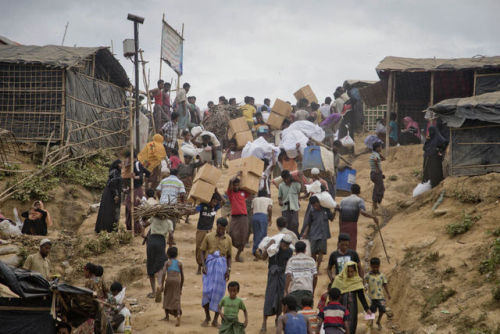
Rohingya Muslims, who crossed over from Myanmar into Bangladesh, walk with bags of aid handouts at Kutupalong refugee camp in Ukhiya, Bangladesh, Wednesday, Nov. 15, 2017. AP/A.M. Ahad
The Philippines, however, could still have voted "yes" and have access to Myanmar at the same time "in a perfect world," according to Cayetano.
"By voting no or by voting by abstaining, our humanitarian people can come in and when the humanitarian groups come in there's eyes on the ground. The human rights situation also improves because there are international observers there already," he said.
The Foreign Affairs chief also agreed with the statement of Philippine Ambassador to the UN Teddy Locsin Jr. that an abstention on the draft UN resolution would be the "right thing."
"Tama siya na it cannot be 'yes', especially when you're ASEAN chair and especially when there is a need not only for the Muslim population," Cayetano said.
https://www.msn.com/
#2476
World Daily News / Re: Philippines mulls 'no' or 'abstain' vote on Rohingya crisis
November 23, 2017, 02:24:23 PMMyanmar leaders might harden its position against the Philippines and revoke access to their country if Manila voted in favor of the UN resolution, he said.
"In other words, what's the objective of the resolution? Objective is humanitarian," the secretary said.
The resolution has two objectives â€" to address the root cause of the crisis in the Rakhine state and to provide immediate humanitarian access.
Cayetano added that Sen. Richard Gordon had requested for the Philippine Red Cross to return to Myanmar to assist the Myanmar Red Cross and the International Red Cross.
#2477
World Daily News / Re: Philippines mulls 'no' or 'abstain' vote on Rohingya crisis
November 23, 2017, 02:10:17 PM"Abstain or 'no' is our option but so far we voted no," Cayetano said in an interview with ANC's "Headstart" on Tuesday.
Defending the country's vote, Cayetano said that the Philippines cannot be compared to the 135 countries that voted "yes" to the resolution as "they're not chair of the ASEAN."
Noting that Myanmar is a member of the Association of Southeast Asian Nations, Cayetano stressed that Southeast Asian leaders want peace and prosperity in the region.
#2478
World Daily News / Philippines mulls 'no' or 'abstain' vote on Rohingya crisis
November 23, 2017, 02:09:40 PMPhilippines mulls 'no' or 'abstain' vote on Rohingya crisis
PhilStar Global
Patricia Lourdes Viray
November 21, 2017
MANILA, Philippines â€" Government officials and experts are still discussing on whether the Philippines will vote "no" or abstain from a United Nations draft resolution on the Rohingya crisis in Myanmar, Foreign Affairs Secretary Alan Peter Cayetano said.
The Philippines is among 10 countries that voted against the UN draft resolution calling on Myanmar to end a military campaign against Rohingya Muslims in the nation's Rakhine state.
The draft resolution will be up for debate next month before the UN general assembly.
#2479
Philippine Laws / Re: What was discussed in SC oral arguments on drug war?
November 22, 2017, 01:30:01 PM8. Can victims just apply for a writ of habeas data?
The writ of habeas data, which took effect during the cruel anti-insurgency campaign of the Arroyo administration, is a remedy for a person whose right to life is threatened.
The writ sets up a mechanism where information which is erroneous and can be damaging to an individual can be destroyed, or rectified. In this context, individuals labeled as drug personalities can avail of the writ so that the information against them can be addressed.
This is what Leonen asked Butuyan, saying those on the drug list can challenge the basis of the police for identifying them as drug personalities.
Lawyer Marnie Tonson of the Philippine Internet Freedom Alliance noted, however, that the writ will be “quick and painless†on the police and that the Data Privacy Act might be more useful to those labeled as drug personalities.
A breach of the data privacy act, Tonson said, would impose “hefty fines and imprisonment†which would be a better deterrent. â€" with reports from Rambo Talabong/Rappler.com
https://www.rappler.com/
#2480
Philippine Laws / Re: What was discussed in SC oral arguments on drug war?
November 22, 2017, 01:28:56 PM7. Can we apply the principle of ‘void for vagueness’?
Void for vagueness means a law can be invalidated because it is not clear.
Associate Justice Francis Jardeleza said that because there is dispute in the real and practical meaning of the word “neutralizeâ€, then it can be considered vague.
“But I think you have something here, you have a situation where a government circular according to you contains vague terms which can be interpreted to mean a license or authority to kill and you’re saying that in effect, it’s unconstitutional,†Jardeleza said.
Jardeleza explained that the “classical†application of void for vagueness is in the context of freedom of speech, or when somebody is already convicted. He also said that petitioners can wait for a time where a killing incident directly tackles what “neutralize†means although he said “that can take time.â€
“What bothers me is that more than freedom of speech, this is lives, more than the conviction of somebody, this is about lives,†Jardeleza said.

COMMUNITY. Families of drug war victims in San Andres Bukid and nuns of the Religious of the Good Shepherd watch the oral arguments at the Supreme Court. Photo by Ben Nabong/Rappler
#2481
Philippine Laws / Re: What was discussed in SC oral arguments on drug war?
November 22, 2017, 01:27:28 PM6 Did the war on drugs mean to kill?
Diokno said Dela Rosa’s circular instructed policemen to kill. Diokno said the circular was peppered with the words “neutralize†or “negate". The words do not have counterparts in law, he said, and they mean "to kill" given the pronouncements of both Dela Rosa and Duterte.
Senior Associate Justice Antonio Carpio told Diokno that to neutralize, in police parlance, does not necessarily mean to kill a suspect.
“Neutralized, meaning they should surrender, be arrested, or be killed during drug operations. So it doesn't only mean killed, it’s a general term and it has been used even during the previous administration," Carpio pointed out.
#2482
Philippine Laws / Re: What was discussed in SC oral arguments on drug war?
November 22, 2017, 01:26:20 PM5. Is Dela Rosa’s circular necessary for a successful drug campaign?
Associate Justice Teresita Leonardo-De Castro wants the petitioners to clarify how the government can do away with Dela Rosa’s circular and still successfully fight drugs.
De Castro told petitioners: “I also would like you to compare the PNP Operations Manual with this circular and why you say that is better and why you say that the manual will suffice to address the widespread use of illegal drugs in the country.â€
De Castro was leaning towards the circular, telling Diokno: “You said this is the first time that there are so many arrests, and you said there were killings related to the use of illegal drugs, but this is also the first time in our history that we have seen big factories, shabu factories in populated areas and so many barangays whose population is seriously affected by the use of illegal drugs and drugs peddling is quite rampant, to show to us that the manual of operations existing would suffice to meet these serious problems that we have now.â€
Leonen had a contrasting opinion. He said the government does not need the circulars to fight drugs.
“Declaring the circulars unconstitutional will have the effect of probably clarifying certain rights of certain individuals vis-a-vis the power of the government to go against illegal drugs,†Leonen said.
#2483
Philippine Laws / Re: What was discussed in SC oral arguments on drug war?
November 22, 2017, 01:25:37 PM4. Are the petitions moot because PNP is no longer part of the war on drugs?
Given that President Rodrigo Duterte has already taken out the PNP from the campaign and assigned to PDEA the role that the PNP used to play in the war on drugs, Solicitor General Jose Calida said the petitions are moot.
“Moot and academic na kasi wala nang pakialam ang PNP dito sa war on drugs, wala na dapat pag-usapan pa (It’s moot and academic because the PNP doesn’t have anything to do with the war on drugs now, there’s nothing to talk about),†Calida said in an interview with reporters.
It was the same point raised by Associate Justice Samuel Martires, who asked Butuyan of Centerlaw why PNP is still included as respondent. Butuyan said it’s because the PNP is still involved via “auxiliary assistance†if offers PDEA.
Dela Rosa and his operations chief Director Camilo Cascolan said police can still help out in instances such as when PDEA operatives are involved in a gunfight and are losing, if PDEA operatives requested backup support, or if they need help for crowd control.
#2484
Philippine Laws / Re: What was discussed in SC oral arguments on drug war?
November 22, 2017, 01:24:54 PM3. Should the police enjoy presumption of regularity?
Chief Justice Maria Lourdes Sereno has doubts. Sereno said the police is obliged to prioritize capturing suspects over killing them, and that the need for self-defense by the police should be a “rare occurrence.â€
Sereno then led Joel Butuyan of the Center for International Law (CenterLaw) to say that what should have been a rare occurrence has instead grown to thousands dead, and already constitutes a pattern.

LAWYERS AND THE DRUG WAR. Solicitor General Jose Calida, who will be defending the government, shares a light moment with petitioner and human rights lawyer Dean Jose Manuel "Chel" Diokno before the start of the oral arguments on November 21, 2017. Photo by Ben Nabong/Rappler
#2485
Philippine Laws / Re: What was discussed in SC oral arguments on drug war?
November 22, 2017, 01:18:00 PM2. Is DILG’s circular unconstitutional?
Diokno also wants to declare Department of the Interior and Local Government (DILG) Memorandum Circular (MC) No. 2017-112 unconstitutional saying that their mechanism of community reporting violates the rights of community members.
Leonen agreed with this. He said the drug list, in itself, violates fundamental rights.
The circular operationalized the Mamamayang Ayaw sa Anomalya, Mamamayang Ayaw sa Iligal na Droga or Masa Masid program. It requires cities, municipalities, and barangays to establish a system of reporting suspected drug personalities. From these reports, the police draw up a drug list.
Leonen pointed out that there is no mechanism for making a case and getting one's name off the list. This, he said, violates Section 11, Article II of the Constitution which says that: "The State values the dignity of every human person and guarantees full respect for human rights."
#2486
Philippine Laws / Re: What was discussed in SC oral arguments on drug war?
November 22, 2017, 01:17:13 PM1. Is Dela Rosa’s circular unconstitutional?
Associate Justice Estela Perlas-Bernabe pointed out that Dela Rosa’s Command Memorandum Circular (CMC) No. 16-2016 expressly states that policemen conducting the war on drugs should adhere to the law. Because the circular enumerates statutes and provisions, and even includes an instruction to follow the Constitution, Bernabe asked how it can be unconstitutional?
Diokno said the provisions paid mere lip service and were not implemented by police on the ground.
Associate Justice Marvic Leonen then led petitioner Dean Jose Manuel “Chel†Diokno of the Free Legal Assistance Group (FLAG) to identify the provisions in the circular which can be deemed unconstitutional.
Under number 4, letter E of the circular, any person suspected of having drug links and who refuses to open his doors to police “shall be referred to the Anti-Illegal Drugs Units for immediate case buildup and negation.â€
Leonen said that because there is a threat of something happening to the person who refuses to open his doors to the police, it is a violation of the right against self-incrimination. And if the person does open his doors, the element of coercion is already at play, and violates provisions of the anti-torture law, Leonen added.
#2487
Philippine Laws / Re: What was discussed in SC oral arguments on drug war?
November 22, 2017, 01:15:52 PMSolicitor General Jose Calida will take the floor on November 28 and was instructed to bring with him Police chief General Ronald dela Rosa and other concerned officials, including the head of the Philippine Drug Enforcement Agency (PDEA), designated as the sole agency in charge of the war on drugs.
On Tuesday, November 21, the High Court justices interpellated the two petitioners and here's a wrap of the highlights of the discussions.
#2488
Philippine Laws / What was discussed in SC oral arguments on drug war?
November 22, 2017, 01:15:13 PMHIGHLIGHTS: What was discussed in SC oral arguments on drug war?
Here's a summary of the most important points raised during the petitioners' round in the Supreme Court oral arguments on the war on drugs
Lian Buan
@lianbuan
November 22, 2017

ORAL ARGUMENTS. Supreme Court Chief Justice Maria Lourdes Sereno leads other justices in deliberating on the constitutionality of Duterte's drug war during oral arguments at the Supreme Court on November 21, 2017. Photo by Ben Nabong/Rappler
MANILA, Philippines â€" Two petitions before the Supreme Court seek to declare the police and interior department circulars on the war on drugs unconstitutional. They want to investigate all cases of "nanlaban" or those killed while resisting arrest, and want prosecutors to conduct a preliminary investigation on the 35 killings in San Andres Bukid, Manila perpetrated by masked vigilantes.
For the first time since the war on drugs began in July 2016, the government will face the Supreme Court to explain why the campaign is legal in the face of thousands of alleged extrajudicial killings.
#2489
Health and Food / Re: Seven ways to get thicker hair
November 22, 2017, 01:32:51 AMTakeaway
It is important to remember that the results of natural treatments will vary depending on the individual. In many cases, natural remedies for thin hair have not been well-studied, and there are no scientifically-proven results.
People with allergies should use caution and common sense, as rubbing an allergen on the scalp may trigger an allergic reaction.
People who experience a sudden or unexplained hair loss or thinning should talk to their doctor, as there may be an underlying medical reason for the hair loss.
In most cases, natural home remedies are low cost and low risk and may be worth trying.
https://www.medicalnewstoday.com/
#2490
Health and Food / Re: Seven ways to get thicker hair
November 22, 2017, 01:32:09 AM7. Castor Oil
Castor oil is also high in vitamin E and fatty acids. Vitamin E is known for aiding hair health.
Castor oil is easy to apply to the hair with no preparation. Simply, rub the oil over the scalp and hair until the hair is coated. Leave the oil on the head for about 30 minutes before rinsing out.
#2491
Health and Food / Re: Seven ways to get thicker hair
November 22, 2017, 01:31:31 AM6. Avocado

An avocado rub will also include olive oil.
Avocado is rich in vitamin E, and many people believe it to be a good moisturizer. Make a simple avocado rub and apply it twice a week.
To make an avocado rub:
-combine the fruit of 1 avocado with 1 tbsp olive oil
-apply the mixture to hair and scalp
-let it sit for about 30 minutes
-rinse thoroughly with mild shampoo
#2492
Health and Food / Re: Seven ways to get thicker hair
November 22, 2017, 01:30:42 AM5. Aloe gel
Many people believe that the Aloe vera plant is helpful for the skin, scalp, and hair. Applying aloe oil directly to the hair and scalp may help strengthen the hair and thicken it over time.
Several commercial products that contain aloe as an active ingredient are readily available. These products often take the form of gels and creams that are applied directly to the scalp and hair.
For a homemade solution, a person can try rubbing some pure aloe gel into the scalp and letting it sit for 30 minutes before rinsing. Some people mix the aloe with coconut oil or olive oil.
People can use this treatment once or twice per week.
#2493
Health and Food / Re: Seven ways to get thicker hair
November 22, 2017, 01:30:03 AM4. Orange puree
The vitamin C, pectin, and acid in oranges can help a person's hair in a few different ways.
The vitamins and nutrients may improve hair's natural luster, which makes the hair appear thicker.
The acid in oranges helps break apart residue left from hair products. These residues may interfere with hair growth. Unlike some of the other treatments, orange puree has a pleasant scent that makes the treatment more enjoyable.
A person can use orange puree as a hair treatment by blending fresh oranges then massaging the puree into the hair and scalp. Leave the puree on the hair for about 1 hour before rinsing it out.
Some people like to use a light conditioner to rehydrate their hair following an orange puree treatment.
#2494
Health and Food / Re: Seven ways to get thicker hair
November 22, 2017, 01:29:12 AM3. Proper nutrition
A nutritious diet that contains healthful fats, protein, and a range of vitamins can help with thinning or thin hair. In fact, thin hair can be a sign that a person is not getting enough nutrients.
To help remedy this, people with thin hair should include some of the following nutrient-rich foods in their diets:
-salmon, which is high in protein and fatty acids
-eggs, which contain protein, omega3, and iron
-walnuts, almonds, and other nuts, which are sources of fatty acids
-greek yogurt, which is a source of protein
-green, black, pinto, and other beans, which contain protein
A person should look to add 1 or 2 servings of any of the above foods to their daily diet. Even adding just 3 or 4 servings a week can contribute to improved hair health.
#2495
Health and Food / Re: Seven ways to get thicker hair
November 22, 2017, 01:28:22 AM2. Olive oil
Olive oil is rich in omega3 acids and other nutrients that are essential for overall health, including hair health. When applied directly to the scalp and hair, olive oil helps promote thicker hair.
Olive oil also has the added benefit of softening the hair and relieving dry scalp.
To use olive oil:
-heat the oil to body temperature
-massage the warm oil into the scalp and hair
-leave in hair for about 30 to 45 minutes
-rinse out the olive oil with mild shampoo
Some people add honey to the olive oil and others suggest leaving the olive oil on overnight using a shower cap to cover the hair.
#2496
Health and Food / Seven ways to get thicker hair
November 22, 2017, 01:21:42 AMSeven ways to get thicker hair
There is a range of natural ways to thicken thinning hair, but results will vary from person to person.
Everyday products to make hair look thicker include:
1. Eggs

An egg treatment may help to make hair look thicker.
Eggs are high in protein, which is essential for the body to build strong, thick hair. When used regularly, an egg treatment may help thicken and strengthen a person's hair.
To use an egg treatment:
-beat 1 or 2 eggs together
-apply the eggs to the scalp and damp hair
-leave the eggs on the scalp for about 30 minutes
-wash hair thoroughly with warm water and mild shampoo
Alternately, combine the eggs with oil and water. To use this method:
-mix egg yolks, 1 tablespoon (tbsp) olive oil, and 2 tbsp of water
-apply the mixture to the scalp and dry hair
-leave for 15 minutes
-rinse out with warm water and a mild shampoo
Using an egg treatment once or twice a week for several weeks might help strengthen the hair.
#2497
Lifestyle, Culture and Arts / Re: PETS AND ANIMALS CARE, Useful Tips, Urgent Advice
November 21, 2017, 11:22:38 PM#5 â€" It can cause more bad behavior

IMAGE SOURCE: SURTR VIA FLICKR
Yelling at your dog for barking will sound like more barking to your dog and is unlikely to discourage the behavior. Instead, you should try to figure out what is causing them to bark in the first place and take steps to address the cause rather than the behavior itself.
While it may be difficult to stop yelling at your dog if you’ve already gotten into the habit, changing your reaction will have its rewards. You’ll develop a stronger bond with your dog because you address the source of their problem instead of the symptoms, and that will make everything worthwhile.
(H/T: Paw Culture)
#2498
Lifestyle, Culture and Arts / Re: PETS AND ANIMALS CARE, Useful Tips, Urgent Advice
November 21, 2017, 11:20:28 PM#4 â€" They’ll be confused

IMAGE SOURCE: BETSY WEBER VIA FLICKR
Since your dog doesn’t understand the words coming out of your mouth, yelling at them for something they may have done hours ago doesn’t do any good. They won’t understand what behavior led you to yell at them. If you can’t catch your dog in the act, yelling at them after the fact is pointless. Even if they act ashamed, this behavior is to appease your current anger and is not an admission of guilt for a previous “crime†that they don’t understand they’ve committed.
#2499
Lifestyle, Culture and Arts / Re: PETS AND ANIMALS CARE, Useful Tips, Urgent Advice
November 21, 2017, 11:15:37 PM#3 â€" It’s not efficient

IMAGE SOURCE: LEO HIDALGO VIA FLICKR
Since dogs don’t understand English, they won’t understand what you’re yelling at them for. They’re likely to become confused and afraid and won’t understand what they should do instead to avoid your anger. A better way to train your dog is to teach them desirable behaviors and manage your environment. If your dog tends to get into the trash while you’re gone, for example, set him up for success by putting the trash out of reach when you leave or investing in a heavy-duty step can that will keep nosy dogs out.
#2500
Lifestyle, Culture and Arts / Re: PETS AND ANIMALS CARE, Useful Tips, Urgent Advice
November 21, 2017, 10:48:22 PM#2 â€" They can become afraid of you

Maybe in the past it was considered a good idea for your dog to be afraid of you, but current training practices show that positive reinforcement is a much more effective training method. While some dogs might tolerate rough handling, many dogs will actually develop more problems such as submissive urination. Some dogs will become helpless and will stop offering any behavior for fear of bringing on more yelling. They become paralyzed with fear and don’t learn the desirable behavior you want them to perform in place of the negative one you scolded them for.
Pages 1 2 3 4 5 6 7 8 9 10 11 12 13 14 15 16 17 18 19 20 21 22 23 24 25 26 27 28 29 30 31 32 33 34 35 36 37 38 39 40 41 42 43 44 45 46 47 48 49 50 51 52 53 54 55 56 57 58 59 60 61 62 63 64 65 66 67 68 69 70 71 72 73 74 75 76 77 78 79 80 81 82 83 84 85 86 87 88 89 90 91 92 93 94 95 96 97 98 99 100 101 102 103 104 105 106 107 108 109 110 111 112 113 114 115 116 117 118 119 120 121 122 123 124 125 126 127 128 129 130 131 132 133 134 135 136 137 138 139 140 141 142 143 144 145 146 147 148 149 150 151 152 153 154 155 156 157 158 159 160 161 162 163 164 165 166 167 168 169 170 171 172 173 174 175 176 177 178 179 180 181 182 183 184 185 186 187 188 189 190 191 192 193 194 195 196 197 198 199 200 201 202 203 204 205 206 207 208 209 210 211 212 213 214 215 216 217 218 219 220 221 222 223 224 225 226 227 228 229 230 231 232 233 234 235 236 237 238 239 240 241 242 243 244 245 246 247 248 249 250 251 252 253 254 255 256 257 258 259 260 261 262 263 264 265 266 267 268 269 270 271 272 273 274 275 276 277 278 279 280 281 282 283 284 285 286 287 288 289 290 291 292 293 294 295 296 297 298 299 300 301 302 303 304 305 306 307 308 309 310 311 312 313 314 315 316 317 318 319 320 321 322 323 324 325 326 327 328 329 330 331 332 333 334 335 336 337 338 339 340 341 342 343 344 345 346 347 348 349 350 351 352 353 354 355 356 357 358 359 360 361 362 363 364 365 366 367 368 369 370 371 372 373 374 375 376 377 378 379 380 381 382 383 384 385 386 387 388 389 390 391 392 393 394 395 396 397 398 399 400 401 402 403 404 405 406 407 408 409 410 411 412 413 414 415 416 417 418 419 420 421 422 423 424 425 426 427 428 429 430 431 432 433 434 435 436 437 438 439 440 441 442 443 444 445 446 447 448 449 450 451 452 453 454 455 456 457 458 459 460 461 462 463 464 465 466 467 468 469