Join MikeLigalig.com!

Why Just Read When You Can Join, Post, and Read!

Menu

Show posts

This section allows you to view all posts made by this member. Note that you can only see posts made in areas you currently have access to.

Show posts Menu

Messages - hofelina

#2401
Bible Study / Re: Minute Meditations
August 08, 2011, 02:28:45 PM
Called Together    

When we form a Christian community, we come together not because of similar experiences, knowledge, problems, color, or sex, but because we have been called together by the same Lord.
#2402
Bible Study / Re: Saints Of The Day
August 07, 2011, 02:00:15 PM
St. Cajetan
(1480-1557)

Like most of us, Cajetan seemed headed for an “ordinary” lifeâ€"first as a lawyer, then as a priest engaged in the work of the Roman Curia.

His life took a characteristic turn when he joined the Oratory of Divine Love in Rome, a group devoted to piety and charity, shortly after his ordination at 36. When he was 42 he founded a hospital for incurables at Venice. At Vicenza, he joined a “disreputable” religious community that consisted only of men of the lowest stations of lifeâ€"and was roundly censured by his friends, who thought his action was a reflection on his family. He sought out the sick and poor of the town and served them.

The greatest need of the time was the reformation of a Church that was “sick in head and members.” Cajetan and three friends decided that the best road to reformation lay in reviving the spirit and zeal of the clergy. (One of them later became Paul IV.) Together they founded a congregation known as the Theatines (from Teate [Chieti] where their first superior-bishop had his see). They managed to escape to Venice after their house in Rome was wrecked when Charles V’s troops sacked Rome in 1527. The Theatines were outstanding among the Catholic reform movements that took shape before the Protestant Reformation. He founded a monte de pieta (“mountain [or fund] of piety”) in Naplesâ€"one of many charitable, nonprofit credit organizations that lent money on the security of pawned objects. The purpose was to help the poor and protect them against usurers. Cajetan’s little organization ultimately became the Bank of Naples, with great changes in policy.


Comment:

If Vatican II had been summarily stopped after its first session in 1962, many Catholics would have felt that a great blow had been dealt to the growth of the Church. Cajetan had the same feeling about the Council of Trent. But, as he said, God is the same in Naples as in Venice, with or without Trent or Vatican II (or III). We open ourselves to God’s power in whatever circumstances we find ourselves, and God’s will is done. God’s standards of success differ from ours.
#2403
Bible Study / Re: Minute Meditations
August 07, 2011, 01:59:02 PM
Trust in God    

O Heart of love, I put all my trust in you; for I fear all things from my own weakness, but I hope for all things from your goodness.
#2404
Bible Study / Re: Saints Of The Day
August 06, 2011, 02:27:58 PM
Transfiguration of the Lord


All three Synoptic Gospels tell the story of the Transfiguration (Matthew 17:1-8; Mark 9:2-9; Luke 9:28-36). With remarkable agreement, all three place the event shortly after Peter’s confession of faith that Jesus is the Messiah and Jesus’ first prediction of his passion and death. Peter’s eagerness to erect tents or booths on the spot suggests it occurred during the Jewish weeklong, fall Feast of Booths.

In spite of the texts’ agreement, it is difficult to reconstruct the disciples’ experience, according to Scripture scholars, because the Gospels draw heavily on Old Testament descriptions of the Sinai encounter with God and prophetic visions of the Son of Man. Certainly Peter, James and John had a glimpse of Jesus’ divinity strong enough to strike fear into their hearts. Such an experience defies description, so they drew on familiar religious language to describe it. And certainly Jesus warned them that his glory and his suffering were to be inextricably connectedâ€"a theme John highlights throughout his Gospel.

Tradition names Mt. Tabor as the site of the revelation. A church first raised there in the fourth century was dedicated on August 6. A feast in honor of the Transfiguration was celebrated in the Eastern Church from about that time. Western observance began in some localities about the eighth century.

On July 22, 1456, Crusaders defeated the Turks at Belgrade. News of the victory reached Rome on August 6, and Pope Callistus III placed the feast on the Roman calendar the following year.


Comment:

One of the Transfiguration accounts is read on the second Sunday of Lent each year, proclaiming Christ’s divinity to catechumens and baptized alike. The Gospel for the first Sunday of Lent, by contrast, is the story of the temptation in the desertâ€"affirmation of Jesus’ humanity. The two distinct but inseparable natures of the Lord were a subject of much theological argument at the beginning of the Church’s history; it remains hard for believers to grasp.

Quote:

“At his Transfiguration Christ showed his disciples the splendor of his beauty, to which he will shape and color those who are his: ‘He will reform our lowness configured to the body of his glory’” (Philippians 3:21) (St. Thomas Aquinas, Summa Theologiae).
#2405
Bible Study / Re: Minute Meditations
August 06, 2011, 02:26:29 PM
Live to the Fullest    

Lord, let me live this day with all the wonder and amazement of a new-born child; the trust that welcomes all I meet, expects of them only the best, and grants them the benefit of every possible doubt.
#2406
Bible Study / Re: Saints Of The Day
August 05, 2011, 01:56:19 PM
Dedication of St. Mary Major Basilica


First raised at the order of Pope Liberius in the mid-fourth century, the Liberian basilica was rebuilt by Pope Sixtus III shortly after the Council of Ephesus affirmed Mary’s title as Mother of God in 431. Rededicated at that time to the Mother of God, St. Mary Major is the largest church in the world honoring God through Mary. Standing atop one of Rome’s seven hills, the Esquiline, it has survived many restorations without losing its character as an early Roman basilica. Its interior retains three naves divided by colonnades in the style of Constantine’s era. Fifth-century mosaics on its walls testify to its antiquity.

St. Mary Major is one of the four Roman basilicas known as patriarchal cathedrals in memory of the first centers of the Church. St. John Lateran represents Rome, the See of Peter; St. Paul Outside the Walls, the See of Alexandria, allegedly the see presided over by Mark; St. Peter’s, the See of Constantinople; and St. Mary’s, the See of Antioch, where Mary is supposed to have spent most of her life.

One legend, unreported before the year 1000, gives another name to this feast: Our Lady of the Snows. According to that story, a wealthy Roman couple pledged their fortune to the Mother of God. In affirmation, she produced a miraculous summer snowfall and told them to build a church on the site. The legend was long celebrated by releasing a shower of white rose petals from the basilica’s dome every August 5.


Comment:

Theological debate over Christ’s nature as God and man reached fever pitch in Constantinople in the early fifth century. The chaplain of Bishop Nestorius began preaching against the title Theotokos, “Mother of God,” insisting that the Virgin was mother only of the human Jesus. Nestorius agreed, decreeing that Mary would henceforth be named “Mother of Christ” in his see. The people of Constantinople virtually revolted against their bishop’s refutation of a cherished belief. When the Council of Ephesus refuted Nestorius, believers took to the streets, enthusiastically chanting, “Theotokos! Theotokos!”

Quote:

“From the earliest times the Blessed Virgin is honored under the title of Mother of God, in whose protection the faithful take refuge together in prayer in all their perils and needs. Accordingly, following the Council of Ephesus, there was a remarkable growth in the cult of the People of God towards Mary, in veneration and love, in invocation and imitation...” (Dogmatic Constitution on the Church, 66).
#2407
Bible Study / Re: Minute Meditations
August 05, 2011, 01:55:09 PM
Prayer for Humility    

Lord, keep me truly humble in whatever measure of success this day may bring. And grant, in all things, whether failure or success, that I might find you, and finding you, find all that I can ever ask or hope for.
#2408
Bible Study / Re: Saints Of The Day
August 04, 2011, 02:11:24 PM
St. John Vianney
(1786-1859)


A man with vision overcomes obstacles and performs deeds that seem impossible. John Vianney was a man with vision: He wanted to become a priest. But he had to overcome his meager formal schooling, which inadequately prepared him for seminary studies.

His failure to comprehend Latin lectures forced him to discontinue. But his vision of being a priest urged him to seek private tutoring. After a lengthy battle with the books, John was ordained.

Situations calling for “impossible” deeds followed him everywhere. As pastor of the parish at Ars, John encountered people who were indifferent and quite comfortable with their style of living. His vision led him through severe fasts and short nights of sleep. (Some devils can only be cast out by prayer and fasting.)

With Catherine Lassagne and Benedicta Lardet, he established La Providence, a home for girls. Only a man of vision could have such trust that God would provide for the spiritual and material needs of all those who came to make La Providence their home.

His work as a confessor is John Vianney’s most remarkable accomplishment. In the winter months he was to spend 11 to 12 hours daily reconciling people with God. In the summer months this time was increased to 16 hours. Unless a man was dedicated to his vision of a priestly vocation, he could not have endured this giving of self day after day.

Many people look forward to retirement and taking it easy, doing the things they always wanted to do but never had the time. But John Vianney had no thoughts of retirement. As his fame spread, more hours were consumed in serving God’s people. Even the few hours he would allow himself for sleep were disturbed frequently by the devil.

Who, but a man with vision, could keep going with ever-increasing strength? In 1929, Pope Pius XI named him the patron of parish priests worldwide.


Comment:

Indifference toward religion, coupled with a love for material comfort, seem to be common signs of our times. A person from another planet observing us would not likely judge us to be pilgrim people, on our way to somewhere else. John Vianney, on the other hand, was a man on a journey with his goal before him at all times.

Quote:

Recommending liturgical prayer, John Vianney would say, “Private prayer is like straw scattered here and there: If you set it on fire it makes a lot of little flames. But gather these straws into a bundle and light them, and you get a mighty fire, rising like a column into the sky; public prayer is like that.”

Patron Saint of:

Parish priests
Priests
#2409
Bible Study / Re: Minute Meditations
August 04, 2011, 02:08:40 PM
Our Humble Creator

God certainly has power, which we can see in creation and in his miracle. However, God can show himself without power, as he did by becoming an infant and ultimately by dying on the cross.
#2410
Bible Study / Re: Saints Of The Day
August 03, 2011, 02:24:53 PM
St. Peter Julian Eymard
(1811-1868)

Born in La Mure d'Isère in southeastern France, Peter Julian's faith journey drew him from being a priest in the Diocese of Grenoble (1834) to joining the Marists (1839) to founding the Congregation of the Blessed Sacrament (1856).

In addition to those changes, Peter Julian coped with poverty, his father's initial opposition to Peter's vocation, serious illness, a Jansenistic striving for inner perfection and the difficulties of getting diocesan and later papal approval for his new religious community.

His years as a Marist, including service as a provincial leader, saw the deepening of his eucharistic devotion, especially through his preaching of Forty Hours in many parishes.Inspired at first by the idea of reparation for indifference to the Eucharist, Peter Julian was eventually attracted to a more positive spirituality of Christ-centered love. Members of the men's community, which Peter founded, alternated between an active apostolic life and contemplating Jesus in the Eucharist. He and Marguerite Guillot founded the women's Congregation of the Servants of the Blessed Sacrament.

Peter Julian Eymard was beatified in 1925 and canonized in 1962, one day after Vatican II's first session ended.


Comment:

In every century, sin has been painfully real in the life of the Church. It is easy to give in to despair, to speak so strongly of human failings that people may forget the immense and self-sacrificing love of Jesus, as his death on the cross and his gift of the Eucharist make evident. Peter Julian knew that the Eucharist was key to helping Catholics live out their Baptism and preach by word and example the Good News of Jesus Christ.

Quote:

“The Eucharist is the life of the people. The Eucharist gives them a center of life. All can come together without the barriers of race or language in order to celebrate the feast days of the Church. It gives them a law of life, that of charity, of which it is the source; thus it forges between them a common bond, a Christian kinship” (Peter Julian Eymard).

#2411
Bible Study / Re: Minute Meditations
August 03, 2011, 02:24:08 PM
Jesus’ Great Mercy    

Christ died and rose so that sin and accusation would never have the last word. I rejoice that mercy and redemption are possible for every repentant sinner who comes to Christ, because this means it is possible for me!
#2412
Bible Study / Re: Saints Of The Day
August 02, 2011, 02:21:03 PM
St. Eusebius of Vercelli
(283?-371)


Someone has said that if there had been no Arian heresy it would be very difficult to write the lives of many early saints. Eusebius is another of the defenders of the Church during one of its most trying periods.

Born on the isle of Sardinia, he became a member of the Roman clergy and is the first recorded bishop of Vercelli in Piedmont. He is also the first to link the monastic life with that of the clergy, establishing a community of his diocesan clergy on the principle that the best way to sanctify his people was to have them see a clergy formed in solid virtue and living in community.

He was sent by Pope Liberius to persuade the emperor to call a council to settle Catholic-Arian troubles. When it was called at Milan, Eusebius went reluctantly, sensing that the Arian block would have its way, although the Catholics were more numerous. He refused to go along with the condemnation of Athanasius; instead, he laid the Nicene Creed on the table and insisted that all sign it before taking up any other matter. The emperor put pressure on him, but Eusebius insisted on Athanasius’ innocence and reminded the emperor that secular force should not be used to influence Church decisions. At first the emperor threatened to kill him, but later sent him into exile in Palestine. There the Arians dragged him through the streets and shut him up in a little room, releasing him only after his four-day hunger strike. They resumed their harassment shortly after.

His exile continued in Asia Minor and Egypt, until the new emperor permitted him to be welcomed back to his see in Vercelli. He attended the Council of Alexandria with Athanasius and approved the leniency shown to bishops who had wavered. He also worked with St. Hilary of Poitiers (January 13)against the Arians.

He died peacefully in his own diocese at an advanced age.


Comment:

Catholics in the U.S. have sometimes felt penalized by an unwarranted interpretation of the principle of separation of Church and state, especially in the matter of Catholic schools. Be that as it may, the Church is happily free today from the tremendous pressure put on it after it became an “established” Church under Constantine. We are happily rid of such things as a pope asking an emperor to call a Church council, Pope John I being sent by the emperor to negotiate in the East, the pressure of kings on papal elections. The Church cannot be a prophet if it’s in someone’s pocket.

Quote:

"To render the care of souls more efficacious, community life for priests is strongly recommended, especially for those attached to the same parish. While this way of living encourages apostolic action, it also affords an example of charity and unity to the faithful" (Decree on the Bishops' Pastoral Office, 30).
#2413
Bible Study / Re: Minute Meditations
August 02, 2011, 02:20:05 PM
God, Make Me Humble    

In a sense idolatry is at the core of every sin. I prefer my own designs to the design of God; I view my own way of seeing or acting or reacting as better than his. I act as if I know the needs of my heart better than my heart’s creator. Grace pierces through this illusion.
#2414
Bible Study / Re: Saints Of The Day
August 01, 2011, 02:28:34 PM
St. Alphonsus Liguori
(1696-1787)


Moral theology, Vatican II said, should be more thoroughly nourished by Scripture, and show the nobility of the Christian vocation of the faithful and their obligation to bring forth fruit in charity for the life of the world. Alphonsus, declared patron of moral theologians by Pius XII in 1950, would rejoice in that statement.

In his day, Alphonsus fought for the liberation of moral theology from the rigidity of Jansenism. His moral theology, which went through 60 editions in the century following him, concentrated on the practical and concrete problems of pastors and confessors. If a certain legalism and minimalism crept into moral theology, it should not be attributed to this model of moderation and gentleness.

At the University of Naples he received, at the age of 16, a doctorate in both canon and civil law by acclamation, but soon gave up the practice of law for apostolic activity. He was ordained a priest and concentrated his pastoral efforts on popular (parish) missions, hearing confessions, forming Christian groups.

He founded the Redemptorist congregation in 1732. It was an association of priests and brothers living a common life, dedicated to the imitation of Christ, and working mainly in popular missions for peasants in rural areas. Almost as an omen of what was to come later, he found himself deserted, after a while, by all his original companions except one lay brother. But the congregation managed to survive and was formally approved 17 years later, though its troubles were not over.

Alphonsus’ great pastoral reforms were in the pulpit and confessionalâ€"replacing the pompous oratory of the time with simplicity, and the rigorism of Jansenism with kindness. His great fame as a writer has somewhat eclipsed the fact that for 26 years he traveled up and down the Kingdom of Naples, preaching popular missions.

He was made bishop (after trying to reject the honor) at 66 and at once instituted a thorough reform of his diocese.

His greatest sorrow came toward the end of his life. The Redemptorists, precariously continuing after the suppression of the Jesuits in 1773, had difficulty in getting their Rule approved by the Kingdom of Naples. Alphonsus acceded to the condition that they possess no property in common, but a royal official, with the connivance of a high Redemptorist official, changed the Rule substantially. Alphonsus, old, crippled and with very bad sight, signed the document, unaware that he had been betrayed. The Redemptorists in the Papal States then put themselves under the pope, who withdrew those in Naples from the jurisdiction of Alphonsus. It was only after his death that the branches were united.

At 71 he was afflicted with rheumatic pains which left incurable bending of his neck; until it was straightened a little, the pressure of his chin caused a raw wound on his chest. He suffered a final 18 months of “dark night” scruples, fears, temptations against every article of faith and every virtue, interspersed with intervals of light and relief, when ecstasies were frequent.

Alphonsus is best known for his moral theology, but he also wrote well in the field of spiritual and dogmatic theology. His Glories of Mary is one of the great works on that subject, and his book Visits to the Blessed Sacrament went through 40 editions in his lifetime, greatly influencing the practice of this devotion in the Church.


Comment:

St. Alphonsus was known above all as a practical man who dealt in the concrete rather than the abstract. His life is indeed a “practical” model for the everyday Christian who has difficulty recognizing the dignity of Christian life amid the swirl of problems, pain, misunderstanding and failure. Alphonsus suffered all these things. He is a saint because he was able to maintain an intimate sense of the presence of the suffering Christ through it all.

Quote:

Someone once remarked, after a sermon by Alphonsus, "It is a pleasure to listen to your sermons; you forget yourself and preach Jesus Christ."

Patron Saint of:

Theologians
Vocations
#2415
Bible Study / Re: Minute Meditations
August 01, 2011, 02:24:30 PM
God is Love    

God has power, but he can reveal himself without it, for it is not of his essence. However, God can never reveal himself without love, because Love is what God is.
#2416
Bible Study / Re: Saints Of The Day
July 31, 2011, 10:51:23 AM
St Ignatius de Loyola

St. Ignatius was born in the family castle in Guipúzcoa, Spain, the youngest of 13 children, and was called Iñigo. When he was old enough, he became a page, and then a soldier of Spain to fight against the French. A cannon ball and a series of bad operations ended his military career in 1521. While St. Ignatius recovered, he read the lives of the saints, and decided to dedicate himself to becoming a soldier of the Catholic Faith. Soon after he experienced visions, but a year later suffered a trial of fears and scruples, driving him almost to despair. Out of this experience he wrote his famous "Spiritual Exercises". After traveling and studying in different schools, he finished in Paris, where he received his degree at the age of 43. Many first hated St. Ignatius because of his humble Lifestyle. Despite this, he attracted several followers at the university, including St. Francis Xavier, and soon started his order called The Society of Jesus, or Jesuits. There are 38 members of the Society of Jesus who have been declared Blessed, and 38 who have been canonized as saints. He died at the age of 65.
#2417
Bible Study / Re: Minute Meditations
July 31, 2011, 10:48:43 AM
Redeem the World    

We are baptized into Christ, and in Christ our actions, too, become redemptive. By our ordinary lives, poured out in love in imitation of the Trinity, we can redeem the world.
#2418
Bible Study / Re: Saints Of The Day
July 30, 2011, 02:44:51 PM
St. Peter Chrysologus
(406-450?)


A man who vigorously pursues a goal may produce results far beyond his expectations and his intentions. Thus it was with Peter of the Golden Words, as he was called, who as a young man became bishop of Ravenna, the capital of the empire in the West.

At the time there were abuses and vestiges of paganism evident in his diocese, and these he was determined to battle and overcome. His principal weapon was the short sermon, and many of them have come down to us. They do not contain great originality of thought. They are, however, full of moral applications, sound in doctrine and historically significant in that they reveal Christian life in fifth-century Ravenna. So authentic were the contents of his sermons that, some 13 centuries later, he was declared a doctor of the Church by Pope Benedict XIII. He who had earnestly sought to teach and motivate his own flock was recognized as a teacher of the universal Church.

In addition to his zeal in the exercise of his office, Peter Chrysologus was distinguished by a fierce loyalty to the Church, not only in its teaching, but in its authority as well. He looked upon learning not as a mere opportunity but as an obligation for all, both as a development of God-given faculties and as a solid support for the worship of God.

Some time before his death, St. Peter returned to Imola, his birthplace, where he died around A.D. 450.


Comment:

Quite likely, it was St. Peter Chrysologus’s attitude toward learning that gave substance to his exhortations. Next to virtue, learning, in his view, was the greatest improver of the human mind and the support of true religion. Ignorance is not a virtue, nor is anti-intellectualism. Knowledge is neither more nor less a source of pride than physical, administrative or financial prowess. To be fully human is to expand our knowledgeâ€"whether sacred or secularâ€"according to our talent and opportunity.
#2419
Bible Study / Re: Minute Meditations
July 30, 2011, 02:43:00 PM
Sharing in the Nature of God    

We share in the nature of God when we struggle to make our homes happy homes, when we make sacrifices for the good of others, even and perhaps especially when the others really get on our nerves.
#2420
Bible Study / Re: Saints Of The Day
July 29, 2011, 02:02:58 PM
St. Martha


Martha, Mary and their brother Lazarus were evidently close friends of Jesus. He came to their home simply as a welcomed guest, rather than as one celebrating the conversion of a sinner like Zacchaeus or one unceremoniously received by a suspicious Pharisee. The sisters feel free to call on Jesus at their brother’s death, even though a return to Judea at that time seems almost certain death.

No doubt Martha was an active sort of person. On one occasion (see Luke 10:38-42) she prepares the meal for Jesus and possibly his fellow guests and forthrightly states the obvious: All hands should pitch in to help with the dinner.

Yet, as biblical scholar Father John McKenzie points out, she need not be rated as an “unrecollected activist.” The evangelist is emphasizing what our Lord said on several occasions about the primacy of the spiritual: “...[D]o not worry about your life, what you will eat [or drink], or about your body, what you will wear…. But seek first the kingdom [of God] and his righteousness” (Matthew 6:25b, 33a); “One does not live by bread alone” (Luke 4:4b); “Blessed are they who hunger and thirst for righteousness…” (Matthew 5:6a).

Martha’s great glory is her simple and strong statement of faith in Jesus after her brother’s death. “Jesus told her, ‘I am the resurrection and the life; whoever believes in me, even if he dies, will live, and everyone who lives and believes in me will never die. Do you believe this?’ She said to him, ‘Yes, Lord. I have come to believe that you are the Messiah, the Son of God, the one who is coming into the world’” (John 11:25-27).


Comment:

Scripture commentators point out that in writing his account of the raising of Lazarus, St. John intends that we should see Martha’s words to Mary before the resurrection of Lazarus as a summons that every Christian must obey. In her saying “The teacher is here and is asking for you,” Jesus is calling every one of us to resurrectionâ€"now in baptismal faith, forever in sharing his victory over death. And all of us, as well as these three friends, are in our own unique way called to special friendship with him.

Quote:

“This great company of witnesses spurs us on to victory, to share their prize of everlasting glory, through Jesus Christ our Lord" (Preface of Holy Men and Women I).

Patron Saint of:

Housewives
Waiters, waitresses
#2421
Bible Study / Re: Minute Meditations
July 29, 2011, 02:01:21 PM
Deepest Human Desire    

Saint Augustine wrote that the deepest human desire is to look upon one who looks back in love. This is the gift God gives us from the beginning, but little by little, in increments and in longing. The gift will be fulfilled perfectly in heaven.
#2422
Bible Study / Re: Saints Of The Day
July 28, 2011, 02:15:12 PM
St. Leopold Mandic
(1887-1942)


Western Christians who are working for greater dialogue with Orthodox Christians may be reaping the fruits of Father Leopold’s prayers.

A native of Croatia, Leopold joined the Capuchin Franciscans and was ordained several years later in spite of several health problems. He could not speak loudly enough to preach publicly. For many years he also suffered from severe arthritis, poor eyesight and a stomach ailment.

Leopold taught patrology, the study of the Church Fathers, to the clerics of his province for several years, but he is best known for his work in the confessional, where he sometimes spent 13-15 hours a day. Several bishops sought out his spiritual advice.

Leopold’s dream was to go to the Orthodox Christians and work for the reunion of Roman Catholicism and Orthodoxy. His health never permitted it. Leopold often renewed his vow to go to the Eastern Christians; the cause of unity was constantly in his prayers.

At a time when Pope Pius XII said that the greatest sin of our time is "to have lost all sense of sin," Leopold had a profound sense of sin and an even firmer sense of God’s grace awaiting human cooperation.

Leopold, who lived most of his life in Padua, died on July 30, 1942, and was canonized in 1982.


Comment:

St. Francis advised his followers to "pursue what they must desire above all things, to have the Spirit of the Lord and His holy manner of working" (Rule of 1223, Chapter 10)â€"words that Leopold lived out. When the Capuchin minister general wrote his friars on the occasion of Leopold’s beatification, he said that this friar’s life showed "the priority of that which is essential."

Quote:

Leopold used to repeat to himself: “Remember that you have been sent for the salvation of people, not because of your own merits, since it is the Lord Jesus and not you who died for the salvation of souls.... I must cooperate with the divine goodness of our Lord who has deigned to choose me so that by my ministry, the divine promise would be fulfilled: ‘There will be only one flock and one shepherd’” (John 10:16).
#2423
Bible Study / Re: Minute Meditations
July 28, 2011, 02:13:53 PM
Imitation of Christ    

The life of Jesus is a picture-perfect illustration of the true self in action. Through the imitation of Christ, the grace of God, and a dialogue of dependence with each other, we can nourish and mature the true self we have received.
#2424
Bible Study / Re: Saints Of The Day
July 27, 2011, 02:35:04 PM
Blessed Antonio Lucci
(1682-1752)


Antonio studied with and was a friend of St. Francesco Antonio Fasani, who after Antonio Lucci’s death testified at the diocesan hearings regarding the holiness of Lucci.

Born in Agnone in southern Italy, a city famous for manufacturing bells and copper crafts, he was given the name Angelo at Baptism. He attended the local school run by the Conventual Franciscans and joined them at the age of 16. Antonio completed his studies for the priesthood in Assisi, where he was ordained in 1705. Further studies led to a doctorate in theology and appointments as a teacher in Agnone, Ravello and Naples. He also served as guardian in Naples.

Elected minister provincial in 1718, the following year he was appointed professor at St. Bonaventure College in Rome, a position he held until Pope Benedict XIII chose him as bishop of Bovino (near Foggia) in 1729. The pope explained, "I have chosen as bishop of Bovino an eminent theologian and a great saint."

His 23 years as bishop were marked by visits to local parishes and a renewal of gospel living among the people of his diocese. He dedicated his episcopal income to works of education and charity. At the urging of the Conventual minister general, Bishop Lucci wrote a major book about the saints and blesseds in the first 200 years of the Conventual Franciscans.

He was beatified in 1989, three years after his friend Francesco Antonio Fasani was canonized.


Comment:

As Pope Paul VI wrote in 1975, people today "are more impressed by witnesses than by teachers, and if they listen to these it is because they also bear witness" (Evangelization in the Modern World, #41).

Quote:

When Francis of Assisi learned that Anthony of Padua was teaching theology to the friars in Bologna, Francis wrote: "It pleases me that you teach sacred theology to the brothers, as long asâ€"in the words of the Ruleâ€"you do not extinguish the spirit of prayer and devotion with study of this kind."
#2425
Bible Study / Re: Minute Meditations
July 27, 2011, 02:34:13 PM
Accepting His Gifts    

As the perfect combination of idealist and realist, Jesus knew he could save us if we accepted his gifts of reconciliation, forgiveness, a second chance to start over, and the hope for eternal life and joy.
#2426
Bible Study / Re: Saints Of The Day
July 26, 2011, 02:16:45 PM
Sts. Joachim and Anne


In the Scriptures, Matthew and Luke furnish a legal family history of Jesus, tracing ancestry to show that Jesus is the culmination of great promises. Not only is his mother’s family neglected, we also know nothing factual about them except that they existed. Even the names Joachim and Anne come from a legendary source written more than a century after Jesus died.

The heroism and holiness of these people, however, is inferred from the whole family atmosphere around Mary in the Scriptures. Whether we rely on the legends about Mary’s childhood or make guesses from the information in the Bible, we see in her a fulfillment of many generations of prayerful persons, herself steeped in the religious traditions of her people.

The strong character of Mary in making decisions, her continuous practice of prayer, her devotion to the laws of her faith, her steadiness at moments of crisis, and her devotion to her relativesâ€"all indicate a close-knit, loving family that looked forward to the next generation even while retaining the best of the past.

Joachim and Anneâ€"whether these are their real names or notâ€"represent that entire quiet series of generations who faithfully perform their duties, practice their faith and establish an atmosphere for the coming of the Messiah, but remain obscure.


Comment:

This is the “feast of grandparents.” It reminds grandparents of their responsibility to establish a tone for generations to come: They must make the traditions live and offer them as a promise to little children. But the feast has a message for the younger generation as well. It reminds the young that older people’s greater perspective, depth of experience and appreciation of life’s profound rhythms are all part of a wisdom not to be taken lightly or ignored.

Quote:

“...[T]he family is the foundation of society. In it the various generations come together and help one another to grow wise and to harmonize personal rights with the other requirements of social life” (Pastoral Constitution on the Church in the Modern World, 52).
#2427
Bible Study / Re: Minute Meditations
July 26, 2011, 02:15:48 PM
Keys to Self-Worth    

Dependence on and involvement with othersâ€"Jesus as well as other peopleâ€"are the real keys to achieving the correct sense of self-worth, a self-image that makes the heart sing.
#2428
Bible Study / Re: Saints Of The Day
July 25, 2011, 02:10:49 PM
St. James


This James is the brother of John the Evangelist. The two were called by Jesus as they worked with their father in a fishing boat on the Sea of Galilee. Jesus had already called another pair of brothers from a similar occupation: Peter and Andrew. “He walked along a little farther and saw James, the son of Zebedee, and his brother John. They too were in a boat mending their nets. Then he called them. So they left their father Zebedee in the boat along with the hired men and followed him” (Mark 1:19-20).

James was one of the favored three who had the privilege of witnessing the Transfiguration, the raising to life of the daughter of Jairus and the agony in Gethsemani.

Two incidents in the Gospels describe the temperament of this man and his brother. St. Matthew tells that their mother came (Mark says it was the brothers themselves) to ask that they have the seats of honor (one on the right, one on the left of Jesus) in the kingdom. “Jesus said in reply, ‘You do not know what you are asking. Can you drink the cup that I am going to drink?’ They said to him, ‘We can’” (Matthew 20:22). Jesus then told them they would indeed drink the cup and share his baptism of pain and death, but that sitting at his right hand or left was not his to giveâ€"it “is for those for whom it has been prepared by my Father” (Matthew 20:23b). It remained to be seen how long it would take to realize the implications of their confident “We can!”

The other disciples became indignant at the ambition of James and John. Then Jesus taught them all the lesson of humble service: The purpose of authority is to serve. They are not to impose their will on others, or lord it over them. This is the position of Jesus himself. He was the servant of all; the service imposed on him was the supreme sacrifice of his own life.

On another occasion, James and John gave evidence that the nickname Jesus gave themâ€"“sons of thunder”â€"was an apt one. The Samaritans would not welcome Jesus because he was on his way to hated Jerusalem. “When the disciples James and John saw this they asked, ‘Lord, do you want us to call down fire from heaven to consume them?’ Jesus turned and rebuked them...” (Luke 9:54-55).

James was apparently the first of the apostles to be martyred. “About that time King Herod laid hands upon some members of the church to harm them. He had James, the brother of John, killed by the sword, and when he saw that this was pleasing to the Jews he proceeded to arrest Peter also” (Acts 12:1-3a).

This James, sometimes called James the Greater, is not to be confused with James the Lesser (May 3) or with the author of the Letter of James and the leader of the Jerusalem community.


Comment:

The way the Gospels treat the apostles is a good reminder of what holiness is all about. There is very little about their virtues as static possessions, entitling them to heavenly reward. Rather, the great emphasis is on the Kingdom, on God’s giving them the power to proclaim the Good News. As far as their personal lives are concerned, there is much about Jesus’ purifying them of narrowness, pettiness, fickleness.

Quote:

“...Christ the Lord, in whom the entire revelation of the most high God is summed up (see 2 Corinthians 1:20; 3:16â€"4:6), having fulfilled in his own person and promulgated with his own lips the Gospel promised by the prophets, commanded the apostles to preach it to everyone as the source of all saving truth and moral law, communicating God’s gifts to them. This was faithfully done: it was done by the apostles who handed on, by oral preaching, by their example, by their dispositions, what they themselves had receivedâ€"whether from the lips of Christ, from his way of life and his works, or by coming to know it through the prompting of the Holy Spirit” (Constitution on Divine Revelation, 7).

Patron Saint of:

Chile
Laborers
Nicaragua
Rheumatism
Spain
#2429
Bible Study / Re: Minute Meditations
July 25, 2011, 02:09:56 PM
Get Involved    

We must do more than look at Jesus as though we were staring at a masterpiece in a museum. This spectator attitude requires no involvement, no openness to receiving the love that is an absolute necessity for our personal growth.
#2430
Bible Study / Re: Saints Of The Day
July 24, 2011, 11:29:30 AM
St. Bridget
(1303?-1373)


From age seven on, Bridget had visions of Christ crucified. Her visions formed the basis for her activityâ€"always with the emphasis on charity rather than spiritual favors.

She lived her married life in the court of the Swedish king Magnus II. Mother of eight children (the second eldest was St. Catherine of Sweden), she lived the strict life of a penitent after her husband’s death.

Bridget constantly strove to exert her good influence over Magnus; while never fully reforming, he did give her land and buildings to found a monastery for men and women. This group eventually expanded into an Order known as the Bridgetines (still in existence).

In 1350, a year of jubilee, Bridget braved a plague-stricken Europe to make a pilgrimage to Rome. Although she never returned to Sweden, her years in Rome were far from happy, being hounded by debts and by opposition to her work against Church abuses.

A final pilgrimage to the Holy Land, marred by shipwreck and the death of her son, Charles, eventually led to her death in 1373. In 1999, she, Saints Catherine of Siena and Edith Stein were named co-patronesses of Europe.


Comment:

Bridget’s visions, rather than isolating her from the affairs of the world, involved her in many contemporary issues, whether they be royal policy or the years that the legitimate Bishop of Rome lived in Avignon, France. She saw no contradiction between mystical experience and secular activity, and her life is a testimony to the possibility of a holy life in the marketplace.

Quote:

Despite the hardships of life and wayward children (not all became saints), Margery Kempe of Lynn says Bridget was “kind and meek to every creature” and “she had a laughing face.”

Patron Saint of:

Europe
#2431
Bible Study / Re: Minute Meditations
July 24, 2011, 11:28:36 AM
Love is the only Solution    

We have all known the long loneliness and we have learned that the only solution is love and that love comes with community.
#2432
Bible Study / Re: Minute Meditations
July 23, 2011, 06:52:26 PM
Love is the only Solution

We have all known the long loneliness and we have learned that the only solution is love and that love comes with community.
#2433
Bible Study / Re: Saints Of The Day
July 23, 2011, 06:51:06 PM
Saturday, July 23, 2011
St. Bridget
(1303?-1373)

   
From age seven on, Bridget had visions of Christ crucified. Her visions formed the basis for her activityâ€"always with the emphasis on charity rather than spiritual favors.

She lived her married life in the court of the Swedish king Magnus II. Mother of eight children (the second eldest was St. Catherine of Sweden), she lived the strict life of a penitent after her husband's death.

Bridget constantly strove to exert her good influence over Magnus; while never fully reforming, he did give her land and buildings to found a monastery for men and women. This group eventually expanded into an Order known as the Bridgetines (still in existence).

In 1350, a year of jubilee, Bridget braved a plague-stricken Europe to make a pilgrimage to Rome. Although she never returned to Sweden, her years in Rome were far from happy, being hounded by debts and by opposition to her work against Church abuses.

A final pilgrimage to the Holy Land, marred by shipwreck and the death of her son, Charles, eventually led to her death in 1373. In 1999, she, Saints Catherine of Siena and Edith Stein were named co-patronesses of Europe.
Comment:

    Bridget's visions, rather than isolating her from the affairs of the world, involved her in many contemporary issues, whether they be royal policy or the years that the legitimate Bishop of Rome lived in Avignon, France. She saw no contradiction between mystical experience and secular activity, and her life is a testimony to the possibility of a holy life in the marketplace.

Quote:

    Despite the hardships of life and wayward children (not all became saints), Margery Kempe of Lynn says Bridget was "kind and meek to every creature" and "she had a laughing face."


#2434
Bible Study / Re: Saints Of The Day
July 22, 2011, 02:35:23 PM
St. Mary Magdalene


Except for the mother of Jesus, few women are more honored in the Bible than Mary Magdalene. Yet she could well be the patron of the slandered, since there has been a persistent legend in the Church that she is the unnamed sinful woman who anointed the feet of Jesus in Luke 7:36-50.

Most Scripture scholars today point out that there is no scriptural basis for confusing the two women. Mary Magdalene, that is, “of Magdala,” was the one from whom Christ cast out “seven demons” (Luke 8:2)â€"an indication, at the worst, of extreme demonic possession or, possibly, severe illness.

Father W.J. Harrington, O.P., writing in the New Catholic Commentary, says that “seven demons” “does not mean that Mary had lived an immoral lifeâ€"a conclusion reached only by means of a mistaken identification with the anonymous woman of Luke 7:36.” Father Edward Mally, S.J., writing in the Jerome Biblical Commentary, agrees that she “is not...the same as the sinner of Luke 7:37, despite the later Western romantic tradition about her.”

Mary Magdalene was one of the many “who were assisting them [Jesus and the Twelve] out of their means.” She was one of those who stood by the cross of Jesus with his mother. And, of all the “official” witnesses that might have been chosen for the first awareness of the Resurrection, she was the one to whom that privilege was given. She is known as the "Apostle to the Apostles."


Comment:

Mary Magdalene has been a victim of mistaken identity for almost 20 centuries. Yet she would no doubt insist that it makes no difference. We are all sinners in need of the saving power of God, whether our sins have been lurid or not. More importantly, we are all, with her, “unofficial” witnesses of the Resurrection.

Patron Saint of:

Penitents
Perfumers
#2435
Bible Study / Re: Minute Meditations
July 22, 2011, 02:32:31 PM
God in our Midst    

The spirit of God reminds us daily of our responsibility to care for the poor and those less fortunate because they are the special presence of God in our midst.
#2436
Bible Study / Re: Saints Of The Day
July 21, 2011, 01:47:51 PM
St. Lawrence of Brindisi
(1559-1619)


At first glance perhaps the most remarkable quality of Lawrence of Brindisi is his outstanding gift of languages. In addition to a thorough knowledge of his native Italian, he had complete reading and speaking ability in Latin, Hebrew, Greek, German, Bohemian, Spanish and French.

He was born on July 22, 1559, and died exactly 60 years later on his birthday in 1619. His parents William and Elizabeth Russo gave him the name of Julius Caesar, Caesare in Italian. After the early death of his parents, he was educated by his uncle at the College of St. Mark in Venice.

When he was just 16 he entered the Capuchin Franciscan Order in Venice and received the name of Lawrence. He completed his studies of philosophy and theology at the University of Padua and was ordained a priest at 23.

With his facility for languages he was able to study the Bible in its original texts. At the request of Pope Clement VIII, he spent much time preaching to the Jews in Italy. So excellent was his knowledge of Hebrew, the rabbis felt sure he was a Jew who had become a Christian.

In 1956 the Capuchins completed a 15-volume edition of his writings. Eleven of these 15 contain his sermons, each of which relies chiefly on scriptural quotations to illustrate his teaching.

Lawrence’s sensitivity to the needs of peopleâ€"a character trait perhaps unexpected in such a talented scholarâ€"began to surface. He was elected major superior of the Capuchin Franciscan province of Tuscany at the age of 31. He had the combination of brilliance, human compassion and administrative skill needed to carry out his duties. In rapid succession he was promoted by his fellow Capuchins and was elected minister general of the Capuchins in 1602. In this position he was responsible for great growth and geographical expansion of the Order.

Lawrence was appointed papal emissary and peacemaker, a job which took him to a number of foreign countries. An effort to achieve peace in his native kingdom of Naples took him on a journey to Lisbon to visit the king of Spain. Serious illness in Lisbon took his life in 1619.


Comment:

His constant devotion to Scripture, coupled with great sensitivity to the needs of people, present a lifestyle which appeals to Christians today. Lawrence had a balance in his life that blended self-discipline with a keen appreciation for the needs of those whom he was called to serve.

Quote:

“God is love, and all his operations proceed from love. Once he wills to manifest that goodness by sharing his love outside himself, then the Incarnation becomes the supreme manifestation of his goodness and love and glory. So, Christ was intended before all other creatures and for his own sake. For him all things were created and to him all things must be subject, and God loves all creatures in and because of Christ. Christ is the first-born of every creature, and the whole of humanity as well as the created world finds its foundation and meaning in him. Moreover, this would have been the case even if Adam had not sinned” (St. Lawrence of Brindisi, Doctor of the Universal Church, Capuchin Educational Conference, Washington, D.C.).
#2437
Bible Study / Re: Minute Meditations
July 21, 2011, 01:46:53 PM
Conduit of Peace    

God, we desire to be your presence to the least among us and to know your presence in them as we work through you to bring justice and peace to this world in desperate need.
#2438
Bible Study / Re: Saints Of The Day
July 20, 2011, 01:49:33 PM
St. Apollinaris
(1st century)

According to tradition, St. Peter sent Apollinaris to Ravenna, Italy, as its first bishop. His preaching of the Good News was so successful that the pagans there beat him and drove him from the city. He returned, however, and was exiled a second time. After preaching in the area surrounding Ravenna, he entered the city again. After being cruelly tortured, he was put on a ship heading to Greece. Pagans there caused him to be expelled to Italy, where he went to Ravenna for a fourth time. He died from wounds received during a savage beating at Classis, a suburb of Ravenna. A beautiful basilica honoring him was built there in the sixth century.

Comment:

Following Jesus involves risksâ€"sometimes the supreme risk of life itself. Martyrs are people who would rather accept the risk of death than deny the cornerstone of their whole life: faith in Jesus Christ. Everyone will die eventuallyâ€"the persecutors and those persecuted. The question is what kind of a conscience people will bring before the Lord for judgment. Remembering the witness of past and present martyrs can help us make the often-small sacrifices that following Jesus today may require.

Quote:

During his remarks prior to the Regina Caeli on May 7, 2000, Pope John Paul II noted that later that day at Rome's Colosseum he would participate in an ecumenical service honoring 20th-century martyrs. He said, “It is the same paschal light that shines in them. Indeed, it is from Christ's resurrection that the disciples receive the strength to follow the Master in their hour of trial.” What the pope said of those martyrs is true of all martyrs for Christ, including today's saint.

#2439
Bible Study / Re: Minute Meditations
July 20, 2011, 01:46:28 PM
Ongoing Conversion    

The goal of evangelization is ongoing conversion. We ourselves, of course, cannot convert anyoneâ€"even ourselves. Only the Holy Spirit can change the hearts and minds of people.
#2440
Bible Study / Re: Saints Of The Day
July 19, 2011, 01:58:56 PM
Servant of God Francis Garcés and Companions
(c. 1781)


Government interference in the missions and landgrabbing sparked the Indian uprising which cost these friars their lives.

A contemporary of the American Revolution and of Blessed Junipero Serra, Francisco Garcés was born in 1738 in Spain, where he joined the Franciscans. After ordination in 1763, he was sent to Mexico. Five years later he was assigned to San Xavier del Bac near Tucson, one of several missions the Jesuits had founded in Arizona and New Mexico before being expelled in 1767 from all territories controlled by the Catholic king of Spain. In Arizona, Francisco worked among the Papago, Yuma, Pima and Apache Native Americans. His missionary travels took him to the Grand Canyon and to California.

Friar Francisco Palou, a contemporary, writes that Father Garcés was greatly loved by the indigenous peoples, among whom he lived unharmed for a long time. They regularly gave him food and referred to him as "Viva Jesus," which was the greeting he taught them to use.

For the sake of their indigenous converts, the Spanish missionaries wanted to organize settlements away from the Spanish soldiers and colonists. But the commandant in Mexico insisted that two new missions on the Colorado River, Misión San Pedro y San Pablo and Misión La Purísima Concepción, be mixed settlements.

A revolt among the Yumas against the Spanish left Friars Juan Diaz and Matias Moreno dead at Misión San Pedro y San Pablo. Friars Francisco Garcés and Juan Barreneche were killed at Misión La Purísima Concepción (the site of Fort Yuma).


Comment:

In the 18th century the indigenous peoples of the American Southwest saw Catholicism and Spanish rule as a package deal. When they wanted to throw off the latter, the new religion had to go also. Do we appreciate sufficiently the acceptable adjustment our faith can make among various peoples? Are we offended by the customs of Catholics in other cultures? Do we see our good example as a contribution to missionary evangelization?

Quote:

On a visit to Africa in 1969, Pope Paul VI told 22 young Ugandan converts that "being a Christian is a fine thing but not always an easy one."

#2441
Bible Study / Re: Minute Meditations
July 19, 2011, 01:57:24 PM
Proclaiming the Gospel    

The best gift you have to offer may not be your theological knowledge but yourself. You are your best ammunition in terms of proclaiming the gospel. People can argue with your theology; they cannot argue with your personal experience.
#2442
Bible Study / Re: Saints Of The Day
July 18, 2011, 02:04:22 PM
Blessed Angeline of Marsciano
(1374-1435)


Blessed Angeline founded the first community of Franciscan women other than Poor Clares to receive papal approval.

Angeline was born to the Duke of Marsciano (near Orvieto). She was 12 when her mother died. Three years later the young woman made a vow of perpetual chastity. That same year, however, she yielded to her father’s decision that she marry the Duke of Civitella. Her husband agreed to respect her previous vow.

When he died two years later, Angeline joined the Secular Franciscans and with several other women dedicated herself to caring for the sick, the poor, widows and orphans. When many other young women were attracted to Angeline’s community, some people accused her of condemning the married vocation. Legend has it that when she came before the King of Naples to answer these charges, she had burning coals hidden in the folds of her cloak. When she proclaimed her innocence and showed the king that these coals had not harmed her, he dropped the case.

Angeline and her companions later went to Foligno, where her community of Third Order sisters received papal approval in 1397. She soon established 15 similar communities of women in other Italian cities.

Angeline died on July 14, 1435, and was beatified in 1825.


Comment:

Priests, sisters and brothers cannot be signs of God’s love for the human family if they belittle the vocation of marriage. Angeline respected marriage but felt called to another way of living out the gospel. Her choice was life-giving in its own way.

Quote:

Pope Paul VI wrote in 1971: "Without in any way undervaluing human love and marriageâ€" is not the latter, according to faith, the image and sharing of the union of love joining Christ and the Church?â€" consecrated chastity evokes this union in a more immediate way and brings that surpassing excellence to which all human love should tend" (Apostolic Exhortation on the Renewal of Religious Life, #13).
#2443
Bible Study / Re: Minute Meditations
July 18, 2011, 02:03:04 PM
Befriending People    

Prayer is an absolutely necessary foundation for effective evangelization, but eventually you have to get out of your prayer chair and move! After becoming disciples ourselves, we begin to practice this second step of evangelization by reaching out and befriending people.
#2444
Bible Study / Re: Saints Of The Day
July 17, 2011, 03:42:46 PM
St. Francis Solano
(1549-1610)

Francis came from a leading family in Andalusia, Spain. Perhaps it was his popularity as a student that enabled Francis in his teens to stop two duelists. He entered the Friars Minor in 1570, and after ordination enthusiastically sacrificed himself for others. His care for the sick during an epidemic drew so much admiration that he became embarrassed and asked to be sent to the African missions. Instead he was sent to South America in 1589.

While working in what is now Argentina, Bolivia and Paraguay, Francis quickly learned the local languages and was well received by the indigenous peoples. His visits to the sick often included playing a song on his violin.

Around 1601 he was called to Lima, Peru, where he tried to recall the Spanish colonists to their baptismal integrity. Francis also worked to defend the indigenous peoples from oppression. He died in Lima and was canonized in 1726.


Comment:

Francis of Solano knew from experience that the lives of Christians sometimes greatly hinder the spread of the gospel of Jesus Christ. Francis lived an exemplary life himself, and urged his fellow Spaniards to make their lives worthy of their Baptism.

Quote:

"When Francis Solano was about to die, one of the friars asked him, 'Father, when God takes you to heaven remember me when you enter the everlasting kingdom.' With joy Francis answered, 'It is true, I am going to heaven but this is so because of the merits of the passion and death of Christ; I am the greatest of sinners. When I reach our homeland, I will be your good friend'" (contemporary biography of St. Francis Solano).
#2445
Bible Study / Re: Minute Meditations
July 17, 2011, 03:41:43 PM
Becoming Disciples    

Discipleship is both the beginning and the end of evangelization. In order for us to be effective messengers of the Good News, we first have to be sure of what we believe.
#2446
Bible Study / Re: Saints Of The Day
July 16, 2011, 02:38:14 PM
Our Lady of Mount Carmel


Hermits lived on Mount Carmel near the Fountain of Elijah (northern Israel) in the 12th century. They had a chapel dedicated to Our Lady. By the 13th century they became known as “Brothers of Our Lady of Mount Carmel.” They soon celebrated a special Mass and Office in honor of Mary. In 1726 it became a celebration of the universal Church under the title of Our Lady of Mount Carmel. For centuries the Carmelites have seen themselves as specially related to Mary. Their great saints and theologians have promoted devotion to her and often championed the mystery of her Immaculate Conception.

St. Teresa of Avila (October 15) called Carmel “the Order of the Virgin.” St. John of the Cross (December 14) credited Mary with saving him from drowning as a child, leading him to Carmel and helping him escape from prison. St. Theresa of the Child Jesus (October 1) believed that Mary cured her from illness. On her First Communion, she dedicated her life to Mary. During the last days of her life she frequently spoke of Mary.

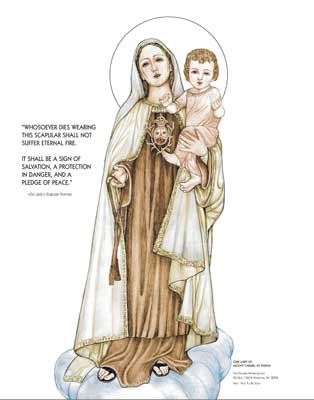
There is a tradition (which may not be historical) that Mary appeared to St. Simon Stock, a leader of the Carmelites, and gave him a scapular, telling him to promote devotion to it. The scapular is a modified version of Mary’s own garment. It symbolizes her special protection and calls the wearers to consecrate themselves to her in a special way. The scapular reminds us of the gospel call to prayer and penanceâ€"a call that Mary models in a splendid way.


Comment:

The Carmelites were known from early on as “Brothers of Our Lady of Mount Carmel.” The title suggests that they saw Mary not only as “mother,” but also as “sister.” The word “sister” is a reminder that Mary is very close to us. She is the daughter of God and therefore can help us be authentic daughters and sons of God. She also can help us grow in appreciation of being sisters and brothers to one another. She leads us to a new realization that all human beings belong to the family of God. When such a conviction grows, there is hope that the human race can find its way to peace.

Quote:

“The various forms of piety toward the Mother of God, which the Church has approved within the limits of sound and orthodox doctrine, according to the dispositions and understanding of the faithful, ensure that while the mother is honored, the Son through whom all things have their being (cf. Colossians 1:15â€"16) and in whom it has pleased the Father that all fullness should dwell (cf. Colossians 1:19) is rightly known, loved and glorified and his commandments are observed” (Dogmatic Constitution on the Church, 66).

Patron Saint of:

Chile
#2447
Bible Study / Re: Minute Meditations
July 16, 2011, 02:36:52 PM
Hold Us Close To You    

Keep reminding me that the best part of prayer is not so much in gaining information about you, O Jesus, as it is in growing into a closer love union with you
#2448
Bible Study / Re: Minute Meditations
July 15, 2011, 02:37:44 PM
Christ, Strengthen Me    

It is your power and mercy that saves me and gives me strength, and not my own. Help me to stay united with you and your passion, which reveals your saving love for me and all your people.
#2449
Bible Study / Re: Saints Of The Day
July 15, 2011, 02:36:47 PM
St. Bonaventure
(1221-1274)


Bonaventure, Franciscan, theologian, doctor of the Church, was both learned and holy. Because of the spirit that filled him and his writings, he was at first called the Devout Doctor; but in more recent centuries he has been known as the Seraphic Doctor after the “Seraphic Father” Francis because of the truly Franciscan spirit he possessed.

Born in Bagnoregio, a town in central Italy, he was cured of a serious illness as a boy through the prayers of Francis of Assisi. Later, he studied the liberal arts in Paris. Inspired by Francis and the example of the friars, especially of his master in theology, Alexander of Hales, he entered the Franciscan Order, and became in turn a teacher of theology in the university. Chosen as minister general of the Order in 1257, he was God’s instrument in bringing it back to a deeper love of the way of St. Francis, both through the life of Francis which he wrote at the behest of the brothers and through other works which defended the Order or explained its ideals and way of life.


Comment:

Bonaventure so united holiness and theological knowledge that he rose to the heights of mysticism while yet remaining a very active preacher and teacher, one beloved by all who met him. To know him was to love him; to read him is still for us today to meet a true Franciscan and a gentleman.
#2450
Bible Study / Re: Saints Of The Day
July 14, 2011, 02:24:13 PM
Blessed Kateri Tekakwitha
(1656-1680)


The blood of martyrs is the seed of saints. Nine years after the Jesuits Isaac Jogues and John de Brébeuf were tomahawked by Iroquois warriors, a baby girl was born near the place of their martyrdom, Auriesville, New York.

Her mother was a Christian Algonquin, taken captive by the Iroquois and given as wife to the chief of the Mohawk clan, the boldest and fiercest of the Five Nations. When she was four, Kateri lost her parents and little brother in a smallpox epidemic that left her disfigured and half blind. She was adopted by an uncle, who succeeded her father as chief. He hated the coming of the Blackrobes (Jesuit missionaries), but could do nothing to them because a peace treaty with the French required their presence in villages with Christian captives. She was moved by the words of three Blackrobes who lodged with her uncle, but fear of him kept her from seeking instruction. She refused to marry a Mohawk brave and at 19 finally got the courage to take the step of converting. She was baptized with the name Kateri (Catherine) on Easter Sunday.

Now she would be treated as a slave. Because she would not work on Sunday, she received no food that day. Her life in grace grew rapidly. She told a missionary that she often meditated on the great dignity of being baptized. She was powerfully moved by God’s love for human beings and saw the dignity of each of her people.

She was always in danger, for her conversion and holy life created great opposition. On the advice of a priest, she stole away one night and began a 200-mile walking journey to a Christian Indian village at Sault St. Louis, near Montreal.

For three years she grew in holiness under the direction of a priest and an older Iroquois woman, giving herself totally to God in long hours of prayer, in charity and in strenuous penance. At 23 she took a vow of virginity, an unprecedented act for an Indian woman, whose future depended on being married. She found a place in the woods where she could pray an hour a dayâ€"and was accused of meeting a man there!

Her dedication to virginity was instinctive: She did not know about religious life for women until she visited Montreal. Inspired by this, she and two friends wanted to start a community, but the local priest dissuaded her. She humbly accepted an “ordinary” life. She practiced extremely severe fasting as penance for the conversion of her nation. She died the afternoon before Holy Thursday. Witnesses said that her emaciated face changed color and became like that of a healthy child. The lines of suffering, even the pockmarks, disappeared and the touch of a smile came upon her lips. She was beatified in 1980.


Comment:

We like to think that our proposed holiness is thwarted by our situation. If only we could have more solitude, less opposition, better health. Kateri repeats the example of the saints: Holiness thrives on the cross, anywhere. Yet she did have what Christiansâ€"all peopleâ€"need: the support of a community. She had a good mother, helpful priests, Christian friends. These were present in what we call primitive conditions, and blossomed in the age-old Christian triad of prayer, fasting and alms: union with God in Jesus and the Spirit, self-discipline and often suffering, and charity for her brothers and sisters.

Quote:

Kateri said: “I am not my own; I have given myself to Jesus. He must be my only love. The state of helpless poverty that may befall me if I do not marry does not frighten me. All I need is a little food and a few pieces of clothing. With the work of my hands I shall always earn what is necessary and what is left over I’ll give to my relatives and to the poor. If I should become sick and unable to work, then I shall be like the Lord on the cross. He will have mercy on me and help me, I am sure.”
#2451
Bible Study / Re: Minute Meditations
July 14, 2011, 02:23:08 PM
Christ, Wash Me    

Yes, Jesus, let the water flowing from your side cleanse me, as did the life-giving water which flowed over me at baptism. This saving stream never stops flowing through meâ€"unless I separate myself from your love.
#2452
Bible Study / Re: Saints Of The Day
July 13, 2011, 01:51:28 PM
St. Henry
(972-1024)


As German king and Holy Roman Emperor, Henry was a practical man of affairs. He was energetic in consolidating his rule. He crushed rebellions and feuds. On all sides he had to deal with drawn-out disputes so as to protect his frontiers. This involved him in a number of battles, especially in the south in Italy; he also helped Pope Benedict VIII quell disturbances in Rome. Always his ultimate purpose was to establish a stable peace in Europe.

According to eleventh-century custom, Henry took advantage of his position and appointed as bishops men loyal to him. In his case, however, he avoided the pitfalls of this practice and actually fostered the reform of ecclesiastical and monastic life.


Comment:

All in all, this saint was a man of his times. From our standpoint, he may have been too quick to do battle and too ready to use power to accomplish reforms. But, granted such limitations, he shows that holiness is possible in a busy secular life. It is in doing our job that we become saints.

Quote:

“We deem it opportune to remind our children of their duty to take an active part in public life and to contribute toward the attainment of the common good of the entire human family as well as to that of their own political community. They should endeavor, therefore, in the light of their Christian faith and led by love, to insure that the various institutionsâ€"whether economic, social, cultural or political in purposeâ€"should be such as not to create obstacles, but rather to facilitate or render less arduous man’s perfecting of himself in both the natural order and the supernatural.... Every believer in this world of ours must be a spark of light, a center of love, a vivifying leaven amidst his fellow men. And he will be this all the more perfectly, the more closely he lives in communion with God in the intimacy of his own soul” (Blessed Pope John XXIII, Peace on Earth, 146, 164).

#2453
Bible Study / Re: Minute Meditations
July 13, 2011, 01:49:57 PM
Christ, Inebriate Me

You have redeemed me, Jesus, by your blood shed upon the cross. Your burning love is so overwhelming that one feels intoxicated by the intensity of your care.
#2454
Bible Study / Re: Saints Of The Day
July 12, 2011, 02:21:26 PM
Sts. John Jones and John Wall
(c. 1530-1598; 1620-1679)


These two friars were martyred in England in the 16th and 17th centuries for refusing to deny their faith.

John Jones was Welsh. He was ordained a diocesan priest and was twice imprisoned for administering the sacraments before leaving England in 1590. He joined the Franciscans at the age of 60 and returned to England three years later while Queen Elizabeth I was at the height of her power. John ministered to Catholics in the English countryside until his imprisonment in 1596. He was condemned to be hanged, drawn and quartered. John was executed on July 12, 1598.

John Wall was born in England but was educated at the English College of Douai, Belgium. Ordained in Rome in 1648, he entered the Franciscans in Douai several years later. In 1656 he returned to work secretly in England.

In 1678 Titus Oates worked many English people into a frenzy over an alleged papal plot to murder the king and restore Catholicism in that country. In that year Catholics were legally excluded from Parliament, a law which was not repealed until 1829. John Wall was arrested and imprisoned in 1678 and was executed the following year.

John Jones and John Wall were canonized in 1970.


Comment:

Every martyr knows how to save his/her life and yet refuses to do so. A public repudiation of the faith would save any of them. But some things are more precious than life itself. These martyrs prove that their 20th-century countryman, C. S. Lewis, was correct in saying that courage is not simply one of the virtues but the form (shape) of every virtue at the testing point, that is, at the point of highest reality.

Quote:

"No one is a martyr for a conclusion; no one is a martyr for an opinion. It is faith that makes martyrs" (Cardinal Newman, Discourses to Mixed Congregations).

#2455
Bible Study / Re: Minute Meditations
July 12, 2011, 02:20:44 PM
Jesus, Sanctify Me    

Jesus, Risen One, may your soul invade my whole being and make me holy. Set me free of sin and fill me with the holiness that fills your own soul.
#2456
Bible Study / Re: Saints Of The Day
July 11, 2011, 02:01:25 PM
St. Benedict
(480?-543)

It is unfortunate that no contemporary biography was written of a man who has exercised the greatest influence on monasticism in the West. Benedict is well recognized in the later Dialogues of St. Gregory, but these are sketches to illustrate miraculous elements of his career.

Benedict was born into a distinguished family in central Italy, studied at Rome and early in life was drawn to the monastic life. At first he became a hermit, leaving a depressing worldâ€"pagan armies on the march, the Church torn by schism, people suffering from war, morality at a low ebb.

He soon realized that he could not live a hidden life in a small town any better than in a large city, so he withdrew to a cave high in the mountains for three years. Some monks chose him as their leader for a while, but found his strictness not to their taste. Still, the shift from hermit to community life had begun for him. He had an idea of gathering various families of monks into one “Grand Monastery” to give them the benefit of unity, fraternity, permanent worship in one house. Finally he began to build what was to become one of the most famous monasteries in the worldâ€"Monte Cassino, commanding three narrow valleys running toward the mountains north of Naples.

The Rule that gradually developed prescribed a life of liturgical prayer, study, manual labor and living together in community under a common father (abbot). Benedictine asceticism is known for its moderation, and Benedictine charity has always shown concern for the people in the surrounding countryside. In the course of the Middle Ages, all monasticism in the West was gradually brought under the Rule of St. Benedict.

Today the Benedictine family is represented by two branches: the Benedictine Federation and the Cistercians.


Comment:

The Church has been blessed through Benedictine devotion to the liturgy, not only in its actual celebration with rich and proper ceremony in the great abbeys, but also through the scholarly studies of many of its members. Liturgy is sometimes confused with guitars or choirs, Latin or Bach. We should be grateful to those who both preserve and adapt the genuine tradition of worship in the Church.

Quote:

“Rightly, then, the liturgy is considered as an exercise of the priestly office of Jesus Christ. In the liturgy the sanctification of man is manifested by signs perceptible to the senses...; in the liturgy full public worship is performed by the Mystical Body of Jesus Christ, that is, by the Head and his members.

“From this it follows that every liturgical celebration, because it is an action of Christ the priest and of his Body the Church, is a sacred action, surpassing all others” (Constitution on the Sacred Liturgy, 7).


Patron Saint of:

Europe
Kidney disease
Poisoning
Schoolchildren
#2457
Bible Study / Re: Minute Meditations
July 11, 2011, 02:00:18 PM
Heal Those Around You

Pray and fast for those in need. Touch the marginalized and oppressed with your compassionate love. Expel the demons of violence and death, and help others live in the Holy Spirit of love and peace.
#2458
Bible Study / Re: Minute Meditations
July 10, 2011, 03:44:59 PM
Love and Serve Other

The inner life of peace means acting from a deep conviction about who we are, that each one of us is a beloved child of God, a human being called to love and serve other human beings.
#2459
Bible Study / Re: Saints Of The Day
July 10, 2011, 03:44:05 PM
St. Veronica Giuliani
(1660-1727)

Veronica’s desire to be like Christ crucified was answered with the stigmata.

Veronica was born in Mercatelli, Italy. It is said that when her mother Benedetta was dying she called her five daughters to her bedside and entrusted each of them to one of the five wounds of Jesus. Veronica was entrusted to the wound below Christ’s heart.

At the age of 17, Veronica joined the Poor Clares directed by the Capuchins. Her father had wanted her to marry, but she convinced him to allow her to become a nun. In her first years in the monastery, she worked in the kitchen, infirmary and sacristy and also served as portress. At the age of 34, she was made novice mistress, a position she held for 22 years. When she was 37, Veronica received the stigmata. Life was not the same after that.

Church authorities in Rome wanted to test Veronica’s authenticity and so conducted an investigation. She lost the office of novice mistress temporarily and was not allowed to attend Mass except on Sundays or holy days. Through all of this Veronica did not become bitter, and the investigation eventually restored her as novice mistress.

Though she protested against it, at the age of 56 she was elected abbess, an office she held for 11 years until her death. Veronica was very devoted to the Eucharist and to the Sacred Heart. She offered her sufferings for the missions. Veronica was canonized in 1839.


Comment:

Why did God grant the stigmata to Francis of Assisi and to Veronica? God alone knows the deepest reasons, but as Celano points out, the external sign of the cross is a confirmation of these saints’ commitment to the cross in their lives. The stigmata that appeared in Veronica’s flesh had taken root in her heart many years before. It was a fitting conclusion for her love of God and her charity toward her sisters.

Quote:

Thomas of Celano says of Francis: "All the pleasures of the world were a cross to him, because he carried the cross of Christ rooted in his heart. And therefore the stigmata shone forth exteriorly in his flesh, because interiorly that deeply set root was sprouting forth from his mind" (2 Celano, #211).
#2460
Bible Study / Re: Saints Of The Day
July 09, 2011, 01:47:31 PM
St. Augustine Zhao Rong and Companions
(17th-20th centuries)


Christianity arrived in China by way of Syria in the 600s. Depending on China's relations with the outside world, Christianity over the centuries was free to grow or was forced to operate secretly.

The 120 martyrs in this group died between 1648 and 1930. Most of them (87) were born in China and were children, parents, catechists or laborers, ranging from nine years of age to 72. This group includes four Chinese diocesan priests.

The 33 foreign-born martyrs were mostly priests or women religious, especially from the Order of Preachers, the Paris Foreign Mission Society, the Friars Minor, Jesuits, Salesians and Franciscan Missionaries of Mary.

Augustine Zhao Rong was a Chinese solider who accompanied Bishop John Gabriel Taurin Dufresse (Paris Foreign Mission Society) to his martyrdom in Beijing. Augustine was baptized and not long after was ordained as a diocesan priest. He was martyred in 1815.

Beatified in groups at various times, these 120 martyrs were canonized in Rome on October 1, 2000.


Comment:

The People's Republic of China and the Roman Catholic Church each have well over a billion members, but there are over 12 million Catholics in China. The reasons for that are better explained by historical conflicts than by a wholesale rejection of the Good News of Jesus Christ. The Chinese-born martyrs honored by today's feast were regarded by their persecutors as dangerous because they were considered allies of enemy, Catholic countries. The martyrs born outside China often tried to distance themselves from European political struggles relating to China, but their persecutors saw them as Westerners and therefore, by definition, anti-Chinese.

The Good News of Jesus Christ is intended to benefit all peoples; today's martyrs knew that. May 21st-century Christians live in such a way that Chinese women and men will be attracted to hear that Good News and embrace it.


Quote:

A year after these martyrs were canonized, Pope John Paul II addressed a group of Chinese and Western scholars, gathered in Rome for a symposium honoring the 400th anniversary of the arrival in Beijing of Matteo Ricci, a Jesuit scholar and Chinese intellectual.

After noting the positive contributions that Christianity had made to China, especially in health care and education, Pope John Paul II continued: "History, however, reminds us of the unfortunate fact that the work of members of the church in China was not always without error, the bitter fruit of their personal limitations and of the limits of their action. Moreover, their action was often conditioned by difficult situations connected with complex historical events and conflicting political interests. Nor were theological disputes lacking, which caused bad feelings and created serious difficulties in preaching the Gospel….

"I feel deep sadness for these errors and limits of the past, and I regret that in many people these failings may have given the impression of a lack of respect and esteem for the Chinese people on the part of the Catholic Church, making them feel that the church was motivated by feelings of hostility toward China. For all of this I ask the forgiveness and understanding of those who may have felt hurt in some way by such actions on the part of Christians."
#2461
Bible Study / Re: Minute Meditations
July 09, 2011, 01:46:45 PM
God’s Invitation    

Every moment offers us God’s invitation to live in God’s own peace. Wherever we are, we can reject violence and war and take up the exciting journey by proclaiming God’s reign of peace here on earth.
#2462
General Topic / 5 Old-School Kitchen Essentials
July 08, 2011, 09:09:30 PM
Top 5 Old-School Kitchen Essentials

By Adam Verwymeren

Published July 06, 2011

| FoxNews.com

Read more: http://www.foxnews.com/leisure/2011/07/06/top-5-old-school-kitchen-essentials/#ixzz1RWERJQB5
So whether you’re a college student looking to equip your first kitchen, or even a veteran home cook looking to cut the kitchen clutter and get back to the basics, here are the top five pieces of equipment every kitchen should have.

1. Knife

The single most important tool in your kitchen arsenal, the humble knife is a tool that you will use every day.

Forget expensive sets that come with ten or more knives that you will never use. Invest in one good quality chef’s knife â€" an 8-inch knife is the most standard size, or a 7-inch santoku knife, if you prefer something a little shorter.

There are many factors to consider when buying a knife, but the most important is whether it feels good in your hand. This is the kitchen tool you’ll spend the most time with, so you don’t want something that will give you hand cramps.

2. Cutting Board

Often overlooked but nearly as important as the knife, the cutting board protects your countertops and ensures that you have a clean space to prepare your food on.

While you can get thick, heavy boards made of solid maple that will last for years, a lightweight cutting board is often preferable since you can easily pick it up and transport chopped meat and vegetables from the counter to the frying pan.

Wooden boards tend to last longer, but they can’t stand up to the high heat of the dishwasher. So unless you want to hand-wash your cutting board, go with plastic.

3. Skillet or Sauté Pan

Once you have prepared your dinner with your knife and cutting board, it is time to do some actual cooking, and that’s where the skillet or sauté pan comes in.

At $12 to $14, a cast iron pan is about the cheapest option out there, and in many ways, it’s also the best. Sure it’s heavy, but that added heft means it handles heat well. Thin aluminum frying pans go from cold to scorching in no time, meaning there’s no margin of error when it comes to burning tonight’s dinner. A cast iron pan conducts heat evenly and gradually, and because it has metal handles, a cast iron pan or skillet can do double duty on the stove top and as a roasting pan inside the oven.

If you do opt for something a little more lightweight, or something with a nonstick coating, make sure it’s solid. Most quality pans have a stainless steel exterior for strength, and an aluminum interior for better heat conduction.

4. Pots

Whether you use it to heat up canned soup, or make complex sauces from scratch, a good pot is key. A two-quart pot is an ample size for most tasks, though you’ll also need a larger pot â€" between five to 12 quarts â€" for cooking pasta or making stocks. As with the pans, look for a solid stainless steel pot with an aluminum core.

5. A Wooden Spoon

Once the food is cooking in your pots and pans, you’re going to need some way to stir and flip it without burning your hands, and that’s where the wooden spoon and spatula come in. You want something with a handle long enough to keep your hands clear of the heat, but not so long that the tool becomes unwieldy. And if you have nonstick equipment, steer clear of metal utensils, which will scratch and damage pots and pans.

If you start by mastering these five basic tools, rather than chasing after the latest in kitchen gadgetry, you’ll be a top chef in no time.

Read more: http://www.foxnews.com/leisure/2011/07/06/top-5-old-school-kitchen-essentials/#ixzz1RWEelpgf

#2463
Tira-Pasagad | Saksak-Sinagol / After ten years!
July 08, 2011, 09:00:54 PM


Foxnews
Fast forward almost 10 years and we arrive to today, where the same little girl who portrayed the precocious Hermonie Granger has blossomed into a grown up, fashion-minded, 21-year-old starlet.

With a weepy voice, Watson spoke to the thousands of fans who filled Trafalagar Square for the premiere thanking her co-stars for their time spent over the last ten years and calling Daniel Radcliffe "the perfect Harry."

Gone are the days of her frizzy long locks and the tongue twisting lines Watson had to deliver as Harry Potter's resourceful and smart female sidekick, but even when she is old a gray, she'll still be Hermoine Granger.

Watson isn't alone, take a trip down memory lane and look back at Daniel Radcliffe and Rupert Grint's transformations from little guys to grown ups!
http://www.popeater.com/2011/07/07/emma-watson-harry-potter-premiere-photos/
#2464
Bible Study / Re: Saints Of The Day
July 08, 2011, 02:07:36 PM
St. Gregory Grassi and Companions
(d. 1900)


Christian missionaries have often gotten caught in the crossfire of wars against their own countries. When the governments of Britain, Germany, Russia and France forced substantial territorial concessions from the Chinese in 1898, anti-foreign sentiment grew very strong among many Chinese people.

Gregory Grassi was born in Italy in 1833, ordained in 1856 and sent to China five years later. Gregory was later ordained Bishop of North Shanxi. With 14 other European missionaries and 14 Chinese religious, he was martyred during the short but bloody Boxer Uprising of 1900.

Twenty-six of these martyrs were arrested on the orders of Yu Hsien, the governor of Shanxi province. They were hacked to death on July 9, 1900. Five of them were Friars Minor; seven were Franciscan Missionaries of Mary â€" the first martyrs of their congregation. Seven were Chinese seminarians and Secular Franciscans; four martyrs were Chinese laymen and Secular Franciscans. The other three Chinese laymen killed in Shanxi simply worked for the Franciscans and were rounded up with all the others. Three Italian Franciscans were martyred that same week in the province of Hunan. All these martyrs were beatified in 1946.


Comment:

Martyrdom is the occupational hazard of missionaries. Throughout China during the Boxer Uprising, five bishops, 50 priests, two brothers, 15 sisters and 40,000 Chinese Christians were killed. The 146,575 Catholics served by the Franciscans in China in 1906 had grown to 303,760 by 1924 and were served by 282 Franciscans and 174 local priests. Great sacrifices often bring great results.

Quote:

"Martyrdom is part of the Church's nature since it manifests Christian death in its pure form, as the death of unrestrained faith, which is otherwise hidden in the ambivalence of all human events. Through martyrdom the Church's holiness, instead of remaining purely subjective, achieves by God's grace the visible expression it needs. As early as the second century one who accepted death for the sake of Christian faith or Christian morals was looked on and revered as a 'martus' (witness). The term is scriptural in that Jesus Christ is the 'faithful witness' absolutely (Revelations 1:5; 3:14)" (Karl Rahner, Theological Dictionary, volume 2, pp. 108-09).

#2465
Bible Study / Re: Minute Meditations
July 08, 2011, 02:06:40 PM
Instruments of Peace    

Be vulnerable before God and take the risk of peacemaking, the mystics tell us, and then God can use us as instruments of God’s peaceâ€"in ways we never dreamed possible.
#2466
Bible Study / Re: Minute Meditations
July 07, 2011, 02:51:41 PM
When Bad Things Happen    

Tough times can be God’s way of shaking me free from the false gods and worldly ways that I’m hanging on to. He’s rattling me for my own good, so that I’ll be left with the unshakeableâ€"God, the beginning and end of my life.
#2467
Bible Study / Re: Saints Of The Day
July 07, 2011, 02:51:09 PM
St. Nicholas Pick and Companions
(d. 1572)


It is not always possible to choose when and how we will witness to our faith.

In 1568 the Low Countries revolted against Spain. In the northern part (now the Netherlands), the revolt was also directed against Catholicism. This rebellion ultimately led to the recognition in 1648 of an independent Republic of United Provinces (Netherlands).

Nicholas and his companions (11 Franciscans and eight diocesan priests) are also known as "the martyrs of Gorcum," where they were arrested by Calvinist soldiers. They were taken to Briel and urged to renounce the Roman Catholic teaching on Christ’s presence in the Eucharist and on the pope’s primacy. They refused and were hung from crossbeams. The execution was clumsily handled; it took two hours for some of them to strangle. They were canonized in 1867.


Comment:

Notice which teachings were presented to these martyrs. Turning the Eucharist into some vague remembrance of Christ and denying the leadership of the successor of Peter might have seemed easy. Nicholas and his companions knew these teachings were part of God’s plan for his people, and so they would not deny their faith. Both the Eucharist and the successor of Peter will eventually be instrumental in restoring unity among Christians.

Quote:

"'The hour is now at hand,' Father Nicholas said, 'to receive from the hand of the Lord the long desired reward of the struggle, the crown of eternal happiness.' He encouraged them [his companions] not to fear death nor to lose through cowardice the crown prepared for them and soon to be placed on their brows. Finally he prayed that they would joyfully follow the path on which they saw him leading the way. With these and similar words he joyfully mounted the ladder without ceasing to exhort his companions until strangulation deprived him of the use of his voice" (contemporary account of the martyrdom).
#2468
Bible Study / Re: Minute Meditations
July 05, 2011, 02:39:03 PM
Transformation of Heart    

Jesus’ tomb was a place of transformation. Once opened, the tomb allowed the sunlight in and the Son’s light out. That’s how it is with our hearts when God breathes life into us.
#2469
Bible Study / Re: Saints Of The Day
July 05, 2011, 02:38:14 PM
St. Anthony Zaccaria
(1502-1539)


At the same time that Martin Luther was attacking abuses in the Church, a reformation within the Church was already being attempted. Among the early movers of the Counter-Reformation was Anthony Zaccaria. His mother became a widow at 18 and devoted herself to the spiritual education of her son. He received a medical doctorate at 22 and, while working among the poor of his native Cremona in Italy, was attracted to the religious apostolate. He renounced his rights to any future inheritance, worked as a catechist and was ordained a priest at the age of 26. Called to Milan in a few years, he laid the foundations of three religious congregations, one for men and one for women, plus an association of married couples. Their aim was the reform of the decadent society of their day, beginning with the clergy, religious and lay people.

Greatly inspired by St. Paul (his congregation is named the Barnabites, after the companion of that saint), Anthony preached with great vigor in church and street, conducted popular missions and was not ashamed of doing public penance.

He encouraged such innovations as the collaboration of the laity in the apostolate, frequent Communion, the Forty Hours devotion and the ringing of church bells at 3:00 p.m. on Fridays.

His holiness moved many to reform their lives but, as with all saints, it also moved many to oppose him. Twice his community had to undergo official religious investigation, and twice it was exonerated.

While on a mission of peace, he became seriously ill and was brought home for a visit to his mother. He died at Cremona at the age of 36.


Comment:

The austerity of Anthony's spirituality and the Pauline ardor of his preaching would probably "turn off" many people today. When even some psychiatrists complain at the lack of a sense of sin, it may be time to tell ourselves that not all evil is explained by emotional disorder, subconscious and unconscious drives, parental influence and so on. The old-time "hell and damnation" mission sermons have given way to positive, encouraging, biblical homilies. We do indeed need assurance of forgiveness, relief from existential anxiety and future shock. But we still need prophets to stand up and tell us, "If we say 'We are without sin,' we deceive ourselves and the truth is not in us" (1 John 1:8).

Quote:

''I charge you in the presence of God and of Christ Jesus, who will judge the living and the dead, and by his appearing and his kingly power: proclaim the word; be persistent whether it is convenient or inconvenient; convince, reprimand, encourage through all patience and teaching. For the time will come when people will not tolerate sound doctrine but, following their own desires and insatiable curiosity, will accumulate teachers and will stop listening to the truth and will be diverted to myths" (2 Timothy 4:1-4).
#2470


More than 3,500 Palestinian children play with brightly colored parachutes at a United Nations Relief and Works Agency (UNRWA) event on June 30 in the southern Gaza Strip. The children are attending a six-week summer camp organized by the UNRWA during which they will try to break world records in a number of activities -- including world's biggest parachute game, which they managed for the third year in a row. "The children of Gaza have shown again that they can be the best in the world," Sebastien Trives, UNRWA's deputy director of programs in Gaza, said in a statement. "These events raise the spirits and aspirations of the children and give them a real sense of accomplishment and hope. They can achieve special things when given the opportunity."
#2471
Bible Study / Re: Saints Of The Day
July 01, 2011, 02:06:56 PM
Blessed Junipero Serra
(1713-1784)


In 1776, when the American Revolution was beginning in the east, another part of the future United States was being born in California. That year a gray-robed Franciscan founded Mission San Juan Capistrano, now famous for its annually returning swallows. San Juan was the seventh of nine missions established under the direction of this indomitable Spaniard.

Born on Spain’s island of Mallorca, Serra entered the Franciscan Order, taking the name of St. Francis’ childlike companion, Brother Juniper. Until he was 35, he spent most of his time in the classroomâ€"first as a student of theology and then as a professor. He also became famous for his preaching. Suddenly he gave it all up and followed the yearning that had begun years before when he heard about the missionary work of St. Francis Solanus in South America. Junipero’s desire was to convert native peoples in the New World.

Arriving by ship at Vera Cruz, Mexico, he and a companion walked the 250 miles to Mexico City. On the way Junipero’s left leg became infected by an insect bite and would remain a crossâ€"sometimes life-threateningâ€"for the rest of his life. For 18 years he worked in central Mexico and in the Baja Peninsula. He became president of the missions there.

Enter politics: the threat of a Russian invasion south from Alaska. Charles III of Spain ordered an expedition to beat Russia to the territory. So the last two conquistadorsâ€"one military, one spiritualâ€"began their quest. José de Galvez persuaded Junipero to set out with him for present-day Monterey, California. The first mission founded after the 900-mile journey north was San Diego (1769). That year a shortage of food almost canceled the expedition. Vowing to stay with the local people, Junipero and another friar began a novena in preparation for St. Joseph’s day, March 19, the scheduled day of departure. On that day, the relief ship arrived.

Other missions followed: Monterey/Carmel (1770); San Antonio and San Gabriel (1771); San Luís Obispo (1772); San Francisco and San Juan Capistrano (1776); Santa Clara (1777); San Buenaventura (1782). Twelve more were founded after Serra’s death.

Junipero made the long trip to Mexico City to settle great differences with the military commander. He arrived at the point of death. The outcome was substantially what Junipero sought: the famous “Regulation” protecting the Indians and the missions. It was the basis for the first significant legislation in California, a “Bill of Rights” for Native Americans.

Because the Native Americans were living a nonhuman life from the Spanish point of view, the friars were made their legal guardians. The Native Americans were kept at the mission after Baptism lest they be corrupted in their former hauntsâ€"a move that has brought cries of “injustice” from some moderns.

Junipero’s missionary life was a long battle with cold and hunger, with unsympathetic military commanders and even with danger of death from non-Christian native peoples. Through it all his unquenchable zeal was fed by prayer each night, often from midnight till dawn. He baptized over 6,000 people and confirmed 5,000. His travels would have circled the globe. He brought the Native Americans not only the gift of faith but also a decent standard of living. He won their love, as witnessed especially by their grief at his death. He is buried at Mission San Carlo Borromeo, Carmel, and was beatified in 1988.


Comment:

The word that best describes Junipero is zeal. It was a spirit that came from his deep prayer and dauntless will. “Always forward, never back” was his motto. His work bore fruit for 50 years after his death as the rest of the missions were founded in a kind of Christian communal living by the Indians. When both Mexican and American greed caused the secularization of the missions, the Chumash people went back to what they had beenâ€"God again writing straight with crooked lines.

Quote:

During his homily at Serra’s beatification, Pope John Paul II said: “Relying on the divine power of the message he proclaimed, Father Serra led the native peoples to Christ. He was well aware of their heroic virtuesâ€"as exemplified in the life of Blessed Kateri Tekakwitha [July 14]â€"and he sought to further their authentic human development on the basis of their new-found faith as persons created and redeemed by God. He also had to admonish the powerful, in the spirit of our second reading from James, not to abuse and exploit the poor and the weak.”

#2472
Bible Study / Re: Minute Meditations
July 01, 2011, 02:06:16 PM
Despite Everything


I can sit for hours and know everything and bear everything and grow stronger in the bearing of it, and at the same time feel sure that life is beautiful and worth living and meaningful. Despite everything. â€"Etty Hillesum
#2473
Bible Study / Re: Saints Of The Day
June 30, 2011, 02:18:03 PM
First Martyrs of the Church of Rome
(d. 68)


There were Christians in Rome within a dozen or so years after the death of Jesus, though they were not the converts of the “Apostle of the Gentiles” (Romans 15:20). Paul had not yet visited them at the time he wrote his great letter in 57-58 A.D..

There was a large Jewish population in Rome. Probably as a result of controversy between Jews and Jewish Christians, the Emperor Claudius expelled all Jews from Rome in 49-50 A.D. Suetonius the historian says that the expulsion was due to disturbances in the city “caused by the certain Chrestus” [Christ]. Perhaps many came back after Claudius’s death in 54 A.D. Paul’s letter was addressed to a Church with members from Jewish and Gentile backgrounds.

In July of 64 A.D., more than half of Rome was destroyed by fire. Rumor blamed the tragedy on Nero, who wanted to enlarge his palace. He shifted the blame by accusing the Christians. According to the historian Tacitus, many Christians were put to death because of their “hatred of the human race.” Peter and Paul were probably among the victims.

Threatened by an army revolt and condemned to death by the senate, Nero committed suicide in 68 A.D. at the age of 31.


Comment:

Wherever the Good News of Jesus was preached, it met the same opposition as Jesus did, and many of those who began to follow him shared his suffering and death. But no human force could stop the power of the Spirit unleashed upon the world. The blood of martyrs has always been, and will always be, the seed of Christians.

Quote:

Pope Clement I, third successor of St. Peter, writes: “It was through envy and jealousy that the greatest and most upright pillars of the Church were persecuted and struggled unto death.... First of all, Peter, who because of unreasonable jealousy suffered not merely once or twice but many times, and, having thus given his witness, went to the place of glory that he deserved. It was through jealousy and conflict that Paul showed the way to the prize for perseverance. He was put in chains seven times, sent into exile, and stoned; a herald both in the east and the west, he achieved a noble fame by his faith....”

“Around these men with their holy lives there are gathered a great throng of the elect, who, though victims of jealousy, gave us the finest example of endurance in the midst of many indignities and tortures. Through jealousy women were tormented, like Dirce or the daughters of Danaus, suffering terrible and unholy acts of violence. But they courageously finished the course of faith and despite their bodily weakness won a noble prize.”


#2474
Bible Study / Re: Minute Meditations
June 30, 2011, 02:17:25 PM
Image of God

We are made in the image and likeness of God and God expects us to act accordingly. When we act selfishly, we distort our original goodness.
#2475


A swimmer stands out thanks to his yellow security cap while taking a dip in Lake Zurich on Monday, June 27. As a preventative measure against the frequent swimming accidents that occur in Zurich's lakes during the summer, the Swiss city has undertaken a new safety intitiative: Bathing caps like the one seen here will be distributed to swimmers for free. The brightly-colored caps make swimmers more visible to boats above the water. The campaign, "Smart Swimmers Live Longer," launched on Monday.
#2476
Keko, you are still alive and kicking!
I met Bol-anons in Tagbilaran city who might be coming to this occasion. You are right with these Gypsy kids, it is a sore because they worked systematically and well organized.
#2477
Bible Study / Re: Saints Of The Day
June 29, 2011, 01:27:56 PM
Sts. Peter and Paul
(d. 64 & 67)

Peter (d. 64?). St. Mark ends the first half of his Gospel with a triumphant climax. He has recorded doubt, misunderstanding and the opposition of many to Jesus. Now Peter makes his great confession of faith: "You are the Messiah" (Mark 8:29b). It was one of the many glorious moments in Peter's life, beginning with the day he was called from his nets along the Sea of Galilee to become a fisher of men for Jesus.

The New Testament clearly shows Peter as the leader of the apostles, chosen by Jesus to have a special relationship with him. With James and John he was privileged to witness the Transfiguration, the raising of a dead child to life and the agony in Gethsemane. His mother-in-law was cured by Jesus. He was sent with John to prepare for the last Passover before Jesus' death. His name is first on every list of apostles.

And to Peter only did Jesus say, "Blessed are you, Simon son of Jonah. For flesh and blood has not revealed this to you, but my heavenly Father. And so I say to you, you are Peter, and upon this rock I will build my church, and the gates of the netherworld shall not prevail against it. I will give you the keys to the kingdom of heaven. Whatever you bind on earth shall be bound in heaven; and whatever you loose on earth shall be loosed in heaven" (Matthew 16:17b-19).

But the Gospels prove their own trustworthiness by the unflattering details they include about Peter. He clearly had no public relations person. It is a great comfort for ordinary mortals to know that Peter also has his human weakness, even in the presence of Jesus.

He generously gave up all things, yet he can ask in childish self-regard, "What are we going to get for all this?" (see Matthew 19:27). He receives the full force of Christ's anger when he objects to the idea of a suffering Messiah: "Get behind me, Satan! You are an obstacle to me. You are thinking not as God does, but as human beings do" (Matthew 16:23b).

Peter is willing to accept Jesus' doctrine of forgiveness, but suggests a limit of seven times. He walks on the water in faith, but sinks in doubt. He refuses to let Jesus wash his feet, then wants his whole body cleansed. He swears at the Last Supper that he will never deny Jesus, and then swears to a servant maid that he has never known the man. He loyally resists the first attempt to arrest Jesus by cutting off Malchus's ear, but in the end he runs away with the others. In the depth of his sorrow, Jesus looks on him and forgives him, and he goes out and sheds bitter tears. The Risen Jesus told Peter to feed his lambs and his sheep (John 21:15-17).

Paul (d. 64?). If the most well-known preacher today suddenly began preaching that the United States should adopt Marxism and not rely on the Constitution, the angry reaction would help us understand Paul's life when he started preaching that Christ alone can save us. He had been the most Pharisaic of Pharisees, the most legalistic of Mosaic lawyers. Now he suddenly appears to other Jews as a heretical welcomer of Gentiles, a traitor and apostate.

Paul's central conviction was simple and absolute: Only God can save humanity. No human effortâ€"even the most scrupulous observance of lawâ€"can create a human good which we can bring to God as reparation for sin and payment for grace. To be saved from itself, from sin, from the devil and from death, humanity must open itself completely to the saving power of Jesus.

Paul never lost his love for his Jewish family, though he carried on a lifelong debate with them about the uselessness of the Law without Christ. He reminded the Gentiles that they were grafted on the parent stock of the Jews, who were still God's chosen people, the children of the promise.

In light of his preaching and teaching skills, Paul's name has surfaced (among others) as a possible patron of the Internet.


Comment:

We would probably go to confession to Peter sooner than to any of the other apostles. He is perhaps a more striking example of the simple fact of holiness. Jesus says to us as he said, in effect, to Peter: "It is not you who have chosen me, but I who have chosen you. Peter, it is not human wisdom that makes it possible for you to believe, but my Father's revelation. I, not you, build my Church." Paul's experience of the risen Jesus on the road to Damascus was the driving force that made him one of the most zealous, dynamic and courageous ambassadors of Christ the Church has ever had. But persecution, humiliation and weakness became his day-by-day carrying of the cross, material for further transformation. The dying Christ was in him; the living Christ was his life.
#2478
Bible Study / Re: Minute Meditations
June 29, 2011, 01:27:16 PM
Eternally Present    

Thank You, Lord, for always being there for me. I know with certainty there were times when you carried me, when through your strength I got through the dark times in my life.
#2479
Quote from: islander on June 28, 2011, 01:09:47 AM
hehe.  basta iring, i'm not far behind. 

nag-death watch ko ron ug kitten mora rag kinumo kadak-a.  ambot unsay nasulod sa ulo sa inahan ani, basta iyang gidala ug gibiyaan sa pultahan.  natambalan na ni ganina ug veterinarian as an emergency case, but i'm not leaving it to chance.  sigehan nakog force-feed ug liquids.  if it makes it in 48 hours, ingon ang vet nga okay na.  sige intawon ug siyagit si bullet (ngan ni kitten) looy kaayo.  i'm going to have a long night.     


Mabuhay ka Isles, you are my hero!
#2480
Bible Study / Re: Saints Of The Day
June 28, 2011, 01:58:04 PM
St. Irenaeus
(130?-220)

The Church is fortunate that Irenaeus was involved in many of its controversies in the second century. He was a student, well trained, no doubt, with great patience in investigating, tremendously protective of apostolic teaching, but prompted more by a desire to win over his opponents than to prove them in error.

As bishop of Lyons he was especially concerned with the Gnostics, who took their name from the Greek word for “knowledge.” Claiming access to secret knowledge imparted by Jesus to only a few disciples, their teaching was attracting and confusing many Christians. After thoroughly investigating the various Gnostic sects and their “secret,” Irenaeus showed to what logical conclusions their tenets led. These he contrasted with the teaching of the apostles and the text of Holy Scripture, giving us, in five books, a system of theology of great importance to subsequent times. Moreover, his work, widely used and translated into Latin and Armenian, gradually ended the influence of the Gnostics.

The circumstances and details about his death, like those of his birth and early life in Asia Minor, are not at all clear.


Comment:

A deep and genuine concern for other people will remind us that the discovery of truth is not to be a victory for some and a defeat for others. Unless all can claim a share in that victory, truth itself will continue to be rejected by the losers, because it will be regarded as inseparable from the yoke of defeat. And so, confrontation, controversy and the like might yield to a genuine united search for God's truth and how it can best be served.

Quote:

A group of Christians in Asia Minor had been excommunicated by Pope Victor III because of their refusal to accept the Western church's date for celebrating Easter. Irenaeus, the "lover of peace" as his name indicates, interceded with the pope to lift the ban. Irenaeus indicated that this was not an essential matter and that these people were merely following an old tradition, one that men such as Saint Polycarp and Pope Anicetus had not seen as divisive. The pope responded favorably and the rift was healed. Some 100 years later, the Western practice was voluntarily adopted.
#2481
Bible Study / Re: Minute Meditations
June 28, 2011, 01:57:12 PM
Eternal Rest    

We will lie down for such a long time after death that it is worthwhile to keep standing while we are alive. Let us work now; one day we will rest.
#2482
Bible Study / Re: Saints Of The Day
June 27, 2011, 04:52:00 PM
St. Cyril of Alexandria
(376?-444)


Saints are not born with halos around their heads. Cyril, recognized as a great teacher of the Church, began his career as archbishop of Alexandria, Egypt, with impulsive, often violent, actions. He pillaged and closed the churches of the Novatian heretics, participated in the deposing of St. John Chrysostom (September 13) and confiscated Jewish property, expelling the Jews from Alexandria in retaliation for their attacks on Christians.

Cyril’s importance for theology and Church history lies in his championing the cause of orthodoxy against the heresy of Nestorius.

The controversy centered around the two natures in Christ. Nestorius would not agree to the title “God-bearer” for Mary. He preferred “Christ-bearer,” saying there are two distinct persons in Christ (divine and human) joined only by a moral union. He said Mary was not the mother of God but only of the man Christ, whose humanity was only a temple of God. Nestorianism implied that the humanity of Christ was a mere disguise.

Presiding as the pope’s representative at the Council of Ephesus (431), Cyril condemned Nestorianism and proclaimed Mary truly the “God-bearer” (the mother of the one Person who is truly God and truly human). In the confusion that followed, Cyril was deposed and imprisoned for three months, after which he was welcomed back to Alexandria as a second Athanasius (the champion against Arianism).

Besides needing to soften some of his opposition to those who had sided with Nestorius, Cyril had difficulties with some of his own allies, who thought he had gone too far, sacrificing not only language but orthodoxy. Until his death, his policy of moderation kept his extreme partisans under control. On his deathbed, despite pressure, he refused to condemn the teacher of Nestorius.


Comment:

Lives of the saints are valuable not only for the virtue they reveal but also for the less admirable qualities that also appear. Holiness is a gift of God to us as human beings. Life is a process. We respond to God's gift, but sometimes with a lot of zigzagging. If Cyril had been more patient and diplomatic, the Nestorian Church might not have risen and maintained power so long. But even saints must grow out of immaturity, narrowness and selfishness. It is because theyâ€"and weâ€"do grow, that we are truly saints, persons who live the life of God.

Quote:

Cyril's theme: "Only if it is one and the same Christ who is consubstantial with the Father and with men can he save us, for the meeting ground between God and man is the flesh of Christ. Only if this is God's own flesh can man come into contact with Christ's divinity through his humanity. Because of our kinship with the Word made flesh we are sons of God. The Eucharist consummates our kinship with the word, our communion with the Father, our sharing in the divine natureâ€"there is very real contact between our body and that of the Word" (New Catholic Encyclopedia).
#2483
Bible Study / Re: Minute Meditations
June 27, 2011, 04:51:25 PM
The Best Prayer    

I always remember that a short prayer from the bottom of one’s heart, if one can do no better, is the most pleasing to God.
#2484
Quote from: Lorenzo on June 25, 2011, 12:43:35 AM
I was shocked to see this video, Manay Tess sent me a link via email. I watched the whole video. Jeez. Talk about dental power? lol.

The German reaction was priceless. :)
The guy was good. I was also amazed at the young girl who spoke excellent German and Bisayan. I presume she attended or grew up in Germany since she was accent free and I was so curious who is her mother and where from Visayan region she comes from.
#2485
Bible Study / Re: Saints Of The Day
June 26, 2011, 04:05:07 PM
Blessed Raymond Lull
(1235-1315)


Raymond worked all his life to promote the missions and died a missionary to North Africa.

Raymond was born at Palma on the island of Mallorca in the Mediterranean Sea. He earned a position in the king’s court there. One day a sermon inspired him to dedicate his life to working for the conversion of the Muslims in North Africa. He became a Secular Franciscan and founded a college where missionaries could learn the Arabic they would need in the missions. Retiring to solitude, he spent nine years as a hermit. During that time he wrote on all branches of knowledge, a work which earned him the title "Enlightened Doctor."

Raymond then made many trips through Europe to interest popes, kings and princes in establishing special colleges to prepare future missionaries. He achieved his goal in 1311 when the Council of Vienne ordered the creation of chairs of Hebrew, Arabic and Chaldean at the universities of Bologna, Oxford, Paris and Salamanca. At the age of 79, Raymond went to North Africa in 1314 to be a missionary himself. An angry crowd of Muslims stoned him in the city of Bougie. Genoese merchants took him back to Mallorca, where he died. Raymond was beatified in 1514.


Comment:

Raymond worked most of his life to help spread the gospel. Indifference on the part of some Christian leaders and opposition in North Africa did not turn him from his goal.

Three hundred years later Raymond’s work began to have an influence in the Americas. When the Spanish began to spread the gospel in the New World, they set up missionary colleges to aid the work. Blessed Junipero Serra belonged to such a college.


Quote:

Thomas of Celano wrote of St. Francis: "In vain does the wicked man persecute one striving after virtue, for the more he is buffeted, the more strongly will he triumph. As someone says, indignity strengthens a generous spirit" (I Celano, #11).

#2486
Bible Study / Re: Minute Meditations
June 26, 2011, 04:04:29 PM
Lingering Thoughts

When a bad thought crosses my mind, if it remains in spite of me, I am not responsible for it. For it to be a sin that must be confessed, it must have voluntarily lingered there.
#2487
Bible Study / Re: Saints Of The Day
June 25, 2011, 03:06:39 PM
Blessed Jutta of Thuringia
(d. 1264?)


Today's patroness of Prussia began her life amidst luxury and power but died the death of a simple servant of the poor.

In truth, virtue and piety were always of prime importance to Jutta and her husband, both of noble rank. The two were set to make a pilgrimage together to the holy places in Jerusalem, but her husband died on the way. The newly widowed Jutta, after taking care to provide for her children, resolved to live in a manner utterly pleasing to God. She disposed of the costly clothes, jewels and furniture befitting one of her rank, and became a Secular Franciscan, taking on the simple garment of a religious.

From that point her life was utterly devoted to others: caring for the sick, particularly lepers; tending to the poor, whom she visited in their hovels; helping the crippled and blind with whom she shared her own home. Many of the townspeople of Thuringia laughed at how the once-distinguished lady now spent all her time. But Jutta saw the face of God in the poor and felt honored to render whatever services she could.

About the year 1260, not long before her death, Jutta lived near the non-Christians in eastern Germany. There she built a small hermitage and prayed unceasingly for their conversion. She has been venerated for centuries as the special patron of Prussia.


Comment:

Jesus once said that a camel can pass through a needle’s eye more easily than a rich person can enter God’s realm. That’s pretty scary news for us. We may not have great fortunes, but we who live in the West enjoy a share of the world’s goods that people in the rest of the world cannot imagine. Much to the amusement of her neighbors, Jutta disposed of her wealth after her husband’s death and devoted her life to caring for those who had no means. Should we follow her example, people will probably laugh at us, too. But God will smile.
#2488
Bible Study / Re: Minute Meditations
June 25, 2011, 03:05:34 PM
Holy Spirit, Inspire Me    

Love of God, consume me. Along the true road, lead me. Mary, my good mother, look down upon me. With Jesus, bless me. From all evil, all illusion, all danger, preserve me.
#2489
Bible Study / Re: Saints Of The Day
June 24, 2011, 10:55:54 AM
June 24

John the Baptist was the son of Zachary, a priest of the Temple in Jerusalem, and Elizabeth, a kinswoman of Mary who visited her. He was probably born at Ain-Karim southwest of Jerusalem after the Angel Gabriel had told Zachary that his wife would bear a child even though she was an old woman. He lived as a hermit in the desert of Judea until about A.D. 27. When he was thirty, he began to preach on the banks of the Jordan against the evils of the times and called men to penance and baptism "for the Kingdom of Heaven is close at hand". He attracted large crowds, and when Christ came to him, John recognized Him as the Messiah and baptized Him, saying, "It is I who need baptism from You". When Christ left to preach in Galilee, John continued preaching in the Jordan valley. Fearful of his great power with the people, Herod Antipas, Tetrarch of Perea and Galilee, had him arrested and imprisoned at Machaerus Fortress on the Dead Sea when John denounced his adultrous and incestuous marriage with Herodias, wife of his half brother Philip. John was beheaded at the request of Salome, daughter of Herodias, who asked for his head at the instigation of her mother. John inspired many of his followers to follow Christ when he designated Him "the Lamb of God," among them Andrew and John, who came to know Christ through John's preaching. John is presented in the New Testament as the last of the Old Testament prophets and the precursor of the Messiah. His feast day is June 24th and the feast for his beheading is August 29th.
#2490
Bible Study / Re: Minute Meditations
June 24, 2011, 10:45:01 AM

Family Prayer Time    

We need to make the time for a peaceful occasion at dinner to gather together to pray, communicate, and eat—nourishing our bodies and our souls while resting in Our Lord’s peace.   
.
#2491
Health and Food / Re: 8 Signs of Alzheimer’s
June 24, 2011, 01:52:35 AM
this reminds me of a great German playboy Gunther Sachs, he killed himself using a shotgun out of fear that he suffers this illness. I turn out that he didn´t have Alzheimer. His thyroid glands is underfunctioning manifesting some signs of Alzheimer. German doctors are  giving people to seek professional advice before jumping to this conclusion. Malfunction of the kidneys affects our memory which might be misunderstood  as a sign of Alzheimer.

wikipedia:
A playboy in his early years, Sachs was romantically linked to the former Iranian queen Soraya Esfandiary. He married three times. His first wife, Anne-Marie Faure, died in 1958 during surgery .He courted his second wife, Brigitte Bardot, by flying over her villa on the French Riviera in a helicopter and dropping hundreds of roses. The couple were married on 14 July 1966 in Las Vegas; they divorced in 1969. His final marriage was to Swedish former model, Mirja Larsson, (who was 26 at the time of their engagement which lasted from 1969 until his death. He had a son Rolf Sachs (born 1955), with his first wife, and a further two sons (Christian Gunnar and Claus Alexander) with his third wife.

Sachs became a Swiss citizen in 1976.[5]
#2492
Health and Food / Re: Correct Time to Drink Water
June 24, 2011, 01:35:46 AM
Pastilan ang akong thread, maka heart attack ang mga postings! :o
#2493
Bible Study / Re: Saints Of The Day
June 23, 2011, 03:35:10 PM
St. John Fisher
(1469-1535)


John Fisher is usually associated with Erasmus, Thomas More and other Renaissance humanists. His life, therefore, did not have the external simplicity found in the lives of some saints. Rather, he was a man of learning, associated with the intellectuals and political leaders of his day. He was interested in the contemporary culture and eventually became chancellor at Cambridge. He had been made a bishop at 35, and one of his interests was raising the standard of preaching in England. Fisher himself was an accomplished preacher and writer. His sermons on the penitential psalms were reprinted seven times before his death. With the coming of Lutheranism, he was drawn into controversy. His eight books against heresy gave him a leading position among European theologians.

In 1521 he was asked to study the question of Henry VIII’s marriage. He incurred Henry’s anger by defending the validity of the king’s marriage with Catherine of Aragon and later by rejecting Henry’s claim to be the supreme head of the Church of England.

In an attempt to be rid of him, Henry first had him accused of not reporting all the “revelations” of the nun of Kent, Elizabeth Barton. John was summoned, in feeble health, to take the oath to the new Act of Succession. He and Thomas More refused because the Act presumed the legality of Henry’s divorce and his claim to be head of the English Church. They were sent to the Tower of London, where Fisher remained 14 months without trial. They were finally sentenced to life imprisonment and loss of goods.

When the two were called to further interrogations, they remained silent. Fisher was tricked, on the supposition he was speaking privately as a priest, and declared again that the king was not supreme head. The king, further angered that the pope had made John Fisher a cardinal, had him brought to trial on the charge of high treason. He was condemned and executed, his body left to lie all day on the scaffold and his head hung on London Bridge. More was executed two weeks later.


Comment:

Today many questions are raised about Christians' and priests' active involvement in social issues. John Fisher remained faithful to his calling as a bishop. He strongly upheld the teachings of the Church; the very cause of his martyrdom was his loyalty to Rome. He was involved in the cultural enrichment circles as well as in the political struggles of his time. This involvement caused him to question the moral conduct of the leadership of his country. "The Church has the right, indeed the duty, to proclaim justice on the social, national and international level, and to denounce instances of injustice, when the fundamental rights of man and his very salvation demand it" (Justice in the World, 1971 Synod of Bishops).

Quote:

Erasmus said of John Fisher: "He is the one man at this time who is incomparable for uprightness of life, for learning and for greatness of soul."

#2494
Bible Study / Re: Minute Meditations
June 23, 2011, 03:33:01 PM
Serving One Another

We have a very high calling and we must acknowledge it and move forward, one foot in front of the other each day, serving one another in our families and also setting an example for the world.
#2495
Health and Food / Correct Time to Drink Water
June 23, 2011, 04:09:21 AM
From A Cardiac Specialist! Yale University School of Medicine.

Drinking water at certain time maximizes it's effectiveness on the body:


2 glasses of water after waking up - helps activate internal organs


1 glass of water 30 minutes before a meal - helps digestion

1 glass of water before taking a bath - helps lower blood pressure

1 glass of water before going to bed - avoids stroke or heart attack


#2496
Bible Study / Re: Saints Of The Day
June 22, 2011, 05:20:58 PM
St. Thomas More
(1478-1535)


His belief that no lay ruler has jurisdiction over the Church of Christ cost Thomas More his life.

Beheaded on Tower Hill, London, July 6, 1535, he steadfastly refused to approve Henry VIII’s divorce and remarriage and establishment of the Church of England.

Described as “a man for all seasons,” More was a literary scholar, eminent lawyer, gentleman, father of four children and chancellor of England. An intensely spiritual man, he would not support the king’s divorce from Catherine of Aragon in order to marry Anne Boleyn. Nor would he acknowledge Henry as supreme head of the Church in England, breaking with Rome and denying the pope as head.

More was committed to the Tower of London to await trial for treason: not swearing to the Act of Succession and the Oath of Supremacy. Upon conviction, More declared he had all the councils of Christendom and not just the council of one realm to support him in the decision of his conscience.


Comment:

Four hundred years later, in 1935, Thomas More was canonized a saint of God. Few saints are more relevant to the 20th century. The supreme diplomat and counselor, he did not compromise his own moral values in order to please the king, knowing that true allegiance to authority is not blind acceptance of everything that authority wants. King Henry himself realized this and tried desperately to win his chancellor to his side because he knew More was a man whose approval counted, a man whose personal integrity no one questioned. But when Thomas resigned as chancellor, unable to approve the two matters that meant most to Henry, the king had to get rid of Thomas More.

Patron Saint of:

Attorneys
Civil servants
Court clerks
Lawyers
Politicians, public servants
#2497
Bible Study / Re: Saints Of The Day
June 21, 2011, 04:54:22 PM
St. Aloysius Gonzaga
(1568-1591)

The Lord can make saints anywhere, even amid the brutality and license of Renaissance life. Florence was the “mother of piety” for Aloysius Gonzaga despite his exposure to a “society of fraud, dagger, poison and lust.” As a son of a princely family, he grew up in royal courts and army camps. His father wanted Aloysius to be a military hero.

At age seven he experienced a profound spiritual quickening. His prayers included the Office of Mary, the psalms and other devotions. At age nine he came from his hometown of Castiglione to Florence to be educated; by age 11 he was teaching catechism to poor children, fasting three days a week and practicing great austerities. When he was 13 years old he traveled with his parents and the Empress of Austria to Spain and acted as a page in the court of Philip II. The more Aloysius saw of court life, the more disillusioned he became, seeking relief in learning about the lives of saints.

A book about the experience of Jesuit missionaries in India suggested to him the idea of entering the Society of Jesus, and in Spain his decision became final. Now began a four-year contest with his father. Eminent churchmen and laypeople were pressed into service to persuade him to remain in his “normal” vocation. Finally he prevailed, was allowed to renounce his right to succession and was received into the Jesuit novitiate.

Like other seminarians, Aloysius was faced with a new kind of penanceâ€"that of accepting different ideas about the exact nature of penance. He was obliged to eat more, to take recreation with the other students. He was forbidden to pray except at stated times. He spent four years in the study of philosophy and had St. Robert Bellarmine (September 17) as his spiritual adviser.

In 1591, a plague struck Rome. The Jesuits opened a hospital of their own. The general himself and many other Jesuits rendered personal service. Because he nursed patients, washing them and making their beds, Aloysius caught the disease himself. A fever persisted after his recovery and he was so weak he could scarcely rise from bed. Yet, he maintained his great discipline of prayer, knowing that he would die within the octave of Corpus Christi, three months later, at the age of 23.


Comment:

As a saint who fasted, scourged himself, sought solitude and prayer and did not look on the faces of women, Aloysius seems an unlikely patron of youth in a society where asceticism is confined to training camps of football teams and boxers, and sexual permissiveness has little left to permit. Can an overweight and air-conditioned society deprive itself of anything? It will when it discovers a reason, as Aloysius did. The motivation for letting God purify us is the experience of God loving us, in prayer.

Quote:

"When we stand praying, beloved brethren, we ought to be watchful and earnest with our whole heart, intent on our prayers. Let all carnal and worldly thoughts pass away, nor let the soul at that time think on anything except the object of its prayer" (St. Cyprian, On the Lord's Prayer, 31).

Patron Saint of:

Catholic youth
Teenagers
Youth
#2498
Bible Study / Re: Minute Meditations
June 21, 2011, 04:53:34 PM
Self-Patience    

Be patient with everyone, but above all with yourself. Do not lose courage in considering your own imperfection but instantly set about remedying themâ€"every day begin the task anew. â€"St. Francis de Sales
#2499
Talking of quality of research, thanks to world wide web, interacting per web or networking has given such research a big impetus since people who are on the same field of profession share their ideas, knowledge and experiences.
It is a priority of learning institutions to set aside financial budget to finance and support research works and studies. It  elevates the  reputation of the said institution.
#2500
Question and Answer / Re: Motuo kag faith healing?
June 21, 2011, 06:29:16 AM
Father Jun was referring to Fr Fernando Suarez. I was there and I experienced the spiritual healing after he celebrated the mass. As of slaying of the Holy Spirit, nakatilaw pod ko. We are all in a row for some healing ( he asked us to touch the part of our body where our illness lies), I touched my knee which was once injured after a biking accident.  It was my turn, as he tried to touch my forehead, I fell . Morag nakatulog nga hinanok. Tingali after 3-5 minutes maulian ka nga gaan ang lawas.