This section allows you to view all posts made by this member. Note that you can only see posts made in areas you currently have access to.
Pages 1 2 3 4 5 6 7 8 9 10 11 12 13 14 15 16 17 18 19 20 21 22 23 24 25 26 27 28 29 30 31 32 33 34 35 36 37 38 39 40 41 42 43 44 45 46 47 48 49 50 51 52 53 54 55 56 57 58 59 60 61 62 63 64 65 66 67 68 69 70 71 72 73 74 75 76 77 78 79 80 81 82 83 84 85 86 87 88 89 90 91 92 93 94 95 96 97 98 99 100 101 102 103 104 105 106 107 108 109 110 111 112 113 114 115 116 117 118 119 120 121 122 123 124 125 126 127 128 129 130 131 132 133 134 135 136 137 138 139 140 141 142 143 144 145 146 147 148 149 150 151 152 153 154 155 156 157 158 159 160 161 162 163 164 165 166 167 168 169 170 171 172 173 174 175 176 177 178 179 180 181 182 183 184 185 186 187 188 189 190 191 192 193 194 195 196 197 198 199 200 201 202 203 204 205 206 207 208 209 210 211 212 213 214 215 216 217 218 219 220 221 222 223 224 225 226 227 228 229 230 231 232 233 234 235 236 237 238 239 240 241 242 243 244 245 246 247 248 249 250 251 252 253 254 255 256 257 258 259 260 261 262 263 264 265 266 267 268 269 270 271 272 273 274 275 276 277 278 279 280 281 282 283 284 285 286 287 288 289 290 291 292 293 294 295 296 297 298 299 300 301 302 303 304 305 306 307 308 309 310 311 312 313 314 315 316 317 318 319 320 321 322 323 324 325 326 327 328 329 330 331 332 333 334 335 336 337 338 339 340 341 342 343 344 345 346 347 348 349 350 351 352 353 354 355 356 357 358 359 360 361 362 363 364 365 366 367 368 369 370 371 372 373 374 375 376 377 378 379 380 381 382 383 384 385 386 387 388 389 390 391 392 393 394 395 396 397 398 399 400 401 402 403 404 405 406 407 408 409 410 411 412 413 414 415 416 417 418 419 420 421 422 423 424 425 426 427 428 429 430 431 432 433 434 435 436 437 438 439 440 441 442 443 444 445 446 447 448 449 450 451 452 453 454 455 456 457 458 459 460 461 462 463 464 465 466 467 468 469 470 471 472 473 474 475 476 477 478 479 480 481 482 483 484 485 486 487 488 489 490 491 492 493 494 495 496 497 498 499 500 501 502 503 504 505 506 507 508 509 510 511 512 513 514 515 516 517 518 519 520 521 522 523 524 525 526 527 528 529 530 531 532 533 534 535 536 537 538 539
#20401
Science and Research / Microbiology: Viruses Vs Prokaryotes Vs Eukaryotes
July 21, 2011, 04:02:53 AM #20402
Philippine Provinces / Re: Nars naghikog sud sa opisina sa iyang uyab
July 20, 2011, 03:05:11 AM
king lake, imbis mag hikog, maayo pa ug ni adto ni siya sa simbahan. ug sakit ang kasingkasing , ug hapdos gyud kaayo, maayo pa og mo ampo sa Ginoo.
luoy pood intawn.
luoy pood intawn.
#20404
Philippine Provinces / Re: Nars naghikog sud sa opisina sa iyang uyab
July 20, 2011, 03:00:04 AMQuote from: hubag bohol on July 20, 2011, 01:35:35 AM
It's losing, not loosing. It's irritating how you keep making the same mistake.

i didn't know i have to edit my posts as if i were writing a graded paper.
thanks for the correction, tho.
#20405
Philippine Business News / Re: Even Chinese diplomats are bullies?
July 20, 2011, 02:53:54 AM
My point, hubag bohol, is that the Chinese Government have a history of bullying neighbors as per their geopolitical stance from 1962 to present.
China's recent military activity in the South China Sea coincides with her military and strategic movements in South Asia. As we speak, the Chinese are also cooperating with the Pakistanis in containing India. The Chinese are building a naval port in Gwadar , Pakistan-- the Pakistanis are also requesting the Chinese maintain a naval presence -- of course as a deterrant to possible Indian military movements.
The Chinese' habitual tendency in arming neighbours of India -- namely: Nepal, Sri Lanka and Myanmar (Burma) is also visibly seen by the Indians as China's growing influence in the region. Unfortunately, to the detriment of Indian national interest.
---
If we look to the north, The Chinese are also warming relations with Russia and Euroasian nations, namely Kazakhstan via the Shanghai Cooperation Agenda.
The Chinese know what they are doing. The United States is loosing its polarity, and loosing its influence abroad. China is trying to fill that vacuum.
This is, indeed, a concern for us Filipinos and for the integrity of our Philippine Fatherland.
#20406
Philippine Business News / Re: Even Chinese diplomats are bullies?
July 20, 2011, 01:05:41 AM
If one studies the international politics concerning China and her territorial claims, one notices a trend: strategic, tactical and operational management.
1. Sino-India War of 1962 established Chinese dominance over India ; and reiterated the western fears that China , even then during the infancy of the Communist Government, had spherical interest in hegemony in South -South East Asia. India, after the war, conceded to Chinese territorial demands.
2. 1979 Sino-Vietnamese War. China invaded North Vietnam after Vietnam's involvement in Cambodia. China send a 20,000 man action force to bombard northern provinces of Vietnam.
3. 1988 Sino-Vietnamese Naval Confrontation in the Spratlys. China's Naval Battle Group engaged Vietnamese navy ships; wiping out the Vietnamese contingent.
4. 2011. China and Pakistan are holding military talks and military operations. Chinese troops, Chinese engineers are now in the Pakistan-Occupied Kashmir, in an effort to boost Pakistan-Chinese relations. The aim is to outflank and contain India.
5. 2011. China and Thailand hold joint military exercises together. This is seen by ASEAN members and western countries as China's move to flex its muscle. The Chinese Marine Corps were, for the first time in its history, operated outside the shores of China in a foreign country to hold joint military exercises. This move indicates to us that the Chinese Military is ready to send its forces , acclimate its forces to the south east asian environment.
6. 2011. China sends a powerful naval battle group near the Philippine-Occupied Spratlys Islands.

Chinese nuclear submarines , flanked by Destroyers of the PLAN

1. Sino-India War of 1962 established Chinese dominance over India ; and reiterated the western fears that China , even then during the infancy of the Communist Government, had spherical interest in hegemony in South -South East Asia. India, after the war, conceded to Chinese territorial demands.
2. 1979 Sino-Vietnamese War. China invaded North Vietnam after Vietnam's involvement in Cambodia. China send a 20,000 man action force to bombard northern provinces of Vietnam.
3. 1988 Sino-Vietnamese Naval Confrontation in the Spratlys. China's Naval Battle Group engaged Vietnamese navy ships; wiping out the Vietnamese contingent.
4. 2011. China and Pakistan are holding military talks and military operations. Chinese troops, Chinese engineers are now in the Pakistan-Occupied Kashmir, in an effort to boost Pakistan-Chinese relations. The aim is to outflank and contain India.
5. 2011. China and Thailand hold joint military exercises together. This is seen by ASEAN members and western countries as China's move to flex its muscle. The Chinese Marine Corps were, for the first time in its history, operated outside the shores of China in a foreign country to hold joint military exercises. This move indicates to us that the Chinese Military is ready to send its forces , acclimate its forces to the south east asian environment.
6. 2011. China sends a powerful naval battle group near the Philippine-Occupied Spratlys Islands.
Chinese nuclear submarines , flanked by Destroyers of the PLAN
#20407
Philippine Provinces / Re: Nars naghikog sud sa opisina sa iyang uyab
July 20, 2011, 12:53:36 AMQuote from: kiamoy on July 19, 2011, 10:41:58 PM
mas prone jud ang mga lake maghikug

luoy bitaw ni siya, bem. severe heart break ni siya sigoro. i am sure he was not thinking clearly when he did this, that or he was battling acute clinical depression when he decided to hang himself.
to him, in his mind, this woman was the world to him. loosing her meant the end of his world. luoy pood.
rip.
#20408
Photos Unlimited / Re: The Carmelites of Wyoming, United States of America
July 19, 2011, 02:19:19 PM
#20409
Photos Unlimited / Re: The Carmelites of Wyoming, United States of America
July 19, 2011, 02:17:33 PM
#20410
Photos Unlimited / Re: The Carmelites of Wyoming, United States of America
July 19, 2011, 02:17:01 PM
The Ordination of Priesthood of the Carmelite Monastery

...beautiful
...beautiful
#20411
Photos Unlimited / Re: The Carmelites of Wyoming, United States of America
July 19, 2011, 02:12:46 PM
A Carmelite monk in silent, reflective prayer...

#20412
Bible Study / Re: Daily Scriptural Verse
July 19, 2011, 02:06:23 PMQuote from: Lorenzo on July 19, 2011, 02:05:29 PM
“For God did not call us to be impure, but to live a holy life.â€
-1 Thessalonians 4:7
God expects us to be live a holy life. How do we live a Holy Life? Keep yourself pure from all what you see; all what you hear and speak; all actions you perform. By doing so, you will move away from sin and will move closer to God.
Yours In Christ,
#20413
Bible Study / Re: Daily Scriptural Verse
July 19, 2011, 02:05:29 PM
“For God did not call us to be impure, but to live a holy life.â€
-1 Thessalonians 4:7
-1 Thessalonians 4:7
#20414
Bible Study / Re: Daily Scriptural Verse
July 19, 2011, 02:01:29 PMQuote from: Lorenzo on July 19, 2011, 02:00:44 PM
Good and upright is the Lord;
therefore he instructs sinners in his ways.
He guides the humble in what is right
and teaches them his way.
All the ways of the Lord are loving and faithful
for those who keep the demands of his covenant.
For the sake of your name, O Lord,
forgive my iniquity, though it is great.
Who, then, is the man that fears the Lord?
He will instruct him in the way chosen for him.
â€" Psalm 25:8-12 â€"
To fear the Lord is to recognize God for who he is: holy, almighty, righteous, pure, all-knowing, all-powerful, and all-wise. When we regard God correctly, we gain a clearer picture of ourselves: sinful, weak, frail and needy. When we recognize who God is and who we are, we fall at his feet in humble respect.
#20415
Bible Study / Re: Daily Scriptural Verse
July 19, 2011, 02:00:44 PM
Good and upright is the Lord;
therefore he instructs sinners in his ways.
He guides the humble in what is right
and teaches them his way.
All the ways of the Lord are loving and faithful
for those who keep the demands of his covenant.
For the sake of your name, O Lord,
forgive my iniquity, though it is great.
Who, then, is the man that fears the Lord?
He will instruct him in the way chosen for him.
â€" Psalm 25:8-12 â€"
#20416
Bible Study / Re: Minute Meditations
July 19, 2011, 01:56:10 PM
"Kinsa gud way sala? Kita tanan naay sala. Pasayloa kami, Ginoo, sa among sala...."
#20417
Bible Study / Re: Minute Meditations
July 19, 2011, 01:52:19 PMQuote from: magbalantay on July 19, 2011, 09:31:49 AM
Thanks Lorenz
"......... If what they are saying about you is true, mend your ways.
If it isn't, forget it.
Go on and serve the Lord!"

Aha! I like this one , too!

#20419
Bible Study / Re: Minute Meditations
July 19, 2011, 01:11:49 AMQuote from: magbalantay on July 18, 2011, 11:30:46 PM
GOD'S PEACE PLAN
".......God takes life's broken pieces and gives us unbroken peace."
What a very nice quote, Magbalantay.
#20420
Philippine Provinces / Re: Nars naghikog sud sa opisina sa iyang uyab
July 19, 2011, 01:10:56 AM
luoy pood intawon ang lake. nag desperado ni siya. no woman is worth taking one's life for.
#20421
History / Re: World's First Heart Surgeon: Sir Henry Sessions Souttar
July 18, 2011, 11:26:08 PM
#20422
History / World's First Heart Surgeon: Sir Henry Sessions Souttar
July 18, 2011, 11:25:33 PM
(December 14, 1875 â€" November 12, 1964), was a surgeon with a wide breadth of interests. He trained first as a mathematician and engineer. His engineer’s training enabled him to design and make new types of surgical instrument. His mathematical training made him a leader in setting out the first British guidelines for Radiotherapy. In 1925 he pioneered “blind†open heart surgery on a patient with congenital heart defect. This was not repeated until 1948.
source: Wikipedia.com
source: Wikipedia.com
#20423
Health and Food / Stem Cell Research : Revitalizing Stroke Patients A Possibility?
July 18, 2011, 05:54:47 PM
The first Texas patient has been enrolled by researchers at The University of Texas Health Science Center at Houston (UTHealth) in the country's first double-blind clinical trial studying the safety and efficacy of an innovative stem cell therapy that can be given up to 19 days after an ischemic stroke.
The Phase II study, cleared by the Federal Drug Administration, examines a regenerative therapy developed by Aldagen that uses a patient's own bone marrow stem cells. The therapy, called ALD-401, consists of stem cells that are identified using Aldagen's proprietary technology to isolate cells that express high levels of an enzyme that serve as a marker of stem cells. Studies found that these cells enhance recovery after stroke in mice. The cells are administered into the carotid artery.
"This represents a new approach using stem cells for stroke," said Sean Savitz, M.D., senior investigator for the multi-center study and associate professor of neurology at the UTHealth Medical School. "A major question in the field of stem cell research is whether we can extend the time window for administering stem cells. A longer window increases the number of patients that might be helped."
Preclinical research, including research at UTHealth, has suggested that stem cells can promote the repair of the brain after an ischemic stroke, which is caused by a blood clot in the brain. Stroke is a leading cause of disability and the fourth-leading cause of death in the United States, according to 2008 statistics reported by the Centers for Disease Control and Prevention.
The Houston resident (who cannot be identified by name at this time because of the study design) received either placebo or ALD-401 on June 8 at Memorial Hermann-Texas Medical Center after suffering a stroke May 23 while on a trip to California. Her stroke was caused by previously undiagnosed atrial fibrillation.
"We were waiting for our taxi at the hotel and I immediately couldn't talk and my husband said my face was drooping," said the 67-year-old cosmetics developer. "We were just three blocks from a major trauma center. I had an angel with me because if it had happened two hours later, I would have been on an airplane."
Once back in Houston, she was referred to Savitz' study by Erin Furr-Stimming, M.D., UTHealth assistant professor of neurology, who treats her for Parkinson's disease.
While she doesn't know whether or not she received the stem cells in the double-blind study, she didn't hesitate to join the trial.
"I did a lot of research on stem cells online. I was very excited when I heard about the trial. I wanted to participate in the research for me, if possible, and for other people behind me," she said.
Savitz and his research team are studying other stem cell therapies for acute stroke, and these must be administered within a few days of the stroke. One of those, a safety and efficacy trial using a patient's own bone marrow stem cells administered intravenously, is funded by the National Institutes of Health. UTHealth researchers in the Department of Pediatric Surgery also are studying the use of stem cells for pediatric traumatic brain injury.
http://www.medicalnewstoday.com/releases/231147.php
#20424
Health and Food / Discovery Opens New Options For Improving Blood Transfusions
July 18, 2011, 05:52:41 PM
Donated red blood cells lose a key feature that diminishes their lifesaving power the longer they have been stored, according to researchers at Duke University Medical Center.
The finding, published Friday in the journal Critical Care Medicine, details how banked blood undergoes a change during storage that decreases its ability to transport oxygen.
Slowing that process could offer a way to boost the longevity and vitality of stored blood - more than 14 million units of which are used each year in the United States to treat cancer, acute heart syndromes, trauma and other critical illnesses.
"Studies have indicated that older red blood cells appear to be inferior for some patients," said Timothy J. McMahon, M.D., PhD, associate professor of medicine at Duke and senior author of the study.
"With the supply and demand balance for red blood cells very, very tight, it's important to find ways to optimize the benefit of transfusions and extend the shelf life of stored blood," McMahon said.
Doctors have long noted complications among some critically ill patients who have undergone transfusions for anemia, and researchers have been working to ease these problems by identifying and correcting the shortcomings of stored blood.
One finding reported previously by Duke scientists focused on nitric oxide, a chemical that helps keep blood vessels open. Banked blood quickly begins losing nitric oxide, making it difficult for it to speed through the body and deliver oxygen.
The current Duke team's finding offers an additional insight. Stored red blood cells also lose the ability to release a key molecule called adenosine-5'-triphosphate (ATP), which works as a sort of anti-adhesive.
As their ability to release ATP diminishes the longer they're stored, red blood cells develop a sticky quality. When transfused, these older cells tend to adhere to the blood vessels in the lungs instead of transporting their oxygen payload throughout the body.
When that happens, patients may be at risk for heart attacks, respiratory failure and other complications that have been associated with transfusions.
"We show that the export of ATP is important to prevent red blood cells from sticking to the inner lining of blood vessel walls," McMahon said. "Whereas previous reports had shown increasing adhesion as a function of storage time, there were very few studies on the mechanism of that adhesion."
McMahon said the researchers are now exploring whether they can ease the problem, perhaps by fortifying stored red blood cells with additional ATP or with an agent that stimulates ATP release.
Notes:
In addition to McMahon, study authors include: Hongmei Zhu; Rahima Zennadi; Bruce X. Xu; Jerry P. Eu; Jordan A. Torok; and Marilyn J. Telen.
The work was supported with grants from the National Institutes of Health and the U.S. Department of Veterans Affairs.
http://www.medicalnewstoday.com/releases/231225.php
#20425
Health and Food / Parkinson's Disease: Mutation In VPS35 Gene Linked To Late-Onset
July 18, 2011, 05:51:09 PM
Using the latest technology in genetic research, a Canadian-led study found a mutation in a gene called VPS35 causes late-onset Parkinson's disease. The researchers hope their discovery offers a new target for drugs to cure or stop the progress of this debilitating neurodegenerative condition.
You can read about the work of the international team in a paper published in the 15 July issue of The American Journal of Human Genetics, where lead author Carles Vilariño-Güell, from the University of British Columbia (UBC), and colleagues, describe how they used exome sequencing to screen for candidate gene mutations.
Exome sequencing analyzes just the "exome", or that part of the genome that expresses the genes responsible for making proteins and developing the human being after the fertilized egg stage. As it represents less than 2% of the total genome, sequencing just the exome is a more cost-effective way of screening for mutations behind diseases than looking at the whole genome.
Previous research has already identifed mutations in five genes that make people more susceptible to developing Parkinson's.
For this study, Vilariño-Güell, who is a post-doctoral research associate in the Department of Medical Genetics at UBC, and colleagues applied the novel technology to DNA samples from two cousins diagnosed with Parkinson's.
The cousins belong to a Swiss family where eleven members have developed the disease, and whose diagnostic characteristics the authors describe as "tremor-predominant dopa-responsive parkinsonism with a mean onset of 50.6 [plus or minus] 7.3 years".
Vilariño-Güell, who is also a member of the Centre for Molecular Medicine & Therapeutics (CMMT), told the press:
"We found one previously unidentified mutation was present in all the individuals in this family who had developed Parkinson's disease, but we did not see this mutation in any of the more than 3,000 healthy individuals whose DNA samples we studied."
The authors describe the mutation as an "aspartic-acid-to-asparagine mutation within vacuolar protein sorting 35 [VPS35]".
They also found the mutation in nine other people with Parkinson's: eight of whom came from three families with a history of Parkinson's, and the ninth had no family history of the disease. This second group of participants came from families spread around the world: from Tunisia to the US.
Vilariño-Güell said this further evidence was conclusive proof that the mutation caused the disease in these patients.
Senior author Matthew Farrer, a professor in the Department of Medical Genetics and Canada Excellence Research Chair in Neurogenetics and Translational Neuroscience at UBC, said their finding offers a new clue for understanding how Parkinson's develops.
VPS35 plays a key role in the retromer, the system that recycles proteins in neurons or brain cells. Faulty retromers have been implicated in Alzheimer's disease and Charcot-Marie-Tooth, a genetic disorder characterised by slowly progressive muscle weakness.
Farrer, who joined UBC from the Mayo Clinic in Florida, US, last year, said these findings are the first evidence that the retromer is also important for Parkinson's. He and his fellow authors conclude:
"Our study implicates disruption of VPS35 and retromer-mediated trans-membrane protein sorting, rescue, and recycling in the neurodegenerative process leading to PD [Parkinson's Disease]."
More than 10 million people worldwide are affected by Parkinson's disease: including 1 million in the US and more than 100,000 in Canada. There is currently no cure for the disease, and most treatments only deal with the symptoms, which include: trembling in the arms, legs, hands and face, stiffness in the limbs and the torso, poor balance and coordination and slowness of movement.
Funds from the Michael J. Fox Foundation, the Parkinson's Disease Foundation, and the Canada Excellence Research Chairs program helped pay for the study.
http://www.medicalnewstoday.com/articles/231250.php
#20426
Photos Unlimited / Re: The Carmelites of Wyoming, United States of America
July 18, 2011, 05:44:11 PM
#20427
Photos Unlimited / Re: The Carmelites of Wyoming, United States of America
July 18, 2011, 05:34:11 PM
#20428
Photos Unlimited / Re: The Carmelites of Wyoming, United States of America
July 18, 2011, 05:32:29 PM
Spiritual Fatherhood

We are reminded daily that what the world needs more than anything else at this time is spiritual fathers. A spiritual father is a man of deep faith, much prayer and paternal love; he is one who is willing to sacrifice every ounce of his being for his sons and daughters, so that they may become saints. The Church and the world need men such as these to intercede for souls and to be the presence of Christ’s love in a world of much sorrow.
At the heart of the life lived by the Carmelite Monks is the vocation to spiritual fatherhood; this is their rich spiritual heritage as cloistered, contemplative monks.
#20429
Photos Unlimited / Re: The Carmelites of Wyoming, United States of America
July 18, 2011, 05:29:07 PM
Profession Crucifix

A monk when making his temporary profession receives the Profession Crucifix, which is worn upon the heart by being attached to a buttonhole on the tunic. The Profession Crucifix with its cross of wood and metal corpus is an outward sign of the conformity to Christ, which is sealed in the profession of the Vows of Obedience, Chastity and Poverty. Worn over the heart, the Profession Crucifix is also a reminder that the monk has now given his heart to Christ in immolating himself for the love of God and the salvation of souls.
As one hymn proclaims, "Hail, O Cross, our only hope." Indeed it is this very cry that must gush forth from the professed monk's heart as his prayers challenge the world to embrace the Cross of Christ and to stand at the foot of that infamous gibbet with the Blessed Mother, St. John, St. Mary Magdalene and the others gazing up at Him whom we have pierced. More marvelous still, the Profession Crucifix is hidden below the Scapular and not outwardly visible; this too ought to inspire the Carmelite to hide his sufferings, his little crosses, that God alone might know them.
#20430
Photos Unlimited / Re: The Carmelites of Wyoming, United States of America
July 18, 2011, 05:27:40 PM
The Mantle of Our Lady of Mt. Carmel

In a vision, Blessed Angela de Arena saw Our Lady of Mount Carmel and the saints dedicated to Her during their lives, but Bl. Angela saw no Carmelites. Asking the Blessed Mother where the Carmelites were, the Queen of Heaven pulled back Her white mantle and hidden below were Her Carmelite saints appearing as roses. The white mantle worn by Carmelites is an extension of the mantle of Mary where she protects and hides souls that have recourse to Her.
The white mantle worn by the Carmelite Monks for Holy Mass and the Divine Office on major feast days covers the brown tunic, scapular and cowl below, clothing the monk in white. This mantle is a "sign of [the] internal purity" which the monk aspires to in imitation of Our Lady; it is therefore most fitting that the mantle is worn at these times as a reminder not only of the purity with which the monk should approach God, but also that the monk should approach God clothed in the virtues of the Immaculate Mother.
#20431
Photos Unlimited / Re: The Carmelites of Wyoming, United States of America
July 18, 2011, 05:24:31 PM
The Scapular: a Privilege indeed

The Scapular is truly the "garment of salvation", although it is humble even in its appearance. The scapular can best be recognized as the brown rectangular piece of fabric that hangs down the monk's front and back, covering the tunic and hiding the monk's hands folded beneath. Until Our Lady of Mount Carmel appeared to St. Simon Stock in 1251, the scapular was worn by many and varied religious orders as an apron to protect the tunic when working. It can be said that the scapular was the least important garment of the habit, a garment of work, a garment of a slave. And yet, the Blessed Mother offered the Scapular to St. Simon Stock in response to his prayer for a privilege and as a sign of Her particular love for the Order of Carmel. In the gift of the Holy Scapular, we see Our Lady's humility: she is truly the Handmaid of the Lord, so how appropriate it is that she gave to Her Carmelites the garment of a slave as their privilege.
At the reception of the Scapular, which is simply the making of a Carmelite, the prior urges, "Take up the sweet yoke of Christ, and his light burden." The Scapular is a constant reminder of the Cross borne by Our Blessed Lord for it shares its brown color and both are borne upon the shoulders. In this conformity to our Savior, we first conform ourselves to Mary and the "burden" becomes utter sweetness. The Scapular, long venerated and upheld by pope after pope, is indulgenced and its promise is protection from hell's flames. The Carmelite Monks, seeking to distinguish themselves from other Carmelite religious, wear the Scapular over the cowl.
#20432
Photos Unlimited / Re: The Carmelites of Wyoming, United States of America
July 18, 2011, 05:22:28 PM
Monks in Sandals

Ss. John of the Cross and Teresa of Avila when instituting the Discalced Reform of Carmel in the sixteenth century, prescribed a return to the poverty of the original hermits on Mount Carmel. This poverty was manifested in many ways, but one of the best-known ways was that the Discalced Carmelites did not wear shoes. The word "discalced" actually means "barefooted" or "shoeless." Although originally the Discalced Fathers did not wear shoes and went about barefoot, St. Teresa of Jesus moderated their austerity by urging them to wear poor sandals. This has remained the custom up to present times.
The Carmelite Monks in seeking to imitate the purity and wisdom of the Carmelite life, prescribed by these great saints, wear poor leather sandals crafted by their own Brother Cobbler. Through the winter and cold months, the sandals are especially a reminder of the poor, and those in our society who are truly cold and without protection from the harshness of winter. In this way, the Carmelite Monks are conformed more perfectly still unto Our Lord whose poverty in this world was real and chosen.
#20433
Photos Unlimited / Re: The Carmelites of Wyoming, United States of America
July 18, 2011, 05:18:55 PM
Girded with the Cincture of Chastity

St. Albert, the legislator of the Holy Rule of the Virgin (this is the rule the Carmelite Monks strive to follow), says that the monk's "loins must be girt with the belt of chastity." The cincture is just that, a leather belt that the monk knots over the tunic at the waist. How prophetic are the words spoken by the prior when the monk receives the cincture, "When you were younger, you would gird yourself, and would walk where you willed; but since you will be older, another will gird thee." This mysterious "another" is the Blessed Virgin whom the monk takes not only as his Mother, but also mystically as his wife and greatest love among men. It is in imitation of Her virginal purity and that of St. Joseph that inspires the monk to gird his loins in chastity. He does not marry or have natural children that he might have instead as spiritual children all the souls whom God places before him. The Carmelite monk's cincture hangs on the right to the bottom hem of his tunic. On the left from the cincture hangs the Most Holy Rosary. In this way it can be said that the monk has his spiritual weapons around his waist; like a cowboy or a soldier, the Carmelite monk must be always prepared for spiritual warfare.
St. Albert, the legislator of the Holy Rule of the Virgin (this is the rule the Carmelite Monks strive to follow), says that the monk's "loins must be girt with the belt of chastity." The cincture is just that, a leather belt that the monk knots over the tunic at the waist. How prophetic are the words spoken by the prior when the monk receives the cincture, "When you were younger, you would gird yourself, and would walk where you willed; but since you will be older, another will gird thee." This mysterious "another" is the Blessed Virgin whom the monk takes not only as his Mother, but also mystically as his wife and greatest love among men. It is in imitation of Her virginal purity and that of St. Joseph that inspires the monk to gird his loins in chastity. He does not marry or have natural children that he might have instead as spiritual children all the souls whom God places before him. The Carmelite monk's cincture hangs on the right to the bottom hem of his tunic. On the left from the cincture hangs the Most Holy Rosary. In this way it can be said that the monk has his spiritual weapons around his waist; like a cowboy or a soldier, the Carmelite monk must be always prepared for spiritual warfare.
#20434
Photos Unlimited / Re: The Carmelites of Wyoming, United States of America
July 18, 2011, 05:17:20 PMQuote from: Lorenzo on July 18, 2011, 05:16:00 PM
The Tunic of the New Man
The monastic tunic is commonly known as a monk's robe. Covering the monk from the collar to the sandals, the tunic clothes the monk in modesty. Although not commonly known, tunics were the garments worn by men throughout history until modern times. Now however, the tunic stands as a sign of contradiction to modern fashion. How fitting it is that only monks and religious continue to wear the tunic!
When a monk is clothed in the tunic at the time of his Investiture in the Holy Habit, the suit coat is taken off and in its place the prior invests him in the tunic. While doing so, the prior prays, "May the Lord clothe you a new man, who is created according to God in justice and holiness of truth." Indeed, the tunic is ultimately this: a sign of the new man who has renounced the world that he might be united to God and bring God to the world through his life of prayer, penance and sacrifice.
Perfection.....
#20435
Photos Unlimited / Re: The Carmelites of Wyoming, United States of America
July 18, 2011, 05:16:00 PM
The Tunic of the New Man
The monastic tunic is commonly known as a monk's robe. Covering the monk from the collar to the sandals, the tunic clothes the monk in modesty. Although not commonly known, tunics were the garments worn by men throughout history until modern times. Now however, the tunic stands as a sign of contradiction to modern fashion. How fitting it is that only monks and religious continue to wear the tunic!
When a monk is clothed in the tunic at the time of his Investiture in the Holy Habit, the suit coat is taken off and in its place the prior invests him in the tunic. While doing so, the prior prays, "May the Lord clothe you a new man, who is created according to God in justice and holiness of truth." Indeed, the tunic is ultimately this: a sign of the new man who has renounced the world that he might be united to God and bring God to the world through his life of prayer, penance and sacrifice.
#20436
Photos Unlimited / Re: The Carmelites of Wyoming, United States of America
July 18, 2011, 05:14:08 PM
The Holy Habit

The Carmelite monk wears the Holy Habit as an external sign of his complete consecration to God in the Vows of Obedience, Chastity and Poverty. The Holy Habit becomes for him a constant reminder that he is called to imitate the Blessed Virgin Mary; he, like a soldier, is clothed in the armor of the habit as he bravely does battle for God and for souls. Although the Holy Scapular is the habit properly speaking, each article of the monk's clothing has been entrusted by Holy Mother Church with a significance that urges him on to the heights of holiness..
The most obvious quality of the Carmelite habit is that it is made of durable brown wool. The Cross is brown; the humus of the earth is brown. Indeed, it is no coincidence that Carmelites wear brown, since they are called to carry the Cross of Our Lord, Jesus Christ and to imitate the humility of the Blessed Virgin.
http://www.carmelitemonks.org/habit.html
#20437
Photos Unlimited / Re: The Carmelites of Wyoming, United States of America
July 18, 2011, 05:02:44 PM
There is no noise for all is still, except perhaps for the wind from the canyon beating against the walls. Each room is dark and silent as the bright brilliant moon shines its glow and the stars twinkle in the heavens above. The towns and cities of Wyoming are black; every man is asleep in bed. It is 4:10 in the morning and the day for many has not yet begun, but in this silent stillness there tolls a bell for the space of a “Hail Mary†and those precious words of the new day sound from the monk’s lips, “Praised be Jesus Christ!†Many do not hear these words, but to the monks who wake to such a resounding cry the day has begun. Jesus is waiting for them in their small, poor little chapel; there is work to be done, prayers to be said and souls to be saved.
The young monks hurry to wash the sleep from their eyes and to arrange the ribbons in their prayer books, just in time for the prior’s knock as his venerable voice cuts through the early morning silence, “We shall go into the house of the Lord.†As this sweet psalm chimes forth from each mouth, the brown robed monks slowly process down the stairs and into the chapel “to praise the name of the Lord.†Each morning begins in this way, as it is written “Seven times a day I have given praise to thee.†Yes indeed, the monks’ eyes are still tired, but their hearts and minds are filled with love and peace as the Divine Office echoes back and forth, from one side of the chapel to the other in the ancient monastic tradition. In this way Matins and Lauds are prayed and God is praised by His Carmelite Monks who come to Him with the prayers and intentions of His Church. With 6 a.m. near, the Angelus bell breaks forth in its joyful tone and words of the Angel Gabriel are spoken, the Virgin May honored, and the Incarnation of God adored.
With the public prayer of the Church said, the monks’ voices rest for one hour as they contemplate the Lord in silence and love. Each monk listens in the stillness of His heart to the gentle voice of God who is so very near, and places at God’s feet the world, the Church and the many intentions of the monastery’s friends and family. How delightful and profound is the silence during the morning hour of mental prayer as the monk gazes intently upon His God, hidden in the tabernacle and as God gazes back at His servant! This is the work of the monk, to be alone with the Alone and to elevate all men to our Loving and Merciful God.
As the sun rises on the monastery in Clark, the Divine Office continues with Prime and Terce. His Church once more prays the psalms prayed by Christ, as the monk’s mind and heart turn ever more to the Lord. The chant of the monks flows forth in hymns, psalms and readings as the Holy Sacrifice of the Mass draws nearer.
Arising from prayer, the monks prepare with joy for the coming of the Lord upon the Altar and for the Sacrifice of Calvary to be made present in their midst. There is no greater delight for the monk than to hear Holy Mass and to receive the Lord within. Fr. Prior vested as a soldier set for battle ascends to the Altar to offer the Sacrifice of Sacrifice in expiation for sin and in burning love of God. The eyes of the monks’ glisten and their voices resound as they too share in Christ’s Crucifixion and in His love. You see, each monk is like another Christ; he sacrifices his life for souls in an unbloody, but nonetheless real way. The Carmelite must become all the more like Christ, the Lamb of God who takes away the sins of the world. The monk must come close and learn from the Lord and Master.
With the Blessed Sacrament within them, and after due thanksgiving has been given to our God, the monks process forth to the work of the day chanting in humble thanksgiving, “Let all the people give praise to thee.†Although the busy day of the young monastery must begin, the praise of God shall not be deterred for in every act and word, God must be praised who has blessed us. Looking to the prior to render his obedience, each monk’s work is assigned. The monks head to their manual labor to earn their bread by the work of their hands.
In the coffee workshop the roaster is started, the bags of green beans opened and roasted to pure perfection. Back at the monastery, the phone begins to ring and the bell at the gate beckons. One woman has a prayer intention that the Lord bless her with health and for a dieing friend. A neighbor comes to the gate with fresh rhubarb, asparagus and eggs. A priest writes asking for the monks’ prayers for his confirmation class and a newly married couple. And so the morning passes, as the monks labor for their keep. Each monk has his role to support the monastery’s growth and its future in Wyoming, but none of the work can stir the monk’s innermost peace and joy where God dwells. Here the monk confides the little struggles and challenges, the intentions of the world, and the good of the Church. The monk turns in to renew his love and his zeal for the Lord who has called him to be occupied in praising Him.
The morning passes as sweat drops down the monk’s brow, but this too is passing as the bell tolls anew at twenty till noon. The work must be punctuated by prayer in that rich balance of the monastic life. The monk prepares with haste to process to the chapel and to behold again the dwelling place of God. There the psalms are once again taken up and the morning’s cares and labors brought to Christ. After the heavenly singing has stopped, the Angelus is rung and the monks’ process off to the refectory to take their noon meal.
The food is blessed, each monk takes his spot and the reader begins in calm tone, “In the name of the Lord Jesus Christ. Amen.†The Gospels are read and then the wisdom of the saints as each monk begins to eat his portion, mind and heart ever fixed on the Lord. As the mind is preoccupied with holy thoughts, the body too is nourished by the simple food put before each monk. The reading is ended by the prior’s knock and the community chants its thanksgiving and returns to the chapel to pray the Divine Office of None. There is much to give thanks for and much to pray for as God has provided. “Praise is truly fitting.â€
When prayer is done, the monks wash the dishes. This chore is accomplished in silence, but with great love and peace as each dish is washed and dried for supper. The crucifix hanging on the kitchen wall and the icon of Mary above the sink are reminders; the monks’ labor is love in the presence of God and His Virgin Mother.
The silence and prayer are interrupted for one hour each day, so that the monks may find rest and laughter in the company of the community. The monks joke and tell stories; they speak of the saints and of nature, and sometimes even play a little football. Laughter is not found wanting, but peace and fraternal charity abound as the seven young monks marvel and praise God who brought them together in a little cloistered monastery in Wyoming. Perhaps even a letter from a mother or a picture of a Brother’s family is shared. Carmel is a family, the family of Mary.
The 3 o’clock hour at last arrives and the monks stop everything; this is the hour when Christ died for love of us poor sinners. The monks kneel and turn to the Mother of Mercy, the Virgin Mary invoking Her maternal tenderness on the monastery, Wyoming and the world as Her glorious titles are proclaimed and Her intercession fervently beseeched. “We offer thee, o Lord Jesus this Chaplet of Divine Mercy…†begins Fr. Prior and the many intentions are brought to the Cross. The monks turn to God’s Mercy and gaze upon their suffering Lord on that infamous gibbet. The Church, the Holy Father, and our dear Bishop are remembered most especially, as are all of the Diocese’s priests, deacons, religious, seminarians and laity.
Work is once more begun as the lawn is mowed, vegetables prepared for dinner and guests welcomed at the gate. The words of the psalms and the monastery’s special intentions dwell in the monk’s mind, as an ardent love of God inflames his young heart. Many come to the monastery during these visiting hours to encounter the peace of the monks, to witness their love, share God’s blessings and often to be clothed in Carmel’s brown Scapular of protection. The monastery is a refuge of prayer and peace for all who draw near and share in its founding in the solitude of northern Wyoming.
At last the day’s work must end with the ringing of the bell for prayer. The monks wash and prepare for Vespers, Holy Mother Church’s Evening Prayer. Once more the psalms are chanted as they arise from the heart and the Magnificat of the Blessed Mother is sung by Her Carmelites. Evening meditation is made in that great tradition of St. Teresa of Avila and St. John of the Cross. For this hour of silent contemplation, the monks retire to the solitude of their own rooms where they find God. There, in those poor and austere bedrooms, the monk’s sole duty is to occupy Himself with the Lord God of Hosts. In the interior of his soul, the monk converses freely with God. He is reminded of the sweet yoke promised by Christ to those who leave all to follow Him into the desert.
In the rhythm of monastic life, this treasured time of prayer too must end with the Angelus being prayed. Then the monks process to the evening meal. Supper is hearty and simple, once more taken in silence with the slow, calm reading sounding forth. When the meal is finished and the prior knocks, each of the monastery’s benefactors, from the neighbor who donated food to the woman who made new habits is prayed for by name. This powerful apostolate of prayer is the monks’ poor gift of thanksgiving in return for such generosity. Dishes are done as the sun starts to hide away amongst the clouds and the monks are reminded that one more day in the paradise of the cloister is coming to a close.
The bell summons the community to the chapel where the Most Holy Rosary is prayed in common as the wooden Rosary beads softly clatter and each monk takes his turn at leading the recitation. The voice of each monk is strong and filled with love for his Heavenly Queen as the needs of our Diocese, the Church and the world once more are poured forth in the presence of God. Each intention is carefully tucked under the white mantle of Mary that She may in turn bring the monks’ prayers to Her Divine Son.
Now at last, the Carmelites are exhausted from a day of prayer and penance and the work of founding a monastery. The day has drawn to a close and so must the Church’s Liturgy with the chanting of Compline. In the darkening dusk each night, the monks conclude their prayers with the day’s last psalms, hymn and reading. With Simeon, the monk does pray, “Now thou dost dismiss thy servant, O Lord, according to thy word in peace.†The Carmelite Monks fix their gaze upon their august Queen, Our Lady of Mt. Carmel whose statue beautifully adorns their chapel and chant Her prayer, the Hail, Holy Queen. The day that has passed, the night and the morning to come are left in Her Immaculate hands, as is the monk who is the servant of God’s Mother.
Each monk in turn comes forward to kneel for his night blessing, to depart in silence as darkness covers the earth. The Great Silence is now observed, the monks’ beloved time for prayer, reading and study. The door to each bedroom is shut and all is seemingly still, but in each room a monk is ever at work in loving God and in praising His loving kindness. With a last glance upon the clock and prayer complete, the monk retires to his straw bed in peace. Often the miracles of the day and the goodness of God fill the mind; the monk is reminded that he is the Lord’s, even in his sleep.
Many do not know there is a monastery in Wyoming where the Carmelite life is kept alive in a tradition at least a thousand years old, but this is that hidden life of prayer and penance. The Carmelite life is ultimately one of praise of the Lord, for the Carmelite desires nothing other than that God and His Immaculate Mother might be more praised. Take heart in the prayers of Wyoming’s Carmelite monks for they are the prayer warriors. Night and day this ancient life of loving praise continues behind the monastery walls, a wellspring of peace and grace for the entire Church and its many labors. At last, Wyoming has her monks.
http://www.carmelitemonks.org/Dayinthelife.html
#20438
Photos Unlimited / The Carmelites of Wyoming, United States of America
July 18, 2011, 05:01:04 PM
The Handsome Faith of the Carmelite Monks of Wyoming. These monks focus on silent veneration and prayer.

#20439
Photos Unlimited / Roman Catholic Mass (1940's Era, United States of America)
July 18, 2011, 04:56:08 PM
Beautiful!
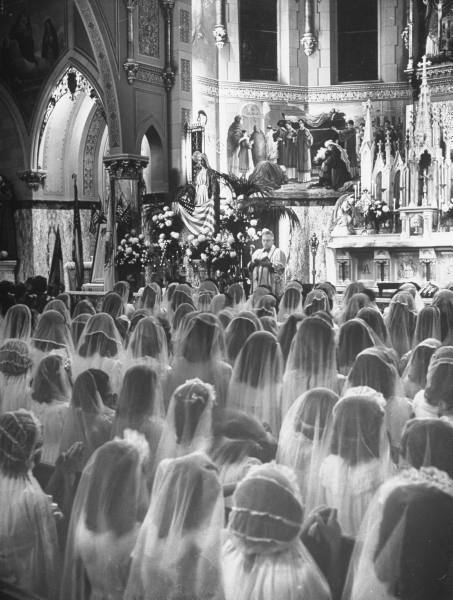
#20440
Photos Unlimited / Catholica Ecclesia : Teaching and Preaching
July 18, 2011, 04:53:34 PM
Sr. Leonie's home economics class at Central Catholic High School in Great Falls, Montana in 1953.
#20441
Photos Unlimited / Holy Priest of God In Winter Skates
July 18, 2011, 04:51:51 PM
Beautiful Picture.

#20442
Photos Unlimited / Re: The Redemptorist Monks
July 18, 2011, 04:49:03 PM
Redemptorists in Rome...
(beautiful , beautiful!)

(beautiful , beautiful!)
#20443
Photos Unlimited / Re: The Redemptorist Monks
July 18, 2011, 04:48:13 PM
Redemptorist Habit at the Alfonsiana in Rome...

#20444
Photos Unlimited / The Redemptorist Monks
July 18, 2011, 04:41:18 PM
After 700 years, the Transalpine Redemptorist Congregation has brought Catholicism back to the site of the most northerly early Christian monastery ever found. Situated on Papa Stronsay, an island in Orkney, north of Scotland, Papa Stronsay means 'Priest Island of Stronsay' in the Old Norse language. From this holy desert, the Fathers and Brothers work for the salvation of the most abandoned souls by their prayers and their apostolic labours.
#20445
Photos Unlimited / Re: Ang Amahan Ug Anak
July 18, 2011, 04:32:34 PM
A father teaching his son the 'ropes' in surfing.

#20446
Obituary / Death Anniversary
July 18, 2011, 02:41:12 PM
July 13, 15 was the death anniversary of my grandmothers: Mrs. Fortunata Tan-Salvo and Mrs. Maria Luz E. Lucino, respectively.
Mama Luz passed on into eternal life on July 15, 1995. Lola Nating passed on into eternal life on July 13, 1998.
Prayer:
Eternal rest grant unto them, O Lord,
and let perpetual light shine upon them.
May they rest in peace.
Amen.
Mama Luz passed on into eternal life on July 15, 1995. Lola Nating passed on into eternal life on July 13, 1998.
Prayer:
Eternal rest grant unto them, O Lord,
and let perpetual light shine upon them.
May they rest in peace.
Amen.
#20447
Photos Unlimited / Re: Ang Amahan Ug Anak
July 18, 2011, 02:26:49 PM
A Penguin Father and His Chick-let

#20448
Photos Unlimited / Re: Ang Amahan Ug Anak
July 18, 2011, 02:04:03 PM
Dad and Lad
"Gusto ko mo uban nimo, 'Tay"

"Gusto ko mo uban nimo, 'Tay"
#20449
Photos Unlimited / Re: Ang Amahan Ug Anak
July 18, 2011, 02:02:54 PM
The child approaches the father


#20452
Bisaya Cebuano Language / Salmo 121
July 18, 2011, 01:52:43 PM
Iyahat ko ang akong mga mata ngadto sa kabukiran: Diin ba magagikan ang akong tabang?
Ang akong tabang nagagikan kang Ginoo, Nga nagbuhat sa langit ug sa yuta.
Dili niya itugot nga mahidalin-as ang imong mga tiil: Siya nga nagabantay kanimo dili mahatagpilaw.
Ania karon, siya nga nagabantay sa Israel Dili mahatagpilaw ni mahikatulog.
Ang Ginoo mao ang imong magbalantay: Ang Ginoo mao ang imong salimbong sa imong toong kamot.
Ang kainit sa adlaw dili moluya kanimo sa adlaw, Ni ang bulan sa kagabhion.
Ang Ginoo magabantay kanimo gikan sa tanan nga kadautan; Siya magabantay sa imong kalag.
Ang Ginoo magabantay sa imong paggula ug sa imong pagsulod Sukad karon ngadto sa umalabut ug sa walay katapusan.
-Psalm 121

#20454
History / Re: The Life and Story of Vincent De Paul
July 18, 2011, 01:36:22 PM
The Incorruptible Body of St. Vincent de Paul, who was known during his life as "The Champion of the Poor..."
#20455
History / Re: The Life and Story of Vincent De Paul
July 18, 2011, 01:32:36 PM
Work for the poor
Vincent de Paul had established the Daughters of Charity almost at the same time as the exercises des ordinands. At first they were intended to assist the conferences of charity. When these conferences were established at Paris (1629) the ladies who joined them readily brought their alms and were willing to visit the poor, but it often happened that they did not know how to give them care which their conditions demanded and they sent their servants to do what was needful in their stead. Vincent conceived the idea of enlisting good young women for this service of the poor. They were first distributed singly in the various parishes where the conferences were established and they visited the poor with these ladies of the conferences or when necessary cared for them during their absence. In recruiting, forming, and directing these servants of the poor, Vincent found able assistance in Mlle Legras. When their number increased he grouped then into a community under her direction, coming himself every week to hold a conference suitable to their condition. (For further details see Sisters of Charity.) Besides the Daughters of Charity Vincent de Paul secured for the poor the services of the Ladies of Charity, at the request of the Archbishop of Paris. He grouped (1634) under this name some pious women who were determined to nurse the sick poor entering the Hotel-Dieu to the number of 20,000 or 25,000 annually; they also visited the prisons. Among them were as many as 200 ladies of the highest rank. After having drawn up their rule St. Vincent upheld and stimulated their charitable zeal. It was due to them that he was able to collect the enormous sums which he distributed in aid of all the unfortunates. Among the works, which their co-operation enabled him to undertake, that of the care of foundlings was one of the most important. Some of the foundlings at this period were deliberately deformed by miscreants anxious to exploit public pity. Others were received into a municipal asylum called "la couche", but often they were ill-treated or allowed to die of hunger. The Ladies of Charity began by purchasing twelve children drawn by lot. who were installed in a special house confided to the Daughters of Charity and four nurses. Thus years later the number of children reached 4000; their support cost 30,000 livres; soon with the increase in the number of children this reached 40,000 livres.
With the assistance of a generous unknown who placed at his disposal the sum of 10,000 livres, Vincent founded the Hospice of the Name of Jesus, where forty old people of both sexes found a shelter and work suited to their condition. This is the present hospital of the uncurables. The same beneficence was extended to all the poor of Paris but the creation of the general hospital which was first thought of by several Ladies of Charity, such as the Duchesse d'Aiguillon. Vincent adopted the idea and did more than anyone for the realization of what has been called one of the greatest works of charity of the seventeenth century, the sheltering of 40,000 poor in an asylum where they would be given a useful work. In answer St. Vincent's appeal the gifts poured in. The king granted the lands of the Salpétriere for the erection of the hospital, with a capital of 50,000 liveres and an endowment of 3000; Cardinal Mazarin sent 100,000 livres as first gift, Président de Lamoignon 20,000 crowns, a lady of the Bullion family 60,000 livres. St. Vincent attached the Daughters of Charity to the work and supported it with all his strength.
St. Vincent's charity was not restricted to Paris, but reached to all the provinces desolated by misery. In that period of the Thirty Years War known as the French period, Lorraine, Trois-Evechés, Franche-Comté, and Champagne underwent for nearly a quarter of a century all the horrors and scourges which then more than ever war drew in its train. Vincent made urgent appeals to the Ladies of Charity; it has been estimated that at his reiterated requests he secured 12,000 livres equivalent to $60,000 in our time (1913). When the treasury was empty he again sought alms which he dispatched at once to the stricken districts. When contributions began to fail Vincent decided to print and sell the accounts sent him from those desolated districts; this met with great success, even developing a periodical newspaper called "Le magasin charitable". Vincent took advantage of it to fund in the ruined provinces the work of the potages économiques, the tradition of which still subsists in our modern economic kitchens. He himself compiled with minute care instructions concerning the manner of preparing these potages and the quantity of fat, butter, vegetables, and bread which should be used. He encouraged the foundation of societies undertaking to bury the dead and to clean away the dirt which was a permanent cause of plague. They were often headed by the missionaries and the Sisters of Charity. Through them also Vincent distributed to their land. At the same time, in order to remove them from the brutality of the soldiers, he brought to Paris 200 young women whom he endeavored to shelter in various convents. and numerous children whom he received at St-Lazare. He even founded a special organization for the relief of the nobility of Lorraine who had sought refuge in Paris. After the general peace he directed his solicitude and his alms to the Irish and English Catholics who had been driven from their country.
All these benefits had rendered the name of Vincent de Paul popular in Paris and even at the Court. Richelieu sometimes received him and listened favorably to his requests; he assisted him in his first seminary foundations and established a house for his missionaries in the village of Richelieu. On his deathbed Louis XIII desired to be assisted by him: "Oh, Monsieur Vincent", said he, "if I am restored to health I shall appoint no bishops unless they have spent three years with you." His widow, Ann of Austria, made Vincent a member of the council of conscience charged with nominations to benefices. These honors did not alter Vincent's modesty and simplicity. He went to the Court only through necessity, in fitting but simple garb. He made no use of his influence save for the welfare of the poor and in the interest of the Church. Under Mazarin, when Paris rose at the time of the Fronde (1649) against the Regent, Anne of Austria, who was compelled to withdraw to St-Fermain-en-Laye, Vincent braved all dangers to go and implore her clemency in behalf of the people of Paris and boldly advised her to sacrifice at least for a time the cardinal minister in order to avoid the evils which the war threatened to bring on the people. He also remonstrated with Mazarin himself. His advice was not listened to. St. Vincent only redoubled his efforts to lessen the evils of the war in Paris. Through his care soup was distributed daily to 15,000 or 16,000 refugees or worthy and poor; 800 to 900 young women were sheltered; in the single parish of St. Paul the Sisters of Charity made and distributed soup every day to 500 poor, besides which they had to care for 60 to 80 sick. During this time Vincent, indifferent to dangers which he ran, multiplied letters and visits to the Court at St-Denis to win minds to peace and clemency; he even wrote a letter to the pope asking him to intervene and to interpose his mediation to hasten peace between the two parties.
Jansenism also made evident his attachment to the Faith and the use to which he put his influences in its defense. When Duvergier de Hauranne, later celebrated as the Abbé de St-Cyran, came to Paris (about 1621), Vincent de Paul showed some interest in him as in a fellow countryman and a priest in whom he discerned learning and piety. But when he became better acquainted with the basis of his ideas concerning grace, far from being misled by them, he endeavored to arrest him in the path of error. When the "Augustinus" of Jansenius and "Frequent Communion" of Arnauld revealed the true ideas and opinions of the sect, Vincent set about combating; he persuaded the Bishop of Lavaur, Abra de Raconis, to write against them. In the Council of Conscience he opposed the admission to benefices of anyone who shared them, and joined the chancellor and the nuncio in seeking means to stay their progress. Stimulated by him some bishops at St-Lazare took the initiative in relating these errors to the pope. St. Vincent induced 85 bishops to request the condemnation of the five famous propositions, and persuaded Anne of Austria to write to the pope to hasten his decision. When the five propositions had been condemned by Innocent X (1655) and Alexander VII (1656), Vincent sought to have this sentence accepted by all. His zeal for the Faith, however, did not suffer him to forget his charity; he gave evidence in behalf of St-Cyran, whom Richelieu had imprisoned (1638), and is said to have assisted at his funeral. When Innocent X had announced his decision he went to the solitaries of Port-Royal to congratulate them on the intention they had previously manifested of submitting fully; he even begged preachers renowned for their anti-Jansenist zeal to avoid in their sermons all that might embitter their adversaries. The religious orders also benefited by the great influence of Vincent. Not only did he long act as director to the Sisters of the Visitation, founded by Francis de Sales, but he received at Paris the Religious of the Blessed Sacrament, supported the existence of the Daughters of the Cross (whose object was to teach girls in the country), and encouraged the reform of the Benedictines, Cistercians, Antonines, Augustinians, Premonstratensians, and the Congregation of Grandmont; and Cardinal de Rochefoucault, who was entrusted with the reform of the religious orders in France, called Vincent his right hand and obliged him to remain in the Council of Conscience.
Vincent's zeal and charity went beyond the boundaries of France. As early as 1638 he commissioned his priests to preach to the shepherds of the Roman Campagna; he had them give at Rome and Genoa the exercices des ordinands and preach missions on Savoy and Piedmont. He sent others to Ireland, Scotland, the Hebrides, Poland, and Madagascar (1648-60). Of all the works carried on abroad none perhaps interested him so much as the poor slaves of Barbary, whose lot he had once shared. These were from 25,000 to 30,000 of these unfortunates divided chiefly between Tunis, Algiers, and Bizaerta. Christians for the most part, they had been carried off from their families by the Turkish corsairs. They were treated as veritable beasts of burden, condemned to frightful labour, without any corporal or spiritual care. Vincent left nothing undone to send them aid as early as 1645 he sent among them a priest and a brother, who were followed by others. Vincent even had one of these invested with the dignity of consul in order that he might work more efficaciously for the slaves. They gave frequent missions to them, and assured them the services of religion. At the same time they acted as agents with their families, and were able to free some of them. Up to the time of St. Vincent's death these missionaries had ransomed 1200 slaves, and they had expended 1,200,000 liveres in behalf of the slaves of Barbary, not to mention the affronts and persecutions of all kinds which they themselves had endured from the Turks. This exterior life so fruitful in works had its source in a profound spirit of religion and in an interior life of wonderful intensity. He was singularly faithful to the duties of his state, careful to obey the suggestions of faith and piety, devoted to prayer, meditation, and all religious and ascetic exercises. Of practical and prudent mind, he left nothing to chance; his distrust of himself was equalled only by his trust in Providence; when he founded the Congregation of the Mission and the Sisters of Charity he refrained from giving them fixed constitutions beforehand; it was only after tentatives, trials, and long experience that he resolved in the last years of his life to give them definitive rules. His zeal for souls knew no limit; all occasions were to him opportunities to exercise it. When he died the poor of Paris lost their best friend and humanity a benefactor unsurpassed in modern times.
Forty years later (1705) the Superior-General of the Lazarists requested that the process of his canonization might be instituted. Many bishops, among them Bossuet, Fénelon, Fléchier, and Cardinal de Noailles, supported the request. On 13 August, 1729, Vincent was declared Blessed by Benedict XIII, and canonized by Clement XII on 16 June, 1737. In 1885 Leo XIII gave him as patron to the sisters of Charity. In the course of his long and busy life Vincent de Paul wrote a large number of letters, estimated at not less than 30,000. After his death the task of collecting them was begun; in the eighteenth century nearly 7000 had been gathered; many have since been lost. Those which remained were published rather incorrectly as "Lettres et conferérences de s. Vincent de Paul" (supplement, Paris, 1888); "Lettres inédites de saint Vincent de Paul" (Coste in"Revuede Gascogne", 1909, 1911); Lettres choisies de saint Vincent de Paul" (Paris, 1911); the total of letters thus published amounts to about 3200. There have also been collected and published the saint's "Conférences aux missionaires" (Paris, 1882) and "Conférences aux Filles de la Charite" (Paris, 1882).
Source: Catholic Encyclopedia
#20456
History / The Life and Story of Vincent De Paul
July 18, 2011, 01:30:13 PM
Born at Pouy, Gascony, France, in 1580, though some authorities have said 1576; died at Paris, 27 September, 1660. Born of a peasant family, he made his humanities studies at Dax with the Cordeliers, and his theological studies, interrupted by a short stay at Saragossa, were made at Toulouse where he graduated in theology. Ordained in 1600 he remained at Toulouse or in its vicinity acting as tutor while continuing his own studies. Brought to Marseilles for an inheritance, he was returning by sea in 1605 when Turkish pirates captured him and took him to Tunis. He was sold as a slave, but escaped in 1607 with his master, a renegade whom he converted. On returning to France he went to Avignon to the papal vice-legate, whom he followed to Rome to continue his studies. He was sent back to France in 1609, on a secret mission to Henry IV; he became almoner to the Queen Marguerite of Valois, and was provided with the little Abbey of Saint-Léonard-de-Chaume. At the request of M. de Berulle, founder of the Oratory, he took charge of the parish of Clichy near Paris, but several months later (1612) he entered the services of the Gondi, an illustrious French family, to educate the children of Philippe-Emmanuel de Gondi. He became the spiritual director of Mme de Gondi. With her assistance he began giving missions on her estates; but to escape the esteem of which he was the object he left the Gondi and with the approval of M. de Berulle had himself appointed curé of Chatillon-les-Dombes (Bresse), where he converted several Protestants and founded the first conference of charity for the assistance of the poor. He was recalled by the Gondi and returned to them (1617) five months later, resuming the peasant missions. Several learned Paris priests, won by his example, joined him. Nearly everywhere after each of these missions, a conference of charity was founded for the relief of the poor, notably at Joigny, Châlons, Mâcon, Trévoux, where they lasted until the Revolution.
After the poor of the country, Vincent's solicitude was directed towards the convicts in the galleys, who were subject to M. de Gondi as general of the galleys of France. Before being convoyed aboard the galleys or when illness compelled them to disembark, the condemned convicts were crowded with chains on their legs onto damp dungeons, their only food being black bread and water, while they were covered with vermin and ulcers. Their moral state was still more frightful than their physical misery. Vincent wished to ameliorate both. Assisted by a priest, he began visiting the galley convicts of Paris, speaking kind words to them, doing them every manner of service however repulsive. He thus won their hearts, converted many of them, and interested in their behalf several persons who came to visit them. A house was purchased where Vincent established a hospital. Soon appointed by Louis XIII royal almoner of the galleys, Vincent profited by this title to visit the galleys of Marseilles where the convicts were as unfortunate as at Paris; he lavished his care on them and also planned to build them a hospital; but this he could only do ten years later. Meanwhile, he gave on the galley of Bordeaux, as on those of Marseilles, a mission which was crowned with success (1625).
Congregation of the Mission
The good wrought everywhere by these missions together with the urging of Mme de Gondi decided Vincent to found his religious institute of priests vowed to the evangelization of country people--the Congregation of Priests of the Mission.
Experience had quickly revealed to St. Vincent that the good done by the missions in country places could not last unless there were priests to maintain it and these were lacking at that time in France. Since the Council of Trent the bishops had been endeavoring to found seminaries to form them, but these seminaries encountered many obstacles, the chief of which were the wars of religion. Of twenty founded not ten had survived till 1625. The general assembly of the French clergy expressed the wish that candidates for Holy Orders should only be admitted after some days of recollection and retreat. At the request of the Bishop of Beauvais, Potierdes Gesvres, Vincent undertook to attempt at Beauvais (September, 1628) the first of these retreats. According to his plan they comprised ascetic conferences and instructions on the knowledge of things most indispensable to priests. Their chief service was that they gave rise to the seminaries as these prevailed later in France. At first they lasted only ten days, but in extending them by degrees to fifteen or twenty days, then to one, two, or three months before each order, the bishops eventually prolonged the stay of their clerics to two or three years between philosophy and the priesthood and there were what were called seminaries d'ordinands and later grands seminaries, when lesser ones were founded. No one did more than Vincent towards this double creation. As early as 1635 he had establish a seminary at the Collége des Bons-Enfants. Assisted by Richelieu, who gave him 1000 crowns, he kept at Bons-Enfants only ecclesiastics studying theology (grand seminarie) and he founded besides Saint-Lazare for young clerics studying the humanities a lesser seminary called the Seminary of St. Charles (1642). He had sent some of his priests to the Bishop of Annecy (1641) to direct his seminary, and assisted the bishops to establish others in their dioceses by furnishing priests to direct them. At his death he had thus accepted the direction of eleven seminaries. Prior to the Revolution his congregation was directing in France fifty-three upper and nine lesser seminaries, that is a third of all in France.
The ecclesiastical conference completed the work of the seminaries. Since 1633 St. Vincent held one every Tuesday at Saint-Lazare at which assembled all the priests desirous of conferring in common concerning the virtues and the functions of their state. Among others Bossuet and Tronson took part. With the conferences, St. Vincent instituted at St-Lazare open retreats for laymen as well as priests. It is estimated that in the last twenty-five years of St. Vincent's life there came regularly more than 800 persons yearly, or more than 20,000 in all. these retreats contributed powerfully to infuse a Christian spirit among the masses, but they imposed heavy sacrifices on the house of St-Lazare. Nothing was demanded of the retreatants; when there was question of the good of souls Vincent thought little of expense. At the complaints of his brethren who desired that the admission of the retreatants should be made more difficult he consented one day to keep the door. Towards evening there had never been so many accepted and when the embarrassed brother came to inform him that there was no more room he merely replied "well, give mine".
#20457
Bisaya Cebuano Language / Re: Ginoo, Wala'y Sukod
July 18, 2011, 01:24:16 PM
"Tungod sa mga mahigugmaongkalolot sa Ginoo kita wala mangalaglag, kay ang iyang mga kalooy walay paghubas. Sila ginabag-o sa matag-buntag; daku ang imong pagkamatinumanon."
-Lamentations 3: 22-24
(Cebuano)

#20459
Bisaya Cebuano Language / Ginoo, Wala'y Sukod
July 18, 2011, 01:16:13 PM
by: bluewave
Nagpapasalamat kami
Sa kinabuhing gihatag kanamo
Sa kalipay nga among gibati
Sa among pag-ampo
Salamat, salamat sa ginoo
Walay sukod imong kayo
Salamat, salamat sa ginoo
Walay sukod imong kayo
Walay paghamay ginoo
Sa among pagsalig kanimo
Ang kalipay ug among kasakit
Gihalad kanimo
Ginoo, dawata kami
#20460
Bible Study / Re: Minute Meditations
July 18, 2011, 01:13:00 PM
Ang Ginoo naa nimo. Ang Ginoo naa pood nako.
#20461
Music and Video / Re: Amazing Grace by: Il Divo
July 18, 2011, 01:08:29 PM
This song was sung during Roman Catholic Mass today. The lyrics brought me to absolute tears. Truly, it is a beautiful and spiritual song that speaks from the depths of the Heart.
"Amazing Grace, how sweet the sound. That saved a wretch like me. I once was lost, but now am found..."
Powerful kaayo..
"Amazing Grace, how sweet the sound. That saved a wretch like me. I once was lost, but now am found..."
Powerful kaayo..
#20462
Music and Video / Re: Amazing Grace by: Il Divo
July 18, 2011, 01:06:28 PM
"Amazing Grace, how sweet the sound,
That saved a wretch like me....
I once was lost but now am found,
Was blind, but now, I see.
T'was Grace that taught...
my heart to fear.
And Grace, my fears relieved.
How precious did that Grace appear...
the hour I first believed.
Through many dangers, toils and snares...
we have already come.
T'was Grace that brought us safe thus far...
and Grace will lead us home.
The Lord has promised good to me...
His word my hope secures.
He will my shield and portion be...
as long as life endures.
Yea, when this flesh and heart shall fail,
and mortal life shall cease,
I shall possess within the veil,
a life of joy and peace.
When we've been here ten thousand years...
bright shining as the sun.
We've no less days to sing God's praise...
then when we've first begun.
"Amazing Grace, how sweet the sound,
That saved a wretch like me....
I once was lost but now am found,
Was blind, but now, I see.
That saved a wretch like me....
I once was lost but now am found,
Was blind, but now, I see.
T'was Grace that taught...
my heart to fear.
And Grace, my fears relieved.
How precious did that Grace appear...
the hour I first believed.
Through many dangers, toils and snares...
we have already come.
T'was Grace that brought us safe thus far...
and Grace will lead us home.
The Lord has promised good to me...
His word my hope secures.
He will my shield and portion be...
as long as life endures.
Yea, when this flesh and heart shall fail,
and mortal life shall cease,
I shall possess within the veil,
a life of joy and peace.
When we've been here ten thousand years...
bright shining as the sun.
We've no less days to sing God's praise...
then when we've first begun.
"Amazing Grace, how sweet the sound,
That saved a wretch like me....
I once was lost but now am found,
Was blind, but now, I see.
#20464
Music and Video / Amazing Grace by: Il Divo
July 18, 2011, 01:04:10 PM #20465
Music and Video / Native American - Amazing Grace (in cherokee)
July 18, 2011, 01:02:41 PM
a tribute to: msdabinsi , who is a fan of native american culture.
Native American - Amazing Grace (in cherokee)
Native American - Amazing Grace (in cherokee)
#20466
Bible Study / Re: Veni Sancte Spiritus (Come Holy Spirit)
July 18, 2011, 12:56:43 PM
Come, Holy Spirit,
send forth the heavenly
radiance of your light.
Come, father of the poor,
come giver of gifts,
come, light of the heart.
Greatest comforter,
sweet guest of the soul,
sweet consolation.
In labor, rest,
in heat, temperance,
in tears, solace.
O most blessed light,
fill the inmost heart
of your faithful.
Without your divine will,
there is nothing in man,
nothing is harmless.
Wash that which is unclean,
water that which is dry,
heal that which is wounded.
Bend that which is inflexible,
warm that which is chilled,
make right that which is wrong.
Give to your faithful,
who rely on you,
the sevenfold gifts.
Give reward to virtue,
give salvation at our passing on,
give eternal joy.
Amen. Alleluia.
#20467
Bible Study / Re: Veni Sancte Spiritus (Come Holy Spirit)
July 18, 2011, 12:55:47 PM
Veni, Sancte Spiritus,
et emitte caelitus
lucis tuae radium.
Veni, pater pauperum,
veni, dator munerum
veni, lumen cordium.
Consolator optime,
dulcis hospes animae,
dulce refrigerium.
In labore requies,
in aestu temperies
in fletu solatium.
O lux beatissima,
reple cordis intima
tuorum fidelium.
Sine tuo numine,
nihil est in homine,
nihil est innoxium.
Lava quod est sordidum,
riga quod est aridum,
sana quod est saucium.
Flecte quod est rigidum,
fove quod est frigidum,
rege quod est devium.
Da tuis fidelibus,
in te confidentibus,
sacrum septenarium.
Da virtutis meritum,
da salutis exitum,
da perenne gaudium,
Amen, Alleluia.
#20468
Bible Study / Re: Veni Sancte Spiritus (Come Holy Spirit)
July 18, 2011, 12:55:26 PM #20469
Bible Study / Veni Sancte Spiritus (Come Holy Spirit)
July 18, 2011, 12:53:13 PM #20470
Bible Study / Re: Let's Study The Holy Bible
July 18, 2011, 12:48:00 PM
That is indeed a definitive and powerful statement, "Don't allow yourself to be overpowered by evil; take the offensive-- overpower evil with good!"
In today's world this is quite interesting to hear considering the numerous instances of how people avenge murder with murder. For me, when i read this verse from Matthew, I am reminded of the transcendental message we receive from God through the Gospel. That is: focusing on --as much as possible-- on the teachings of Christ. Forgiveness is an integral part of the Gospel.
Now, admittingly, the world is antagonistic to Christ's teachings. There are instances in this world and in our lives that makes forgiveness almost next to impossible. However, I have come to realize that it is the power of the devil that instigates us to anger, hate, and malcontent. It is not of the Spirit of God for us to continue to hate and to maintain hostility. And in reflection, we know that Christ expects the best that we can give to Him. Forgiving those who -- we might view as antagonistic and hurtful to us. For it is written, "It is in forgiving that you are forgiven...." (Ephesians 4).
So , we must forgive. Forgive each other so that when we approach the altar of God in prayer, are forgiven also of our sins.
Blessings and Peace,
Lorenzo
#20471
Bible Study / Re: Let's Study The Holy Bible
July 18, 2011, 12:36:19 PM
Today I would like to focus on studying one aspect of Christian Virtue, and one that Our Lord Jesus Christ implemented actively--that is the act of Forgiveness. I stumbled on a verse in Mark Chapter 2 that made me think.
"Why does this man use such words?" they said; "He is blaspheming. Who can pardon sins but One--that is, God?"... Jesus asked them, "Which is easier?--to say to this paralytic, 'Your sins are pardoned,' or to say, 'Rise, take up your mat, and walk?' But that you may know that the Son of Man has authority on earth to pardon sins"--He turned to the paralytic, and said, "To you I say, 'Rise, take up your mat and go home."
-Mark 2: 7-11
Sometimes, friends, the best thing to do is just to forgive and let go any past conflicts. Repay evil with good and repay offenses with good.
We are reminded this in Romans Chapter 12: 17-21 that says,
" Don't pay back a bad turn by a bad turn, to anyone. See that your public behavior is above criticism. As far as your responsibility goes, live at peace with everyone. Never take vengeance into your own hands, my dear friends: stand back and let God punish if he will. For it is written: "It is mine to avenge, I will repay," says the Lord. And it is also written: "If your enemy is hungry, feed him; if he is thirsty, give him something to drink. In doing this, you will heap burning coals on his head." Don't allow yourself to be overpowered by evil. Take the offensive--overpower evil with good!"
#20472
Science and Research / Re: How To Place the 12 Lead ECG : Medical Lab Presentation
July 18, 2011, 12:22:38 PM #20473
Health and Food / Re: Philippines warns against geckos as AIDS treatment
July 18, 2011, 10:06:03 AM
Hehe, payts !
#20474
Bible Study / Re: A man asked Jesus, "How can I become perfect?"
July 18, 2011, 10:00:40 AMQuote from: chicogon on July 16, 2011, 03:22:09 AM
The Gospel reading today has Jesus saying, "Go learn the meaning of the words 'It is mercy I desire, not sacrifice.'" For quite sometime I racked my brain on the meaning of those words "mercy" "sacrifice" etc. But then it dawned on me, maybe, just maybe, Jesus was talking about something else when He said "Go learn the meaning of the WORD" (not mercy nor sacrifice) but the meaning of the WORD as in Word made Flesh or Word who is Life... as in the ways of the WORD that dwelt among us, who says He has come not to condemn the world but to save it or that it may have life to the full... as in the ways of the Word (re: ways of love, compassion, service, etc). Or perhas, the way of the cross. Hmmm... this I wonder.
Fr. Roel,
I took some time to reflect on your message this weekend during my 'weekend off'. This week, I managed to visit the campus of DePaul University , which is named after St. Vincent De Paul , the compassionate Catholic Saint.
As I visited the campus and learned more about the life of St. Vincent De Paul, I remembered the words you used in reference to 'learning the word, per se living the word'. St. Vincent de Paul was actually , interestingly enough, the confessor of the Gondi Family, which was an illustrious family in France. However, instead of staying most of the time in the family household , he actually persuaded the members of the Gondi Family to help the poor peasants and the destitute via food, charity, and the building of homes for those who could not afford.
De Paul could not change the society, the laws that governed the world that he lived in, however, through the Word of God, was able to help the lives of the people in that era through faithful works. He reminded the rich to give back to the poor and to truly be 'Christ-like' in that aspect.
I was able to connect the life of Vincent De Paul to your post here. Thank You.
#20475
Bible Study / Re: Daily Scriptural Verse
July 18, 2011, 09:46:38 AM
Christ is the end of the law so that there may be righteousness for everyone who believes.
-Romans 10:4
-Romans 10:4
#20476
Bible Study / Re: Daily Scriptural Verse
July 18, 2011, 09:44:20 AM
But the fruit of the Spirit is love, joy, peace, forbearance, kindness, goodness, faithfulness, gentleness and self-control. Against such things there is no law.
-Galatians 5:22-23
-Galatians 5:22-23
#20477
Bible Study / Re: Let's Study The Holy Bible
July 18, 2011, 09:41:38 AM
Why We Should Hear The Word Of God
The foundation for obedience begins with listening—with hearing the Word. Hearing is a protection against scarring or hardening
-Hebrews 3: 7
Hearing is a protection against scarring and / or hardening. Scarring of the faith, hardening of the heart. It is apparent of the many antagonistic factors in the world that affect our Trust and Absolute Faith in God and in God's Word. By opening our heart and our mind to His Word, we are reminded of God's Love and of God's Plans for us in this life and in the life to come.
#20478
World Daily News / Re: China calls on US to retract Dalai Lama invite
July 18, 2011, 09:21:09 AM
Obama met the Dalai Lama, despite harsh Chinese protest and opposition


#20479
History / Sugar Farmers of Iloilo Province
July 18, 2011, 09:15:50 AM
The 'Sugar Cane Capital' of the Philippines--- Iloilo Province

#20480
History / Re: Old Filipino Cinema
July 18, 2011, 09:12:58 AM
hehehe , one of the 'heart-warming' films of 'DA KING'

#20481
History / Old Filipino Cinema
July 18, 2011, 09:12:03 AM
Does he look familiar?

the young Fernando Poe Jr.
the young Fernando Poe Jr.
#20482
History / Re: Life During Spanish Colonial Rule
July 18, 2011, 09:02:19 AM
Spain's Lasting Imprint on the Philippines: Roman Catholicism

#20483
History / Life During Spanish Colonial Rule
July 18, 2011, 08:58:45 AM
Pictures of people, places during Spanish Colonial Rule. The Philippines (Las Islas Filipinas) were for a time part of the Viceroyalty of Nueva Espana for almost 200 years. After Mexico's independence in 1821 (Mexico was then known as Nueva Espana) , The Philippines were placed under immediate control and governance of the Kingdom of Spain as a special overseas colony. The Philippines was under Spanish control for almost half a millennium.

Filipino workers
Filipino workers
#20484
History / Re: Spanish-Era Funeral Carriage
July 18, 2011, 08:53:42 AM
Note that the Filipino servants are wearing the traditional European 'wigs'. As was the style during processions and during religious festivals during Spanish Colonial Days.

#20485
History / Spanish-Era Funeral Carriage
July 18, 2011, 08:51:43 AM
A Spanish Peninsulare's horse-drawn Funeral carriage being prepared by a Filipino servant.

#20486
History / Re: Filipinos During The Turn of the Century (1900's Era)
July 18, 2011, 08:49:44 AM
#20488
Cars and Automotive / Re: Selebrasyon Sa Mga Santos Sa Unang Panahon
July 18, 2011, 08:44:24 AM
ang mga tocaradores

#20489
Cars and Automotive / Selebrasyon Sa Mga Santos Sa Unang Panahon
July 18, 2011, 08:33:23 AM
sa una lagi ni
#20490
Cars and Automotive / Mga Artistadora Sa Unang Panahon
July 18, 2011, 08:31:16 AM
Cute lagi ni sila duha.

#20491
Cars and Automotive / The Filipino Jeepneys From The Past
July 18, 2011, 08:28:11 AM
Sa unang panahon..
#20492
Introduce Yourself / Re: Bag-ong tangka sa ganghaan sa bohol
July 18, 2011, 08:24:02 AMQuote from: Marikit on June 12, 2011, 10:54:33 AM
All about bohol ba ni deri?

Kamusta Marikit ug Maayong Gabii (gabii man gud dinhi sa ahoa)!
Welcome to Tubag Bohol Dot Com. May your stay here be enjoyable and fun!
Welcome and Have a Fun Ride.
#20493
Bible Study / Re: Let's Study The Holy Bible
July 18, 2011, 08:16:28 AM
Those Who Have Ears Ought To Hear
Have you ever taken part in a bible study group and come across a particular book, chapter, or verse that was unfavorable to your palate? That you disagreed with? I know I have from time to time. It is a result of our generation's own prejudices towards the Word of God.
Take for example the following verse:
"Every word of God is flawless; he is a shield to those who take refuge in him. Do not add to his words, or he will rebuke you and prove you a liar. "
â€" Proverbs 30:5-6
Comment:
Have you ever read a Scripture that made you very uncomfortable? This shouldn’t be surprising. Because the Bible is flawless and eternal, it will challenge each generation’s prejudices and blind spots. For all of our attempts to tame or adjust it, the Scripture is above every culture. So seek refuge in His word. Our discomfort doesn’t mean that the Scripture is not true, but the assumptions that are unique to our generation are being exposed in a light that is not of this earth.
http://www.thedailybibleverse.org/
#20494
Photos Unlimited / Re: Bunyag ni Matt Daniel Adame (from Valencia) perform in Dublin(16 Jul 2011)
July 18, 2011, 07:17:02 AMQuote from: chicogon on July 18, 2011, 04:15:59 AM
Ms Isles, kadungog ko imo daw pod kagikan is Balingsya... ikaw man daw to si Ms McTan Isle de Guadalupe
If my memory serves me right, Isles' mother is from Valencia. When she, Isles, was a new member to the forum, she would respond to my posts in the Valencia threads; sharing how she used to visit Valencia as a child ; and during her vacations.
It is true in the fact that for many Valencianhons , the memories spent in our beloved Valencia keeps us coming back. Sometimes, the time in between those visits may be a bit extended. My sister, who recently went back to Bohol, Philippines, visited Valencia this past May 2011. The last time she was home (Valencia) was back in 1998, for the funeral of our grandmother, anhing Mrs. Fortunata Tan-Salvo.
Ning hilak daw ahong igsoon baje when naka visit sija sa ang grave sa among Lola. Ning flood back ijang memories sa among lola og lolo sa bata pa mi. Na hilak ko when I was told of this by my aunt and relatives.
#20495
Bible Study / Re: Today's Mass Readings
July 17, 2011, 11:30:40 PM
July 17, 2011
Gospel Reading:
Jesus proposed another parable to the crowds, saying:
“The kingdom of heaven may be likened
to a man who sowed good seed in his field.
While everyone was asleep his enemy came
and sowed weeds all through the wheat, and then went off.
When the crop grew and bore fruit, the weeds appeared as well.
The slaves of the householder came to him and said,
‘Master, did you not sow good seed in your field?
Where have the weeds come from?’
He answered, ‘An enemy has done this.’
His slaves said to him,
‘Do you want us to go and pull them up?’
He replied, ‘No, if you pull up the weeds
you might uproot the wheat along with them.
Let them grow together until harvest;
then at harvest time I will say to the harvesters,
“First collect the weeds and tie them in bundles for burning;
but gather the wheat into my barn.â€â€™â€
He proposed another parable to them.
“The kingdom of heaven is like a mustard seed
that a person took and sowed in a field.
It is the smallest of all the seeds,
yet when full-grown it is the largest of plants.
It becomes a large bush,
and the ‘birds of the sky come and dwell in its branches.’â€
He spoke to them another parable.
“The kingdom of heaven is like yeast
that a woman took and mixed with three measures of wheat flour
until the whole batch was leavened.â€
All these things Jesus spoke to the crowds in parables.
He spoke to them only in parables,
to fulfill what had been said through the prophet:
I will open my mouth in parables,
I will announce what has lain hidden from the foundation
of the world.
Then, dismissing the crowds, he went into the house.
His disciples approached him and said,
“Explain to us the parable of the weeds in the field.â€
He said in reply, “He who sows good seed is the Son of Man,
the field is the world, the good seed the children of the kingdom.
The weeds are the children of the evil one,
and the enemy who sows them is the devil.
The harvest is the end of the age, and the harvesters are angels.
Just as weeds are collected and burned up with fire,
so will it be at the end of the age.
The Son of Man will send his angels,
and they will collect out of his kingdom
all who cause others to sin and all evildoers.
They will throw them into the fiery furnace,
where there will be wailing and grinding of teeth.
Then the righteous will shine like the sun
in the kingdom of their Father.
Whoever has ears ought to hear.â€
-Matthew 13: 24-43
#20496
Bible Study / Re: Today's Mass Readings
July 17, 2011, 11:29:16 PM
July 17, 2011
Responsorial Psalm
R. (5a) Lord, you are good and forgiving.
You, O LORD, are good and forgiving,
abounding in kindness to all who call upon you.
Hearken, O LORD, to my prayer
and attend to the sound of my pleading.
R. Lord, you are good and forgiving.
All the nations you have made shall come
and worship you, O LORD,
and glorify your name.
For you are great, and you do wondrous deeds;
you alone are God.
R. Lord, you are good and forgiving.
You, O LORD, are a God merciful and gracious,
slow to anger, abounding in kindness and fidelity.
Turn toward me, and have pity on me;
give your strength to your servant.
R. Lord, you are good and forgiving.
#20497
Bible Study / Re: Today's Mass Readings
July 17, 2011, 11:27:41 PM
July 17, 2011
Reading 1
Wisdom 12:13, 16-19
There is no god besides you who have the care of all,
that you need show you have not unjustly condemned.
For your might is the source of justice;
your mastery over all things makes you lenient to all.
For you show your might when the perfection of your power is disbelieved;
and in those who know you, you rebuke temerity.
But though you are master of might, you judge with clemency,
and with much lenience you govern us;
for power, whenever you will, attends you.
And you taught your people, by these deeds,
that those who are just must be kind;
and you gave your children good ground for hope
that you would permit repentance for their sins.
#20498
Bible Study / Re: Daily Scriptural Verse
July 17, 2011, 11:11:52 PM
Sing Praise to The Lord!
Sing out your thanks to the Lord; sing
praises to our God, accompanied by harps.
He covers the heavens with clouds,
provides rain for the earth, and makes
the green grass grow in mountain pastures.
He feeds the wild animals, and the
young ravens cry to Him for food.
The strength of a horse does not impress Him;
how puny in His sight is the strength of a man.
Rather, the Lord's delight is in those
who honor Him, those who put their
hope in His unfailing love.
Psalm 147
#20499
Bible Study / Re: Daily Scriptural Verse
July 17, 2011, 11:06:59 PM
Praise the Lord!
Yes, give praise, O servants of the Lord.
Praise the name of the Lord!
Blessed be the name of the Lord forever and ever.
Everywhere--from east to west--
praise the name of the Lord.
For the Lord is high above the nations;
His glory is far greater than the heavens.
Who can be compared with the Lord our God,
who is enthroned on high?
Far below Him are the heavens and the earth.
He stoops to look, and He lifts the poor from the dirt
and the needy from the garbage dump.
He sets them among princes,
even the princes of His own people!
He gives the barren woman a home,
so that she becomes a happy mother.
Praise the Lord!
Psalm 113
#20500
Photos Unlimited / Re: Bunyag ni Matt Daniel Adame (from Valencia) perform in Dublin(16 Jul 2011)
July 17, 2011, 11:01:21 PM
What an auspicious day for the parents and family of Ondoy Matthew Adame. Congratulations to Mr. and Mrs. Adame. May your tribe increase.
A prayer for Ondoy Matthew:
Heavenly Father,
In your love you have called us to know you,
led us to trust you,
and bound our life with yours.
Surround this child with your love,
protect it from evil.
Fill it with the holy spirit and
receive it into the family of your church,
that it may walk with us in the way of Christ,
and grow in the knowledge of your love.
Amen.
Pages 1 2 3 4 5 6 7 8 9 10 11 12 13 14 15 16 17 18 19 20 21 22 23 24 25 26 27 28 29 30 31 32 33 34 35 36 37 38 39 40 41 42 43 44 45 46 47 48 49 50 51 52 53 54 55 56 57 58 59 60 61 62 63 64 65 66 67 68 69 70 71 72 73 74 75 76 77 78 79 80 81 82 83 84 85 86 87 88 89 90 91 92 93 94 95 96 97 98 99 100 101 102 103 104 105 106 107 108 109 110 111 112 113 114 115 116 117 118 119 120 121 122 123 124 125 126 127 128 129 130 131 132 133 134 135 136 137 138 139 140 141 142 143 144 145 146 147 148 149 150 151 152 153 154 155 156 157 158 159 160 161 162 163 164 165 166 167 168 169 170 171 172 173 174 175 176 177 178 179 180 181 182 183 184 185 186 187 188 189 190 191 192 193 194 195 196 197 198 199 200 201 202 203 204 205 206 207 208 209 210 211 212 213 214 215 216 217 218 219 220 221 222 223 224 225 226 227 228 229 230 231 232 233 234 235 236 237 238 239 240 241 242 243 244 245 246 247 248 249 250 251 252 253 254 255 256 257 258 259 260 261 262 263 264 265 266 267 268 269 270 271 272 273 274 275 276 277 278 279 280 281 282 283 284 285 286 287 288 289 290 291 292 293 294 295 296 297 298 299 300 301 302 303 304 305 306 307 308 309 310 311 312 313 314 315 316 317 318 319 320 321 322 323 324 325 326 327 328 329 330 331 332 333 334 335 336 337 338 339 340 341 342 343 344 345 346 347 348 349 350 351 352 353 354 355 356 357 358 359 360 361 362 363 364 365 366 367 368 369 370 371 372 373 374 375 376 377 378 379 380 381 382 383 384 385 386 387 388 389 390 391 392 393 394 395 396 397 398 399 400 401 402 403 404 405 406 407 408 409 410 411 412 413 414 415 416 417 418 419 420 421 422 423 424 425 426 427 428 429 430 431 432 433 434 435 436 437 438 439 440 441 442 443 444 445 446 447 448 449 450 451 452 453 454 455 456 457 458 459 460 461 462 463 464 465 466 467 468 469 470 471 472 473 474 475 476 477 478 479 480 481 482 483 484 485 486 487 488 489 490 491 492 493 494 495 496 497 498 499 500 501 502 503 504 505 506 507 508 509 510 511 512 513 514 515 516 517 518 519 520 521 522 523 524 525 526 527 528 529 530 531 532 533 534 535 536 537 538 539