Join MikeLigalig.com!

Why Just Read When You Can Join, Post, and Read!

Menu

Show posts

This section allows you to view all posts made by this member. Note that you can only see posts made in areas you currently have access to.

Show posts Menu

Messages - hofelina

#201
The Bhutan Glory is a member of the Swallowtail family, sporting a 5 inch wingspan. The wings have beautiful, large red patterns on its rear. The Glory is so rare, it was thought to be extinctions, only to be “rediscovered” in 2011 in several locations in Bhutan.
#202
The Common Buckeye is found in southern Manitoba, Ontario, Quebec, and Nova Scotia and all parts of the United States except the northwest. It is especially common in the south, the California coast, and throughout Central America and Colombia. Its habitat is open areas with low vegetation and some bare ground.
#203

These unique butterflies are native to Costa Rica, but have also been spotted in rainforests in Belize. The Sapho Longwing is one of the few species of butterflies that breed on one specific plant. If the plant is gone, the Longwing will surely follow.
#204

The Purple Emperor sports iridescent wings that shine blue or purple in the light and used to be quite common in the British Isles. The Emperor’s diet is different to other butterflies - it eats the honeydew secreted by aphids, and occasionally on dung and carrion.
#205

Found in China and Vietnam, the Golden Kaiser-i-Hind is considered an endangered species, and is quite threatened by the wildlife trade, despite being protected by Chinese law.
#206

Every year in September, the orange and black Monarchs begin their migration to Mexico for the winter. The journey can be as long as 2,800 miles. Sadly, climate change is making winters in Mexico colder and wetter, and summer breeding grounds are becoming hotter and drier and combined with the common use of herbicide in America has all but eliminated the Monarch’s primary food source -  the milkweed plant.
#207
Found in Pakistan, India, Sri Lanka and parts of South Asia, the Banded Peacock is known as quite the fast flyer. Its name comes from the pattern of black and green wing bands, reminiscent of a peacock.
#208


Butterflies have large, often brightly colored wings, and a conspicuous, fluttering flight. Culturally, butterflies are a popular motif in the visual and literary arts, signifying beauty, freedom and the the coming of spring.

You’ll find these beautiful specimen in the canopies of the Central American forests. The Morpho butterflies are easy to spot thanks to their massive, bright, iridescent blue colored wings. The real beauty, though, is when the blue Morpho flies: the contrasting bright blue and dull brown colors flash, making it look like it is appearing and disappearing.
#210
Bible Study / Re: Saints Of The Day
November 07, 2014, 07:55:51 PM
St. Didacus
(1400-1463)


Didacus is living proof that God "chose what is foolish in the world to shame the wise; God chose what is weak in the world to shame the strong" (1 Corinthians 1:27).

As a young man in Spain, Didacus joined the Secular Franciscan Order and lived for some time as a hermit. After Didacus became a Franciscan brother, he developed a reputation for great insight into God’s ways. His penances were heroic. He was so generous with the poor that the friars sometimes grew uneasy about his charity.

Didacus volunteered for the missions in the Canary Islands and labored there energetically and profitably. He was also the superior of a friary there.

In 1450 he was sent to Rome to attend the canonization of St. Bernardine of Siena. When many friars gathered for that celebration fell sick, Didacus stayed in Rome for three months to nurse them. After he returned to Spain, he pursued a life of contemplation full-time. He showed the friars the wisdom of God’s ways.

As he was dying, Didacus looked at a crucifix and said: "O faithful wood, O precious nails! You have borne an exceedingly sweet burden, for you have been judged worthy to bear the Lord and King of heaven" (Marion A. Habig, O.F.M., The Franciscan Book of Saints, p. 834).

San Diego, California, is named for this Franciscan, who was canonized in 1588.


Comment:

We cannot be neutral about genuinely holy people. We either admire them or we consider them foolish. Didacus is a saint because he used his life to serve God and God’s people. Can we say the same for ourselves?

Quote:

"He was born in Spain with no outstanding reputation for learning but was like our first teachers and leaders unlettered as men count wisdom, an unschooled person, a humble lay brother in religious life. [God chose Didacus] to show in him the abundant riches of his grace to lead many on the way of salvation by the holiness of his life and by his example and to prove over and over to a weary old world almost decrepit with age that God's folly is wiser than men, and his weakness is more powerful than men" (Bull of Canonization).

#211
Bible Study / Re: Minute Meditations
November 07, 2014, 07:55:10 PM
Faith is Trusting    Minute Meditations
Like Peter, we are being called out of the security of our worldly boats into the waters of Jesus’s life. As we grow in discipleship, the Lord will repeatedly call us to trust in his ability to handle every part of our lives.
#212
Bible Study / Re: Saints Of The Day
November 05, 2014, 06:35:52 PM
Venerable Solanus Casey
(1870-1957)


Barney Casey became one of Detroit’s best-known priests even though he was not allowed to preach formally or to hear confessions!

Barney came from a large family in Oak Grove, Wisconsin. At the age of 21, and after he had worked as a logger, a hospital orderly, a streetcar operator and a prison guard, he entered St. Francis Seminary in Milwaukeeâ€"where he found the studies difficult. He left there and, in 1896, joined the Capuchins in Detroit, taking the name Solanus. His studies for the priesthood were again arduous.

On July 24, 1904, he was ordained, but because his knowledge of theology was judged to be weak, Father Solanus was not given permission to hear confessions or to preach. A Franciscan Capuchin who knew him well said this annoying restriction "brought forth in him a greatness and a holiness that might never have been realized in any other way." During his 14 years as porter and sacristan in Yonkers, New York, the people there recognized him as a fine speaker. "For, though he was forbidden to deliver doctrinal sermons," writes his biographer, James Derum, "he could give inspirational talks, or feverinos, as the Capuchins termed them" (18:96). His spiritual fire deeply impressed his listeners.

Father Solanus served at parishes in Manhattan and Harlem before returning to Detroit, where he was porter and sacristan for 20 years at St. Bonaventure Monastery. Every Wednesday afternoon he conducted well-attended services for the sick. A co-worker estimates that on the average day 150 to 200 people came to see Father Solanus in the front office. Most of them came to receive his blessing; 40 to 50 came for consultation. Many people considered him instrumental in cures and other blessings they received.

Father Solanus’ sense of God’s providence inspired many of his visitors. "Blessed be God in all his designs" was one of his favorite expressions.

The many friends of Father Solanus helped the Capuchins begin a soup kitchen during the Depression. Capuchins are still feeding the hungry there today.

In 1946 in failing health, he was transferred to the Capuchin novitiate in Huntington, Indiana, where he lived until 1956 when he was hospitalized in Detroit. He died on July 31, 1957. An estimated 20,000 people passed by his coffin before his burial in St. Bonaventure Church in Detroit.

At the funeral Mass, the provincial Father Gerald said: "His was a life of service and love for people like me and you. When he was not himself sick, he nevertheless suffered with and for you that were sick. When he was not physically hungry, he hungered with people like you. He had a divine love for people. He loved people for what he could do for themâ€"and for God, through them."

In 1960 a Father Solanus Guild was formed in Detroit to aid Capuchin seminarians. By 1967 the guild had 5,000 membersâ€"many of them grateful recipients of his practical advice and his comforting assurance that God would not abandon them in their trials. He was declared Venerable in 1995.


Comment:

James Patrick Derum, his biographer, writes that eventually Father Solanus was weary from bearing the burdens of the people who visited him. "Long since, he had come to know the Christ-taught truth that pure love of God and one’s fellowmen as children of God are in the final event all that matter. Living this truth ardently and continuously had made him, spiritually, a free manâ€"free from slavery to passions, from self-seeking, from self-indulgence, from self-pityâ€"free to serve wholly both God and man" (The Porter of St. Bonaventure’s, page 199).

Quote:

Father Maurice Casey, a brother of Father Solanus, was once in a sanitarium near Baltimore and was annoyed at the priest-chaplain there. Father Solanus wrote his brother: "God could have established his Church under supervision of angels that have no faults or weaknesses. But who can doubt that as it stands today, consisting of and under the supervision of poor sinnersâ€"successors to the ‘poor fishermen of Galilee’ #151; the Church is a more outstanding miracle than any other way?"
#213
Bible Study / Re: Minute Meditations
November 05, 2014, 06:33:30 PM
Encountering God Minute Meditations
I invite you to ask God to break into your world and show you that he is present. Ask Christ to reveal himself and make himself known. The Lord desires that you encounter him. “Knock and the door will be opened to you” (Matthew 7:7).
#215
this place is included in a tourist guide in german language as a must to see when visiting Manila.
#216
this has been in the news quite sometime, they are asking for financial compensations but  to no avail.
#218
Bible Study / Re: Saints Of The Day
November 04, 2014, 09:44:25 PM
St. Charles Borromeo
(1538-1584)

The name of St. Charles Borromeo is associated with reform. He lived during the time of the Protestant Reformation, and had a hand in the reform of the whole Church during the final years of the Council of Trent (1545-63).

Although he belonged to Milanese nobility and was related to the powerful Medici family, he desired to devote himself to the Church. When his uncle, Cardinal de Medici, was elected pope in 1559 as Pius IV, he made Charles cardinal-deacon and administrator of the Archdiocese of Milan while he was still a layman and a young student. Because of his intellectual qualities he was entrusted with several important offices connected with the Vatican and later appointed secretary of state with responsibility for the papal states. The untimely death of his elder brother brought Charles to a definite decision to be ordained a priest, despite relatives’ insistence that he marry. Soon after he was ordained a priest at the age of 25, he was consecrated bishop of Milan.

Because of his work at the Council of Trent, he was not allowed to take up residence in Milan until the Council was over. Charles had encouraged the pope to renew the Council in 1562 after it had been suspended for 10 years. Working behind the scenes, St. Charles deserves the credit for keeping the Council in session when at several points it was on the verge of breaking up. He took upon himself the task of the entire correspondence during the final phase.

Eventually Charles was allowed to devote his time to the Archdiocese of Milan, where the religious and moral picture was far from bright. The reform needed in every phase of Catholic life among both clergy and laity was initiated at a provincial council of all the bishops under him. Specific regulations were drawn up for bishops and other clergy: If the people were to be converted to a better life, he had to be the first to give a good example and renew their apostolic spirit.

Charles took the initiative in giving good example. He allotted most of his income to charity, forbade himself all luxury and imposed severe penances upon himself. He sacrificed wealth, high honors, esteem and influence to become poor. During the plague and famine of 1576, he tried to feed 60,000 to 70,000 people daily. To do this he borrowed large sums of money that required years to repay. Whereas the civil authorities fled at the height of the plague, he stayed in the city, where he ministered to the sick and the dying, helping those in want.

Work and the heavy burdens of his high office began to affect his health. He died at the age of 46.


Comment:

St. Charles made his own the words of Christ: "...I was hungry and you gave me food, I was thirsty and you gave me drink, a stranger and you welcomed me, naked and you clothed me, ill and you cared for me, in prison and you visited me" (Matthew 25:35-36). Charles saw Christ in his neighbor and knew that charity done for the least of his flock was charity done for Christ.

Quote:

"Christ summons the Church, as she goes her pilgrim way, to that continual reformation of which she always has need, insofar as she is an institution of men here on earth. Consequently, if, in various times and circumstances, there have been deficiencies in moral conduct or in Church discipline, or even in the way that Church teaching has been formulatedâ€"to be carefully distinguished from the deposit of faith itselfâ€"these should be set right at the opportune moment and in the proper way" (Vatican II, Decree on Ecumenism, 6, Austin Flannery translation).

Patron Saint of:

Catechists
Catechumens
Seminarians
#219
Bible Study / Re: Minute Meditations
November 04, 2014, 09:43:50 PM
The Gift of Life    Minute Meditations
Lord, give us the patience to await healing in your time, not to give up hope, and to be thankful each new day for the gift of life that you have given us. Amen.
#220
Eat foods in its natural form, they give you the assurance that they are good to your health.
#221
Bible Study / Re: Saints Of The Day
November 02, 2014, 03:41:57 PM
Commemoration of All the Faithful Departed


The Church has encouraged prayer for the dead from the earliest times as an act of Christian charity. "If we had no care for the dead," Augustine noted, "we would not be in the habit of praying for them." Yet pre-Christian rites for the deceased retained such a strong hold on the superstitious imagination that a liturgical commemoration was not observed until the early Middle Ages, when monastic communities began to mark an annual day of prayer for the departed members.

In the middle of the 11th century, St. Odilo, abbot of Cluny, France, decreed that all Cluniac monasteries offer special prayers and sing the Office for the Dead on November 2, the day after the feast of All Saints. The custom spread from Cluny and was finally adopted throughout the Roman Church.

The theological underpinning of the feast is the acknowledgment of human frailty. Since few people achieve perfection in this life but, rather, go to the grave still scarred with traces of sinfulness, some period of purification seems necessary before a soul comes face-to-face with God. The Council of Trent affirmed this purgatory state and insisted that the prayers of the living can speed the process of purification.

Superstition easily clung to the observance. Medieval popular belief held that the souls in purgatory could appear on this day in the form of witches, toads or will-o’-the-wisps. Graveside food offerings supposedly eased the rest of the dead.

Observances of a more religious nature have survived. These include public processions or private visits to cemeteries and decorating graves with flowers and lights. This feast is observed with great fervor in Mexico.


Comment:

Whether or not one should pray for the dead is one of the great arguments which divide Christians. Appalled by the abuse of indulgences in the Church of his day, Martin Luther rejected the concept of purgatory. Yet prayer for a loved one is, for the believer, a way of erasing any distance, even death. In prayer we stand in God's presence in the company of someone we love, even if that person has gone before us into death.

Quote:

“We must not make purgatory into a flaming concentration camp on the brink of hellâ€"or even a ‘hell for a short time.’ It is blasphemous to think of it as a place where a petty God exacts the last poundâ€"or ounceâ€"of flesh...." St. Catherine of Genoa, a mystic of the 15th century, wrote that the ‘fire’ of purgatory is God’s love ‘burning’ the soul so that, at last, the soul is wholly aflame. It is the pain of wanting to be made totally worthy of One who is seen as infinitely lovable, the pain of desire for union that is now absolutely assured, but not yet fully tasted” (Leonard Foley, O.F.M., Believing in Jesus).
#222
Bible Study / Re: Minute Meditations
November 02, 2014, 03:40:15 PM
Spiritual Companionship    Minute Meditations
Every one of us has the ability to be a healing presence and provide spiritual companionship to someone who is dying. To touch gently is to give hopeâ€"not the false hope of recovery where none may be possible, but the hope of a tangible presence of God in our lives.
#224
most of these are toxic, we have regular infos in german television to be wary about this kind of products. Most of them are detrimental to health.
#226
Bible Study / Re: Saints Of The Day
November 01, 2014, 08:30:46 PM
Solemnity of All Saints


The earliest certain observance of a feast in honor of all the saints is an early fourth-century commemoration of "all the martyrs." In the early seventh century, after successive waves of invaders plundered the catacombs, Pope Boniface IV gathered up some 28 wagonloads of bones and reinterred them beneath the Pantheon, a Roman temple dedicated to all the gods. The pope rededicated the shrine as a Christian church. According to Venerable Bede, the pope intended "that the memory of all the saints might in the future be honored in the place which had formerly been dedicated to the worship not of gods but of demons" (On the Calculation of Time).

But the rededication of the Pantheon, like the earlier commemoration of all the martyrs, occurred in May. Many Eastern Churches still honor all the saints in the spring, either during the Easter season or immediately after Pentecost.

How the Western Church came to celebrate this feast, now recognized as a solemnity, in November is a puzzle to historians. The Anglo-Saxon theologian Alcuin observed the feast on November 1 in 800, as did his friend Arno, Bishop of Salzburg. Rome finally adopted that date in the ninth century.


Comment:

This feast first honored martyrs. Later, when Christians were free to worship according to their consciences, the Church acknowledged other paths to sanctity. In the early centuries the only criterion was popular acclaim, even when the bishop's approval became the final step in placing a commemoration on the calendar. The first papal canonization occurred in 993; the lengthy process now required to prove extraordinary sanctity took form in the last 500 years. Today's feast honors the obscure as well as the famousâ€"the saints each of us have known.

Quote:

“After this I had a vision of a great multitude, which no one could count, from every nation, race, people, and tongue. They stood before the throne and before the Lamb, wearing white robes and holding palm branches in their hands.... [One of the elders] said to me, ‘These are the ones who have survived the time of great distress; they have washed their robes and made them white in the blood of the Lamb’” (Revelation 7:9,14).
#227
Bible Study / Re: Minute Meditations
November 01, 2014, 08:30:00 PM
Act of Kindness    Minute Meditations
Touch can be an act of kindness when someone is dying. If you visit a sick person and find that you are at a loss for words, reach out and touch her hand.
#228
Family & Parenting / Re: 50 Payo Para sa Mag Asawa
November 01, 2014, 08:27:27 PM
nindot ni dah! Mangita sah ko ug mabana 8)
#229
Quote from: hubag bohol on July 23, 2014, 02:46:29 PM


;D
Shoktong ang solod! Ilarah tah tits!
#232
Bible Study / Re: Saints Of The Day
October 31, 2014, 06:57:11 PM
St. Wolfgang of Regensburg
(c. 924-994)

Wolfgang was born in Swabia, Germany, and was educated at a school located at the abbey of Reichenau. There he encountered Henry, a young noble who went on to become Archbishop of Trier. Meanwhile, Wolfgang remained in close contact with the archbishop, teaching in his cathedral school and supporting his efforts to reform the clergy.

At the death of the archbishop, Wolfgang chose to become a Benedictine monk and moved to an abbey in Einsiedeln, now part of Switzerland. Ordained a priest, he was appointed director of the monastery school there. Later he was sent to Hungary as a missionary, though his zeal and good will yielded limited results.

Emperor Otto II appointed him Bishop of Regensburg near Munich. He immediately initiated reform of the clergy and of religious life, preaching with vigor and effectiveness and always demonstrating special concern for the poor. He wore the habit of a monk and lived an austere life.

The draw to monastic life never left him, including the desire for a life of solitude. At one point he left his diocese so that he could devote himself to prayer, but his responsibilities as bishop called him back.

In 994 Wolfgang became ill while on a journey; he died in Puppingen near Linz, Austria. He was canonized in 1052. His feast day is celebrated widely in much of central Europe.


Comment:

Wolfgang could be depicted as a man with rolled-up sleeves. He even tried retiring to solitary prayer, but taking his responsibilities seriously led him back into the service of his diocese. Doing what had to be done was his path to holinessâ€"and ours.
#233
Bible Study / Re: Minute Meditations
October 31, 2014, 06:56:28 PM
Good Stewardship    Minute Meditations
Good stewards know that they didn’t earn their time, talents or treasure. These are truly gifts from a generous Godâ€"miraculously and randomly scattered over the human raceâ€"who asks only that we also be generous.
#235
Bible Study / Re: Saints Of The Day
October 30, 2014, 03:25:21 PM
St. Alphonsus Rodriguez
(c. 1533-1617)

Tragedy and challenge beset today’s saint early in life, but Alphonsus Rodriguez found happiness and contentment through simple service and prayer.

Born in Spain in 1533, Alphonsus inherited the family textile business at 23. Within the space of three years, his wife, daughter and mother died; meanwhile, business was poor. Alphonsus stepped back and reassessed his life. He sold the business and, with his young son, moved into his sisters’ home. There he learned the discipline of prayer and meditation.

Years later, at the death of his son, Alphonsus, almost 40 by then, sought to join the Jesuits. He was not helped by his poor education. He applied twice before being admitted. For 45 years he served as doorkeeper at the Jesuits’ college in Majorca. When not at his post, he was almost always at prayer, though he often encountered difficulties and temptations.

His holiness and prayerfulness attracted many to him, including St. Peter Claver, then a Jesuit seminarian. Alphonsus’s life as doorkeeper may have been humdrum, but he caught the attention of poet and fellow-Jesuit Gerard Manley Hopkins, who made him the subject of one of his poems.

Alphonsus died in 1617. He is the patron saint of Majorca.


Comment:

We like to think that God rewards the good even in this life. But Alphonsus knew business losses, painful bereavement and periods when God seemed very distant. None of his suffering made him withdraw into a shell of self-pity or bitterness. Rather, he reached out to others who lived with pain, including enslaved blacks. Among the many notables at his funeral were the sick and poor people whose lives he had touched. May they find such a friend in us!

#236
Bible Study / Re: Minute Meditations
October 30, 2014, 03:24:44 PM
Hunger for God    Minute Meditations
Fasting is more than a means of developing self-control. It is often an aid to prayer, as the pangs of hunger remind us of our hunger for God.
#237
Bible Study / Re: Minute Meditations
October 29, 2014, 10:02:17 PM
Two Hearts    Minute Meditations
Tell everybody that God grants us graces through the Immaculate Heart of Mary; that people are to ask for them; and that the Heart of Jesus wants the Immaculate Heart of Mary to be venerated at his side. â€"Blessed Jacinta Marto
#238
Bible Study / Re: Saints Of The Day
October 29, 2014, 10:01:38 PM
St. Narcissus of Jerusalem
(d. 215)

Life in second- and third-century Jerusalem couldn’t have been easy, but St. Narcissus managed to live well beyond 100. Some even speculate he lived to 160.

Details of his life are sketchy, but there are many reports of his miracles. The miracle for which he is most remembered was turning water into oil for use in the church lamps on Holy Saturday when the deacons had forgotten to provide any.

We do know that Narcissus became bishop of Jerusalem in the late second century. He was known for his holiness, but there are hints that many people found him harsh and rigid in his efforts to impose church discipline. One of his many detractors accused Narcissus of a serious crime at one point. Though the charges against him did not hold up, he used the occasion to retire from his role as bishop and live in solitude. His disappearance was so sudden and convincing that many people assumed he had actually died.

Several successors were appointed during his years in isolation. Finally, Narcissus reappeared in Jerusalem and was persuaded to resume his duties. By then, he had reached an advanced age, so a younger bishop was brought in to assist him until his death.

#241
Bible Study / Re: Minute Meditations
October 27, 2014, 07:03:55 PM
Discern God’s Will    Minute Meditations
The way isn’t always clear. Sometimes, we think God is calling us to do something when it turns out our ego or personality or fears, not God, are pushing us in that direction. Piety’s example reminds us to take time out to and not to rush into things.
#242
Bible Study / Re: Saints Of The Day
October 27, 2014, 07:03:30 PM
Blessed Bartholomew of Vicenza
(c. 1200-1271)


Dominicans honor one of their own today, Blessed Bartholomew of Vicenza. This was a man who used his skills as a preacher to challenge the heresies of his day.

Bartholomew was born in Vicenza around 1200. At 20 he entered the Dominicans. Following his ordination he served in various leadership positions. As a young priest he founded a military order whose purpose was to keep civil peace in towns throughout Italy.

In 1248, Bartholomew was appointed a bishop. For most men, such an appointment is an honor and a tribute to their holiness and their demonstrated leadership skills. But for Bartholomew, it was a form of exile that had been urged by an antipapal group that was only too happy to see him leave for Cyprus. Not many years later, however, Bartholomew was transferred back to Vicenza. Despite the antipapal feelings that were still evident, he worked diligentlyâ€"especially through his preachingâ€"to rebuild his diocese and strengthen the people’s loyalty to Rome.

During his years as bishop in Cyprus, Bartholomew befriended King Louis the Ninth of France, who is said to have given the holy bishop a relic of Christ’s Crown of Thorns.

Bartholomew died in 1271. He was beatified in 1793.
#243
Bible Study / Re: Saints Of The Day
October 25, 2014, 02:34:40 PM
St. Antônio de Sant’Anna Galvão
(1739-1822)

God’s plan in a person’s life often takes unexpected turns which become life-giving through cooperation with God’s grace.

Born in Guarantingueta near São Paulo (Brazil), Antônio attended the Jesuit seminary in Belem but later decided to become a Franciscan friar. Invested in 1760, he made final profession the following year and was ordained in 1762.

In São Paulo, he served as preacher, confessor and porter. Within a few years he was appointed confessor to the Recollects of St. Teresa, a group of nuns in that city. He and Sister Helena Maria of the Holy Spirit founded a new community of sisters under the patronage of Our Lady of the Conception of Divine Providence. Sister Helena Maria’s premature death the next year left Father Antônio responsible for the new congregation, especially for building a convent and church adequate for their growing numbers.

He served as novice master for the friars in Macacu and as guardian of St. Francis Friary in São Paulo. He founded St. Clare Friary in Sorocaba. With the permission of his provincial and the bishop, he spent his last days at the Recolhimento de Nossa Senhora da Luz, the convent of the sisters’ congregation he had helped establish.

He was beatified in Rome on October 25, 1998, and canonized in 2007.


Comment:

Holy women and men cannot help calling our attention to God, to God’s creation and to all the people whom God loves. The lives of holy people are so oriented toward God that this has become their definition of "normal." Do people see my life or yours as a living sign of God’s steadfast love? What might have to change for that to happen?

Quote:

During the beatification homily, Pope John Paul II quoted from the Second Letter to Timothy (4:17), "The Lord stood by me and gave me strength to proclaim the word fully," and then said that Antônio "fulfilled his religious consecration by dedicating himself with love and devotion to the afflicted, the suffering and the slaves of his era in Brazil." The pope continued, "His authentically Franciscan faith, evangelically lived and apostolically spent in serving his neighbor, will be an encouragement to imitate this ‘man of peace and charity.’"

#244
Bible Study / Re: Minute Meditations
October 25, 2014, 02:33:59 PM
Passionate Love Affair    Minute Meditations
Christians must realize that the Christian faith is a love affair between God and man. Not just a simple love affair: It is a passionate love affair. God so loved man that he became man himself, died on a cross, was raised from the dead by the Father, ascended into heavenâ€"and all this in order to bring man back to himself, to that heaven which he had lost through his own fault. â€"Catherine de Hueck Doherty
#246
Bible Study / Re: Saints Of The Day
October 24, 2014, 02:28:17 PM
Oct 24, About Today for Friday of the 29th week of Ordinary Time

October 24
Saint Anthony Mary Claret

St. Anthony Mary Claret was born near Barcelona in 1807. The son of a wool manufacturer, he became a weaver; but at age 22, he decided to enter a seminary. After ordination, he discovered his heart for missionary work. In 1848, he traveled to the Canary Islands and ran retreats for 15 months. Upon his return, he founded the Congregation of the Missionary Sons of the Immaculate Heart of Mary as well as an extremely successful publishing company. His efforts were recognized, and at the request of Queen Isabella II of Spain, Pius IX made him Archbishop of Cuba. He traveled to Cuba and served faithfully, building a hospital and numerous schools. At age 50, he returned to Spain and became confessor to Isabella II. He preached widely and established religious libraries. Also, he founded a scientific lab, a natural history museum, as well as a school of language and music. He was canonized in 1950 by Pope Pius XII. [1]

Written by Sarah Ciotti
#247
Bible Study / Re: Minute Meditations
October 24, 2014, 02:27:10 PM
Where Love Is, God Is    Minute Meditations
The greatest tragedy of our world is that men do not know, really know, that God loves them. Some believe it in a shadowy sort of way. If they were to really think about it they would soon realize that their belief in God’s love for them is very remote and abstract. Because of this lack of realization of God’s love for them, men do not know how to love God back. â€"Catherine de Hueck Doherty
#250
Bible Study / Re: Minute Meditations
October 23, 2014, 08:03:44 PM
Leaning into Love    Minute Meditations
When we are linked by the power of prayer, we as it were, hold each other’s hand as we walk side by side along a slippery path; and thus by the bounteous disposition of charity, it comes about that the harder each one leans on the other, the more firmly we are riveted together in brotherly love. â€"St. Gregory the Great
#251
Bible Study / Re: Saints Of The Day
October 23, 2014, 08:03:14 PM
St. John of Capistrano
(1386-1456)

io
It has been said the Christian saints are the world’s greatest optimists. Not blind to the existence and consequences of evil, they base their confidence on the power of Christ’s redemption. The power of conversion through Christ extends not only to sinful people but also to calamitous events.

Imagine being born in the 14th century. One-third of the population and nearly 40 percent of the clergy were wiped out by the bubonic plague. The Western Schism split the Church with two or three claimants to the Holy See at one time. England and France were at war. The city-states of Italy were constantly in conflict. No wonder that gloom dominated the spirit of the culture and the times.

John Capistrano was born in 1386. His education was thorough. His talents and success were great. When he was 26 he was made governor of Perugia. Imprisoned after a battle against the Malatestas, he resolved to change his way of life completely. At the age of 30 he entered the Franciscan novitiate and was ordained a priest four years later.

His preaching attracted great throngs at a time of religious apathy and confusion. He and 12 Franciscan brethren were received in the countries of central Europe as angels of God. They were instrumental in reviving a dying faith and devotion.

The Franciscan Order itself was in turmoil over the interpretation and observance of the Rule of St. Francis. Through John’s tireless efforts and his expertise in law, the heretical Fraticelli were suppressed and the "Spirituals" were freed from interference in their stricter observance.

He helped bring about a reunion with the Greek and Armenian Churches, unfortunately only a brief arrangement.

When the Turks captured Constantinople in 1453, he was commissioned to preach a crusade for the defense of Europe. Gaining little response in Bavaria and Austria, he decided to concentrate his efforts in Hungary. He led the army to Belgrade. Under the great General John Hunyadi, they gained an overwhelming victory, and the siege of Belgrade was lifted. Worn out by his superhuman efforts, Capistrano was an easy prey to an infection after the battle. He died October 23, 1456.


Comment:

John Hofer, a biographer of John Capistrano, recalls a Brussels organization named after the saint. Seeking to solve life problems in a fully Christian spirit, its motto was: "Initiative, Organization, Activity." These three words characterized John's life. He was not one to sit around, ever. His deep Christian optimism drove him to battle problems at all levels with the confidence engendered by a deep faith in Christ.

Quote:

On the saint's tomb in the Austrian town of Villach, the governor had this message inscribed: "This tomb holds John, by birth of Capistrano, a man worthy of all praise, defender and promoter of the faith, guardian of the Church, zealous protector of his Order, an ornament to all the world, lover of truth and religious justice, mirror of life, surest guide in doctrine; praised by countless tongues, he reigns blessed in heaven." That is a fitting epitaph for a real and successful optimist.

Patron Saint of:

Judges
#252
English Dictionary / Re: Monkey on somebody's back
October 22, 2014, 07:02:08 PM
Quote from: hubag bohol on October 22, 2014, 05:32:11 PM
Sama ani...


Oi, wa ra man maproblema si Inday, nahimuot man hinuon... :)

ganahan jud ko nimo Bay Hubs...this made my day!
#253
Philippine Photo Gallery / way nausab!
October 22, 2014, 07:00:46 PM
#254
How To Tips / Re: How to Make Beer Shampoo
October 22, 2014, 06:24:01 PM
Butangi!
#255
depende kon asa nga buhok......:o
#257
Jokes and Humor / Re: Duck faces
October 22, 2014, 04:33:51 PM
BAy Hubs..pakita palihog pod ang imong simod!;D
#259
Bible Study / Re: Saints Of The Day
October 22, 2014, 04:20:50 PM
St. John Paul II
(1920-2005)


“Open wide the doors to Christ,” urged John Paul II during the homily at the Mass when he was installed as pope in 1978.

Born in Wadowice, Poland, Karol Jozef Wojtyla had lost his mother, father and older brother before his 21st birthday. Karol’s promising academic career at Krakow’s Jagiellonian University was cut short by the outbreak of World War II. While working in a quarry and a chemical factory, he enrolled in an “underground” seminary in Kraków. Ordained in 1946, he was immediately sent to Rome where he earned a doctorate in theology.

Back in Poland, a short assignment as assistant pastor in a rural parish preceded his very fruitful chaplaincy for university students. Soon he earned a doctorate in philosophy and began teaching that subject at Poland’s University of Lublin.

Communist officials allowed him to be appointed auxiliary bishop of Kraków in 1958, considering him a relatively harmless intellectual. They could not have been more wrong!

He attended all four sessions of Vatican II and contributed especially to its Pastoral Constitution on the Church in the Modern World. Appointed as archbishop of Kraków in 1964, he was named a cardinal three years later.

Elected pope in October 1978, he took the name of his short-lived, immediate predecessor. Pope John Paul II was the first non-Italian pope in 455 years. In time, he made pastoral visits to 124 countries, including several with small Christian populations.

He promoted ecumenical and interfaith initiatives, especially the 1986 Day of Prayer for World Peace in Assisi. He visited Rome’s Main Synagogue and the Western Wall in Jerusalem; he also established diplomatic relations between the Holy See and Israel. He improved Catholic-Muslim relations and in 2001 visited a mosque in Damascus, Syria.

The Great Jubilee of the Year 2000, a key event in John Paul’s ministry, was marked by special celebrations in Rome and elsewhere for Catholics and other Christians. Relations with the Orthodox Churches improved considerably during his ministry as pope.

“Christ is the center of the universe and of human history” was the opening line of his 1979 encyclical, Redeemer of the Human Race. In 1995, he described himself to the United Nations General Assembly as “a witness to hope.”

His 1979 visit to Poland encouraged the growth of the Solidarity movement there and the collapse of communism in central and eastern Europe 10 years later. He began World Youth Day and traveled to several countries for those celebrations. He very much wanted to visit China and the Soviet Union but the governments in those countries prevented that.

One of the most well-remembered photos of his pontificate was his one-on-one conversation in 1983 with Mehmet Ali Agca, who had attempted to assassinate him two years earlier.

In his 27 years of papal ministry, John Paul II wrote 14 encyclicals and five books, canonized 482 saints and beatified 1,338 people.

In the last years of his life, he suffered from Parkinson’s disease and was forced to cut back on some of his activities.

Pope Benedict XVI beatified John Paul II in 2011, and Pope Francis canonized him in 2014.

Comment:

Before John Paul II’s funeral Mass in St. Peter’s Square, hundreds of thousands of people had waited patiently for a brief moment to pray before his body, which lay in state inside St. Peter’s for several days. The media coverage of his funeral was unprecedented.

Cardinal Joseph Ratzinger, then dean of the College of Cardinals and later Pope Benedict XVI, presided at the funeral Mass and concluded his homily by saying: “None of us can ever forget how, in that last Easter Sunday of his life, the Holy Father, marked by suffering, came once more to the window of the Apostolic Palace and one last time gave his blessing urbi et orbi [‘to the city and to the world’].

“We can be sure that our beloved pope is standing today at the window of the Father’s house, that sees us and blesses us. Yes, bless us, Holy Father. We entrust your dear soul to the Mother of God, your Mother, who guided you each day and who will guide you now to the glory of her Son, our Lord Jesus Christ. Amen.”

Quote:

In his 1999 Letter to the Elderly, Pope John Paul II wrote: “Grant, O Lord of life,...when the moment of our definitive ‘passage’ comes, that we may face it with serenity, without regret for what we shall leave behind. For in meeting you, after having sought you for so long, we shall find once more every authentic good which we have known here on earth, in the company of all those who have gone before us marked with the sign of faith and hope....Amen.”
#260
Bible Study / Re: Minute Meditations
October 22, 2014, 04:20:08 PM
Love Without Measure    Minute Meditations
Lord, may I have balance and measure in everythingâ€"except in Love. â€"St. Josemaría Escrivá
#261
maka padaghan ug buhok...busa ang mga shampoo karon coffeinated

#262
LGU Philippines / Re: Binay’s P1.2B estate
October 21, 2014, 07:52:23 PM
porbida...asa rah man ang mga konsensya?
#263
Bible Study / Re: Saints Of The Day
October 21, 2014, 07:50:37 PM
St. Hilarion
(c. 291-371)


Despite his best efforts to live in prayer and solitude, today’s saint found it difficult to achieve his deepest desire. People were naturally drawn to Hilarion as a source of spiritual wisdom and peace. He had reached such fame by the time of his death that his body had to be secretly removed so that a shrine would not be built in his honor. Instead, he was buried in his home village.

St. Hilarion the Great, as he is sometimes called, was born in Palestine. After his conversion to Christianity he spent some time with St. Anthony of Egypt, another holy man drawn to solitude. Hilarion lived a life of hardship and simplicity in the desert, where he also experienced spiritual dryness that included temptations to despair. At the same time, miracles were attributed to him.

As his fame grew, a small group of disciples wanted to follow Hilarion. He began a series of journeys to find a place where he could live away from the world. He finally settled on Cyprus, where he died in 371 at about age 80.

Hilarion is celebrated as the founder of monasticism in Palestine. Much of his fame flows from the biography of him written by St. Jerome.
#264
Photos Unlimited / Re: Islander's doggie
October 21, 2014, 07:49:05 PM
Wow, fashionista!;D
#265
Bible Study / Re: Minute Meditations
October 21, 2014, 07:46:55 PM
Spirit of Peace    Minute Meditations
Therefore if any thought agitates you, this agitation never comes from God, who gives you peace, being the Spirit of Peace, but from the devil.
#268
Bible Study / Re: Saints Of The Day
October 19, 2014, 05:49:02 PM
Blessed Paul VI
(1897-1978)


Born near Brescia in northern Italy, Giovanni Battista Montini was the second of three sons. His father, Giorgio, was a lawyer, editor, and eventually a member of the Italian Chamber of Deputies. His mother, Giuditta, was very involved in Catholic Action.

After ordination in 1920, Giovanni did graduate studies in literature, philosophy, and canon law in Rome before he joined the Vatican Secretariat of State in 1924, where he worked for 30 years. He was also chaplain to the Federation of Italian Catholic University Students, where he met and became a very good friend of Aldo Moro, who eventually became prime minister (1963-68 and 1974-76). Moro was kidnapped by the Red Brigade in March 1978 and murdered two months later. A devastated Pope Paul VI presided at his funeral.

In 1954, Montini was named archbishop of Milano, where he sought to win disaffected workers back to the Catholic Church. He called himself the “archbishop of the workers” and visited factories regularly while overseeing the rebuilding of a local Church tremendously disrupted by World War II.

In 1958, Montini was the first of 23 cardinals named by St. John XXIII (October 11), two months after the latter’s election as pope. Cardinal Montini helped in preparing Vatican II and participated enthusiastically in its first sessions. When he was elected pope in June 1963, he immediately decided to continue that Council, which had another three before its conclusion on December 8, 1965. He worked very hard to ensure that bishops would approve the Council’s 16 documents by overwhelming majorities. Pope Paul VI stunned the world by visiting the Holy Land in January 1964 and meeting Athenagoras, the Ecumenical Patriarch of Constantinople. The pope made eight more international trips, including one in 1965 to visit New York City and speak on behalf of peace before the United Nations General Assembly. He also visited India, Columbia, Uganda, and seven Asian countries during a 10-day visit in 1970.

He instituted the World Synod of Bishops (1965) and the next year decreed that bishops must offer their resignations on reaching 75. In 1970, he decided that cardinals over 80 would no longer vote in papal conclaves or head the Holy See’s major offices. He had increased the number of cardinals tremendously, giving many countries their first cardinal. Eventually establishing diplomatic relations between the Holy See and 40 countries, he also instituted a permanent observer mission at the United Nations (1964). Pope Paul wrote seven encyclicals; his last one on human life (1968) prohibited artificial birth control.

He died at Castel Gandolfo on August 6, 1978, buried in St. Peter’s Basilica, and was beatified on October 19, 2014.

Comment:

Blessed Paul VI’s greatest accomplishment was the completion and implementation of Vatican II. Its decisions about liturgy were the first ones noticed by most Catholics, but its other documentsâ€"especially the ones about ecumenism, interfaith relations, divine revelation, religious liberty, the Church’s self-understand, and the Church’s work with the entire human familyâ€"have become the Catholic Church’s roadmap since 1965.

Quote:

His 1975 post-synodal apostolic exhortation, Announcing the Gospel, complete3d the work of the previous year’s synod on evangelization. In that text, Blessed Paul VI noted that people listen more carefully to witnesses than to teachersâ€" or rather, to teachers who are witnesses.
#269
Bible Study / Re: Minute Meditations
October 19, 2014, 05:48:19 PM
Total Transformation    Minute Meditations
May Jesus fill you with His holy love, and may He transform you totally in Him! May our most sweet Savior remove your heart, as He did with His servant St. Catherine of Siena, in order to grant you His most divine heart, through which you can then live totally of His holy love.
#272
Bible Study / Re: Minute Meditations
October 18, 2014, 07:42:00 PM
The Meaning of Sin    Minute Meditations
Listen, my son, you think, like many others, that sin is the breaking of the law, but it’s not that but infidelity to love.
#273
Bible Study / Re: Saints Of The Day
October 18, 2014, 07:41:24 PM
St. Luke


Luke wrote one of the major portions of the New Testament, a two-volume work comprising the third Gospel and Acts of the Apostles. In the two books he shows the parallel between the life of Christ and that of the Church. He is the only Gentile Christian among the Gospel writers. Tradition holds him to be a native of Antioch, and Paul calls him "our beloved physician" (Colossians 4:14). His Gospel was probably written between A.D. 70 and 85.

Luke appears in Acts during Paul’s second journey, remains at Philippi for several years until Paul returns from his third journey, accompanies Paul to Jerusalem and remains near him when he is imprisoned in Caesarea. During these two years, Luke had time to seek information and interview persons who had known Jesus. He accompanied Paul on the dangerous journey to Rome where he was a faithful companion. "Only Luke is with me," Paul writes (2 Timothy 4:11).


Comment:

Luke wrote as a Gentile for Gentile Christians. This Gospel reveals Luke's expertise in classic Greek style as well as his knowledge of Jewish sources.

The character of Luke may best be seen by the emphases of his Gospel, which has been given a number of subtitles: 1) The Gospel of Mercy: Luke emphasizes Jesus' compassion and patience with the sinners and the suffering. He has a broadminded openness to all, showing concern for Samaritans, lepers, publicans, soldiers, public sinners, unlettered shepherds, the poor. Luke alone records the stories of the sinful woman, the lost sheep and coin, the prodigal son, the good thief. 2) The Gospel of Universal Salvation: Jesus died for all. He is the son of Adam, not just of David, and Gentiles are his friends too. 3) The Gospel of the Poor: "Little people" are prominentâ€"Zechariah and Elizabeth, Mary and Joseph, shepherds, Simeon, and the elderly widow Anna. He is also concerned with what we now call "evangelical poverty." 4) The Gospel of Absolute Renunciation: He stresses the need for total dedication to Christ. 5) The Gospel of Prayer and the Holy Spirit: He shows Jesus at prayer before every important step of his ministry. The Spirit is bringing the Church to its final perfection. 6) The Gospel of Joy: Luke succeeds in portraying the joy of salvation that permeated the primitive Church.


Quote:

"Then [Jesus] led them [out] as far as Bethany, raised his hands, and blessed them. As he blessed them he parted from them and was taken up to heaven. They did him homage and then returned to Jerusalem with great joy, and they were continually in the temple praising God" (Luke 24:50-53).

Patron Saint of:

Artists
Brewers
Butchers
Doctors
Notaries
Painters
Physicians
Surgeons
#274
hingaon tingali ug iro...otok iro!
#275
Bible Study / Re: Saints Of The Day
October 15, 2014, 02:17:04 PM
St. Teresa of Avila
(1515-1582)


Teresa lived in an age of exploration as well as political, social and religious upheaval. It was the 16th century, a time of turmoil and reform. She was born before the Protestant Reformation and died almost 20 years after the closing of the Council of Trent.

The gift of God to Teresa in and through which she became holy and left her mark on the Church and the world is threefold: She was a woman; she was a contemplative; she was an active reformer.

As a woman, Teresa stood on her own two feet, even in the man's world of her time. She was "her own woman," entering the Carmelites despite strong opposition from her father. She is a person wrapped not so much in silence as in mystery. Beautiful, talented, outgoing, adaptable, affectionate, courageous, enthusiastic, she was totally human. Like Jesus, she was a mystery of paradoxes: wise, yet practical; intelligent, yet much in tune with her experience; a mystic, yet an energetic reformer. A holy woman, a womanly woman.

Teresa was a woman "for God," a woman of prayer, discipline and compassion. Her heart belonged to God. Her ongoing conversion was an arduous lifelong struggle, involving ongoing purification and suffering. She was misunderstood, misjudged, opposed in her efforts at reform. Yet she struggled on, courageous and faithful; she struggled with her own mediocrity, her illness, her opposition. And in the midst of all this she clung to God in life and in prayer. Her writings on prayer and contemplation are drawn from her experience: powerful, practical and graceful. A woman of prayer; a woman for God.

Teresa was a woman "for others." Though a contemplative, she spent much of her time and energy seeking to reform herself and the Carmelites, to lead them back to the full observance of the primitive Rule. She founded over a half-dozen new monasteries. She traveled, wrote, foughtâ€"always to renew, to reform. In her self, in her prayer, in her life, in her efforts to reform, in all the people she touched, she was a woman for others, a woman who inspired and gave life.

Her writings, especially the Way of Perfection and The Interior Castle, have helped generations of believers.

In 1970, the Church gave her the title she had long held in the popular mind: Doctor of the Church. She and St. Catherine of Siena were the first women so honored.


Comment:

Ours is a time of turmoil, a time of reform and a time of liberation. Modern women have in Teresa a challenging example. Promoters of renewal, promoters of prayer, all have in Teresa a woman to reckon with, one whom they can admire and imitate.

Quote:

Teresa knew well the continued presence and value of suffering (physical illness, opposition to reform, difficulties in prayer), but she grew to be able to embrace suffering, even desire it: "Lord, either to suffer or to die." Toward the end of her life she exclaimed: "Oh, my Lord! How true it is that whoever works for you is paid in troubles! And what a precious price to those who love you if we understand its value."

Patron Saint of:

Headaches
#276
Bible Study / Re: Minute Meditations
October 15, 2014, 02:16:27 PM
Moments of Joy    Minute Meditations
Even though the now can be difficult, God puts moments of joy in our lives each day. We just have to pull our blinders off and look for them.
#279
Bible Study / Re: Saints Of The Day
October 14, 2014, 02:27:06 PM
St. Callistus I
(d. 223?)

The most reliable information about this saint comes from his enemy St. Hippolytus, an early antipope, later a martyr for the Church. A negative principle is used: If some worse things had happened, Hippolytus would surely have mentioned them.

Callistus was a slave in the imperial Roman household. Put in charge of the bank by his master, he lost the money deposited, fled and was caught. After serving time for a while, he was released to make some attempt to recover the money. Apparently he carried his zeal too far, being arrested for brawling in a Jewish synagogue. This time he was condemned to work in the mines of Sardinia. He was released through the influence of the emperor's mistress and lived at Anzio (site of a famous World War II beachhead).

After winning his freedom, Callistus was made superintendent of the public Christian burial ground in Rome (still called the cemetery of St. Callistus), probably the first land owned by the Church. The pope ordained him a deacon and made him his friend and adviser.

He was elected pope by a majority vote of the clergy and laity of Rome, and thereafter was bitterly attacked by the losing candidate, St. Hippolytus, who let himself be set up as the first antipope in the history of the Church. The schism lasted about 18 years.

Hippolytus is venerated as a saint. He was banished during the persecution of 235 and was reconciled to the Church. He died from his sufferings in Sardinia. He attacked Callistus on two frontsâ€"doctrine and discipline. Hippolytus seems to have exaggerated the distinction between Father and Son (almost making two gods) possibly because theological language had not yet been refined. He also accused Callistus of being too lenient, for reasons we may find surprising: 1) Callistus admitted to Holy Communion those who had already done public penance for murder, adultery, fornication; 2) he held marriages between free women and slaves to be validâ€"contrary to Roman law; 3) he authorized the ordination of men who had been married two or three times; 4) he held that mortal sin was not a sufficient reason to depose a bishop; 5) he held to a policy of leniency toward those who had temporarily denied their faith during persecution.

Callistus was martyred during a local disturbance in Trastevere, Rome, and is the first pope (except for Peter) to be commemorated as a martyr in the earliest martyrology of the Church.


Comment:

The life of this man is another reminder that the course of Church history, like that of true love, never did run smooth. The Church had to (and still must) go through the agonizing struggle to state the mysteries of the faith in language that, at the very least, sets up definite barriers to error. On the disciplinary side, the Church had to preserve the mercy of Christ against rigorism while still upholding the gospel ideal of radical conversion and self-discipline. Every popeâ€"indeed every Christianâ€"must walk the difficult path between "reasonable" indulgence and "reasonable" rigorism.

Quote:

His contemporaries, Jesus said, were "like children who sit in marketplaces and call to one another, 'We played the flute for you, but you did not dance, we sang a dirge but you did not mourn.' For John [the Baptist] came neither eating nor drinking, and they said, 'He is possessed by a demon.' The Son of Man came eating and drinking and they said, 'Look, he is a glutton and a drunkard, a friend of tax collectors and sinners'" (Matthew 11:16b-19a).
#280
Bible Study / Re: Minute Meditations
October 14, 2014, 02:26:13 PM
Working Together    Minute Meditations
I believe in God and I also believe in the power of faith to transform any life, any situation or any crisis, because it means that we take the best of who we are and look into the eyes of another and work it out. The working it outâ€"that, too, is divine. â€"Adriana Trigiani
#281
Bible Study / Re: Saints Of The Day
October 03, 2014, 11:51:23 AM
St. Theodora Guérin
(1798-1856)


Trust in God’s Providence enabled Mother Theodore to leave her homeland, sail halfway around the world, and found a new religious congregation.

Born in Etables, France, Anne-Thérèse Guerin’s life was shattered by her father’s murder when she was 15. For several years she cared for her mother and younger sister. She entered the Sisters of Providence in 1823, taking the name Sister St. Theodore. An illness during novitiate left her with lifelong fragile health; that did not keep her from becoming an accomplished teacher.

At the invitation of the bishop of Vincennes, she and five sisters were sent in 1840 to Saint Mary-of-the-Woods, Indiana, to teach and to care for the sick poor. She was to establish a motherhouse and novitiate. Only later did she learn that her French superiors had already decided the sisters in the United States should form a new religious congregation under her leadership.

She and her community persevered despite fires, crop failures, prejudice against Catholic women religious, misunderstandings and separation from their original religious congregation. She once told her sisters, “Have confidence in the Providence that so far has never failed us. The way is not yet clear. Grope along slowly. Do not press matters; be patient, be trustful.” Another time, she asked, “With Jesus, what shall we have to fear?”

She is buried in the Church of the Immaculate Conception in Saint Mary-of-the-Woods, Indiana, and was beatified in 1998. Eight years later she was canonized.


Comment:

God’s work gets done by people ready to take risks and to work hardâ€"always remembering what St. Paul told the Corinthians, “I planted, Apollos watered, but God caused the growth” (1 Corinthians 3:6). Every holy person has a strong sense of God’s Providence.

Quote:

During his homily at the beatification Mass, Pope John Paul II said that Mother Theodore “continues to teach Christians to abandon themselves to the providence of our heavenly Father and to be totally committed to doing what pleases him. The life of Blessed Theodora Guérin is a testimony that everything is possible with God and for God.”

Related St. Anthony Messenger article(s)

Mother Theodore Guerin: Indiana's Very Own Saint, by John Fink

#282
Bible Study / Re: Minute Meditations
October 03, 2014, 11:50:37 AM
The Greatest Shepherd    Minute Meditations
How holy and beloved, how pleasing and lowly, how peaceful, delightful, lovable and desirable above all things it is to have a Brother like this, who laid down His life for His sheep.
#283
Bible Study / Re: Minute Meditations
October 02, 2014, 01:49:38 PM
Don’t Hold Back    Minute Meditations
Nothing then, must keep us back, nothing separate us from Him, and nothing come between us and Him.
#284
Bible Study / Re: Saints Of The Day
October 02, 2014, 01:49:13 PM
Feast of the Guardian Angels

Perhaps no aspect of Catholic piety is as comforting to parents as the belief that an angel protects their little ones from dangers real and imagined. Yet guardian angels are not only for children. Their role is to represent individuals before God, to watch over them always, to aid their prayer and to present their souls to God at death.

The concept of an angel assigned to guide and nurture each human being is a development of Catholic doctrine and piety based on Scripture but not directly drawn from it. Jesus' words in Matthew 18:10 best support the belief: "See that you do not despise one of these little ones, for I say to you that their angels in heaven always look upon the face of my heavenly Father."

Devotion to the angels began to develop with the birth of the monastic tradition. St. Benedict gave it impetus and Bernard of Clairvaux, the great 12th-century reformer, was such an eloquent spokesman for the guardian angels that angelic devotion assumed its current form in his day.

A feast in honor of the guardian angels was first observed in the 16th century. In 1615, Pope Paul V added it to the Roman calendar.


Comment:

Devotion to the angels is, at base, an expression of faith in God's enduring love and providential care extended to each person day in and day out until life's end.

Quote:

"May the angels lead you into paradise;
may the martyrs come to welcome you
and take you to the holy city,
the new and eternal Jerusalem." (Rite for Christian Burial)
#287
Bible Study / Re: Minute Meditations
October 01, 2014, 08:34:15 PM
St. Thérèse of Lisieux
(1873-1897)

"I prefer the monotony of obscure sacrifice to all ecstasies. To pick up a pin for love can convert a soul." These are the words of Thérèse of the Child Jesus, a Carmelite nun called the "Little Flower," who lived a cloistered life of obscurity in the convent of Lisieux, France. (In French-speaking areas, she is known as Thérèse of Lisieux.) And her preference for hidden sacrifice did indeed convert souls. Few saints of God are more popular than this young nun. Her autobiography, The Story of a Soul, is read and loved throughout the world. Thérèse Martin entered the convent at the age of 15 and died in 1897 at the age of 24. She was canonized in 1925, and two years later she and St. Francis Xavier were declared co-patrons of the missions.

Life in a Carmelite convent is indeed uneventful and consists mainly of prayer and hard domestic work. But Thérèse possessed that holy insight that redeems the time, however dull that time may be. She saw in quiet suffering redemptive suffering, suffering that was indeed her apostolate. Thérèse said she came to the Carmel convent "to save souls and pray for priests." And shortly before she died, she wrote: "I want to spend my heaven doing good on earth."

On October 19, 1997, Saint John Paul II proclaimed her a Doctor of the Church, the third woman to be so recognized, in light of her holiness and the influence on the Church of her teaching on spirituality. Her parents, Louis and Zélie were beatified in 2008.


Comment:

Thérèse has much to teach our age of the image, the appearance, the "sell." We have become a dangerously self-conscious people, painfully aware of the need to be fulfilled, yet knowing we are not. Thérèse, like so many saints, sought to serve others, to do something outside herself, to forget herself in quiet acts of love. She is one of the great examples of the gospel paradox that we gain our life by losing it, and that the seed that falls to the ground must die in order to live (John 12:24).

Preoccupation with self separates modern men and women from God, from their fellow human beings, and ultimately from themselves. We must relearn to forget ourselves, to contemplate a God who draws us out of ourselves, and to serve others as the ultimate expression of selfhood. These are the insights of St. Thérèse of Lisieux, and they are more valid today than ever.


Quote:

All her life St. Thérèse suffered from illness. As a young girl she underwent a three-month malady characterized by violent crises, extended delirium and prolonged fainting spells. Afterwards she was ever frail and yet she worked hard in the laundry and refectory of the convent. Psychologically, she endured prolonged periods of darkness when the light of faith seemed all but extinguished. The last year of her life she slowly wasted away from tuberculosis. And yet shortly before her death on September 30 she murmured, "I would not suffer less."

Truly she was a valiant woman who did not whimper about her illnesses and anxieties. Here was a person who saw the power of love, that divine alchemy which can change everything, including weakness and illness, into service and redemptive power for others. Is it any wonder that she is patroness of the missions? Who else but those who embrace suffering with their love really convert the world?


Patron Saint of:

Florists
Missionaries
Pilots
#288
Bible Study / Re: Minute Meditations
October 01, 2014, 08:33:19 PM
For Ever and Ever    Minute Meditations
How glorious, how holy and wonderful it is to have a Father in Heaven.
#290
Bible Study / Re: Saints Of The Day
September 30, 2014, 06:09:02 PM
Sori for the long absence, namiyabas ko sa Bohol ....
St. Jerome
(345-420)

Most of the saints are remembered for some outstanding virtue or devotion which they practiced, but Jerome is frequently remembered for his bad temper! It is true that he had a very bad temper and could use a vitriolic pen, but his love for God and his Son Jesus Christ was extraordinarily intense; anyone who taught error was an enemy of God and truth, and St. Jerome went after him or her with his mighty and sometimes sarcastic pen.

He was above all a Scripture scholar, translating most of the Old Testament from the Hebrew. He also wrote commentaries which are a great source of scriptural inspiration for us today. He was an avid student, a thorough scholar, a prodigious letter-writer and a consultant to monk, bishop and pope. St. Augustine (August 28) said of him, "What Jerome is ignorant of, no mortal has ever known."

St. Jerome is particularly important for having made a translation of the Bible which came to be called the Vulgate. It is not the most critical edition of the Bible, but its acceptance by the Church was fortunate. As a modern scholar says, "No man before Jerome or among his contemporaries and very few men for many centuries afterwards were so well qualified to do the work." The Council of Trent called for a new and corrected edition of the Vulgate, and declared it the authentic text to be used in the Church.

In order to be able to do such work, Jerome prepared himself well. He was a master of Latin, Greek, Hebrew and Chaldaic. He began his studies at his birthplace, Stridon in Dalmatia (in the former Yugoslavia). After his preliminary education he went to Rome, the center of learning at that time, and thence to Trier, Germany, where the scholar was very much in evidence. He spent several years in each place, always trying to find the very best teachers. He once served as private secretary of Pope Damasus (December 11).

After these preparatory studies he traveled extensively in Palestine, marking each spot of Christ's life with an outpouring of devotion. Mystic that he was, he spent five years in the desert of Chalcis so that he might give himself up to prayer, penance and study. Finally he settled in Bethlehem, where he lived in the cave believed to have been the birthplace of Christ. On September 30 in the year 420, Jerome died in Bethlehem. The remains of his body now lie buried in the Basilica of St. Mary Major in Rome.


Comment:

Jerome was a strong, outspoken man. He had the virtues and the unpleasant fruits of being a fearless critic and all the usual moral problems of a man. He was, as someone has said, no admirer of moderation whether in virtue or against evil. He was swift to anger, but also swift to feel remorse, even more severe on his own shortcomings than on those of others. A pope is said to have remarked, on seeing a picture of Jerome striking his breast with a stone, "You do well to carry that stone, for without it the Church would never have canonized you" (Butler's Lives of the Saints).

Quote:

"In the remotest part of a wild and stony desert, burnt up with the heat of the scorching sun so that it frightens even the monks that inhabit it, I seemed to myself to be in the midst of the delights and crowds of Rome. In this exile and prison to which for the fear of hell I had voluntarily condemned myself, I many times imagined myself witnessing the dancing of the Roman maidens as if I had been in the midst of them: In my cold body and in my parched-up flesh, which seemed dead before its death, passion was able to live. Alone with this enemy, I threw myself in spirit at the feet of Jesus, watering them with my tears, and I tamed my flesh by fasting whole weeks. I am not ashamed to disclose my temptations, but I grieve that I am not now what I then was" ("Letter to St. Eustochium").

Patron Saint of:
#291
Bible Study / Re: Minute Meditations
September 30, 2014, 06:07:53 PM
Sori for the long absence, dugay ko namiyabas sa Bohol...

Mad With Love    Minute Meditations
O fire of love! Was it not enough to gift us with creation in your image and likeness, and to create us anew to grace in your Son’s blood, without giving us yourself as food, the whole of divine being, the whole of God? What drove you? Nothing but your charity, mad with love as your are! â€"St. Catherine of Siena
#292
Bible Study / Re: Saints Of The Day
August 13, 2014, 11:26:37 AM
Sts. Pontian and Hippolytus
(d. 235)


Two men died for the faith after harsh treatment and exhaustion in the mines of Sardinia. One had been pope for five years, the other an antipope for 18. They died reconciled.

Pontian. Pontian was a Roman who served as pope from 230 to 235. During his reign he held a synod which confirmed the excommunication of the great theologian Origen in Alexandria. Pontian was banished to exile by the Roman emperor in 235, and resigned so that a successor could be elected in Rome. He was sent to the “unhealthy” island of Sardinia, where he died of harsh treatment in 235. With him was Hippolytus (see below) with whom he was reconciled. The bodies of both martyrs were brought back to Rome and buried with solemn rites as martyrs.

Hippolytus. As a priest in Rome, Hippolytus (the name means “a horse turned loose”) was at first “holier than the Church.” He censured the pope for not coming down hard enough on a certain heresyâ€"calling him a tool in the hands of one Callistus, a deaconâ€"and coming close to advocating the opposite heresy himself. When Callistus was elected pope, Hippolytus accused him of being too lenient with penitents, and had himself elected antipope by a group of followers. He felt that the Church must be composed of pure souls uncompromisingly separated from the world: Hippolytus evidently thought that his group fitted the description. He remained in schism through the reigns of three popes. In 235 he was also banished to the island of Sardinia. Shortly before or after this event, he was reconciled to the Church, and died with Pope Pontian in exile.

Hippolytus was a rigorist, a vehement and intransigent man for whom even orthodox doctrine and practice were not purified enough. He is, nevertheless, the most important theologian and prolific religious writer before the age of Constantine. His writings are the fullest source of our knowledge of the Roman liturgy and the structure of the Church in the second and third centuries. His works include many Scripture commentaries, polemics against heresies and a history of the world. A marble statue, dating from the third century, representing the saint sitting in a chair, was found in 1551. On one side is inscribed his table for computing the date of Easter, on the other a list of how the system works out until the year 224. Blessed John XXIII installed the statue in the Vatican library.


Comment:

Hippolytus was a strong defender of orthodoxy, and admitted his excesses by his humble reconciliation. He was not a formal heretic, but an overzealous disciplinarian. What he could not learn in his prime as a reformer and purist, he learned in the pain and desolation of imprisonment. It was a fitting symbolic event that Pope Pontian shared his martyrdom.

Quote:

“Christ, like a skillful physician, understands the weakness of men. He loves to teach the ignorant and the erring he turns again to his own true way. He is easily found by those who live by faith; and to those of pure eye and holy heart, who desire to knock at the door, he opens immediately. He does not disdain the barbarian, nor does he set the eunuch aside as no man. He does not hate the female on account of the woman’s act of disobedience in the beginning, nor does he reject the male on account of the man’s transgression. But he seeks all, and desires to save all, wishing to make all the children of God, and calling all the saints unto one perfect man” (Hippolytus, Treatise on Christ and Antichrist).

#293
Bible Study / Re: Minute Meditations
August 13, 2014, 11:25:58 AM
God is Good!    Minute Meditations
The God Saul encountered on the road to Damascus was different than the God he had come to know on his own. When Saul was humbled, he was startled; when he was blinded, he began to truly see. That’s what grace doesâ€"it gives us the eyes of faith.
#295
Philippine Daily News / Re: Jovito Palparan arrested
August 12, 2014, 01:45:08 PM
bahala na aboton ug siyam-siyam, nadakpan rah jud.
#297
Bible Study / Re: Saints Of The Day
August 12, 2014, 01:39:55 PM
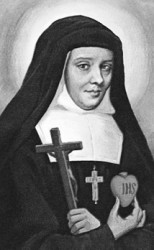
St. Jane Frances de Chantal
(1562-1641)


Jane Frances was wife, mother, nun and founder of a religious community. Her mother died when Jane was 18 months old, and her father, head of parliament at Dijon, France, became the main influence on her education. She developed into a woman of beauty and refinement, lively and cheerful in temperament. At 21 she married Baron de Chantal, by whom she had six children, three of whom died in infancy. At her castle she restored the custom of daily Mass, and was seriously engaged in various charitable works.

Jane's husband was killed after seven years of marriage, and she sank into deep dejection for four months at her family home. Her father-in-law threatened to disinherit her children if she did not return to his home. He was then 75, vain, fierce and extravagant. Jane Frances managed to remain cheerful in spite of him and his insolent housekeeper.

When she was 32, she met St. Francis de Sales who became her spiritual director, softening some of the severities imposed by her former director. She wanted to become a nun but he persuaded her to defer this decision. She took a vow to remain unmarried and to obey her director.

After three years Francis told her of his plan to found an institute of women which would be a haven for those whose health, age or other considerations barred them from entering the already established communities. There would be no cloister, and they would be free to undertake spiritual and corporal works of mercy. They were primarily intended to exemplify the virtues of Mary at the Visitation (hence their name, the Visitation nuns): humility and meekness.

The usual opposition to women in active ministry arose and Francis de Sales was obliged to make it a cloistered community following the Rule of St. Augustine. Francis wrote his famous Treatise on the Love of God for them. The congregation (three women) began when Jane Frances was 45. She underwent great sufferings: Francis de Sales died; her son was killed; a plague ravaged France; her daughter-in-law and son-in-law died. She encouraged the local authorities to make great efforts for the victims of the plague and she put all her convent’s resources at the disposal of the sick.

During a part of her religious life, she had to undergo great trials of the spiritâ€"interior anguish, darkness and spiritual dryness. She died while on a visitation of convents of the community.


Comment:

It may strike some as unusual that a saint should be subject to spiritual dryness, darkness, interior anguish. We tend to think that such things are the usual condition of “ordinary” sinful people. Some of our lack of spiritual liveliness may indeed be our fault. But the life of faith is still one that is lived in trust, and sometimes the darkness is so great that trust is pressed to its limit.

Quote:

St. Vincent de Paul said of Jane Frances: “She was full of faith, yet all her life had been tormented by thoughts against it. While apparently enjoying the peace and easiness of mind of souls who have reached a high state of virtue, she suffered such interior trials that she often told me her mind was so filled with all sorts of temptations and abominations that she had to strive not to look within herself...But for all that suffering her face never lost its serenity, nor did she once relax in the fidelity God asked of her. And so I regard her as one of the holiest souls I have ever met on this earth” (Butler’s Lives of the Saints).

#298
Bible Study / Re: Minute Meditations
August 12, 2014, 01:39:12 PM
Learn to Praise God    Minute Meditations
The desire to praise God, which is written on the human heart, is often obscured or deadened by the cares and worries of life in a fallen world. Praise is a kind of prayer, so understanding what distinguishes it may help you in your efforts to do it.
#299
Bible Study / Re: Saints Of The Day
August 10, 2014, 12:28:55 PM
St. Lawrence
(d. 258?)


The esteem in which the Church holds Lawrence is seen in the fact that today’s celebration ranks as a feast. We know very little about his life. He is one of those whose martyrdom made a deep and lasting impression on the early Church. Celebration of his feast day spread rapidly.

He was a Roman deacon under Pope St. Sixtus II. Four days after this pope was put to death, Lawrence and four clerics suffered martyrdom, probably during the persecution of the Emperor Valerian.

Legendary details of his death were known to Damasus (Dec 11), Prudentius, Ambrose (December 7)  and Augustine (August 28). The church built over his tomb became one of the seven principal churches in Rome and a favorite place for Roman pilgrimages.

A well-known legend has persisted from earliest times. As deacon in Rome, Lawrence was charged with the responsibility for the material goods of the Church, and the distribution of alms to the poor. When Lawrence knew he would be arrested like the pope, he sought out the poor, widows and orphans of Rome and gave them all the money he had on hand, selling even the sacred vessels to increase the sum. When the prefect of Rome heard of this, he imagined that the Christians must have considerable treasure. He sent for Lawrence and said, “You Christians say we are cruel to you, but that is not what I have in mind. I am told that your priests offer in gold, that the sacred blood is received in silver cups, that you have golden candlesticks at your evening services. Now, your doctrine says you must render to Caesar what is his. Bring these treasuresâ€"the emperor needs them to maintain his forces. God does not cause money to be counted: He brought none of it into the world with himâ€"only words. Give me the money, therefore, and be rich in words.”

Lawrence replied that the Church was indeed rich. “I will show you a valuable part. But give me time to set everything in order and make an inventory.” After three days he gathered a great number of blind, lame, maimed, leprous, orphaned and widowed persons and put them in rows. When the prefect arrived, Lawrence simply said, “These are the treasure of the Church.”

The prefect was so angry he told Lawrence that he would indeed have his wish to dieâ€"but it would be by inches. He had a great gridiron prepared, with coals beneath it, and had Lawrence’s body placed on it. After the martyr had suffered the pain for a long time, the legend concludes, he made his famous cheerful remark, “It is well done. Turn me over!”


Stories:

A well-known legend has persisted from earliest times. As deacon in Rome, Lawrence was charged with the responsibility for the material goods of the church and the distribution of alms to the poor. When Lawrence knew he would be arrested like the pope, he sought out the poor, widows and orphans of Rome and gave them all the money he had on hand, selling even the sacred vessels to increase the sum. When the prefect of Rome heard of this, he imagined that the Christians must have considerable treasure. He sent for Lawrence and said, “You Christians say we are cruel to you, but that is not what I have in mind. I am told that your priests offer in gold, that the sacred blood is received in silver cups, that you have golden candlesticks at your evening services. Now, your doctrine says you must render to Caesar what is his. Bring these treasuresâ€"the emperor needs them to maintain his forces. God does not cause money to be counted: He brought none of it into the world with himâ€"only words. Give me the money, therefore, and be rich in words.”


Lawrence replied that the church was indeed rich. “I will show you a valuable part. But give me time to set everything in order and make an inventory.” After three days he gathered a great number of blind, lame, maimed, leprous, orphaned and widowed persons and put them in rows. When the prefect arrived, Lawrence simply said, “These are the treasure of the church.”


The prefect was so angry he told Lawrence that he would indeed have his wish to dieâ€"but it would be by inches. He had a great gridiron prepared, with coals beneath it, and had Lawrence’s body placed on it. After the martyr had suffered the pain for a long time, the legend concludes, he made his famous cheerful remark, “It is well done. Turn me over!”


Comment:

Once again we have a saint about whom almost nothing is known, yet one who has received extraordinary honor in the Church since the fourth century. Almost nothingâ€"yet the greatest fact of his life is certain: He died for Christ. We who are hungry for details about the lives of the saints are again reminded that their holiness was, after all, a total response to Christ, expressed perfectly by a death like this.

Patron Saint of:

Cooks
Poor
#300
Bible Study / Re: Minute Meditations
August 10, 2014, 12:27:59 PM
Walk By Faith    Minute Meditations
We have to always remember that we must live our entire lives, including our prayer lives, in the light of our faith, not only in accordance with what we perceive and with what we feel. As St. Paul said so powerfully, “We walk by faith, not by sight” (2 Corinthians 5:7).