Join MikeLigalig.com!

Why Just Read When You Can Join, Post, and Read!

Menu

Show posts

This section allows you to view all posts made by this member. Note that you can only see posts made in areas you currently have access to.

Show posts Menu

Messages - islander

#1501

The Transition Council has vast powers:

SECTION 2. The Federal Transition Commission shall have the following powers and duties:

(a) To formulate and adopt a transition plan for the orderly shift to the new system of government as provided for in this Constitution. The transition plan shall be published in the Official Gazette and in at least two (2) newspapers of general circulation, and any digital platform chosen by the Transition Commission;

(b) For the proper execution of the transition plan, it shall promulgate the necessary rules, regulations, orders, decrees, proclamations, and other issuances, do all acts to implement the same, and resolve all issues and disputes that may arise therefrom; (similar to the powers of Marcos)

(c) To organize, reorganize, and fully establish the Federal Government and the governments of the Federated Regions, in accordance with this Constitution;

(d) To exercise all powers necessary and proper to ensure a smooth, speedy and successful transition.
#1502

•   The good news of the version I have seen, if genuine, is that the social justice provisions appear to be intact both those in Art. XII on the Economy and Article XIII on social justice, with some amendments on labor rights, for example, unlike the PDP-Laban proposed constitution. But the bad news is that with regard to land, natural resources, and public utilities, Congress is now allowed to change the requirements of acquisition, lease or ownership, which opens the door to transactional legislation.

•   On the transitory provision: The President shall head the Transition Council from 2019-2022 (assuming a plebiscite sometime in 2019), with 10 members with the nominees to be appointed by the President from a search committee headed by the CSC Chair with four members appointed by the President.
#1503

There would be no more need for confirmation. Instead, the candidates shall be vetted by a reconstituted Judicial Appointments and Disciplinary Council consisting of 11 ex-officio members: the four CJs, Fed Ombudsmen, SC administrator, minority Senator, majority rep. CSC, COA, Sec Justice. The regular members would be someone from the IBP, a law professor, representatives from the associations of generals/flag officers/ retired Fed SC. Do you think that these agencies under a Duterte administration will be objective in their choices?

•   The federated regions will not share sovereignty. There are exclusive powers and shared powers to be exercised jointly or separately. In case of dispute, the federal power shall prevail. This is not substantially different from the present multi-tiered unitary system.

•   With regards to the fiscal powers, can these not be done today with an overhaul of the Local Government Code? These are standard recommendations by fiscal expert Prof. Rosario 'Chat' Manasan on a meaningful fiscal decentralization without federalization.
#1504

But the questions and comments by people, including myself, based on the Resolutions 8 and 9 of the House and the PDP-Laban proposed federal constitution appear to be addressed by the ConCom. I will only cover six items for lack of time in digesting all the changes, as follows:

On the form of government: Federal-Presidential, without a parliamentary system;

•   On the checks and balance system: The creation of new institutions that is broader in scope than the present system among the three great departments, the three constitutional commissions, and the office of the Ombudsman and the Commission on Human Rights. Under the new distribution of powers the Fed CHR is now expressly included as well as three additional supreme courts to the Federal Supreme Court, namely the Federal Constitutional Court, the Federal Administrative Court, and the Federal Electoral Court. The appointing power would be distributed other than the president For example, to the Fed CC 3-3-3 shall be appointed among the President, Commission on Appointments and Federal Constitutional Court. In turn appointments to the Federal Constitutional Court 3-shall also be appointed 3-3-3 by the President, the Commission on Appointments and the Federal Supreme Court. And the Fed. Adm Court 3-3-3 by the President, COA appointments, and Fed Sup Court. The Fed Electoral Court will have 15 members – with 5-5-5 (by the Pres., COA appointment, Fed. Cons. Court). And then there is the Federal Intergovernmental Commission to handle the "equalization fund" and help poor regions become viable.
#1505

Based on the various drafts of a federal constitution and the statements of high officials of the administration, my best guess is that the extension of the terms of the office are likely to be done through any of these alternatives:

•   By the suspension of elections; or or extension of terms. By changing the rules for re-election for those who would otherwise be banned from staying in power, including the president himself. Moreover, during the transition between 2018 or 2019 until 2022, by allowing President Duterte to finish his elected term but with much greater powers, until the election of the President under a Federal System, where the cards are stacked in his favor.

The recommendations of the ConCom (as supposed to be finalized yesterday with all 22 commissioners signing it) I received parts of it from two reliable sources and one complete version from a reputable institution that was branded by the ConCom as "not genuine."
#1506

In a span of only two years, the President has taken control of Congress, especially the House, most of the LGUs and ruling dynasties, and of the Supreme Court. By 2022, he will have appointed 13 of the 15 justices. He has gone out of his way to secure the loyalty of the military and the police, including doubling their salaries. I am not sure if the President really wants or considers it still necessary to shift to federalism given his almost total control of these power centers. And he must be aware of the succession risks to the country of a Constitution that is tailored to his way of governance, if he dies before his time.

But if he wants to stay in power beyond 2022, the only legal way to do it is by charter change. With a new constitution that allows him to run again. Mainly through its Transitory Provisions, the way Marcos did it.

Which gives rise to another question: Is federalism a Trojan horse to stay in power?
#1507

Who determines what is "extreme exercise" and what are "issues of primordial importance"? What happens to the system of checks and balances? Where in that kind of government is the role of the Supreme Court as the "conscience of the nation"?

Where are we going?

The President is a master politician. He has not lost a local election in 28 years and he won in his first attempt in national elections. He knows that any attempt to bring him down through "people power" will not prosper given his very high trust ratings. He is perceived as incorrupt and considered as a hope for radical social change across the economic classes. Moreover, there is a changing paradigm of people power. The ordinary people will no longer allow themselves to be used as pawns for power players who all come from the same elite class.

In 2016, many voters deserted the mainstream. As someone describes the phenomenon, most voters "hungered for politicians who can make a rousing argument for drastic solutions." In other words, Duterte the Mayor got it right on the deeper yearnings of the people and was elected by a huge plurality. But can Duterte the President pull it off on his own terms – the radical change he promised? We can only ignore the sentiment behind the vote for him at the peril of undertaking the wrong solutions.
#1508

With regard to the ad hoc Consultative Committee or ConCom, one of its more credible members denied that the President has tried to interfere with its work.. He missed the point. The selection of appointees to the ConCom predetermined its agenda. The ConCom was not meant to seriously study other options to the articulated purpose of federalism: to end the reign of "Imperial Manila" in order to address the underdevelopment of the outlying areas and the urgent problems of mass poverty and gross inequalities.

There may be a second purpose to charter change. In this regard, a comparison of the ConCom Chairman Reynato Puno's statement to Business in July 2017 and his marching orders to the ConCom in its opening session last February 19 is instructive. To Business, the former chief justice said that federalism is a slippery slope with six conditions to protect or avoid, the most important being a truly independent judiciary. To the Concom he said, "There ought to be a moderation on the extreme exercise of the checking power by each branch of government....On certain issues of primordial importance to the political, economic, and social interest of our people, the three departments of our government must speak with one voice. In times of crises, more than one voice is noise."

That sounds dangerously Marcosian. It uses lofty rhetoric to rationalize authoritarianism – a throwback to the Marcos regime when all three departments of government spoke with "one voice."
#1509

With the weakening of the constitutional "checking powers" of Congress, of the Supreme Court, the Office of the Ombudsman, and of the media (i.e. Rappler and the Philippine Daily Inquirer, among others), there remained the potential checking power of the Church to deal with. There are only three institutions with a nationwide reach: the LGUs, the police/military establishment, and the Church. That may account for the latest attempt to smear the "source" of its power – God.

Legal adventurism encourages disrespect of the Constitution and devalues the most potent weapon to protect the rights and freedoms of the people. That would constitute, wittingly or unwittingly, a step toward what mental-health experts refer to as "malignant normality," which can take different forms but, in the case of democratic countries, would consider aberrant behavior or language as part of the democratic process. Thus, a dangerous leader becomes normalized, and malignant normality would dominate the governing dynamic. Clearly, this endangers our democracy.

Who could have foreseen a situation where the designated guard dogs of the Constitution would become the lapdogs of the President?
#1510


Think about Sen. Leila de Lima, under detention for 15 months through trumped-up testimonies of 12 convicted felons, which were upheld by the Supreme Court. Or about former Supreme Court Chief Justice Lourdes Sereno, deposed from her position through quo warranto proceeding by no less than the Supreme Court that ignored the constitutional provision on impeachment and the ethical norms of inhibition by five justices.

Or think about Congress, especially the House that could not establish an "impeachable offense" against Sereno and suspended its transmission to the Senate of a weak case in order to give way to the quo warranto proceeding. Or the proclamation of martial law and its extension for one year in the whole of Mindanao that was affirmed by the Supreme Court with unusual deference to the President and abdicating its mandate to determine the sufficiency of the factual basis for the proclamation of martial law. Such that now, the President is empowered to declare martial law anywhere, anytime in the Philippines.

What about the attempt at a zero budget for the Commission on Human Rights and the attacks on the Ombudsman, which only stopped since the Honorable Ombudsman Conchita Carpio-Morales will be stepping down this July – an Ombudsman who, to paraphrase Albert Camus, put herself at the service not of those who make history but of those who suffer it.
#1511

A book entitled How Democracies Die published earlier this year, among several books on the same subject, says that where authoritarianism during the Cold War was imposed through coups d'etat by the military, since then authoritarianism has been assumed by elected leaders through constitutional revisions that would allow them to stay in power indefinitely, i.e. Fujimori of Peru, Chavez of Venezuela, Erdogen of Turkey, even our Marcos and several others. It also says that there is already danger when even just one of the four signs that an elected leader wants to become a dictator is present. The signs are:

•   Rejects in words or actions the democratic rules of the game – both in written constitutions or unwritten norms of conduct and civility in a functioning democracy;

•   Denies the legitimacy of opponents;

•   Tolerates or encourages violence; and

•   Indicates a willingness to curtail the civil liberties of opponents.

The question: are these happening in the Philippines today?
#1512

Since December, another uncertainty has been added with some urgency – a charter change that threatens not only our "spaces" for democracy but also democracy itself with a new constitution that is likely to allow or facilitate "constitutional authoritarianism." The urgency may have been triggered by statements from the military that it would not support a "revolutionary government," because it would be an extra-constitutional measure beyond its scope of powers and duties.

How easily we forget. The Marcos years were not just about the brutality in the violation of human rights, but also the economic disaster from which we did not recover until 2002, or 20 years after our per capita real income collapsed in 1983 from the weight of foreign debt. And on top of that — perhaps the worst legacy of all — was the culture of corruption that persists to this day.

We are told that our leaders, especially judges, not only shape our lives but also our values. From the experience of the last 18 months, it's clearer now that the Duterte Administration knows how to govern only through the use of fear and force. Thus, if the Marcos legacy is a culture of corruption, then the Duterte legacy would be a culture of violence. In fact, I believe that we are already on a slippery slope to authoritarianism even without charter change.
#1513

Our Constitution gives social and economic rights equal primacy with civil and political rights because we are a country of inequalities from the colonial days to the present where the starting positions of the rich and the poor are not equal. Social Justice and human rights are about the adjustment of these starting positions. It is the central theme, the heart, of the Constitution.

It is a Constitution under threat of overhaul because it is blamed as the source of our problems today and is not part of the solutions.

A week ago, I was a speaker at a forum of an international NGO about the future of their operations because of its external environment, both international and domestic. As of December 2017 their list of uncertainties in the Philippines were: democratic space, rule of law, political institutions, civil and political space, domestic and foreign policy, the government's openness to international aid and development assistance, martial law, revolutionary government and escalating conflicts in Mindanao.
#1514

Our Constitution is considered one of the most progressive in the world alongside that of South Africa. We already have the provisions that many countries are trying to install in theirs in the search for peace and development.

The 1987 Constitution was the first time that we spoke to the world as a truly independent and democratic Filipino nation. It is a document that had not been imposed on us by any colonial power or by a dictatorship.

The 1987 Constitution cut the umbilical cord of the 1935 and 1973 constitutions to the United States Constitution, which gives primacy to civil and political rights because it is a country of immigrants who all started from the same position and only wanted to be free from autocracy.
#1515

This is validated by the studies of experts that a number of factors account for our laggardness among our neighbors in addressing mass poverty and inequality. But foremost are flawed policies and weak institutions rooted in a feudalistic system that has been impervious to change for generations and, of course, its companion evil: corruption.

The 1987 Constitution is the history of Filipino struggles to achieve an independent democracy. One used to oppressive colonial forces is balanced by a stronger citizenry; a tendency to defer to foreigners with parity rights to our land and resources balanced with stronger pro-Filipino policies; a strong business sector balanced with economic opportunities for the poor; a culture of corruption balanced by more avenues to hold our government officials accountable.

Thus, the Constitution can be viewed as affirmative action for our democracy – to correct the shortcomings of previous constitutions, to address the "wrongs" of history and to empower and enable the ordinary Filipino to rise above himself. It provides a system that should correct itself whenever it threatens to get out of control. And in that process of correction, the role of the people is critical because "sovereignty resides in the people."
#1516

THE INSPIRATION for the 1987 Constitution was EDSA and the restoration of democracy through peaceful means. But EDSA was more than that – it was also the promise of a new social order especially to the poor with radical changes, but through democratic means.

Before its writing, consultations nationwide were held to listen to the people and they overwhelmingly preferred the stability of familiar structures – a democratic, representative, unitary presidential system, with checks and balances and separation of powers. And, they wanted the power to directly vote for and have access to their president. But from the experience of the Marcos regime, they also wanted safeguards against the return of authoritarianism in any form. They wanted social justice and wanted our national destiny to be firmly and safely placed on Filipinos themselves. Thus, these are the central themes of our Constitution.

All this was, in many ways, counter-cultural and therefore "radical" because our history is marked by a tendency to give up powers to colonizers and dictators, of deferring to so-called "strong" leaders, of allowing business to rule our economy, and of an over-dependence of the poor on rich landowners for their basic necessities.
#1517

State of the PH in 2018: Perils, Pitfalls of Shifting to Federalism

by Atty. Christian S. Monsod
Former Commission on Elections Chairman
and Member, 1986 Constitutional Commission

MONDAY, JULY 23RD, 2018


IS the proposed shift to federalism "a Trojan horse to stay in power" for President Duterte and his political allies?

What follows is the speech of Atty. Christian S. Monsod, former Commission on Elections chairman and member of the 1986 Constitutional Commission, at the forum on "Democracy and Governance in the Philippines: Deficit, Surplus, and Unfinished Business" that was organized by the Philippine Center for Investigative Journalism, in partnership with the Office of the Ombudsman of the Philippines and the Right to Know, Right Now! Coalition, on July 5, 2018, in Pasig City, Metro Manila.
#1518

viva, groots!
#1519

Most important of the regional units' powers are to levy and collect the following taxes, licenses and fees: real property tax; estate tax; donor's tax; documentary stamp tax; professional tax; franchise tax; games and amusement tax; environment tax, pollution tax, and similar taxes; road users tax; vehicle registration fees; transport franchise fees; and local taxes and other taxes which may be granted by federal law.

Five ill effects can ruin power devolution, says economics professor Victor Abola, University of Asia and the Pacific. One is hyperinflation, like the 2,500% that hit federalized Mexico and Brazil a decade ago. The national governments could not control the federated states' deficit spending, mostly in aide of local officials' reelection, Abola recalls. Another is unequal income distribution among regions. Only three of the 18 proposed regional states – Metro Manila, Southern Tagalog and Central Visayas – are expected to be self-supporting income-wise. PCIJ cites data from the Bureau of Internal Revenue, Philippine Statistics Authority and Department of Budget and Management. Third, federalism can drain government finances and disrupt infrastructure programs. No less than Economic Planning Sec. Ernesto Pernia says so. Abola explains: "We have problems with absorptive capacity; infrastructure spending might be set aside because collections of regions won't be enough." Fourth, double taxation will scare away investors. "If regions are given power to impose taxes, all the more we will be uncompetitive in ASEAN," Abola adds. Lastly, there will be duplication of expenses. "Regions will say they need more for staff and other expenses – wasteful," Abola says.

Will not the dynasts thrive in such economic and taxation powers? All the more they will control businesses in their locales, from highway construction to family resorts, bus lines to shipping, construction supplies to malls.

https://www.philstar.com/opinion/2018/07/23/
#1520

Dynasts won't give up easily, says PCIJ's Malou Mangahas. Only 200 families lorded it over the last five elections, 2004-2016, she cites Comelec studies. Dynasts have been in power since the last two decades of Spanish rule. The 1987 Constitution requires Congress to enact the ban on dynasties. The dynasts have blocked it all these 32 years.

National and regional units will share power under the federal charter. Regions shall have exclusive power over: economic planning; creating revenue sources; financial administration; tourism, investment, and, trade development; infrastructure, public utilities, and, public works; economic zones; land use and housing; justice system; local government units; business permits and licenses; municipal waters; indigenous peoples; culture and language; sports development; and parks and recreation. Although very limited under the 1987 Constitution, these powers are what local officials capitalize on for grease money. They demand bribes in exchange for permits and resolutions of support.
#1521

The federal constitution may not be amended or revised within five years of ratification, and touched again for five years after any change. It is easy to guess what dynasts can do to that anti-dynasty proviso after five years. And that's if the present dynasts in Congress do not delete the ban altogether in their Constituent Assembly to finalize the draft.

"The shift would happen but the local elite should also give up part of their advantage. It's the same starting line for everyone," says Julio Teehankee, one of the 22 drafters of the federal charter. The political scientist's thoughts on his extensively researched subject are contained in a recent article by the Philippine Center for Investigative Journalism (pcij.org).
#1522

The purpose of equalizing chances for public office is defeated. Power still can be concentrated on a clan. Example: Father runs for national Congress representing the district of Kami-Kami; son runs for governor of their home province of Pa Rin; and favorite nephew and niece, who are cousins, run for mayors of the capital city of Aangal and their home town of Ka Pa. Winning by usual guns, goons, and gold, they will still control the jurisdiction of Kami-Kami, Pa Rin, Aangal, Ka Pa. They can win one reelection, then rigodon among themselves or expand with new clansmen. There are many positions to choose from and collaborate on: President, national senator or congressman, regional parliamentarian, provincial governor, board member, city and municipal mayor and councilor, vices, and barangay chairman.

The ban supposedly is self-executory. But that's subject to interpretation. The shift from present unitary to federal government calls for simultaneous federal, regional, and local elections in May 2022. That transition balloting can be deemed a new slate. All incumbents – including dynasts – can be allowed to run under the new constitution. Only President Rodrigo Duterte, by self-renunciation, is prohibited in the draft. They will have four-year national, regional, or local tenures, and can be reelected once. That would give all dynasts eight more years to reign freely.
#1523

Cha-cha: More chances for dynasts to steal

GOTCHA
Jarius Bondoc
The Philippine Star
July 23, 2018

The draft federal constitution does not abolish political dynasties. It even expands their clout. Dynasts will have more chances to rob Filipinos blind.*

The political dynasty ban is only partial. It covers kinsmen only up to the second degree of consanguinity and affinity, legitimate or not, full- or half-blood. That means spouses, offspring, siblings, in-laws, grandparents, and grandchildren. They will be barred from running simultaneously or successively for the same elective position. But they may run simultaneously for one national and one federated state or local position.

*underscoring is the poster's
#1524
Inspiration & Hope / Re: When to be silent
July 23, 2018, 06:16:25 PM

#1525
Inspiration & Hope / Re: When to be silent
July 23, 2018, 06:15:09 PM

#1526
Inspiration & Hope / Re: When to be silent
July 23, 2018, 06:13:35 PM

#1527
Inspiration & Hope / Re: When to be silent
July 23, 2018, 06:01:39 PM

#1528
Inspiration & Hope / Re: When to be silent
July 23, 2018, 06:00:53 PM

#1529
Inspiration & Hope / Re: When to be silent
July 23, 2018, 05:58:34 PM

#1530
Inspiration & Hope / Re: When to be silent
July 23, 2018, 05:56:52 PM

#1531
Inspiration & Hope / Re: When to be silent
July 23, 2018, 05:55:58 PM

#1532
Inspiration & Hope / When to be silent
July 23, 2018, 05:53:51 PM

#1533
Photos Unlimited / Re: Awto ni Inday Aylandil
July 23, 2018, 05:46:54 PM

salamat, bai hubag. kung transformer kana, abot langit akong kalipay. :)
#1534
Philippine Government / Re: Why federalism?
July 21, 2018, 02:04:57 AM

Yet, even in a prosperous nation like America, with two centuries of federalist experience, we are yet to see poorer Southern and Midwestern states catching up with California and New York. America still remains as one of the most unequal nations on earth.

I'm not against federalism per se. But as British philosopher-statesman Edmund Burke once memorably warned, "Better to be despised for too anxious apprehensions, than ruined by too confident a security."

http://opinion.inquirer.net/
#1535
Philippine Government / Re: Why federalism?
July 21, 2018, 02:04:33 AM

Even a cursory look at the works of leading political economists of our time, ranging from Francis Fukuyama (think of "Political Order and Political Decay") to Dani Rodrik ("One Economics, Many Recipes") and Kamer Daron Acemoglu ("Why Nations Fail"), reveals that nations fail and succeed not because of the "form" of their government, but because of the nature of their institutions and state policies.

Finally, what proponents of federalism are yet to demonstrate is our preparedness for Charter change. It's one thing to give more autonomy to local governments; it's entirely another thing to ensure they can stand on their own.

Currently, we know that only few regions, mostly in the industrialized heartland of Luzon, are capable of raising enough taxes on their own. A shift to federalism means that the more prosperous regions will be able to further concentrate on their own development, thus making themselves even more competitive and attractive to capital and labor.
#1536
Philippine Government / Re: Why federalism?
July 21, 2018, 02:03:42 AM

Third, what many proponents of federalism tend to overlook is that what they're advocating for is, per Aristotle's distinction, a change in "form" of government, not in the "substance" of our political system.

For example, France, Turkey and South Korea have a practically identical presidential-parliamentary "form" of government, with a dominant presidency. Yet, their actual political systems have hardly converged over the decades. Turkey has become more autocratic in recent years, while South Korea has become one of the freest nations on earth.

And this brings me to my fourth point of concern: Never trust simplistic, mono-causal explanations of development, which have been largely discredited and ridiculed in cutting-edge social science research.
#1537
Philippine Government / Re: Why federalism?
July 21, 2018, 02:02:33 AM

According to the latest Pulse Asia survey (March 23-28), almost 7 out of 10 Filipinos oppose a shift to a federal government. Clearly, there is no public clamor for it, only widespread and profound public confusion as well as skepticism.

Second, I'm astonished at how a good number of pro-federalism proponents carelessly indulge what scientists call "selection bias." They enthusiastically cite flattering examples of federalism, such as contemporary Germany or Switzerland, which happen to have circumstances entirely different from those in the Philippines.

Few mention the brutal mid-19th century civil war in federal America, which claimed the lives of close to a million individuals, or the breakdown of federal Yugoslavia into a genocidal anarchy not long ago. Not many talk about the actual experience of federalism in fellow developing countries such as Nigeria, India, Brazil, and Iraq, which have been wracked by deep inequality, persistent ethnic-communal tensions, and uneven development throughout much of their recent history.
#1538
Philippine Government / Re: Why federalism?
July 21, 2018, 02:01:44 AM

Yet, I can't help but remain skeptical vis-à-vis the ongoing push for federalism, for at least five reasons.

First of all, is there a public clamor for Charter change? What's the evidence?

According to the latest Social Weather Stations survey (March 23-27), only 14 percent of Filipinos "strongly agree" with pushing for a federal form of government. As many as 75 percent of Filipinos, or 3 out of 4, are not even aware of the mechanics and implications of it.
#1539
Philippine Government / Re: Why federalism?
July 21, 2018, 02:01:09 AM

Like any other Filipino citizen, I'm hungry for political transformation. I'm sick and tired of empty slogans and the perpetuation of an unjust, extractive status quo.

As a probinsyano, born and raised in Baguio, I have carried, perhaps subconsciously, a liminal grievance against "Imperial Manila."

Our political system is an oligarchy disguised as a democracy. Our society simply has too many poor, oppressed and marginalized citizens to deserve the label of democracy.
#1540
Philippine Government / Why federalism?
July 21, 2018, 02:00:05 AM

HORIZONS

Why federalism?

Richard Heydarian
AM July 17, 2018

In theory, federalism aims for unity by recognizing diversity, redistributes fiscal and legislative powers to the peripheries, and encourages local government units to become captains of their own destinies.

On paper, everything looks beautiful. But reality is a completely different matter. And this is where social science, rather than law, can make more substantive contributions to the ongoing debate on Charter change in this country.

After all, the crafting of a new constitution isn't only a legal matter. Instead, it's primarily a leap of faith into a new realm of political economy, namely the interface of power and finite resources.
#1541

Thirdly, political circumstances are a determining factor in the success or failure of any shift to federalism. Already, we have seen that the Duterte administration is engaging in propaganda to make the federalism project a little more acceptable. The other day, PTV4 ran a false story alleging that 6,000 Albayanos in Legazpi City had pledged support for the proposed shift after a two-day consultation with the committee. But participants themselves said there was no such signing and pledging of support.

This Marcosian tactic of fabricating public approval is a potent counterargument to the federalism project, because the weight of history is heavier than all the books that Aquino belatedly studied. If the proposed federal constitution, presumably enriched by Aquino's scholarship, is good in itself, why is the government lying about support for it?

http://opinion.inquirer.net/
#1542

In the first place, there is no lack of experts from federal systems, not merely those who studied the treatises but those who actually lived in federal regimes, who have warned that minimum conditions must be met before attempting a shift to federalism. In other words, there is no guarantee that just because Aquino read all those books, he has the best interests of the Philippines in mind.

Secondly, the fundamental principle of democracy remains the same: one person, one vote. Aquino's alleged learning does not invalidate the opinion, and thus the vote, of an ordinary citizen who does not understand why, if the shift to federalism is so important, it must be rushed; or why, if federalism supposedly solves poverty, learned men like Aquino cannot offer proof, only insult.

If Aquino thinks the answer to a debate is to look down on the lack of learning of those unlucky enough not to be him, he is not genuinely seeking a shift from presidential to federal, but from democratic to aristocratic.
#1543

At least one member of the committee, however, does not seem to see the need to engage the 75 percent who are not aware of what federalism is, or the 29 percent who disagree with or the 34 percent who are uncertain about the proposed federal system of government.

On Facebook, Fr. Ranhilio Aquino, a legal scholar but not a lawyer, laid down the law. "If you oppose federalism, the presupposition is that you have studied it, and your studies show you that it is not good for the country. To which I must now retort: Really, now? Have you studied it? Upon being named to the committee, I started studying it and that meant NOT JUST reading constitutions, but reading constitutional law treatises of Germany, Canada, Malaysia (2 volumes) and South Africa (12 volumes). I also studied the constitutional law of Spain because of its Autonomous Communities and of Italy because its regions enjoy a wide latitude of self-governance... Now, when you oppose federalism tell me what studies you did that I did not do, or studies that the likes of Reynato Puno, Antonio Nachura, Virgilio Bautista, Rodolfo Robles, Aquilino Pimentel, Edmund Tayao or Julio Teehankee did not do."

Pardon the extended excerpt, but the defensive, brittle condescension of this unchristian priest, this undemocratic nonlawyer, must be put on the record.
#1544
Philippine Government / Undemocratic condescension
July 21, 2018, 01:30:19 AM

EDITORIAL

Undemocratic condescension

Philippine Daily Inquirer
July 11, 2018

Last March, Social Weather Stations found that only 25 percent of voting-age Filipinos classified themselves as aware of what a federal system of government was. The same survey found that only 37 percent said they agree (sumasang-ayon) with a federal system—presumably as the new form of government for the Philippines. (The survey questions are vague on this point.) The survey findings show that a large majority of voting-age Filipinos (75 percent) do not know what federalism is, and that almost two-thirds either disagree with the federal system or are undecided about it.

The implication is clear: There is no clamor for a shift to federalism; there is no groundswell of support for a change in the Constitution to allow the shift to a federal system of government. On the other hand, the Duterte administration is intent on effecting the change, and hence the shift.

This is the context in which the members of the consultative committee appointed by President Duterte convened to draft a proposed federal constitution last February; it is the same context in which they presented the completed draft this week. They have, to put it mildly, their work cut out for them. The need to explain the proposed new charter, and the benefits as well as the costs of adopting the federal system of government, is part of the burden the members share.
#1545
Photos Unlimited / Re: Awto ni Inday Aylandil
July 21, 2018, 01:21:12 AM

ang akong latest nga awto:

#1546
Photos Unlimited / Re: High five buddies
July 21, 2018, 12:46:18 AM

sakto tuod. ;D
#1547

barbarians! as if it's not enough to burn animals to a crisp. they still have to humiliate them first. >:(
#1548
Tira-Pasagad | Saksak-Sinagol / Re: Girl's Ride
July 21, 2018, 12:42:59 AM

the best way to say "attention to me, please." ;D
#1549
Tira-Pasagad | Saksak-Sinagol / Re: Double Jeopardy
July 21, 2018, 12:41:40 AM

whew! those who are due to heaven are instead experiencing how it is to be in hell first instead of purgatory.
#1550

hahaha! hunger follows this kind of cracking sadism. i know it would be easier to crack the husband's head if i were the wife. ;D
#1551
Tira-Pasagad | Saksak-Sinagol / Re: Cat zealot
July 21, 2018, 12:35:25 AM

pa-cute-cute pa kunohay. :P
#1552
Facts and Trivia / The Age Factor
July 18, 2018, 02:08:55 PM

just so we may know---

Millennials - ages 22 to 37 (born 1981 to 1996)

Gen Xers - ages 38-53 (born 1965 to 1980)

Baby Boomers - ages 54-72 (born 1946 to 1964)

Silent Generation - ages 73-90 (born 1928 to 1945)
#1553

"We wanted to show the science capabilities of this new instrument", says Fernando Camilo, chief scientist of the South African Radio Astronomy Observatory (SARAO), which built and operates MeerKAT.

"The centre of the galaxy was an obvious target: unique, visually striking and full of unexplained phenomena – but also notoriously hard to image using radio telescopes ... Although it's early days with MeerKAT, and a lot remains to be optimised, we decided to go for it – and were stunned by the results."

https://www.sciencealert.com/
#1554

"This image is remarkable", says Farhad Yusef-Zadeh of Northwestern University in Evanston, Illinois, an expert on the filaments. "It could provide the key to cracking the code and solve this three-decade riddle."

The centre of the Milky Way is incredibly hard to photograph, not only because it's 25,000 light-years away, but also because it lies behind the constellation Sagittarius and is constantly enshrouded by clouds of gas and dust, making it invisible from Earth using optical telescopes.

But infrared, X-ray, and some radio wavelengths, like the ones MeerKAT detects, can penetrate this dust, providing a unique view of the region. The telescope's location in South Africa is also ideal, with the Milky Way passing overhead and visible for almost 12 hours each day.
#1555


The colours here represent the brightness of the radio waves picked up by the telescope: ranging from red for faint emissions through orange and yellow to white for the strongest emissions.

While it looks like a fiery swirling mess, the image shows never-before-seen features, such as the compact sources of those long, magnetised filaments that come off the central region. It also provides a clearer view than ever before of previously known supernova remnants and star-forming regions.

The long and narrow filaments you can see in the image were first discovered in the 1980s, but their origin has remained a mystery. They're seen near the central black hole of our galaxy, but nowhere else in the Milky Way.
#1556


This Is The Clearest View of The Centre of The Milky Way to Date, And It Is Breathtaking

This is the blazing heart of our galaxy.

FIONA MACDONALD
15 JUL 2018

A mega new telescope has captured the clearest view to date of the centre of our Milky Way.

The fiery image shows in extraordinary detail the region surrounding the supermassive black hole at the heart of the galaxy - a target 25,000 light-years away.

The telescope is called the MeerKAT radio telescope, and it's actually made up of 64 individual dishes, all of which detect radio waves. They're built in the semi-desert Karoo region of South Africa and offer more sensitivity than any other telescope of its kind.
#1557


At the final whistle, Mbappé drops to his knees and is embraced by Benjamin Mendy. France are world champions. Photograph: Christian Hartmann/Reuters

Instead Lloris tried to dribble past Mandzukic in his own six-yard area, made a pig's ear of it and at least that gave the score a bit more respectability from a Croatian perspective. There were 20 minutes to play and the losing players kept pushing forward, trying to pull off an improbable feat of escapology. Luka Modric demonstrated why he would later be announced as the Golden Ball winner, as the tournament's outstanding player, and an argument could legitimately be made that Croatia matched their opponents in everything but goals. Dalic's team had set off as though affronted that France were viewed as favourites.

Deschamps had substituted N'Golo Kanté, France's midfield shield, early in the second half, mindful that the Chelsea player had been booked, but there were only fleeting moments when their opponents threatened to examine whether Lloris might be vulnerable again. France had joined Uruguay and Argentina as two-times winners and the World Cup had been given a fitting finale.

https://www.theguardian.com/
#1558


French President Emmanuel Macron is loving what he's witnessing from the stands. Photograph: Alexei Nikolsky/AP

It certainly was not a straightforward decision for the Argentinian referee, Néstor Pitana, and the length of time he spent analysing the replays told its own story. Eventually the handball decision was given against Perisic because it could be argued his arm was sticking out at an unnatural angle as he stooped behind Blaise Matuidi to defend a corner.

Was Matuidi's flick-on on target or heading towards a teammate? The answer is no to both questions. But maybe that was deemed irrelevant. The ball did strike Perisic's hand, however little he knew about it, and that was enough for the penalty to be awarded, no matter how tough that might seem. Griezmann held his nerve to guide the penalty past Danijel Subasic, the Croatia goalkeeper, and after nearly four minutes of arguments and counter-arguments France were back in front.

The game was still finely poised until Mbappé and Griezmann combined to set up Pogba to make it 3-1 just before the hour. Pogba's first effort came back to him off a defender. The second was a more controlled finish with his left foot to wrong-foot Subasic and, when Mbappé fired in a low 25-yard effort for France's fourth goal six minutes later, it was starting to feel as if it could be a rout.
#1559

That was the 53rd own goal in the history of the World Cup, going all the way back to a Mexican player, Manuel Rosas, doing the same against Chile in 1930. Nobody, however, had ever done it before in a final and presumably Rosas did not have to suffer the indignity, as Mandzukic did here, of the public announcer making sure everyone knew who had applied the decisive touch. Mandzukic's attempt to help out in defence had gone horribly wrong. The ball had skimmed off his head from Griezmann's free-kick and France were ahead before any of their own players had managed an attempt at goal.

By now everyone should know enough about Croatia not to be taken aback by the strength of their response, culminating in a beautifully taken equaliser from Ivan Perisic 10 minutes later, using that precious left foot to fire a low, diagonal shot through a congested penalty area.


Paul Pogba celebrates after scoring his side's third goal. Photograph: Martin Meissner/AP

All this was rather unexpected bearing in mind the previous seven finals had yielded only four first-half goals between them. Yet it had quickly become clear that a thrilling tournament was not going to be let down by a cagey, prosaic final and the only pity, perhaps, went back to the first-half incident that led Croatia's fans to whistle noisily when the match officials collected their medals.
#1560


French goalkeeper Hugo Lloris has the ball stolen off him by Mandzukic and it's suddenly 4-2 with 21 minutes remaining. Can Croatia stage a late comeback?
Photograph: Abedin Taherkenareh/EPA


The mistake from Lloris that allowed Mario Mandzukic to pull a goal back for Croatia did not matter greatly in the end and France are deserving champions bearing in mind their assured performances throughout the tournament. Any team that score four times in a final are entitled to feel they have won in style and nobody seemed to mind too much, in the long wait for the trophy presentation, that the only person being sheltered from the rain was Vladimir Putin. Kudos to the chap in the suit who suddenly appeared with an umbrella to keep the president dry while Gianni Infantino and the other assorted Fifa dignitaries took a soaking.

This was the highest-scoring final since 1966 and it was laced with drama and incident, not least a second-half pitch invasion apparently from members of Pussy Riot, and featuring a fair amount of controversy, too, bearing in mind that France's second goal, a penalty scored by Antoine Griezmann, came from a borderline VAR decision that will always polarise opinion.

Even before that point it was difficult not to sympathise with Croatia given they had suffered the grievous setback of an own goal from Mandzukic. Zlatko Dalic, the Croatia manager, had promised that, if necessary, his team would take defeat with dignity and at least his players did not veer from that line, in trying circumstances. They will leave Russia, however, feeling that key moments of luck went against them, right down to the smaller details. Marcelo Brozovic's alleged foul on Griezmann for the free-kick that led to Mandzukic's own goal was a case in point: a generous decision, to say the least.
#1561

World Cup 2018

France seal second World Cup triumph with 4-2 win over brave Croatia

Daniel Taylor at the Luzhniki Stadium
@DTguardian
Sun 15 Jul 2018
Last modified on Mon 16 Jul 2018


France's Hugo Lloris lifts the World Cup trophy as they celebrate winning. Photograph: Shaun Botterill/Getty Images

When the decisive blows arrived the entire squad piled on top of one another in the victory scrum. Hugo Lloris, the goalkeeper, had run the entire length of the pitch to join in the celebrations. All the substitutes were throwing themselves into this heap of arms and legs. There were even members of the backroom staff contemplating joining in, and who could blame them? France were on their way to winning the World Cup and a party was under way behind the goal where the tricolours were fluttering.

Those were the moments when everybody knew that no side – not even one with Croatia's resilience and powers of durability – would find a way back. Paul Pogba and Kylian Mbappé had scored in quick succession and the next edition of the France national shirt will have two stars, rather than one, above the cockerel.

Didier Deschamps has become only the third man in history to win the World Cup as a player and manager, standing alongside two giants of the game in Mário Zagallo and Franz Beckenbauer. Mbappé is a world champion at the age of 19, the first teenager to score in a final since Pelé in 1958, and there were jubilant scenes after the final whistle as the players gave their manager the bumps as the rain turned biblical and the trophy was lifted to a backdrop of thunder and slate skies.
#1562
Tira-Pasagad | Saksak-Sinagol / Re: Napikon na ni
July 15, 2018, 02:01:29 PM

super pikon. ;D
#1563

Final

15 July 2018
18:00 Local time

Luzhniki Stadium
Moscow

Full-Time

France   4
Croatia   2


https://www.fifa.com/worldcup/matches/
#1564
Tira-Pasagad | Saksak-Sinagol / Re: Cat zealot
July 14, 2018, 01:45:11 PM

meow. and the original poster is a...(take your pick; multiple choice) hexaprotodon liberiensis, macaca sylvanus, tyrannosaurus rex. ;D 
#1565
Science and Research / Pluto!
July 14, 2018, 01:28:54 PM


An image of the Tenzing Montes peaks on Pluto created with New Horizons data and released on July 10, 2018. The mountains range from about 1.8 miles to 3.7 miles (3 to 6 kilometers) above the dwarf planet's surface.
Credit: Paul Schenk/Lunar and Planetary Institute
#1566

Play-off for third place

14 July 2018
17:00 Local time


Saint Petersburg Stadium
St. Petersburg

Full-Time

Belgium   2
England   0


https://www.fifa.com/worldcup/matches/
#1567
Tira-Pasagad | Saksak-Sinagol / Re: Cat zealot
July 13, 2018, 03:07:54 AM

i think the writer is a cat. :)
#1568
Philippine Daily News / Re: Jose Midas Marquez
July 12, 2018, 05:21:12 AM

he's too partisan to be a credible member of the supreme court.
#1569
Quotable Quotes / Re: Quote For The Day
July 10, 2018, 12:44:37 PM

#1570

hayahay pa sa pulis... :D
#1571
Tira-Pasagad | Saksak-Sinagol / Re: Touché
July 10, 2018, 12:24:52 PM

bravo!

#1572

SEMI-FINALS

10 July 2018
21:00 Local time


Saint Petersburg Stadium
St. Petersburg


Full-Time

France   1
Belgium   0


11 July 2018
21:00 Local time


Luzhniki Stadium
Moscow

Full-Time

Croatia   2
England   1

Croatia win after extra time


https://www.fifa.com/worldcup/matches/
#1573

KNOCKOUT PHASE
Quarter-Finals
06 July - 07 July 2018


06 July 2018
17:00 Local time


Nizhny Novgorod Stadium
Nizhny Novgorod

Full-Time

Uruguay   0
France   2


06 July 2018
21:00 Local time


Kazan Arena
Kazan

Full-Time

Brazil   1
Belgium   2


07 July 2018
18:00 Local time


Samara Arena
Samara

Full-Time

Sweden   0
England   2


07 July 2018
21:00 Local time


Fisht Stadium
Sochi

Full-Time

Russia   2
Croatia   2

Croatia win on penalties (3-4)


https://www.fifa.com/worldcup/matches/
#1574
Photos Unlimited / Re: Tantrum
July 08, 2018, 01:30:29 AM

kaluoy, mahadlok malumos. ;D
#1575
Photos Unlimited / Re: Dili kaya
July 08, 2018, 01:29:15 AM

bad kitten! >:(
#1576
Quotable Quotes / Re: Grace under pressure
July 08, 2018, 01:23:33 AM

truly, those crocodiles have grace under pressure.
#1577

salute! he's creative! :)
#1578
Photos Unlimited / Re: Photobomb level: Expert
July 08, 2018, 01:16:09 AM
#1581


Edith fled from Karol Wojtyla when they arrived at Krakow in 1945. The family on the train, also Jews, had warned her that he might take her off to "the cloisters." She recalls him calling out, "Edyta, Edyta!" -- the Polish form of her name -- as she hid behind large containers of milk.

But hiding was not forgetting. She wrote his name in a diary, her savior, and in 1978, when she read in a copy of Paris-Match that he had become pope, she broke into tears. By then Edith Zierer was in Haifa, Israel, where she now lives.

Letters to him went unanswered. But at last, in 1997, she received a letter from the Vatican in which the pope recalled their meeting. A year later they met again at the Vatican. Edith thanked the pope for saving her. He put one hand on her head, another hand in hers, and blessed her. As she parted, he said, "Come back, my child."

https://www.nytimes.com/
#1582


It was based in the belief that, as he once put it, "a degradation, indeed a pulverization, of the fundamental uniqueness of each human being" was at the root of the mass movements of the 20th century, Communism and Fascism.

Stalin once contemptuously asked, "How many divisions has the pope?" Starting with his 1979 visit to Poland, John Paul gave an answer.

Perhaps the strength that enabled him to play a central role in ending Communism and the strength that led him to save Edith Zierer did not differ fundamentally. Like his healing ecumenism, those acts required the courage born of a core certitude.
#1583


What moved this young seminarian to save the life of a lost Jewish girl cannot be known. But it is clear that his was an act of humanity made as the two great mass movements of the 20th century, the twin totalitarianisms of Fascism and Communism, bore down on his nation, Poland.

Here were two people in a ravaged land, a 24-year-old Catholic and a 13-year-old Jew. The future pope had already lost his mother, father and brother. Edith, although she did not know it yet, had already lost her mother at Belzec, her father at Maidanek and her little sister at Auschwitz. They could not have been more alone.

Pope John Paul II is widely viewed as having been a man of unshakable convictions that some found old-fashioned or rigid. But perhaps he offered his truth with the same simplicity and directness he showed in proffering tea and bread and shelter from cold to an abandoned Jewish girl in 1945, when nobody was watching.
#1584


The man disappeared. He came back with a cup of tea. Edith drank. He said he could help her get to Krakow. Again the mysterious benefactor went away, returning with bread and cheese. They talked about the advancing Soviet Army. Edith said she believed that her parents and younger sister, Judith, were alive.

"Try to stand," the man said. Edith tried and failed. He carried her to another village, where he put her in the cattle car of a train bound for Krakow. Another family was there. The man got in beside Edith, covered her with his cloak and made a small fire.

His name, he told Edith, was Karol Wojtyla. Although she took him for a priest, he was still a seminarian who would not be ordained until the next year. Thirty-three more years would pass before he became Pope John Paul II and embarked on a papacy that would help break the Communist hold on Central Europe and so transform the world.
#1585


The elder of these daughters was Edith Zierer. In January 1945, at age 13, she emerged from a Nazi labor camp in Czestochowa, Poland, a waif on the verge of death. Separated from her family, unaware that her mother had been killed by the Germans, she could scarcely walk.

But walk she did, to a train station, where she climbed onto a coal wagon. The train moved slowly, the wind cut through her. When the cold became too much to bear, she got down at a village called Jedrzejow. In a corner of the station, she sat. Nobody looked at her, a girl in the striped and numbered uniform of a prisoner, late in a terrible war. Unable to move, Edith waited.

Death was approaching, but a young man approached first, "very good looking," as she recalled, and vigorous. He wore a long robe and appeared to be a priest. "Why are you here?" he asked. "What are you doing?" Edith said she was trying to get to Krakow to find her parents.
#1586

The Polish Seminary Student and the Jewish Girl He Saved

By ROGER COHEN
APRIL 6, 2005
The New York Times

Here is a family story of Pope John Paul II, an intimate tale of his humanity.

During the summer of 1942, two women in Krakow, Poland, were denounced as Jews, taken to the city's prison, held there for a few months and then sent to the Belzec death camp, where in October they were killed in primitive Nazi gas chambers by carbon monoxide from diesel engines.

Their names were Frimeta Gelband and Salomea Zierer; they were sisters. As it happens, Frimeta was my wife's grandmother. Salomea -- known as Salla -- had two daughters, one of whom survived the war and one of whom did not.
#1587
General Topic / Re: Carenderia Cat
July 02, 2018, 07:49:34 PM

In Turkey, a cat shops for meat at deli counter
with thanks to a kind deli shopkeeper/owner


https://www.youtube.com/watch?v=RRzRxPJgygs
#1588

Dressing room division

The political scandal involving Mesut Özil and Ilkay Gündogan meeting with Turkey president Recep Tayyip Erdogan was less than ideal preparation and reports of a fractious squad have blighted the team's tournament. Hummel's pointed comments after the defeat to Mexico, when he complained the side had been too open, did not point to a unified group.

Head coach Joachim Löw only signed a contract extension to 2022 last month, but after the defeat to South Korea, he hinted he may not fulfill it. The Germans still have some hugely impressive young players - Joshua Kimmich, Werner, and the aforementioned Sané for example – and will surely come back strongly. But while Löw insisted the World Cup exit would not bring about a "dark time" in German soccer, right now the players and fans will need help seeing the light.

https://www.forbes.com/
#1589

Vulnerable defense

German teams are often built on a stingy defense and this one is no different. The Bayern Munich triangle of goalkeeper Manuel Neuer and center backs Jérôme Boateng and Mats Hummels is one of the strongest in the world. They helped Germany concede a miserly four goals in 10 wins from 10 in World Cup qualifying.

During this tournament, the defense was hopelessly exposed during the first match against Mexico. The team played an unnecessarily open style and the Mexicans could have scored more than the one needed for victory. In the second match, a 2-1 win over Sweden, Boateng had a nightmare without injured defensive partner Hummels beside him, misplacing passes and out of position before being sent off. Even putting the two goals conceded to South Korea down to the fact they were chasing the match, Germany's defensive unit has been shaky throughout the tournament.
#1590

Overconfidence?

Germany is not the sort of soccer nation that rests on its laurels. Even in periods of sustained success, the country's soccer federation has worked with experts to gain edges through technology, for example using data analysis to improve their passing speed.

But the team, and the country, have become accustomed to success. Since 1938, every West Germany or unified Germany side has advanced beyond the first stage of the World Cup finals, until now. Several key players in the current team were part of the 2014 World Cup winning team, including a stunning 7-1 victory over Brazil, as well as the cruise through qualifying. Germany even won the 2017 Confederations Cup with an experimental squad. Handed a tricky-looking but hardly terrifying World Cup group, did the German players take their eyes off the prize?
#1591

Blunt attack

In their three group matches, Germany managed just two goals – the second fewest by a defending champion in competition history – and one was the stunning last-minute freekick from Kroos. The blame should not all rest with key goalscorers Thomas Müller and Timo Werner, with a lack of creativity and drive from the midfield. When the team did create chances (they registered 28 shots in the final match against South Korea) wasteful finishing cost them dearly.

When the squad was announced pre-tournament, I thought it was a mistake to leave out flying Manchester City winger Leroy Sané, even with the depth of talent at Germany's disposal. While it's easy to say in retrospect, Sané's pace and trickery could have been the key for Germany to unlock defenses.
#1592

Curse of the champions

It's hard to work out why, but in recent World Cup tournaments, the holders have struggled. Germany's elimination means out of the last five World Cups, four defending champions have exited in the group stage.

France did it in 2002 after winning the 1998 trophy, followed by Italy (winner 2006, out in the group 2010), Spain (winner 2010, out in the group 2014) and now Germany (winner 2014, out in the group 2018). It's unlikely professionals would allow something like this to play on their minds, but at the same time, the winners of this year's competition should take nothing for granted in 2022.
#1593

World Cup 2018: 5 Reasons Defending Champion Germany Is Out

Robert Kidd
CONTRIBUTOR

Opinions expressed by Forbes Contributors are their own.


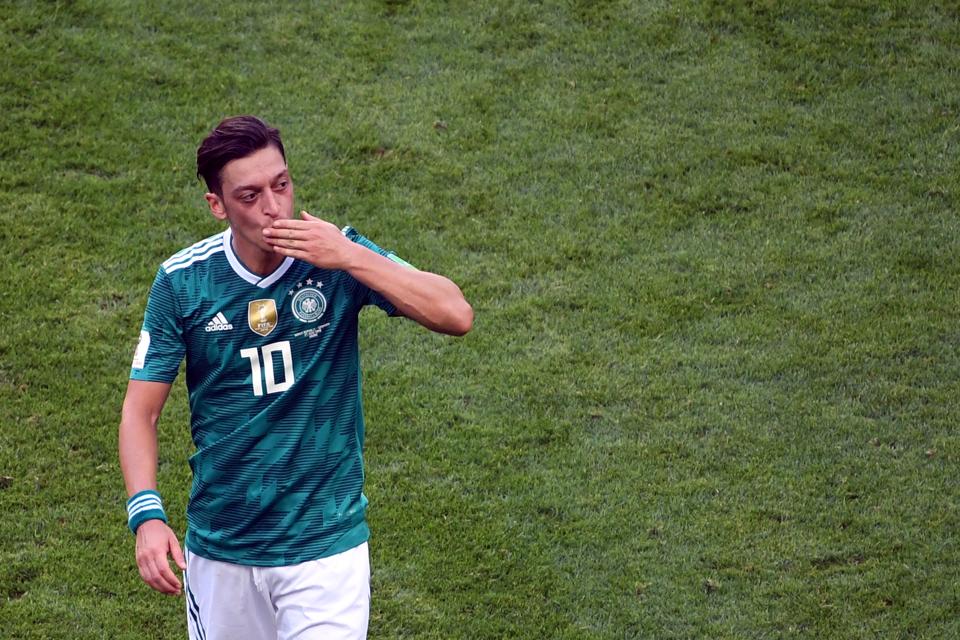
Mesut Özil and his Germany teammates are out of the World Cup. (Photo by Ina Fassbender/picture alliance via Getty Images)

Germany, the reigning champion, has been sensationally eliminated in the first round of World Cup 2018. Die Mannschaft was bidding to become only the third team to win consecutive World Cup titles, but instead, one of the pre-tournament favorites is out at the group stage.

After a surprise defeat to Mexico in their opening match, the Germans gave themselves a real chance with a last-minute free kick from Toni Kroos to beat Sweden. With the Germans needing to win against already-eliminated South Korea on Wednesday, most expected them to advance, but a shock 2-0 defeat leaves them bottom of the group and on their way home. Here are five reasons why.
#1594

Tuesday 03 July 2018
17:00 Local time


Saint Petersburg Stadium
St. Petersburg

Full-Time

Sweden   1
Switzerland   0


Tuesday 03 July 2018
17:00 Local time


Spartak Stadium
Moscow

Full-Time

Colombia   1
England   1

England win on penalties (3-4)


https://www.fifa.com/worldcup/matches/
#1595

Monday 02 July 2018
18:00 Local time


Samara Arena
Samara

Full-Time

Brazil      2
Mexico   0


Monday 02 July 2018
21:00 Local time


Rostov Arena
Rostov-On-Don

Full-Time

Belgium   3
Japan   2


https://www.fifa.com/worldcup/matches/
#1596

Sunday 01 July 2018
17:00 Local time


Luzhniki Stadium
Moscow

Full-Time

Spain   1
Russia   1

Russia win on penalties (3-4)


Sunday 01 July 2018
21:00 Local time


Nizhny Novgorod Stadium
Nizhny Novgorod

Full-Time

Croatia   1
Denmark   1

Croatia win on penalties (3-2)


https://www.fifa.com/worldcup/matches/
#1597

KNOCKOUT PHASE
Round of 16
30 June - 03 July 2018


Saturday 30 June 2018
17:00 Local time


Kazan Arena
Kazan

Full-Time

France   4
Argentina   3


Saturday 30 June 2018
21:00 Local time


Fisht Stadium
Sochi

Full-Time

Uruguay   2
Portugal   1


https://www.fifa.com/worldcup/matches/
#1598

Thursday 28 June 2018
17:00 Local time


Group H
Volgograd Arena
Volgograd

Full-Time

Japan   0
Poland   1


Thursday 28 June 2018
18:00 Local time


Group H
Samara Arena
Samara

Full-Time

Senegal   0
Colombia   1


Thursday 28 June 2018
17:00 Local time


Group G
Mordovia Arena
Saransk

Full-Time

Panama   1
Tunisia   2


Thursday 28 June 2018
20:00 Local time


Group G
Kaliningrad Stadium
Kaliningrad

Full-Time

England   0
Belgium   1


https://www.fifa.com/worldcup/matches/
#1599
Bible Study / Re: When officials cuss and mock
June 30, 2018, 04:01:10 AM

Other groups are girding to question those who will run under Duterte's ticket in the May 2019 congressional-local elections. Names will be known in four months. Filing of candidacies will be in Oct. 2018, for the oversized ballots.

Still others prefer to emulate the dignified silence of Christ. Jesus had kept quiet while mocked by Annas, Caiaphas, and Herod. Speaking would have been futile with those bent on crucifying Him. Silence is often the best reproof for profane behavior, a broadcaster-preacher advises. When officials begin to mock God or lie or cuss, just politely leave.

https://www.philstar.com/
#1600
Bible Study / Re: When officials cuss and mock
June 30, 2018, 04:00:26 AM

At another friend's birthday bash on Nov. 28, 2017, he said: "You know, if you are God, you are perfect. There ought not to be imperfections. Your creation must be good. Why create a snake. Better give that to China, which might cook it tomorrow."

At the meeting with the Filipino community in Seoul, Korea, June 3, 2018, he spoke of the creation of Adam and Eve, then remarked: "Kung yan ang diyos ng Katoliko, torpe yan. Maghanap ka ng diyos na tama."

Some Christian groups view those as violation of the Constitution. Article II, Section 6, states: "The separation of Church and State shall be inviolable." That separation often is misread as a ban on churches from meddling in politics. In truth it bars the State from establishing or promoting any religion. By deriding Christianity, they say, head of state Duterte in effect is imposing his own religion, whatever it is.