
This section allows you to view all posts made by this member. Note that you can only see posts made in areas you currently have access to.
Pages 1 2 3 4 5 6 7 8 9 10 11 12 13 14 15 16 17 18 19 20 21 22 23 24 25 26 27 28 29 30 31 32 33 34 35 36 37 38 39 40 41 42 43 44 45 46 47 48 49 50 51 52 53 54 55 56 57 58 59 60 61 62 63 64 65 66 67 68 69 70 71 72 73 74 75 76 77 78 79 80 81 82 83 84 85 86 87 88 89 90 91 92 93 94 95 96 97 98 99 100 101 102 103 104 105 106 107 108 109 110 111 112 113 114 115 116 117 118 119 120 121 122 123 124 125 126 127 128 129 130 131 132 133 134 135 136 137 138 139 140 141 142 143 144 145 146 147 148 149 150 151 152 153 154 155 156 157 158 159 160 161 162 163 164 165 166 167 168 169 170 171 172 173 174 175 176 177 178 179 180 181 182 183 184 185 186 187 188 189 190 191 192 193 194 195 196 197 198 199 200 201 202 203 204 205 206 207 208 209 210 211 212 213 214 215 216 217 218 219 220 221 222 223 224 225 226 227 228 229 230 231 232 233 234 235 236 237 238 239 240 241 242 243 244 245 246 247 248 249 250 251 252 253 254 255 256 257 258 259 260 261 262 263 264 265 266 267 268 269 270 271 272 273 274 275 276 277 278 279 280 281 282 283 284 285 286 287 288 289 290 291 292 293 294 295 296 297 298 299 300 301 302 303 304 305 306 307 308 309 310 311 312 313 314 315 316 317 318 319 320 321 322 323 324 325 326 327 328 329 330 331 332 333 334 335 336 337 338 339 340 341 342 343 344 345 346 347 348 349 350 351 352 353 354 355 356 357 358 359 360 361 362 363 364 365 366 367 368 369 370 371 372 373 374 375 376 377 378 379 380 381 382 383 384 385 386 387 388 389 390 391 392 393 394 395 396 397 398 399 400 401 402 403 404 405 406 407 408 409 410 411 412 413 414 415 416 417 418 419 420 421 422 423 424 425 426 427 428 429 430 431 432 433 434 435 436 437 438 439 440 441 442 443 444 445 446 447 448 449 450 451 452 453 454 455 456 457 458 459 460 461 462 463 464 465 466 467 468 469 470 471 472 473 474 475 476 477 478 479 480 481 482 483 484 485 486 487 488 489 490 491 492 493 494 495 496 497 498 499 500 501 502 503 504 505 506 507 508 509 510 511 512 513 514 515 516 517 518 519 520 521 522 523 524 525 526 527 528 529 530 531 532 533 534 535 536 537 538 539 540 541 542 543 544 545 546 547 548 549 550 551 552 553 554 555 556 557 558 559 560 561 562 563 564 565 566 567 568 569 570 571 572 573 574 575 576 577 578 579 580 581 582 583 584 585 586 587 588 589 590 591 592 593 594 595 596 597 598 599 600 601 602 603 604 605 606 607 608 609 610 611 612 613 614 615 616 617 618 619 620 621 622 623 624 625 626 627 628 629 630 631 632 633 634 635 636 637 638 639 640 641 642 643 644 645 646 647 648 649 650 651 652 653 654 655 656 657 658 659 660 661 662 663 664 665 666 667 668 669 670 671 672 673 674 675 676 677 678 679 680 681 682 683 684 685 686 687 688 689 690 691 692 693 694 695 696 697 698 699 700 701 702 703 704 705 706 707 708 709 710 711 712 713 714 715 716 717 718 719 720 721 722 723 724 725 726 727 728 729 730 731 732 733 734 735 736 737 738 739 740 741 742 743 744 745 746 747 748 749 750 751 752 753 754 755 756 757 758 759 760 761 762 763 764 765 766 767 768 769 770 771 772 773 774 775 776 777 778 779 780 781 782 783 784 785 786 787 788 789 790 791 792 793 794 795 796 797 798 799 800 801 802 803 804 805 806 807 808 809 810 811 812 813 814 815 816 817 818 819 820 821 822 823 824 825 826 827 828 829 830 831 832 833 834 835 836 837 838 839 840 841 842 843 844 845 846 847 848 849 850 851 852 853 854 855 856 857 858 859 860 861 862 863 864 865 866 867 868 869 870 871 872 873 874 875 876 877 878 879 880 881 882 883 884 885 886 887 888 889 890 891 892 893 894 895 896 897 898 899 900


#13307
Health and Food / Re: Healthy Eating?
February 05, 2014, 12:55:04 PMQuote from: Lorenzo on February 04, 2014, 01:18:46 AM
o wow. the darker the berry ..the sweeter the juice.

Ah, I see. How about "the darker the eater..."

#13308
Anonymous Diary Blog / Re: Seven Dangers to Human Virtue
February 05, 2014, 11:40:42 AM
Here's more from the great soul...


#13309
Jokes and Humor / Re: Do you "yes" or do you "no"?
February 05, 2014, 11:36:05 AM
Ang "no" kay shotgun approach...
#13310
Lifestyle, Culture and Arts / Re: 10 most horrifying mythical creatures in Cebu and anywhere else in the Philippin
February 04, 2014, 04:14:52 PM #13311
Health and Food / Crispy sumsoman
February 03, 2014, 07:57:20 PM
Di lang kay crispy, crunchy pa jud!
#13312
Jokes and Humor / Re: Wala Magkadimao
February 03, 2014, 07:55:18 PM
Kini nga billatun bord, gusto lang nig ottention...

#13315
Tira-Pasagad | Saksak-Sinagol / Re: Animal Cruelty?
February 03, 2014, 07:44:28 PM
Hala! Wa lagi kuhaa ang sulod sa ginhawaan. Apilon galing og kaon... 
#13316
Lifestyle, Culture and Arts / Re: 10 most horrifying mythical creatures in Cebu and anywhere else in the Philippin
February 03, 2014, 07:36:23 PMQuote from: bugsay on February 02, 2014, 10:28:10 PM
wakwak sa TB?
Hmm... Kadtong naay daghang binuhi?

#13318
Tira-Pasagad | Saksak-Sinagol / Re: Animal Cruelty?
February 03, 2014, 06:59:05 PM
Kini cruelty pood...

#13320
Philippine Photo Gallery / Niño Palaboy
February 03, 2014, 06:46:50 PM
CEBU. Devotees of the Sto. Niño have flocked to the Sto. Niño de Cebu parish in Barangay Mactan, Lapu-Lapu City to take photos of Niño Palaboy, believed to be a talking and, at times, moving Niño. (Alan Tangcawan)
#13321
Asia | Middle East / Re: Indonesia volcano Sinabung in deadly eruption
February 02, 2014, 02:04:38 PM
#13322
Asia | Middle East / Re: Indonesia volcano Sinabung in deadly eruption
February 02, 2014, 02:03:58 PM
#13323
Asia | Middle East / Re: Indonesia volcano Sinabung in deadly eruption
February 02, 2014, 02:00:39 PM
For the past five months, Indonesians have become accustomed to eruptions from Sinabung.

A woman covers her nose and mouth from volcanic ash from the eruption of Mount Sinabung in Sibintun, North Sumatra, Indonesia, Sunday, Jan. 19
A woman covers her nose and mouth from volcanic ash from the eruption of Mount Sinabung in Sibintun, North Sumatra, Indonesia, Sunday, Jan. 19
#13324
Asia | Middle East / Re: Indonesia volcano Sinabung in deadly eruption
February 02, 2014, 01:59:39 PM
When the volcano erupted in 2010, at least two people were killed and 30,000 others were displaced.
Before 2010, Sinabung had not erupted in 400 years.
It is one of about 130 active volcanoes in Indonesia.
Experts say Sinabung has been studied less than more active volcanoes, making it more difficult to predict.

A tourist rides a horse as Sinabung spews volcanic materials in Gundaling, January 21
Before 2010, Sinabung had not erupted in 400 years.
It is one of about 130 active volcanoes in Indonesia.
Experts say Sinabung has been studied less than more active volcanoes, making it more difficult to predict.
A tourist rides a horse as Sinabung spews volcanic materials in Gundaling, January 21
#13325
Asia | Middle East / Re: Indonesia volcano Sinabung in deadly eruption
February 02, 2014, 01:56:38 PM
Saturday's eruption was the worst since Sinabung came back to life in 2010, after 400 years dormancy.

Long-exposure photograph taken on January 27, 2014 from Karo district of Mount Sinabung volcano during an eruption
Long-exposure photograph taken on January 27, 2014 from Karo district of Mount Sinabung volcano during an eruption
#13326
Asia | Middle East / Re: Indonesia volcano Sinabung in deadly eruption
February 02, 2014, 01:41:28 PM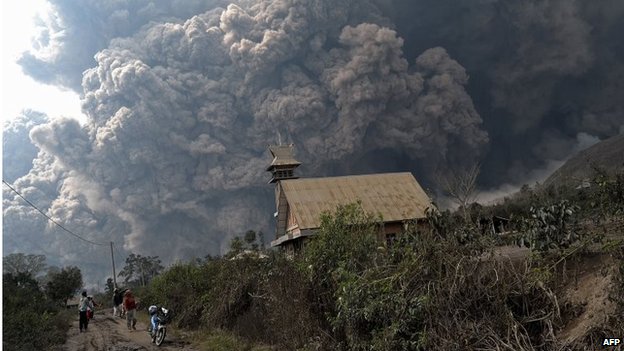
A giant cloud of hot volcanic ash clouds engulfs villages in Karo district during the eruption of Mount Sinabung volcano located in Sumatra on February 1
#13327
Asia | Middle East / Indonesia volcano Sinabung in deadly eruption
February 02, 2014, 01:40:24 PM
1 February 2014 Last updated at 15:03

A villager run as Mount Sinabung erupt at Sigarang-Garang village in Karo district, Indonesia's North Sumatra province, February 1
A volcano has erupted on the Indonesian island of Sumatra, engulfing villages in ash and killing at least 14 people.
Mount Sinabung spewed hot gas, ash and rocks 2km (1.5 miles) into the air in a series of eruptions during the morning.
Emergency official Sutopo Purwo Nugroho said three schoolchildren and a teacher were among the dead.
Thousands were evacuated in September when Sinabung erupted after being dormant for three years. Many were allowed back to their homes on Friday.
Officials fear there may have been more casualties, but they cannot get closer because of the heat from the eruption.
Pictures taken at the scene showed rescue workers recovering bodies that were buried in ash.
#13328
Jokes and Humor / Re: The wheels of life
February 02, 2014, 01:32:54 PM
Kini kay mas kumpleto...


#13330
Lifestyle, Culture and Arts / Re: 10 most horrifying mythical creatures in Cebu and anywhere else in the Philippin
February 02, 2014, 12:37:44 PMQuote from: chicogon on February 02, 2014, 03:04:08 AM

Tinuod ning manananggal. Niay usa, ay, nga nabuntagan, nakodakan hinuon...

#13331
Photos Unlimited / Re: The Best Animal Photobomb Ever
February 01, 2014, 02:35:02 PM
Si Bugsay maoy atong himoong trainer...
#13332
Photos Unlimited / Re: Composition in gray and gold
February 01, 2014, 02:31:26 PMQuote from: islander on January 29, 2014, 03:24:18 PM
aw, hehe, guwapa man diay koh.
Mo lang. Misteryoso ra bag tinan-awan...
#13333
World Daily News / Re: Syria crisis: Geneva peace talks end in recriminations
February 01, 2014, 02:28:51 PM
Both sides agreed to use a 2012 document known as the Geneva Communique as a basis for discussions, and agreed to meet in the same room.
But neither side could agree on the focus, with the opposition insisting that political transition was the focus, and the government wanting to talk about terrorism.
Diplomats described the atmosphere between the two sides as extremely tense all the way through the conference.
And the talks were further hampered by the lack of representation of some of the rebel fighting groups, including the al-Qaeda-linked al-Nusra Front.
Diplomats have said that a top priority in Geneva is to keep the talks process going, in the hope that hard-line positions can be modified over time.
#13334
World Daily News / Re: Syria crisis: Geneva peace talks end in recriminations
February 01, 2014, 02:28:09 PM
"There have been moments when one side has even acknowledged the concerns and difficulties of the other side," he said.
The first round of talks between the government and the opposition National Coalition began last week.
A UN-backed meeting in 2012 issued the document and urged Syria to:
Form transitional governing body
Start national dialogue
Review constitution and legal system
Hold free and fair elections
The first round of talks between the government and the opposition National Coalition began last week.
A UN-backed meeting in 2012 issued the document and urged Syria to:
Form transitional governing body
Start national dialogue
Review constitution and legal system
Hold free and fair elections
#13335
World Daily News / Re: Syria crisis: Geneva peace talks end in recriminations
February 01, 2014, 02:25:40 PM
As talks came to an end in Geneva, activists accused government forces of an air strike in Aleppo
#13336
World Daily News / Re: Syria crisis: Geneva peace talks end in recriminations
February 01, 2014, 02:23:26 PM
But she said that, so far, an agreed ceasefire in the besieged city of Homs had not had any effect, and no aid has got through.
Parts of Homs have been under government siege for more than 18 months. Some residents have told the BBC that they are eating grass to survive.
More than 100,000 people have died in Syria since the uprising against President Bashar al-Assad began in March 2011.
Mr Brahimi said: "Progress is very slow indeed, but the sides have engaged in an acceptable manner. This is a very modest beginning, but it is a beginning on which we can build."
Though the gap between the two sides was "wide", they had become used to sitting in the same room, he said.
#13337
World Daily News / Re: Syria crisis: Geneva peace talks end in recriminations
February 01, 2014, 02:22:40 PM
Mr Safi said the opposition would not sit in talks "endlessly", and urged the government to "talk seriously about transferring power".
Opposition leader Ahmed Jarba said he and his colleagues had "stood up to the regime, a regime that only knows blood and death".
The two sides discussed humanitarian issues and possible ways to end the violence.
They made some agreements on local ceasefires to allow access for humanitarian workers.
UN aid chief Valerie Amos said the deals had allowed some aid to get through to a few thousand families.
#13338
World Daily News / Re: Syria crisis: Geneva peace talks end in recriminations
February 01, 2014, 02:21:46 PM
"We represent the concerns and interests of our people. If we find that [another meeting] is their demand, then we will come back," he told reporters.
The only obvious success from these talks is that a second round is planned. There's been no breakdown. Even that small achievement was not guaranteed when this process was launched by Ban Ki-moon 10 days ago.
The lack of concrete results, however disappointing, is not surprising. Levels of anger, even hatred between the two delegations, were very apparent in Geneva. Civil war is usually even harder to end than war between states.
In this case, it's not just that the core divides are so stark over ending the violence and discussing the possibility of sharing power. The order in which those issues are dealt with is disputed too. Expect a lot of focus at international meetings over the next few days on failure to achieve any agreement on humanitarian issues too.
He railed at the opposition, saying they had tried to "implode the conference" by insisting that the government hands power over.
#13339
World Daily News / Syria crisis: Geneva peace talks end in recriminations
February 01, 2014, 02:20:55 PM
31 January 2014 Last updated at 21:19

Lakhdar Brahimi said the gap was wide but there had been some progress
The Syrian government and opposition have traded insults after a week-long peace conference in Geneva ended with no firm agreement.
Foreign Minister Walid Muallem said the opposition were immature, while the opposition's Louay Safi said the regime had no desire to stop the bloodshed.
However, UN envoy Lakhdar Brahimi said he had seen some "common ground", and scheduled more talks for 10 February.
The opposition has agreed to take part, but Mr Muallem refused to commit.
#13340
Philippine Provinces / Re: Duha putol kahoy wala permit dakpan chainsaw kumpiska pulis andam kaso
February 01, 2014, 02:11:30 PM
He he, luoy Insik Islander mingaw Ininsik...


#13343
Inspiration & Hope / Re: Lasting friendships start early, Part 2
January 31, 2014, 04:48:56 PM
#13344
Health and Food / Re: Killer of Russian men
January 31, 2014, 04:45:39 PM
More effective alcohol policy is needed
"Because some who said they were light drinkers later became heavy drinkers, and vice-versa," says co-author Dr. Paul Brennan, "the differences in mortality that we observed must substantially under-estimate the real hazards of persistent heavy drinking."
Commenting on the study, Dr. Jürgen Rehm, from the Centre for Addiction and Mental Health in Toronto, Canada, says, however, that the overall volume of alcohol consumed in Russia cannot explain on its own the high mortality rates.
"It is the combination of high overall volume with the specific pattern of episodic binges that is necessary to explain the high level and fluctuating trends of total and alcohol-attributed mortality in Russia," he says.
"Since the average life expectancy from birth for men in Russia is still only 64 years, ranking among the lowest 50 countries in the world, more effective alcohol and tobacco policy measures are urgently needed."
In 2012, Medical News Today reported on a study comparing the health implications of drinking vodka with drinking wine.
#13345
Health and Food / Re: Killer of Russian men
January 31, 2014, 04:44:56 PM
Risk tied to drinking three or more bottles of vodka a week
However, the risks of early death are still substantial. The new study, which is published in The Lancet, recorded for up to a decade the vodka-drinking habits of 151,00 Russians. By the end of the study period, 8,000 of the participants had died.
The study found that men who drank three or more bottles of vodka a week were much more likely to die than men who drank less than one bottle each week.
The risk of death for men aged between 35 and 54 who drank three or more half-liter bottles of vodka a week was 35%. Men who drank less than one bottle in the same age group had a risk of death of 16%.
Between the ages of 55 and 74, the risk of death for the heavier drinkers was 64%, and 50% for the men who drank less than one bottle a week.
The main causes of death among the heavy drinkers were alcohol poisoning, accidents, violence, suicide, throat cancer, liver cancer, tuberculosis, pneumonia, pancreatitis, liver disease and heart disease.
#13346
Health and Food / Re: Killer of Russian men
January 31, 2014, 04:43:35 PM
Prof. Peto and his colleagues note that under Mikhail Gorbachev's alcohol restrictions in the mid-1980s, alcohol consumption and death rates both fell by 25%.
Following the collapse of communism there was a steep rise again in both alcohol consumption and death rates. More recently, there has been a drop in consumption of spirits as a result of Russia's 2006 alcohol policy reforms. Again, the death rates have corresponded, with a fall in risk of death before age 55.
Study leader Prof. David Zaridze, from the Russian Cancer Research Centre in Moscow, says:
"The significant decline in Russian mortality rates following the introduction of moderate alcohol controls in 2006 demonstrates the reversibility of the health crisis from hazardous drinking. People who drink spirits in hazardous ways greatly reduce their risk of premature death as soon as they stop."
#13347
Health and Food / Killer of Russian men
January 31, 2014, 04:42:17 PM
Vodka confirmed as major factor in early death of Russian men
http://www.medicalnewstoday.com/
Written by David McNamee
Friday 31 January 2014 - 12am PST
A large study shows that alcohol - and, in particular, vodka - is responsible for Russia's high and sharply fluctuating death rates. Russia currently has an abnormally high early death rate in men - 25% of all Russian men will die before the age of 55.
One of the authors of the new study, Prof. Sir Richard Peto, explains:
"Russian death rates have fluctuated wildly over the past 30 years as alcohol restrictions and social stability varied under Presidents Gorbachev, Yeltsin, and Putin, and the main thing driving these wild fluctuations in death was vodka. This has been shown in retrospective studies, and now we've confirmed it in a big, reliable prospective study."
#13348
Philippine Provinces / Duha putol kahoy wala permit dakpan chainsaw kumpiska pulis andam kaso
January 31, 2014, 03:13:02 PM
SuperBalita Davao
Thursday, January 30, 2014
STA. CRUZ, Davao del Sur -- Naaktuhan sa kapulisan ang duha ka mga lalaki nga ilegal nga namutol og kahoy atol sa ilang pagresponde sa taho sa molupyo didto sa Purok Dalisay, Barangay Bato, alas 4:00 sa hapon, Miyerkules.
Giila ang mga suspek nga sila si Renato Lasarte Loyola, 65, ulitawo, ug Dominador Cabatan Estremos, 49, minyo, pulos molupyo sa Barangay Sinawilan ug Badiang, siyudad sa Digos.
Sumala pa nga gigabas sa mga suspek ang mga punoan sa Alom nga kahoy didto sa lugar apan sa pagsuta sa kapulisan wa silay lisensiya ug permit gikan sa Department of Environment and Natural Resources (DENR).
Nakumpiska gikan sa ilang posisyon ang usa ka chainsaw machine nga ilang gigamit sa pagabas sa mga punoan sa kahoy.
Apan, gitudlo sa mga suspek ang usa ka Teting Formentera, molupyo sa Badiang, nga maoy nagsugo kanila sa pagputol sa kahoy apan wa maabti sa kapulisan.
Sa kasamtangan, gihikay na sa kapulisan ang kasong paglapas sa Presidential Decree 705 kun illegal cutting of trees. (Orlando B. Dinoy)
#13349
World Daily News / Re: Poof: Pope Francis superhero street art disappears
January 31, 2014, 03:08:21 PM
Hmm, OK ra baya unta. But on the other hand, lisod pud tuod, basin drowingan sa non-believers og bungot, o kaha sungay.
#13350
Philippine Business News / Re: Not Even Seen on Movies: Family Suicide in Bohol Too Shocking
January 31, 2014, 03:01:15 PMQuote from: islander on January 31, 2014, 09:49:21 AM
warning: graphic image in next post.
Bad girl man ka, Islander.

#13351
Philippine Daily News / Re: HK cancels visa-free travel for Filipino diplomatic, official passport holders
January 31, 2014, 02:56:47 PMQuote from: hubag bohol on January 31, 2014, 02:51:19 PM
Kontrabida jud hinuon kaayog nawong ning tawhana...
#13352
Philippine Daily News / Re: HK cancels visa-free travel for Filipino diplomatic, official passport holders
January 31, 2014, 02:55:12 PM
Leung has not specified other sanctions it will impose on the Philippines over the tragedy and whether or not this will include economic restrictions.
On August 23, 2010, eight tourists from Hong Kong died after they were hostaged by disgruntled policeman Rolando Mendoza.
The Manila bus hostage crisis lasted for 10 hours and was aired live in major news outfits around the world.
Separate probes have since been launched by both Hong Kong and Philippine governments, with Hong Kong demanding a formal apology from President Benigno "Noynoy" Aquino III.
Recently, Manila Mayor Joseph Estrada issued an apology for the bus crisis.
Government data show that more than 160,000 Filipinos are now in Hong Kong, most of them workers.
Total trade between the two countries meanwhile amounted to some $6.2 million in 2012.
#13353
Philippine Daily News / Re: HK cancels visa-free travel for Filipino diplomatic, official passport holders
January 31, 2014, 02:52:30 PM
The new sanction comes after talks over a Philippine apology to relatives of Hong Kong citizens killed in the 2010 fiasco broke down, Leung said.
Leung laments that “the Philippine side is still unable to meet the demand of the victims and their families for a formal apology.â€
“The victims and their families and the SAR government agree the response is unacceptable,†Leung added, noting that the sanction is just the first phase.
Under the erstwhile agreement, holders of official and diplomatic Philippine passports may stay in Hong Kong for 14 days without a visa.
“The sanctions that we have announced are just and justified. We welcome the continuation of dialogue between Hong Kong and the Philippines to bring the matter to a final conclusion,†Leung said further.
Prior to the travel sanctions, Hong Kong lawmakers have urged their government to impose limits tighter rules on hiring Filipino workers.
There is also a long-standing warning to Hong Kong citizens looking to travel to the Philippines.
#13354
Philippine Daily News / HK cancels visa-free travel for Filipino diplomatic, official passport holders
January 31, 2014, 02:51:19 PM
By Kim Arveen Patria | Yahoo Southeast Asia Newsroom â€" Wed, Jan 29, 2014

Hong Kong's Chief Executive Leung Chun-ying attends the Asian Financial Forum in Hong Kong January 13, 2014. REUTERS/Tyrone Siu
(UPDATE5) Hong Kong will suspend visa-free travel for Filipinos holding diplomatic and official passports starting February 5, amid political tensions over the Manila bus hostage crisis.
Regular passport holders are not affected for now.
An official passport is issued to government officials and those who hold diplomatic posts abroad while a diplomatic passport is issued to Philippine diplomatic service members, Cabinet officials, service attachés and Filipino delegates to international institutions.
“To visit Hong Kong, holders of these passport will have to apply for a visa beforehand in accordance with normal procedures in the immigration department of Hong Kong or Chinese and consular missions overseas,†Hong Kong leader Leung Chun-ying said in a press briefing.
#13355
Talk of the Town / Re: Senators take home P1.4M a month
January 31, 2014, 02:42:13 PMQuote from: islander on January 30, 2014, 08:51:45 PM
But Drilon admitted that aside from a senator’s P90,000 salary, he or she was also entitled to a confidential budget of up to P280,000.
Mao lagi ni ron, confidential kunohay...
#13357
Philippine Entertainment / Re: Rape Victim of Vhong Navarro?
January 31, 2014, 02:34:30 PMQuote from: islander on January 30, 2014, 07:44:29 PM
Could he have considered the possibility that the supposed rapist was instead the victim of a frame-up? If he did entertain such thoughts, chances are they would have been quickly dispelled by the earnest request of a seemingly contrite Navarro that the incident be kept out of the media.
Hmm, di ba kaha naglikay si Navarro sa media tungod sa kauwaw kay siya diay maoy gi-rape?

#13358
Photos Unlimited / Re: Kataw
January 31, 2014, 02:26:03 PMQuote from: islander on January 31, 2014, 09:39:05 AM
manananggal tingali nga sirena kay nahibuwag man ang lower part sa upper part ni ariel aning winning photo ni hubag.
Wa mahimuwag, oi. Taas lang jud ang iyang lawas. Kon nairo pa ni siya, ingon ani:

#13359
Inspiration & Hope / Re: Cute convalescent
January 31, 2014, 02:19:57 PMKini siya ang supirkyut.
#13360
Inspiration & Hope / Re: Cute convalescent
January 31, 2014, 02:16:55 PM
Ang ikog maoy gigamit pagkawot sa katol...


#13362
Jokes and Humor / Re: Parade Blunder
January 30, 2014, 06:29:45 PM
Maayo na lang kay wa magbikini...
#13363
Philippine Entertainment / Re: Rape Victim of Vhong Navarro?
January 30, 2014, 06:25:32 PM
The plot thickens...

#13366
Business and Economy / Re: ‘Fragile Five’ Is the Latest Club of Emerging Nations in Turmoil
January 30, 2014, 01:51:18 PM
That is not surprising. Banks are always wary of promoting critical investment calls, especially when important, fee-generating nations like Brazil and Turkey are concerned.
But more skeptical investors remain less inclined to view currency-stabilizing steps taken by Turkey and other Fragile Five members in such a sanguine light.
“People made mistakes investing in these markets just because of the headline G.D.P. and demographics,†said Stephen L. Jen, a former economist for the International Monetary Fund who now manages a hedge fund based in London. Important issues like corruption and governance, not to mention excessive lending in urban areas that favored the political and economic elites, have been ignored, he pointed out.
“Istanbul does not need 100 malls,†he said. “There is a reason these people are poor.â€
Mr. Jen did make a stab at crafting his own catchphrase and considered adding Russia to transform the Fragile Five into the Sorry Six, before ditching the notion.
Better to keep it simple, he said, and steer clear of currencies with four letters: the Mexican peso, the South African rand, the Brazilian real and, of course, the Turkish lira.
#13367
Business and Economy / Re: ‘Fragile Five’ Is the Latest Club of Emerging Nations in Turmoil
January 30, 2014, 01:50:18 PM
Food shopping in São Paulo, Brazil. Nacho Doce/Reuters
Turkey, more than any of the others, has been the primary target. Since May, foreign investors have sold, in net terms, $3.9 billion worth of lira-denominated bonds, according to data from the Institute of International Finance, a substantial amount for such a short period.
Although Mr. O’Neill, while at Goldman, aggressively marketed his BRICs notion, Mr. Lord and his team at Morgan Stanley have been more circumspect, avoiding for the most part public statements in the news media.
In response to questions about his Fragile Five thesis, Mr. Lord, who this year was promoted from vice president to a more senior position, asked that he be quoted playing down his original thesis.
“We have been using the term less and less in our research,†he said, explaining that responses by policy makers in these countries have to some extent addressed the issues he raised.
#13368
Business and Economy / Re: ‘Fragile Five’ Is the Latest Club of Emerging Nations in Turmoil
January 30, 2014, 01:48:35 PM
Yield-starved investors began pouring into Mr. O’Neill’s markets and their economies. Since 2010, annual net inflows into these markets have averaged a little over $1 trillion a year.
As a result, Mr. O’Neill became quite the global man about town. He has been celebrated by investors and the BRIC nations themselves, which even formed a BRIC-development bank.
All this changed last summer, when the Fed’s announcement that it would eventually reverse its bond-buying program panicked giddy emerging-market investors. Other concerns, like a slowdown of growth in China, political uncertainty in Russia and Turkey and most crucially, vulnerable currencies in Brazil and South Africa, spurred concerns over the possibility of a broader market panic.
So in early August, when James K. Lord, a fairly junior currency analyst at Morgan Stanley sent out a research note warning of the risks within the “fragile five,†the name spread quickly, especially among investors already nervous about their emerging-market holdings.
#13369
Business and Economy / Re: ‘Fragile Five’ Is the Latest Club of Emerging Nations in Turmoil
January 30, 2014, 01:47:14 PM
“I still believe these are the best investment opportunities in the world,†said Mr. O’Neill, who acknowledges being irritated at having to defend his thesis every time there is an emerging market wobble.
Mr. O’Neill, who recently left Goldman and now works independently, has just come up with yet another, similarly dynamic club. This one, of populous countries with high growth potential, he calls MINTs, for Mexico, Indonesia, Nigeria and Turkey.
When Mr. O’Neill coined the BRICs phrase, foreign capital inflows into emerging markets were about $190 billion a year, according to data from the Institute of International Finance, the trade group for international banks.
His timing could not have been better: The Federal Reserve was moving to a policy of very low interest rates and China’s growth engine was revving up, driving what would become a long-running commodity boom.
#13370
Business and Economy / Re: ‘Fragile Five’ Is the Latest Club of Emerging Nations in Turmoil
January 30, 2014, 01:46:16 PM
A miner in Indonesia. Mercury is used to process ore from small-scale mines, which carries risks to the miners and the environment. Yusuf Ahmad/Reuters
#13371
Business and Economy / Re: ‘Fragile Five’ Is the Latest Club of Emerging Nations in Turmoil
January 30, 2014, 01:44:42 PM
Investment analysts love to come up with catchy names that simplify their views and, ideally, capture the market spirit of the moment. During the early period of the euro crisis, PIGS, unkindly, came to describe Portugal, Ireland, Greece and Spain. And when the focus turned to Greece and its future in the euro zone, Grexit became the term of art.
Not all of them catch on. In September, Deutsche Bank analysts came up with Biits, which covers the same countries as the Fragile Five, but it graced hardly any analysts’ reports.
The countries in the Asian financial crisis of 1997 never got saddled with a nickname. As in that and other emerging market blowups, foreign investors and lenders pulled their money out because of broader concerns about political and economic uncertainty.
And while there have been sharp outflows from Turkey and some of the other members of the Fragile Five, broadly speaking, foreign investors have retreated from the asset class as a whole.
None of which surprises Jim O’Neill, who, as an economist at Goldman Sachs in late 2001, came up with the phrase BRICs as a way to highlight the long-term growth potential of large emerging market economies.
#13372
Business and Economy / Re: ‘Fragile Five’ Is the Latest Club of Emerging Nations in Turmoil
January 30, 2014, 01:43:57 PM
The Morgan Stanley report came out in August, when there were reports that the Federal Reserve would soon reduce its bond-buying program. The term that report coined became a quick and easy way for investors to give voice to fears of a broader emerging markets rout, propelled by runs on the Turkish lira, Brazilian real and South African rand.
These fears were realized this week when Turkey, seen by most investors as the most fragile of the Fragile Five, raised interest rates 4.25 percentage points on Tuesday.
The sharper-than-expected increase by the country’s central bank â€" which previously took a fairly passive approach to defending its currency â€" was intended to persuade foreign investors, as well as corporate and household savers, to hold on to their lira instead of exchanging them for dollars.
As with other members of the Fragile Five, Turkey relies heavily on fickle short-term investment from foreigners to finance gaping current account deficits â€" the result of which has been a currency that many investors say is overvalued.
#13373
Business and Economy / ‘Fragile Five’ Is the Latest Club of Emerging Nations in Turmoil
January 30, 2014, 01:40:12 PM
http://www.nytimes.com/
By LANDON THOMAS Jr.JAN. 28, 2014

Winnowing crops in India. Jayanta Dey/Reuters
The long-running boom in emerging markets came to be identified, if not propped up, by wide acceptance of the term BRICs, shorthand for the fast-growing countries Brazil, Russia, India and China. Recent turmoil in these and similar markets has produced a rival expression: the Fragile Five.
The new name, as coined by a little-known research analyst at Morgan Stanley last summer, identifies Turkey, Brazil, India, South Africa and Indonesia as economies that have become too dependent on skittish foreign investment to finance their growth ambitions.
The term has caught on in large degree because it highlights the strains that occur when countries place too much emphasis on stoking fast rates of economic growth. The new catchphrase also raises pressing questions about not just the BRICs but about emerging markets in general.
By LANDON THOMAS Jr.JAN. 28, 2014
Winnowing crops in India. Jayanta Dey/Reuters
The long-running boom in emerging markets came to be identified, if not propped up, by wide acceptance of the term BRICs, shorthand for the fast-growing countries Brazil, Russia, India and China. Recent turmoil in these and similar markets has produced a rival expression: the Fragile Five.
The new name, as coined by a little-known research analyst at Morgan Stanley last summer, identifies Turkey, Brazil, India, South Africa and Indonesia as economies that have become too dependent on skittish foreign investment to finance their growth ambitions.
The term has caught on in large degree because it highlights the strains that occur when countries place too much emphasis on stoking fast rates of economic growth. The new catchphrase also raises pressing questions about not just the BRICs but about emerging markets in general.
#13374
Anonymous Diary Blog / Re: Unsay Akong Gikaon Karon?
January 30, 2014, 01:30:57 PMQuote from: chicogon on January 30, 2014, 12:25:21 AM
Kini ako geluto kay tugnaw

Hmm, for Botoy, a food for thought...



#13387
Science and Research / Re: A Century of Quantum Atom
January 30, 2014, 12:32:32 PM
Gremlins
A new interpretation, presented for the first time here, is that there are little green gremlins hovering around, going backwards and forwards in time, shaking hands and collapsing with mirth as they poke and prod subatomic particles in a way they calculate most likely to confuse us. This explains all of the observed experimental results, but it does introduce gremlins, and the need for a further theory about why they should want to confuse us. Using the principle of Ockham's razor, this interpretation will probably not find much popularity among the scientific community although it may be the basis for a new religion. Watch this space.
What happens to the Cat? Depends on what the gremlins think will confuse us most.
http://www.higgo.com/quantum/laymans.htm
#13388
Science and Research / Re: A Century of Quantum Atom
January 30, 2014, 12:31:54 PM
Transactional Interpretation
Like Stenger's, John Cramer's Transactional Interpretation relies on the fundamental time-symmetry of the universe. He argues that particles perform a kind of 'handshake' in the course of interacting. One sends out a wave forward in time, and another sends one out backwards in time.
What happens to the Cat? Ermm...
#13389
Science and Research / Re: A Century of Quantum Atom
January 30, 2014, 12:31:14 PM
Time Reversibility
Richard Feynman (1918-1988) was a genius who developed a new approach to quantum mechanics. He formalised its crowning achievement, Quantum Electrodynamics, which is the most accurate scientific theory ever devised. He also developed the Feynman Diagram, which represents the interaction of two particles as the exchange of a third particle. This diagram has time on one axis and space on the other and the interaction can be viewed as happening both in forward and in reverse time.
An electron, on its way from point A to point B, can bump into a photon. In the diagram this can be drawn as sending it backwards not just in space, but also in time. Then it bumps into another photon, which sends it forward in time again, but in a different direction in space. In this way, it can be in two places at once.
There is little doubt that a Feynman diagram offers the easiest way to predict the results of a subatomic experiment. Many physicists have seen the power of this tool and taken the next step, arguing that reverse time travel is what actually happens in reality. Victor Stenger of the University of Hawaii argues strongly for this ontology in his forthcoming book. Of course, for a layman, it is hard to understand why a photon bounces around in such a way that it appears in two slits at once.
What happens to the Cat? It is both dead and alive simultaneously. We don't see this because of the macroscopic 'measurement problem'.
#13390
Science and Research / Re: A Century of Quantum Atom
January 30, 2014, 12:30:26 PM
Alternate Histories
The Alternate Histories Interpretation is quite different, being similar to the Many-Worlds Interpretation, but with the insistence that only the actual outcome is the real world and the ones we're not in don't actually exist. Unfortunately this gets us right back to their being some kind of 'collapse'.
What happens to the cat? Again, you're not supposed to ask.
#13391
Science and Research / Re: A Century of Quantum Atom
January 30, 2014, 12:29:39 PM
Consistent Histories
The Consistent Histories interpretation, put forward by Robert Griffiths in 1984, works backwards from the result of an experiment, arguing that only a few possible histories are consistent with the rules of quantum mechanics. It's an interesting idea but not very popular because it still doesn't explain how a particle can go through two slits and interfere with itself. Roland OmnÂs, in The Interpretation of Quantum Mechanics (1994) wrote down 80 equations in a single chapter and came to the conclusion that the 'consistent histories' interpretation was pretty much the same as Copenhagen, with a few knobs on.
What happens to the Cat? Again, you're not supposed to ask.
#13392
Science and Research / Re: A Century of Quantum Atom
January 30, 2014, 12:28:51 PM
Pilot Waves, Hidden Variables and the Implicate Order
David Bohm (1917-1992) was a very brilliant physicist and that's why people went along with him when he came up with an elegant but more complicated theory to explain the same set of phenomena (normally, more complicated theories are disqualified by the principle known as Ockham's Razor).
Bohm's theory follows on some original insights by Prince Louis de Broglie (1892-1987), who first studied the wave-like properties of the behaviour of particles in 1924. De Broglie suggested that, in addition to the normal wavefunction of the Copenhagen Interpretation, there is a second wave that determines a precise position for the particle at any particular time. In this theory, there is some 'hidden variable' that determines the precise position of the photon.
Sadly, John von Neumann (1903-1957) wrote a paper in 1932 proving that this theory was impossible. Von Neumann was such a great mathematician that nobody bothered to check his maths until 1966, when John Bell (1928-1990) proved he'd bodged it and there could be hidden variables after all -- but only if particles could communicate faster than light (this is called 'nonlocality'). In 1982 Alain Aspect demonstrated that this superluminal signaling did appear to exist, although David Mermin then showed that you could not actually signal anything. There is still some argument about whether this means very much.
Bohm's theory was that the second wave was indeed faster than light, and moreover it did not get weaker with distance but instantly permeated the entire universe, acting as a guide for the movement of the photon. This is why it is called a 'pilot wave'.
This theory explains the paradoxes of quantum physics perfectly. But it introduces a new faster-than-light wave and some hidden mechanism for deciding where it goes -- to create an 'implicate order'. That's quite a lot of extra baggage, and scientists like to travel light. Worse still, Bohm went on to become a mystic, identifying his 'implicate order' with Eastern spirituality and spawning books like Fritjof Capra's The Tao of Physics . That's heretical behaviour in the eyes of any decent physicist.
What happens to the cat? It's either dead or alive, of course!
#13393
Science and Research / Re: A Century of Quantum Atom
January 30, 2014, 12:28:03 PM
Many Worlds Interpretation (MWI)
The various paradoxes that the Copenhagen Interpretation gave rise to (famously Schroedinger's cat, and Einstein's dislike of "spooky action at a distance") led others to keep on trying to find a better interpretation.
The simplest was put forward by a student, Hugh Everett, in 1957. He simply said that the Schroedinger equation does not collapse. Of course, everyone laughed at him, because they could see that the photon, for example, was in just one place when they looked, not in all possible places. But after a couple of decades, this issue was resolved with the concept of decoherence - the idea that different universes can very quickly branch apart, so that there is very little relationship between them after a tiny fraction of a second.
This has led to what should strictly be called the 'post-Everett' Interpretation, but is still usually called MWI. It is now one of the most popular interpretations and has won some impromptu beauty contests at physics conferences. Unfortunately it means that billions of you are splitting off every fraction of a second into discrete universes and it implies that everything possible exists in one universe or another. This comes up with its own set of hard-to-digest concepts, such as the fact that a 500-year-old you exists in some universes, whereas in others you died at birth.
In 1997, Max Tegmark at Princeton University proposed an experiment to prove that MWI was correct. It involved pointing a loaded gun at your head and pulling the trigger. Of course, you will only survive in those universes where the gun, for whatever reason, fails to go off. If you get a misfire every time, you can satisfy yourself -- with an arbitrarily high level of confidence -- that MWI is true. Of course, in most universes your family will be weeping at your funeral (or possibly just shaking their heads and muttering).
What happens to the cat? It's dead in half the subsequent universes and alive in the other half.
#13394
Science and Research / Re: A Century of Quantum Atom
January 30, 2014, 12:27:08 PM
Copenhagen Interpretation (CI)
This is the granddaddy of interpretations, championed by the formidable Niels Bohr of Copenhagen university. He browbeat all dissenters into submission (with the notable exception of Einstein) at a Brussels conference sponsored by a man called Solvay in 1927. Bohr thereby stifled the debate for a generation or two.
The CI has a bit of a cheek calling itself an interpretation, because it essentially says "thou shalt not ask what happens before ye look". He pointed out that the Schroedinger equation worked as a tool for calculating where the particle would be, except that it 'collapsed' as soon as you took a peek. If anyone asked why this was, he would say, "shut up and calculate" (or he might as well have done).
When you do try to take Copenhagen seriously you come to the conclusion that consciousness and particle physics are inter-related, and you rush off to write a book called The Dancing Wu-Li Masters.
More recently, Henry Stapp at the University of California has written papers such as On Quantum Theories of the Mind (1997). Stapp's central thesis is that the synapses in your brain are so small that quantum effects are significant. This means that there is quantum uncertainty about whether a neuron will fire or not - and this degree of freedom that nature has allows for the interaction of mind and matter.
What happens to the cat? You're not allowed to ask.
#13395
Science and Research / Re: A Century of Quantum Atom
January 30, 2014, 12:26:17 PM
These are the results of the different interpretations of quantum physics. The interpretations all compete with each other. Otherwise respectable physicists can get quite heated about how sensible their pet interpretation is and how crazy all the others are. At the moment, there's about one new interpretation every three months, but most of them fit into these categories.
What does it mean?
The meaning of quantum physics is a bit of a taboo subject, but everyone thinks about it. To make it all a bit more respectable, it is better to say 'ontology' than 'meaning' -- it's the same thing. There are several competing interpretations and the one thing they all have in common is that each of them explains all the facts and predicts every experiment's outcome correctly.
#13396
Science and Research / Re: A Century of Quantum Atom
January 30, 2014, 12:25:29 PM
If you dare to think about it (you're not really supposed to), you have to believe one of the following things:
MENU
Your consciousness affects the behaviour of subatomic particles
- or -
Particles move backwards as well as forwards in time and appear in all possible places at once
- or -
The universe is splitting, every Planck-time (10 E-43 seconds) into billions of parallel universes
- or -
The universe is interconnected with faster-than-light transfers of information
----
Full English Breakfast
Coffee or Tea
#13397
Science and Research / Re: A Century of Quantum Atom
January 30, 2014, 12:23:58 PM
A Lazy Layman's Guide to Quantum Physics
James Higgo 1999
What is Quantum Physics?
That's an easy one: it's the science of things so small that the quantum nature of reality has an effect. Quantum means 'discrete amount' or 'portion'. Max Planck discovered in 1900 that you couldn't get smaller than a certain minimum amount of anything. This minimum amount is now called the Planck unit.
Why is it weird?
Niels Bohr, the father of the orthodox 'Copenhagen Interpretation' of quantum physics once said, "Anyone who is not shocked by quantum theory has not understood it".
To understand the weirdness completely, you just need to know about three experiments: Light Bulb, Two Slits, Schroedinger's Cat.
Two Slits
The simplest experiment to demonstrate quantum weirdness involves shining a light through two parallel slits and looking at the screen. It can be shown that a single photon (particle of light) can interfere with itself, as if it travelled through both slits at once.
Light Bulb
Imagine a light bulb filament gives out a photon, seemingly in a random direction. Erwin Schroedinger came up with a nine-letter-long equation that correctly predicts the chances of finding that photon at any given point. He envisaged a kind of wave, like a ripple from a pebble dropped into a pond, spreading out from the filament. Once you look at the photon, this 'wavefunction' collapses into the single point at which the photon really is.
Schroedinger's Cat
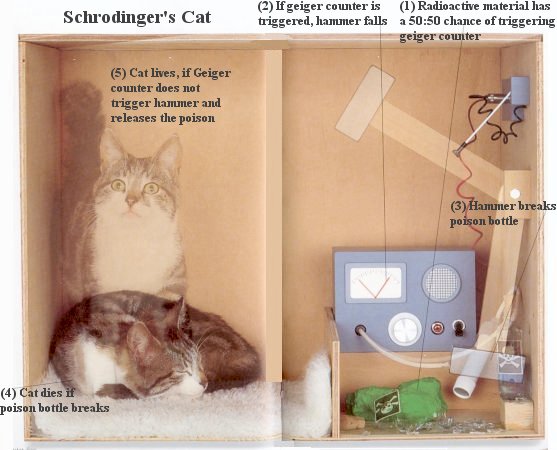
In this experiment, we take your pet cat and put it in a box with a bottle of cyanide. We rig it up so that a detector looks at an isolated electron and determines whether it is 'spin up' or 'spin down' (it can have either characteristic, seemingly at random). If it is 'spin up', then the bottle is opened and the cat gets it. Ten minutes later we open the box and see if the cat is alive or dead. The question is: what state is the cat in between the detector being activated and you opening the box. Nobody has actually done this experiment (to my knowledge) but it does show up a paradox that arises in certain interpretations.
#13398
Science and Research / Re: A Century of Quantum Atom
January 30, 2014, 11:58:22 AM
Niels Bohr with Albert Einstein at Paul Ehrenfest's home in Leiden (December 1925)
#13399
Science and Research / Re: A Century of Quantum Atom
January 30, 2014, 11:57:17 AM
Bohrâ€"Einstein debates
The Bohrâ€"Einstein debates were a series of public disputes about quantum mechanics between Albert Einstein and Niels Bohr, who were two of its founders. Their debates are remembered because of their importance to the philosophy of science. An account of the debates has been written by Bohr in an article titled "Discussions with Einstein on Epistemological Problems in Atomic Physics". Despite their differences of opinion regarding quantum mechanics, Bohr and Einstein had a mutual admiration that was to last the rest of their lives.
The Bohrâ€"Einstein debates were a series of public disputes about quantum mechanics between Albert Einstein and Niels Bohr, who were two of its founders. Their debates are remembered because of their importance to the philosophy of science. An account of the debates has been written by Bohr in an article titled "Discussions with Einstein on Epistemological Problems in Atomic Physics". Despite their differences of opinion regarding quantum mechanics, Bohr and Einstein had a mutual admiration that was to last the rest of their lives.
#13400
How To Tips / Re: How To Close A Bag Using Plastic Bottle
January 30, 2014, 11:53:38 AM
Magbantay lang sa ginuntingan kay medyo hait, labi na kon baga ang plastik. Nasamad ang akong tudlo sa una nakong paggamit og ingon ani. Pero OK kaayo ni.
P.S. Unya ang pinutlan nga bahin mahimong himoon nga tagayanan sa bahal...
P.S. Unya ang pinutlan nga bahin mahimong himoon nga tagayanan sa bahal...
Pages 1 2 3 4 5 6 7 8 9 10 11 12 13 14 15 16 17 18 19 20 21 22 23 24 25 26 27 28 29 30 31 32 33 34 35 36 37 38 39 40 41 42 43 44 45 46 47 48 49 50 51 52 53 54 55 56 57 58 59 60 61 62 63 64 65 66 67 68 69 70 71 72 73 74 75 76 77 78 79 80 81 82 83 84 85 86 87 88 89 90 91 92 93 94 95 96 97 98 99 100 101 102 103 104 105 106 107 108 109 110 111 112 113 114 115 116 117 118 119 120 121 122 123 124 125 126 127 128 129 130 131 132 133 134 135 136 137 138 139 140 141 142 143 144 145 146 147 148 149 150 151 152 153 154 155 156 157 158 159 160 161 162 163 164 165 166 167 168 169 170 171 172 173 174 175 176 177 178 179 180 181 182 183 184 185 186 187 188 189 190 191 192 193 194 195 196 197 198 199 200 201 202 203 204 205 206 207 208 209 210 211 212 213 214 215 216 217 218 219 220 221 222 223 224 225 226 227 228 229 230 231 232 233 234 235 236 237 238 239 240 241 242 243 244 245 246 247 248 249 250 251 252 253 254 255 256 257 258 259 260 261 262 263 264 265 266 267 268 269 270 271 272 273 274 275 276 277 278 279 280 281 282 283 284 285 286 287 288 289 290 291 292 293 294 295 296 297 298 299 300 301 302 303 304 305 306 307 308 309 310 311 312 313 314 315 316 317 318 319 320 321 322 323 324 325 326 327 328 329 330 331 332 333 334 335 336 337 338 339 340 341 342 343 344 345 346 347 348 349 350 351 352 353 354 355 356 357 358 359 360 361 362 363 364 365 366 367 368 369 370 371 372 373 374 375 376 377 378 379 380 381 382 383 384 385 386 387 388 389 390 391 392 393 394 395 396 397 398 399 400 401 402 403 404 405 406 407 408 409 410 411 412 413 414 415 416 417 418 419 420 421 422 423 424 425 426 427 428 429 430 431 432 433 434 435 436 437 438 439 440 441 442 443 444 445 446 447 448 449 450 451 452 453 454 455 456 457 458 459 460 461 462 463 464 465 466 467 468 469 470 471 472 473 474 475 476 477 478 479 480 481 482 483 484 485 486 487 488 489 490 491 492 493 494 495 496 497 498 499 500 501 502 503 504 505 506 507 508 509 510 511 512 513 514 515 516 517 518 519 520 521 522 523 524 525 526 527 528 529 530 531 532 533 534 535 536 537 538 539 540 541 542 543 544 545 546 547 548 549 550 551 552 553 554 555 556 557 558 559 560 561 562 563 564 565 566 567 568 569 570 571 572 573 574 575 576 577 578 579 580 581 582 583 584 585 586 587 588 589 590 591 592 593 594 595 596 597 598 599 600 601 602 603 604 605 606 607 608 609 610 611 612 613 614 615 616 617 618 619 620 621 622 623 624 625 626 627 628 629 630 631 632 633 634 635 636 637 638 639 640 641 642 643 644 645 646 647 648 649 650 651 652 653 654 655 656 657 658 659 660 661 662 663 664 665 666 667 668 669 670 671 672 673 674 675 676 677 678 679 680 681 682 683 684 685 686 687 688 689 690 691 692 693 694 695 696 697 698 699 700 701 702 703 704 705 706 707 708 709 710 711 712 713 714 715 716 717 718 719 720 721 722 723 724 725 726 727 728 729 730 731 732 733 734 735 736 737 738 739 740 741 742 743 744 745 746 747 748 749 750 751 752 753 754 755 756 757 758 759 760 761 762 763 764 765 766 767 768 769 770 771 772 773 774 775 776 777 778 779 780 781 782 783 784 785 786 787 788 789 790 791 792 793 794 795 796 797 798 799 800 801 802 803 804 805 806 807 808 809 810 811 812 813 814 815 816 817 818 819 820 821 822 823 824 825 826 827 828 829 830 831 832 833 834 835 836 837 838 839 840 841 842 843 844 845 846 847 848 849 850 851 852 853 854 855 856 857 858 859 860 861 862 863 864 865 866 867 868 869 870 871 872 873 874 875 876 877 878 879 880 881 882 883 884 885 886 887 888 889 890 891 892 893 894 895 896 897 898 899 900