Join MikeLigalig.com!

Why Just Read When You Can Join, Post, and Read!

Menu

Show posts

This section allows you to view all posts made by this member. Note that you can only see posts made in areas you currently have access to.

Show posts Menu

Messages - islander

#1301

Using the VISIR mid-infrared camera on the European Southern Observatory's Very Large Telescope, Pope, Callingham, and their colleagues measured the velocity of the dust within the spiral arms. At this end-stage of their brief life cycle (these systems only last a few hundred thousand years—a blink of the eye in cosmological terms), stars within Wolf-Rayet systems spin rapidly, producing stellar winds that move at horrendous speeds. These winds carry significant portions of stellar material into space, and they're responsible for forming the majestic plumes of dust particles. In the case of Apep, its spiral arms measure several light-years across.

By measuring the rotational speeds within this nebula, the researchers concluded that at least one of the three stars within the system is spinning fast enough such that it'll trigger a long-duration gamma-ray burst when it finally explodes as supernova (the exact timing is still impossible to predict). The speed of gas within the nebula was clocked at 12 million kilometers per hour, but the dust is moving at "just" 570 million kilometers per hour. The researchers say this discrepancy is indicative of a star approaching near-critical rotation.
#1302

Apep is one such gamma-ray progenitor system, featuring a massive triple star system at its core—a binary pair and a lone star—and vast spiral arms composed of gas and dust. The system is located around 8,000 light-years from Earth, which is uncomfortably close given its explosive potential.

"This was a very fun project to do in some ways, in the sense that Joe found this object and first showed it to me in 2012 when we were officemates as undergrads in Sydney—and it took us six years to gather all the data to reveal this surprising story," Benjamin Pope, a NASA Sagan fellow at New York University's Center for Cosmology and Particle Physics and a co-author of the new study, told Gizmodo. "Sometimes science is slow! But I remember when last year, the day before my PhD defense in Oxford, he was visiting and showed me the picture of the Apep spiral—I literally gasped, it was so shocking. There's really nothing quite like this."
#1303

Stunning Pinwheel Nebula Is a Cosmic Cataclysm in the Making

George Dvorsky


Apep, the first Wolf-Rayet star system to be discovered in the Milky Way.
Image: ESO/Callingham et al.


This image of a dusty, gas-rich nebula looks pretty, but appearances can be deceiving. Known as a Wolf-Rayet star system, it's poised to unleash a catastrophic gamma-ray burst when it finally goes supernova. What's remarkable about this particular Wolf-Rayet system, however, is that it's the first to be discovered in our own galaxy. Cue the ominous music...

This Wolf-Rayet star system is formally known as 2XMM J160050.7-514245, but to the researchers who recently investigated this enigmatic object, it's simply "Apep"—an exotic object named for the serpentine ancient Egyptian god of chaos. In a press release, Joseph Callingham, the lead author of the new study and an astronomer at the Netherlands Institute for Radio Astronomy (ASTRON), said "it's the first such system to be discovered in our own galaxy"—a system he never expected to find "in our own backyard." The details of this research were published today in Nature Astronomy.

Indeed, astronomers have observed Wolf-Rayet stars before, but only in other galaxies. These massive star systems are on the verge of entering into their death throes, at which time they'll generate a type of supernova that emits an extremely powerful and narrow jet of plasma—the dreaded gamma-ray burst.
#1305


Maya Lin


Jean-Michel Basquiat


Georgia O'Keeffe
#1306


Andy Warhol

Contemporary artist Ai Weiwei lives with more than 40 cats in his Beijing studio. Offering him daily solace, he often posts pictures of them on social media. In 2006, the artist revealed more about his connection with his furry companions in one of his blog posts: "The cats and dogs in my home enjoy high status; they seem more like the lords of the manor than I do," he writes. "The poses they strike in the courtyard often inspire more joy in me than the house itself. Their self-important positions seem to be saying, 'This is my territory,' and that makes me happy."

In fact, it was Nastasi's own love of cats that inspired her to curate the book. She reveals, "I dedicated Artists and Their Cats to my late cats who were wonderful pets. Several years ago, I was living and working in a massive artist loft in Philadelphia that was big enough to ride a bike around inside. They loved the space and always kept me company while I worked."


Ai Weiwei
#1307

Master of surrealism, Salvador Dali, graces the book's cover with his treasured, majestic Colombian ocelot Babou (Baby). The ocelot (Leopardus pardalis) is a species of wild cat found predominantly in South and Central America. It is similar in appearance to a domestic cat, though its fur resembles that of a leopard or jaguar. Never one to conform, Dalí acquired Babou in the 1960s, and for a time it was seen to accompany him on a leash with a stone studded collar almost everywhere he went.


Pablo Picasso
#1308


Herbert Tobias

Among many iconic artists, Pablo Picasso, Andy Warhol, and Frida Kahlo are all known to have had kitty accomplices. Having lived with many cats throughout his life, Picasso even portrayed them in his many of his paintings, including Woman with Cat (1900) and Chat et homard (Cat and Lobster, 1965). Warhol even published a book of cat drawings titled 25 Cats Name Sam and One Blue Pussy and Kahlo's Self-Portrait with Thorn Necklace (1940) features a black cat on her shoulder.
#1309

Believing that "behind many great artists is a great...cat," Nastasi writes in the book's introduction, "Many artists buck notions of a stereotypical temperament, but researchers have long speculated that creative individuals share common attributes—which mirror those of cats." Accompanied by a series of endearing photographs of both past and present artists and their cats, the book explores the roles felines play in their lives, and even how they affect their artistic practices. The portfolio of intimate photos capture the unique bonds between artist and feline, often showing the cats perched on laps, desks, and even atop heads.


Henri Matisse


John Cage
#1310
Tira-Pasagad | Saksak-Sinagol / Artists and their PETS
November 17, 2018, 03:42:25 PM

50 Intimate Portraits of Famous Artists and Their Pet Cats

By Emma Taggart
November 12, 2018


When considering the "artistic type," many could be described as non-conformist, impulsive, or even introverted. It's no surprise then that the typically aloof domestic cat makes the perfect pet for creative individuals. In fact, cats have inspired artists for centuries, serving as constant companions in artists' studios. New to the My Modern Met store, Alison Nastasi's book, Artists and Their Cats, features over 50 legendary creatives and the stories behind their feline friendships.
#1311

binuang. hinaot fake news ni. :(
#1312
Quote from: islander on November 13, 2018, 06:42:28 PM

Marcos was a model of the politician as thief.


:(:(:(
#1313

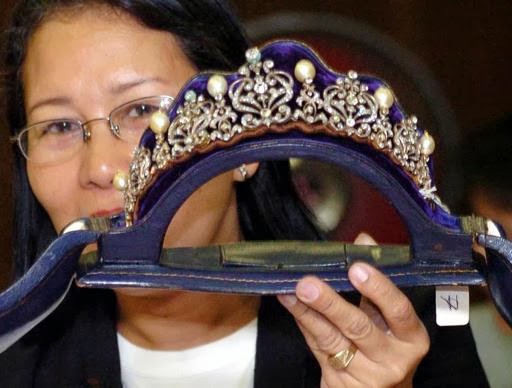
Deep in the vaults of the Central Bank, he says, there is a large collection of Imelda's jewellery, due to be auctioned next month. It includes most of what was seized 30 years ago by US customs, another stash found in the palace, and a third intercepted at Manila airport as a friend of Imelda's attempted to fly out of the country. Last year, Christie's valued the collection; they identified treasures that had previously been missed, including a tiara with 25 pearls in a diamond frame seized from the Russian tsar's family in the 1918 revolution. It is estimated to be worth more than $4m. Amurao's workers have invented their own word to describe anybody who is extravagantly greedy: "Imeldific".

What will happen if Bongbong Marcos is elected vice-president? Will he allow his mother access to the vaults to retrieve the jewellery she insists is hers? Will he kill the PCGG entirely? Bongbong, 58, started his political career before his family was exiled, becoming vice-governor of Ilocos Norte province in 1981, aged 23. Six years after exile, he returned to become a congressman. He recently denied any involvement in the legal moves that have blocked so much of the PCGG's work. In February, Amurao issued a tough response, saying his claim was "belied by court records which show his involvement". He listed cases in which Bongbong and his mother are still laying claim to what the PCGG says is ill-gotten wealth. Imelda is now 86, and actively campaigning for her son.

"The work is not finished," Amurao says. "There is no statute of limitation on seeking justice. But the passing of time makes it more and more difficult to find new leads. Time is an ally for those who want us to forget. And if Bongbong wins, we don't really see how we can do our work – not with the son of the former president only a heartbeat away from the presidency."

https://www.theguardian.com/
#1314


Imelda's diamond and pearl tiara. Photograph: Joel Nito/AFP/Getty Images

Even so, the PCGG has dragged some victories out of the swamp. In 2004, they finally retrieved the money from the five Swiss accounts. At an even slower pace, they seized the assets of half a dozen crony companies and recovered most of the coconut levy. They auctioned paintings, jewellery, silver and dozens of houses.

In total, the PCGG has succeeded in retrieving $3.7bn. That amounts to less than half the top estimate for what was taken by Marcos alone. In spite of their efforts, they have watched his associates retire to a life of self-indulgence with most of their fortunes intact. They have dozens of cases still bogged down in the courts, including 22 that started in 1987 or earlier.

The head of the PCGG, Richard Amurao, is a conspicuously decent lawyer, aged 41, who spent five years as a commissioner before becoming chairman last year. He points out how a single piece of Imelda's jewellery could have paid for 2,000 young Filipinos to go through college. He is not giving up, yet reflects that it has been exhausting, and hard to see how they can win. "It is like the traffic jams in Manila. You begin to accept that it just is this way."
#1315

Soon, the PCGG was running into more problems, as Marcos allies found their way back into power and argued that the failure to retrieve more stolen money proved the commission was pointless and should be closed. Worse, the PCGG was tainted by the corruption it was trying to expose. Some officials were caught exploiting empty Marcos properties and pocketing "excessive" expenses. Twice the weakened PCGG made compromise agreements with the Marcos family that were so generous, the Philippine courts blocked them.

By the late 1990s, Imelda had been elected to the Philippine House of Representatives and was emboldened to give provocative interviews in which she declared "there is more money the government is not yet aware of" and "we own practically everything in the Philippines". Increasingly secure, her confidence got the better of her. In 2007, she gave more interviews and posed for photographs that clearly showed eight of the missing paintings gleaming on her walls, including Goya's portrait. Another old master hung on the wall of her office in the House of Representatives.

The PCGG went to court for an order to recover them. But with the Marcoses opposing every move, the case took six years. When they finally raided Imelda's office and four of her homes in October 2014, they again found only pale patches on the walls where the eight paintings had once hung and "Imelda crying into her handkerchief".
#1316

By the autumn of 1991, Imelda Marcos was feeling sufficiently safe to go back to the Philippines with her three adult children. In New York, the PCGG picked up rumours that some of the paintings were still there and being sold by a professional dealer. They hired a firm of private investigators, IGI, to watch the dealer, and established that he had some of the Marcos collection, including Goya's portrait of the Marquesa de Santa Cruz.

Early in June 1992, the investigators discovered the dealer had been warned that they were on to him. The next morning, they watched as five men and women "of Filipino appearance" turned up outside the dealer's apartment in two vans, loaded up boxes and large blue suitcases, and drove out to JFK airport, where all five checked in as first-class passengers along with their unusual cargo. With no legal power to intervene, the investigators could only watch as they flew off to Manila.
                                                                                                                                       
"Bongbong is still laying claim to stolen wealth: 'If he wins, we don't see how we can do our work.'"

The pattern of impunity was set. In Seattle in December 1989, a jury found that the Marcoses were implicated in a plot to murder two Filipino union activists who had been shot there in 1981. The jury ordered them to pay $15.1m compensation to the victims' families. The money has not been paid. In Hawaii in 1995, a court found the regime had abused the human rights of thousands who'd been tortured and killed, and ordered that Ferdinand's estate pay nearly $2bn compensation. Less than 1% of that has been paid. Having returned to Manila, in September 1993 Imelda was convicted of personally defrauding the state in a land deal while Marcos was still in power. She was sentenced to 18 years in prison but bailed while she lodged an appeal. Five years later the supreme court threw out her conviction on technical grounds.
#1317


Ronald Reagan dances with Imelda Marcos, while President Marcos dances with Nancy, during a state visit to Manila in 1969. Photograph: Getty Images

The problem for these governments was that they had turned a blind eye while their companies had waded into the muck alongside Marcos – taking his money without asking where it came from. In some cases, Marcos, in turn, had paid bribes to senior politicians and made illegal contributions to election campaigns, including those of US presidents Jimmy Carter and Ronald Reagan. (When this surfaced in 1986, they said they had not known where the money came from.)

A PCGG veteran of nearly 30 years has a special frustration with the US. He says they have never handed over all the paperwork seized from Marcos when he arrived in Hawaii, and he flicks through the copies he has: "See? Some pages which are blank, some inventory pages which are blank. We think they have redacted transactions involving US organisations. They were partners in theft." And he pauses to consider how the US would react if some other nation seized evidence of their most prolific criminal and handed it over in redacted form.

***
#1318

The US authorities agreed to take no further legal action if Khashoggi surrendered the paintings and the skyscrapers. But when the skyscrapers were finally sold, it turned out they had been mortgaged to the hilt by the Marcoses. The city demanded unpaid property taxes. Though the buildings' total sale price was $50m, the Philippine people received only $5.7m. Most of the dozens of paintings Khashoggi is believed to have handled were no longer in his possession. The PCGG retrieved just 26.

For the investigators, this was a frustrating journey. Aquino's government, which had launched the commission in the heat of revolution, rapidly stepped on the brake. Her supporters say there was no option: Marcos and his cronies owned so much of the economy that to seize their assets would crash the banks. Her critics, meanwhile, argue that her government was always compromised: the Aquinos were one of the wealthiest families in the country; the old oligarchy was back in power. Whatever the motive, the PCGG was ordered to seize nothing, but instead to work through the courts. Over the following few years, it became clear that this had handed the initiative to the Marcoses, who had the money to hire the very best lawyers. Soon, dozens of cases were sidetracked by endless technical argument.

Just as Marcos's wealth was too great to seize, so his political influence was too big to beat. Two weeks after the revolution, a source in New York had shown the PCGG a report revealing that, even before he was deposed, his allies in US intelligence were aware that he had stolen up to $10bn. But the CIA refused to disclose what they knew. The Japanese government made it clear to Aquino that they were not going to hand over information, and aid packages could be in jeopardy if the PCGG pushed too hard. In the UK, Margaret Thatcher's government said it was "not our business".
#1319

One of those who came forward was Oscar Cariño, former manager of the New York branch of the Philippine National Bank. In a sworn statement, he claimed he had created accounts for two fictitious companies to conceal the Marcos millions. It emerged that the paintings had changed hands with the help of some powerful connections. The court heard that some part had been played by Adnan Khashoggi, the notorious Saudi arms dealer. An Australian TV programme claimed that dozens of Marcos paintings had been flown out of the US on a private plane; 38 others had been shipped from Hawaii. Acting on a request from the PCGG, French police raided two of Khashoggi's apartments and found paperwork confirming that many of the masterpieces were now in his hands.

"Reports said the White House was leaning on the prosecutors to go soft to avoid embarrassment for five US presidents."

Khashoggi argued that he had made bona fide purchases from the couple, of the paintings and of four Manhattan skyscrapers. But the US authorities claimed that the documents he produced to support this had been backdated, and formally accused him of obstructing the course of justice.

Khashoggi was arrested in Switzerland and extradited to New York, where he joined Marcos, Imelda and a network of others indicted under anti-racketeering law. But Ferdinand Marcos died in September 1989, before the case came to trial; he was 72 and had been in a hospital in Honolulu for months. Without Marcos, some evidence became inadmissible. There were reports that the White House was leaning on the prosecutors to go soft, that there was too much potential embarrassment for the last five US presidents. Imelda told the court she was "a poor widow who knew nothing about her husband's activities". Khashoggi protested his innocence and was acquitted of any offence. The transcript of the trial runs to thousands of pages. It ended in July 1990, with all the defendants declared not guilty on all counts.
#1320

Consider the saga of the missing paintings. When the PCGG searched the president's palace after he fled, they found that the walls of the ballroom displayed 23 pale patches where once there had been masterpieces. The Marcoses had a town house on East 66th Street in New York, where Imelda held many parties. Neighbours told investigators that they had seen two 18-wheel trailers pull up a few days after the couple went into exile: they had been loaded up with antiques and paintings, and driven away. By the time the house was searched a few weeks later, there were only brass plaques boasting of treasures that had once occupied its walls: the Madonna And Child by Michelangelo, the Marquesa de Santa Cruz by Goya, a couple of Monets, two Braques, a Pissarro, a Manet.


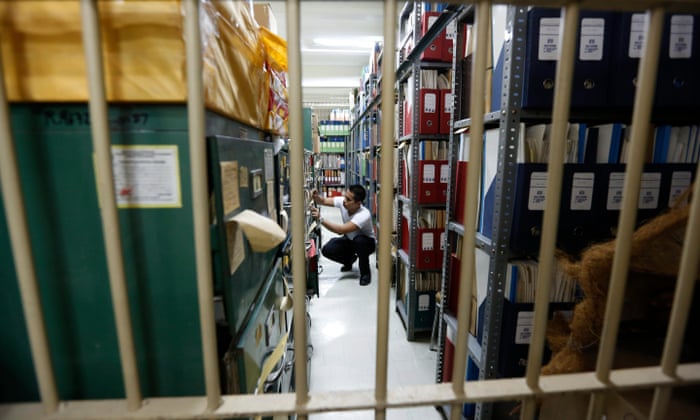
The vast PCGG archive of documents in Manila. Photograph: Rolex Dela Pena/EPA/Corbis

Paperwork retrieved from their various homes revealed that the Marcoses had bought at least 304 valuable paintings. Almost all were now missing. The Philippine investigators were left with a few dozen inferior works abandoned in some of the Philippine homes, and one Henri Fantin-Latour found wrapped in a blanket under a maid's bed in one of their New York apartments, apparently an attempt to thieve from the thief. They got a judge to order galleries and auction houses not to sell anything that might have come from the Marcoses. There was not much else they could do.

During their first year, the PCGG received a little help from several former Marcos staff and allies. A financial aide, Rolando Gapud, gave them details of five Swiss bank accounts. By Marcos standards, they did not contain very much (only $356m) and the banks refused to hand it over. All the PCGG could do was persuade a Swiss court to freeze the accounts. Gapud and others began to disclose the scale of Marcos's ownership of the Philippine economy. In Manila, the government set up an "anti-graft" court; by the end of 1986, the PCGG was opening cases against Marcos and his network.
#1321

Above all, the banks acted like a network of dykes receiving his ocean of income. Bank staff would make regular – sometimes weekly – trips to the palace, to pick up cheques and bundles of cash, which were then deposited in dozens of accounts. The millions were then channelled into Marcos's expanding reservoir of offshore accounts (he had 69 in Switzerland alone). Then all he and Imelda had to do was turn on the taps anywhere in the world and cash would come pouring out; cash that had been washed clean of its connection to crime.

For all its craziness, the gorging on consumer goods that followed now seems a natural progression. There were multiple houses for the extended family, a $5.5m yacht, private planes, helicopters and dozens of Mercedes-Benzes. When their youngest daughter was married in June 1983, they built a new runway and hotel, renovated a 200-year-old church, demolished nearby houses and rebuilt them in traditional style, imported carriages from Austria and horses from Morocco.

The men and women who work at the PCGG are driven by an anger. Each day they discover more detail of this crime, while its victims sleep on the pavements and in the slums around them. They are well aware of what the money could do for the impoverished people of the Philippines: if Marcos stole $10bn, this would have paid for the entire government budget for his last year in power three times over. And so they want not only to retrieve the stolen money, but to restore it. It is not easy. The Marcoses, with their money and their connections, have always been in the lead.

***
#1322

Crucially, he saw his crime through a lawyer's eyes. Of course people would observe that the Marcoses were suddenly very wealthy – they could live with that. What mattered was to ensure that there was no evidence. Repeatedly, he set up his companies so that outwardly they belonged to other people. Marcos deployed dozens of cronies: relatives, golf partners, political allies, anybody who shared his greed. The crony would sign a deed transferring ownership of most of the business – usually 60% – but would leave a blank space for the name. Marcos would hold the deed and leave the space blank. There was no "evidence" that he owned the 60%.

Marcos stole, then stole more. The Japanese paid reparations for the second world war; he skimmed it and put the profit into his Swiss accounts. He stole international aid money, gold from the Central Bank, loans from international banks and military aid from the US. He decreed that more than a million impoverished coconut farmers must pay a levy, supposedly to improve the industry, amounting to $216m. He had already issued decrees to gift most of the coconut trade to one of his own companies; now he stole great chunks of the levy fund, all the while taking kickbacks on government contracts.

"All the Marcoses had to do was turn on the taps anywhere in the world and cash would come pouring out."

All this theft created a logistical problem: how to handle the tidal flow of money. The PCGG archive shows how Marcos set up his own banking system, using cronies to buy private banks and others to control the state banks. These were useful for stealing more money, in loans that would never be repaid, and for accessing foreign currency – although eventually he set up his own specialist bank to trade currency on the black market.
#1323

This was no longer just about kickbacks. Marcos started to steal whole companies, using the crude tactics of a gangster. He wanted the nation's electricity company, Meralco, owned by Eugenio Lopez, patriarch of one of the families who had run the country for centuries. He had Lopez's son charged with plotting to assassinate him, which carried the death penalty. The old oligarch handed over his company for $220 (it was worth $400m). To have gunmen is a gangster's requirement; to have gunmen in uniforms, with all the power of the state behind them, is a gangster's dream.

Yet most of Marcos's takeovers involved no violence. Martial law allowed him, literally, to write his own law: his decrees passed straight on to the statute book. When he wanted to take over the sugar industry, he set up companies and then issued decrees that allowed them to dominate the planting, milling and international marketing of Philippine sugar, which accounted for 27% of export earnings. He then created a Philippine Exchange Company, decreed it should handle all foreign sugar sales and used its monopoly position to buy from farmers at rock-bottom prices and sell at vast profit. This allowed him to buy Northern Lines, which had the contract to ship the sugar overseas. Finally, he decreed that the sugar industry be exempt from minimum-wage law, with the result that 500,000 labourers saw their income fall to less than $1 a day, making even more profit.


Marcos's scribbled sums counting his stolen millions. Photograph: Nick Davies

The PCGG archive shows how, in the same way, Marcos used his own companies to take over the three other key areas of agriculture: coconuts, tobacco and bananas. Granting himself government contracts, monopoly deals and tax exemptions, he levered his way into dominating industries across the whole economy – logging and paper, meat, oil, insurance, shipping and airlines, beer and cigarettes, textiles, hotels and casinos, newspapers, radio and TV. His was an early and particularly rapacious version of privatisation.
#1324


Ferdinand Marcos with Richard Nixon after a meeting at the White House in 1969. Photograph: Getty Images

In the early years, the PCGG documents suggest, Marcos was naive in his crime. With sacks of cash from rich backers and help from the CIA, the bright young lawyer won elections to congress, then the senate, but he was nothing special, just another "Mr Ten Per Cent" selling his political influence. After he became President Ten Per Cent in 1965, his income from kickbacks for government contracts increased, but his guile went no further than stashing $215,000 in a New York bank in his own name. As far as the records show, he and Imelda took their first steps to real secrecy on 20 March 1968, when they used false names to deposit $950,000 in four accounts with Credit Suisse, he as William Saunders (he practised his new signature on the headed paper), she as Jane Ryan. By February 1970, the Swiss accounts were so loaded, the couple added an extra layer of concealment, transferring their ownership to foundations registered in Liechtenstein. Then Marcos started to get really clever.

On 21 September 1972, he declared martial law. As his diary records, the Nixon administration consented as he shut down congress, arrested his political opponents, took control of the media and courts, and suspended all civil rights. On the same day – as a PCGG worker pointed out to me with some passion – he took time off to open another Swiss bank account. In his diary a week later, reflecting on his "reforms", Marcos wrote: "The legitimate use of force on chosen targets is the incontestable secret of the reform movement."

Over the following nine years, an estimated 34,000 trade unionists, student leaders, writers and politicians were tortured with electric shocks, heated irons and rape; 3,240 men and women were dumped dead in public places; 398 others simply disappeared. With total power over politics, the president closed in on the country's wealth.
#1325

A single document in the Manila archive marks the start of the detective story. In a sworn deposition, a young civil servant named Chito Roque describes how, on the night the Marcoses flew into exile, he worked his way through the crowds outside the presidential palace to the gates where anxious soldiers were posted. He was with his boss, a senior official in the new government, and they eventually found their way into the inner sanctum, the Marcoses' private living quarters. There, they could see the signs of hasty flight: food still warm on the dining table, empty boxes, papers scattered on the floor, shredding machines stuffed with more paper.

His boss went home, but Chito wandered into the bedroom of the deposed president, where "I saw a filing cabinet and I opened the first drawer and I saw a safe inside and there were numbers, a combination that was pasted on the door, so I followed the combination and opened the safe." Inside, he found records of bank accounts in Switzerland and Canada, share certificates and several letters signed by Marcos.

Those documents now sit in the offices of the PCGG, along with thousands more retrieved from the palace and the 50 or so other properties the Marcoses and their allies owned in the Philippines, and from homes and offices in the US. As the years have gone by, hundreds of thousands of pages have been added from other sources, all now sitting, neatly ordered, in a white, two-storey building near the centre of Manila. Outside, a six-lane highway is jammed with traffic, bellowing and belching fumes. Inside, all is calm and cool. A notice asks visitors kindly to leave their firearms at reception.
#1326

It needs to be said that this is not about Imelda Marcos and her infamous collection of shoes, although her shopping habit is real. She bought perfume not by the ounce but by the gallon. She hoarded old masters; at one point, she tried to buy Tiffany & Co. But in this particular circus she was only a clown, her crazy consumption deflecting attention from the big beast that was out of its cage.

"Other autocrats were stealing from their people – in Haiti, Nicaragua, Iran – but Marcos stole more and he stole better."

The PCGG archive tells the inside story of the biggest theft in history, and of the master criminal who organised it: skilful, arrogant, cruel. It also opens a door into the offshore world revealed by the Panama Papers. Marcos was one of the first to exploit the rats' nest of secret jurisdictions and hidden ownership then in the early stages of being built beneath the floorboards of public life.

But what is most important about Marcos is that he committed his crimes as a politician. His career starts with a cynicism that now seems familiar – manipulating electorates, using money to buy power and power to make money. But he went one big step further in merging politics and finance, converting the instruments of government into one vast cash machine. A handful of other autocrats were also busy stealing from their people in that era – in Haiti, Nicaragua, Iran – but Marcos stole more and he stole better. Ultimately, he emerges as a laboratory specimen from the early stages of a contemporary epidemic: the global contagion of corruption that has since spread through Africa and South America, the Middle East and parts of Asia. Marcos was a model of the politician as thief.
#1327

Thirty years later, the PCGG is still working, its 94 lawyers, researchers and administrators housed proudly in a building recovered from the Marcos family. The government gives it an annual budget of $2.2m. Its staff have traced money through jurisdictions all over the world and fought their way through hundreds of court cases. And yet something has gone terribly wrong: to date, the PCGG has recovered only a fraction of what was stolen by the Marcos network; no one has served a prison sentence for their part in the crime.


Bongbong Marcos campaigns for the vice-presidency. Photograph: Erik de Castro

Now, with its task still far from complete, its survival is threatened by a political development that would never have been anticipated by the crowds who swelled the streets in triumph as Marcos fled. The former president's son, Ferdinand Marcos Jr, generally known as "Bongbong", is a frontrunner to become vice-president in the national elections on 9 May. If he wins, he would have the power to shut down the PCGG, as political allies of his family have tried to do in the past. The world's biggest thief will have won.

Last month I was given unrestricted access to the enormous archive the PCGG has assembled in its years of global detective work: the president's handwritten diary, frequently puffed with self-regard; the notepaper headed "From the office of the president", with scribbled sums endlessly totting up his cash; minutes of company meetings with his comments scrawled in the margins; contracts; "side agreements"; records of multiple bank accounts; hundreds of share certificates; private investigators' reports; and tens of thousands of pages of court judgments.
#1328

This was a fortune by any standards, easily enough to see the couple through the rest of their lives. Yet the new government of the Philippines knew this was only a very small part of the Marcoses' wealth. The reality, they discovered, was that Ferdinand Marcos had amassed a fortune up to 650 times greater. According to a subsequent estimate by the Philippine supreme court, he had accumulated up to $10bn while in office.

Since his official salary had never risen above $13,500 a year, it was blazingly clear this was stolen wealth on the most spectacular scale. Some of his closest allies also stole billions. As their victim was a nation in which 40% of the people survive on less than $2 a day, the Republic of the Philippines decided urgently to try to retrieve its money.

Even amid the chaos of the revolution, the very first executive order issued by the new president, Cory Aquino, established the Presidential Commission on Good Government, the PCGG. It was to recover "all ill-gotten wealth accumulated by former president Ferdinand Marcos, his immediate family, relatives, subordinates and close associates" and given the power to sequester any assets believed to be the proceeds of crime.
#1329

The $10bn question: what happened to the Marcos millions?

In the 21 years Ferdinand Marcos ran the Philippines, billions went missing. As his son stands for vice-president, will the stolen fortune ever be recovered?

by Nick Davies
Sat 7 May 2016 08.00 BST
Last modified on Thu 4 Oct 2018


Imelda Marcos in her Manila apartment in 2007; the paintings disappeared before a raid in 2014. Photograph: Romeo Gacad/AFP/Getty Images

IN THE EARLY HOURS OF A FEBRUARY MORNING IN 1986, Ferdinand and Imelda Marcos flew into exile. After 21 years as president of the Philippines, Marcos had rigged one too many elections. The army had turned against him, and the people had come out on to the streets in their thousands. The Marcoses had seen the crisis coming and been able to prepare their escape, so when they landed that morning at the Hickham USAF base in Hawaii, they brought plenty of possessions with them.

The official US customs record runs to 23 pages. In the two C-141 transport planes that carried them, they had packed: 23 wooden crates; 12 suitcases and bags, and various boxes, whose contents included enough clothes to fill 67 racks; 413 pieces of jewellery, including 70 pairs of jewel-studded cufflinks; an ivory statue of the infant Jesus with a silver mantle and a diamond necklace; 24 gold bricks, inscribed "To my husband on our 24th anniversary"; and more than 27m Philippine pesos in freshly-printed notes. The total value was $15m.
#1330
Quote from: MIKELIGALIG.com on November 08, 2018, 07:29:12 PM

29. Question everything except your own intuition.


YES!
#1331

To survive, the newspaper (like such related forms as the book) must turn to its advantage what are considered to be its limitations: slowness, limited space and circulation (as against the boundless Web), selectivity and, yes, bias. That it is slow, compared to the new media, means that it can offer more in terms of reflexivity and depth (we have put such a premium on speed, we need to relearn the virtues of slowing things down). That it is limited and selective means that it can be more discriminate in choosing and organizing what it considers significant for the specific audience or "public" that it has chosen to address. That it is biased means, assuming that it is self-aware, that it is honest about the position from which it speaks. Bias is not a problem; it is a problem only when it is ill-informed, disguised as "objective," imposed on others as "the Truth," and serves purposes that are socially irresponsible and inimical.

Though print journalism must be grounded in "facts," it should not be just about the facts. As the author Alain de Botton writes: "The problem with facts is that there is nowadays no shortage of sound examples. The issue is not that we need more of them but that we don't know what to do with the ones we have."

There are facts however that we still lack, and we need a reliable source for them. (How well, for instance, has Philippine journalism gone beyond the "he-said/she-said" kind of journalism in the coverage of the corruption charges against Vice President Jejomar Binay, to inform us about what the true facts are?) In a world inundated with gossip, innuendo, useless facts, unbridled opinions and political lies, surely there is a place for good journalism still.

Slowness, selectivity, bias: these are values that journalism must consciously and critically cultivate.

https://www.cebujournalism.org/

24 September 2015
#1332

Redefining roles

This does not mean that we should not continue to put more effort into promoting good journalism, working toward accurate, factual and balanced reporting, sound editorial judgment, trained media practitioners (versed in social knowledge and not just the technical matters that are the focus of mass media education) and ethical professionalism.

But looking beyond, particularly in the context of a technologically driven, burgeoning world of media, journalism can begin to renew itself by acknowledging the built-in limitations and bias in its form and practice. It has, to begin with, abandon or avoid simplistic or inflated claims of "objectivity" and "independence," or of "reporting all the news all the time."

The phenomenal advance of electronic and digital media is not only a threat to the survival of print journalism; it presents an opportunity for redefining the place and role of print journalism. (While newspapers have turned to the Net as a platform for widening their reach, it does not seem to me that this shift has radically changed its orientation and content.)

The time will come (some say it is already here) when the printed newspaper will no longer be the preferred purveyor of news, information and opinion since the new media technologies will be, for this purpose, faster, cheaper, more convenient and user friendly, and will offer abundantly more. That the newspaper is the source of news, information and opinion will no longer be enough to justify its existence. What will justify its existence is that it presents all these in a form more compact, better-organized, more discriminating, intelligent and credible.
#1333

Bias resides in routinized conceptions of what is "newsworthy" (crime, scandals, the doings of the powerful and popular). The German cultural critic Hans Magnus Enzensberger rightly calls media the "consciousness industry," since what newspapers, television, radio and others, create or shape is our consciousness of the society we inhabit. When newspapers select or privilege certain topics over others, what consciousness of the world (and blindnesses) do they create?

Less recognized is the bias in favor of "events." Journalism is extremely weak in covering or explaining matters of social "process" and "structure." Newspapers find "events" congenial because they are current, dramatic and easily communicable, while changes in the structure are long-term and less apparent.

The bias for events is such that those who want to get into the news stage "events." A good example was the event staged by Serging Osmeña in 1953. Anxious about his prospects for reelection as governor, having lost political ground due to controversies surrounding his tenure, he announced on radio that he was thinking of retiring from politics because of the sacrifices it has entailed (including, he said, "the heartbreaking pain of loneliness for the affection of my wife and children of whose company I have been deprived"). He then left Cebu for Manila, fueling speculation about his plans. When he returned a few days after, a crowd met him at the airport and brought him to a huge rally at Fuente Osmeña where the crowd and a battery of speakers "pleaded" that Serging continue as governor. Faced with such "public clamor," Serging declared—against the call of "paternal feelings and obligations ever haunting me day and night... and the sad voices of my lonely children ever beseeching me to be at their side always"—that he will not abandon the Cebuanos but continue to serve them as governor.


POST-WAR NEWSPAPERS. The Daily News (March 24, 1953 issue) and The Republic Daily (May 9, 1952 issue) showed their political color.

It was an event made for the press, and Serging was not the first or the last politician to exploit the "soap opera" values of Philippine politics. (A more recent though less grandiose example took place in 1992-95 when Gov. Vicente de la Serna publicly announced that he was retiring from politics and would not seek reelection, and then changed his mind as the election approached when his office was "besieged" by supporters pleading with him to run.) Media is a sucker for such events because they have dramatic value and they fill up newspaper space. The problem is that the press often gives manufactured events the weight and space of real events, reporting them at face value instead of focusing on the "back story."

The bias for events, for what happens on the surface instead of in the structure, can create ephemeral excitement, and yet in the end also the weariness that comes from the sense that while "many things are happening," news is essentially repetitive and nothing much has really changed. Thus, many remark that they have stopped reading the news because "it's all the same story." As one cynic puts it, "There is no news, only olds."
#1334

Professionalization

Since then advances have been made in the professionalization of journalism. If we compare today's journalism with that of the prewar period, several shifts can be noted. Today's media organizations are more formal and autonomous enterprises; the technology has vastly improved; media workers are better trained in the craft; content is more diverse and inclusive; clearer demarcations divide news and editorial matter; and there is greater concern for issues of ethics and objectivity.

This is not to say that journalism has been freed of political interference or the pressures of the "market" (indexed by readership numbers and advertising revenues), whose influence is often more decisive than that of the amorphous body called the "public."

But what is more basic is the bias that is built into the form and practice of journalism itself. Take the newspaper as a specific case. The newspaper (and media in general) is necessarily manipulated (in the literal sense of being "handled"). It is not unmediated: what is published is selected, written, edited and laid out in very structured space where precedence, length and visibility distinguish between the "more" and "less" significant. To say, therefore, that the newspaper mirrors society by "simply reporting the news" is either simplifying or dissembling.

Bias is built into the routinized practices of news gathering, as in the reliance on established "beats" and the "usual sources" (and the press release, though less so as in the past). The Indian journalist and Ramon Magsaysay Awardee Palagummi Sainath, for instance, laments that India's major newspapers have several reporters assigned to the "business beat" (in practice, corporate business) but not a single reporter is assigned to cover agriculture or the rural areas. This led him to caustically remark that, by and large, media is mere "stenography," the transcript of the doings and opinions of big business and the governing elite. (This is, of course, a product of the character of newspapers as distinctly urban, male and middle class in orientation, by virtue of their location, readership, advertising base and personnel.)
#1335

Those that aspired to be mainstream newspapers tried to balance commercial and political interests by projecting themselves as the mouthpiece of the "public interest." But such were the pressures of partisanship that their bias was evident. Bag-ong Kusog built up the image of its owner-publisher, Vicente Rama. Rama himself (in the manner of Vicente Sotto, who wrote short stories that projected himself as a hero) would, in the middle of a fierce congressional fight between him and Maximino Noel, write and publish in Bag-ong Kusog (22 July 1927), under the pen name Datu Dakula, a thinly disguised story, "Si Amar ug si Leon," in which Rama (Amar) is the virtuous hero and Noel (Leon) the despicable villain.

Political partisanships would continue in the postwar period, as shown for instance in the war between the Cuencos' The Republic Daily (first established as The Republic in 1947) and its bitter rival in the 1950s, Sergio (Serging) Osmeña Jr.'s The Daily News (1951-60). Each would manipulate coverage for political advantage: putting out "documented exposes," employing columnists as attack dogs, publishing forecasts to create a bandwagon effect, splicing photographs to show "massive" crowds at their candidate's rallies, and freely using political humor to ridicule opponents. Reporting an accident involving a bus of the Cuenco-owned Bisaya Land Transportation Company, The Daily News reported the accident in an item with the head "Tree Hits Bisaya Bus," to twit the Cuencos for their penchant (so Osmenistas say) for avoiding responsibility by blaming somebody else.

Politics in Cebu was so polarized that even an attempt by two non-Cebuanos (Angel C. Anden and Alfredo S. Cruz) to publish a non-partisan newspaper, Pioneer Press, did not survive. After reporting on poll violence in 1949, the paper's editorial office was visited by heavily armed men and the paper's editors had to flee to Manila.

(On the subject of media fabrications, I have a personal anecdote to narrate. As a college student, I moved around with literary-types, one of them already a practicing, street-wise journalist who suggested we put out a magazine to cash in on the election season by selling advertising space and stories. The cover (photograph and story) was sold to a congressman who was running for reelection, articles were written and materials readied for the press, but for logistical and other reasons it looked like the magazine would not be able to come out before election day. To salvage the magazine, it was decided that the cover article be turned into a post-mortem piece on why the congressman lost in the elections (since it looked certain that he was going to lose). And so I found myself tasked to write, even before the polls had actually taken place, the cover article about why the congressman lost. The magazine came out after the elections but I do not now recall—and perhaps did not know even then—how my journalist friend got out of the fix (dealing with a congressman who had paid for an article about his defeat), or how much was paid. Mostly, we were in it for the fun and adventure. Such were the rough-and-tumble days of journalism.)
#1336

Partisan passions

Cebuano journalism flourished in the 20th century. Since the century began with the US occupation, partisan passions were high and these passions played out in the press, as shown in the suppression of the first Cebuano-owned newspapers, the volatile nationalist Vicente Sotto's La Justicia (1899) and El Nacional (1899). But opposition to US rule would quickly give way to a spirit of accommodation, as exemplified by Sergio Osmeña's El Nuevo Dia (1900-03).

Other kinds of media partisanship would emerge. Catholic anxieties over rising secularism, the Aglipayan breakaway and the entry of Protestantism instigated the appearance of the pro-Catholic newspaper Ang Camatuoran (1902-11), published by Imprenta del Seminario de San Carlos upon the instance of prelate (later bishop) Juan Gorordo and the Vincentian Pedro Julia. More important, the advent of electoral politics and the fierce competition for local leadership would fuel the proliferation of newspapers.

It is remarkable that all the major newspapers of the prewar period were either owned by or allied to politicians. The Sotto brothers, Vicente and Filemon, singly owned El Pueblo (1900), Ang Suga (1901-12), Ang Kaluwasan (1902-10), and La Revolucion (1910-41). The Cuencos (Mariano Albao Cuenco, a failed candidate for governor, and his sons Mariano Jesus and Jose Maria Cuenco) owned El Precursor (1907-41) and El Boletin Catolico (1915-30). Vicente Rama owned La Nueva Fuerza/Bag-ong Kusog (1915-40), while Paulino Gullas published The Freeman (1919+).


HERO AND VILLAIN. On July 22, 1927, Bag-ong Kusog owner-publisher Vicente Rama wrote and published the thinly disguised story "Si Amar ug si Leon" under a pen name portraying Rama (Amar) as the hero and his congressional rival Maximino Noel (Leon) as the villain.

There were many newspapers that presented themselves as party organs, like the Nacionalistas' El Nacionalista, published intermittently between 1909 and 1921, and Partido Democrata's El Democrata, between 1919 and 1927. But these were mostly election-season publications and the good thing that can be said about them is that they openly identified their bias.
#1337

First newspaper

In Cebu, the first local newspaper did not appear until the last decade of the Spanish period. This was El Boletin de Cebu (1886-98), founded and edited by the Spaniard Eduardo Jimenez y Frades, whose father, a printing press owner in Manila, published, together with his son Diego, El Porvenir Filipino (1865-76), an important Manila periodical. Diego subsequently relocated to Iloilo where he founded El Porvenir de Visayas in 1885. Diego's brother Eduardo moved to Cebu and started El Boletin de Cebu. Eduardo, however, died a year after and control of the paper passed to Spaniard and Cebu resident Alfredo Velasco.

Boletin de Cebu was born at a time when journalism (typically combined with printing and publishing) had emerged as both profession and enterprise. However, journalism at the time was dominated by Spaniards (both Iberian and Philippineborn) since they usually had the resources and connections, and the sense of entitlement to speak for and about the country. While many were motivated by a genuine zeal for modern reforms, it was a zeal dedicated to the glory of the Empire and the maintenance of the colony.

This was the case of Boletin de Cebu, published by Spaniards in the Spanish language, devoted (as the Spanish historian Wenceslao Retana wrote) to "matters that affect the prosperity of Spanish colonization" in Cebu. This outlook can be seen in the person of its publisher-editor, Alfredo Velasco. The son of a colonial official, Velasco was a fairly prosperous merchant and one-time presiding officer of the Cebu City council (ayuntamiento). A conservative and earnest Royalist, his pet advocacies were civic celebrations exalting Spanish rule and economic measures and physical improvements that would show that Cebu was a prospering and proper "Spanish city."

As the only newspaper in Cebu, Boletin is priceless as historical record but its pro-Spanish bias is clear. When the anti-Spanish revolution broke out in the environs of Manila in August 1896, Boletin's reports condemned the insurrection as the "criminal" activities of "ingrates and malcontents," an "act of parricide" against Mother Spain. (In the journalism of the time, little distinction was made between news and editorial.) Boletin proudly reported that in Cebu, "loyal capital of the Visayas," there was "an outcry of general protest, of unanimous indignation" among the "peaceful and honorable residents in whose hearts live the love for Mother Spain."

That, in reality, things were not too cozy in the "loyal capital," as Boletin depicted, is shown in the fact that the revolution would erupt in Cebu less than two years later.
#1338
Philippine Archive / Bias and the future of journalism
November 08, 2018, 03:12:55 AM

Bias and the future of journalism

Cebu Journalism & Journalists
September 24, 2015 9:57 pm
17 Min Read

By Dr. Resil B. Mojares

bias1 - Start new topic
POLITICAL BENT. In the 1900s, all the major newspapers of the prewar period were either owned by or allied to politicians.

Bias—a term that is not necessarily pejorative—has always characterized media from the beginning.

From the introduction of the printing press in 1593 and the appearance of the country's first newspaper (Del Superior Gobierno) in 1811, until the mid-19th century, the printing press was a virtual state and church monopoly. The press was the voice of the ruling authorities; it was essential in the functioning of state and church, from disseminating information on civil and ecclesiastical decrees, programs and activities, and commercial information (shipping schedules, market prices) vital to the functioning of the economy, to propagating the knowledge and values useful to the formation of good colonial subjects and Catholics.

It was not until the mid-19th century that the press began to be privatized and secularized as persons and groups outside church and government came to own and operate print shops and publish materials out of them. While the state exercised licensing and censorship powers, this time marked the appearance of socalled "independent" and "commercial" newspapers.

The mid-19th century also saw the birth of a "public," since the idea of a "public" presupposes the claim to a source of authority ("the People") apart from church and state, and puts the premium on rational discussion, debate and consensus rather than simple obedience. (Where the authority of Pope or King is absolute, there can be no "public," only believers and subjects.)

The press is both cause and result of the rise of a public. This is when the press begins to make the claim of being the articulator of "public interest," medium of "public opinion," and voice of "the people."

The reality, of course, is much more complicated.
#1339
Photos Unlimited / Re: Pale horse, dark rider
November 08, 2018, 01:25:28 AM

pale sand, red horse rider

#1340
Health and Food / Five Rules for a Better Life
November 04, 2018, 11:20:03 AM

#1341

When asked about the Wu Chung House connections, the UN's Douglas stressed that each case is different and the age of a specific holding company was not something he could comment on.

"That said, if the holding company has been a front for drug trafficking for 10 years it is pretty serious and concerning, and authorities should be investigating," said Douglas.

"If links are found and organized crime activities are confirmed then there should be some serious actions taken, and questions will need to be asked about how a front company has been able to run for so long in the open in Hong Kong."

Hong Kong authorities declined to comment when asked about the case.

CNN's Yong Xiong, Chermaine Lee and Sean Walker and contributed reporting

https://edition.cnn.com/
#1342

"Operating 10 years without changing the name, that's pretty brazen."

When CNN rang the doorbell at the office, a middle-aged, bespectacled man answered. He said the company was previously involved in the jade trade but now works in funeral services.

He refused to give CNN his name, but said he had been an account manager at the company for 20 years, during which time he has known the two individuals currently listed as Shuen Wai's co-directors. He said the duo are based in mainland China and only come to Hong Kong a few times a year, a couple days at a time. He agreed to pass on a message to them from CNN -- which they did not respond to -- and then retreated back into the office. When CNN called back a couple days later, the individual said the couple was not willing to speak to CNN.
#1343

Down the dark hallway at the office's entrance, Shuen Wai is the only business that's visible. Its name is displayed in shiny block letters above an empty secretary's desk. It was decorated with ornate wooden sculptures and marble floors, but with half the lights off and no one in sight.

The fact that the business was highly visible was a surprise to some of the sanctions experts CNN spoke with about the case.

"They usually at least make an effort to repaint the sign, even if it is the same address and same cast of characters in front of you," said Peter Harrell, a sanctions expert at the Center for New American Security who previously served as deputy assistant secretary for counter threat finance and sanctions in the State Department's Bureau of Economic and Business Affairs.
#1344


An entrance to Wu Chung House in Hong Kong's Wan Chai district.

The Kings Romans office is supposed to be located at the end of a dimly lit hallway on the 36th floor of Wu Chung House, according to public records, but there was no sign of it when CNN visited.

The building's directory shows that a company called Shuen Wai Holding Limited uses the office space. Real estate records confirm that Shuen Wai is the property's owner.

Shuen Wai and Kings Romans share more than just an address, however. Shuen Wai and one of its two company directors were sanctioned by the US Treasury Department in 2008 amid allegations that the office was a key part of the financial network used by the UWSA to launder profits from drug sales.

"It makes total sense that the UWSA would be operating out of Hong Kong. They have a long history of mixing illicit with legal activities ... and Hong Kong is the perfect place to do that for them," said Evan Rees, an analyst at the intelligence firm Stratfor.
#1345


Wu Chung House, Hongkong

The Treasury did not specify what exactly goes on in the office. Hong Kong, however, maintains a reputation as a notorious hub for moving dirty money, with authorities in the city openly acknowledging the problem.

"Our competitive advantages here -- namely, free flows of capital, people, goods and information; well established legal system; sophisticated market infrastructure; and advanced professional services -- also make our market attractive for criminals seeking to hide or move funds or evade financial sanctions," Arthur Yuen, the deputy chief executive of the Hong Kong Monetary Authority (HKMA), said in April, during a speech at a conference sponsored by the Association of Certified Anti Money Laundering Specialists.
#1346

Cashflow

The US Treasury Department, which did not respond to CNN's request for comment for this story, alleges that a key cog in Zhao's operation sits thousands of miles away from his casino in the hustle and bustle of Hong Kong.

That cog is a company called Kings Romans International (HK) Co., Limited. It and Zhao were both sanctioned by the Treasury Department in January of this year.

According to records from the US Treasury Department and the Hong Kong Corporate Registry, the business is housed in a spartan office tower called Wu Chung House nestled in a commercial part of the city's busy Wan Chai district, a fast gentrifying red light district still famous for its seedy bars.
#1347


The exterior of the Kings Romans Casino

Zhao has persistently maintained that the accusations leveled against him are "groundless."

"The US government's unilateral sanctions on other countries and regions is unreasonable and ridiculous behavior and for other purposes. Such behavior has created profound misunderstanding for the world community thus causing unnecessary concern for a number of investors and visitors," he said in February, shortly after the Treasury Department ruling, according to Lao state media.

"The Kings Romans Group's investment and development strictly complies with the law and signed agreements. There are neither reasons nor motivations for us to run illegal businesses. On the contrary, we have cooperated with the government of Laos to prevent and combat strictly illegal acts."

The Lao Ministry of Planning and Investment did not respond to CNN's request for comment, and the US Drug Enforcement Agency declined CNN's request for an interview for this story "due to some ongoing activity related to the case."
#1348

Zhao's agreement with the Lao government allows his business to operate under its own set of unique laws, rules and regulations.

The only areas in which Zhao defers to the central government are on matters related to the military, the judiciary, and Cambodian foreign policy, Zhao told Chinese state media in 2011.

The system is ostensibly designed to help attract foreign investors into the special economic zone. However, the US Treasury Department imposed sanctions on Zhao and the casino in January, alleging that Zhao uses the lax regulation to help facilitate "the storage and distribution of heroin, methamphetamine, and other narcotics for illicit networks, including the United Wa State Army, operating in neighboring Burma."
#1349


Thai national police chief general Chaktip Chaijinda (second from the right) watches police department chemists inspect seized drugs during a press conference in Bangkok on May 11. Ten million yaba pills made in Myanmar and nearly half a tonne of crystal meth hidden in tea packages was seized from a convoy in downtown Bangkok, Thai police said.

Laundering

All that money has to go somewhere, and law enforcement say drug dealers are using intricate financial networks to hide their ill-gotten gains.

The most prominent -- at least publicly -- is the case of the Zhao Wei, a gambling magnate accused by the US government of using his casino in Laos to help the UWSA launder proceeds from the sale of meth.

Casinos are used for laundering because they involve so much cash trading hands, but Zhao has the added benefit of operating inside what Douglas at the UNODC calls a "criminal mini-state."

"It operates like his personal fiefdom," Douglas said.

Zhao has reportedly negotiated a 99-year lease with the Lao government to operate what's known as the Golden Triangle Special Economic Zone. The zone lies along the Mekong River that flows between Thailand, Myanmar and Laos. At its center sits the Kings Romans casino.
#1350

Meth from northern Shan State in both crystal and pill form has been found as far away as Japan, New Zealand and Australia. A record 1.04 billion Australian dollars ($800 million) worth of meth, believed to have originated in Shan State, was found by police in Western Australia in December.

This year, authorities have conducted dozens of meth seizures in Thailand, China, Cambodia, Laos, Malaysia and Indonesia.

https://pmd.cdn.turner.com/cnn/.e/interactive/html5-video-media/2018/10/23/trafficking_map.mp4
Data supplied by the United Nations shows major cyrstal meth trafficking flows in the Mekong River Delta region and beyond.

Shockingly, it only took five months for seizures in Malaysia and Myanmar to surpass the 2017 totals, according to Douglas.

While those busts could mean law enforcement is winning its fight against traffickers, it also shows the sheer quantity of meth being moved.

Coyne warns of another possibility -- that meth producers have gone into overproduction, which drives down the per unit cost of making drugs, which in turn makes it easier for dealers to live with these massive busts.

"They can afford to lose larger quantities and still make profits," he said.
#1351


A photograph shared by the Myanmar Ministry of Defense shows a meth lab seized in Northern Shan State in February 2018.

Distribution

Once the meth is made, the next challenge is transportation. The Golden Triangle was for years one of the most impoverished and underdeveloped places on the planet, but that's changing thanks to China's One Belt One Road initiative -- a massive infrastructure development project intended to help connect global, predominately developing economies.
Beijing has big plans in Myanmar, where it has spent billions to connect China's landlocked Yunnan province to port cities in South and Southeast Asia. Laos and Thailand have seen similar investments.

An unintended side affect of these infrastructure improvements is that they've made it easier for meth traffickers to transport product from deep inside Shan State to the rest of Southeast Asia, Coyne said.

"What you've got is a large, legitimate trade of people, goods, etc., flowing out of Myanmar and Laos in which you can hide your drugs," said Coyne.
#1352


This photo taken on June 26, 2017 shows a Wa ethnic woman with a buffalo seen next to members of the United Wa State Army in the Poung Par Khem region, near the Thai-Myanmar border.

The UWSA's decision to get into the meth game, experts say, is partly a response to market forces, but it's also motivated by profit and ease of production.

Methamphetamine is a synthetic drug. It's made in a lab using chemicals and doesn't require drug makers to cultivate organic crops, such as poppies, as is the case with heroin.

These labs can be covered by a tarp or moved on short notice. You can't do that with a poppy field.
#1353


A United Wa State Army soldier in a poppy field in 1995.

Verifying either claim is incredibly difficult. Northern Shan State is one of the hardest places in the world to access; some joke it's easier to get into North Korea. The UWSA granted journalists a rare visit to the region in 2016, during which time they denied allegations of narcotics trafficking.

Official numbers appeared to lend credence to the claim that the UWSA is no longer producing heroin, at least at first glance. Golden Triangle heroin production and distribution has been on the decline, according to numbers from the United Nations.

Authorities warn that's likely because the big players have ditched heroin in favor of a new, cheaper to produce alternative: methamphetamine.

"There's a lot of evidence coming together from across the region pointing back to the same groups, pointing back to the same locations," said Douglas with the UNODC.
#1354

Production

A large portion of meth seized throughout the Asia Pacific region has been traced to Myanmar's northern Shan State, where militias and warlords reign supreme.


Perhaps the most prominent is the United Wa State Army (UWSA) and its political wing, the United Wa State Party (UWSP).

The two have waged a years-long struggle for autonomy for the ethnic Wa population, people who share a common language as well as cultural and historic ties with their neighbors in China's southern Yunnan province.

Shan State boasts a compelling combination of a good poppy-growing climate and a dearth of law enforcement. For years, the Golden Triangle was the source of the majority of the world's illegal heroin and opium.

Authorities in the West have long accused the UWSA and UWSP of funding their armed struggle against the Myanmar central government with the profits from drug production. The UWSA is believed to boast around 30,000 fighters.
#1355

And the profits, likely worth hundreds of millions of dollars, are being laundered via intricate international schemes, often using front companies in countries where lax oversight makes it easy to hide money.

"It's a perfect storm in terms of the production of methamphetamine," says John Coyne, a former head of strategic intelligence at the Australian Federal Police who now works on border security issues at the Australia Strategic Policy Institute.

"It's pushing Southeast Asia into what could be in time a methamphetamine epidemic."
#1356

Experts say the boom is due to a serendipitous combination of domestic and geopolitical issues that have aligned to the benefit of the region's drug gangs.

The majority of meth production is happening deep inside the jungles of the Golden Triangle, a lawless area where the borders of Thailand, Laos, and Myanmar meet. Experts say it's easy to conceal drug production there and move it on at short notice.

Drug runners, meanwhile, are exploiting new roads and infrastructure being built as part of an ambitious, trillion-dollar Chinese initiative to connect markets across the globe, using the flow of people and licit goods to mask drug trafficking.
#1357

But this isn't "Breaking Bad" -- meth isn't just used by the poor and the downtrodden.

Meth no longer discriminates in Asia; it has become the dominant drug of choice across the region, irrespective of class, age or gender, according to Jeremy Douglas, who is in charge of United Nations Office on Drugs and Crime (UNODC) southeast Asia operations.

In a career spanning 16 years, Douglas said he's never seen demand like this.

"No situation is exactly comparable, but this is off the charts," he said.
#1358

Asia's meth boom
How a war on drugs went continent-wide


By Joshua Berlinger, CNN

Hong Kong (CNN)From the jungles of Myanmar to the streets of Hong Kong, police throughout Asia are fighting a war against methamphetamine.

By many indications, they're losing.

Demand for both crystal meth and yaba, tablets that typically contain a mixture of meth and caffeine, is skyrocketing. Production is increasing at an unprecedented clip, and so is the body count. Leaders in places like Bangladesh and the Philippines are waging deadly drug wars that have cost thousands of lives.
#1359
Health and Food / Re: Vitamin D Deficiency
November 03, 2018, 01:33:58 PM

#Treatment for Vitamin D Deficiency

Treatment for vitamin D deficiency involves getting more vitamin D -- through diet and supplements. Although there is no consensus on vitamin D levels required for optimal health -- and it likely differs depending on age and health conditions -- a concentration of less than 20 nanograms per milliliter is generally considered inadequate, requiring treatment.

Guidelines from the Institute of Medicine increased the recommended dietary allowance (RDA) of vitamin D to 600 international units (IU) for everyone ages 1-70, and raised it to 800 IU for adults older than age 70 to optimize bone health. The safe upper limit was also raised to 4,000 IU. Doctors may prescribe more than 4,000 IU to correct a vitamin D deficiency.

If you don't spend much time in the sun or always are careful to cover your skin (sunscreen inhibits vitamin D production), you should speak to your doctor about taking a vitamin D supplement, particularly if you have risk factors for vitamin D deficiency.

https://www.webmd.com/
#1360
Health and Food / Re: Vitamin D Deficiency
November 03, 2018, 01:32:55 PM

#Tests for Vitamin D Deficiency

The most accurate way to measure how much vitamin D is in your body is the 25-hydroxy vitamin D blood test. A level of 20 nanograms/milliliter to 50 ng/mL is considered adequate for healthy people. A level less than 12 ng/mL indicates vitamin D deficiency.
#1361
Health and Food / Re: Vitamin D Deficiency
November 03, 2018, 01:32:09 PM

#Causes of Vitamin D Deficiency

Vitamin D deficiency can occur for a number of reasons:

You don't consume the recommended levels of the vitamin over time. This is likely if you follow a strict vegan diet, because most of the natural sources are animal-based, including fish and fish oils, egg yolks, fortified milk, and beef liver.

Your exposure to sunlight is limited. Because the body makes vitamin D when your skin is exposed to sunlight, you may be at risk of deficiency if you are homebound, live in northern latitudes, wear long robes or head coverings for religious reasons, or have an occupation that prevents sun exposure.

You have dark skin. The pigment melanin reduces the skin's ability to make vitamin D in response to sunlight exposure. Some studies show that older adults with darker skin are at high risk of vitamin D deficiency.

Your kidneys cannot convert vitamin D to its active form. As people age, their kidneys are less able to convert vitamin D to its active form, thus increasing their risk of vitamin D deficiency.

Your digestive tract cannot adequately absorb vitamin D. Certain medical problems, including Crohn's disease, cystic fibrosis, and celiac disease, can affect your intestine's ability to absorb vitamin D from the food you eat.

You are obese. Vitamin D is extracted from the blood by fat cells, altering its release into the circulation. People with a body mass index of 30 or greater often have low blood levels of vitamin D.
#1362
Health and Food / Re: Vitamin D Deficiency
November 03, 2018, 01:30:35 PM

#Symptoms and Health Risks of Vitamin D Deficiency

Symptoms of bone pain and muscle weakness can mean you have a vitamin D deficiency. However, for many people, the symptoms are subtle. Yet, even without symptoms, too little vitamin D can pose health risks. Low blood levels of the vitamin have been associated with the following:

-Increased risk of death from cardiovascular disease
-Cognitive impairment in older adults
-Severe asthma in children
-Cancer

Research suggests that vitamin D could play a role in the prevention and treatment of a number of different conditions, including type 1 and type 2 diabetes, hypertension, glucose intolerance, and multiple sclerosis.
#1363
Health and Food / Vitamin D Deficiency
November 03, 2018, 01:28:59 PM

Vitamin D Deficiency

In this article:

#Symptoms and Health Risks of Vitamin D Deficiency
#Causes of Vitamin D Deficiency
#Tests for Vitamin D Deficiency
#Treatment for Vitamin D Deficiency


If you shun the sun, suffer from milk allergies, or adhere to a strict vegan diet, you may be at risk for vitamin D deficiency. Known as the sunshine vitamin, vitamin D is produced by the body in response to skin being exposed to sunlight. It is also occurs naturally in a few foods -- including some fish, fish liver oils, and egg yolks -- and in fortified dairy and grain products.

Vitamin D is essential for strong bones, because it helps the body use calcium from the diet. Traditionally, vitamin D deficiency has been associated with rickets, a disease in which the bone tissue doesn't properly mineralize, leading to soft bones and skeletal deformities. But increasingly, research is revealing the importance of vitamin D in protecting against a host of health problems.
#1364
Question and Answer / Re: Unsay Imong Gikaon Karon?
November 03, 2018, 01:20:46 PM

well, hello to the kangaroos and koalas and wombats then, lolla! have a great life down under! :)
#1365

If a Pakistani maid fell off the seventh floor of a condo in Dubai, for instance, we would likely not bother with it. But if she were a Filipina, however obscure her origin, we would go all out to report on it. We would nag consular and labor officials for details, and track down her family in the Philippines.

Even if the Western press glosses over Sayoc's father being of Filipino descent – who left the family when Cesar was just a kid – we are interested for our readers/audience.

But I believe we should not tag him as a "Fil-Am terrorist," especially in the headlines. The description has an alarming ring to it and is not fair to Filipinos in general. More info on Sayoc: https://tinyurl.com/ybtkmfsu

*      *      *


https://www.philstar.com/
#1366

The answer to that is a big No. When we write news or opinion pieces, we editorial people do not bother with sales. We just write the best way we can under the pressure of strict deadlines. Selling the paper is the problem of another department.

So why do we mention Sayoc's Filipino blood, even if not highlighted by US authorities? We do that for the same reason why we cite Filipino athletes, artists, soldiers, pioneers, professionals, workers, etc., who did something significant or at least interesting abroad.

Among the key elements that come into play are affinity, proximity (physical or psychological nearness), identification – which establish a link between the story's subject and the Filipino reader/viewer wherever he is in the global village.
#1367

In Sunday's Associated Press report of 937 words (as long as this Postscript column) it was only toward its end that a cousin of his was quoted saying: "Sayoc was born in New York City. His mother was Italian and his biological father was Filipino, and his parents separated when he was a young boy." There was no other reference to his Philippine ties, except his having mailed the bombs using manila envelopes.

Records show that he was born in the US in 1962, making him as natural-born American as his idol President Trump. Sayoc never claimed being a dual citizen, has never been to the Philippines, and US authorities never identified him other than being an American.

So, some netizens asked why the local big fuss over his being part Filipino, and a terrorist to boot? Is the Manila media's focusing on that obscure detail calculated to boost sales or circulation?
#1368

• Reporting on Pinoys in trouble abroad

The mention of 56-year-old Cesar Sayoc, tagged in some reports in Manila as a "Fil-Am terrorist" being the suspect in the mailing of explosives to several prominent Trump critics, has set off a minor debate on how the news media operate.

The sensitive nerve touched was with reference to Sayoc's being partly Filipino. Assuming he is Fil-American (or Italian-American?), what has his ancestry got to do with his abnormal behavior?

Monitoring on US TV the bomb-in-the-mail story, I have not caught any major mention of Sayoc being Fil-American. But Manila media held on to that thread of his being another Pinoy in trouble abroad.
#1369

Pardon our having to say these things, especially since we are not in the best position to cast the first stone, but somebody has to speak up before we are all engulfed by our common degradation.

The economic difficulties weighing down on us feel heavier because the administration has no moral compass to help guide us out of the morass.

We remember former Vice President Emmanuel Pelaez who was ambushed on July 21, 1982, in Quezon City. Bleeding from bullet wounds, he asked then QC Police Chief Tomas Karingal who had rushed to the emergency room: "What's happening to our country, General?"

Today, a bleeding nation wants to know: What is happening to our dear Philippines?
#1370

When the President himself shows no qualms about tolerating immorality, or saying the mayor should be first in line in the gang-raping of a pretty missionary, or telling soldiers to shoot the vagina of captured female rebels, or calling a married OFW to the stage and kissing her on the lips in slow-motion, et cetera....

With all due respect, for we are all sinners, such uncouth and unpresidential conduct has the effect – intended or not – of lowering moral standards as manifested by, among other things, widespread vulgarity, cursing in official functions, extra-judicial killings, and runaway corruption.

If the ulterior motive is to erode moral and legal standards, thereby making the public accustomed to a new normal and becoming more tolerant of officials' misconduct, the administration has been eminently successful.
#1371

Valencia reasoned out to his chief: "Sir, may pamilya po ako. Sir, hindi na po bago sa ating mga operatiba 'yung ganoon (raping a suspect's kin) kapag may nahuli po tayong drug pusher, Sir."

(He was saying "I have a family, sir, but isn't that the practice among us operatives when we catch a drug pusher?" We were waiting for Eleazar to shoot the handcuffed policeman Tokhang-style – another "accepted" police practice – but he did not.)

The incident at the Manila police station not only poses the question of who will watch the watchmen, but also examines the moral fiber of persons in authority, their fitness as role models to subordinates and to the masses exposed to their moral/immoral influence.
#1372

POSTSCRIPT

Who'll now police the police, general?

Federico D. Pascual Jr.
The Philippine Star
October 30, 2018


The question of who will police the police is an adaptation of the Latin phrase "Quis custodiet ipsos custodes?" found in the work of the Roman poet Juvenal which translates as "Who will guard the guards themselves?"

Its original context was in watching out for marital infidelity (which even at that time in the 1st/2nd Century referred, unfairly we think, only to a woman's cheating on her husband), but it still reflects our being wary of "bantay salakay," or the guards themselves looting the premises.

Our raising the point was prompted by a GMA News video showing NCRPO Director Guillermo Eleazar bawling out PO1 Eduardo Valencia who had allegedly raped a 15-year-old girl in exchange for the release of her parents who had been arrested on drug charges.
#1373
Obituary / Re: Hail to the hoaxer-in-chief
October 21, 2018, 01:46:53 PM

If he had waited another decade or two he could have enjoyed one of his Euthanasia Cruises, which offered the chance to expire in luxury. He could have boarded a three-masted sloop, The Last Supper, at Fort Lauderdale, enjoying dancing, gambling and one-on-one therapy from beautiful social workers, until the ship listed gently to one side in international waters. He had already made the voyage, as a reporter with a rare round-trip ticket. And some reporters would believe anything.


This article appeared in the Obituary section of the print edition under the headline "One born every minute"
Print edition | Obituary
Oct 4th 2018
The Economist
https://www.economist.com/
#1374
Obituary / Re: Hail to the hoaxer-in-chief
October 21, 2018, 01:45:56 PM

And then in 1980 he died. His skis were found in the shape of a cross at Robert Redford's resort in Sundance, Utah. An undertaker gathered up his few belongings, his wake was announced, and an actress playing his wife called the New York Times. The Times ran an eight-inch obituary, two inches longer than for the guy who invented the six-pack. It then had to retract it when, miraculously, he rose again.
#1375
Obituary / Re: Hail to the hoaxer-in-chief
October 21, 2018, 01:45:21 PM

There was certainly no money in it. His elaborate planning—official press releases, bookings of hotel suites, dedicated phone lines—was expensive. Cheques sent to SINA, one for $40,000, were fondled but returned. A few angels helped, as did his band of merry pranksters, actor friends. Several were filmed attending Omar's School for Beggars, founded during the recession of the 1970s to teach the art of creative panhandling with good clothes and nice manners. It made Omar rich; he appeared on TV, hooded, with an enormous cigar. Strangely it brought nothing to the rusty railroad caboose in the woods where Mr Abel plotted, with pencil and plain pad, what he might do next.
#1376
Obituary / Re: Hail to the hoaxer-in-chief
October 21, 2018, 01:44:52 PM

Her manager's career was somewhat crazy, as many pointed out. He was in fact a first-rate jazz drummer, and could almost have made a career in that. But being Count von Blitzstein, Rufus Thunderberg, Dr Harrison T. Rogers or Martin Swagg junior proved much more fun. He had the sort of serious plain face people couldn't be sure whether they had seen before, which was useful. The press moved more slowly in those days, which was useful too. It wasn't hard to create a little havoc and, at times, administer a kick in the intellect.
#1377
Obituary / Re: Hail to the hoaxer-in-chief
October 21, 2018, 01:44:02 PM

Betta with Yetta

Americans, he sometimes sighed, were a nation of sheep. If he looked up at the sky, people round him did. When his father put "Limit—two per customer" on hard-to-shift items in his general store in Coshocton, Ohio, they sold in a minute. But he was on Everyman's side. He suggested a plastic arm should be sewn on people's spines, to give them a tripod to sit on while in line. He put up ads in the subway ("Squid for sale. Harmless and lovable"), to add interest to weary lives. His book "Don't Get Mad, Get Even", told poor saps how they could legally retaliate when clods kept dumping on them. In 1964 and 1968 he ran the campaigns of Yetta Bronstein, a cab driver's wife from the Bronx (aka his own wife, Jeanne), for the presidency. Yetta offered bagels for votes, the chicken-soup comfort of a Jewish mother in the White House, and a cabinet staffed with people who had failed in life but learned to live with it. She also proposed putting truth serum in the Senate drinking fountain.
#1378
Obituary / Re: Hail to the hoaxer-in-chief
October 21, 2018, 01:43:17 PM

Mr Abel's targets were not only foolish hacks and lazy fact-checkers—as well as the scalpers who ran the Lotto—but anyone eager to censor what the press could say or show. Hence his Society for Indecency to Naked Animals (SINA, founded 1958, president, G. Clifford Prout), inspired when he found himself stuck in traffic in Texas by a cow and bull having sex on the highway. For the sake of public decency, he recommended shorts for any creature taller than four inches or longer than six, and encouraged people to report neighbours taking naked pets for walks. The society got serious coverage on the "Today Show" and from Walter Cronkite, gained 50,000 members (said its founder) and, though exposed after four years, ran on and on.
#1379
Obituary / Re: Hail to the hoaxer-in-chief
October 21, 2018, 01:42:46 PM

Perhaps the best event was in the Omni Park Central in Manhattan in 1990 to announce the winner of the $35m jackpot in the New York State Lotto. All the press came. Champagne flowed as Charlene Taylor, a pretty cosmetologist from Dobbs Ferry, announced that she would spend the money to install restrooms on the subway. Dollar bills were thrown from the window to increase the crowd. The party was on the fourth floor so that journalists would race down the stairs to spread the wild excitement, and they did: "$35M AND SHE'S SINGLE!" cried the New York Post.
#1380
Obituary / Hail to the hoaxer-in-chief
October 21, 2018, 01:38:45 PM

One born every minute

Obituary: Alan Abel died on September 14th
America's hoaxer-in-chief was 94


The Economist
Print edition
Oct 4th 2018

SINCE there are few folk more gullible than editors and reporters desperate to fill the front page, an invitation covertly devised by Alan Abel was sure to pull them in. The venue was often some swank hotel, with food and liquor served. And the guest would fit the fever of the moment. In 1972 journalists packed in to see Howard Hughes, the reclusive billionaire, who appeared scarved in bandages to announce that he was going to be frozen cryogenically, and would emerge when the stock market peaked. In 1974 they were summoned to hear a former White House employee play the missing 18½ minutes of the Watergate tapes on an impressively cumbersome, but mute, machine. Two years later 150 pressmen elbowed each other frantically to meet Deep Throat, the source of Watergate secrets, who to their surprise mostly spent the conference arguing with his wife, and left in an ambulance.
#1381
Inspiration & Hope / Re: When humans care enough
October 20, 2018, 02:47:18 AM

13

   
Cheezburger Images
Via Sliptalk
#1382
Inspiration & Hope / Re: When humans care enough
October 20, 2018, 02:46:47 AM

12
#1383
Inspiration & Hope / Re: When humans care enough
October 20, 2018, 02:46:21 AM

11
#1384
Inspiration & Hope / Re: When humans care enough
October 20, 2018, 02:45:51 AM

10
#1385
Inspiration & Hope / Re: When humans care enough
October 20, 2018, 02:45:25 AM

9
#1386
Inspiration & Hope / Re: When humans care enough
October 20, 2018, 02:44:57 AM

8
#1387
Inspiration & Hope / Re: When humans care enough
October 20, 2018, 02:44:28 AM

7
#1388
Inspiration & Hope / Re: When humans care enough
October 20, 2018, 02:44:01 AM

6
#1389
Inspiration & Hope / Re: When humans care enough
October 20, 2018, 02:43:07 AM

5
#1390
Inspiration & Hope / Re: When humans care enough
October 20, 2018, 02:42:32 AM

4
#1391
Inspiration & Hope / Re: When humans care enough
October 20, 2018, 02:22:19 AM

3
#1392
Inspiration & Hope / Re: When humans care enough
October 20, 2018, 02:21:57 AM

2
#1393
Inspiration & Hope / Re: When humans care enough
October 20, 2018, 02:18:08 AM

1
#1394
Inspiration & Hope / When humans care enough
October 20, 2018, 02:13:50 AM

13 Times Animals Suffered a Tragic Misfortune But Were Saved By Their Human Friends

Sometimes the animals we love suffer from tragic misfortunes. It is up to us to help these beautiful friends out and make their lives a little bit better as they do the same for us. Here are 14 pictures that show the compassion and love that some people out there have shown to their best friends. (Via: Slip Talk)
#1395
Photos Unlimited / The best way to do a selfie
October 20, 2018, 01:52:41 AM

#1396

You're convinced something bad is going to happen


iStock/PeopleImages

Constantly worried about something—but don't exactly know what? Overwhelming stress can blow normal worries out of proportion, triggering an emotional breakdown. Extreme paranoia could also be a symptom of an undiagnosed anxiety disorder, especially if your fears disrupt your work and social life.  These natural remedies may help relieve anxiety, but it's a good idea to talk to your doctor to see whether he or she recommends medication or other treatments to help you feel better.

https://www.rd.com/health/
#1397

Your nose goes into overdrive


iStock/SIphotography

If your normally spotless home starts smelling fishy or acidic, it may be time to tune into your stress level. When test subjects at the University of Wisconsin-Madison were exposed to disturbing material, such as pictures or texts about car crashes and war, their brains mistook neutral smells for foul ones. As their anxiety increased, so did the intensity of the odor. Researchers concluded that bad odors could also increase anxiety, throwing the subjects into a cycle of distress. Here are 8 more strange symptoms you didn't know were linked to stress.
#1398

You start slouching


iStock/endopack

In a 2012 study from San Francisco State University, 110 students were asked to walk down a hallway with a slouched back, and then skip down the hallway. The entire group agreed that slouching drained their energy while skipping increased it. Students who were generally more depressed felt these feelings worsen when they slouched. Poor posture may be a sign of a depressed mood; pay attention to your natural sitting state at work. Intentionally trying to sit up straighter may influence your outlook, keep you from feeling blue, and even help fend off an emotional breakdown. These are the silent signs that stress is making you sick.
#1399

You stop caring about how you look


iStock/cirano83

You spill coffee on your shirt on your way to work and don't bother to blot the stain out. You may think you're just feeling lazy, but a "meh" attitude that doesn't go away could spell onset of a more serious problem, such as an emotional breakdown. Stress taxes the mind and body, draining your energy levels. This fatigue is often accompanied by apathy. As it worsens, you experience a loss of happiness or lack of motivation for activities you used to enjoy, like getting dressed up for work. Doctors also suggest that keeping up personal appearance may seem too overwhelming for people with mental health problems.
#1400

Your stomach is acting angry


iStock/vitapix

Stomach aches and cramps are often physical manifestations of stress and anxiety.  But if you notice a cluster of symptoms that includes abdominal pain, constipation, bloating, gas, and diarrhea, you could have irritable bowel syndrome, which research suggests is linked with, but not solely caused by, anxiety. IBS could be triggered by the immune system's response to stress, though researchers are still studying this. According to the Anxiety and Depression Association of America, anywhere from 50 to 90 percent of those suffering from IBS have a mental health condition, like generalized anxiety disorder or depression. If you suspect you have IBS, talk to your doctor about options for physical and emotional relief. Make sure you know the 7 different types of stress and how to ease them.