Join MikeLigalig.com!

Why Just Read When You Can Join, Post, and Read!

Menu

Show posts

This section allows you to view all posts made by this member. Note that you can only see posts made in areas you currently have access to.

Show posts Menu

Messages - islander

#12901
Angelou's last public statement was a Tweet May 23, which will join the canon of Angelou's oft-quoted wisdom:


"Listen to yourself and in that quietude you might hear the voice of God."

http://abcnews.go.com/
#12902
"People will forget what you said, people will forget what you did, but people will never forget how you made them feel."


“Everything in the universe has a rhythm, everything dances."


"While one may encounter many defeats, one must not be defeated."


"My great hope is to laugh as much as I cry; to get my work done and try to love somebody and have the courage to accept the love in return."
#12903
"Nothing can dim the light which shines from within."


"Nothing will work unless you do."


"If you don't like something, change it. If you can't change it, change your attitude. Don't complain."
#12904
Maya Angelou's Wisdom Distilled in 10 of Her Best Quotes

May 28, 2014
Colleen Curry
Reporter
via Good Morning America


"If you have only one smile in you, give it to the people you love."


"The truth is, no one of us can be free until everybody is free."


"I'm a woman Phenomenally."
#12905
Quote from: hubag bohol on May 29, 2014, 12:10:41 PM
Imagine a toilet seat that lifts and closes automatically, heats up, adjusts to your size, and even has an automatic bidet, if so inclined a user can even link their smartphone to the bowl to play music and keep a record of comings and goings.

recorded?  no, no, no.  tagai na lang kog antipolo. :P
#12906
attagirl, rochelle!
#12907
i'm curious as to how many children the husband had with the car. ;D
#12909
European Union EU / Re: French snipers
May 28, 2014, 08:59:05 PM


american sniper with advance invisible rifle
(the invisible rifle can be had with invisible money.  invisible license is free.)
#12910
Quote from: Lorenzo on May 28, 2014, 10:43:14 AMOther students chimed in, agreeing that they’d like to see China attack Vietnam or the Philippines. Some wanted to solidify territorial claims; others just wanted to “teach them a lesson” without specifying what exactly that lesson would be. If there were any dissenters in the class, they didn’t speak up.

this is the problem when one doesn't bother to read other narratives even as one devours historical myths as long as they're ones own.

sorry, folks, but the only lesson we can learn from the chinese is to initiate provocations and blame others and be greedy at all costs.  it's not much of a lesson, if at all.  the real lesson here is how the chinese will defend their claims in international arbitration.  they have refused.  is there anything that they're afraid of?
#12912


Marine Gunnery Sgt. Kristopher Knight conditions Ronnie to the sound of gunfire at Yuma Proving Ground in Arizona, so that the dog will learn to remain calm during a firefight. National Geographic notes that some trainers don turbans, play calls to prayer, and bring in farm animals to prepare dogs for the sights, sounds, and smells of Afghanistan. (Adam Ferguson/National Geographic)
#12913

Photograph by Adam Ferguson

After several combat tours Kimberley, a retired detection dog, has a new family in Texas. Many former military dogs are put up for adoption, with federal agencies, local law enforcement, and former handlers given priority. The wait for a dog is a year to 18 months.
#12914

Photograph by Adam Ferguson

Eliana and Jose Armenta relax with their Boston terriers, Oreo and Sassy, and their German shepherd, Zenit. A retired Marine dog handler, Jose lost his legs in an IED blast while on patrol with Zenit. In 2012 he adopted Zenit. “Dogs complete our family,” he says, a family soon to include a baby.
#12915

Photograph by Adam Ferguson

A black Lab named Eli comforts Kathy Rusk at the Texas gravesite of her son, Marine Lance Cpl. Colton Rusk, killed in Afghanistan in 2010. Colton and Eli worked together in IED detection. Kathy and her husband later adopted Eli and put a small statue of a Lab on the grave.
#12916

Photograph by Adam Ferguson

Staff Sgt. Thomas Sager carries the body of Dinomt, a dog killed by an IED while on patrol in Kandahar. His death spared the lives of nearby soldiers. “It’s like losing a teammate,” says Major Hux (at left).
#12917

Photograph by Adam Ferguson

At an airfield in Kandahar, Army veterinarian Maj. Bryan Hux (at center) awaits a medevac bringing in an injured military working dog.
#12918

Photograph by Adam Ferguson

Sergeant Bourgeois clips Oopey’s toenails before a mission in Afghanistan. Handlers care for their dogs’ every need, learning canine CPR as well as how to spot canine post-traumatic stress disorder, which afflicts some 5 percent of deployed dogs.
#12919

Photograph by Adam Ferguson

Sergeant Cartwright has Isaac sniff for weapons and explosives in a basement in Kandahar. A dog is trained to sit or lie down and not bark when it locates a target scent. The handler rewards the dog by letting it chew on its toy.
#12920

Photograph by Adam Ferguson

Army Staff Sgt. Jason Cartwright bonds with his Labrador retriever, Isaac, during a mission to disrupt a Taliban supply route. Dogs are very sensitive to their handlers’ emotions. Says Jay Crafter, a trainer for the military, “If you’re having a bad day, your dog is going to have a bad day.”
#12921

Photograph by Adam Ferguson

Army Staff Sgt. Terry Young and his German shepherd, Wero, search for explosives at a checkpoint in Kandahar, Afghanistan. More than 500 U.S. military working dogs are deployed worldwide at any given time.
#12922

Photograph by Adam Ferguson

In Afghanistan a helicopter transports an IED-detecting Belgian Malinois named Oopey, sitting next to his handler, Air Force Staff Sgt. Jonathan Bourgeois.
#12923

Photograph by Adam Ferguson

Marine Cpl. John Dolezal poses with Cchaz, a Belgian Malinois, at Twentynine Palms in California. Dogs bred at Lackland Air Force Base in Texas, the military’s primary canine facility, are given names that begin with a double letter.
#12924
Paterniti writes in National Geographic:

    This age-old bond between man and dog is the essence of our fascination with these teams: The human reliance on superior animal sensesâ€"dogs are up to 100,000 times more alert to smells than humans are. The seriousness of the serviceman’s endeavor, in contrast to the dog’s heedless joy at being on the hunt or at play. The selflessness and loyalty of handler and dog in putting themselves in harm’s wayâ€"one wittingly and one unwittinglyâ€"to save lives.

The U.S. military trains combat dogs for patrol, detection, or tracking duties at the Lackland Air Force base in San Antonio, Texas. Around 2,500 canines served the U.S. at the peak of the Iraq and Afghanistan wars, Paterniti writes.
#12925
Dogs of War

The relationship between a combat dog and their Marine handler is forged on the battle lines, but often extends far beyond the end of military service.

In the June issue of National Geographic magazine, reporter Michael Paterniti and photographer Adam Ferguson document the incredible bond between these partners. In a moving series of portraits from military bases in the U.S. and Afghanistan, they show how these heroes work side by side from training, to deployment, to recovery.
#12926
So far the U.S. government has not commented on any plans for a Philippines-sponsored “mini-Subic” at Oyster Bay, but even if such plans are in place, they may amount to “a port to nowhere,” as Beijing banks on the same advantage it has long had vis-à-vis the Philippines â€" pervasive corruption that keeps this beautiful, welcoming and typhoon-pummeled nation of 7,100 islands utterly defenseless against not only natural disasters, but state-sponsored aggression as well.

http://cbholganzablog.wordpress.com/
https://medium.com/
#12927
When a Philippine navy officer was asked on local television in October if there was “a possibility that U.S. warships could be able to have access to the port,” he replied “not only US; we have allied forces, allied countries’ navies.” The 1987 Philippine constitution bans permanent foreign military bases in the country, but allowing “transit” by foreign air and sea forces is an established way to circumvent this constraint, as the recent U.S. presence at Subic illustrates.
#12928
Commodore Joseph Rostum Peña, commander of the Philippines’ western navy, nevertheless said in October that the base would be “a mini-Subic” that could accommodate “at least four large naval vessels.” He added that planned new radar facilities running the length of Palawan would provide a coastal watch program that “should allow us eventually to monitor our seas in real time.”
#12929
So far are the flashpoints from U.S. naval bases at Guam and Okinawa, and even from the tenuous berthing station at Subic, that the Philippines has begun to develop a new deep-water naval base at pristine Oyster Bay on the west coast of Palawan, facing the South China Seaâ€"which Manila calls the West Philippine Sea. Oyster Bay (see photo), 220 miles from China’s installations at Mischief Reef, currently hosts only a shambles pier, but a road is being built to support construction of a more substantial facility that could host the Philippine navy’s two frigates, the Gregorio del Pilar and the Ramon Alcaraz, as well as other ships. There is vocal opposition from nearby communities who loathe the idea of a repeat of the U.S. naval base at Subic with its history of accompanying prostitution, as well as from environmentalists who wish to protect the rare ecosystem of Palawan.


Oyster Bay (arrow) within Ulugan Bay (oval), Palawan. Photo by Victor Robert Lee.
#12930
But as Typhoon Haiyan demonstrated, it would be a one-sided confrontation, unless the Philippines can count on the U.S. to answer its calls for military assistance. Herein lies the crux of the Philippines’ security dilemma. Twenty-two years after kicking out the U.S. military, and after decades of failing to create any credible defense capability of its own, can the country count on the U.S. to protect it from China’s aggression?
#12931
Navigators have historically called the region of the Spratlys “Dangerous Ground” because of the numerous ships sunk by its shallow reefs. The same title applies today, but for different reasons. This is where Beijing’s naval patrols and installations on barren islands pointedly reinforce the ongoing annexation of the South China Sea. Close to the Philippines’ Palawan Island, the smattering of islets is also the most likely ignition point for a military confrontation between the two countries.
#12932
Within this border lie islands claimed by China and the Philippines as well as Malaysia, Taiwan, Vietnam and Brunei. China has quickly augmented its footprint throughout the South China Sea, including on the Spratly Islands, building, for example, structures on Mischief Reef (see photo), 143 miles off Palawan (and 680 miles distant from the nearest China shore).


Mischief Reef, Spratly Islands, November 7th, 2013. Photo by Victor Robert Lee.
#12933
Aside from the Scarborough Shoal, a disputed fishing area with no habitable land 160 miles west of Subic Bay, the main stage for clashing South China Sea interests between Manila and Beijing is the Spratly islands, approximately 400 miles to the southwest of Subic, off the Philippines’ sword-shaped island of Palawan. Running as close as 25 miles from Palawan’s coast is the imaginary “nine-dash line” that Beijing has promulgated as defining its territory.


China’s imaginary 9-dash line.
#12934
The further opening of Subic to U.S. navy ships was signaled in 2012, when the U.S. company Huntington Ingalls Industries signed an agreement with South Korea’s Hanjin corporation to service U.S. navy vessels at Hanjin’s new state-of-the-art shipyard on the west side of Subic Bay (see photo). The Hanjin facilities dwarf the U.S. navy’s old Subic docks, and would provide a boost to U.S. naval operations in the region, yet their location is not especially close to the naval action that would occur in a confrontation between the Philippines and China.


Hanjin Shipyard, Subic Bay, November 13th, 2013. Photo by Victor Robert Lee
#12935
Over the past year, the Philippine government has haltingly opened the door to renewed U.S. Navy visits at Subic port, twenty-two years after the U.S. navy and air force were ejected by the Philippine legislature in a convulsion of nationalism. U.S. navy vessels, including aircraft carriers, submarines and destroyers, have been visiting Subic, on average, once a month during 2013 for fuel, resupply, and occasional joint exercises. Early in the year a U.S. aircraft carrier and a companion cruiser docked at Subic, along with a U.S. submarine. Four Osprey aircraft made maneuvers off the carrier’s deck, and an amphibious vessel made a hover-craft-style landing on the beach near a tourist hotel. The local Subic press is buzzing with the prospect of ramped-up U.S. naval activity and the economic infusion it might bring.
#12936
Enrile, who has stated he is innocent, previously served for fifteen years as Secretary of Defense during the 1965-1986 Marcos administration, now recognized as one of the most corrupt regimes of the twentieth century. A week after the ombudsman’s action against Enrile, the Philippine Supreme Court upheld an anti-graft ruling against former Armed Forces Chief Lisandro Abadia in a 2005 case alleging accumulation of “unexplained wealth.”

Although the recent anti-corruption investigations are encouraging, the continuing culture of defense-crippling graft stemming from the Marcos years will likely require generations to remedy. This must give comfort to geopolitical planners in Beijing. But Beijing’s recent annexation of the South China Sea (the largest territorial expansion since Japan’s acquisitions leading up to World War II) must also carry calculations of the willingness and ability of the United States to act as a defense backstop for the Philippines, as enshrined in a 1951 mutual defense treaty.
#12937
Nor did the Philippine air force shine in the crisis. The New York Times reported that due to a lack of spare parts, the nation’s fleet of C-130 cargo planes, heavy-lift transporters useful for relief efforts (as well as defense), had been whittled down to two or three aircraft. IHS Jane’s Defense Weekly reported that of the Philippine Air Force’s 44 Huey helicopters, only 28 were functioning. The New York Times also noted, in an understatement, that “the military budget itself has been pilfered by corrupt government officials in previous administrations.”

As the extent of the typhoon tragedy unfolded in the Visayan Islands, another story unfolded in the national prosecutor’s office in Manila. Numerous legislators were implicated in a US$230 million scheme to pocket government poverty-reduction funds. On November 21st, thirteen days after more than 5,500 people were killed by the storm surge and 195-mph winds of Haiyan, a government ombudsman placed three lawmakers under investigation, including Juan Ponce Enrile, the 89-year-old Senate Minority Leader.
#12938
Not until November 14th, six days after the typhoon struck, did one of the ships, the Ramon Alcaraz, leave portâ€"not to hurry toward hard-hit Leyte and Samar islands in the country’s Visayan region, but to Manila, for a brief christening ceremony on November 22nd that had been postponed from October, when the ship was already operational. The Ramon Alcaraz finally anchored near the devastated town of Tacloban, Leyte Island, on November 24th. It carried 200 tons of relief supplies and equipment, but this was sixteen days after the typhoon had struck.

The sister ship Gregorio del Pilar remained tranquilly docked at its Subic pier until November 15th, arriving at Tacloban on the 17th, nine days after the typhoon, according to a navy spokesperson. The Gregorio del Pilar carried no additional relief supplies or equipment. When asked why, as dozens of vessels from foreign navies were arriving to help the devastated region, the Philippines kept its most advanced ships at dock, the navy spokesperson said “we had lots of ships already there, in the Visayas,” and he had no clear explanation of why, then, the two Philippine ships were eventually deployed to the same region when the crisis was less severe.


The Gregorio del Pilar, Subic Bay, November 13th, 2013. Photo by Victor Robert Lee.
#12939
In the immediate aftermath of the typhoon, whose devastation became more apparent by the hour, the U.S. mobilized an entire aircraft carrier strike force of more than 5,000 sailors along with five KC-130 aircraft to provide relief supplies and transport injured victims. Other nations, including Japan, Australia, Taiwan, and Singapore soon followed suit. (Eleven days after the typhoon, following sharp international and domestic criticism, China offered to send a hospital ship and medical personnel.)

Remarkably, the two lead ships of the Philippine Navy were inactive during the critical week following the typhoon. The Gregorio del Pilar and the Ramon Alcaraz, two 1960s-era former U.S. Hamilton-class coastguard cutters transferred to the Philippine navy in the past two years, were moored at Subic Bay in the northern part of the country, the site of a former U.S. naval base. (See photos taken November 13th, five days after the typhoon, showing no deployment loading of the ships.)
#12940
The day before the typhoon struck on November 8th, Philippine president Benigno Aquino III sent his ministers of defense and interior to Leyte Island, which was to bear the brunt of the storm. But for crucial hours after the storm, according to reports in multiple national newspapers, neither of the two ministers could communicate with the president’s office because they were wholly reliant on cell phone communications, which had been knocked out by the typhoon. The lack of more resilient communications such as satellite phones and weather-safe radios extended beyond the Philippine military and interior department; the country’s disaster relief agency acknowledged that it did not have a single satellite phone, and was largely without communications in critical areas for days after the storm.
#12941
What the Typhoon Revealed

by: Victor Robert Lee
April 24, 2014


This scathing article was written by the author last December 2013 and published in ‘China and the World’.  It is said that it is only in facing the truth squarely that we can move forward to attain more favorable results. The author surfaces some hard-to-swallow facts that must all be factored in on all serious talks addressing the Western Philippine Seas issue.

November’s Typhoon Haiyan (known in the Philippines as Typhoon Yolanda) tragically wiped away thousands of lives and brought extreme hardship to hundreds of thousands of Filipinos. It also wiped away any veneer on their country’s military, revealing the Philippines, a nation of almost 100 million people, to be without any meaningful self-defense capabilities. This may not be news to the government of China, whose recent claims on the near-entirety of the South China Sea put it in an escalating dispute with the Philippines and neighboring countries, but Beijing is undoubtedly making note of the sheer scale of the Philippines’ feebleness.
#12942
General Topic / Re: Best Friends
May 27, 2014, 08:01:47 PM
kalooy.  at least naman after the tsunami trauma he had moved on, with a little help from a friend. :)
#12943
siyaro na man pod ug maminyo nga di man lang pod moabiso.  di bitaw ta maka-gatecrash sa reception bisag gusto pa nato...
#12944
#12945
They said that the EDCA is in fact a basing agreement that was not ratified by the Senate, hence is in violation of the Constitution.

The petitioners believe that the agreed locations under EDCA fit the description of a forward base, citing the definition of the The Encyclopedia of United States National Security.

On Monday, two former senators -- Rene Saguisag and Wigberto Tanada-- spearheaded the filing of petition before the High Court, contesting the legality of EDCA.

The two ex-legislators were among the 12 senators who had voted against the continuous stay in the country of the US bases in 1991.

http://www.philstar.com/
#12946
Petitioners argued that in entering into EDCA, the respondents’ waiver of sovereignty "is so gross that it constitutes a derogation of our country’s dignity and an unconscionable sellout of our sovereignty."

They added that the EDCA is in contravention of national interest, citing the deal was primarily motivated by the US strategic rebalancing towards Asia and is therefore in the service of US security and economic interests.

The petitioners said that the EDCA was replete with provisions that are contrary to national interest and disadvantageous to the Filipino people, including the rent-free provision for agreed locations, tax exemptions for US forces and their contractors, as well as the unlimited term of the EDCA which will go beyond 10 years.
#12947
Named respondents are Executive Secretary Paquito Ochoa, Defense Secretary Voltaire Gazmin, Foreign Affairs Secretary Alberto del Rosario, Armed Forces chief of staff Gen. Emmanuel Bautista, and the entire Philippine negotiating panel that came up with the EDCA.

Petitioners are represented by the Public Interest Law Center (PILC) and the National Union of People’s Lawyers.

"The text and subtext of the arguments in this petition are openly directed at the subservience of the Philippine Government to the blatant and outright prevarications and lies that US interests have peddled for more than a century now. The arguments at their core consist of the reality of trampled sovereignty and subordinated, nay, subjugated, Philippine public interests," they said.
#12948
They are also seeking the issuance of a Temporary Restraining Order (TRO) ordering respondents to cease and desist from implementing EDCA.

"Fifteen years ago, we went to the Supreme Court to question the VFA based on the fear that it would lead to the return of US bases and permanent troop presence. We have been proven right as we now have the EDCA which would allow the return of US bases under a different name...It is time for the SC to strike down this most heinous affront to our national sovereignty, dignity and national interest," Bayan secretary general Renato Reyes Jr. said.

Aside from Bayan, the petitioners include Bayan Muna Reps. Neri Colmenares and Carlos Zarate, Gabriela Reps. Luzviminda Ilagan and Emi de Jesus, ACT Teachers Rep. Antonio Tinio, Anakpawis Rep. Fernando Hicap, Kabataan Rep. Terry Ridon, National Artist for Literature Bienvenido Lumbera, film and television director Joel Lamangan, and anti-bases activist Renato Constantino Jr.
#12949
2nd petition vs EDCA filed before SC

By Dennis Carcamo (philstar.com)
Updated May 27, 2014


MANILA, Philippines - Militant group Bayan, partylist legislators, and leaders of various sectoral organizations, on Tuesday filed a second petition questioning the constitutionality of the Enhanced Defense Cooperation Agreement between the US and the Philippine governments before the Supreme Court.

The filing of the petition for certiorari and prohibition coincided with the 15th anniversary of the ratification of the Visiting Forces Agreement (VFA).

The petitioners are asking the High Court to declare the EDCA as unconstitutional and invalid and to permanently enjoin its implementation and to stop any further negotiations on agreed locations.
#12950
Secretary Edwin Lacierda, presidential spokesperson: "Well, certainly there will be voices who will not be in agreement with the signing of the Enhanced Defense Cooperation Agreement. But we have made it very, very clear that if you look at the provisions of the EDCA, you will see their provisions sustaining and maintaining the position of the provisions on the Constitution regarding bases, regarding related matters with respect to basing.

"We believe that the government can ably support and defend the position in case a petition is filed â€" or if a petition has already been filed before the Supreme Court. That has been anticipated owing also primarily to the statements coming from some senators."

But for the petitioners, the agreement is nothing but a lopsided deal favoring the US and leaving the country with nothing more than empty promises of support in case of an armed conflict with China over disputed waters.

http://www.solarnews.ph/
#12951
Worse, petitioners say, this provision impedes proper legal procedures, and is not clear on how US troops and personnel facing criminal charges will be treated.

Petitioners also explained that Gazmin failed to formally transmit EDCA to the Senate, arguing that it is a treaty and not merely an executive agreement.

Malacañan, for its part, says it is ready to defend the agreement in court, maintaining that it is constitutional.
#12952
Petitioners also said the agreement violated the prohibition on nuclear weapons in the country.

Here, they noted that there is no absolute statement in EDCA which prohibits the entry of nuclear weapons into local shores.

They also argued that the agreement deprives the Supreme Court of its constitutional powers â€" citing a provision in EDCA that says resolving disputes need not be referred to any national or international court.
#12953
This isn't possible, they argue, since MDT itself is unconstitutional and contrary to the spirit of the United Nations Charter.

To the petitioners, MDT is quote "a creature of different era" that has already been superseded by the 1987 Constitution.

They added that the Constitution expressly rejects war as a national policy.

They also pointed out that the treaty contradicts the country's commitment to the United Nations â€" where the use of force as a means to settle disputes has already been outlawed.
#12954

former senators rene saguisag and wigberto tañada

Steve Salonga said: "Kung ano po ang nagawa natin nung 1992 na itinakwil na po natin ang pagpapahaba pa ng ating mga base militar sa Pilipinas â€" na inabot tayo ng ganong katagal bago magawa yun â€" ito pong EDCA binabawi po lahat natin yun [What ever we achieved in 1992 when we denied the extension of US bases in the Philippines â€" which took us a long time â€" EDCA negates all our efforts]."

Petitioners filed a petition before the Supreme Court, raising six grounds to point out the defense pact's alleged unconstitutionality.

They noted that Defense Secretary Voltaire Gazmin committed grave abuse of discretion in signing EDCA, which is purportedly pursuant to the Mutual Defense Treaty (MDT).
#12955
Mon, May 26, 2014

Ex-senators file petition with SC against EDCA

By Anjo Alimario

Back in 1991, former Senators Rene Saguisag and Wigberto Tañada were among the so-called "Magnificent 12" â€" senators who voted to kick the US military bases out of the country.

The lawmakers were led by then Senate President Jovito Salonga.

On Monday (May 26), the same battle is being carried out by these two former senators â€" along with other petitioners, including Salonga's son â€" this time against the Enhanced Defense Cooperation Agreement (EDCA).
#12956
30. Do we have the support of the Filipino people for EDCA?

A recent Social Weather Station survey showed at least 7 out of 10 Filipinos support measures to strengthen the country’s defense capabilities and that the Philippines may ask its partners in achieving this objective.

Through EDCA, the Philippines will cooperate with its defense treaty ally in further strengthening their respective individual and collective defense capabilities.

All Filipinos should unite in support for a stronger Philippines.

dfa.gov.ph
#12957
29. Was the Philippine Congress briefed on this Agreement?

During the course of the negotiations, the leadership of both Houses of Congress was informed of the progress of the negotiations. We will be scheduling a full briefing for interested members of Congress.
#12958
28. How long did the negotiations take?

The eight rounds of negotiations and preceded by preparatory discussions took almost two years to complete.
#12959
27. Is it true that the negotiation was rushed in order to coincide with US President Barack Obama’s visit to the Philippines?

The pace of negotiations for EDCA was dictated by the need for full understanding and consensus by both negotiating panels on all provisions of the Agreement. It was more important for both parties to come up with an Agreement that would be fully and mutually acceptable to both sides â€" consistent with their respective laws.
#12960
26. What will be our neighbors’ reaction to this Agreement?

We would hope that this Agreement will also be viewed by our neighbors as a positive contribution towards peace and stability in the region.
#12961
25. Will EDCA affect bilateral relations with neighboring countries?

EDCA reaffirms the desire of both the Philippines and the United States to strengthen international and regional security and stability, a common and shared interest of countries in the region.
#12962
24. Does EDCA address the matter on criminal jurisdiction and custody of indicted servicemen?

With the finalization of EDCA, we can now fast track the bilateral consultations on the implementing arrangements of the VFA.
#12963
23. If the above activities are within the ambit of the MDT and VFA, why is there a need for a new agreement on enhanced defense cooperation?

In advancing the benefits that could be derived from our defense alliance with the United States, we needed to articulate the parameters, modalities and mechanisms to a greater degree.
#12964
22. How does EDCA relate to the Visiting Forces Agreement (VFA)?

The VFA lays out the terms and conditions on the entry and visit of US military personnel for military exercises. These provisions shall likewise apply to the entry and temporary stay of US personnel under EDCA.
#12965
21. How does EDCA relate to the Mutual Defense Treaty (MDT)?

The MDT obligated the Philippines and the United States to maintain and develop their individual and collective defense capabilities.

EDCA is therefore within the ambit and in furtherance of the MDT.
#12966
20. Does EDCA address concerns on environmental protection and human health and safety?

Yes. This is a landmark and defining feature of EDCA.

This agreement has robust provisions on environmental protection, human health and safety, including the adoption of a “preventative approach” to environmental protection, the application of “environmental compliance standards that reflect the more protective of Philippines, US or applicable international agreement standards,” immediate action to contain and address environmental contamination resulting from spills, and other measures.
#12967
19. How will EDCA improve humanitarian assistance and disaster relief?

As shown in the aftermath of Typhoon Yolanda, the need for timely delivery of relief assistance is critical.

Under EDCA, activities aimed at increasing and strengthening the Parties’ individual and collective HADR capabilities will be facilitated and strengthened through prepositioned materiel and closer cooperation with the US.
#12968
18. How will the Philippines benefit from the prepositioning of US military equipment?

EDCA recognizes the value of prepositioning and storing equipment, supplies and materiel to the enhancement of the AFP’s defense capabilities.

Moreover, prepositioned materiel will allow for timely responses in the event of disasters â€" natural or otherwise. This is well recognized by the Philippines and the United States. As stated in Article IV para 2, “The Parties share a recognition of the benefits that such prepositioning could have for humanitarian assistance and disaster relief.”
#12969
17. Which AFP bases will be shared with and used by the US under EDCA?

The designated areas in a limited number of AFP bases that will be shared and jointly used with the US will be specified in an annex and agreed implementing arrangements. Given the mutuality of benefits to be derived from the Agreement (such as making available defense and HADR equipment, supplies and materiel for the benefit of the Philippines), the areas will be made available to US forces without rental. In addition, the buildings and other infrastructure to be constructed by the US military will be owned by the Philippines.
#12970
16. Will the entry of nuclear weapons, chemical weapons and biological weapons be allowed under the EDCA?

EDCA clearly provides that the materials the US military may bring into the country “shall not include nuclear weapons,” in compliance with the Philippine Constitution. EDCA also reaffirms the two countries’ respective obligations under the Convention on Chemical Weapons and Convention on Biological Weapons.
#12971
15. How many US personnel will be allowed into the Philippines under this Agreement?

The number of visiting US personnel will depend on the scale and the frequency of the activities to be approved by both Parties.

There will be no stationing of US personnel under EDCA. US personnel will come on temporary and rotational basis in relation to activities that will be held in AFP facilities.
#12972
14. How long will EDCA be in effect?

EDCA will have an initial term of 10 years. There will be regular bilateral consultations on the implementation of the Agreement.
#12973
13. Will EDCA also provide a blanket authority for all activities of the US troops in the future?

No. Activities to be undertaken under EDCA will have to be approved by the Philippines through the MDB and SEB.
#12974
12. Does EDCA give the US military blanket authority to build facilities in AFP military bases? Will the Philippines have access to these facilities? Who will own them?

Under EDCA, before constructions and other activities can be undertaken, prior consent of the Philippines will have to be secured through the Mutual Defense Board (MDB) and Security Engagement Board (SEB) which were established under the MDT and the VFA. The AFP base commander will have access to the entire area of the facilities shared with the US military. The Philippines will also own any building and similar infrastructure that will be built by the US military.
#12975
11. Does EDCA mean the return of US bases in the Philippines?

The Agreement is very clear on this matter and specifies in the Preamble the Parties’ “understanding for the US not to establish a permanent military presence or base in the territory of the Philippines.”

EDCA does not authorize the establishment of US bases. It allows the US military access to Agreed Locations.
#12976
10. Is EDCA constitutional?

Yes. EDCA provides that the access and use of AFP facilities by the US military will be “at the invitation of the Philippines and with full respect for the Philippine Constitution and Philippine laws.”

The constitutional provision which prohibits the establishment of “foreign military bases… or facilities” in the country except under a treaty duly concurred in by the Senate does not apply to EDCA.

The defining features of “foreign military bases” â€" extraterritoriality, exclusivity in use and foreign ownership â€" will not be applicable in the Agreed Locations.

On the other hand, the entry of US military troops for military exercises and other approved activities is already allowed under the PH-US Visiting Forces Agreement (VFA) which is a treaty concurred in by the Senate and upheld by the Supreme Court.

The provisions of EDCA, an executive agreement, are consistent with the Philippine Constitution, laws, and jurisprudence.
#12977
9. What is the reason behind the change in the title of the agreement from “Increased Rotational Presence Framework Agreement” to “Enhanced Defense Cooperation Agreement”?

The change in the title reflects the desire of the Philippines and the US for a more comprehensive agreement that covers the full range of enhanced defense cooperation, including developing maritime security, maritime domain awareness and humanitarian assistance and disaster relief capabilities. Increased rotational presence is just one modality of enhanced defense cooperation.
#12978
8. What other benefits will the Philippines derive from EDCA?

In addition to interoperability, maritime security, maritime domain awareness, capacity building and more expeditious HADR, the Agreement will further benefit the Philippines economically through the provision of jobs and other economic opportunities in the construction activities in the Agreed Locations and procurement of local goods and supplies by the US military and personnel.
#12979
7. How does the Philippine Government envision defense cooperation with the US?

The Philippines will strengthen its capabilities for external and territorial defense by continuing to work with its treaty ally in a mutually beneficial way in line with what is allowed by the Philippine Constitution.
#12980
6. What are the main features of EDCA?

Consistent with the President’s guidelines, the agreement has the following main features:

    -Clear provision that the US would “not establish a permanent military presence or base in the Philippines”;

    -US access to and use of designated areas in AFP owned and controlled facilities (“Agreed Locations”) will be at the invitation of the Philippine Government;

    -Prior consent of the Philippines, through the Mutual Defense Board (MDB) and Security Engagement Board (SEB), with regard to US access and use of Agreed Locations which may be listed in an annex and further described in implementing arrangements;

    -Philippines retention of primary responsibility for security of the Agreed Locations;

    -Access of the AFP base commander to the entire area of the Agreed Locations;

    -Philippine ownership of buildings and infrastructure once constructed by US military;

    -Sharing and joint use of facilities in the Agreed Locations, including those built by the US military;

    -Value of prepositioned materiel in the enhancement of AFP defense capabilities and possible transfer or purchase of materiel determined to be excess;

    -Prohibition of entry to the Philippines of nuclear weapons, and reference to respective obligations of both Parties under the Chemical Weapons Convention and the Biological Weapons Convention;

    -Strong commitment by both Parties in protecting the environment, human health and safety;

    -Preference for Philippine suppliers of goods, products and service in US military procurement; and,

    -Regular consultation on the implementation of the agreement.
#12981
5. What principles were adhered to in ensuring that the national interests are protected and advanced?

Upon the instructions of the President, we observed the following principles:

    -Strict compliance with the Philippine Constitution, laws and jurisprudence;

    -Utmost respect for Philippine sovereignty;

    -Requirement for Philippine consent for all activities;

    -No permanent presence or base by US troops in the Philippines;

    -Full Philippine control over facilities to be used;

    -Mutuality of benefits;

    -Non-exclusivity of use of the designated areas for US armed forces;

    -Enhancement of AFP capabilities through joint training exercises;

    -Prohibition of nuclear weapons; and,

    -US commitment for long-term AFP capability build-up.
#12982
4. Where will the construction and prepositioning take place?

These will take place in designated areas within a few AFP bases to be agreed upon by both Parties.
#12983
3. How will these objectives be achieved?

We are currently holding joint training exercises, such as the Balikatan, and undertaking humanitarian assistance and disaster relief cooperation activities, i.e., during the aftermath of Typhoon Yolanda (Haiyan).

To improve on the above, we intend to undertake additional cooperation by way of (1) Construction of facilities and infrastructure upgrades; and (2) Storage and prepositioning of defense and HADR equipment, supplies and material.
#12984
2. What purpose does the EDCA serve?

The EDCA is designed to promote the following between the Philippines and its defense treaty ally the United States:

    -Interoperability
    -Capacity building towards AFP modernization
    -Strengthening AFP for external defense
    -Maritime security
    -Maritime domain awareness
    -Humanitarian assistance and disaster response (HADR)
#12985
Q&A on the Enhanced Defense Cooperation Agreement

1. What is the Enhanced Defense Cooperation Agreement (EDCA)?

The EDCA is an agreement between the Philippines and the United States which is envisioned to advance the implementation of the Philippine-U.S. Mutual Defense Treaty (MDT).
#12986
“Minsan niya rin akong  hiningan ng isang Hyundai Starex na ang sabi nya ay ibibigay sa kaarawan ng maybahay ni Senador Sotto (Once she asked for a Hyundai Starex that she said she would give as a birthday present to Senator Sotto’s wife),” she said.

Napoles said Corpuz asked 40 percent commission for Sotto and 10 percent for herself for every project that she gave to her.

Napoles also claimed that a certain Tet De Joya, who allegedly served as agent of former congressman Gilbert Remulla, received a Camry and CR-V from her in 2002 as cash advance.

But De Joya, she said, did not deliver the project after receiving  the cash advance.

http://newsinfo.inquirer.net/
#12987
Napoles also claimed giving a Hyundai Starex to Jennifer Corpuz, who  allegedly served as agent of Senator Vicente “Tito” Sotto III,  supposedly as a birthday gift to the senator’s wife.

Even before Sotto ran for the Senate, she said, Corpuz received about P100 million rebate for bringing in P200 million worth of special allotment release order (SARO) for the Department of Agrarian Reform.

“Sa lahat ng transakyong ito, ang tanging kausap ko lang ay si Jennifer Corpuz. Siya ang kumukuha ng mga dokumento sa aking opisina na kailangan ng implementing agency upang papirmahan sa senador. Siya din ang kumukuha ng pera mula sa aking opisina at minsan ay kanyang ipinapahatid sa kanyang nail salon sa Wilson St. San Juan (In all these transactions, I was just talking to Jennifer Corpuz. She was the one getting documents from my office needed by the implementing agency for signature by the senator. She’s the one getting the money also from my office and sometimes she would ask that they be sent to her nail salon on Wilson St. in San Juan),” Napoles said.
#12988
“Nag cash advance siya (Daza) ng P3 million. Natatandan ko pa nga na  noong panahon na iyon, merong Nanette Daza Cup tournament at humingi pa sya ng lechon baka (She received a cash advance of P3 million.  I even recall during that time that there was a Nanette Daza Cup tournament and she even asked for roasted beef),” Napoles said in the affidavit.

She said Daza’s brother, Bobby, came back to ask for another cash advance so she gave him check named under the brother.

“Ngunit nang mag-iimplement na sa proyekto na kanilang ibinigay, nalaman ko na binenta din nila sa ibang supplier na kagaya ko iyong parehong proyekto. Hanggang matapos ang kanyang termino, walang nangyari (But when we were about to implement the project she gave us, I learned that she also sold it to another supplier, who has the same project like me. Nothing happened until she finished her term),” said Napoles.
#12989
Napoles claims giving expensive cars to lawmakers

By Maila Ager
INQUIRER.net
Tuesday, May 27th, 2014


Janet Lim-Napoles INQUIRER FILE PHOTO

MANILA, Philippinesâ€"Alleged “pork barrel” scam mastermind Janet Lim-Napoles claimed giving cash advances and gifts â€" from “lechon baka” to expensive cars like  Camry  and CR-V â€" to lawmakers or their agents in exchange for projects.

In her affidavit submitted to the Senate blue ribbon committee Monday,  Napoles alleged that former Congresswoman Nanette Daza personally went to her office and promised to give her projects.
#12991
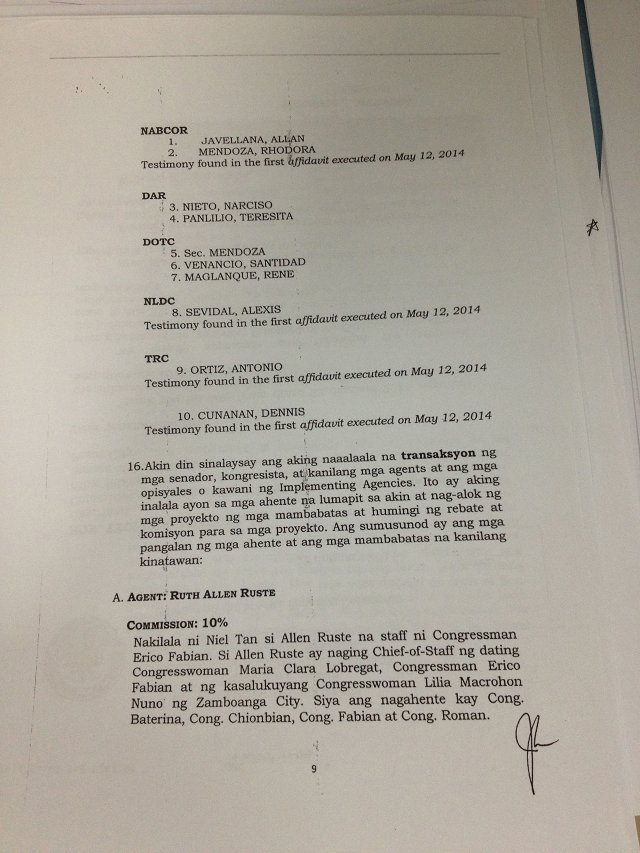
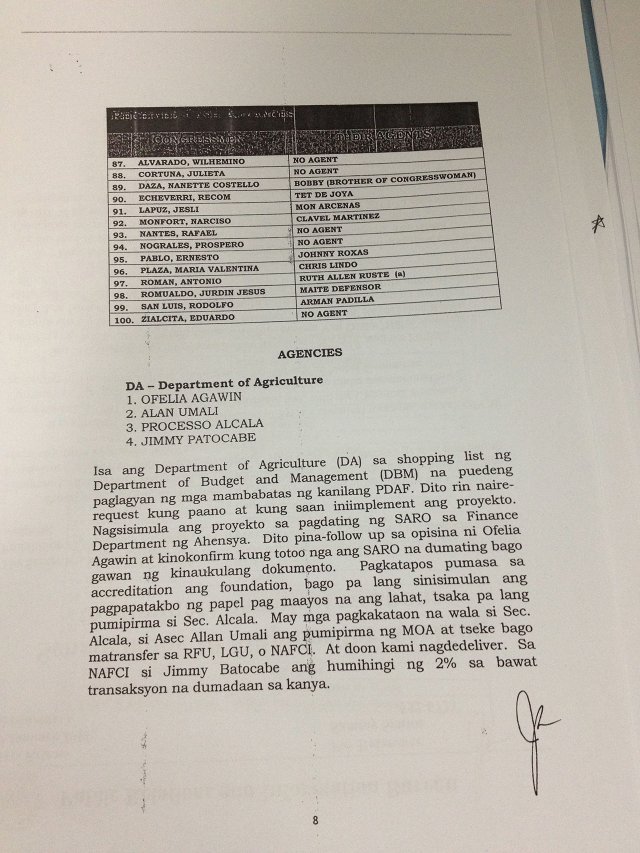
AGENCIES

DA - Department of Agriculture
1. Ofelia Agawin
2. Alan Umali
3. Proceso Alcala (spelled as Processo in affidavit)
4. Jimmy Patocabe

NABCOR
1. Javellana, Allan
2. Mendoza, Rhodora

DAR
3. Nieto, Narciso
4. Panlilio, Teresita

DOTC
5. Sec. Mendoza
6. Venancio, Santidad
7. Maglanque, Rene

NLDC
8. Sevidal, Alexis

TRC
9. Ortiz, Antonio
10. Cunanan, Dennis
#12995
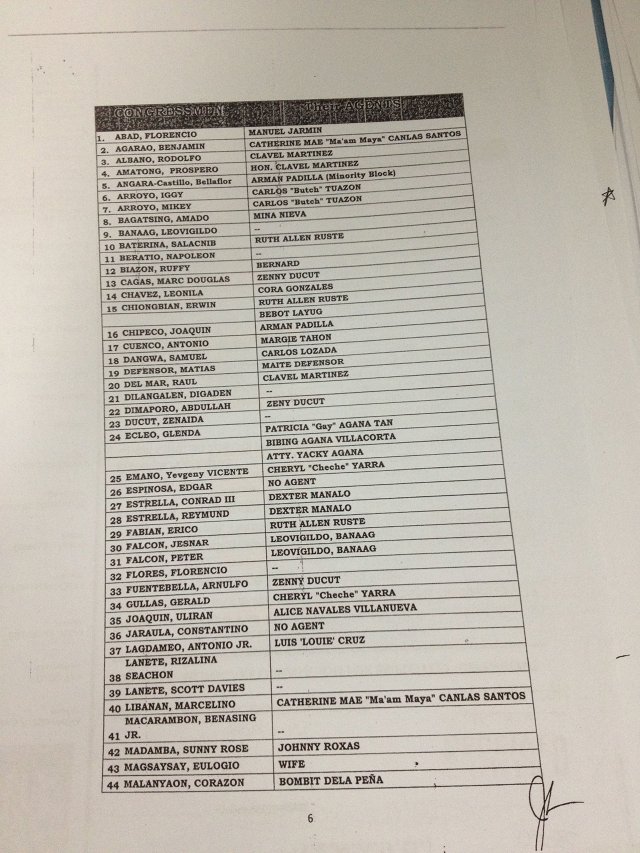
CONGRESSMEN

1. Abad, Florencio
2. Agarao, Benjamin
3. Albano, Rodolfo
4. Amatong, Prospero
5. Angara-Castillo, Bellaflor
6. Arroyo, Iggy
7. Arroyo, Mikey
8. Bagatsing, Amado
9. Banaag, Leovigildo
10. Baterina, Salacnib
11. Beratio, Napoleon
12. Biazon, Ruffy
13. Cagas, Marc Douglas
14. Chavez, Leonila
15. Chiongbian, Erwin
16. Chipeco, Joaquin
17. Cuenco, Antonio
18. Dangwa, Samuel
19. Defensor, Matias
20. Del Mar, Raul
21. Dilangalen, Didagen (spelled as Digaden in affidavit)
22. Dimaporo, Abdullah
23. Ducut, Zenaida
24. Ecleo, Glenda
25. Emano, Yevgeny Vincente
26. Espinosa, Edgar
27. Estrella, Conrado III
28. Estrella, Raymund (spelled as Reymund in affidavit)
29. Fabian, Erico
30. Falcon, Jesnar
31. Falcon, Peter
32. Flores, Florencio
33. Fuentebella, Arnulfo
34. Gullas, Gerald
35. Joaquin, Uliran
36. Jaraula, Constantino
37. Lagdameo, Antonio Jr.
38. Lanete, Rizalina Seachon
39. Lanete, Scott Davies
40. Libanan, Marcelino
41. Macarambon, Benasing Jr.
42. Madamba, Sunny Rose
43. Magsaysay, Eulogio
44. Malanyaon, Corazon
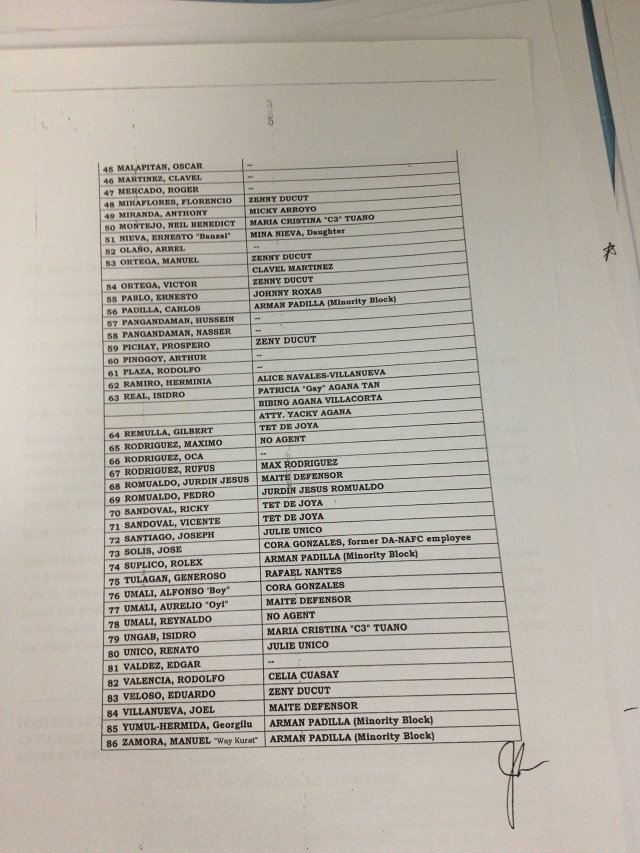
45. Malapitan, Oscar
46. Martinez, Clavel
47. Mercado, Roger
48. Miraflores, Florencio
49. Mranda, Anthony
50. Montejo, Neil Benedict
51. Nieva, Ernesto "Banzai"
52. Olaño, Arrel
53. Ortega, Manuel
54. Ortega, Victor
55. Pablo, Ernesto
56. Padilla, Carlos
57. Pangandaman, Hussein
58. Pangandaman, Nasser
59. Pichay, Prospero
60. Pingoy, Arthur
61. Plaza, Rodolfo
62. Ramiro, Herminia
63. Real, Isidoro Jr. (spelled as Isidro in affidavit)
64. Remulla, Gilbert
65. Rodriguez, Maximo
66. Rodriguez, Oscar "Oca"
67. Rodriguez, Rufus
68. Romualdo, Jurdin Jesus
69. Romualdo, Pedro
70. Sandoval, Federico "Ricky"
71. Sandoval, Vicente
72. Santiago, Joseph
73. Solis, Jose
74. Suplico, Rolex
75. Tulagan, Generoso
76. Umali, Alfonso "Boy"
77. Umali, Aurelio "Oyi"
78. Umali, Reynaldo
79. Ungab, Isidro
80. Unico, Renato
81. Valdez, Edgar
82. Valencia, Rodolfo
83. Veloso, Eduardo
84. Villanueva, Joel
85. Yumul-Hermida, Georgilu
86. Zamora, Manuel "Way Kurat"

Received Cash Allowances

87. Alvarado, Wilhelmino
88. Cortuna, Julieta
89. Daza, Nanette Castelo (spelled as Costello in affidavit)
90. Echiverri, Enrico "Recom"
91. Lapus, Jesli
92. Monfort, Narciso
93. Nantes, Rafael
94. Nograles, Prospero
95. Pablo, Ernesto
96. Plaza, Maria Valentina
97. Roman, Antonino (spelled as Antonio in affidavit)
98. Romualdo, Jurdin Jesus
99. San Luis, Rodolfo
100. Zialcita, Eduardo
#12997
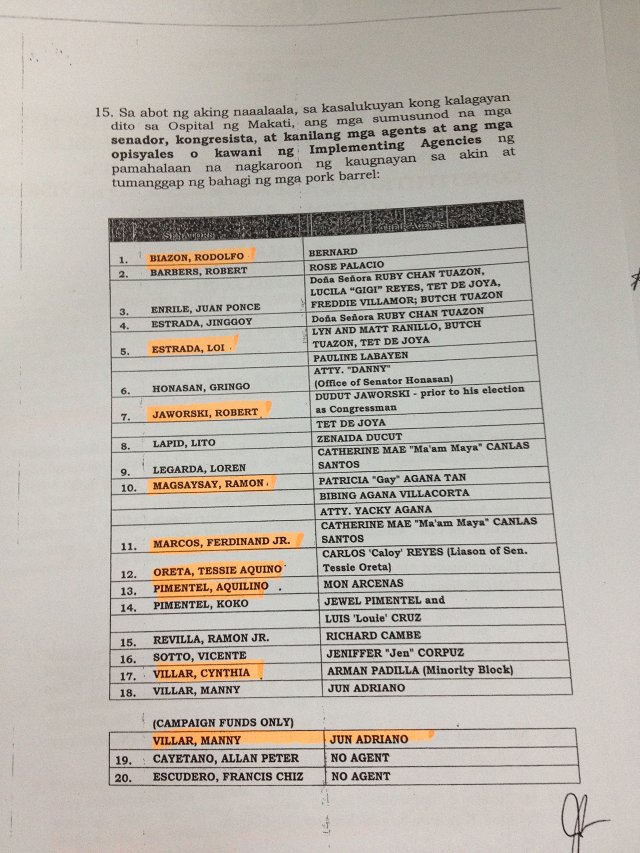
to summarize, here is the complete list of lawmakers (senators and congressmen) implicated in the affidavit of janet lim napoles:

SENATORS

1.  Biazon, Rodolfo
2.  Barbers, Robert
3.  Enrile, Juan Ponce
4.  Estrada, Jinggoy
5.  Estrada, Loi
6.  Honasan, Gringo
7.  Jaworksi, Robert
8.  Lapid, Lito
9.  Legarda, Loren
10. Magsaysay, Ramon
11. Marcos, Ferdinand Jr
12. Oreta, Tessie Aquino
13. Pimentel, Aquilino (sic)
14. Pimentel, Koko
15. Revilla, Ramon Jr
16. Sotto, Vicente (sic)
17. Villar, Cynthia
18. Villar, Manny

Senators (Campaign Funds Only):

Villar, Manny (#18)
19. Cayetano, Allan Peter (sic)
20. Escudero, Francis Chiz
#12999
20. The late senator Robert Barbers

Agent: Rose Palacio

Napoles said, “Our project was DA-LGU then. What I recall is Rose Palacio asked for 50% and she got this from the office.”

(Editor's note: Barbers passed away in December 2005. A former police officer, he became congressman in 1992 and then was appointed to the Department of the Interior and Local Government by then president Fidel V. Ramos. He ran for the Senate in 1998 and won but lost when he sought reelection in 2004.)

http://www.rappler.com/
#13000
19. Former Senator Roberto Jaworski

Agents: Tet de Joya and Freddie Villamor

Napoles said de Joya and Villamor became agents for a P10-million project of Jaworski, consisting of “funds from CA” around 2004. “I did not talk to or meet Senator Jaworski. Tet introduced to me Dudut Jaworski.”