hampasabol. plastic kana ng giugbok. wa goy dahon.
This section allows you to view all posts made by this member. Note that you can only see posts made in areas you currently have access to.
Pages 1 2 3 4 5 6 7 8 9 10 11 12 13 14 15 16 17 18 19 20 21 22 23 24 25 26 27 28 29 30 31 32 33 34 35 36 37 38 39 40 41 42 43 44 45 46 47 48 49 50 51 52 53 54 55 56 57 58 59 60 61 62 63 64 65 66 67 68 69 70 71 72 73 74 75 76 77 78 79 80 81 82 83 84 85 86 87 88 89 90 91 92 93 94 95 96 97 98 99 100 101 102 103 104 105 106 107 108 109 110 111 112 113 114 115 116 117 118 119 120 121 122 123 124 125 126 127 128 129 130 131 132 133 134 135 136 137 138 139 140 141 142 143 144 145 146 147 148 149 150 151 152 153 154 155 156 157 158 159 160 161 162 163 164 165 166 167 168 169 170 171 172 173 174 175 176 177 178 179 180 181 182 183 184 185 186 187 188 189 190 191 192 193 194 195 196 197 198 199 200 201 202 203 204 205 206 207 208 209 210 211 212 213 214 215 216 217 218 219 220 221 222 223 224 225 226 227 228 229 230 231 232 233 234 235 236 237 238 239 240 241 242 243 244 245 246 247 248 249 250 251 252 253 254 255 256 257 258 259 260 261 262 263 264 265 266 267 268 269 270 271 272 273 274 275 276 277 278 279 280 281 282 283 284 285 286 287 288 289 290 291 292 293 294 295 296 297 298 299 300 301 302 303 304 305 306 307 308 309 310 311 312 313 314 315 316 317 318 319 320 321 322 323 324 325 326 327 328 329 330 331 332 333 334 335 336 337 338 339 340 341 342 343 344 345 346 347 348 349 350 351 352 353 354 355 356 357 358 359 360 361 362 363 364 365 366 367 368 369 370 371 372 373 374 375 376 377 378 379 380 381 382 383 384 385 386 387 388 389 390 391 392 393 394 395 396 397 398 399 400 401 402 403 404 405 406 407 408 409 410 411 412 413 414 415 416 417 418 419 420 421 422 423 424 425 426 427 428 429 430 431 432 433 434 435 436 437 438 439 440 441 442 443 444 445 446 447 448 449 450 451 452 453 454 455 456 457 458 459 460 461 462 463 464 465 466 467 468 469
#10501
Tira-Pasagad | Saksak-Sinagol / Re: Garbage dump madonna
April 08, 2015, 10:25:32 PMhampasabol. plastic kana ng giugbok. wa goy dahon.
#10502
Philippine Provinces / Re: Mga mahuyang gibugaw; mga bugaw nasikop; mga nasikop mahuyang usab
April 08, 2015, 10:24:06 PMbtw, ang headline ani mao ba gyod sa news item o tinumo-tumo na pod ni ni hubag?
#10503
Philippine Provinces / Re: Mga mahuyang gibugaw; mga bugaw nasikop; mga nasikop mahuyang usab
April 08, 2015, 10:23:08 PMug ang mga langyaw nga customers hayahay nga mopauli sa ilang mga asawa. the end.
#10504
Tira-Pasagad | Saksak-Sinagol / Re: Garbage dump madonna
April 08, 2015, 11:58:14 AMno sweat. vampire na siya. the tinge of the skin is no different from those vampires in the twilight saga.
#10505
Anonymous Diary Blog / Re: Ipagawas Ang Inyung Gibati
April 08, 2015, 11:54:49 AMnevah. repeat after me, loll: nevah.
#10506
Bible Study / Re: Why Evangelicals Should Love the Pope
April 08, 2015, 04:13:56 AMSince the mid-1970s, one dominant strain of cultural engagement among Christian leaders in America has been to warn about God’s judgment on a disobedient, decadent nation. This approach assumes that the main task of the church is to call us back to moral righteousness. Among the most prominent representatives of this kind of Christian cultural engagement is the Rev. Franklin Graham, the son of the famed evangelist...
for the full enlightening article:
http://www.nytimes.com/2015/04/05/opinion/sunday/why-evangelicals-should-love-the-pope.html
#10507
Bible Study / Why Evangelicals Should Love the Pope
April 08, 2015, 04:13:19 AMWhy Evangelicals Should Love the Pope
Peter Wehner, New York Times
ON Easter Sunday, Christians celebrate an event that inspires more than two billion of the faithful with eternal hope. Jesus spoke often about the life to come. Yet he also spoke about God’s will being done here on Earth. How best to live out one’s faith in this world has been a complicated issue throughout Christian history, and it remains so today.
#10508
Inspiration & Hope / Re: Stray dogs show up to a woman’s funeral to pay their respects
April 08, 2015, 03:57:59 AMhere are hopes that these grieving dogs have happy endings, like they were adopted into loving homes.

#10510
Tira-Pasagad | Saksak-Sinagol / Re: Garbage dump madonna
April 08, 2015, 03:38:25 AMmotilaw pa sa basura kun magkalisod.
#10511
Philippine Provinces / Re: Lalaki Naghikog Pagkahibalo nga Iyang Nabuntisan ang Iyang Uyab
April 08, 2015, 03:36:43 AMlabad ra pod si ondoy. ang gihuktan unta niyag pisi ang nakapamabdos, di ang iyang liog.
#10512
Tira-Pasagad | Saksak-Sinagol / Re: Butterflies in love
April 07, 2015, 07:01:13 PMjust because humans feel butterflies in their stomach when they're in love? ugh. i doubt if there's mutuality here. butterflies are better than that. they may feel crows in their stomach. that's more believable.
#10513
Anonymous Diary Blog / Re: Ipagawas Ang Inyung Gibati
April 07, 2015, 06:57:38 PMhow proud can you get? (grin)
#10514
Tira-Pasagad | Saksak-Sinagol / Re: The Enigma of an Autumn Afternoon of Islander's Mysterious and Melancholy Cat
April 07, 2015, 06:56:29 PM
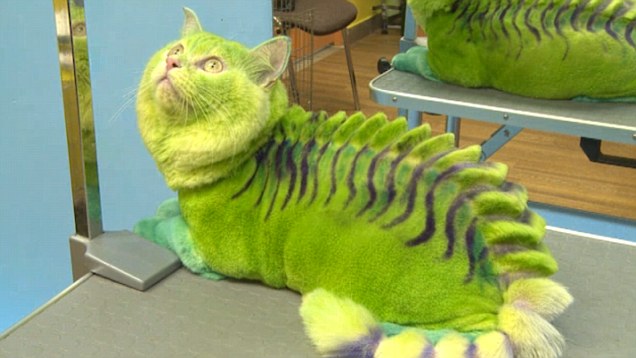
is this a cat or a dragon?
#10515
Tira-Pasagad | Saksak-Sinagol / Re: The Enigma of an Autumn Afternoon of Islander's Mysterious and Melancholy Cat
April 07, 2015, 06:55:44 PMit depends on where i am.

#10516
History / Re: The Historical Perspective of the Middle East Turbulence
April 07, 2015, 06:47:23 PM
What was the Sykes-Picot agreement?
The Sykes-Picot agreement is a secret understanding concluded in May 1916, during World War One, between Great Britain and France, with the assent of Russia, for the dismemberment of the Ottoman Empire
The agreement led to the division of Turkish-held Syria, Iraq, Lebanon, and Palestine into various French and British-administered areas. The agreement took its name from its negotiators, Sir Mark Sykes of Britain and Georges Picot of France.
http://www.bbc.com/
#10517
History / Re: The Historical Perspective of the Middle East Turbulence
April 07, 2015, 06:44:19 PMThe new generation
That state structure was poised for explosion, and the changing demographics proved to be the trigger. Over the past four decades, the Arab world has doubled its population, to over 330 million people, two-thirds of them are under 35 years old.

The signatures of Francois Georges-Picot and Mark Sykes on the original map, now held by the National Archives
This is a generation that has inherited acute socio-economic and political problems that it did not contribute to, and yet has been living its consequences - from education quality, job availability, economic prospects, to the perception of the future.
At core, the wave of Arab uprisings that commenced in 2011 is this generation's attempt at changing the consequences of the state order that began in the aftermath of World War One.
This currently unfolding transformation entails the promise of a new generation searching for a better future, and the peril of a wave of chaos that could engulf the region for several years.
http://www.bbc.com/
#10518
History / Re: The Historical Perspective of the Middle East Turbulence
April 07, 2015, 06:39:59 PMIdentity struggle
The third problem was that the state system that was created after the World War One has exacerbated the Arabs' failure to address the crucial dilemma they have faced over the past century and half - the identity struggle between, on one hand nationalism and secularism, and on the other, Islamism (and in some cases Christianism).
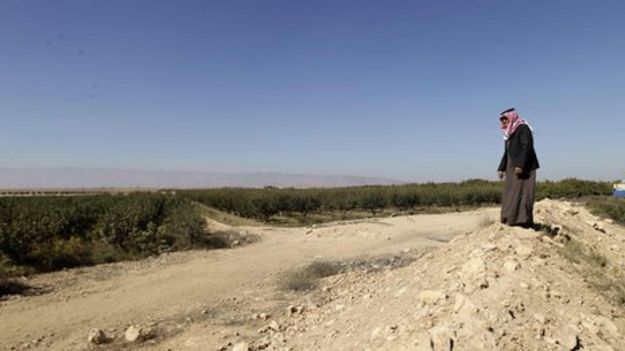
Contemplating the dirt barrier between Lebanon and Syria
The founders of the Arab liberal age - from the late 19th Century to the 1940s - created state institutions (for example a secular constitution in Tunisia in 1861 and the beginnings of a liberal democracy in Egypt in the inter-war period), and put forward a narrative that many social groups (especially in the middle classes) supported - but failed to weave the piousness, conservatism, and religious frame of reference of their societies into the ambitious social modernisation they had led.
And despite major advancements in industrialisation, the dramatic inequity between the upper middle classes and the vast majority of the populations continued. The strong men of Arab nationalism championed - with immense popular support - a different (socialist, and at times militarist) narrative, but at the expense of civil and political freedoms.
And for the past four decades, the Arab world has lacked any national project or serious attempt at confronting the contradictions in its social fabric.
#10519
History / Re: The Historical Perspective of the Middle East Turbulence
April 07, 2015, 06:36:13 PMBrutality
In the period from the late 1950s to the late 1970s, and especially during the heydays of Egypt's Gamal Abdel Nasser (from the Suez Crisis in 1956 to the end of the 1960s) Arab nationalism gave immense momentum to the idea that a united Arab world would dilute the socio-demographic differences between its populations.
In the 1980s and 1990s, the Arab world's strong men - for example, Hafez Assad and Saddam Hussein in the Levant and Col Muammar Gaddafi in North Africa - suppressed the differences, often using immense brutality.
But the tensions and aspirations that these differences gave rise to neither disappeared nor were diluted. When cracks started to appear in these countries - first by the gradual disappearance of these strong men, later by several Arab republics gradually becoming hereditary fiefdoms controlled by small groups of economic interests, and most recently after the 2011 uprisings - the old frictions, frustrations, and hopes that had been concealed for decades, came to the fore.
#10520
History / Re: The Historical Perspective of the Middle East Turbulence
April 07, 2015, 06:35:14 PMGeography helped.
For the period from the end of the Crusades up until the arrival of the European powers in the 19th Century, and despite the region's vibrant trading culture, the different sects effectively lived separately from each other.
But the thinking behind Sykes-Picot did not translate into practice. That meant the newly created borders did not correspond to the actual sectarian, tribal, or ethnic distinctions on the ground.
These differences were buried, first under the Arabs' struggle to eject the European powers, and later by the sweeping wave of Arab nationalism.
#10521
History / Re: The Historical Perspective of the Middle East Turbulence
April 07, 2015, 06:31:55 PM
Tribal lines
The second problem lay in the tendency to draw straight lines.
Sykes-Picot intended to divide the Levant on a sectarian basis:
-Lebanon was envisioned as a haven for Christians (especially Maronites) and Druze
-Palestine with a sizable Jewish community
-the Bekaa valley, on the border between the two countries, effectively left to Shia Muslims
-Syria with the region's largest sectarian demographic, Sunni Muslims
"The newly created borders did not correspond to the actual sectarian, tribal, or ethnic distinctions on the ground."
#10522
History / Re: The Historical Perspective of the Middle East Turbulence
April 07, 2015, 06:27:37 PMWhen that independence did not materialise after World War One, and as these colonial powers, in the 1920s, 30s and 40s, continued to exert immense influence over the Arab world, the thrust of Arab politics - in North Africa and in the eastern Mediterranean - gradually but decisively shifted from building liberal constitutional governance systems (as Egypt, Syria, and Iraq had witnessed in the early decades of the 20th Century) to assertive nationalism whose main objective was getting rid of the colonialists and the ruling systems that worked with them.
This was a key factor behind the rise of the militarist regimes that had come to dominate many Arab countries from the 1950s until the 2011 Arab uprisings.
#10523
History / Re: The Historical Perspective of the Middle East Turbulence
April 07, 2015, 06:26:55 PMA secret deal

But there were three problems with the geo-political order that emerged from the Sykes-Picot agreement.
First, it was secret without any Arabic knowledge, and it negated the main promise that Britain had made to the Arabs in the 1910s - that if they rebelled against the Ottomans, the fall of that empire would bring them independence.
#10524
History / Re: The Historical Perspective of the Middle East Turbulence
April 07, 2015, 06:24:11 PMThe map that the two men drew divided the land that had been under Ottoman rule since the early 16th Century into new countries - and relegated these political entities to two spheres of influence:
Iraq, Transjordan, and Palestine under British influence
Syria and Lebanon under French influence
The two men were not mandated to redraw the borders of the Arab countries in North Africa, but the division of influence existed there as well, with Egypt under British rule, and France controlling the Maghreb.
#10525
History / Re: The Historical Perspective of the Middle East Turbulence
April 07, 2015, 06:22:33 PM
Sykes and Picot were quintessential "empire men". Both were aristocrats, seasoned in colonial administration, and crucially believers in the notion that the people of the region would be better off under the European empires.
Both men also had intimate knowledge of the Middle East.
The key tenets of the agreement they had negotiated in relative haste amidst the turmoil of the World War One continue to influence the region to this day. But while Sykes-Picot's straight lines had proved significantly helpful to Britain and France in the first half of the twentieth century, their impact on the region's peoples was quite different.
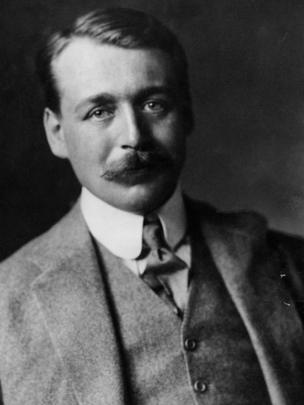
At a meeting in Downing Street, Mark Sykes pointed to a map
and told the prime minister: "I should like to draw a line
from the "e" in Acre to the last "k" in Kirkuk."
Both men also had intimate knowledge of the Middle East.
The key tenets of the agreement they had negotiated in relative haste amidst the turmoil of the World War One continue to influence the region to this day. But while Sykes-Picot's straight lines had proved significantly helpful to Britain and France in the first half of the twentieth century, their impact on the region's peoples was quite different.
At a meeting in Downing Street, Mark Sykes pointed to a map
and told the prime minister: "I should like to draw a line
from the "e" in Acre to the last "k" in Kirkuk."
#10526
History / Re: The Historical Perspective of the Middle East Turbulence
April 07, 2015, 06:18:55 PMWhy border lines drawn with a ruler in WW1 still rock the Middle East
By Tarek Osman (@TarekmOsman)
Presenter: The Making of the Modern Arab World
14 December 2013

The original secret Sykes-Picot map of 1916: "A" would go to France, "B" to Britain.
A map marked with crude chinagraph-pencil in the second decade of the 20th Century shows the ambition - and folly - of the 100-year old British-French plan that helped create the modern-day Middle East.
Straight lines make uncomplicated borders. Most probably that was the reason why most of the lines that Mark Sykes, representing the British government, and Francois Georges-Picot, from the French government, agreed upon in 1916 were straight ones.
#10527
History / Re: The Rogue Gallery of Kleptocrats
April 07, 2015, 06:09:43 PMsakit sa dughan nga anhi ra ta nakalupig sa uban.
#10528
Anonymous Diary Blog / Re: Ipagawas Ang Inyung Gibati
April 07, 2015, 05:37:19 PMselfie? (no. 4 emoticon here; grin)
#10529
Philippine Provinces / Re: Gisulong og luwag ang bana nga gasabak-sabak og GRO sa videokehan
April 07, 2015, 05:28:58 PMwow, superwife.
#10530
Bible Study / Re: Holy Week
April 01, 2015, 01:34:21 AM
Easter Vigil

Easter vigil in Texcoco, Mexico. (A01333441jarh)
The name of the Easter Vigil, even if the vigil is held on what on the civil calendar is still Saturday, indicates that liturgically it is already Easter, no longer part of Holy Week, but still part of the Easter Triduum.
In the Anglican, Catholic, Methodist, and Presbyterian traditions, the Easter Vigil, one of the longest and most solemn of liturgical services, lasts up to three or four hours, consists of four parts:
#The Service of Light
#The Liturgy of the Word
#The Liturgy of Baptism: The sacraments of Baptism and Confirmation for new members of the Church and the Renewal of Baptismal Promises by the entire congregation.
#Holy Eucharist
The Liturgy begins after sundown on Holy Saturday as the crowd gathers inside the unlit church. In the darkness (often in a side chapel of the church building or, preferably, outside the church), a new fire is kindled and blessed by the priest. This new fire symbolizes the light of salvation and hope that God brought into the world through Christ's Resurrection, dispelling the darkness of sin and death.
From this fire is lit the Paschal candle, symbolizing the Light of Christ. This Paschal candle will be used throughout the season of Easter, remaining in the sanctuary of the Church or near the lectern, and throughout the coming year at baptisms and funerals, reminding all that that Christ is "light and life."
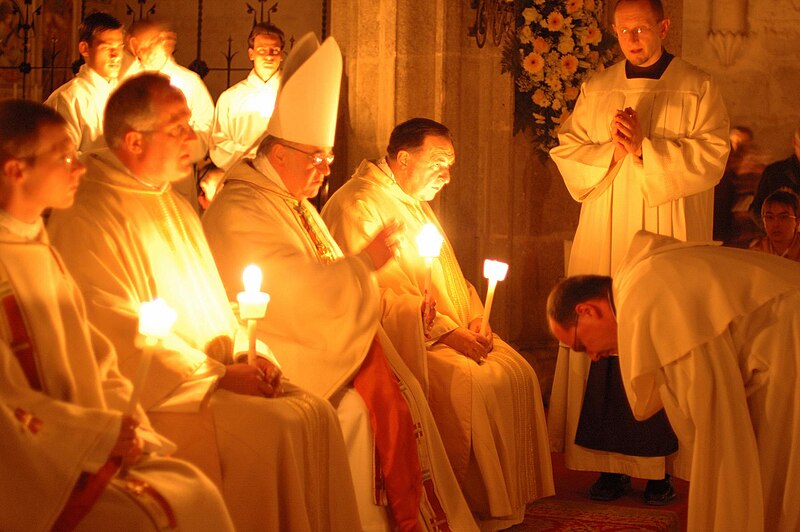
Candles lit for the Easter Vigil at Heiligenkreuz Abbey in Austria. (Melchior2008)
The candles of those present are lit from the Paschal candle. As this symbolic "Light of Christ" spreads throughout those gathered, the darkness is decreased. A deacon, or the priest if there is no deacon, carries the Paschal Candle at the head of the entrance procession and, at three points, stops and chants the proclamation "The Light of Christ" (until Easter 2011, the official English text was "Christ our Light"), to which the people respond "Thanks be to God." Once the procession concludes with the singing of the third proclamation, the lights throughout the church are lit, except for the altar candles. Then the deacon or a cantor chants the Exultet (also called the "Easter Proclamation"), After that, the people put aside their candles and sit down for the Liturgy of the Word.
The Liturgy of the Word includes between three and seven readings from the Old Testament, followed by two from the New (an Epistle and a Gospel). The Old Testament readings must include the account in Exodus 14 of the crossing of the Red Sea, seen as an antitype of baptism and Christian salvation. Each Old Testament reading is followed by a psalm or canticle (such as Exodus 15:1-18 and a prayer relating what has been read to the Mystery of Christ. After the Old Testament readings conclude, the Gloria in excelsis Deo, which has been suspended during Lent, is intoned and bells are rung.
A reading from the Epistle to the Romans is proclaimed. The Alleluia is sung for the first time since the beginning of Lent. The Gospel of the Resurrection then follows, along with a homily.
After the conclusion of the Liturgy of the Word, the water of the baptismal font is blessed and any catechumens or candidates for full communion are initiated into the church, by baptism and/or confirmation. After the celebration of these sacraments of initiation, the congregation renews their baptismal vows and receive the sprinkling of baptismal water. The general intercessions follow.
After the Liturgy of Baptism, the Liturgy of the Eucharist continues as usual. This is the first Mass of Easter Day. During the Eucharist, the newly baptised receive Holy Communion for the first time. According to the rubrics of the Missal, the Eucharist should finish before dawn. (wikipedia)
Easter vigil in Texcoco, Mexico. (A01333441jarh)
The name of the Easter Vigil, even if the vigil is held on what on the civil calendar is still Saturday, indicates that liturgically it is already Easter, no longer part of Holy Week, but still part of the Easter Triduum.
In the Anglican, Catholic, Methodist, and Presbyterian traditions, the Easter Vigil, one of the longest and most solemn of liturgical services, lasts up to three or four hours, consists of four parts:
#The Service of Light
#The Liturgy of the Word
#The Liturgy of Baptism: The sacraments of Baptism and Confirmation for new members of the Church and the Renewal of Baptismal Promises by the entire congregation.
#Holy Eucharist
The Liturgy begins after sundown on Holy Saturday as the crowd gathers inside the unlit church. In the darkness (often in a side chapel of the church building or, preferably, outside the church), a new fire is kindled and blessed by the priest. This new fire symbolizes the light of salvation and hope that God brought into the world through Christ's Resurrection, dispelling the darkness of sin and death.
From this fire is lit the Paschal candle, symbolizing the Light of Christ. This Paschal candle will be used throughout the season of Easter, remaining in the sanctuary of the Church or near the lectern, and throughout the coming year at baptisms and funerals, reminding all that that Christ is "light and life."
Candles lit for the Easter Vigil at Heiligenkreuz Abbey in Austria. (Melchior2008)
The candles of those present are lit from the Paschal candle. As this symbolic "Light of Christ" spreads throughout those gathered, the darkness is decreased. A deacon, or the priest if there is no deacon, carries the Paschal Candle at the head of the entrance procession and, at three points, stops and chants the proclamation "The Light of Christ" (until Easter 2011, the official English text was "Christ our Light"), to which the people respond "Thanks be to God." Once the procession concludes with the singing of the third proclamation, the lights throughout the church are lit, except for the altar candles. Then the deacon or a cantor chants the Exultet (also called the "Easter Proclamation"), After that, the people put aside their candles and sit down for the Liturgy of the Word.
The Liturgy of the Word includes between three and seven readings from the Old Testament, followed by two from the New (an Epistle and a Gospel). The Old Testament readings must include the account in Exodus 14 of the crossing of the Red Sea, seen as an antitype of baptism and Christian salvation. Each Old Testament reading is followed by a psalm or canticle (such as Exodus 15:1-18 and a prayer relating what has been read to the Mystery of Christ. After the Old Testament readings conclude, the Gloria in excelsis Deo, which has been suspended during Lent, is intoned and bells are rung.
A reading from the Epistle to the Romans is proclaimed. The Alleluia is sung for the first time since the beginning of Lent. The Gospel of the Resurrection then follows, along with a homily.
After the conclusion of the Liturgy of the Word, the water of the baptismal font is blessed and any catechumens or candidates for full communion are initiated into the church, by baptism and/or confirmation. After the celebration of these sacraments of initiation, the congregation renews their baptismal vows and receive the sprinkling of baptismal water. The general intercessions follow.
After the Liturgy of Baptism, the Liturgy of the Eucharist continues as usual. This is the first Mass of Easter Day. During the Eucharist, the newly baptised receive Holy Communion for the first time. According to the rubrics of the Missal, the Eucharist should finish before dawn. (wikipedia)
#10531
Bible Study / Re: Holy Week
April 01, 2015, 01:18:31 AM4 April 2015. Holy Saturday (Black Saturday)
Mass is not celebrated on what is liturgically Holy Saturday. The celebration of Easter begins after sundown on what, though still Saturday in the civil calendar, is liturgically Easter Sunday.
On Holy Saturday the Church waits at the Lord's tomb in prayer and fasting, meditating on his Passion and Death and on his Descent into Hell, and awaiting his Resurrection.
The Church abstains from the Sacrifice of the Mass, with the sacred table left bare, until after the solemn Vigil, that is, the anticipation by night of the Resurrection, when the time comes for paschal joys, the abundance of which overflows to occupy fifty days.
The tabernacle is left empty and open. The lamp or candle usually situated next to the tabernacle denoting the Presence of Christ is put out, and the remaining Eucharistic Hosts consecrated on Holy Thursday are kept elsewhere, usually the sacristy, with a lamp or candle burning before it, so that, in cases of the danger of death, they may be given as viaticum. (wikipedia)

#10532
Bible Study / Re: Holy Week
April 01, 2015, 12:52:42 AM3 April 2015. Good Friday
The evening liturgical celebration on Holy Thursday begins the first of the three days of the Easter Triduum, which continues in an atmosphere of liturgical mourning throughout the next day in spite of the name "Good" given in English to this Friday.
For Roman Catholic and Anglican Christians, Good Friday is a fast day. Western Catholic Church practice is to have only one full meal with, if needed, two small snacks that together do not make a full meal. The Anglican Communion defines fasting more generically as: "The amount of food eaten is reduced."
In some countries, such as Malta, Philippines, Italy and Spain, processions with statues representing the Passion of Christ are held.
The Church mourns for Christ's death, reveres the Cross, and marvels at his life for his obedience until death.
In the Catholic Church, the only sacraments celebrated are Penance and Anointing of the Sick. While there is no celebration of the Eucharist, Holy Communion is distributed to the faithful only in the Service of the Passion of the Lord, but can be taken at any hour to the sick who are unable to attend this service. (wikipedia)

Crucifixion, Bartolome Esteban Murillo
#10533
Bible Study / Re: Holy Week
April 01, 2015, 12:49:52 AM
2 April 2015. Holy Thursday (Maundy Thursday)
In the Catholic Church, on this day the private celebration of Mass is forbidden. Thus, apart from the Chrism Mass for the blessing of the Holy Oils that the diocesan bishop may celebrate on the morning of Holy Thursday, but also on some other day close to Easter, the only Mass on this day is the evening Mass of the Lord's Supper, which inaugurates the period of three days, known as the Easter Triduum, that includes Good Friday (seen as beginning with the service of the preceding evening), Holy Saturday and Easter Sunday up to evening prayer on that day.
The Mass of the Lord's Supper commemorates the Last Supper of Jesus with his Twelve Apostles, "the institution of the Eucharist, the institution of the priesthood, and the commandment of brotherly love that Jesus gave after washing the feet of his disciples." (wikipedia)
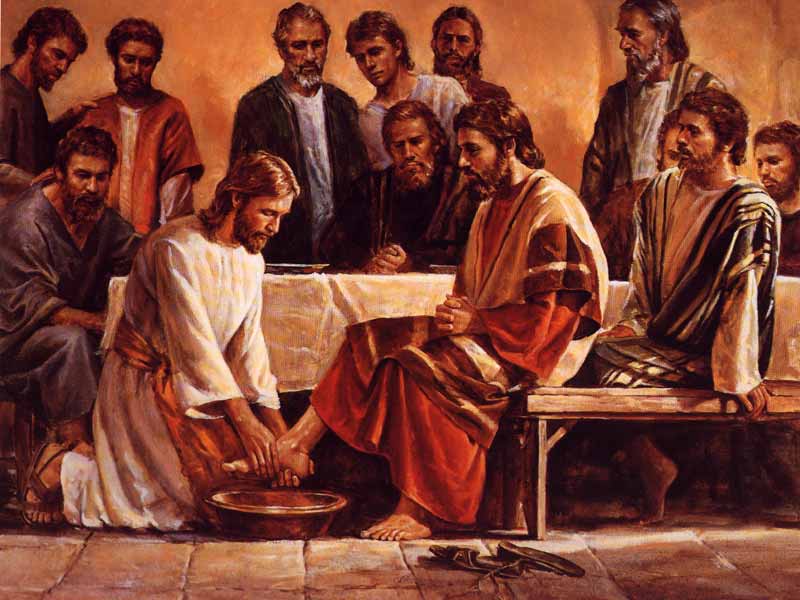
In the Catholic Church, on this day the private celebration of Mass is forbidden. Thus, apart from the Chrism Mass for the blessing of the Holy Oils that the diocesan bishop may celebrate on the morning of Holy Thursday, but also on some other day close to Easter, the only Mass on this day is the evening Mass of the Lord's Supper, which inaugurates the period of three days, known as the Easter Triduum, that includes Good Friday (seen as beginning with the service of the preceding evening), Holy Saturday and Easter Sunday up to evening prayer on that day.
The Mass of the Lord's Supper commemorates the Last Supper of Jesus with his Twelve Apostles, "the institution of the Eucharist, the institution of the priesthood, and the commandment of brotherly love that Jesus gave after washing the feet of his disciples." (wikipedia)
#10534
Bible Study / Re: Holy Week
April 01, 2015, 12:31:55 AM1 April 2015. Holy Wednesday
On Wednesday, the Gospel retells the story of Judas arranging his betrayal of Jesus with the high priests (Matthew 26:14-25). For this reason, the day is sometimes called Spy Wednesday. (In the extraordinary form of the Roman Rite, the Passion according to St. Luke is read instead.) (wikipedia)
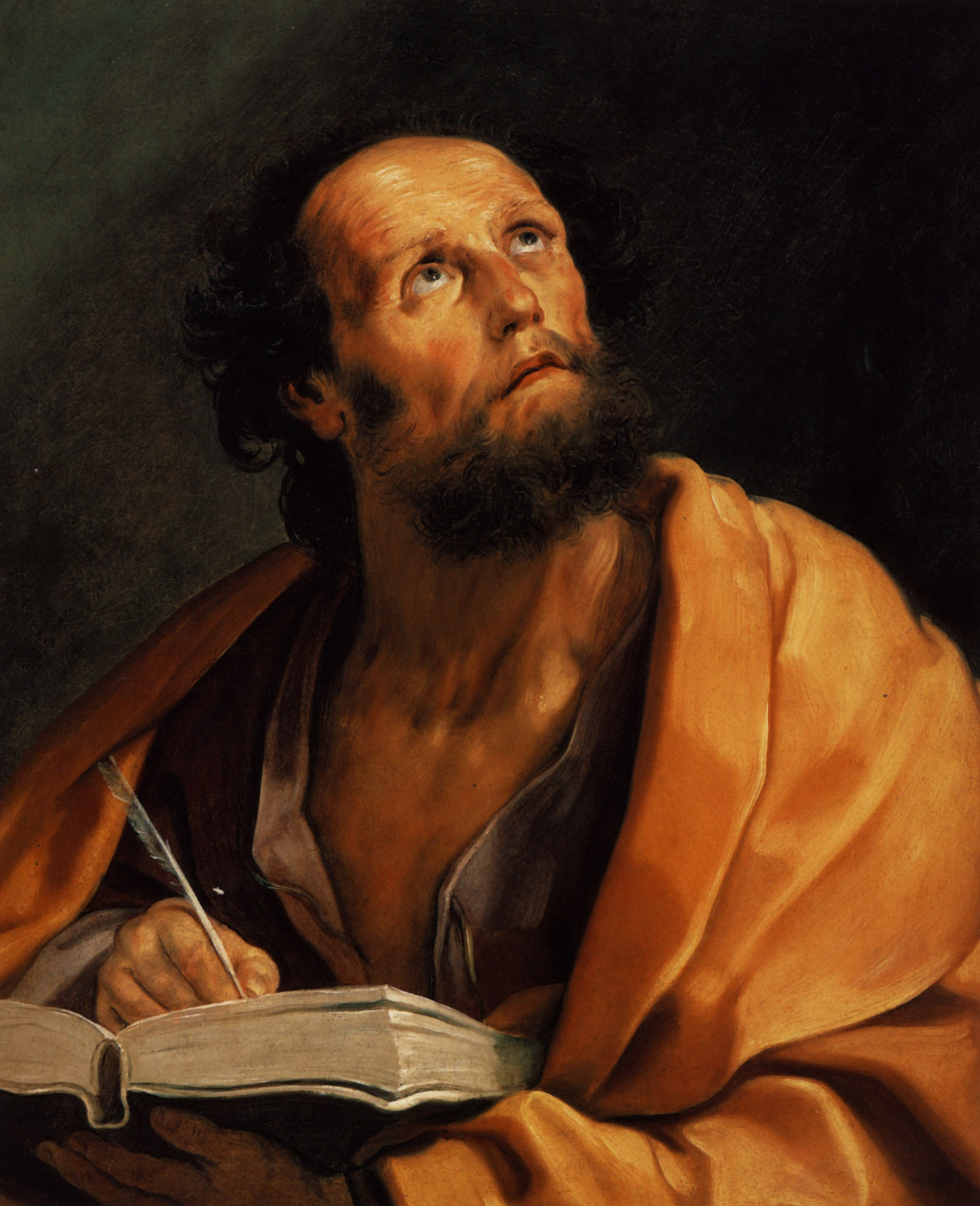
St. Luke (oil by Guido Reni)
#10535
Bible Study / Re: Holy Week
April 01, 2015, 12:30:48 AM
31 March 2015. Holy Tuesday
On Tuesday, the Gospel recalls the foretelling, at the Last Supper, of Judas' betrayal and Peter's denial of Jesus (John 13:21-38). (In the extraordinary form of the Roman rite, the Passion according to St. Mark is read instead.) (wikipedia)
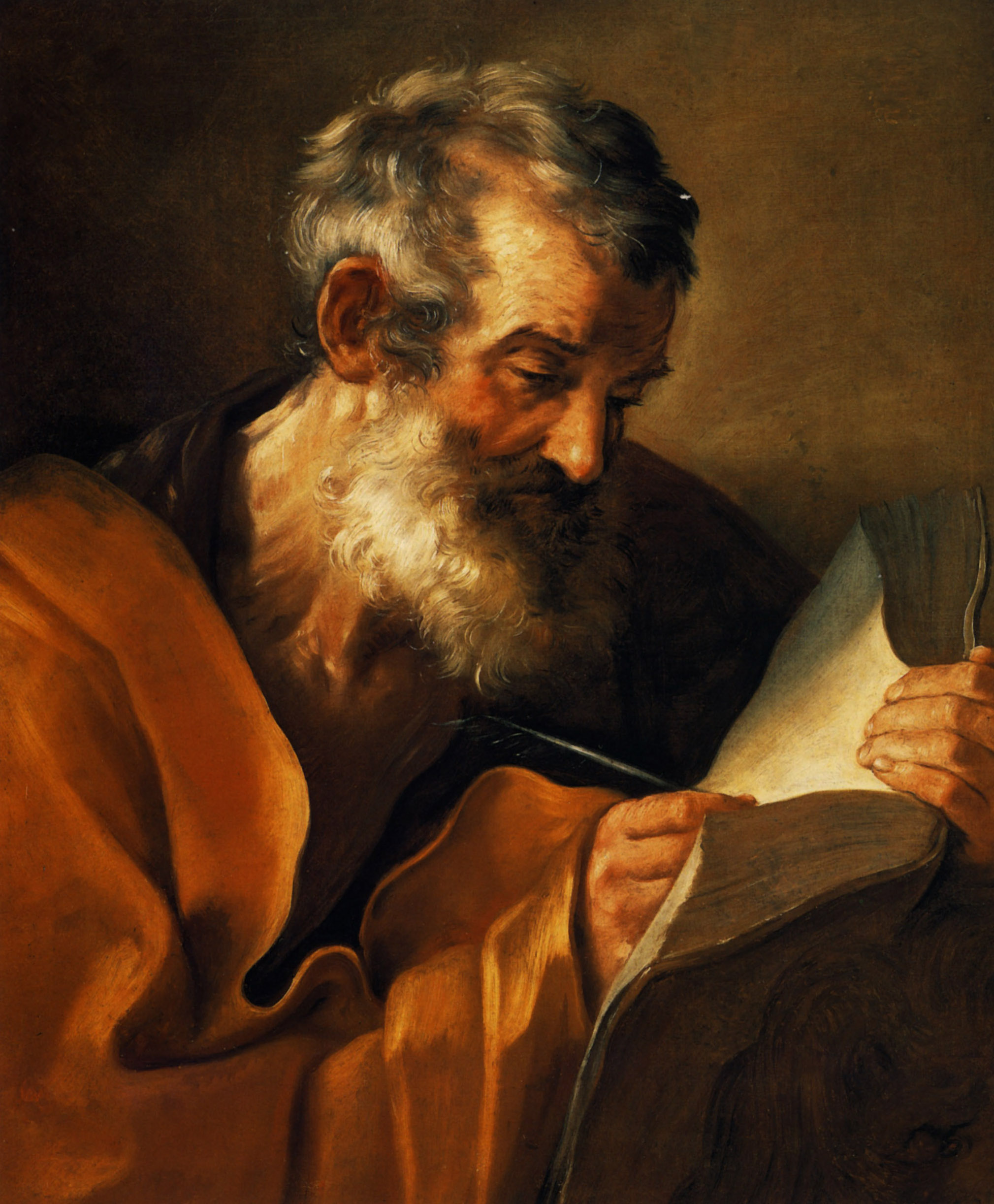
St. Mark (oil by Guido Reni)
On Tuesday, the Gospel recalls the foretelling, at the Last Supper, of Judas' betrayal and Peter's denial of Jesus (John 13:21-38). (In the extraordinary form of the Roman rite, the Passion according to St. Mark is read instead.) (wikipedia)
St. Mark (oil by Guido Reni)
#10536
Bible Study / Re: Holy Week
March 31, 2015, 11:04:08 PM30 March 2015. Holy Monday
On Monday, the Gospel tells of the anointing of Jesus at Bethany (John 12:1-11), an event that occurred before the Palm Sunday event described in John 12:12-19. (wikipedia)

#10537
Bible Study / Re: Holy Week
March 31, 2015, 10:47:42 PM
29 March 2015. Palm Sunday of the Passion of the Lord.
Commemorates the entrance of the Messiah into Jerusalem, to accomplish his paschal mystery. It is customary to have before Mass a blessing of palm leaves (or other branches, for example olive branches). The blessing ceremony, preferably held outside the church includes the reading of a Gospel account of how Jesus rode into Jerusalem humbly on a donkey, reminiscent of a Davidic victory procession, and how people placed palms on the ground in front of him. Immediately following this great time of celebration in the entering of Jesus into Jerusalem, he begins his journey to the cross. (wikipedia)

Commemorates the entrance of the Messiah into Jerusalem, to accomplish his paschal mystery. It is customary to have before Mass a blessing of palm leaves (or other branches, for example olive branches). The blessing ceremony, preferably held outside the church includes the reading of a Gospel account of how Jesus rode into Jerusalem humbly on a donkey, reminiscent of a Davidic victory procession, and how people placed palms on the ground in front of him. Immediately following this great time of celebration in the entering of Jesus into Jerusalem, he begins his journey to the cross. (wikipedia)
#10538
Bible Study / Re: Holy Week
March 31, 2015, 10:39:03 PMHoly Week 2015. may the blessings of this holy season of death and resurrection be shared by all tblanders. HAVE A BLESSED WEEK, ONE AND ALL!
#10539
History / Re: The Rogue Gallery of Kleptocrats
March 31, 2015, 10:04:05 PM13 years later, in 2004...
WORLD'S TEN MOST CORRUPT LEADERS*
(Name, Position, Funds embezzled**)
1. Mohamed Suharto, President of Indonesia (1967â€"1998), $15â€"35 billion
2. Ferdinand Marcos, President of the Philippines (1972â€"1986), 5â€"10 billion
3. Mobutu Sese Seko, President of Zaire (1965â€"1997), 5 billion
4. Sani Abacha, President of Nigeria (1993â€"1998), 2â€"5 billion
5. Slobodan Milosevic, President of Serbia/Yugoslavia (1989â€"2000), 1 billion
6. Jean-Claude Duvalier, President of Haiti (1971â€"1986), 300â€"800 million
7. Alberto Fujimori, President of Peru (1990â€"2000), 600 million
8. Pavlo Lazarenko, Prime Minister of Ukraine (1996â€"1997), 114â€"200 million
9. Arnoldo Alemán, President of Nicaragua (1997â€"2002), 100 million
10. Joseph Estrada, President of the Philippines (1998â€"2001), 78â€"80 million
*Defined as former political leaders who have been accused of embezzling the most funds from their countries over the past two decades.
**All sums are estimates of alleged embezzlement and appear in U.S. dollars.
Source: Transparency International Global Corruption Report 2004.
http://www.infoplease.com/
#10540
History / Re: The Rogue Gallery of Kleptocrats
March 31, 2015, 09:42:12 PM
the gallery of dictators with massive swiss bank accounts as of 1991:
1. Ferdinand (and Imelda) Marcos, PHILIPPINES, 1965-1986 (in the lead story?)
2. Idi Amin, UGANDA, 1971-1979
3. Anastasio Somoza, NICARAGUA, 1967-1972, 1974-1979
4. Jean-Claude Duvalier, HAITI, 1971-1986
5. Manuel Noriega, PANAMA, 1983-1989
6. Mobutu Sese Seko, ZAIRE, 1965-1997
7. Nicolae (and Elena) Ceaușescu, ROMANIA, 1967-1989
8. Haile Selassie I, ETHIOPIA, 1916-1974
9. Abu Nidal (Sabri Khalil al-Banna), PALESTINIAN FATAH, 1974-2002
10. Gaafar Muhammad Nimeiry, SUDAN, 1969â€"1985
11. Suharto, INDONESIA, 1967â€"1998
12. Saddam Hussein, IRAQ, 1979-2003
13. Jean-Bédel Bokassa, CENTRAL AFRICAN REPUBLIC, 1966â€"1979
14. Rajiv Gandhi, INDIA, 1984-1989
15. Mohammad Reza Pahlavi, IRAN, 1941-1979


#10543
History / The Rogue Gallery of Kleptocrats
March 31, 2015, 06:07:48 PMSchweizer Illustrierte (Swiss Illustrated), 11 November 1991
Schweizer Illustrierte's issue of 11 November, 1991 exposed 14 Third World politicians who, it said, had stashed their booty in Swiss banks. The title of the expose in German read "Fluchgelder - Die Schweizer Konten der Dictatoren", meaning in English, "Curse of money: The Swiss bank accounts of the Dictators".
#10544
Tira-Pasagad | Saksak-Sinagol / Re: Trabaho ni Botoy? Tigtugpo og ayroplano
March 30, 2015, 01:03:45 AMunsa man kunoy ngan anang airways sa imong amigo bi...


#10551
Photos Unlimited / Re: Mingkay nga mainampoon
March 30, 2015, 12:40:07 AMQuote from: hubag bohol on March 29, 2015, 07:21:44 PM

unsa man tawon ni nga breed sa mingkay uy, anyone?
#10552
History / Re: The Historical Perspective of the Middle East Turbulence
March 29, 2015, 07:20:17 PMThe ancient Near East is studied in the fields of Near Eastern archaeology and ancient history. It begins with the rise of Sumer in the 4th millennium BC, though the date it ends varies: either covering the Bronze Age and the Iron Age in the region, until the conquest by the Achaemenid Empire in the 6th century BC or Alexander the Great in the 4th century BC.

The ancient Near East is considered the cradle of civilization. It was the first to practice intensive year-round agriculture, it gave the rest of the world the first writing system, invented the potter's wheel and then the vehicular- and mill wheel, created the first centralized governments, law codes and empires, as well as introducing social stratification, slavery and organized warfare, and it laid the foundation for the fields of astronomy and mathematics. (wikipedia)
#10553
History / Re: The Historical Perspective of the Middle East Turbulence
March 29, 2015, 07:19:40 PM1. The Place
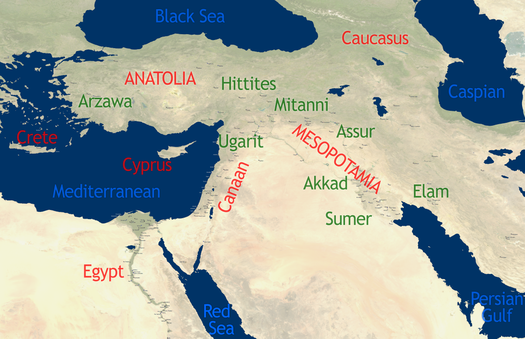
wikipedia commons
The ancient Near East was the home of early civilizations within a region roughly corresponding to the modern Middle East: Mesopotamia (modern Iraq, southeast Turkey, southwest Iran, northeastern Syria and Kuwait), ancient Egypt, ancient Iran (Elam, Media, Parthia and Persia), Anatolia/Asia Minor and Armenian Highlands (Turkey's Eastern Anatolia Region, Armenia, northwestern Iran, southern Georgia, and western Azerbaijan), the Levant (modern Syria, Lebanon, Palestine, Israel, and Jordan), Cyprus and the Arabian Peninsula. (wikipedia)
#10554
History / The Historical Perspective of the Middle East Turbulence
March 29, 2015, 07:16:25 PM
AN INTRODUCTION
may i devote this thread on the middle east, what it was, what it became with western colonialism, what it is now, and the religious divides that add heat to a simmering place, dangerously bringing it to a boil.
the reason for this thread is simple: i want to know why such a civilized, beautiful, storied place, the place of birth of the world's three monotheistic religions, is teetering on self-destruction, with the possibility of bringing the whole world down with it, into the maelstrom.
i may as well share here what i may find in terms of information and data, filtered to bite-sized and more understandable terms. for knowledge's sake. but mostly for the sake of shedding off bias against a great human race.

Kevin Kallaugher (KAL)
may i devote this thread on the middle east, what it was, what it became with western colonialism, what it is now, and the religious divides that add heat to a simmering place, dangerously bringing it to a boil.
the reason for this thread is simple: i want to know why such a civilized, beautiful, storied place, the place of birth of the world's three monotheistic religions, is teetering on self-destruction, with the possibility of bringing the whole world down with it, into the maelstrom.
i may as well share here what i may find in terms of information and data, filtered to bite-sized and more understandable terms. for knowledge's sake. but mostly for the sake of shedding off bias against a great human race.
Kevin Kallaugher (KAL)
#10555
LGU Philippines / Re: VP Binay considering Mar Roxas as running mate
March 29, 2015, 06:21:50 PMjust curious. on the other hand, is binay the father open to being invited by mar roxas as the running mate? if unity is the aim... oh, enough of those perditious and pernicious words from politicians' mouths.
#10556
Family & Parenting / Re: Understanding domestic violence and abuse
March 29, 2015, 10:29:12 AMfrom dswd, philippines

#10557
Family & Parenting / Re: Understanding domestic violence and abuse
March 29, 2015, 10:26:29 AMTalk to the person in private and let him or her know that you’re concerned. Point out the things you’ve noticed that make you worried. Tell the person that you’re there, whenever he or she feels ready to talk. Reassure the person that you’ll keep whatever is said between the two of you, and let him or her know that you’ll help in any way you can.
Remember, abusers are very good at controlling and manipulating their victims. People who have been emotionally abused or battered are depressed, drained, scared, ashamed, and confused. They need help to get out, yet they’ve often been isolated from their family and friends. By picking up on the warning signs and offering support, you can help them escape an abusive situation and begin healing.
http://www.helpguide.org/
#10558
Family & Parenting / Re: Understanding domestic violence and abuse
March 29, 2015, 10:23:51 AMSpeak up if you suspect domestic violence or abuse
If you suspect that someone you know is being abused, speak up! If you’re hesitatingâ€"telling yourself that it’s none of your business, you might be wrong, or the person might not want to talk about it â€" keep in mind that expressing your concern will let the person know that you care and may even save his or her life.
Do's and Don'ts
Do:
Ask if something is wrong
Express concern
Listen and validate
Offer help
Support his or her decisions
Don’t:
Wait for him or her to come to you
Judge or blame
Pressure him or her
Give advice
Place conditions on your support
Adapted from: NYS Office for the Prevention of Domestic Violence
#10559
Family & Parenting / Re: Understanding domestic violence and abuse
March 29, 2015, 10:20:20 AMThe psychological warning signs of abuse
People who are being abused may:
Have very low self-esteem, even if they used to be confident
Show major personality changes (e.g. an outgoing person becomes withdrawn)
Be depressed, anxious, or suicidal

#10560
Family & Parenting / Re: Understanding domestic violence and abuse
March 29, 2015, 10:13:43 AMWarning signs of isolation
People who are being isolated by their abuser may:
Be restricted from seeing family and friends
Rarely go out in public without their partner
Have limited access to money, credit cards, or the car

#10561
Family & Parenting / Re: Understanding domestic violence and abuse
March 29, 2015, 10:06:32 AMWarning signs of physical violence
People who are being physically abused may:
Have frequent injuries, with the excuse of “accidentsâ€
Frequently miss work, school, or social occasions, without explanation
Dress in clothing designed to hide bruises or scars (e.g. wearing long sleeves in the summer or sunglasses indoors)

#10562
Family & Parenting / Re: Understanding domestic violence and abuse
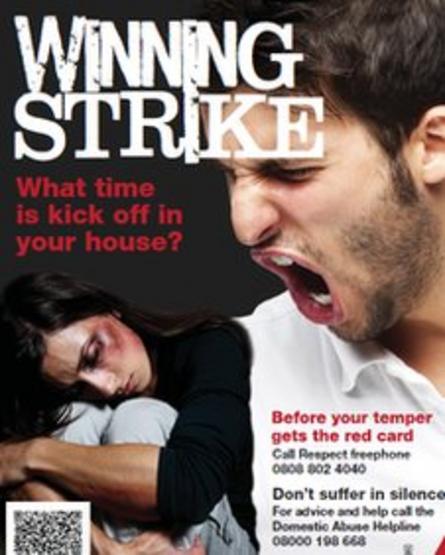
March 29, 2015, 09:07:22 AMGeneral warning signs of domestic abuse
People who are being abused may:
Seem afraid or anxious to please their partner
Go along with everything their partner says and does
Check in often with their partner to report where they are and what they’re doing
Receive frequent, harassing phone calls from their partner
Talk about their partner’s temper, jealousy, or possessiveness
#10563
Family & Parenting / Re: Understanding domestic violence and abuse
March 29, 2015, 09:01:36 AMRecognizing the warning signs of domestic violence and abuse
It's impossible to know with certainty what goes on behind closed doors, but there are some telltale signs and symptoms of emotional abuse and domestic violence. If you witness any warning signs of abuse in a friend, family member, or co-worker, take them very seriously.

#10564
Family & Parenting / Re: Understanding domestic violence and abuse
March 29, 2015, 08:55:35 AMThe Full Cycle of Domestic Violence: An Example
A man abuses his partner. After he hits her, he experiences self-directed guilt. He says, "I'm sorry for hurting you." What he does not say is, "Because I might get caught." He then rationalizes his behavior by saying that his partner is having an affair with someone. He tells her "If you weren't such a worthless whore I wouldn't have to hit you." He then acts contrite, reassuring her that he will not hurt her again. He then fantasizes and reflects on past abuse and how he will hurt her again. He plans on telling her to go to the store to get some groceries. What he withholds from her is that she has a certain amount of time to do the shopping. When she is held up in traffic and is a few minutes late, he feels completely justified in assaulting her because "you're having an affair with the store clerk." He has just set her up.
Source: Mid-Valley Women's Crisis Service
#10565
Family & Parenting / Re: Understanding domestic violence and abuse
March 29, 2015, 08:52:53 AMThe cycle of violence in domestic abuse
Domestic abuse falls into a common pattern, or cycle of violence:

Abuse â€" Your abusive partner lashes out with aggressive, belittling, or violent behavior. The abuse is a power play designed to show you "who is boss."
Guilt â€" After abusing you, your partner feels guilt, but not over what he's done. He’s more worried about the possibility of being caught and facing consequences for his abusive behavior.
Excuses â€" Your abuser rationalizes what he or she has done. The person may come up with a string of excuses or blame you for the abusive behaviorâ€"anything to avoid taking responsibility.
"Normal" behavior â€" The abuser does everything he can to regain control and keep the victim in the relationship. He may act as if nothing has happened, or he may turn on the charm. This peaceful honeymoon phase may give the victim hope that the abuser has really changed this time.
Fantasy and planning â€" Your abuser begins to fantasize about abusing you again. He spends a lot of time thinking about what you’ve done wrong and how he'll make you pay. Then he makes a plan for turning the fantasy of abuse into reality.
Set-up â€" Your abuser sets you up and puts his plan in motion, creating a situation where he can justify abusing you.
Your abuser’s apologies and loving gestures in between the episodes of abuse can make it difficult to leave. He may make you believe that you are the only person who can help him, that things will be different this time, and that he truly loves you. However, the dangers of staying are very real.
#10566
Family & Parenting / Re: Understanding domestic violence and abuse
March 29, 2015, 08:46:49 AMAbusers are able to control their behaviorâ€"they do it all the time
Abusers pick and choose whom to abuse. They don’t insult, threaten, or assault everyone in their life who gives them grief. Usually, they save their abuse for the people closest to them, the ones they claim to love.
Abusers carefully choose when and where to abuse. They control themselves until no one else is around to see their abusive behavior. They may act like everything is fine in public, but lash out instantly as soon as you’re alone.
Abusers are able to stop their abusive behavior when it benefits them. Most abusers are not out of control. In fact, they’re able to immediately stop their abusive behavior when it’s to their advantage to do so (for example, when the police show up or their boss calls).
Violent abusers usually direct their blows where they won’t show. Rather than acting out in a mindless rage, many physically violent abusers carefully aim their kicks and punches where the bruises and marks won’t show.
#10567
Family & Parenting / Re: Understanding domestic violence and abuse
March 29, 2015, 08:42:40 AMAbusers use a variety of tactics to manipulate you and exert their power:
Dominance â€" Abusive individuals need to feel in charge of the relationship. They will make decisions for you and the family, tell you what to do, and expect you to obey without question. Your abuser may treat you like a servant, child, or even as his or her possession.
Humiliation â€" An abuser will do everything he or she can to make you feel bad about yourself or defective in some way. After all, if you believe you're worthless and that no one else will want you, you're less likely to leave. Insults, name-calling, shaming, and public put-downs are all weapons of abuse designed to erode your self-esteem and make you feel powerless.
Isolation â€" In order to increase your dependence on him or her, an abusive partner will cut you off from the outside world. He or she may keep you from seeing family or friends, or even prevent you from going to work or school. You may have to ask permission to do anything, go anywhere, or see anyone.
Threats â€" Abusers commonly use threats to keep their partners from leaving or to scare them into dropping charges. Your abuser may threaten to hurt or kill you, your children, other family members, or even pets. He or she may also threaten to commit suicide, file false charges against you, or report you to child services.
Intimidation â€" Your abuser may use a variety of intimidation tactics designed to scare you into submission. Such tactics include making threatening looks or gestures, smashing things in front of you, destroying property, hurting your pets, or putting weapons on display. The clear message is that if you don't obey, there will be violent consequences.
Denial and blame â€" Abusers are very good at making excuses for the inexcusable. They will blame their abusive and violent behavior on a bad childhood, a bad day, and even on the victims of their abuse. Your abusive partner may minimize the abuse or deny that it occurred. He or she will commonly shift the responsibility on to you: Somehow, his or her violent and abusive behavior is your fault.

#10568
Family & Parenting / Re: Understanding domestic violence and abuse
March 29, 2015, 08:39:41 AMViolent and abusive behavior is the abuser’s choice
Despite what many people believe, domestic violence and abuse is not due to the abuser’s loss of control over his or her behavior. In fact, abusive behavior and violence is a deliberate choice made by the abuser in order to control you.
#10569
Family & Parenting / Re: Understanding domestic violence and abuse
March 29, 2015, 08:24:48 AMEconomic or financial abuse: A subtle form of emotional abuse
Remember, an abuser’s goal is to control you, and he or she will frequently use money to do so. Economic or financial abuse includes:
Rigidly controlling your finances
Withholding money or credit cards
Making you account for every penny you spend
Withholding basic necessities (food, clothes, medications, shelter)
Restricting you to an allowance
Preventing you from working or choosing your own career
Sabotaging your job (making you miss work, calling constantly)
Stealing from you or taking your money
#10570
Family & Parenting / Re: Understanding domestic violence and abuse
March 29, 2015, 08:19:42 AMUnderstanding emotional abuse
The aim of emotional abuse is to chip away at your feelings of self-worth and independence. If you’re the victim of emotional abuse, you may feel that there is no way out of the relationship or that without your abusive partner you have nothing.
Emotional abuse includes verbal abuse such as yelling, name-calling, blaming, and shaming. Isolation, intimidation, and controlling behavior also fall under emotional abuse. Additionally, abusers who use emotional or psychological abuse often throw in threats of physical violence or other repercussions if you don’t do what they want.
You may think that physical abuse is far worse than emotional abuse, since physical violence can send you to the hospital and leave you with scars. But, the scars of emotional abuse are very real, and they run deep. In fact, emotional abuse can be just as damaging as physical abuseâ€"sometimes even more so.

#10571
Family & Parenting / Re: Understanding domestic violence and abuse
March 29, 2015, 08:17:34 AM
Emotional abuse: It’s a bigger problem than you think
When people think of domestic abuse, they often picture battered women who have been physically assaulted. But not all abusive relationships involve violence. Just because you’re not battered and bruised doesn’t mean you’re not being abused. Many men and women suffer from emotional abuse, which is no less destructive. Unfortunately, emotional abuse is often minimized or overlooked â€" even by the person being abused.

When people think of domestic abuse, they often picture battered women who have been physically assaulted. But not all abusive relationships involve violence. Just because you’re not battered and bruised doesn’t mean you’re not being abused. Many men and women suffer from emotional abuse, which is no less destructive. Unfortunately, emotional abuse is often minimized or overlooked â€" even by the person being abused.
#10572
Family & Parenting / Re: Understanding domestic violence and abuse
March 29, 2015, 07:18:24 AM
It Is Still Abuse If...
The incidents of physical abuse seem minor when compared to those you have read about, seen on television or heard other women talk about. There isn’t a “better†or “worse†form of physical abuse; you can be severely injured as a result of being pushed, for example.
The incidents of physical abuse have only occurred one or two times in the relationship. Studies indicate that if your spouse/partner has injured you once, it is likely he will continue to physically assault you.
The physical assaults stopped when you became passive and gave up your right to express yourself as you desire, to move about freely and see others, and to make decisions. It is not a victory if you have to give up your rights as a person and a partner in exchange for not being assaulted!
There has not been any physical violence. Many women are emotionally and verbally assaulted. This can be as equally frightening and is often more confusing to try to understand.
Source: Breaking the Silence Handbook
#10573
Family & Parenting / Re: Understanding domestic violence and abuse
March 29, 2015, 07:11:37 AM
Sexual abuse is a form of physical abuse
Any situation in which you are forced to participate in unwanted, unsafe, or degrading sexual activity is sexual abuse. Forced sex, even by a spouse or intimate partner with whom you also have consensual sex, is an act of aggression and violence. Furthermore, people whose partners abuse them physically and sexually are at a higher risk of being seriously injured or killed.

Any situation in which you are forced to participate in unwanted, unsafe, or degrading sexual activity is sexual abuse. Forced sex, even by a spouse or intimate partner with whom you also have consensual sex, is an act of aggression and violence. Furthermore, people whose partners abuse them physically and sexually are at a higher risk of being seriously injured or killed.
#10574
Family & Parenting / Re: Understanding domestic violence and abuse
March 29, 2015, 07:04:40 AMPhysical abuse and domestic violence
When people talk about domestic violence, they are often referring to the physical abuse of a spouse or intimate partner. Physical abuse is the use of physical force against someone in a way that injures or endangers that person. Physical assault or battering is a crime, whether it occurs inside or outside of the family. The police have the power and authority to protect you from physical attack.

#10575
Family & Parenting / Re: Understanding domestic violence and abuse
March 29, 2015, 06:53:44 AMSigns of an abusive relationship
There are many signs of an abusive relationship. The most telling sign is fear of your partner. If you feel like you have to walk on eggshells around your partner â€" constantly watching what you say and do in order to avoid a blow-up â€" chances are your relationship is unhealthy and abusive. Other signs that you may be in an abusive relationship include a partner who belittles you or tries to control you, and feelings of self-loathing, helplessness, and desperation.

#10576
Family & Parenting / Re: Understanding domestic violence and abuse
March 29, 2015, 06:44:23 AMRecognizing abuse is the first step to getting help
Domestic abuse often escalates from threats and verbal abuse to violence. And while physical injury may be the most obvious danger, the emotional and psychological consequences of domestic abuse are also severe. Emotionally abusive relationships can destroy your self-worth, lead to anxiety and depression, and make you feel helpless and alone. No one should have to endure this kind of painâ€"and your first step to breaking free is recognizing that your situation is abusive. Once you acknowledge the reality of the abusive situation, then you can get the help you need.
#10577
Family & Parenting / Re: Understanding domestic violence and abuse
March 29, 2015, 06:42:52 AM
Domestic violence and abuse does not discriminate. It happens among heterosexual couples and in same-sex partnerships. It occurs within all age ranges, ethnic backgrounds, and economic levels. And while women are more commonly victimized, men are also abusedâ€"especially verbally and emotionally, although sometimes even physically as well. The bottom line is that abusive behavior is never acceptable, whether it’s coming from a man, a woman, a teenager, or an older adult. You deserve to feel valued, respected, and safe.
#10578
Family & Parenting / Re: Understanding domestic violence and abuse
March 29, 2015, 06:39:19 AMDomestic violence and abuse are used for one purpose and one purpose only: to gain and maintain total control over you. An abuser doesn’t “play fair.†Abusers use fear, guilt, shame, and intimidation to wear you down and keep you under his or her thumb. Your abuser may also threaten you, hurt you, or hurt those around you.

#10579
Family & Parenting / Understanding domestic violence and abuse
March 29, 2015, 06:34:47 AMDomestic abuse, also known as spousal abuse, occurs when one person in an intimate relationship or marriage tries to dominate and control the other person. Domestic abuse that includes physical violence is called domestic violence.

#10580
Family & Parenting / Re: Gikitkit ni mister
March 29, 2015, 06:23:58 AMkun di pa hunit si misis, posible pod nga morag lechon kawali ang aping.
#10581
Jokes and Humor / Re: Walking like a boss
March 29, 2015, 12:06:10 AMlooks like the walk of a filipino politician too.
#10582
Help & Support / Re: New Design of Tubag Bohol
March 29, 2015, 12:04:40 AMme gusta demasiado. just let function the buttons lo antes posible aron di na ko mag-minolde.
#10583
Photos Unlimited / Re: Ang kasubo, kasakit ug kamingaw sa nag-inusarang binilanggo
March 28, 2015, 11:37:26 PM
#10584
Photos Unlimited / Re: Ang kasubo, kasakit ug kamingaw sa nag-inusarang binilanggo
March 28, 2015, 11:33:07 PM
#10585
Photos Unlimited / Re: Ang kasubo, kasakit ug kamingaw sa nag-inusarang binilanggo
March 28, 2015, 11:31:32 PM




#10596
Poems and Poets / Re: My Cats
March 26, 2015, 03:16:31 AM
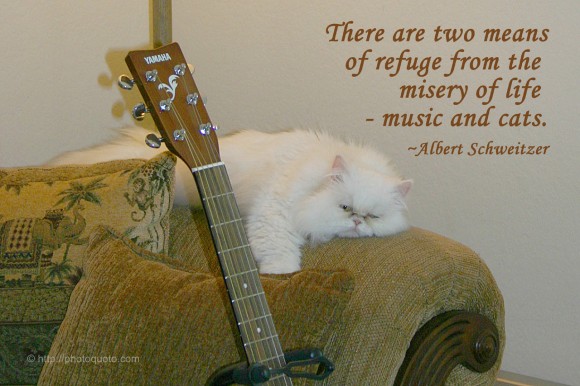
Of all God's creatures there is only one that cannot be made the slave of the lash. That one is the cat. If man could be crossed with the cat it would improve man, but it would deteriorate the cat. - Mark Twain, Notebook, 1894

#10597
Poems and Poets / Re: My Cats
March 26, 2015, 03:03:56 AM“If you want to write, keep cats.†â€" Aldous Huxley (author, Brave New World)

#10598
Poems and Poets / Re: My Cats
March 26, 2015, 02:55:17 AMi agree. i have 30 cats. long live the cats!
#10599
Lifestyle, Culture and Arts / Re: Teaching by phenomenon
March 26, 2015, 02:52:47 AMa real revolutionary method. i won't be surprised if it would be the students who would initiate teaching the teachers thus. well, i refer to my 13-year-old when there's something about the computer and the mobile phone that i just couldn't get.
#10600
World Daily News / Re: Lee Kuan Yew, Founding Father and First Premier of Singapore, Dies at 91
March 26, 2015, 02:38:41 AM"Low salaries will draw in the hypocrites who sweet talk their way into power in the name of public service, but once in charge will show their true colour, and ruin the country."
Pages 1 2 3 4 5 6 7 8 9 10 11 12 13 14 15 16 17 18 19 20 21 22 23 24 25 26 27 28 29 30 31 32 33 34 35 36 37 38 39 40 41 42 43 44 45 46 47 48 49 50 51 52 53 54 55 56 57 58 59 60 61 62 63 64 65 66 67 68 69 70 71 72 73 74 75 76 77 78 79 80 81 82 83 84 85 86 87 88 89 90 91 92 93 94 95 96 97 98 99 100 101 102 103 104 105 106 107 108 109 110 111 112 113 114 115 116 117 118 119 120 121 122 123 124 125 126 127 128 129 130 131 132 133 134 135 136 137 138 139 140 141 142 143 144 145 146 147 148 149 150 151 152 153 154 155 156 157 158 159 160 161 162 163 164 165 166 167 168 169 170 171 172 173 174 175 176 177 178 179 180 181 182 183 184 185 186 187 188 189 190 191 192 193 194 195 196 197 198 199 200 201 202 203 204 205 206 207 208 209 210 211 212 213 214 215 216 217 218 219 220 221 222 223 224 225 226 227 228 229 230 231 232 233 234 235 236 237 238 239 240 241 242 243 244 245 246 247 248 249 250 251 252 253 254 255 256 257 258 259 260 261 262 263 264 265 266 267 268 269 270 271 272 273 274 275 276 277 278 279 280 281 282 283 284 285 286 287 288 289 290 291 292 293 294 295 296 297 298 299 300 301 302 303 304 305 306 307 308 309 310 311 312 313 314 315 316 317 318 319 320 321 322 323 324 325 326 327 328 329 330 331 332 333 334 335 336 337 338 339 340 341 342 343 344 345 346 347 348 349 350 351 352 353 354 355 356 357 358 359 360 361 362 363 364 365 366 367 368 369 370 371 372 373 374 375 376 377 378 379 380 381 382 383 384 385 386 387 388 389 390 391 392 393 394 395 396 397 398 399 400 401 402 403 404 405 406 407 408 409 410 411 412 413 414 415 416 417 418 419 420 421 422 423 424 425 426 427 428 429 430 431 432 433 434 435 436 437 438 439 440 441 442 443 444 445 446 447 448 449 450 451 452 453 454 455 456 457 458 459 460 461 462 463 464 465 466 467 468 469