Join MikeLigalig.com!

Why Just Read When You Can Join, Post, and Read!

Menu

Show posts

This section allows you to view all posts made by this member. Note that you can only see posts made in areas you currently have access to.

Show posts Menu

Messages - islander

#101
Science and Research / Re: Mars! (Part 2)
May 23, 2020, 04:59:03 AM


A carbon dioxide ice cap showing "spiders" which are the spider-like mounds that form when carbon dioxide ice below the surface heats up and releases.
NASA


This enhanced scene from the panoramic camera (Pancam) on NASA's Mars Exploration Rover Opportunity shows the "Spirit Mound".
NASA
#102
Science and Research / Re: Mars! (Part 2)
May 23, 2020, 04:54:01 AM


The nodule in the center of this image from NASA's Curiosity Mars rover shows individual grains of sand.
NASA


This is a fresh, well-preserved landslide and a giant outflow channel carved by ancient floods.
NASA
#103
Science and Research / Re: Mars! (Part 2)
May 23, 2020, 04:50:01 AM


Here are several smaller craters that formed on the floor of Saheki Crater, a 53-mile diameter impact crater north of Hellas Basin.
NASA


Here is one possible place where sand grains are produced on Mars today.
NASA
#104
Science and Research / Re: Mars! (Part 2)
May 23, 2020, 04:44:30 AM

Thinking About Colonization

The search for life is also on the front burner. When scientists discovered water on Mars in the form of ice, they had to wonder if life ever existed on Mars, or if it still could, or if it had the potential to someday arise. Mars pictures from the planet's orbiter show what's called the Korolev crater, and it's a 50.6-mile in diameter crater full of crystal clear ice — could be promising, no?

Researchers are also considering what it takes for humans to survive on Mars if we ever hope to colonize it. There are some who are not only excited but serious about achieving this. Elon Musk is one of those people. "You know there's lots of people who climb mountains. You know why do they climb mountains? People die on Mount Everest all the time," he said. "They like doing it for the challenge."
#105
Science and Research / Re: Mars! (Part 2)
May 23, 2020, 04:42:04 AM


A bird's-eye view of the Curiosity rover (the dot, left centered).
NASA


Mars' Northernmost Polar cap is not only a year-round fixture but ringed by sand dunes. In the winter and spring, the dunes are also frozen, covered by a seasonal cap of dry ice.
NASA
#106
Science and Research / Re: Mars! (Part 2)
May 23, 2020, 04:34:46 AM


The McLaughlin Crater, center, is a large impact crater.
NASA


This view from the Mast Camera (Mastcam) on NASA's Curiosity rover shows a hillside outcrop with layered rocks.
NASA
#107
Science and Research / Re: Mars! (Part 2)
May 23, 2020, 04:29:33 AM


The Korolev crater, a 50.6-mile wide crater just south of the northern polar cap. The crater is filled almost to the brim with pristine ice year-round.
ESA/DLR/FU Berlin, CC BY-SA 3.0 IGO


One of millions of small craters that dot the Elysium Planitia region of Mars.
NASA
#108
Science and Research / Re: Mars! (Part 2)
May 23, 2020, 04:23:21 AM


The dark, smooth-surfaced object at the center of this Oct. 30, 2016, image was examined with laser pulses and discovered to be an iron-nickel meteorite.
NASA


Dunes within what's known as the Arkhangelsky Crater. The red bar is an artifact of NASA image processing.
NASA/JPL/University of Arizona
#109
Science and Research / Re: Mars! (Part 2)
May 23, 2020, 04:18:37 AM

The Mars Reconnaissance Orbiter surveys the planet with close-up Mars pictures and features the largest camera ever included on a planetary mission. This camera is unique as it can discern something as small as an office desk on the planet below. One key element in its mission is also to identify ice, water, and any other clues for the potential of life.

In fact, Mars' formation and evolution are comparable to Earth's. About 3.8-3.5 billion years ago, Mars and Earth shared a lot of similarities. For one, Mars was likely much warmer and wetter which means that perhaps life had the potential to arise in this time. There is a lot to glean about our own planet's past — and future — by studying Mars in greater detail, and often through pictures of Mars like these.
#110
Science and Research / Re: Mars! (Part 2)
May 23, 2020, 04:14:45 AM


An inverted river channel.
NASA


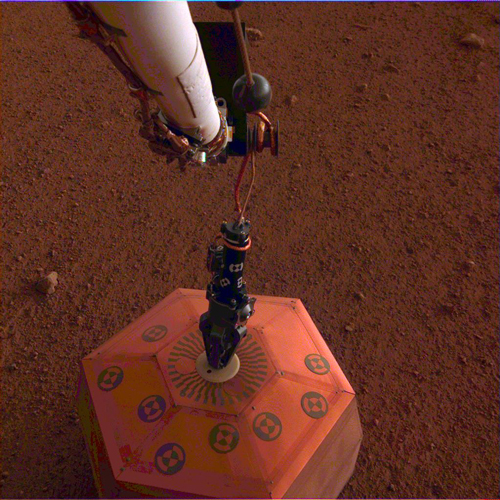
NASA's InSight lander placed a seismometer onto Mars on Dec. 19, 2018. This device measures ground motions like earthquakes, volcanic eruptions, and explosions. This is the first time a seismometer has ever been placed onto the surface of another planet.
NASA
#111
Science and Research / Re: Mars! (Part 2)
May 23, 2020, 04:09:32 AM


Layered deposits in Uzboi Vallis, which sometimes occur in alcoves along the valley or below where tributaries enter it.
NASA


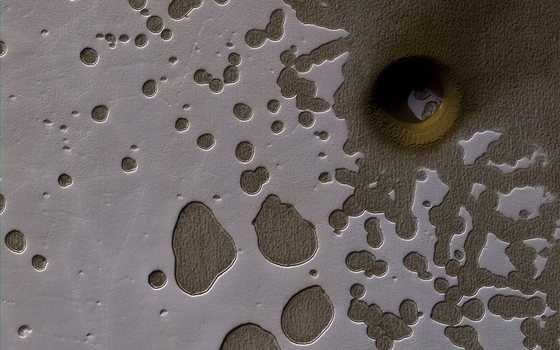
These shallow pits in ice of carbon dioxide are called "Swiss cheese terrain". There is also what might be an impact crater or collapsed pit beneath.
NASA
#112
Science and Research / Re: Mars! (Part 2)
May 23, 2020, 04:03:11 AM

How Mars Pictures Are Taken

The colorization in these Mars pictures is altogether pretty accurate. When the rover sends Mars pictures back to earth, each pixel in the image is coded in zeros and ones, this binary code is then translated into color and brightness once it's picked up by earth's deep space antennas.

"We're basically doing a more sophisticated version of 'Paint by Numbers' when we reconstruct the images," reported Eric De Jong, one of the team members responsible for processing photos of Mars.

The Mars pictures in the gallery above are shot by the Mars Reconnaissance Orbiter, which was launched from Cape Canaveral in 2005, and also from Mars' Curiosity Rover, which is the largest and most capable rover ever sent to Mars and was launched in 2011. Both devices arrived at the red planet about a year after their launch.
#113
Science and Research / Re: Mars! (Part 2)
May 23, 2020, 04:01:42 AM


An area of strange texture on the southern floor of what's known as Gale Crater.
NASA


The edge of a large deposit of wind-blown dust.
NASA
#114
Science and Research / Re: Mars! (Part 2)
May 23, 2020, 03:54:41 AM


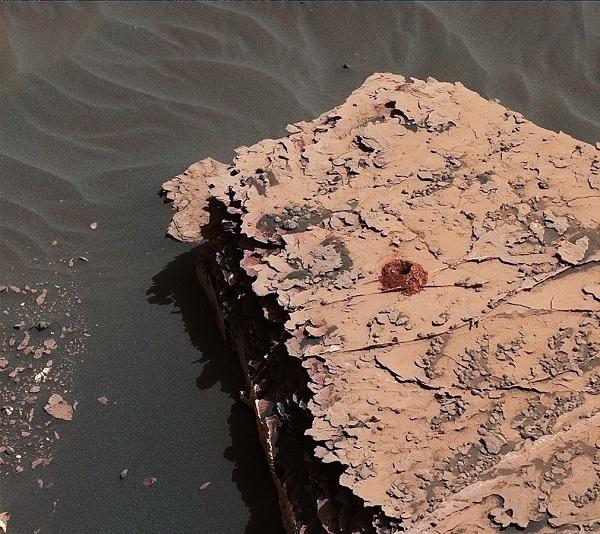
NASA's Curiosity rover successfully drilled a two-inch hole on May 20, 2018. It was the first rock sample captured by the drill since October 2016 when a mechanical issue took the drill offline.
NASA


More bedrock of an unnamed crater.
NASA
#115
Science and Research / Re: Mars! (Part 2)
May 23, 2020, 03:50:02 AM


The Curiosity rover takes a selfie.
NASA


The team operating NASA's Curiosity Mars rover uses the Mars Hand Lens Imager (MAHLI) camera on the rover's arm to check the condition of the wheels at routine intervals.
NASA
#116
Science and Research / Re: Mars! (Part 2)
May 23, 2020, 03:42:29 AM

Ever since NASA's Mariner-4 spacecraft collected the first Mars pictures by way of flyby in 1965, the public has been enraptured by the red planet.

Now, it's easier than ever before to witness the celestial beauty that resides on the red planet with the help of modern orbiters and rovers.

Through pictures of Mars, we have been able to discover that the fourth planet from the sun is not so unlike the roughest conditions on our own home planet. Mars features the remnants of what once were volcanoes, meteors and craters, flash floods, and frost. Though the red planet now is a fairly hostile environment for humans — with freezing temperatures and air of mostly carbon dioxide — NASA forges ahead with plans to send people there — possibly by the 2030s. But for what purpose, exactly?
#117
Science and Research / Re: Mars! (Part 2)
May 23, 2020, 03:24:08 AM


Here Mars' bedrock is exposed except where covered by sand dunes, as shot by NASA's Mars Reconnaissance Orbiter.
NASA


This image shows a set of pits, faults, and layers on Mars' western Valles Marineris.
NASA
#118
Science and Research / Mars! (Part 2)
May 23, 2020, 03:01:21 AM

29 Out-Of-This-World Photos Of Mars To Blow Your Earthling Mind

By Erin Kelly
January 28, 2019

These amazing photos of Mars show just how varied — and not so alien — some of the terrain is on the fourth planet.


This image from NASA's Mars Reconnaissance Orbiter shows Aram Chaos, a 174-mile wide impact crater that lies within in the Southern Highlands of Mars.
NASA
#120

Answers

"The empty cell mystery". The answer: Andy has to use the shovel to create a pile of dirt under the window so he can climb up onto it and escape from the cell.

"The poisonous drinks". The answer: The poison was in the ice. Since Marissa's ice had time to melt, she was poisoned but Juliana wasn't.

"Suicide ... or not?". The answer: She couldn't have jumped from any of the floors because when the detective went to each floor, all of the windows were closed.

"Love at a funeral". The answer: She killed her sister. She was hoping that if someone else in her family died, the man she met at her mother's funeral would show up again. (No one has figured out these strange science mysteries yet, can you?)

"The stolen ring". The answer: As soon as the police got to the "crime scene," they knew that Nicole has most likely staged the break-in. The glass from the broken window was all outside of the house, meaning that it had been broken from the inside.

"The thief at sea". The answer: It was clearly the seaman. It was a Japanese ship and a Japanese flag is white with a single red dot in the middle. It can't be hung upside down.

"A murder at school". The answer: The math teacher killed the history teacher. He claimed that he was giving a mid-year test, but it was the first day of school.

"The poisonous pills". The answer: Neither of the pills was poisonous. The poison was in the water that all the victims used to swallow their pill.

"The honeymoon mystery". The answer: The travel agent revealed that he had only booked a one-way ticket for his wife.

"The science case". The answer: There was a very obvious clue on the piece of paper. If you combine the abbreviations of the chemical substances on the paper, you'll get a name: Ni-C-O-La-S.

"The recorded last words". The answer: If the dead man had killed himself, he wouldn't have been able to press the reverse button on the cassette recorder.

"Guilty in court". The answer: The woman was watching the jury and not the doors because she knew that her husband wouldn't walk through them because she had killed him. If she has really missed him as she said, she would have been watching the doors.

https://www.businessinsider.com/
#121

"Guilty in court"


Case closed.

A woman was in court for killing her husband. She said she wasn't guilty and that she dearly missed him. In the closing statement, the woman's lawyer stands up and says, "Her husband was just missing. Everyone looks at the doors. He's going to walk through them in about 30 seconds."

The entire jury stares at the doors waiting for this woman's husband to walk through the doors. The lawyer and the woman stare at the jury.

The lawyer concludes by saying, "See! If you were so sure she killed her husband, you wouldn't be watching that door!"

The jury immediately gave a guilty verdict. Why?
#122

"The recorded last words"


Think twice about this one. Christopher Boswell/Shutterstock

A man was found on the floor dead with a cassette recorder in one hand and a gun in the other. When the police arrive at the scene they pressed play on the recorder. It was the man's voice. He said, "I have nothing else to live for. I can't go on," followed by the sound of a gunshot. After listening, the police knew that this was a murder, not a suicide. How?
#123

"The science case"


The chemist left behind a useful clue. AP/Jeff Chiu

A chemist was murdered in his own lab. The only evidence was a piece of paper that had the names of chemical substances written on it. The substances were nickel, carbon, oxygen, lanthanum, and sulfur. The chemist only had three people come by his lab on the day of the murder: fellow scientist Claire, his nephew Nicolas, his wife, and his friend Marc. The police arrested the murderer right away. How did they know who it was?
#124

"The honeymoon mystery"


This killer wasn't the smartest. conejota/Shutterstock

A couple went to Hawaii for their honeymoon. Unfortunately, the husband returned home alone because his wife had died in a horrible boating accident. The police contacted the travel agent he booked the trip with and arrested him for murdering his wife. How did they know he did it?
#125

"The poisonous pills"


How did he poison them? Sarah Schmalbruch/INSIDER

A serial killer kidnapped five different people and sat them down each with two pills in their hand and a glass of water. He told them each to take one pill but warned them that one was poisonous and the other was harmless. Whichever pill the victim didn't take, the serial killer would take. Every victim somehow chose the poisonous pill and died. How did the serial killer get them all to take the poisonous pill?
#126

"A murder at school"


This isn't a tough one. Bill Pugliano/Getty Images

On the first day of school, someone murdered a history teacher. There were four people at the school that the police suspected had done it: the landscaper, a math teacher, a basketball coach, and the principal. These were their alibis:

The landscaper said he was outside mowing the lawn.

The math teacher said he was giving a mid-year test.

The basketball coach said he was running practice drills with his players.

The principal said she was in her office.

After giving their alibis, the police arrested the killer immediately. Who killed the history teacher and how did the police know?
#127

"The thief at sea"


Look closely at the flag. Koichi Kamoshida Getty Images

A Japanese ship was leaving the port and on its way to the open sea. The captain went to go oil some parts of the ship and took his ring off so it wouldn't get damaged. He left it on the table next to his bunk. When he returned, it was missing. He had suspected three crew members could be guilty and asked them what they had been doing for the ten minutes that he had been gone.

The cook said, "I was in the kitchen preparing tonight's dinner."

The engineer said, "I was working in the engine room making sure everything was running smoothly."

The seaman said, "I was on the mast correcting the flag because someone had attached it upside down by mistake."

The captain immediately knew who it was. How?
#128

"The stolen ring"


Why did police suspect Nicole? Flickr / Jo Naylor

Nicole went to the police to report that someone had stolen her vintage ring. When the police got to her house they notice that the window was broken, there was a total mess inside, and there were dirty footprints on the carpet. But, there were no other signs of a break-in.

The next day, the police arrested Nicole for fraud. Why?
#129

"Love at a funeral"


Who killed the sister? loonybat/Flickr

A girl is at the funeral of her mother. She meets a nice guy that she didn't know who also was at the funeral and they hit it off. She was busy at the funeral and didn't have time to ask him for his number before he left. She tried really hard to track him down, but no one knew who he was or how to contact him. A few days later her sister dies and the police suspect it to be a murder. Who killed her sister?
#130

"Suicide ... or not?"


How does the detective know it's not a suicide? Hollis Johnson

A dead female body lies at the bottom of a multistory building. It looks as though she committed suicide by jumping from one of the floors.

When the detective arrives, he goes to the first floor of the building, opens the closed window, and flips a coin towards the floor. He goes to the second floor and does the exact same thing. He continues to do this until he gets to the top floor of the building.

When he comes back down, he states that it was a murder and not a suicide. How does he know that?
#131

"The poisonous drinks"


How did only Marissa die? Al_HikesAZ/Flickr

Marissa and Juliana went out for drinks together. They ordered the same drink. Juliana was really thirsty and finished five in the time it took Marissa to finish one. The drinks were poisoned, but only Marissa died. How?
#132

challenge yourself by solving these mysteries first (before reading the answers at the last post of these puzzles). 

"The empty cell mystery"


How can Andy escape? REUTERS/Dario Pignatelli

Andy is put in a cell with a dirt floor and only one window. The window is too high for him to reach. The only thing in the cell is a shovel. He won't be able to get any food or water and only has two days to escape or he'll die. Andy can't dig a tunnel because it will take him much longer than two days to do it. How will Andy escape from the cell?
#133

Of course, those countries have still seen second waves of the virus.

"That approach requires constant vigilance," Cutrell acknowledged. But even as scientists and doctors work to develop effective treatments and a vaccine, he said "thoughtful and incremental" strategies can help us move forward to "a period of more normal activities."

Experts are still learning about the novel coronavirus. The information in this story is what was known or available as of press time, but its possible guidance around COVID-19 could change as scientists discover more about the virus. Please check the Centers for Disease Control and Prevention for the most updated recommendations.

https://www.huffpost.com/
#134

Until we have a vaccine or meaningful treatment, we need to proceed with caution, ramp up testing and isolate the sick quickly if we hope to get back to some "semblance of normalcy," Cutrell said.

"In my opinion, before we have effective treatment or vaccine, we will have to behave similarly to South Korea, Singapore or Hong Kong, with widespread access to testing, contact tracing and isolation, quarantining people in cases of potential contact," he said. "In doing this, they've been able to stave off having large scale epidemics in their country and are allowed to be a little more open than other places where those things are not in place."
#135

"Before we have effective treatment or vaccine, we will have to behave similarly to South Korea, Singapore or Hong Kong, with widespread access to testing, contact tracing and isolation, quarantining people in cases of potential contact."

- JAMES CUTRELL, DIRECTOR OF THE INFECTIOUS DISEASE FELLOWSHIP PROGRAM AT THE UNIVERSITY OF TEXAS SOUTHWESTERN MEDICAL CENTER
#136

"There are also concerns about safety, including cardiac issues and arrhythmias that give doctors pause," Cutrell said, noting that the FDA recently advised Americans not to use hydroxychloroquine outside of a hospital setting.

Finally, COVID-19 might be treatable with convalescent plasma.

"This is where people who have had the disease and recovered donate plasma, and that plasma is given to someone with an active stage of disease," Cutrell explained.

The antibodies and proteins in that plasma could potentially help someone with COVID-19 recover. (You may be able to donate plasma if you have recovered from the coronavirus.)
#137

"A lot of times patients with this virus get sicker in the second week of their illness ― and it's not the virus, but the immune system that makes them get quite sick," Cutrell said. "They experience an exaggerated state of inflammation or 'cytokine storm.'"

Some drugs that might dampen the immune system's effects are currently in clinical trials.

Then there's the now-controversial drug hydroxychloroquine, which has "long been used for malaria or inflammatory conditions like rheumatoid arthritis or lupus," Cutrell said.

Although the drug received a lot of early attention, the studies showing potential benefits for COVID-19 patients have been mostly anecdotal with no control groups to compare against.
#138

Possible coronavirus treatments are also being developed.

Besides vaccine trials, researchers are testing potential treatments for COVID-19. Instead of preventing the disease, these aim to make sick people well again.

"One of the treatments that has gotten a lot of attention is remdesivir, but the data available so far is fairly limited," Cutrell said. No trials comparing use of the antiviral drug against a control group have been published so far. That said, studies are coming, including a National Institutes of Health clinical trial comparing remdesivir against a placebo.

There are also drugs that could potentially address the immune system's response to the virus.
#139

Scientists will still want to minimize risks and ensure the safest possible rollout of a vaccine. "But given the outbreak globally and the impact it's having, I can imagine there are ways to design trials to accelerate testing," Lee said.

There could also be an unconventional study design for the coronavirus vaccine, according to a new report published in the Journal of Infectious Diseases. In place of traditional Phase 3 trials, volunteers at low risk of developing a severe form of COVID-19 ― healthy people without chronic conditions in their 20s, for instance ― might opt in for a "human challenge study." They could be exposed to the coronavirus, monitored closely and given the best care.

This type of study would involve fewer participants and could be done in less time than a traditional Phase 3. Of course, the idea would need to be rigorously discussed beforehand as ethics rules generally forbid deliberately infecting human beings with a serious disease.
#140

"You have some newer technologies that some companies are trying to leverage, where they were already prepared to respond to a pandemic," said Lee. "You can shorten some of that discovery and early development timeline."

Newer biotechnology-based methods, sometimes called "cell culture methods," could make for more rapid development, he said.

Additionally, with a pandemic circling the world, American researchers are hardly alone. There's a global effort to find a viable vaccine.

"You've got private companies and scientists trying to work together on the vaccine. That collaboration can certainly help accelerate the timeline," Lee said.
#141


YULIA REZNIKOV VIA GETTY IMAGES

Scientists might be able to create a COVID-19 vaccine faster than normal.

While it's hard to say when researchers will have a viable vaccine, there are a few factors that could speed up the timeline for this coronavirus vaccine.

Traditional approaches to creating vaccines ― like the use of chicken eggs ― are proven but not necessarily speedy.
#142

The goal is to vaccinate huge numbers of people, "so you then develop immunity in the community that would protect against larger outbreaks," Cutrell said.

Testing and monitoring ― essentially Phase 4 ― continue even after the vaccine is generally available because it takes time to ensure safety, Lee said. "You don't know if something bad is going to happen a month later, two months later, a year later."

Common side effects of vaccines include redness and pain at the site of injection and maybe a low-grade fever; side effects like seizures or allergic reactions are extremely rare. But the bottom line is that scientists and doctors aim to develop a vaccine where the protective benefits far outweigh the risks.
#143

"You would take a susceptible population, vaccinate some while having a control group, and monitor the effect over time and see if there's any difficulty," Cutrell said.

Here, researchers may look for common, short-term side effects and at what dosages those side effects pop up.

"All that has to be done first, and then if Phase 3 shows the vaccine is safe and effective, that's when you'd look at licensing," Cutrell said.

Even after you have a working vaccine approved by the Food and Drug Administration, it still takes time to mass-produce and distribute it across the country.
#144

To roll out a vaccine requires a lot of safety testing. During Phase 1, researchers take a small number of healthy volunteers and test the vaccine for serious side effects, Cutrell explained.

Phase 2 involves smaller studies looking at efficacy, he said. This includes figuring out the best dosage of the vaccine, the scheduling of dosages if you need multiple ones, and more. Scientists will consider whether the vaccine still appears safe enough and whether the immune response or antibody buildup is great enough to warrant moving on to additional clinical studies.

In Phase 3, you will see larger field studies.
#145

"It's very different from developing medicine where someone is ill and you are trying to make them better. In a healthy population, you don't want the vaccine to have negative consequences."

- KELVIN LEE, DIRECTOR OF THE NATIONAL INSTITUTE FOR INNOVATION IN MANUFACTURING BIOPHARMACEUTICALS
#146

There are several kinds of vaccines. Some have a tiny, weakened bit of live virus, which triggers a protective immune response in your body but does not cause the actual illness. Some contain an inactive virus that creates a similar response in the body. And some utilize genetically engineered RNA or DNA, which carries "directions" to make the type of protein that can prevent the virus from binding to our cells and making us ill.

Once researchers decide which vaccine route they think will work best, they get to testing.

"This is where time really comes into play," Lee said. "Even after you do lab tests to make sure it works in the proverbial petri dish, in many cases vaccines will undergo tests in animals to ensure that it's going to be safe for humans and has the desired response. And then, where it really starts to take time is in the human clinical trials."
#147

A vaccine must be rigorously tested before the public gets it.

We often think of vaccines as treatments for illness, but they're not exactly that, said Kelvin Lee, a professor of chemical and biomolecular engineering at the University of Delaware and director of the National Institute for Innovation in Manufacturing Biopharmaceuticals. Vaccines are given to people who are well to keep them from getting sick.

"It's very different from developing medicine where someone is ill and you are trying to make them better. In a healthy population, you don't want the vaccine to have negative consequences," he said.

First, Lee said, researchers will study the virus and attempt to determine which type of vaccine may work best.
#148

More commonly, the development of a vaccine takes eight to 10 years. Can a COVID-19 vaccine be created any faster? There's certainly hope, but no certainty.

"I'd say the 12 to 18 months that's been bandied about by some experts is realistic, but it's [also] optimistic," said James Cutrell, director of the infectious disease fellowship program at the University of Texas Southwestern Medical Center in Dallas. "It is based on the assumption that each phase of trials goes according to plan, with an optimistic time frame at each of those stages."

Here's what goes into each phase of developing a vaccine.
#149

CORONAVIRUS

Why It Takes So Long To Make A Coronavirus Vaccine

This is what goes into creating a COVID-19 shot that can give us immunity against the virus. (Hint: It's a lot.)

By Jenna Birch
April 30, 2020

As of the end of April, the World Health Organization was tracking 71 coronavirus vaccines in preclinical trials, with five additional candidates already in clinical trials. Given how recently the COVID-19 pandemic began spreading, it might seem promising that there's already a lot of activity on the immunization front.

With so many potential vaccines in testing, you also may wonder why medical experts say it will take at least 12 to 18 months before one is ready to go. If a coronavirus vaccine did make it to market on such a timetable, it would actually be the fastest turnaround in history. Currently, that record belongs to the mumps vaccine, which was approved for use in just four years back in the 1960s. For Ebola, a vaccine took five years to develop.
#150

Liquids


Yes, that's why you wake up twice in the night to go to the bathroom. It's so important to have an uninterrupted full night's sleep. Try to stop consuming any liquids after 8 p.m. (just make sure to stay hydrated throughout the day).

https://www.yahoo.com/
#151

Spicy Foods


Spicy foods are another treat better left for daytime. A spicy meal can cause indigestion and irritation of the upper digestive tract. This can cause pain and acid reflux, which can prevent you from getting a peaceful night of sleep.
#152

Red Meat


High-protein, fatty animal meat is one of the toughest foods for our bodies to digest. If you happen to eat red meat in the evening, make a conscious effort to chew it properly to ease its digestibility.
#153

Alcohol


You may think a glass of wine will help you unwind, but it can actually disrupt your sleep cycle. You may fall asleep faster, but you're likely to find yourself unable to stay asleep—and end up with a headache in the morning. Make sure you drink enough water to balance out the effects of alcohol.
#154

Coffee


This rule is pretty simple: no coffee at least six hours before bedtime. Also, beware of hidden caffeine like the kind found in chocolate and soda. Yes, that little piece of dark chocolate you had to quench your sugar craving could be the root of your tossing and turning!
#155

Fried Foods


Beware of these little pockets of grease! Your system will go into overdrive trying to break them down. Stay clear of high-fat culprits like French fries and chicken wings for dinner.
#156

These 6 Foods Are the Reason You Can't Sleep, According to a Nutritionist

Alicia Rountree
May 10, 2020


We pick the brains of models day in and day out, constantly prying into their medicine cabinets and kitchen cupboards in an attempt to uncover their elusive model secrets. In these endeavors, we hear a lot about eating clean and avoiding sugar, but rarely do we hear diet tips from a model who also happens to have her degree in nutritional science. That's exactly what we found in Alicia Rountree. The Mauritian model (she's got the island hair and bronzed glow to prove it) is also a certified nutritionist and restaurateur (she has to be able to put her knowledge into practice, right?), and today she's sharing her secrets with us.

Are you having difficulty sleeping and don't know why? Sure, we all have times when stress is the culprit, and we find ourselves tossing and turning all night. But stress may not be the only reason you're still tossing and turning. It may sound surprising, but the foods you eat can have a huge impact on your ability to get a restful night's sleep and lead to a groggy morning. Take a look at the foods that cause insomnia below, and try avoiding them if you find yourself munching on them in the evening.
#157

i wonder how "metallic bitterness" tastes. did those chefs who said this ever tasted metal?
#158
Health and Food / Re: About skin cancer
May 05, 2020, 03:19:20 AM

Remain aware, even if you're young. Cancer is often thought of as an older person's disease, but skin cancer especially does not follow this pattern. "The number one cause of cancer deaths in patients aged 25 to 29 is melanoma," says Markowitz. Fortunately for all of us in quarantine, patients can have the majority of skin cancer managed from the safety of their home today. The exception remains melanoma, which falls under an essential emergency service that requires immediate surgical attention, according to Markowitz. Melanoma is the least common yet deadliest form of skin cancer, accounting for one percent of all cases, with 2020 projections of 100,350 new cases and 6,850 deaths, according to AIM At Melanoma Foundation. The key to combating any type of skin cancer, including melanoma, is educating yourself on the signs, performing self-exams, and seeing a board-certified dermatologist for guidance when that weird spot just does not look right.

https://www.yahoo.com/
#159
Health and Food / Re: About skin cancer
May 05, 2020, 03:17:46 AM

Don't rely on apps. These days, there's an app for everything. Yet experts warn that apps that claim to track and analyze suspicious moles aren't reliable. In a study published by the BMJ (British Medical Journal), researchers found poor results from smartphone apps using algorithms to alert users to potentially problematic spots. "All of the literature and research shows there is no evidence-based medicine or science that shows current artificial intelligence embedded in smartphone apps helps detect suspicious lesions," says Markowitz, who adds that most of the time, they simply suggest you consult a dermatologist anyway. She does note that apps that provide sun safety help like daily UV index levels, prompts to apply and reapply sunscreen and reminders to get skin checks are all helpful in mitigating behaviors that increase your chance of skin cancer.
#160
Health and Food / Re: About skin cancer
May 05, 2020, 03:16:09 AM

Schedule a telemedicine appointment. Dermatologists are now doing "telederm" visits on platforms like Zoom to diagnose common basal cell carcinomas and squamous cell carcinomas over screens. Most offices offer the ability to send messages and photos securely over patient portals, and your dermatologist can then guide you on the best course of action. Suspected melanomas do require an in-office visit, though some dermatologists are utilizing new technology to make sure you really have to make the trip, like Orit Markowitz, MD, director of Pigmented Lesions and Skin Cancer at Mount Sinai in New York City. Markowitz has patients take a dermatoscope image with their smartphone at home so she can study it in detailed magnification. If it looks like melanoma, she sends the patient a PLA test, which is a tape-like adhesive that the patient places on the spot under clinician supervision. When peeled off, the adhesive removes a small sample of skin cells that is then sent to an independent lab for testing to rule out melanoma. If melanoma can't be ruled out, an in-office appointment follows. This also helps prevent unnecessary hospital visits for patients during the COVID-19 pandemic, says Markowitz.
#161
Health and Food / Re: About skin cancer
May 05, 2020, 03:14:13 AM

Know what to look for. If you have a lesion on your face that might look like a pimple but hasn't gone away in over a month, reach out to your doctor because a regular zit usually resolves within that time frame, says Saedi. Some skin cancers can appear as scaly growths that bleed or develop a crust or pop up as a sore that doesn't heal. Also, remember the "ABCDE" of spotting a melanoma skin lesion: asymmetry, irregular border, color changing, diameter larger than 6mm (the size of a pencil eraser), and anything that is evolving. What should you not worry about? Barnacles, as Saedi refers to them, a  nickname for seborrheic keratosis. "Barnacles have a waxy, stuck on, pasted appearance— they often start off as light brown or tan spots that can get thicker with time and can get irritated and bleed," explains Saedi. If in doubt, always contact a board-certified dermatologist for a medical opinion.
#162
Health and Food / Re: About skin cancer
May 05, 2020, 03:11:32 AM

Stay calm. The good news is that skin cancer is not a fast-moving cancer. The National Comprehensive Cancer Network (NCCN) has advised dermatologists to delay most skin cancer appointments and treatments by three months right now, says Philadelphia-based dermatologist, Nazanin Saedi, MD. "It's unsettling for patients to hear that we're diagnosing a form of skin cancer but holding off on treatment until the office reopens for routine procedures  — we try to reassure patients — these are slow-growing skin cancers that do not tend to spread internally," says Saedi. For any spot that looks like melanoma, the deadliest form of skin cancer that is still 99 percent treatable if caught early, patients can come into the office for an urgent appointment, she adds.
#163
Health and Food / About skin cancer
May 05, 2020, 03:10:12 AM

What if I get a weird spot or bump during quarantine?

Grace Gold
May 4, 2020


The key to combating any type of skin cancer, including melanoma, is educating yourself on the signs, performing self-exams and seeing a board-certified dermatologist for guidance when that weird spot just does not look right. (Photo: Getty Creative)

May is Skin Cancer Awareness Month and May 4 is Melanoma Monday. Skin cancer is the most common form of cancer in the United States, and approximately 9,500 people in the U.S. are diagnosed with skin cancer every day. Yahoo Life is driving awareness with this expert-driven article to help people spot early signs of skin cancer at home.

If you've ever had a skin lesion zapped off to prevent or treat skin cancer, you're not alone; more people are diagnosed with skin cancer each year in the U.S. than all other cancers combined, according to the Skin Cancer Foundation. But just because we're homebound with dermatology offices closed to routine procedures like skin checkups, doesn't mean problematic bumps are also taking a quarantine from popping up. What should you do if you see something suspicious? We asked top experts to advise.
#164

The lesions seen in otherwise healthy people appear to be distinct from those that doctors are seeing in some critically ill Covid-19 patients in intensive care, who are prone to developing blood clots.

Some of these clots may be very small and can block the tiny vessels in the extremities, causing rashes on the toes, said Dr. Humberto Choi, a pulmonologist and critical care physician at the Cleveland Clinic.

Some experts now believe Covid toe should be recognized as sufficient grounds for testing, even in the absence of other symptoms.

"This should be criteria for testing, just like the loss of smell, and shortness of breath and chest pain," Dr. Fox said.

https://www.nytimes.com/2020/05/01/
#165

Patients with viral infections often get a pink bumpy rash called morbilliform, or hives, Dr. Fox said, but added that the toe lesions were "unexpected."

The toe cases make up half of all reports filed by skin doctors around the world to a new international registry started by the American Academy of Dermatology, which is tracking the complications.

No one knows exactly why the new coronavirus might cause chilblain-like lesions. One hypothesis is that they are caused by inflammation, a prominent feature of Covid-19. Inflammation also causes one of the most serious syndromes associated with the coronavirus, acute respiratory distress syndrome.

Other hypotheses are that the lesions are caused by inflammation in the walls of blood vessels, or by small micro clots in the blood. (Clotting has been another feature of the disease.)
#166

Most of the patients were teens or young adults, including one 15-year-old who found out he had Covid-19 pneumonia when he went to the emergency room seeking medical attention for his toes.

Another patient was a 91-year-old man who had been hospitalized with the coronavirus three weeks earlier, and had recovered and returned home.

While dermatologists say it's not unusual for rashes to appear along with viral infections — like measles or chickenpox — the toe lesions surprised them.

Other problems like hives have also been linked to the coronavirus, but Covid toes have been the most common and striking skin manifestation.
#167

But she also dismissed that idea as highly unlikely. "I don't think that's it — I think it's a mild inflammatory process manifesting in this way," Dr. Paller said. "It's a real phenomenon. We don't really understand it at all."

Ms. Spitzer had a test shortly after developing the lesions, and the result was negative, but she is convinced the toe lesions are a delayed response to an earlier infection that was so mild she barely noticed it.

"I've never had anything like this," she said. "It's completely new."

A recent paper by doctors in Spain, published in the International Journal of Dermatology, described six cases of patients with toe lesions and included pictures of the chilblain-like bumps that patients had emailed to their physicians.
#168

She has used hydrocortisone and Benadryl to alleviate the discomfort and said ice is also helpful. Doctors say the lesions disappear on their own within a few weeks.

Adding to the mystery is that some teens and young adults with the lesions have tested negative for the coronavirus.

Dr. Amy Paller, chair of the department of dermatology at Northwestern University Feinberg School of Medicine, said one possible explanation is that these patients had such a mild disease and that viral replication was limited, making the virus undetectable.

Another possibility, she said, is that the lesions are what is called an epiphenomenon — a symptom may accompany a disease without being causally related. For instance, perhaps more people are developing the lesions because they are staying inside and walking around barefoot more than usual.
#169

Patients who get painful lesions are often alarmed. They appear most frequently on the toes, often affecting several toes on one or both feet, and the sores can be extremely painful, causing a burning or itching sensation.

At first, the toes look swollen and take on a reddish tint; sometimes a part of the toe is swollen, and individual lesions or bumps can be seen. Over time, the lesions become purple in color.

Hannah Spitzer, 20, a sophomore at Lafayette College who is finishing the academic year remotely at her home in Westchester County, has lesions on all 10 of her toes, so uncomfortable — painful during the day, and itchy at night — that she can't put anything on her feet, not even socks.

Walking is difficult, and she has trouble sleeping. "At first I thought it was my shoes, but it got worse and worse," Ms. Spitzer said. "Most of my toes are red, swollen, almost shiny. It looks like frostbite."
#170

"They're having what we call a benign clinical course. They're staying home, they're getting better, the toe lesions are going away."

Scientists are just beginning to study the phenomenon, but so far chilblain-like lesions appear to signal, curiously enough, a mild or even asymptomatic infection. They may also develop several weeks after the acute phase of an infection is over.

Patients who develop swollen toes and red and purple lesions should consult their primary care doctor or a dermatologist to rule out other possible causes. But, experts said, they should not run to the emergency room, where they risk being exposed to the coronavirus or exposing others if they are infected.

"The good news is that the chilblain-like lesions usually mean you're going to be fine," Dr. Fox said. "Usually it's a good sign your body has seen Covid and is making a good immune reaction to it."
#171

Federal health officials do not include toe lesions in the list of coronavirus symptoms, but some dermatologists are pushing for a change, saying so-called Covid toe should be sufficient grounds for testing. (Covid-19 is the name of the illness caused by the coronavirus.)

Several medical papers from Spain, Belgium, and Italy described a surge in complaints about painful lesions on patients' toes, Achilles' heels and soles of the feet; whether the patients were infected was not always clear, because they were otherwise healthy and testing was limited.

Most cases have been reported in children, teens, and young adults, and some experts say they may reflect a healthy immune response to the virus.

"The most important message to the public is not to panic — most of the patients we are seeing with these lesions are doing extremely well," Dr. Freeman said.
#172

It's also not the time of year for chilblains, which are caused by inflammation in small blood vessels in reaction to cold or damp conditions. "Usually, we see it in the dead of winter," Dr. Fox said.

Dr. Fox is not the only one deluged with cases. In Boston, Dr. Esther Freeman, director of global health dermatology at the Massachusetts General Hospital, said her telemedicine clinic is also "completely full of toes. I had to add extra clinical sessions, just to take care of toe consults. People are very concerned."

The lesions are emerging as yet another telltale symptom of infection with the new coronavirus. The most prominent signs are a dry cough and shortness of breath, but the virus has been linked to a string of unusual and diverse effects, like mental confusion and a diminished sense of smell.
#173

What Is 'Covid Toe'? Maybe a Strange Sign of Coronavirus Infection

Dermatologists say the lesions should prompt testing for the virus, even though many patients have no other symptoms.


Chilblains, the painful red inflammations that are normally associated with exposure to cold air. A similar condition has been showing up in Covid-19 patients. (Science Source)

By Roni Caryn Rabin
May 1, 2020

Before the coronavirus outbreak, Dr. Lindy Fox, a dermatologist in San Francisco, used to see four or five patients a year with chilblains — painful red or purple lesions that typically emerge on fingers or toes in the winter.

Over the past few weeks, she has seen dozens.

"All of a sudden, we are inundated with toes," said Dr. Fox, who practices at the University of California, San Francisco. "I've got clinics filled with people coming in with new toe lesions. And it's not people who had chilblains before — they've never had anything like this."
#174

Philippine manufacturing, meantime, contracted precipitously in March. The purchasing managers index, which reflects market sentiment, dropped to 39.7 from 52.3 in February. That put the economy well below the contraction-or-expansion line of 50. It also means the Philippines slowed far more abruptly than Japan, South Korea, Vietnam, and a number of other peers.

Nor is the World Bank's most recent assessment comforting: it warned the Philippines could be in for a deeper contraction. As the coronavirus fallout intensifies, the World Bank says, the economy could shrink 0.5% this year.

No leader in Southeast Asia can be blamed for a pandemic upending global markets. But Duterte's Philippines has quickly found itself behind another curve: protecting a BBB credit rating Manila spent the last 10 years earning. The Philippines cannot just "Build, Build, Build' its way to health.

William Pesek is an award-winning Tokyo-based journalist and author of "Japanization: What the World Can Learn from Japan's Lost Decades."

https://asia.nikkei.com/Opinion/
#175

Flattening the coronavirus curve is the most immediate task. Duterte has imposed one of the region's most aggressive COVID-19 responses, a lockdown in the northern island of Luzon affecting roughly 57 million people. He also has, sadly, let his rhetoric get away from him, stating those who ignore stay-at-home measures should be shot.


Duterte has imposed one of the region's most aggressive COVID-19 responses.   © Getty Images

What Duterte must aim for is a balance between public health and getting Aquino-era reforms back on track. There is a view that the Philippines was on a roll before the COVID-19 outbreak hit emerging Asia, but in fact the momentum of the Aquino years had steadily been wearing off. Duterte's economy entered this battle on a weak footing.

Duterte tossed lots of sugar at the problem, including staffing the central bank with an easy-money leadership. Though economic hardware -- better roads, ports and power grids -- is plenty important, Duterte has not upgraded the software much. Steps to empower startups, revamp education and training, modernize the tax system, and champion good governance have been few and far between.
#176

Duterte's pivot back to infrastructure has a certain logic: it might be the fastest way to jolt GDP. Just a few months ago, the International Monetary Fund tipped the nation of 105 million to grow a China-level 6.3%. Now it will be lucky to eke out the 0.6% the IMF is penciling in as coronavirus fallout deepens.

The problem is that Duterte's building boom is racing ahead of progress on eradicating corruption, ease-of-doing-business concerns, and limiting political chaos. One particular gripe among foreign investors is a messy and protracted tax-reform process that was supposed to increase the attraction of sectors like infrastructure.

Such upgrades are challenging in the best of times. In the current pandemic, though, they appear to be falling off Duterte's radar. The Philippines has been vying with Indonesia for the dubious honor of Southeast Asia's worst COVID-19 outbreak.
#177

Duterte was elected to turbocharge the reform process.

His 22 years running Davao City in the south accorded him folk-hero status. Mostly, though, he rested on Aquino's laurels. Instead of building up the economy, he launched a bloody war against the drug trade. Thanks to the average 6% growth in gross domestic product Aquino bequeathed him, Duterte figured the economy was already sorted.

But now inertia is no longer an option as consumption plunges, factory output slides and many of the pillars of growth Manila took for granted go wobbly, chief among them remittances. The cash that about 2 million Filipinos send home from Hong Kong, Dubai, and cruise ships around the globe accounts for at least 10% of GDP. That cash is now in short supply as those jobs disappear. The same goes for tourism, which accounts for 25% of GDP.
#178

Granted, major rating companies are not as yet threatening imminent downgrades. There are, however, hints that sovereign credit raters overseas are getting anxious about Duterte's ability to navigate the COVID-19 storm hitting Southeast Asia.

Moody's Investors Service earlier this month downgraded to negative its outlook for the Philippines' banking sector. Fitch Solutions, the research arm of Fitch Ratings, warned of "external financing challenges" as COVID-19 fallout widens Manila's current-account deficit.

Such concerns are really a microcosm of where Dutertenomics has gone wrong these past four years.

In June 2016, Duterte took over the presidency from Benigno Aquino, who had spent the previous six years repairing the national balance sheet. Aquino's success going after tax cheats, bringing accountability to government institutions and increasing transparency won Manila foreign investment and its first-ever investment-grade ratings.
#179

Duterte cannot build his way out of Philippines' economic troubles

Infrastructure will help fight coronavirus slump, but he needs structural reforms too

William Pesek
APRIL 27, 2020


Duterte's economy entered the battle against the COVID-19 storm on a weak footing.   © Malacanang Presidential Photographers Division/AP

As the coronavirus fallout hits global demand, the Philippines is turning to President Rodrigo Duterte's favorite growth stabilizer: infrastructure.

In recent days, acting Socioeconomic Planning Secretary Karl Chua made clear that the rest of 2020 is all about BBB, referring to Duterte's signature $180 billion "Build, Build, Build" program. "We will be entering a new normal, and we will have to determine which of the BBB projects have the maximum impact," Chua told reporters last week.

Yet it is worth asking whether Manila should be more concerned about a different BBB: the nation's credit rating.
#180

10
ABOVE ALL, DO SOMETHING FOR OTHERS.


In the isolation of your home, you can still do so many things, but beware of selfishness: Avoid thinking only of yourself and what you want.

I recommend that you set a daily goal to foster your concern for others: those in your home or people you can connect with by phone, video call, etc. It's time to recover friendships, to talk to family members who are half-forgotten ... This will brighten your day and theirs.

https://aleteia.org/
#181

9
LOOK FOR A REASON.


In order to achieve something challenging like daily exercise, look for a reason that motivates you to fight for it. Look for your treasure.

What is your treasure? In my case, it was my wife Gabi, my children (7 when I was kidnapped) ... in short, my people. I offered up a minute of jogging for each of them. That way you won't fail. When I did sit-ups, I did the same thing: 50 sit-ups for each child and then 50 sit-ups for Gabi. Then I'd do push-ups.
#182

8
TAKE CARE OF YOUR PHYSICAL HEALTH.


These days, be mindful of what you eat and get exercise. I decided not to eat sugar and to use minimal salt. When I was kidnapped, I did 3 hours of exercise a day: sit-ups, and jogging in my own way, lifting my knees high and going back and forth on the same bit of floor because I didn't have space. If I could do that, you can exercise in the space of your house, whether it's a mansion or 300 square feet.

It's important to get physically tired in order to sleep well: I slept like a baby (despite being kidnapped!). How can you manage to do exercise without quitting? What I did was look for a reason. I'll explain this in the following point.
#183

7
DON'T BE AFRAID TO MAKE SACRIFICES.


Do you exercise to strengthen your body? All right. Well, your most important "muscle" is your will. Self-denial is a great form of exercise, and it strengthens your character. Being able to say "I'm not going to do this now" is a victory in itself. Offering things up is virtuous, and has benefits for yourself and for your children: It will make them strong.
#184

6
GROW IN YOUR PRAYER LIFE.


Confinement is a great opportunity to meditate, to think deeply about the big issues in your life, and to talk to God. Even if you don't have faith, you can still practice meditation and introspection, and adjust your focus on what really matters to you. If you make a habit of praying, this time can be of great value in strengthening and growing in your interior life.
#185

5
FREE YOURSELF FROM ANXIETY.


That way you'll have peace of mind. How do you do that? With intelligence. Because we are intelligent beings, we're able to adapt to new circumstances. Take this period on with a sense of sportsmanship. Adapt to your apartment, your house—tidy it up, clean it up... I did it in a space that's 3 yards long by 1 yard wide.

Viktor Frankl, the author of the classic work Man's Search for Meaning, survived a concentration camp, and later wrote, "When the situation is good, enjoy it. When it is bad, transform it. If it cannot be transformed, transform yourself."

You can change your attitude. How this confinement affects you depends on how you deal with it.
#186

4
TAKE ADVANTAGE OF YOUR TIME.


Time is precious, even in these circumstances. Take advantage of this quarantine to be productive, doing things that matter to you.
#187

3
SPIRITUAL SURVIVAL IS IMPORTANT, TOO.


We should do more than try to save our bodies. It's a good time to remember that we're called to be holy. We're called to heaven, whatever the circumstances of our life. Isolation is what we have to deal with now.
#188

2
REMEMBER YOUR MAIN MOTIVATION.


Remember that we are isolating ourselves for one reason: to avoid catching a virus that can be lethal—not to infect ourselves or other people. That can motivate us to be disciplined.
#189

1
KEEP A DEMANDING SCHEDULE.


Don't let yourself spend the day on the sofa. Draw up a plan for yourself. Your imagination can make your life hell, so don't give it a chance. Get up early and go to bed early. Try to follow the rhythm of the sun.
#190

Practical advice for self-isolation from a former victim of kidnapping


Bosco Gutiérrez Cortina | Facebook | Fair Use

Dolors Massot | Apr 22, 2020

He was held for ransom for 9 months and not only survived but used the time for good, Now he's got tips for the rest of us.

Mexican architect Bosco Gutiérrez was held for ransom for nine months, after which he managed to escape alive. His case is interesting because of the strength he showed upon his return to ordinary life. Thirty years later, he's applying his experience to the isolation that most of the world is living in because of the coronavirus pandemic.
Gutiérrez began self-isolation with his family 15 days before his country's government required it, "in view of what was happening in China, Italy and Spain, and what started to happen to some friends who got infected."

To deal with a prolonged stay at home, during which we cannot go out except for basic needs, here is what Gutiérrez recommends:
#191

How Pulitzer Prize-winning poet Edna St. Vincent Millay framed the injustice:

"[the] men were castaways upon our shore, and we, an ignorant savage tribe, have put them to death because their speech and their manners were different from our own, and because to the untutored mind that which is strange is in its infancy ludicrous, but in its prime evil, dangerous, and to be done away with."

https://time.com/
#192

Famous words of Bartolomeo Vanzetti after the judge rejected their last appeal, May 1927:

If it had not been for these things, I might have lived out my life, talking at street corners to scorning men. I might have died, unmarked, unknown, a failure. Now we are not a failure. This is our career and our triumph. Never in our full life can we hope to do such work for tolerance, for justice, for man's understanding of man as we now do by dying. Our words, our lives, our pains — nothing! The taking of our lives — lives of a good shoemaker and a poor fish peddler — all! That last moment belongs to us — that agony is our triumph.

https://time.com/
#193

Citation Information

Article Title
The Sacco-Vanzetti case draws national attention

Author
History.com Editors

Website Name
HISTORY

URL
https://www.history.com/this-day-in-history/the-sacco-vanzetti-case-draws-national-attention

Access Date
April 15, 2020

Publisher
A&E Television Networks

Last Updated
April 13, 2020

Original Published Date
November 13, 2009
#194

However, the ballistics issue refused to go away as Sacco and Vanzetti waited on death row. In addition, a jailhouse confession by another criminal fueled the controversy. In 1927, Massachusetts Governor A. T. Fuller ordered another inquiry to advise him on the clemency request of the two anarchists. In the meantime, there had been many scientific advances in the field of forensics. The comparison microscope was now available for new ballistics tests and proved beyond a doubt that Sacco's gun was indeed the murder weapon.

Sacco and Vanzetti were executed in August 1927, but even the new evidence didn't completely quell the controversy. In October 1961, and again in March 1983, new investigations were conducted into the matter, but both revealed that Sacco's revolver was indeed the one that fired the bullet and killed the security guards. On August 23, 1977, Massachusetts Governor Michael Dukakis issued a proclamation that Sacco and Vanzetti had not received a fair trial.

#195


Sacco and Vanzetti were anarchists, believing that social justice would come only through the destruction of governments. In the early 1920s, mainstream America developed a fear of communism and radical politics that resulted in an anti-communist, anti-immigrant hysteria. Sacco and Vanzetti, recognizing the uphill battle ahead, tried to put this fear to their advantage by drumming up support from the left wing with claims that the prosecution was politically motivated. Millions of dollars were raised for their defense by the radical left around the world. The American embassy in Paris was even bombed in response to the Sacco-Vanzetti case; a second bomb intended for the embassy in Lisbon was intercepted.

The well-funded defense put up a good fight, bringing forth nearly 100 witnesses to testify on the defendants' behalf. Ultimately, eyewitness identification wasn't the crucial issue; rather, it was the ballistics tests on the murder weapon. Prosecution experts, with rather primitive instruments, testified that Sacco's gun was the murder weapon. Defense experts claimed just the opposite. In the end, on July 14, 1921, Sacco and Vanzetti were found guilty; they were sentenced to death.
#196

1920

April 15

The Sacco-Vanzetti case draws national attention

A paymaster and a security guard are killed during a mid-afternoon armed robbery of a shoe company in South Braintree, Massachusetts. Out of this rather unremarkable crime grew one of the most famous trials in American history and a landmark case in forensic crime detection.

Both Fred Parmenter and Alessandro Berardelli were shot several times as they attempted to move the payroll boxes of their New England shoe company. The two armed thieves, identified by witnesses as "Italian-looking," fled in a Buick. The car was found abandoned in the woods several days later. Through evidence found in the car, police suspected that a man named Mike Boda was involved. However, Boda was one step ahead of the authorities, and he fled to Italy.

Police did manage to catch Boda's colleagues, Nicola Sacco and Bartolomeo Vanzetti, who were each carrying loaded weapons at the time of their arrest. Sacco had a .32 caliber handgun—the same type as was used to kill the security guards—and bullets from the same manufacturer as those recovered from the shooting. Vanzetti was identified as a participant in a previous robbery attempt of a different shoe company.
#197

Ragusa Also Built the First Plague Hospital

Quarantine wasn't the only tool in Europe's ongoing battle with the plague, which would periodically ravage the continent well into the 17th century. Ragusa was also the first city to set up a temporary plague hospital on another island called Mljet. This new type of state-funded treatment facility would soon become known throughout Europe as a lazaretto.

Stevens Crawshaw, who wrote a book about plague hospitals, says that the name lazaretto is a corruption of the word Nazaretto, the nickname for the lagoon island upon which Venice built its first permanent plague hospital, Santa Maria di Nazareth.

The lazaretto served two functions, as a medical treatment center and a quarantine facility. It was a way to compassionately care for both new arrivals and local citizens who fell sick with the plague while keeping them isolated from the healthy. At a lazaretto, plague-infected patients would receive fresh food, clean bedding, and other health-promoting treatments, all paid for by the state.

"They're quite a remarkable early public health structure into which the government has to invest huge sums of money," says Stevens Crawshaw. "Regardless of whether there's a plague in Venice, these hospitals are permanently manned, ready and waiting for incoming ships that may be suspected of carrying an infectious disease."

https://www.history.com/news/
#198

Did the Quarantine Laws Work?

Even with the new quarantine law, Ragusa continued to be hit hard by aftershock outbreaks of the plague in 1391 and 1397. As a maritime city that survived on trade, it would have been impossible to completely wall off Ragusa to disease without gutting the economy.

But even if the quarantine measures didn't fully protect Ragusans from disease, Stevens Crawshaw believes that the laws may have served another purpose—restoring a sense of order.

"There are risks with any sort of epidemic of social breakdown, widespread panic, or complacency, which can be just as dangerous," says Stevens Crawshaw. "There are a lot of emotions that need to be acknowledged and preempted and that was part of public health policy 600 years ago as much as it is now."


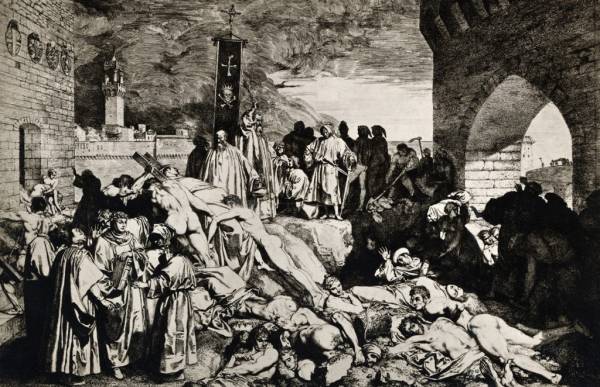
The Plague of Florence in the 14th century, as described by Giovanni Boccaccio. Bettmann Archive/Getty Images
#199

Significance of a 40-Day 'Quarantino'

The 30-day period stipulated in the 1377 quarantine order was known in Italian as a trentino, but Stevens Crawshaw says that doctors and officials also had the authority to impose shorter or longer stays. The English word "quarantine" is a direct descendent of quarantino, the Italian word for a 40-day period.

Why 40 days? Health officials may have prescribed a 40-day quarantine because the number had great symbolic and religious significance to medieval Christians. When God flooded the Earth, it rained for 40 days and 40 nights, and Jesus fasted in the wilderness for 40 days.

Stevens Crawshaw says that even before the arrival of the plague, the biblical notion of a 40-day period of purification had crossed over into health practices. After childbirth, for example, a new mother was expected to rest for 40 days.
#200

The First Quarantine

The Adriatic port city of Ragusa (modern-day Dubrovnik) was the first to pass legislation requiring the mandatory quarantine of all incoming ships and trade caravans in order to screen for infection.

The order, which miraculously survived in the Dubrovnik archives, reads that on July 27, 1377, the city's Major Council passed a law "which stipulates that those who come from plague-infested areas shall not enter [Ragusa] or its district unless they spend a month on the islet of Mrkan or in the town of Cavtat, for the purpose of disinfection."

Mrkan was an uninhabited rocky island south of the city and Cavtat was situated at the end of the caravan road used by overland traders en route to Ragusa, writes Zlata Blazina Tomic in Expelling the Plague: The Health Office and the Implementation of Quarantine in Dubrovnik, 1377-1533.

Tomic says that some medical historians consider Ragusa's quarantine edict one of the highest achievements of medieval medicine. By ordering the isolation of healthy sailors and traders for 30 days, Ragusan officials showed a remarkable understanding of incubation periods. New arrivals might not have exhibited symptoms of the plague, but they would be held long enough to determine if they were in fact disease-free.