Join MikeLigalig.com!

Why Just Read When You Can Join, Post, and Read!

Menu

Show posts

This section allows you to view all posts made by this member. Note that you can only see posts made in areas you currently have access to.

Show posts Menu

Messages - hofelina

#101
Bible Study / Re: Minute Meditations
December 09, 2014, 09:36:23 PM
Jesus Feeds Us Minute Meditations
Oh Jesus, present in the Blessed Sacrament, I believe that you are truly present, Body and Blood, soul and divinity, in the Blessed Sacrament. Where my faith is weak, give me the gift of greater faith. Because I believe in your true presence, I bow before you and worship you.
#103
Bible Study / Re: Saints Of The Day
December 08, 2014, 08:36:32 PM
Solemnity of the Immaculate Conception

A feast called the Conception of Mary arose in the Eastern Church in the seventh century. It came to the West in the eighth century. In the 11th century it received its present name, the Immaculate Conception. In the 18th century it became a feast of the universal Church. It is now recognized as a solemnity.

In 1854, Pius IX solemnly proclaimed: “The most Blessed Virgin Mary, in the first instant of her conception, by a singular grace and privilege granted by almighty God, in view of the merits of Jesus Christ, the savior of the human race, was preserved free from all stain of original sin.”

It took a long time for this doctrine to develop. While many Fathers and Doctors of the Church considered Mary the greatest and holiest of the saints, they often had difficulty in seeing Mary as sinlessâ€"either at her conception or throughout her life. This is one of the Church teachings that arose more from the piety of the faithful than from the insights of brilliant theologians. Even such champions of Mary as Bernard of Clairvaux and Thomas Aquinas could not see theological justification for this teaching.

Two Franciscans, William of Ware and Blessed John Duns Scotus, helped develop the theology. They pointed out that Mary’s Immaculate Conception enhances Jesus’ redemptive work. Other members of the human race are cleansed from original sin after birth. In Mary, Jesus’ work was so powerful as to prevent original sin at the outset.


Comment:

In Luke 1:28 the angel Gabriel, speaking on God’s behalf, addresses Mary as “full of grace” (or “highly favored”). In that context this phrase means that Mary is receiving all the special divine help necessary for the task ahead. However, the Church grows in understanding with the help of the Holy Spirit. The Spirit led the Church, especially non-theologians, to the insight that Mary had to be the most perfect work of God next to the Incarnation. Or rather, Mary’s intimate association with the Incarnation called for the special involvement of God in Mary’s whole life. The logic of piety helped God’s people to believe that Mary was full of grace and free of sin from the first moment of her existence. Moreover, this great privilege of Mary is the highlight of all that God has done in Jesus. Rightly understood, the incomparable holiness of Mary shows forth the incomparable goodness of God.

Quote:

“[Mary] gave to the world the Life that renews all things, and she was enriched by God with gifts appropriate to such a role.

“It is no wonder, then, that the usage prevailed among the holy Fathers whereby they called the mother of God entirely holy and free from all stain of sin, fashioned by the Holy Spirit into a kind of new substance and new creature. Adorned from the first instant of her conception with the splendors of an entirely unique holiness, the Virgin of Nazareth is, on God’s command, greeted by an angel messenger as ‘full of grace’ (cf. Luke 1:28). To the heavenly messenger she replies: ‘Behold the handmaid of the Lord, be it done to me according to thy word’ (Luke 1:38)” (Vatican II, Dogmatic Constitution on the Church, 56).


Patron Saint of:

Brazil
United States
#104
Bible Study / Re: Minute Meditations
December 08, 2014, 08:35:17 PM
Mary’s Role    Minute Meditations
Oh Jesus, present in the Blessed Sacrament, Mary responded wholeheartedly to your invitation to bear you in her womb. In a similar way you ask me to bring you into the world by my love and actions toward others. Like Mary, I am in awe of your invitation. And like Mary, I say yes to you. Let your will be done now and always.
#106
Bible Study / Re: Saints Of The Day
December 08, 2014, 04:15:16 AM
St. Ambrose
(340?-397)


One of Ambrose’s biographers observed that at the Last Judgment people would still be divided between those who admired Ambrose and those who heartily disliked him. He emerges as the man of action who cut a furrow through the lives of his contemporaries. Even royal personages were numbered among those who were to suffer crushing divine punishments for standing in Ambrose’s way.

When the Empress Justina attempted to wrest two basilicas from Ambrose’s Catholics and give them to the Arians, he dared the eunuchs of the court to execute him. His own people rallied behind him in the face of imperial troops. In the midst of riots, he both spurred and calmed his people with bewitching new hymns set to exciting Eastern melodies.

In his disputes with the Emperor Auxentius, he coined the principle: “The emperor is in the Church, not above the Church.” He publicly admonished Emperor Theodosius for the massacre of 7,000 innocent people. The emperor did public penance for his crime. This was Ambrose, the fighter, sent to Milan as Roman governor and chosen while yet a catechumen to be the people’s bishop.

There is yet another side of Ambroseâ€"one which influenced Augustine of Hippo, whom Ambrose converted. Ambrose was a passionate little man with a high forehead, a long melancholy face, and great eyes. We can picture him as a frail figure clasping the codex of sacred Scripture. This was the Ambrose of aristocratic heritage and learning.

Augustine found the oratory of Ambrose less soothing and entertaining but far more learned than that of other contemporaries. Ambrose’s sermons were often modeled on Cicero, and his ideas betrayed the influence of contemporary thinkers and philosophers. He had no scruples in borrowing at length from pagan authors. He gloried in the pulpit in his ability to parade his spoilsâ€"“gold of the Egyptians”â€"taken over from the pagan philosophers.

His sermons, his writings and his personal life reveal him as an otherworldly man involved in the great issues of his day. Humanity, for Ambrose, was, above all, spirit. In order to think rightly of God and the human soul, the closest thing to God, no material reality at all was to be dwelt upon. He was an enthusiastic champion of consecrated virginity.

The influence of Ambrose on Augustine will always be open for discussion. The Confessions reveal some manly, brusque encounters between Ambrose and Augustine, but there can be no doubt of Augustine’s profound esteem for the learned bishop.

Neither is there any doubt that St. Monica loved Ambrose as an angel of God who uprooted her son from his former ways and led him to his convictions about Christ. It was Ambrose, after all, who placed his hands on the shoulders of the naked Augustine as he descended into the baptismal fountain to put on Christ.


Comment:

Ambrose exemplifies for us the truly catholic character of Christianity. He is a man steeped in the learning, law and culture of the ancients and of his contemporaries. Yet, in the midst of active involvement in this world, this thought runs through Ambrose’s life and preaching: The hidden meaning of the Scriptures calls our spirit to rise to another world.

Quote:

“Women and men are not mistaken when they regard themselves as superior to mere bodily creatures and as more than mere particles of nature or nameless units in modern society. For by their power to know themselves in the depths of their being they rise above the entire universe of mere objects.... Endowed with wisdom, women and men are led through visible realities to those which are invisible” (Vatican II, Pastoral Constitution on the Church in the Modern World, 14â€"15, Austin Flannery translation).

Patron Saint of:

Bee keepers
Learning
#107
Bible Study / Re: Minute Meditations
December 08, 2014, 04:14:34 AM
Gift of Grace    Minute Meditations
Oh Jesus, present in the Blessed Sacrament, I open my heart to receive your grace in this sacrament. Although I am unworthy, I believe you are purifying me and bringing me closer to you. Thank you for the free gift of your grace.
#108
it is a matter of life and properties, weather forecasting is no fortunetelling. It is expected that they work professionally.
#109
Philippine Business News / Re: Storms, Typhoons
December 05, 2014, 07:40:17 PM
Quote from: hubag bohol on December 05, 2014, 07:37:21 PM
Agoi, andam diay kog usa a container bahal ani...
pakapini ug itlog bisaya ug tablija.
#111
Bible Study / Re: Saints Of The Day
December 05, 2014, 07:37:14 PM
St. Sabas
(b. 439)


Born in Cappadocia (modern-day Turkey), Sabas is one of the most highly regarded patriarchs among the monks of Palestine, and is considered one of the founders of Eastern monasticism.

After an unhappy childhood in which he was abused and ran away several times, Sabas finally sought refuge in a monastery. While family members tried to persuade him to return home, the young boy felt drawn to monastic life. Although the youngest monk in the house, he excelled in virtue.

At age 18 he traveled to Jerusalem, seeking to learn more about living in solitude. Soon he asked to be accepted as a disciple of a well-known local solitary, though initially he was regarded as too young to live completely as a hermit. Initially, Sabas lived in a monastery, where he worked during the day and spent much of the night in prayer. At the age of 30 he was given permission to spend five days each week in a nearby remote cave, engaging in prayer and manual labor in the form of weaving baskets. Following the death of his mentor, St. Euthymius, Sabas moved farther into the desert near Jericho. There he lived for several years in a cave near the brook Cedron. A rope was his means of access. Wild herbs among the rocks were his food. Occasionally men brought him other food and items, while he had to go a distance for his water.

Some of these men came to him desiring to join him in his solitude. At first he refused. But not long after relenting, his followers swelled to more than 150, all of them living in individual huts grouped around a church, called a laura.

The bishop persuaded a reluctant Sabas, then in his early 50s, to prepare for the priesthood so that he could better serve his monastic community in leadership. While functioning as abbot among a large community of monks, he felt ever called to live the life of a hermit. Throughout each year--consistently in Lent--he left his monks for long periods of time, often to their distress. A group of 60 men left the monastery, settling at a nearby ruined facility. When Sabas learned of the difficulties they were facing, he generously gave them supplies and assisted in the repair of their church.

Over the years Sabas traveled throughout Palestine, preaching the true faith and successfully bringing back many to the Church. At the age of 91, in response to a plea from the Patriarch of Jerusalem, Sabas undertook a journey to Constantinople in conjunction with the Samaritan revolt and its violent repression. He fell ill and soon after his return, died at the monastery at Mar Saba. Today the monastery is still inhabited by monks of the Eastern Orthodox Church, and St. Sabas is regarded as one of the most noteworthy figures of early monasticism.


Comment:

Few of us share Sabas’s yearning for a cave in the desert, but most of us sometimes resent the demands others place on our time. Sabas understands that. When at last he gained the solitude for which he yearned, a community immediately began to gather around him and he was forced into a leadership role. He stands as a model of patient generosity for anyone whose time and energy are required by othersâ€"that is, for all of us.
#112
Bible Study / Re: Minute Meditations
December 05, 2014, 07:36:34 PM
Living Justly    Minute Meditations
We are commandedâ€"a very strong word, but trueâ€"to glorify the Lord. Glorifying God is not the devotion simply of gathering for Church celebrations or lighting our Advent wreaths. The glory God desires is that our hearts be filled with the justice that renders to others the kind of love and service modeled by Jesus.
#115
Bible Study / Re: Saints Of The Day
December 02, 2014, 07:22:16 PM
Blessed Rafal Chylinski
(1694-1741)


Born near Buk in the Poznan region of Poland, Melchior showed early signs of religious devotion; family members nicknamed him "the little monk." After completing his studies at the Jesuit college in Poznan, Melchior joined the cavalry and was promoted to officer rank within three years.

In 1715, against the urgings of his military comrades, Melchior joined the Conventual Franciscans in Krakow. Receiving the name Rafal, he was ordained two years later. After pastoral assignments in nine cities, he came to Lagiewniki (central Poland), where he spent the last 13 years of his life, except for 20 months ministering to flood and epidemic victims in Warsaw. In all these places, Rafal was known for his simple and candid sermons, for his generosity, as well as his ministry in the confessional. People of all levels of society were drawn to the self-sacrificing way he lived out his religious profession and priestly ministry.

Rafal played the harp, lute, and mandolin to accompany liturgical hymns. In Lagiewniki he distributed food, supplies, and clothing to the poor. After his death, the Conventual church in that city became a place of pilgrimage for people throughout Poland. He was beatified in Warsaw in 1991.


Comment:

The sermons preached by Rafal were powerfully reinforced by the living sermon of his life. The Sacrament of Reconciliation can help us bring our daily choices into harmony with our words about Jesus’ influence in our life.

Quote:

During the beatification homily, Pope John Paul II said, "May Blessed Rafal remind us that every one of us, even though we are sinners, has been called to love and to holiness" (L'Osservatore Romano, 1991, vol. 25, number 19).

#116
Bible Study / Re: Minute Meditations
December 02, 2014, 07:21:17 PM
Welcome In Minute Meditations
In Advent we cry out, “Come, O come Emmanuel! Come, visit us and bring your peace to hearts filled with the cares and troubles of our lives. Let us become a holding place for you as we begin this blessed season.”
#118
Bible Study / Re: Saints Of The Day
December 01, 2014, 07:23:58 PM
Blessed Charles de Foucauld
(1858-1916)


Born into an aristocratic family in Strasbourg, France, Charles was orphaned at the age of six, raised by his devout grandfather, rejected the Catholic faith as a teenager and joined the French army. Inheriting a great deal of money from his grandfather, Charles went to Algeria with his regiment, but not without his mistress, Mimi.

When he declined to give her up, he was dismissed from the army. Still in Algeria when he left Mimi, Charles reenlisted in the army. Refused permission to make a scientific exploration of nearby Morocco, he resigned from the service. With the help of a Jewish rabbi, Charles disguised himself as a Jew and in 1883 began a one-year exploration that he recorded in a book that was well received.

Inspired by the Jews and Muslims whom he met, Charles resumed the practice of his Catholic faith when he returned to France in 1886. He joined a Trappist monastery in Ardeche, France, and later transferred to one in Akbes, Syria. Leaving the monastery in 1897, Charles worked as gardener and sacristan for the Poor Clare nuns in Nazareth and later in Jerusalem. In 1901 he returned to France and was ordained a priest.

Later that year Charles journeyed to Beni-Abbes, Morocco, intending to found a monastic religious community in North Africa that offered hospitality to Christians, Muslims, Jews, or people with no religion. He lived a peaceful, hidden life but attracted no companions.

A former army comrade invited him to live among the Tuareg people in Algeria. Charles learned their language enough to write a Tuareg-French and French-Tuareg dictionary, and to translate the Gospels into Tuareg. In 1905 he came to Tamanrasset, where he lived the rest of his life. A two-volume collection of Charles' Tuareg poetry was published after his death.

In early 1909 he visited France and established an association of laypeople who pledged to live by the Gospels. His return to Tamanrasset was welcomed by the Tuareg. In 1915 Charles wrote to Louis Massignon: “The love of God, the love for one’s neighbor…All religion is found there…How to get to that point? Not in a day since it is perfection itself: it is the goal we must always aim for, which we must unceasingly try to reach and that we will only attain in heaven.” 

The outbreak of World War I led to attacks on the French in Algeria. Seized in a raid by another tribe, Charles and two French soldiers coming to visit him were shot to death on December 1, 1916.
Five religious congregations, associations, and spiritual institutes (Little Brothers of Jesus, Little Sisters of the Sacred Heart, Little Sisters of Jesus, Little Brothers of the Gospel and Little Sisters of the Gospel) draw inspiration from the peaceful, largely hidden, yet hospitable life that characterized Charles. He was beatified on November 13, 2005.

Comment:

The life of Charles de Foucauld was eventually centered on God and was animated by prayer and humble service, which he hoped would draw Muslims to Christ. Those who are inspired by his example, no matter where they live, seek to live their faith humbly yet with deep religious conviction.

Quote:

In his homily at the beatification Mass, Cardinal José Saraiva Martins noted that Charles chose as his motto, "Iesus Caritas, Jesus Love." In 1916 Charles wrote: "There is, I believe, no word from the Gospel that has a more profound impression on me nor has transformed my life more than this: 'Whatever you do for the least of my brothers, you do for me.' If we reflect that these words are those from the uncreated Truth, those from the mouth of He who said, 'This is my body...this is my blood,' what forces drive us to seek and to love Jesus in these 'least ones, these sinners, these poor ones.'"
#119
Bible Study / Re: Three-minute retreat from Loyola press
December 01, 2014, 07:21:30 PM
http://www.loyolapress.com/assets/Bookcovers/99855_natures-goodness.swf
Sorry that there are days I am away without internet. MOst of my friends appreciate this three minutes of personal retreat with a great impact.
#120
Bible Study / Re: Minute Meditations
December 01, 2014, 07:19:30 PM
Be Alert    Minute Meditations
Advent is about the One who comes to overwhelm us beyond our wildest dreams with what God has in store for those who wait in joyful hope. So keep awake, wait on the Lord, and pray with expectation that the earth will yield its full bounty when we celebrate the birth of Jesus this Christmas.
#121
Quote from: islander on November 29, 2014, 04:31:07 AM


hof, kanang gwapo nga leather-topped ottoman aning among tete-a-tete corner grasya na ni bugsay.  super furniture, made by his own hands. :)
Wow, what a work of art...
#122
Photos Unlimited / Re: Awesome sunset photo
November 27, 2014, 08:45:30 PM
amaw jud ka Hubs!
#123
Lifestyle, Culture and Arts / Re: ato ning soroyon
November 27, 2014, 08:27:28 PM
Hamburg is considered one of the finest in Europe..wah pa jud ko ka anha hast Berlin
#124
Bible Study / Re: Saints Of The Day
November 27, 2014, 08:20:19 PM
St. Francesco Antonio Fasani
(1681-1742)


Born in Lucera (southeast Italy), Francesco entered the Conventual Franciscans in 1695. After his ordination 10 years later, he taught philosophy to younger friars, served as guardian of his friary and later became provincial. When his term of office ended, Francesco became master of novices and finally pastor in his hometown.

In his various ministries, he was loving, devout and penitential. He was a sought-after confessor and preacher. One witness at the canonical hearings regarding Francesco’s holiness testified, "In his preaching he spoke in a familiar way, filled as he was with the love of God and neighbor; fired by the Spirit, he made use of the words and deed of Holy Scripture, stirring his listeners and moving them to do penance." Francesco showed himself a loyal friend of the poor, never hesitating to seek from benefactors what was needed.

At his death in Lucera, children ran through the streets and cried out, "The saint is dead! The saint is dead!" Francesco was canonized in 1986.


Comment:

Eventually we become what we choose. If we choose stinginess, we become stingy. If we choose compassion, we become compassionate. The holiness of Francesco Antonio Fasani resulted from his many small decisions to cooperate with God’s grace.

Quote:

During his homily at the canonization of Francesco, Pope John Paul II reflected on John 21:15 in which Jesus asks Peter if he loves Jesus more than the other apostles and then tells Peter, "Feed my lambs." The pope observed that in the final analysis human holiness is decided by love. "He [Francesco] made the love taught us by Christ the fundamental characteristic of his existence, the basic criterion of his thought and activity, the supreme summit of his aspirations" (L'Osservatore Romano, vol. 16, number 3, 1986).
#125
Bible Study / Re: Minute Meditations
November 27, 2014, 08:19:29 PM
Sharing God’s Word    Minute Meditations
As people of faith, we wake up with a purpose. We have a sense of mission, and this gives our lives enduring meaning. We can share with confidence the Word of God, no matter what circumstances we find ourselves in. There are no chance encounters!
#128
Bible Study / Re: Saints Of The Day
November 25, 2014, 07:56:09 PM
St. Catherine of Alexandria
(c. 310)


According to the Legend of St. Catherine, this young woman converted to Christianity after receiving a vision. At the age of 18, she debated 50 pagan philosophers. Amazed at her wisdom and debating skills, they became Christiansâ€"as did about 200 soldiers and members of the emperor’s family. All of them were martyred.

Sentenced to be executed on a spiked wheel, Catherine touched the wheel and it shattered. She was beheaded. Centuries later, angels are said to have carried the body of St. Catherine to a monastery at the foot of Mt. Sinai.

Devotion to her spread as a result of the Crusades. She was invoked as the patroness of students, teachers, librarians and lawyers. Catherine is one of the 14 Holy Helpers, venerated especially in Germany and Hungary.


Comment:

The pursuit of God's wisdom may not lead to riches or earthly honors. In Catherine's case, this pursuit contributed to her martyrdom. She was not, however, foolish in preferring to die for Jesus rather than live only by denying him. All the rewards that her tormenters offered her would rust, lose their beauty or in some other way become a poor exchange for Catherine's honesty and integrity in following Jesus Christ.

Quote:

“Therefore I [King Solomon] prayed, and prudence was given me; I pleaded, and the spirit of Wisdom came to me. I preferred her to scepter and throne, and deemed riches nothing in comparison with her, nor did I liken any priceless gem to her; Because all gold, in view of her, is a little sand, and before her, silver is to be accounted mire. Beyond health and comeliness I loved her, and I chose to have her rather than the light, because the splendor of her never yields to sleep. Yet all good things together came to me in her company, and countless riches at her hands; and I rejoiced in them all, because Wisdom is their leader, though I had not known that she is the mother of these” (Wisdom 7:7-12).

Patron Saint of:

Philosophers
Students

#129
Bible Study / Re: Minute Meditations
November 25, 2014, 07:55:22 PM
Live Charitably    Minute Meditations
To live charitably means not looking out for our own interests, but carrying the burdens of the weakest and poorest among us. â€"Pope Francis
#130
tubaga palihog ang request ni Lady Isles!
#132
thanks for this informations, I heared this for the first time.
#133
Anghel Bugsay.....asa na man ka karon nanghatag ug grasya?
#134
and Hubag Bohol is my angel here in Tubagbohol....very funny and witty.But one should be careful because he is also an angel of sarcasm. Peace Doy Hubs.
#138
Jokes and Humor / Joke of the day
November 22, 2014, 08:10:32 PM


An 85-year-old man was requested by his doctor for a sperm count as part of his physical exam. The doctor gave the man a jar and said, "Take this jar home and bring back a semen sample tomorrow." The next day the 85-year-old man reappeared at the doctor's office and gave him the jar, which was as clean and empty as on the previous day. The doctor asked, what happened and the man explained.

"Well, doc, it's like this--first I tried with my right hand, but nothing. Then I tried with my left hand, but still nothing. Then I asked my wife for help. She tried with her right hand, then with her left, still nothing. She tried with her mouth, first with the teeth in, then with her teeth out, still nothing. We even called up Arleen, the lady next door, and she tried too. First with both hands, then an armpit, and she even tried squeezin' it between her knees, but still nothing."

The doctor was shocked! "You asked your neighbor?"

The old man replied, "Yep, none of us could get the jar open."
#140
Bible Study / Re: Saints Of The Day
November 22, 2014, 04:23:47 AM
Presentation of Mary


Mary’s presentation was celebrated in Jerusalem in the sixth century. A church was built there in honor of this mystery. The Eastern Church was more interested in the feast, but it does appear in the West in the 11th century. Although the feast at times disappeared from the calendar, in the 16th century it became a feast of the universal Church.

As with Mary’s birth, we read of Mary’s presentation in the temple only in apocryphal literature. In what is recognized as an unhistorical account, the Protoevangelium of James tells us that Anna and Joachim offered Mary to God in the Temple when she was three years old. This was to carry out a promise made to God when Anna was still childless.

Though it cannot be proven historically, Mary’s presentation has an important theological purpose. It continues the impact of the feasts of the Immaculate Conception (December 8) and of the birth of Mary (September 8). It emphasizes that the holiness conferred on Mary from the beginning of her life on earth continued through her early childhood and beyond.


Comment:

It is sometimes difficult for modern Westerners to appreciate a feast like this. The Eastern Church, however, was quite open to this feast and even somewhat insistent about celebrating it. Even though the feast has no basis in history, it stresses an important truth about Mary: From the beginning of her life, she was dedicated to God. She herself became a greater temple than any made by hands. God came to dwell in her in a marvelous manner and sanctified her for her unique role in God's saving work. At the same time, the magnificence of Mary enriches her children. They, too, are temples of God and sanctified in order that they might enjoy and share in God's saving work.

Quote:

"Hail, holy throne of God, divine sanctuary, house of glory, jewel most fair, chosen treasure house, and mercy seat for the whole world, heaven showing forth the glory of God. Purest Virgin, worthy of all praise, sanctuary dedicated to God and raised above all human condition, virgin soil, unplowed field, flourishing vine, fountain pouring out waters, virgin bearing a child, mother without knowing man, hidden treasure of innocence, ornament of sanctity, by your most acceptable prayers, strong with the authority of motherhood, to our Lord and God, Creator of all, your Son who was born of you without a father, steer the ship of the Church and bring it to a quiet harbor" (adapted from a homily by St. Germanus on the Presentation of the Mother of God).
#141
Bible Study / Re: Minute Meditations
November 22, 2014, 04:22:24 AM
Heavenly Intercessors    Minute Meditations
Having a saint to pray to every day for special intentions draws us into a more intimate union with Jesus, who has blessed us with so many heavenly intercessors for all our needs. It is a great privilege to have someone in heaven who cares so much about our innermost desires and personal needs.
#145
Showbiz & Celebrity / Re: Throwback sounds
November 19, 2014, 07:23:18 PM
thanks for the explanations Islander, this group was really a hit mid ´70s. I think this is very a good music for swing dance.
I also love Perry Como..but my father used to play Frank Sinatra, Neil Sedaka and Nat "King" Cole we have had 33 and 45 before plaka...sadya na kaayo. I grew up listening to jazz.
#147
Dogs are reall men´s best friend
#148
Showbiz & Celebrity / Re: old sayings....
November 18, 2014, 07:37:08 PM
share more please....;D
#149
Showbiz & Celebrity / old sayings....
November 18, 2014, 07:35:21 PM
from my mailbox

‘A SHOT OF WHISKEY’
In the old west a .45 cartridge for a six-gun cost 12 cents, so did a glass of whiskey. If a cowhand was low on cash he would often give the bartender a cartridge in exchange for a drink. This became known as a "shot" of whiskey.

THE WHOLE NINE YARDS
American fighter planes in WW2 had machine guns that were fed by a belt of cartridges. The average plane held belts that were 27 feet (9 yards) long. If the pilot used up all his ammo he was said to have given it the whole nine yards.

BUYING THE FARM
This is synonymous with dying. During WW1 soldiers were given life insurance policies worth $5,000. This was about the price of an average farm so if you died you "bought the farm" for your survivors.

IRON CLAD CONTRACT
This came about from the ironclad ships of the Civil War. It meant something so strong it could not be broken.

PASSING THE BUCK/THE BUCK STOPS HERE
Most men in the early west carried a jack knife made by the Buck knife company. When playing poker it as common to place one of these Buck knives in front of the dealer so that everyone knew who he was. When it was time for a new dealer the deck of cards and the knife were given to the new dealer. If this person didn't want to deal he would "pass the buck" to the next player. If that player accepted then “the buck stopped there".

RIFF RAFF
The Mississippi River was the main way of traveling from north to south. Riverboats carried passengers and freight but they were
expensive so most people used rafts. Everything had the right of way over rafts which were considered cheap. The steering oar on the rafts was called a “riff" and this transposed into riff-raff, meaning low class.

COBWEB
The Old English word for "spider" was "cob".

SHIP STATE ROOMS
Traveling by steamboat was considered the height of comfort. Passenger cabins on the boats were not numbered. Instead they were named after states. To this day cabins on ships are called staterooms.

SHOWBOAT
These were floating theaters built on a barge that was pushed by a steamboat. These played small town along the Mississippi River. Unlike the boat shown in the movie "Showboat" these did not have an engine. They were gaudy and attention grabbing which is why we say someone who is being the life of the party is "showboating".

OVER A BARREL
In the days before CPR a drowning victim would be placed face down over a barrel and the barrel would be rolled back and forth in a effort to empty the lungs of water. It was rarely effective. If you are over a barrel you are in deep trouble.

BARGE IN
Heavy freight was moved along the Mississippi in large barges pushed by steamboats. These were hard to control and would sometimes swing into piers or other boats. People would say they "barged in".

HOGWASH
Steamboats carried both people and animals. Since pigs smelled so bad they would be washed before being put on board. The mud and other filth that was washed off was considered useless "hog wash".

CURFEW
The word "curfew" comes from the French phrase "couvre-feu", which means "cover the fire". It was used to describe the time of blowing out all lamps and candles. It was later adopted into Middle English as "curfeu", which later became the modern "curfew". In the early American colonies homes had no real fireplaces so a fire was built in the center of the room. In order to make sure a fire did not get out of control during the night it was required that, by an agreed upon time, all fires would be covered with a clay pot called-a "curfew".

HOT OFF THE PRESS
As the paper goes through the rotary printing press friction causes it to heat up. Therefore, if you grab the paper right off the press it is hot. The expression means to get immediate information.


#150
lawas man ilang pohonan, kini siInday Heidi one piece of biscuit a week lang kono. The rest is exactly coundted calories foods. According to her nutritionist a biscuit needs to be burn for a 10 minute walk.
#151
Bible Study / Re: Saints Of The Day
November 18, 2014, 05:57:59 PM
 St. Elizabeth of Hungary was a 13th century princess, the daughter of King Andrew II of Hungary and his wife, Gertrude of Andechs-Meran, a family that produced many saints. St. Elizabeth married Ludwig, the duke of Thuringia and their joyous marriage produced three children. She was very generous, donating many of the couple’s possessions to the poor. After Ludwig’s death, St. Elizabeth joined the Third Order of St. Francis. At Marburg, she started a home for the poor, dying, and infirmed, whom she personally tended. She was canonized four years after her death by Pope Gregory IX. [1][2][3]

Written by Sarah Ciotti
#152
Bible Study / Re: Saints Of The Day
November 18, 2014, 05:56:49 PM
November 18
Dedication of the Churches of Peter and Paul, Apostles

Optional Memorial

Optional memorial, 1965 Calendar, celebration November 18.
1955 Calendar, Dedication of the Churches of Peter and Paul, Apostles.
In USA, this is the feast day of St. Rose Philippine Duchesne, virgin.

Today the Catholic Church celebrates Saints Peter and Paul basilicas. St. Peter’s basilica, the Vatican Church is the second patriarchal church at Rome. The body of St Peter was buried on the Vatican hill immediately after his martyrdom in the place where his basilica stands today. St Paul’s remains were deposited on the Ostian Way, where his church now stands.

Pilgrims with extraordinary devotion visited their tombs from the beginning. In 210 Caius, priest of Rome, speaking with Proclus said:
“I can show you the trophies of the apostles. For, whether you go to the Vatican hill, or to the Ostian road, you will meet with the monuments of them who by their preaching and miracles founded this church.”

Constantine the Great, after he founded the mother church of all Catholics, he built the church of St. Peter on the Vatican hill, honoring the place were the prince of the apostles suffered martyrdom and of St. Paul, at his tomb on the Ostian road.

One liturgical celebration takes place only in St. Peter’s and in no other church in the whole world: the Washing of the Altar on Maundy Thursday. At the close of the Matins on this day, the so-called papal altar under the great bronze baldachino is sprinkled with oil and wine. In an extended procession the archpriest, his vicar, the canons, the beneficiaries, the chaplains, and the entire clergy approach in order, and symbolically wash the altar with a sprinkler. A solemn benediction with the great relics from the gallery of St. Helena terminates this very impressive ceremony.

The churches are dedicated only to God, although often have a patron saint so that all faithful may implore the intercession of that saint.

St Augustine says ” We do not build churches or appoint priesthoods, sacred rites and sacrifices to the martyrs, because, not the martyrs, but the God of the martyrs, is our God. Who among the faithful ever heard a priest, standing at the altar set up over the body of a martyr to the honour and worship of God, say in praying: We offer up sacrifices to thee, Peter, or Paul, or Cyprian? When at their memories (or titular altars) it is offered to God, who made them both men and martyrs, and has associated them to his angels in heavenly honour. We do not build churches to martyrs as to gods, but as memorials to men departed this life, whose souls live with God. Nor do we make altars to sacrifice on them to the martyrs, but to their God and our God.”

Fragment source The Catholic Encyclopedia
#153
Bible Study / Re: Minute Meditations
November 18, 2014, 05:55:52 PM
Conduit to God Minute Meditations
A long experience has taught me the great lesson that God leads men in a human manner by other men whom He appointed to be in His place and who should be of the same kindness as He Himself was while on earth. â€"Blessed Francis Xavier Seelos
#155
Heidi Klum at her age of 40 is really great. She works hard to maintian her figure, which she calls body styling. She traines almost 3-4 hours daily with a personal trainer
#156
Bible Study / Re: Minute Meditations
November 17, 2014, 09:26:22 PM
Surrender to Jesus Minute Meditations
O Lord Jesus, I believe in you, I hope in you, I love you, and I grieve of having ever offended you! Behold my resolution to live entirely for you. â€"St. John Neumann
#158
Bible Study / Re: Saints Of The Day
November 17, 2014, 09:25:15 PM
 Saint November 16 : St. Gertrude the Great : Benedictine : Patron of Nuns, Travellers, West Indies

St. Gertrude the Great
BENEDICTINE AND MYSTIC WRITER
Feast: November 16
Information:
Feast Day:
November 16
Born:
6 January 1256 at Eisleben, Germany
Died:
November 17, 1302, Helfta, Germany
Canonized:
received equipotent canonization, and a universal feast day declared in 1677 by Pope Clement XII
Patron of:
nuns, travellers, West Indies
#159
in-ani kabarato ang kinabuhi
#160
Bible Study / Re: Saints Of The Day
November 16, 2014, 04:14:36 PM
St. Margaret of Scotland
(1050?-1093)

Margaret of Scotland was a truly liberated woman in the sense that she was free to be herself. For her, that meant freedom to love God and serve others.

Not Scottish by birth, Margaret was the daughter of Princess Agatha of Hungary and the Anglo-Saxon Prince Edward Atheling. She spent much of her youth in the court of her great-uncle, the English king, Edward the Confessor. Her family fled from William the Conqueror and was shipwrecked off the coast of Scotland. King Malcolm befriended them and was captivated by the beautiful, gracious Margaret. They were married at the castle of Dunfermline in 1070.

Malcolm was good-hearted, but rough and uncultured, as was his country. Because of Malcolm’s love for Margaret, she was able to soften his temper, polish his manners and help him become a virtuous king. He left all domestic affairs to her and often consulted her in state matters.

Margaret tried to improve her adopted country by promoting the arts and education. For religious reform she encouraged synods and was present for the discussions which tried to correct religious abuses common among priests and lay people, such as simony, usury and incestuous marriages. With her husband, she founded several churches.

Margaret was not only a queen, but a mother. She and Malcolm had six sons and two daughters. Margaret personally supervised their religious instruction and other studies.

Although she was very much caught up in the affairs of the household and country, she remained detached from the world. Her private life was austere. She had certain times for prayer and reading Scripture. She ate sparingly and slept little in order to have time for devotions. She and Malcolm kept two Lents, one before Easter and one before Christmas. During these times she always rose at midnight for Mass. On the way home she would wash the feet of six poor persons and give them alms. She was always surrounded by beggars in public and never refused them. It is recorded that she never sat down to eat without first feeding nine orphans and 24 adults.

In 1093, King William Rufus made a surprise attack on Alnwick castle. King Malcolm and his oldest son, Edward, were killed. Margaret, already on her deathbed, died four days after her husband.


Comment:

There are two ways to be charitable: the "clean way" and the "messy way." The "clean way" is to give money or clothing to organizations that serve the poor. The "messy way" is dirtying your own hands in personal service to the poor. Margaret's outstanding virtue was her love of the poor. Although very generous with material gifts, Margaret also visited the sick and nursed them with her own hands. She and her husband served orphans and the poor on their knees during Advent and Lent. Like Christ, she was charitable the "messy way."

Quote:

"When [Margaret] spoke, her conversation was with the salt of wisdom. When she was silent, her silence was filled with good thoughts. So thoroughly did her outward bearing correspond with the staidness of her character that it seemed as if she has been born the pattern of a virtuous life" (Turgot, St. Margaret's confessor).
#161
Bible Study / Re: Minute Meditations
November 16, 2014, 04:13:53 PM
Supporting Others    Minute Meditations
Pray for me occasionally that I may not lose courage; nay, more, that I may be brave enough to hold up others who falter sometimes.
â€"St. Theodore Guérin
#163
Bible Study / Re: Saints Of The Day
November 16, 2014, 02:53:47 AM
St. Albert the Great
(1206-1280)


Albert the Great was a 13th-century German Dominican who decisively influenced the Church's stance toward Aristotelian philosophy brought to Europe by the spread of Islam.

Students of philosophy know him as the master of Thomas Aquinas. Albert’s attempt to understand Aristotle’s writings established the climate in which Thomas Aquinas developed his synthesis of Greek wisdom and Christian theology. But Albert deserves recognition on his own merits as a curious, honest and diligent scholar.

He was the eldest son of a powerful and wealthy German lord of military rank. He was educated in the liberal arts. Despite fierce family opposition, he entered the Dominican novitiate.

His boundless interests prompted him to write a compendium of all knowledge: natural science, logic, rhetoric, mathematics, astronomy, ethics, economics, politics and metaphysics. His explanation of learning took 20 years to complete. "Our intention," he said, "is to make all the aforesaid parts of knowledge intelligible to the Latins."

He achieved his goal while serving as an educator at Paris and Cologne, as Dominican provincial, and even as bishop of Regensburg for a short time. He defended the mendicant orders and preached the Crusade in Germany and Bohemia.

Albert, a Doctor of the Church, is the patron of scientists and philosophers.


Comment:

An information glut faces us Christians today in all branches of learning. One needs only to read current Catholic periodicals to experience the varied reactions to the findings of the social sciences, for example, in regard to Christian institutions, Christian life-styles and Christian theology. Ultimately, in canonizing Albert, the Church seems to point to his openness to truth, wherever it may be found, as his claim to holiness. His characteristic curiosity prompted Albert to mine deeply for wisdom within a philosophy his Church warmed to with great difficulty.

Quote:

"There are some who desire knowledge merely for its own sake; and that is shameful curiosity. And there are others who desire to know, in order that they may themselves be known; and that is vanity, disgraceful too. Others again desire knowledge in order to acquire money or preferment by it; that too is a discreditable quest. But there are also some who desire knowledge, that they may build up the souls of others with it; and that is charity. Others, again, desire it that they may themselves be built up thereby; and that is prudence. Of all these types, only the last two put knowledge to the right use" (St. Bernard, Sermon on the Canticle of Canticles).

Patron Saint of:

Medical technicians
Philosophers
Scientists
#164
Bible Study / Re: Minute Meditations
November 16, 2014, 02:53:02 AM
Our Final Moments Minute Meditations
To die well is our principal concern. For if we attain that, it matters little if we lose all the rest. And if we do not attain it, all the rest is of no value. â€"Blessed Junípero Serra
#166
the poster would be removed soon  according to the reply we got from the Forum in Stuttgart.
#167
Tira-Pasagad | Saksak-Sinagol / Re: Hala, binungotay!
November 13, 2014, 06:53:00 PM
gilok jamo!
#168
Jokes and Humor / Re: Bisaya Vs Tagalog
November 12, 2014, 08:07:08 PM
sixty percent of the population speaks bisaya....this should be our national language
#170
Bible Study / Re: Saints Of The Day
November 12, 2014, 06:59:38 PM
St. Josaphat
(1580?-1623)

In 1964, newspaper photos of Pope Paul VI embracing Athenagoras I, the Orthodox patriarch of Constantinople, marked a significant step toward the healing of a division in Christendom that has spanned more than nine centuries.

In 1595, when today’s saint was a boy, the Orthodox bishop of Brest-Litovsk in present-day Belarus and five other bishops representing millions of Ruthenians, sought reunion with Rome. John Kunsevich (who took the name Josaphat in religious life) was to dedicate his life and die for the same cause. Born in what is now Ukraine, he went to work in Wilno and was influenced by clergy adhering to the Union of Brest (1596). He became a Basilian monk, then a priest, and soon was well known as a preacher and as an ascetic.

He became bishop of Vitebsk (now in Belarus) at a relatively young age, and faced a difficult situation. Most monks, fearing interference in liturgy and customs, did not want union with Rome. By synods, catechetical instruction, reform of the clergy and personal example, however, Josaphat was successful in winning the greater part of the Orthodox in that area to the union.

But the next year a dissident hierarchy was set up, and his opposite number spread the accusation that Josaphat had "gone Latin" and that all his people would have to do the same. He was not enthusiastically supported by the Latin bishops of Poland.

Despite warnings, he went to Vitebsk, still a hotbed of trouble. Attempts were made to foment trouble and drive him from the diocese: A priest was sent to shout insults to him from his own courtyard. When Josaphat had him removed and shut up in his house, the opposition rang the town hall bell, and a mob assembled. The priest was released, but members of the mob broke into the bishop’s home. He was struck with a halberd, then shot and his body thrown into the river. It was later recovered and is now buried in St. Peter’s Basilica in Rome. He was the first saint of the Eastern Church to be canonized by Rome.

His death brought a movement toward Catholicism and unity, but the controversy continued, and the dissidents, too, had their martyr. After the partition of Poland, the Russians forced most Ruthenians to join the Russian Orthodox Church.


Stories:

Surrounded by an angry mob shortly before his death, Josaphat said, “You people of Vitebsk want to put me to death. You make ambushes for me everywhere, in the streets, on the bridges, on the highways and in the marketplace. I am here among you as your shepherd and you ought to know that I should be happy to give my life for you. I am ready to die for the holy union, for the supremacy of Saint Peter and of his successor the Supreme Pontiff.”


Comment:

The seeds of separation were sown in the fourth century when the Roman Empire was divided into East and West. The actual split came over customs such as using unleavened bread, Saturday fasting and celibacy. No doubt the political involvement of religious leaders on both sides was a large factor, and doctrinal disagreement was present. But no reason was enough to justify the present tragic division in Christendom, which is 64 percent Roman Catholic, 13 percent Eastern Churches (mostly Orthodox) and 23 percent Protestant, and this when the 71 percent of the world that is not Christian should be experiencing unity and Christ-like charity from Christians!

#171
Bible Study / Re: Minute Meditations
November 12, 2014, 06:57:24 PM
Our Blessed Mother    Minute Meditations
Mary possesses everything we lack, everything we desire. She is always there for us, willing to teach us and intercede for us if we will only ask her for help. Most importantly, our Blessed Mother will lead us to a closer relationship with her son, Jesus.
#172
pasaylo-a ko nga nasayup ang spelling....Talagsa-on ang sakto
#174
Bible Study / Re: Saints Of The Day
November 11, 2014, 06:26:44 PM
St. Martin of Tours
(316?-397)


A conscientious objector who wanted to be a monk; a monk who was maneuvered into being a bishop; a bishop who fought paganism as well as pleaded for mercy to hereticsâ€"such was Martin of Tours, one of the most popular of saints and one of the first not to be a martyr.

Born of pagan parents in what is now Hungary and raised in Italy, this son of a veteran was forced at the age of 15 to serve in the army. He became a Christian catechumen and was baptized at 18. It was said that he lived more like a monk than a soldier. At 23, he refused a war bonus and told his commander: "I have served you as a soldier; now let me serve Christ. Give the bounty to those who are going to fight. But I am a soldier of Christ and it is not lawful for me to fight." After great difficulties, he was discharged and went to be a disciple of Hilary of Poitiers (January 13).

He was ordained an exorcist and worked with great zeal against the Arians. He became a monk, living first at Milan and later on a small island. When Hilary was restored to his see after exile, Martin returned to France and established what may have been the first French monastery near Poitiers. He lived there for 10 years, forming his disciples and preaching throughout the countryside.

The people of Tours demanded that he become their bishop. He was drawn to that city by a ruseâ€"the need of a sick personâ€"and was brought to the church, where he reluctantly allowed himself to be consecrated bishop. Some of the consecrating bishops thought his rumpled appearance and unkempt hair indicated that he was not dignified enough for the office.

Along with St. Ambrose, Martin rejected Bishop Ithacius’s principle of putting heretics to deathâ€"as well as the intrusion of the emperor into such matters. He prevailed upon the emperor to spare the life of the heretic Priscillian. For his efforts, Martin was accused of the same heresy, and Priscillian was executed after all. Martin then pleaded for a cessation of the persecution of Priscillian’s followers in Spain. He still felt he could cooperate with Ithacius in other areas, but afterwards his conscience troubled him about this decision.

As death approached, his followers begged him not to leave them. He prayed, "Lord, if your people still need me, I do not refuse the work. Your will be done."


Stories:

On a bitterly cold day, a famous legend goes, Martin met a poor man, almost naked, trembling in the cold and begging from passersby at the city gate. Martin had nothing but his weapons and his clothes. He drew his sword, cut his cloak into two pieces, gave one to the beggar and wrapped himself in the other half. Some of the bystanders laughed at his now odd apearance; others were ashamed at not having relieved the man's misery. That night in his sleep Martin saw Christ dressed in the half of the garment he had given away, and heard him say, "Martin, still a catechumen, has covered me with his garment."


Comment:

Martin's worry about cooperation with evil reminds us that almost nothing is either all black or all white. The saints are not creatures of another world: They face the same perplexing decisions that we do. Any decision of conscience always involves some risk. If we choose to go north, we may never know what would have happened had we gone east, west or south. A hypercautious withdrawal from all perplexing situations is not the virtue of prudence; it is, in fact, a bad decision, for "not to decide is to decide."

Quote:


Patron Saint of:

Horses
Soldiers
#175
Bible Study / Re: Minute Meditations
November 11, 2014, 06:25:23 PM
Focus on Heaven    Minute Meditations
When the longing in our hearts for God is seemingly replaced or satisfied by the offerings of the world, lukewarmness is the result. We should keep our focus on our heavenly home and the good things God has in store for us, not the temporary and false pleasure of this world.
#176
Jokes and Humor / Re: Lisod na ron
November 10, 2014, 07:26:36 PM
this made my day...salamat hubs!
#177
genau...vielleicht?
#179
Bible Study / Re: Saints Of The Day
November 10, 2014, 06:35:53 PM
St. Leo the Great
(d. 461)


With apparent strong conviction of the importance of the Bishop of Rome in the Church, and of the Church as the ongoing sign of Christ’s presence in the world, Leo the Great displayed endless dedication as pope. Elected in 440, he worked tirelessly as "Peter’s successor," guiding his fellow bishops as "equals in the episcopacy and infirmities."

Leo is known as one of the best administrative popes of the ancient Church. His work branched into four main areas, indicative of his notion of the pope’s total responsibility for the flock of Christ. He worked at length to control the heresies of Pelagianism (overemphasizing human freedom), Manichaeism (seeing everything material as evil) and others, placing demands on their followers so as to secure true Christian beliefs. A second major area of his concern was doctrinal controversy in the Church in the East, to which he responded with a classic letter setting down the Church’s teaching on the two natures of Christ. With strong faith, he also led the defense of Rome against barbarian attack, taking the role of peacemaker.

In these three areas, Leo’s work has been highly regarded. His growth to sainthood has its basis in the spiritual depth with which he approached the pastoral care of his people, which was the fourth focus of his work. He is known for his spiritually profound sermons. An instrument of the call to holiness, well-versed in Scripture and ecclesiastical awareness, Leo had the ability to reach the everyday needs and interests of his people. One of his sermons is used in the Office of Readings on Christmas.

It is said of Leo that his true significance rests in his doctrinal insistence on the mysteries of Christ and the Church and in the supernatural charisms of the spiritual life given to humanity in Christ and in his Body, the Church. Thus Leo held firmly that everything he did and said as pope for the administration of the Church represented Christ, the head of the Mystical Body, and St. Peter, in whose place Leo acted.


Stories:

It is said of Leo that his true significance rests in his doctrinal insistence on the mysteries of Christ and the church and in the supernatural charisms of the spiritual life given to humanity in Christ and in his body, the church. Thus Leo held firmly that everything he did and said as pope for the administration of the church represented Christ, the head of the Mystical Body, and Saint Peter, in whose place Leo acted.


Comment:

At a time when there is widespread criticism of Church structures, we also hear criticism that bishops and priestsâ€"indeed, all of usâ€"are too preoccupied with administration of temporal matters. Pope Leo is an example of a great administrator who used his talents in areas where spirit and structure are inseparably combined: doctrine, peace and pastoral care. He avoided an "angelism" that tries to live without the body, as well as the "practicality" that deals only in externals.
#180
Bible Study / Re: Minute Meditations
November 10, 2014, 06:34:29 PM
Using Your Talents    Minute Meditations
Let’s pray for discernment, that we will come to understand our own gifts and talents and use them to serve God. If we all dedicate our lives to using our gifts fully to serve Him and those in need around us, the world will be transformed.
#181
no wonder that such illness are rampant in Pinas, since this instant pack is cheap and tasty.
#182
iyang gisusi kon dili ba transe ning manokah!
#183
if you took a closer look at the left side...adunay nalibang. ;D
 
#184
try to read  this...I have written to the Phil Embassy in Berlin to request the removal of this streamer.

http://footandfire.blogspot.de/2014/11/the-obscene-detail-nobody-wants.html?spref=fb
#185


this  picture was taken by german photographer and went on display along the corridors of the train station main platform in Stuttgart, Germany. Pobre man jud tah apan makalagot nga ngano kini pa man jud ang gi presentar!  :-[
#186

The Wallace's Golden Birdwing is named after British naturalist Alfred Russel Wallace, who discovered the species in 1859. They live in the lowland areas of the Maluku Islands in Indonesia. Sadly, the area is suffering from increase in logging, resulting in widespread destruction of its habitat.
#187

The Spicebush Swallowtail prefers marshes, bogs, swamps and agricultural areas for its prime habitats. Sadly, such places are often subjected to development or suffer from an intensive use of herbicides and pesticides.
#188

The Schaus' Swallowtail (or Island Swallowtail) is found in southern Florida with subspecies in the Bahamas, Hispaniola, and Cuba. It is named in honour of William Schaus.
#189


Found almost exclusively in the dark shady forests of Singapore's nature reserves, The Saturn Butterfly’s drab and cryptic undersides help camouflage it among the forest leaf litter while they forage for food.
#190

One of Australia’s largest butterflies, the Richmond Birdwing is experiencing a severe decline in numbers in recent years, thanks to habitat destruction, drought, and invasive species of vine, which causes 100 percent mortality rate among the Richmond Birdwing's larva.
#191


The little Question Mark Butterfly hangs out in any area that has lots of trees and space. The name comes from "The silver mark on the underside of the hindwing is broken into two parts, a curved line and a dot, creating a ?-shaped mark..."
#192

The Palos Verdes Blue is the rarest butterfly in the world. Presumed extinct until 1994, when researchers discovered a population in San Pedro, California. A breeding program was initiated and seems to be successful, but there are still only several hundred in the wild.
#193

It is quite obvious how the Banded Orange Tiger got its name. From Brazil through Central America to central Mexico, and is essential to the eco system as a primary pollinator.
#194


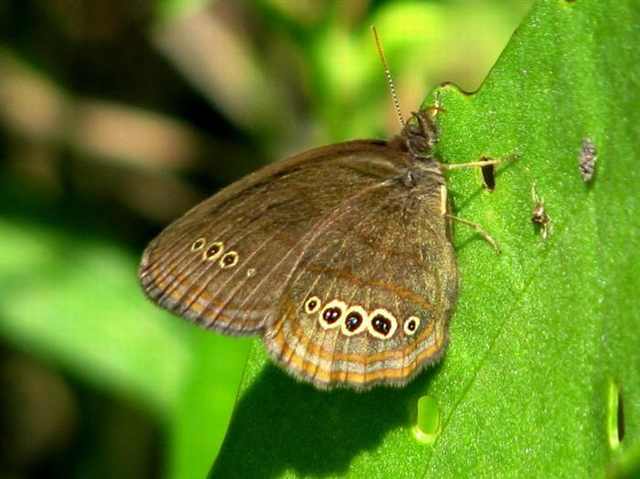
The Mitchell's Satyr is a rare butterfly with a wingspan of up to 1.75 inches (4cm) and is distinguished by rows of orange-ringed, black circular eyespots on each of its chocolate-colored wings. Sadly, urban and agricultural development has destroyed its natural habitat. Combined with contamination from pesticides, fertilizers and nutrient runoff, invasive species and even butterfly collectors, the population numbers alarmingly shrunk.
#195


The Luzon Peacock was discovered in 1965, in the Philippines. The Peacock is mostly black, with fore and hind wings (which span 4 inches) splashed with the bright colored scales that earned it its name.
#196


Native to the island of Jamaica, the Jamaican Swallowtail is the largest butterfly species in the Americas. Sadly, its size and beauty make it prized among collectors. Adults grow to be about 6 inches across, and are dark in color with yellow and blue bands and spots. The Swallowtail prefers to dwell in habitats that are remote and undisturbed.
#197


The Island Marble is known to inhabit only two small islands (San Juan and Lopez) in northwest Washington State, though it used to be native to Canada. These days, the Island Marble is one of the most endangered insects in the world because of habitat loss and an extremely small, isolated populations.
#198


The Glasswing butterfly is quite large and got its name thanks to its magical transparent wing panels. Native to Columbia, Bolivia, Peru, and Ecuador, these butterflies can spend hours feeding on a single flower bloom.
#199


The Chimaera Birdwing’s diet mainly consists of the nectar of hibiscus plants and African tulip trees in the rainforest of Papua New Guinea and Indonesia. It got the name “Chimaera” due to its body’s unique shape, making it look as if it’s made of 3 amalgamated insects.
#200
The Ceylon Rose is an extremely rare swallowtail butterfly found only in Sri Lanka. Sadly, these magnificent butterflies are critically endangered as a result of sever destruction of their habitat through deforestation.